Shoot Apex
-Stem-
Prepared by:
Haider Ali Malik
EXTERNAL
PLANT
MORPHOLOGY
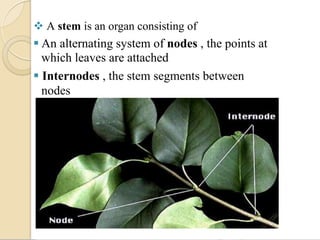
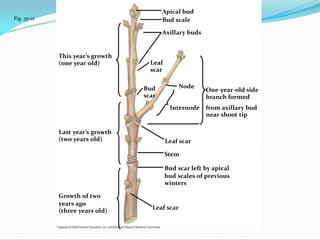
 A stem is an organ consisting of
 An alternating system of nodes , the points at
which leaves are attached
 Internodes , the stem segments between
nodes
 An axillary bud is a structure that has the
potential to form a lateral shoot, or branch
 An apical bud , or terminal bud, is located near
the shoot tip and causes elongation of a young
shoot
 Apical dominance helps to maintain dormancy
in most non-apical buds
 Lenticels are structure that permit the passage of
gas inward and outward.
 Leaf scar are characteristic scar on stem axis
made by leaf abscission.
 Bud scales are small modified leaves for
protection from desiccation.
Dormant shoot apex with its protective scales is a BUD.
 Bud Scars are the scars left from the removal of bud.
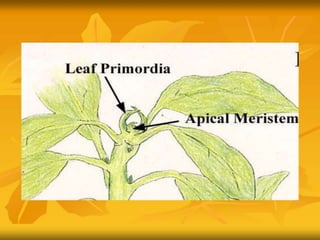
 Leaf primordium is an immature leaf of the
shoot.
 Intercalary meristem the portion of the internodes
above the node . Made up of actively dividing cells
responsible for the elongation of the monocot stem.
Fig. 35-12
This year’s growth
(one year old)
Apical bud
Bud scale
Axillary buds
Leaf
scar
Bud
scar
Node
One-year-old side
branch formed
Internode from axillary bud
near shoot tip
Leaf scar
Stem
Bud scar left by apical
bud scales of previous
winters
Leaf scar
Last year’s growth
(two years old)
Growth of two
years ago
(three years old)
Shoot Apex
Organization
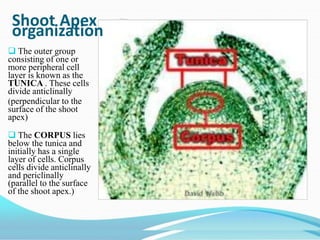
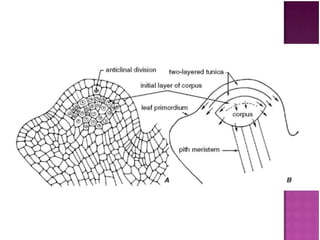
 The outer group
consisting of one or
more peripheral cell
layer is known as the
TUNICA . These cells
divide anticlinally
(perpendicular to the
surface of the shoot
apex)
 The CORPUS lies
below the tunica and
initially has a single
layer of cells. Corpus
cells divide anticlinally
and periclinally
(parallel to the surface
of the shoot apex.)
Shoot Apex
organization
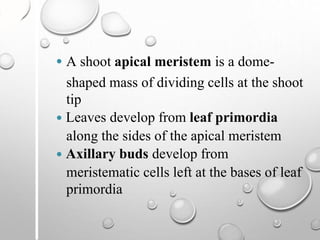
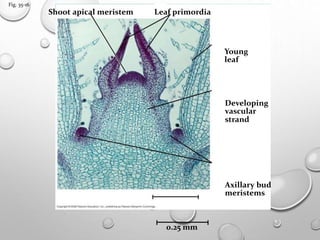
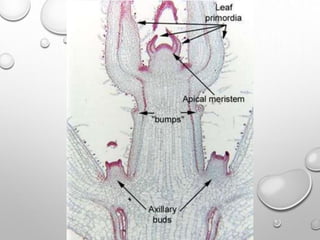
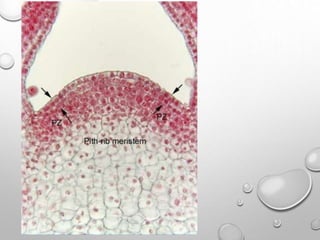
 A shoot apical meristem is a dome-
shaped mass of dividing cells at the shoot
tip
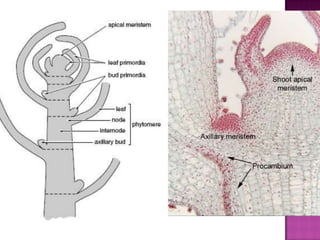
 Leaves develop from leaf primordia
along the sides of the apical meristem
 Axillary buds develop from
meristematic cells left at the bases of leaf
primordia
Fig. 35-16
Shoot apical meristem Leaf primordia
Young
leaf
Developing
vascular
strand
Axillary bud
meristems
0.25 mm
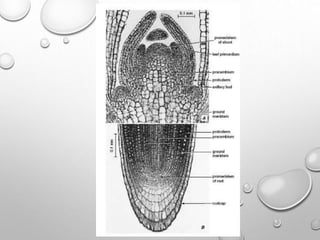
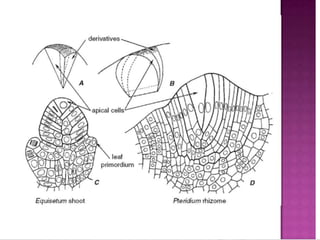
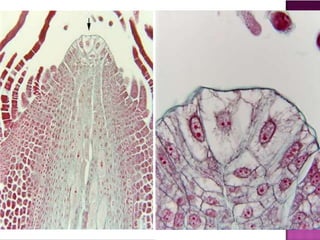
 Shoot apex- where new leaves and tissues of
the stem arise
 Models of tissue organization in the shoot
apex
A. Apical cell theory
B. Histogen theory
C. Tunica-corpus (most accepted in
angiosperms)
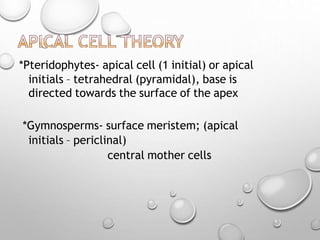
*Pteridophytes- apical cell (1 initial) or apical
initials – tetrahedral (pyramidal), base is
directed towards the surface of the apex
*Gymnosperms- surface meristem; (apical
initials – periclinal)
central mother cells
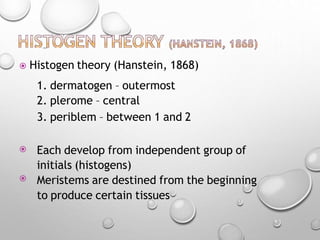
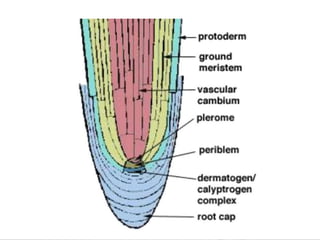
 Histogen theory (Hanstein, 1868)


1. dermatogen – outermost
2. plerome – central
3. periblem – between 1 and 2
Each develop from independent group of
initials (histogens)
Meristems are destined from the beginning
to produce certain tissues
1.
2.
All cells have basically equal potential of
differentiation
One zone of apical meristem may
contribute cells to another one
 Two regions: TUNICA and CORPUS
 No constant relationship can be traced
between the particular initials of the
promeristem and the inner tissues of the
shoot
 2 regions can be distinguished by their plane
of cell division
 Outermost layer
 Surrounds the inner cell mass (corpus)
 Anticlinal division
 Enlarges in surface area
 Layer: 1-9
 Inner cell mass
 Divides in all directions
 Enlarges in volume
TYPES
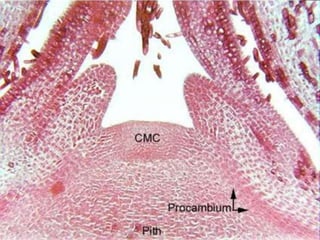
A. Usual – 1. CMC
2. rib meristem
3. peripheral
B. Opuntia -- + cambium-like transition zone
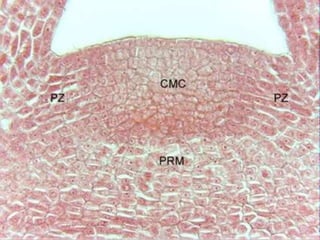
 Central zone – (waiting meristem)- promeristem
- corpus + portions of tunica
- gives rise to:
 Rib zone or pith rib meristem
- below central zone; center location
- becomes the pith
 Peripheral zone or peripheral meristem
- encircles the other zones
- most meristematic (eumeristem)
- densest protoplast and smallest dimensions
- gives rise to leaf primordia,procambium,
cortical ground tissue
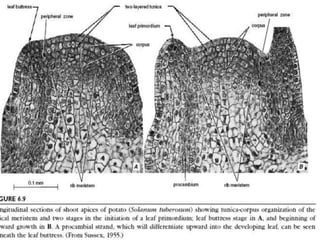
 Initiated by periclinal divisions at the side of
the apical meristem
 Origin: tunica or corpus
 Division  leaf buttress
 Affects Periodic changes in shape of shoot
apex
BRANCHING
 Where do branches originate?
 Superficial layers --- exogenous
 Axillary buds
Shoot Apex

Shoot Apex

  • 1.
  • 2.
  • 3.
     A stemis an organ consisting of  An alternating system of nodes , the points at which leaves are attached  Internodes , the stem segments between nodes
  • 4.
     An axillarybud is a structure that has the potential to form a lateral shoot, or branch  An apical bud , or terminal bud, is located near the shoot tip and causes elongation of a young shoot  Apical dominance helps to maintain dormancy in most non-apical buds  Lenticels are structure that permit the passage of gas inward and outward.  Leaf scar are characteristic scar on stem axis made by leaf abscission.  Bud scales are small modified leaves for protection from desiccation.
  • 5.
    Dormant shoot apexwith its protective scales is a BUD.  Bud Scars are the scars left from the removal of bud.  Leaf primordium is an immature leaf of the shoot.  Intercalary meristem the portion of the internodes above the node . Made up of actively dividing cells responsible for the elongation of the monocot stem.
  • 7.
    Fig. 35-12 This year’sgrowth (one year old) Apical bud Bud scale Axillary buds Leaf scar Bud scar Node One-year-old side branch formed Internode from axillary bud near shoot tip Leaf scar Stem Bud scar left by apical bud scales of previous winters Leaf scar Last year’s growth (two years old) Growth of two years ago (three years old)
  • 8.
  • 9.
     The outergroup consisting of one or more peripheral cell layer is known as the TUNICA . These cells divide anticlinally (perpendicular to the surface of the shoot apex)  The CORPUS lies below the tunica and initially has a single layer of cells. Corpus cells divide anticlinally and periclinally (parallel to the surface of the shoot apex.) Shoot Apex organization
  • 10.
     A shootapical meristem is a dome- shaped mass of dividing cells at the shoot tip  Leaves develop from leaf primordia along the sides of the apical meristem  Axillary buds develop from meristematic cells left at the bases of leaf primordia
  • 11.
    Fig. 35-16 Shoot apicalmeristem Leaf primordia Young leaf Developing vascular strand Axillary bud meristems 0.25 mm
  • 14.
     Shoot apex-where new leaves and tissues of the stem arise  Models of tissue organization in the shoot apex A. Apical cell theory B. Histogen theory C. Tunica-corpus (most accepted in angiosperms)
  • 15.
    *Pteridophytes- apical cell(1 initial) or apical initials – tetrahedral (pyramidal), base is directed towards the surface of the apex *Gymnosperms- surface meristem; (apical initials – periclinal) central mother cells
  • 18.
     Histogen theory(Hanstein, 1868)   1. dermatogen – outermost 2. plerome – central 3. periblem – between 1 and 2 Each develop from independent group of initials (histogens) Meristems are destined from the beginning to produce certain tissues
  • 20.
    1. 2. All cells havebasically equal potential of differentiation One zone of apical meristem may contribute cells to another one
  • 21.
     Two regions:TUNICA and CORPUS  No constant relationship can be traced between the particular initials of the promeristem and the inner tissues of the shoot  2 regions can be distinguished by their plane of cell division
  • 24.
     Outermost layer Surrounds the inner cell mass (corpus)  Anticlinal division  Enlarges in surface area  Layer: 1-9
  • 25.
     Inner cellmass  Divides in all directions  Enlarges in volume TYPES A. Usual – 1. CMC 2. rib meristem 3. peripheral B. Opuntia -- + cambium-like transition zone
  • 26.
     Central zone– (waiting meristem)- promeristem - corpus + portions of tunica - gives rise to:  Rib zone or pith rib meristem - below central zone; center location - becomes the pith  Peripheral zone or peripheral meristem - encircles the other zones - most meristematic (eumeristem) - densest protoplast and smallest dimensions - gives rise to leaf primordia,procambium, cortical ground tissue
  • 30.
     Initiated bypericlinal divisions at the side of the apical meristem  Origin: tunica or corpus  Division  leaf buttress  Affects Periodic changes in shape of shoot apex BRANCHING  Where do branches originate?  Superficial layers --- exogenous  Axillary buds