TISSUE
SYSTEM
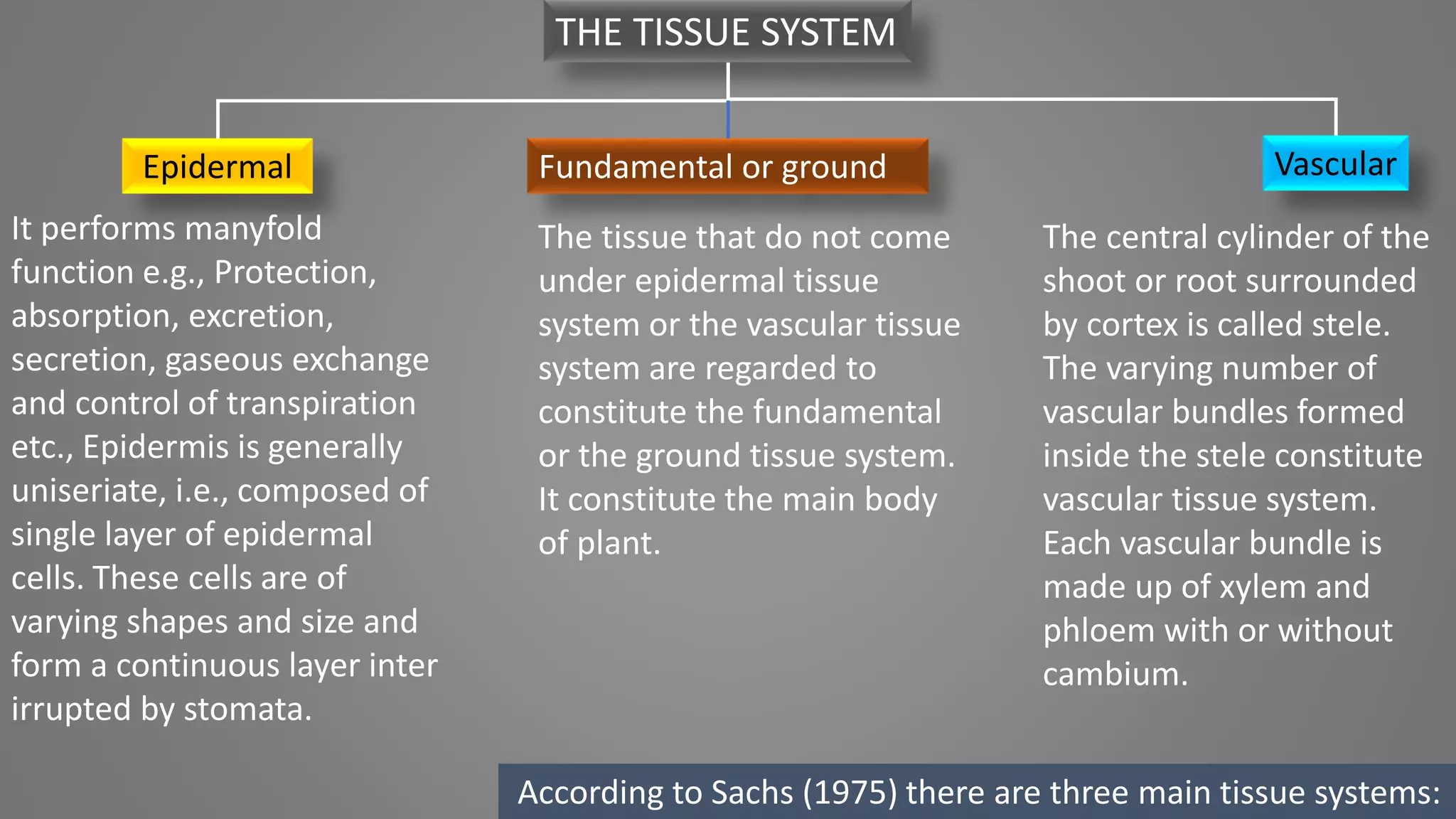
THE TISSUE SYSTEM
Epidermal Fundamental or ground Vascular
According to Sachs (1975) there are three main tissue systems:
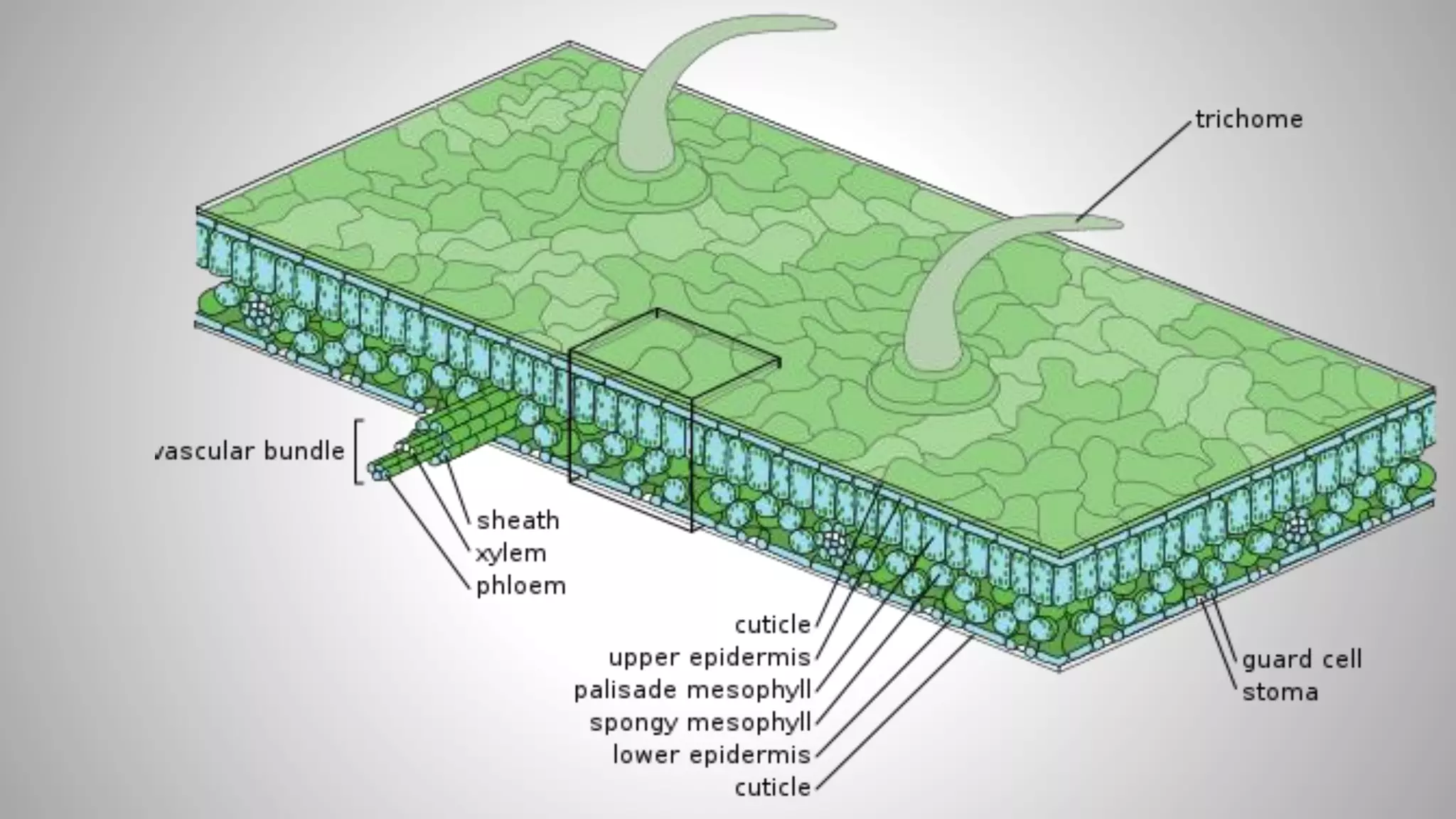
It performs manyfold
function e.g., Protection,
absorption, excretion,
secretion, gaseous exchange
and control of transpiration
etc., Epidermis is generally
uniseriate, i.e., composed of
single layer of epidermal
cells. These cells are of
varying shapes and size and
form a continuous layer inter
irrupted by stomata.
The tissue that do not come
under epidermal tissue
system or the vascular tissue
system are regarded to
constitute the fundamental
or the ground tissue system.
It constitute the main body
of plant.
The central cylinder of the
shoot or root surrounded
by cortex is called stele.
The varying number of
vascular bundles formed
inside the stele constitute
vascular tissue system.
Each vascular bundle is
made up of xylem and
phloem with or without
cambium.
• Deposition of cutin or suberin.
Cutinization and subrization
protects the epidermal cells from
external mechanical injuries and
retards transpiration. Epidermal
cells in some monocot leaves,
become larger thin walled, have
vacuoles and are called bulliform
(bubble like) cells. These cells
bring about rolling of leaves
during dry season. They loose
water in dry season and contract
thus bringing about rolling of
leaves e.g., Ammophila thus
reducing transpiration
• Deposition of cutin or suberin.
Cutinization and subrization
protects the epidermal cells from
external mechanical injuries and
retards transpiration. Epidermal
cells in some monocot leaves,
become larger thin walled, have
vacuoles and are called bulliform
(bubble like) cells. These cells
bring about rolling of leaves
during dry season. They loose
water in dry season and contract
thus bringing about rolling of
leaves e.g., Ammophila thus
reducing transpiration
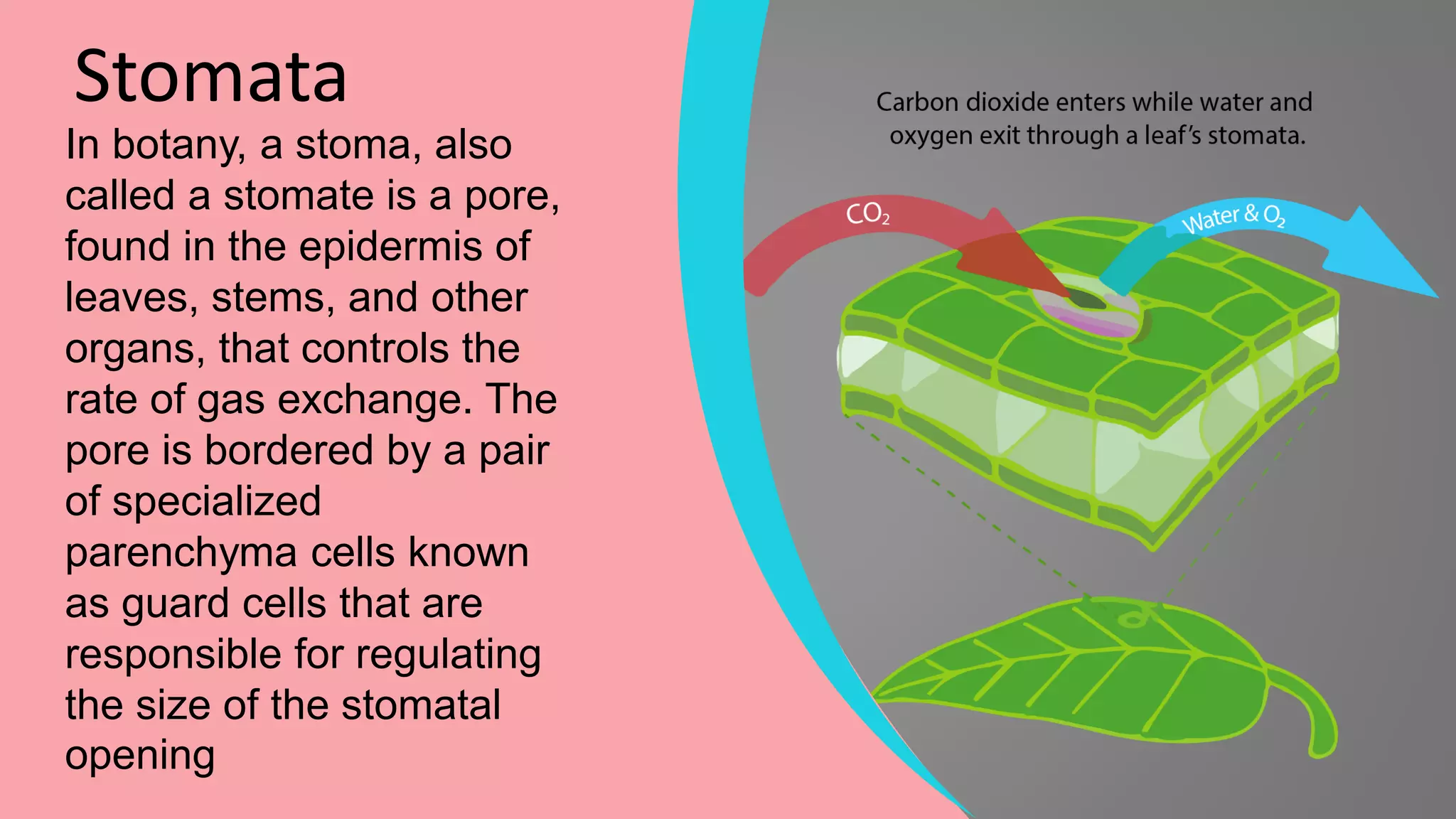
• Stomata
In botany, a stoma, also
called a stomate is a pore,
found in the epidermis of
leaves, stems, and other
organs, that controls the
rate of gas exchange. The
pore is bordered by a pair
of specialized
parenchyma cells known
as guard cells that are
responsible for regulating
the size of the stomatal
opening
In botany, a stoma, also
called a stomate is a pore,
found in the epidermis of
leaves, stems, and other
organs, that controls the
rate of gas exchange. The
pore is bordered by a pair
of specialized
parenchyma cells known
as guard cells that are
responsible for regulating
the size of the stomatal
opening
Stomata
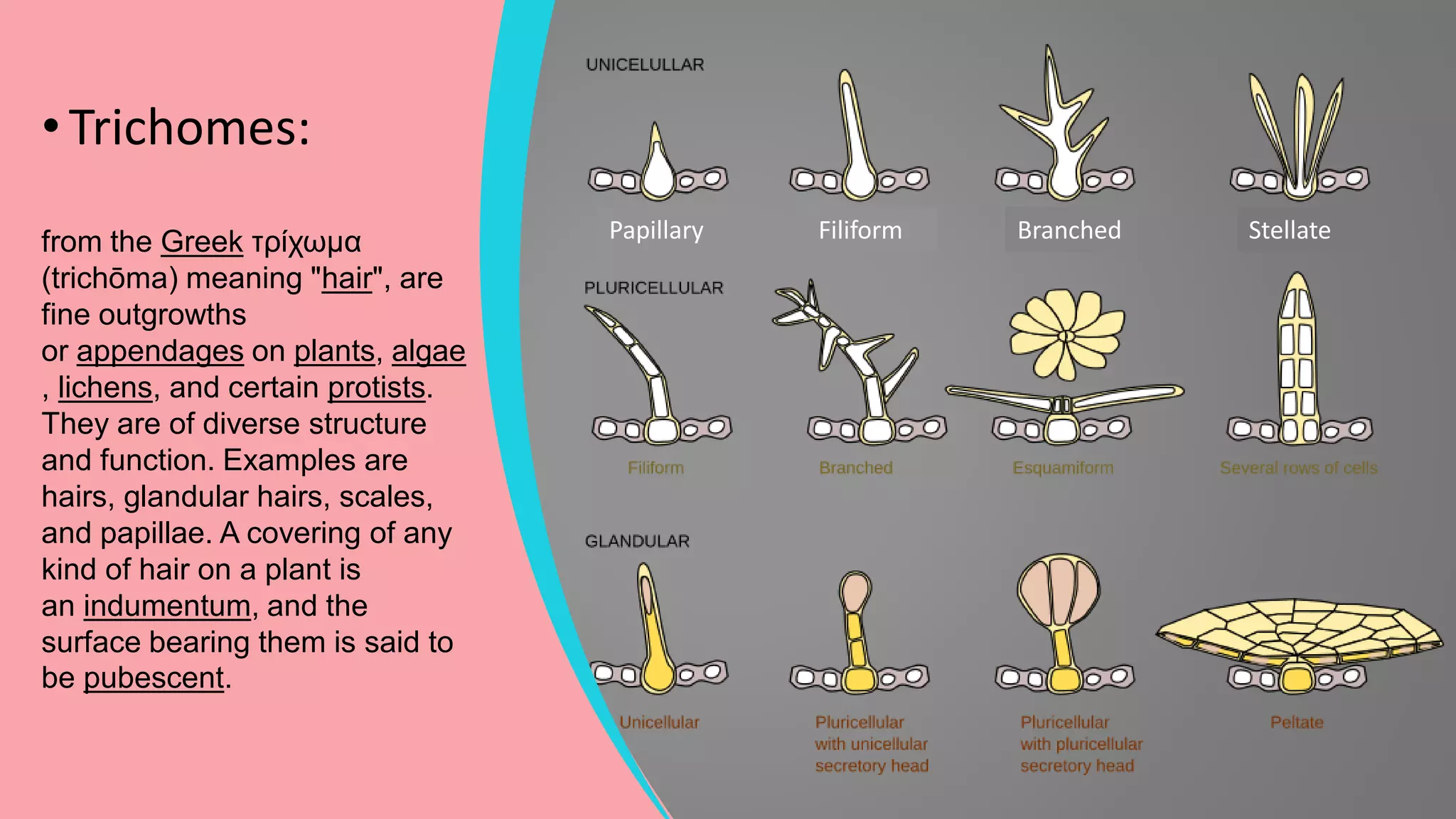
• Trichomes:
from the Greek τρίχωμα
(trichōma) meaning "hair", are
fine outgrowths
or appendages on plants, algae
, lichens, and certain protists.
They are of diverse structure
and function. Examples are
hairs, glandular hairs, scales,
and papillae. A covering of any
kind of hair on a plant is
an indumentum, and the
surface bearing them is said to
be pubescent.
from the Greek τρίχωμα
(trichōma) meaning "hair", are
fine outgrowths
or appendages on plants, algae
, lichens, and certain protists.
They are of diverse structure
and function. Examples are
hairs, glandular hairs, scales,
and papillae. A covering of any
kind of hair on a plant is
an indumentum, and the
surface bearing them is said to
be pubescent.
•Trichomes:
Papillary Filiform Branched Stellate
• In dicots stems and dicot and monocot roots (the ground tissues
constitute the following parts:
• (1) Cortex: The cortex when clearly delimited is the zone that lies
between the epidermis and pericycle. It is differentiated into the
following tissues:
• (a) Hypodermis: In dicot stems below the epidermis there is one or
more layered continuous or in patches collenchymatous tissue which
is called hypodermis. In monocot stem it is sclerenchymatous. In
plants where ridges and groove are found, collenchymatous
hypodermis is present only below the ridges e.g., in Cucurbitaceae.
Hypodermis is protective in function.
• (b) General cortex: It may be few to many layered in thickness. The
cells in most of the cases are thin walled and parenchymatous and
may be rounded or polygonal or cylindrical. The cells have prominent
intercellular spaces. Starch grain, oil, tannins and crystals of various
types are some of the nonliving inclusions of cortical cells.
• (c) Endodermis (Starch sheath): It is a single layer of compactly
arranged cells which have distinctive wall characteristics The cells are
living and may contain starch grains and mucilage. A special thickened
band is present on radial and tangential walls of endodermal cells.
This is called casparian strip. This is made up of lignin, suberin and
cutin.
• In dicots stems and dicot and monocot roots (the ground tissues
constitute the following parts:
• (1) Cortex: The cortex when clearly delimited is the zone that lies
between the epidermis and pericycle. It is differentiated into the
following tissues:
• (a) Hypodermis: In dicot stems below the epidermis there is one or
more layered continuous or in patches collenchymatous tissue which
is called hypodermis. In monocot stem it is sclerenchymatous. In
plants where ridges and groove are found, collenchymatous
hypodermis is present only below the ridges e.g., in Cucurbitaceae.
Hypodermis is protective in function.
• (b) General cortex: It may be few to many layered in thickness. The
cells in most of the cases are thin walled and parenchymatous and
may be rounded or polygonal or cylindrical. The cells have prominent
intercellular spaces. Starch grain, oil, tannins and crystals of various
types are some of the nonliving inclusions of cortical cells.
• (c) Endodermis (Starch sheath): It is a single layer of compactly
arranged cells which have distinctive wall characteristics The cells are
living and may contain starch grains and mucilage. A special thickened
band is present on radial and tangential walls of endodermal cells.
This is called casparian strip. This is made up of lignin, suberin and
cutin.
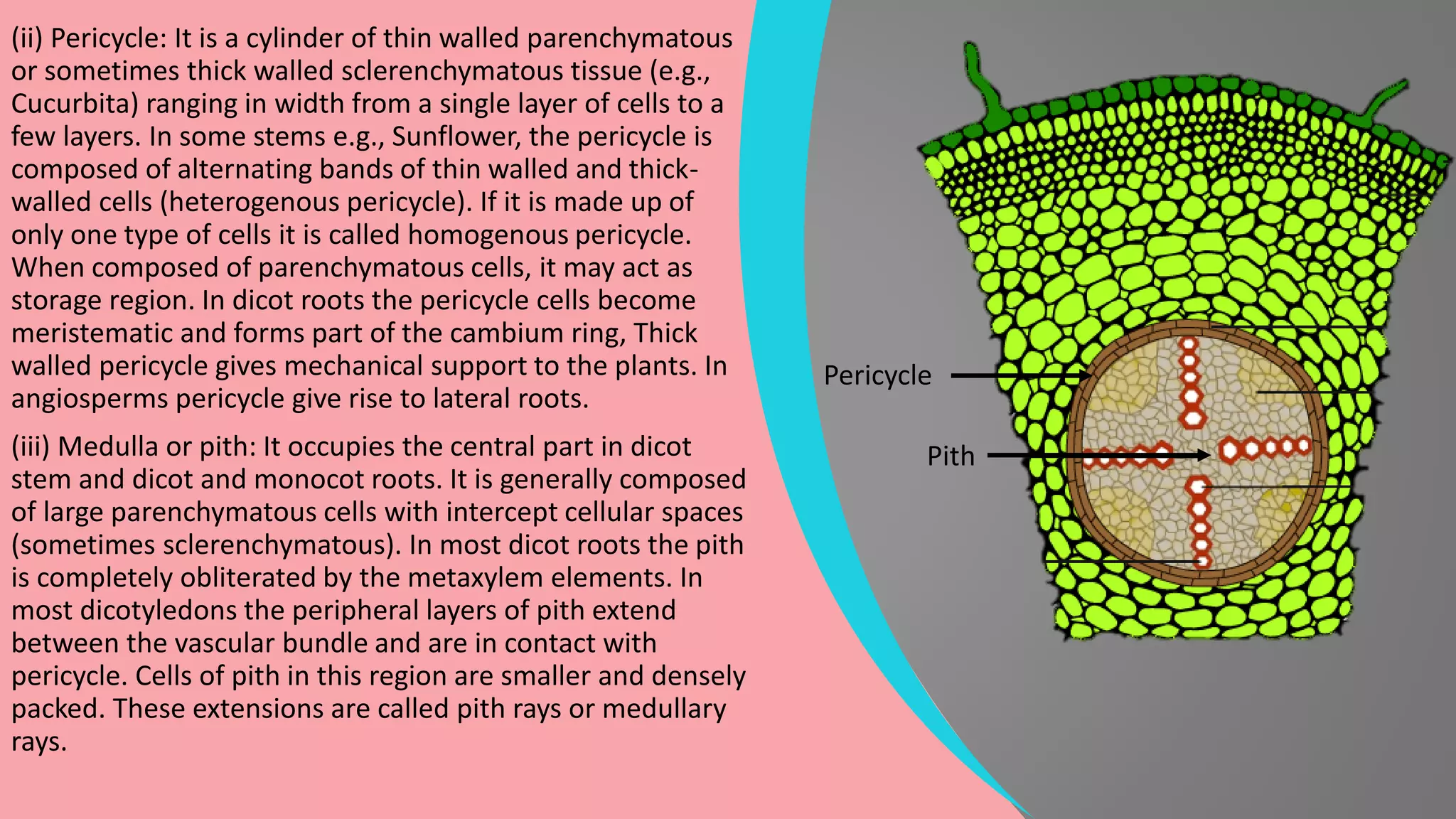
(ii) Pericycle: It is a cylinder of thin walled parenchymatous
or sometimes thick walled sclerenchymatous tissue (e.g.,
Cucurbita) ranging in width from a single layer of cells to a
few layers. In some stems e.g., Sunflower, the pericycle is
composed of alternating bands of thin walled and thick-
walled cells (heterogenous pericycle). If it is made up of
only one type of cells it is called homogenous pericycle.
When composed of parenchymatous cells, it may act as
storage region. In dicot roots the pericycle cells become
meristematic and forms part of the cambium ring, Thick
walled pericycle gives mechanical support to the plants. In
angiosperms pericycle give rise to lateral roots.
(iii) Medulla or pith: It occupies the central part in dicot
stem and dicot and monocot roots. It is generally composed
of large parenchymatous cells with intercept cellular spaces
(sometimes sclerenchymatous). In most dicot roots the pith
is completely obliterated by the metaxylem elements. In
most dicotyledons the peripheral layers of pith extend
between the vascular bundle and are in contact with
pericycle. Cells of pith in this region are smaller and densely
packed. These extensions are called pith rays or medullary
rays.
Pericycle
Pith
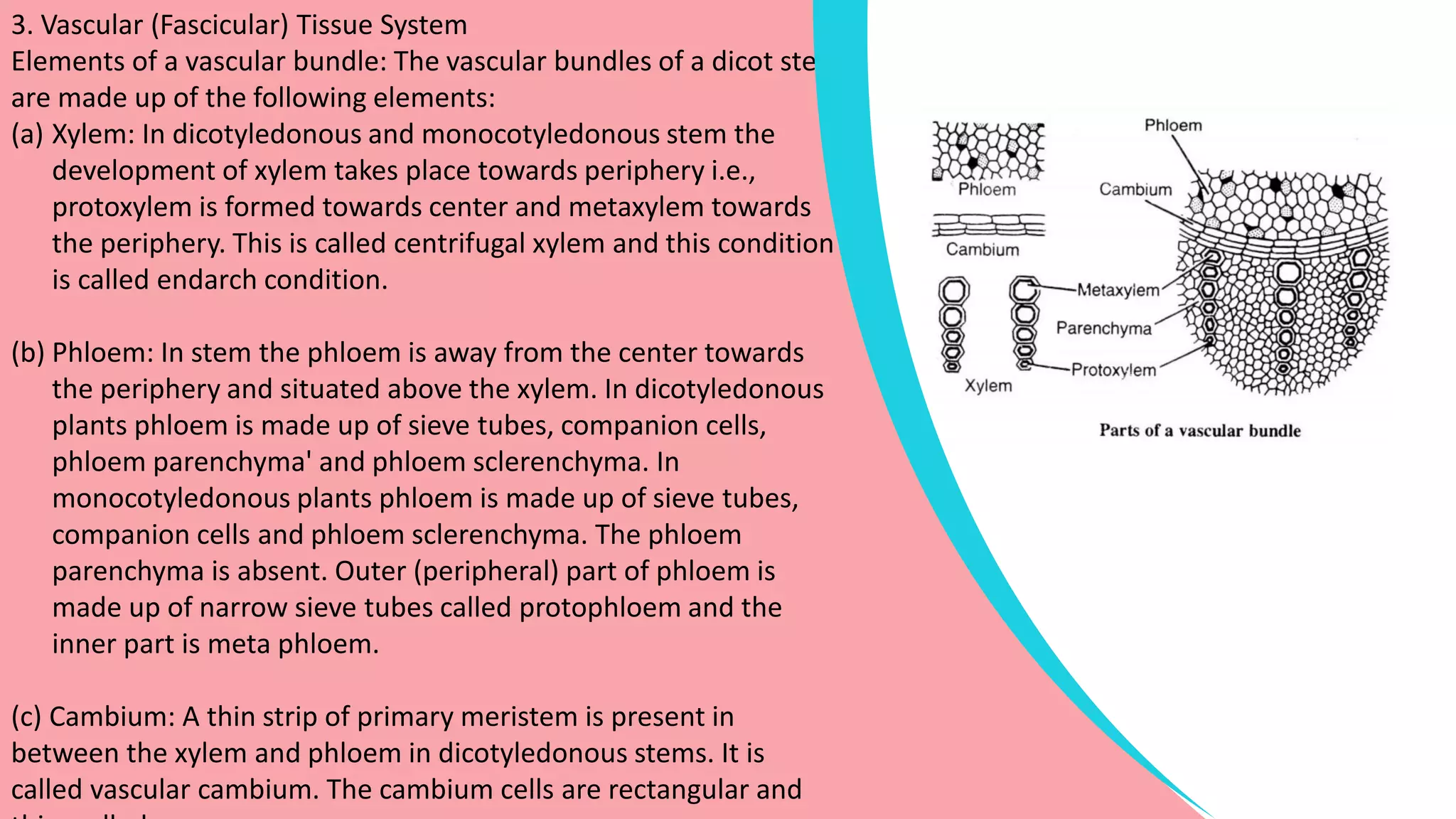
3. Vascular (Fascicular) Tissue System
Elements of a vascular bundle: The vascular bundles of a dicot stem
are made up of the following elements:
(a) Xylem: In dicotyledonous and monocotyledonous stem the
development of xylem takes place towards periphery i.e.,
protoxylem is formed towards center and metaxylem towards
the periphery. This is called centrifugal xylem and this condition
is called endarch condition.
(b) Phloem: In stem the phloem is away from the center towards
the periphery and situated above the xylem. In dicotyledonous
plants phloem is made up of sieve tubes, companion cells,
phloem parenchyma' and phloem sclerenchyma. In
monocotyledonous plants phloem is made up of sieve tubes,
companion cells and phloem sclerenchyma. The phloem
parenchyma is absent. Outer (peripheral) part of phloem is
made up of narrow sieve tubes called protophloem and the
inner part is meta phloem.
(c) Cambium: A thin strip of primary meristem is present in
between the xylem and phloem in dicotyledonous stems. It is
called vascular cambium. The cambium cells are rectangular and
Conjoint
Collateral
Phloem
Cambium
Xylem
Outer Phloem
Outer cambium
Xylem
Inner cambium
Inner phloem
BiCollateral
Open Closed
• Types of Vascular bundles
• (1) Conjoint: In stems the xylem and phloem
are present on the same radius. Such vascular
bundles are of two types:
(a) Collateral: In this type of vascular bundles
xylem is towards the inner side and phloem
towards the outer periphery of xylem. In dicot
stem cambium is present between xylem and
phloem, such vascular bundles are called open.
In monocot stems the cambium is absent, such
vascular bundles are called closed
(b) Bicollateral: In such vascular bundles there
are two patches of phloem one on each side of
xylem. In such a vascular bundles there are two
strips of cambium one on each side of xylem.
Thus the arrangement is outer phloem. outer
cambium, xylem, inner cambium and inner
phloem
(2) Concentric: In this vascular bundle
either xylem surrounds the phloem or
phloem surrounds the xylem.
Concentric vascular bundles are of two
types
(a) Amphicribral (hadrocentric): The
xylem is in the Centre surrounded by
phloem (Fig. 15.35) e.g. Ferns.
(b) Amphivasal (leptocentric): The
xylem completely surrounds the
phloem(Fig. 15.35) e.g., Dracaena,
Yucca. (Fig. 15.35).
Phloem
Xylem
Concentric
AmphicribalAmphivasal
Phloem
Xylem(3) Radial: In roots there are separate and
alternate strands of phloem and xylem that are
separated by parenchymatous cells and are
present on different radii such vascular bundles
are called radial
Radial
(2) Concentric: In this vascular bundle
either xylem surrounds the phloem or
phloem surrounds the xylem.
Concentric vascular bundles are of two
types
(a) Amphicribral (hadrocentric): The
xylem is in the Centre surrounded by
phloem (Fig. 15.35) e.g. Ferns.
(b) Amphivasal (leptocentric): The
xylem completely surrounds the
phloem(Fig. 15.35) e.g., Dracaena,
Yucca. (Fig. 15.35).
(3) Radial: In roots there are separate and
alternate strands of phloem and xylem that are
separated by parenchymatous cells and are
present on different radii such vascular bundles
are called radial

Tissue System in plant

  • 1.
  • 2.
    THE TISSUE SYSTEM EpidermalFundamental or ground Vascular According to Sachs (1975) there are three main tissue systems: It performs manyfold function e.g., Protection, absorption, excretion, secretion, gaseous exchange and control of transpiration etc., Epidermis is generally uniseriate, i.e., composed of single layer of epidermal cells. These cells are of varying shapes and size and form a continuous layer inter irrupted by stomata. The tissue that do not come under epidermal tissue system or the vascular tissue system are regarded to constitute the fundamental or the ground tissue system. It constitute the main body of plant. The central cylinder of the shoot or root surrounded by cortex is called stele. The varying number of vascular bundles formed inside the stele constitute vascular tissue system. Each vascular bundle is made up of xylem and phloem with or without cambium.
  • 4.
    • Deposition ofcutin or suberin. Cutinization and subrization protects the epidermal cells from external mechanical injuries and retards transpiration. Epidermal cells in some monocot leaves, become larger thin walled, have vacuoles and are called bulliform (bubble like) cells. These cells bring about rolling of leaves during dry season. They loose water in dry season and contract thus bringing about rolling of leaves e.g., Ammophila thus reducing transpiration • Deposition of cutin or suberin. Cutinization and subrization protects the epidermal cells from external mechanical injuries and retards transpiration. Epidermal cells in some monocot leaves, become larger thin walled, have vacuoles and are called bulliform (bubble like) cells. These cells bring about rolling of leaves during dry season. They loose water in dry season and contract thus bringing about rolling of leaves e.g., Ammophila thus reducing transpiration
  • 5.
    • Stomata In botany,a stoma, also called a stomate is a pore, found in the epidermis of leaves, stems, and other organs, that controls the rate of gas exchange. The pore is bordered by a pair of specialized parenchyma cells known as guard cells that are responsible for regulating the size of the stomatal opening In botany, a stoma, also called a stomate is a pore, found in the epidermis of leaves, stems, and other organs, that controls the rate of gas exchange. The pore is bordered by a pair of specialized parenchyma cells known as guard cells that are responsible for regulating the size of the stomatal opening Stomata
  • 6.
    • Trichomes: from theGreek τρίχωμα (trichōma) meaning "hair", are fine outgrowths or appendages on plants, algae , lichens, and certain protists. They are of diverse structure and function. Examples are hairs, glandular hairs, scales, and papillae. A covering of any kind of hair on a plant is an indumentum, and the surface bearing them is said to be pubescent. from the Greek τρίχωμα (trichōma) meaning "hair", are fine outgrowths or appendages on plants, algae , lichens, and certain protists. They are of diverse structure and function. Examples are hairs, glandular hairs, scales, and papillae. A covering of any kind of hair on a plant is an indumentum, and the surface bearing them is said to be pubescent. •Trichomes: Papillary Filiform Branched Stellate
  • 7.
    • In dicotsstems and dicot and monocot roots (the ground tissues constitute the following parts: • (1) Cortex: The cortex when clearly delimited is the zone that lies between the epidermis and pericycle. It is differentiated into the following tissues: • (a) Hypodermis: In dicot stems below the epidermis there is one or more layered continuous or in patches collenchymatous tissue which is called hypodermis. In monocot stem it is sclerenchymatous. In plants where ridges and groove are found, collenchymatous hypodermis is present only below the ridges e.g., in Cucurbitaceae. Hypodermis is protective in function. • (b) General cortex: It may be few to many layered in thickness. The cells in most of the cases are thin walled and parenchymatous and may be rounded or polygonal or cylindrical. The cells have prominent intercellular spaces. Starch grain, oil, tannins and crystals of various types are some of the nonliving inclusions of cortical cells. • (c) Endodermis (Starch sheath): It is a single layer of compactly arranged cells which have distinctive wall characteristics The cells are living and may contain starch grains and mucilage. A special thickened band is present on radial and tangential walls of endodermal cells. This is called casparian strip. This is made up of lignin, suberin and cutin. • In dicots stems and dicot and monocot roots (the ground tissues constitute the following parts: • (1) Cortex: The cortex when clearly delimited is the zone that lies between the epidermis and pericycle. It is differentiated into the following tissues: • (a) Hypodermis: In dicot stems below the epidermis there is one or more layered continuous or in patches collenchymatous tissue which is called hypodermis. In monocot stem it is sclerenchymatous. In plants where ridges and groove are found, collenchymatous hypodermis is present only below the ridges e.g., in Cucurbitaceae. Hypodermis is protective in function. • (b) General cortex: It may be few to many layered in thickness. The cells in most of the cases are thin walled and parenchymatous and may be rounded or polygonal or cylindrical. The cells have prominent intercellular spaces. Starch grain, oil, tannins and crystals of various types are some of the nonliving inclusions of cortical cells. • (c) Endodermis (Starch sheath): It is a single layer of compactly arranged cells which have distinctive wall characteristics The cells are living and may contain starch grains and mucilage. A special thickened band is present on radial and tangential walls of endodermal cells. This is called casparian strip. This is made up of lignin, suberin and cutin.
  • 8.
    (ii) Pericycle: Itis a cylinder of thin walled parenchymatous or sometimes thick walled sclerenchymatous tissue (e.g., Cucurbita) ranging in width from a single layer of cells to a few layers. In some stems e.g., Sunflower, the pericycle is composed of alternating bands of thin walled and thick- walled cells (heterogenous pericycle). If it is made up of only one type of cells it is called homogenous pericycle. When composed of parenchymatous cells, it may act as storage region. In dicot roots the pericycle cells become meristematic and forms part of the cambium ring, Thick walled pericycle gives mechanical support to the plants. In angiosperms pericycle give rise to lateral roots. (iii) Medulla or pith: It occupies the central part in dicot stem and dicot and monocot roots. It is generally composed of large parenchymatous cells with intercept cellular spaces (sometimes sclerenchymatous). In most dicot roots the pith is completely obliterated by the metaxylem elements. In most dicotyledons the peripheral layers of pith extend between the vascular bundle and are in contact with pericycle. Cells of pith in this region are smaller and densely packed. These extensions are called pith rays or medullary rays. Pericycle Pith
  • 9.
    3. Vascular (Fascicular)Tissue System Elements of a vascular bundle: The vascular bundles of a dicot stem are made up of the following elements: (a) Xylem: In dicotyledonous and monocotyledonous stem the development of xylem takes place towards periphery i.e., protoxylem is formed towards center and metaxylem towards the periphery. This is called centrifugal xylem and this condition is called endarch condition. (b) Phloem: In stem the phloem is away from the center towards the periphery and situated above the xylem. In dicotyledonous plants phloem is made up of sieve tubes, companion cells, phloem parenchyma' and phloem sclerenchyma. In monocotyledonous plants phloem is made up of sieve tubes, companion cells and phloem sclerenchyma. The phloem parenchyma is absent. Outer (peripheral) part of phloem is made up of narrow sieve tubes called protophloem and the inner part is meta phloem. (c) Cambium: A thin strip of primary meristem is present in between the xylem and phloem in dicotyledonous stems. It is called vascular cambium. The cambium cells are rectangular and
  • 11.
    Conjoint Collateral Phloem Cambium Xylem Outer Phloem Outer cambium Xylem Innercambium Inner phloem BiCollateral Open Closed • Types of Vascular bundles • (1) Conjoint: In stems the xylem and phloem are present on the same radius. Such vascular bundles are of two types: (a) Collateral: In this type of vascular bundles xylem is towards the inner side and phloem towards the outer periphery of xylem. In dicot stem cambium is present between xylem and phloem, such vascular bundles are called open. In monocot stems the cambium is absent, such vascular bundles are called closed (b) Bicollateral: In such vascular bundles there are two patches of phloem one on each side of xylem. In such a vascular bundles there are two strips of cambium one on each side of xylem. Thus the arrangement is outer phloem. outer cambium, xylem, inner cambium and inner phloem
  • 12.
    (2) Concentric: Inthis vascular bundle either xylem surrounds the phloem or phloem surrounds the xylem. Concentric vascular bundles are of two types (a) Amphicribral (hadrocentric): The xylem is in the Centre surrounded by phloem (Fig. 15.35) e.g. Ferns. (b) Amphivasal (leptocentric): The xylem completely surrounds the phloem(Fig. 15.35) e.g., Dracaena, Yucca. (Fig. 15.35). Phloem Xylem Concentric AmphicribalAmphivasal Phloem Xylem(3) Radial: In roots there are separate and alternate strands of phloem and xylem that are separated by parenchymatous cells and are present on different radii such vascular bundles are called radial Radial (2) Concentric: In this vascular bundle either xylem surrounds the phloem or phloem surrounds the xylem. Concentric vascular bundles are of two types (a) Amphicribral (hadrocentric): The xylem is in the Centre surrounded by phloem (Fig. 15.35) e.g. Ferns. (b) Amphivasal (leptocentric): The xylem completely surrounds the phloem(Fig. 15.35) e.g., Dracaena, Yucca. (Fig. 15.35). (3) Radial: In roots there are separate and alternate strands of phloem and xylem that are separated by parenchymatous cells and are present on different radii such vascular bundles are called radial