BIOLOGY
CHAPTER - 2
TISSUES
MERISTEMATIC TISSUE
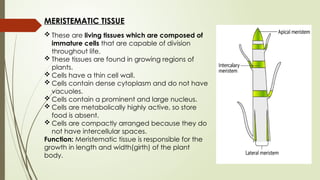
 These are living tissues which are composed of
immature cells that are capable of division
throughout life.
 These tissues are found in growing regions of
plants.
 Cells have a thin cell wall.
 Cells contain dense cytoplasm and do not have
vacuoles.
 Cells contain a prominent and large nucleus.
 Cells are metabolically highly active, so store
food is absent.
 Cells are compactly arranged because they do
not have intercellular spaces.
Function: Meristematic tissue is responsible for the
growth in length and width(girth) of the plant
body.
1. APICAL MERISTEM
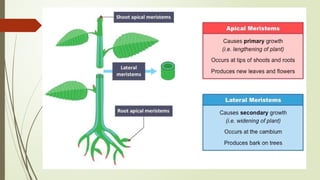
•It is present at the growing tips of stems and roots.
•They are responsible for an increase in the length of plant organs.
•Apical meristem is absent in Algae and Fungi.
•Apical and Intercalary meristem are responsible for the primary
growth of the plant (growth in length).
Competition Window:
Meristematic tissues are of three types on the basis of origin:
•Promeristem: These are embryonic meristem which give rise to
primary meristem.
•Primary Meristem: These are always in active state of division
and give rise to primary permanent tissue.
•Secondary Meristem: These are developed from primary
permanent tissue and give rise to secondary permanent tissues.
2. INTERCALARY MERISTEM
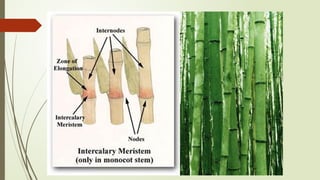
•It is the part of apical meristem which is left
behind during the growth period. They are
short-lived and convert into permanent tissue.
•These are present at the base of the leaf or
internode. Intercalary meristem may be present
either at the node as in grasses, bamboo and
mints.
•They are responsible for the growth in the
length of plant organs.
3. LATERAL MERISTEM
It lies on the lateral sides of the stem
and root or occurs along the sides of
the longitudinal axis of the plant.
It helps in increasing the diameter
(girth or width) of the plant. Hence
helps in secondary growth.
Lateral meristem is present in only
dicot plants.
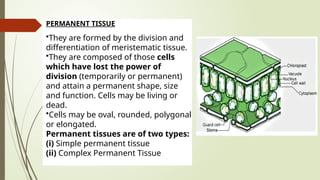
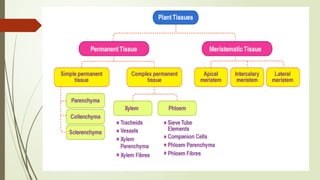
PERMANENT TISSUE
•They are formed by the division and
differentiation of meristematic tissue.
•They are composed of those cells
which have lost the power of
division (temporarily or permanent)
and attain a permanent shape, size
and function. Cells may be living or
dead.
•Cells may be oval, rounded, polygonal
or elongated.
Permanent tissues are of two types:
(i) Simple permanent tissue
(ii) Complex Permanent Tissue
SIMPLE PERMANENT TISSUE
•These tissues are made up of similar types
of cells, that perform a common function.
•They are protective and supportive in
nature.
Simple tissues are of three types:
(i) Parenchyma
(ii) Collenchyma
(iii) Sclerenchyma
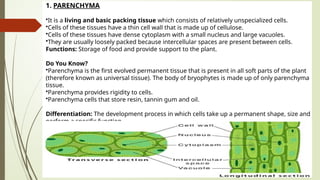
1. PARENCHYMA
•It is a living and basic packing tissue which consists of relatively unspecialized cells.
•Cells of these tissues have a thin cell wall that is made up of cellulose.
•Cells of these tissues have dense cytoplasm with a small nucleus and large vacuoles.
•They are usually loosely packed because intercellular spaces are present between cells.
Functions: Storage of food and provide support to the plant.
Do You Know?
•Parenchyma is the first evolved permanent tissue that is present in all soft parts of the plant
(therefore known as universal tissue). The body of bryophytes is made up of only parenchyma
tissue.
•Parenchyma provides rigidity to cells.
•Parenchyma cells that store resin, tannin gum and oil.
Differentiation: The development process in which cells take up a permanent shape, size and
perform a specific function.
MODIFICATION OF PARENCHYMA:
(a) Chlorenchyma
•Such a type of parenchyma in which an abundant
quantity of chloroplasts is found.
•They are present in the mesophyll of leaves.
•Function: Synthesis of food (Photosynthesis)
(b) Aerenchyma
•Such a type of parenchyma is made up of rounded cells
which surrounds the large air cavities. It is found in
aquatic plants or hydrophytes.
•Example: Petiole of water hyacinth.
•Function: It provides buoyancy to the aquatic plants to
help them float.
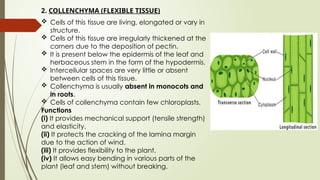
2. COLLENCHYMA (FLEXIBLE TISSUE)
 Cells of this tissue are living, elongated or vary in
structure.
 Cells of this tissue are irregularly thickened at the
corners due to the deposition of pectin.
 It is present below the epidermis of the leaf and
herbaceous stem in the form of the hypodermis.
 Intercellular spaces are very little or absent
between cells of this tissue.
 Collenchyma is usually absent in monocots and
in roots.
 Cells of collenchyma contain few chloroplasts.
Functions
(i) It provides mechanical support (tensile strength)
and elasticity.
(ii) It protects the cracking of the lamina margin
due to the action of wind.
(iii) It provides flexibility to the plant.
(iv) It allows easy bending in various parts of the
plant (leaf and stem) without breaking.
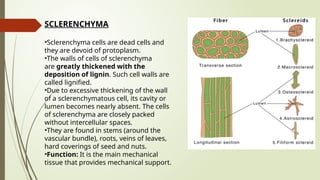
SCLERENCHYMA
•Sclerenchyma cells are dead cells and
they are devoid of protoplasm.
•The walls of cells of sclerenchyma
are greatly thickened with the
deposition of lignin. Such cell walls are
called lignified.
•Due to excessive thickening of the wall
of a sclerenchymatous cell, its cavity or
lumen becomes nearly absent. The cells
of sclerenchyma are closely packed
without intercellular spaces.
•They are found in stems (around the
vascular bundle), roots, veins of leaves,
hard coverings of seed and nuts.
•Function: It is the main mechanical
tissue that provides mechanical support.
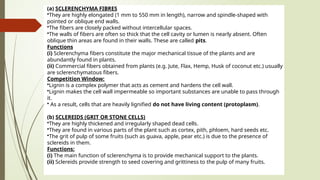
(a) SCLERENCHYMA FIBRES
•They are highly elongated (1 mm to 550 mm in length), narrow and spindle-shaped with
pointed or oblique end walls.
•The fibers are closely packed without intercellular spaces.
•The walls of fibers are often so thick that the cell cavity or lumen is nearly absent. Often
oblique thin areas are found in their walls. These are called pits.
Functions
(i) Sclerenchyma fibers constitute the major mechanical tissue of the plants and are
abundantly found in plants.
(ii) Commercial fibers obtained from plants (e.g. Jute, Flax, Hemp, Husk of coconut etc.) usually
are sclerenchymatous fibers.
Competition Window:
•Lignin is a complex polymer that acts as cement and hardens the cell wall.
•Lignin makes the cell wall impermeable so important substances are unable to pass through
it.
• As a result, cells that are heavily lignified do not have living content (protoplasm).
(b) SCLEREIDS (GRIT OR STONE CELLS)
•They are highly thickened and irregularly shaped dead cells.
•They are found in various parts of the plant such as cortex, pith, phloem, hard seeds etc.
•The grit of pulp of some fruits (such as guava, apple, pear etc.) is due to the presence of
sclereids in them.
Functions:
(i) The main function of sclerenchyma is to provide mechanical support to the plants.
(ii) Sclereids provide strength to seed covering and grittiness to the pulp of many fruits.
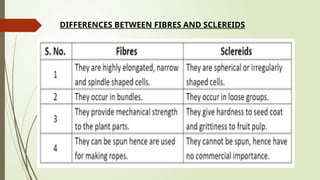
DIFFERENCES BETWEEN FIBRES AND SCLEREIDS
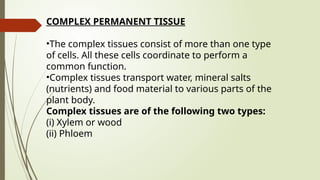
COMPLEX PERMANENT TISSUE
•The complex tissues consist of more than one type
of cells. All these cells coordinate to perform a
common function.
•Complex tissues transport water, mineral salts
(nutrients) and food material to various parts of the
plant body.
Complex tissues are of the following two types:
(i) Xylem or wood
(ii) Phloem
Do You Know?
•Xylem and phloem are both conducting tissues and
also known as vascular tissues (conducting tissue),
together both of them constitute vascular bundles.
PIT FORMATIONS
•No lignin is laid down where plasmodesmata were
present in the original cell walls.
•These non-lignified areas are known as pits and
they allow water to pass sideways between one
xylem vessel and the next.
•As vessels and tracheids of xylem have the lignified
cell walls, so this simply means that these cells are
hollow and there are no cell contents to restrict the
flow of water.
HADROME
•Tracheids & vessels are collectively known as
hadrome and it acts as main conducting elements in
the xylem.
•The annual rings present in the trunk of a tree are
xylem rings. By counting the number of annual
rings we can determine the age of a tree
(Dendrochronology).
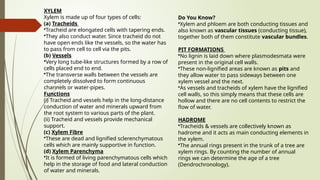
XYLEM
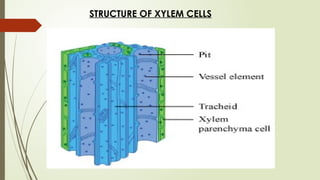
Xylem is made up of four types of cells:
(a) Tracheids
•Tracheid are elongated cells with tapering ends.
•They also conduct water. Since tracheid do not
have open ends like the vessels, so the water has
to pass from cell to cell via the pits.
(b) Vessels
•Very long tube-like structures formed by a row of
cells placed end to end.
•The transverse walls between the vessels are
completely dissolved to form continuous
channels or water-pipes.
Functions
(i) Tracheid and vessels help in the long-distance
conduction of water and minerals upward from
the root system to various parts of the plant.
(ii) Tracheid and vessels provide mechanical
support.
(c) Xylem Fibre
•These are dead and lignified sclerenchymatous
cells which are mainly supportive in function.
(d) Xylem Parenchyma
•It is formed of living parenchymatous cells which
help in the storage of food and lateral conduction
of water and minerals.
STRUCTURE OF XYLEM CELLS
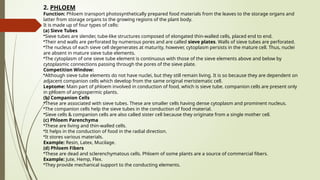
2. PHLOEM
Function: Phloem transport photosynthetically prepared food materials from the leaves to the storage organs and
latter from storage organs to the growing regions of the plant body.
It is made up of four types of cells:
(a) Sieve Tubes
•Sieve tubes are slender, tube-like structures composed of elongated thin-walled cells, placed end to end.
•Their end walls are perforated by numerous pores and are called sieve plates. Walls of sieve tubes are perforated.
•The nucleus of each sieve cell degenerates at maturity, however, cytoplasm persists in the mature cell. Thus, nuclei
are absent in mature sieve tube elements.
•The cytoplasm of one sieve tube element is continuous with those of the sieve elements above and below by
cytoplasmic connections passing through the pores of the sieve plate.
Competition Window:
•Although sieve tube elements do not have nuclei, but they still remain living. It is so because they are dependent on
adjacent companion cells which develop from the same original meristematic cell.
Leptome: Main part of phloem involved in conduction of food, which is sieve tube. companion cells are present only
in phloem of angiospermic plants.
(b) Companion Cells
•These are associated with sieve tubes. These are smaller cells having dense cytoplasm and prominent nucleus.
•The companion cells help the sieve tubes in the conduction of food material.
•Sieve cells & companion cells are also called sister cell because they originate from a single mother cell.
(c) Phloem Parenchyma
•These are living and thin-walled cells.
•It helps in the conduction of food in the radial direction.
•It stores various materials.
Example: Resin, Latex, Mucilage.
(d) Phloem Fibers
•These are dead and sclerenchymatous cells. Phloem of some plants are a source of commercial fibers.
Example: Jute, Hemp, Flex.
•They provide mechanical support to the conducting elements.
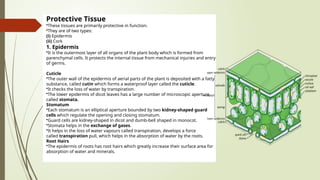
Protective Tissue
•These tissues are primarily protective in function.
•They are of two types:
(i) Epidermis
(ii) Cork
1. Epidermis
•It is the outermost layer of all organs of the plant body which is formed from
parenchymal cells. It protects the internal tissue from mechanical injuries and entry
of germs.
Cuticle
•The outer wall of the epidermis of aerial parts of the plant is deposited with a fatty
substance, called cutin which forms a waterproof layer called the cuticle.
•It checks the loss of water by transpiration.
•The lower epidermis of dicot leaves has a large number of microscopic aperture
called stomata.
Stomatum
•Each stomatum is an elliptical aperture bounded by two kidney-shaped guard
cells which regulate the opening and closing stomatum.
•Guard cells are kidney-shaped in dicot and dumb-bell shaped in monocot.
•Stomata helps in the exchange of gases.
•It helps in the loss of water vapours called transpiration, develops a force
called transpiration pull, which helps in the absorption of water by the roots.
Root Hairs
•The epidermis of roots has root hairs which greatly increase their surface area for
absorption of water and minerals.
2. Cork or Phellem
•Cork is the peripheral tissue of old stems and roots of woody trees and is formed due to the activity
of cork cambium or phellogen (secondary lateral meristem).
•Cork cambium produces off new cell on its both sides, thus, forming cork (phellem) on the outer side and
the Secondary cortex or phelloderm on the inner side.
•It is made up of dead cells with a thick wall but no intercellular spaces.
•The walls of cork cells are heavily thickened by the deposition of an organic substance (a fatty substance),
called suberin.
•Suberin makes these cell impermeable to water and gases and it also helps in the conservation of water
in the trees.
Commercial Importance of Cork
•Cork is light and highly compressible which does not catch fire easily.
•Cork is used in the making of a variety of sports goods such as cricket balls, table tennis, shuttle-cocks,
wooden paddles etc.
Functions
•Cork is protective in function.
•Cork prevents desiccation (by preventing loss of water from the plant).
•Cork prevents infection and mechanical injury.
•Lenticels (pores) present in the cork provide aeration to the inner tissues.
Competition Window:
•Dedifferentiation: In this process, the specialized cells regain the division power and become
meristematic.
Example: Vascular Cambium
•The cork cells do not contain protoplasm but are filled with resin or tannins. In the case of an onion bulb
too, in the skin of onion the cell walls become thick and waterproof due to the addition of suberin.
•Cork and bark are not the same structures.
While cork includes outer products of cork cambium, the bark includes the outer products of cambium
such as secondary phloem and also cork cambium and cork.
•Commercial cork is obtained from the stem surface of Quercus suber.
THANK YOU

CH - 6 TISSUES CLASS 9 PRESENTATION.pptx

  • 1.
  • 3.
    MERISTEMATIC TISSUE  Theseare living tissues which are composed of immature cells that are capable of division throughout life.  These tissues are found in growing regions of plants.  Cells have a thin cell wall.  Cells contain dense cytoplasm and do not have vacuoles.  Cells contain a prominent and large nucleus.  Cells are metabolically highly active, so store food is absent.  Cells are compactly arranged because they do not have intercellular spaces. Function: Meristematic tissue is responsible for the growth in length and width(girth) of the plant body.
  • 5.
    1. APICAL MERISTEM •Itis present at the growing tips of stems and roots. •They are responsible for an increase in the length of plant organs. •Apical meristem is absent in Algae and Fungi. •Apical and Intercalary meristem are responsible for the primary growth of the plant (growth in length). Competition Window: Meristematic tissues are of three types on the basis of origin: •Promeristem: These are embryonic meristem which give rise to primary meristem. •Primary Meristem: These are always in active state of division and give rise to primary permanent tissue. •Secondary Meristem: These are developed from primary permanent tissue and give rise to secondary permanent tissues.
  • 6.
    2. INTERCALARY MERISTEM •Itis the part of apical meristem which is left behind during the growth period. They are short-lived and convert into permanent tissue. •These are present at the base of the leaf or internode. Intercalary meristem may be present either at the node as in grasses, bamboo and mints. •They are responsible for the growth in the length of plant organs.
  • 8.
    3. LATERAL MERISTEM Itlies on the lateral sides of the stem and root or occurs along the sides of the longitudinal axis of the plant. It helps in increasing the diameter (girth or width) of the plant. Hence helps in secondary growth. Lateral meristem is present in only dicot plants.
  • 9.
    PERMANENT TISSUE •They areformed by the division and differentiation of meristematic tissue. •They are composed of those cells which have lost the power of division (temporarily or permanent) and attain a permanent shape, size and function. Cells may be living or dead. •Cells may be oval, rounded, polygonal or elongated. Permanent tissues are of two types: (i) Simple permanent tissue (ii) Complex Permanent Tissue
  • 10.
    SIMPLE PERMANENT TISSUE •Thesetissues are made up of similar types of cells, that perform a common function. •They are protective and supportive in nature. Simple tissues are of three types: (i) Parenchyma (ii) Collenchyma (iii) Sclerenchyma
  • 11.
    1. PARENCHYMA •It isa living and basic packing tissue which consists of relatively unspecialized cells. •Cells of these tissues have a thin cell wall that is made up of cellulose. •Cells of these tissues have dense cytoplasm with a small nucleus and large vacuoles. •They are usually loosely packed because intercellular spaces are present between cells. Functions: Storage of food and provide support to the plant. Do You Know? •Parenchyma is the first evolved permanent tissue that is present in all soft parts of the plant (therefore known as universal tissue). The body of bryophytes is made up of only parenchyma tissue. •Parenchyma provides rigidity to cells. •Parenchyma cells that store resin, tannin gum and oil. Differentiation: The development process in which cells take up a permanent shape, size and perform a specific function.
  • 12.
    MODIFICATION OF PARENCHYMA: (a)Chlorenchyma •Such a type of parenchyma in which an abundant quantity of chloroplasts is found. •They are present in the mesophyll of leaves. •Function: Synthesis of food (Photosynthesis) (b) Aerenchyma •Such a type of parenchyma is made up of rounded cells which surrounds the large air cavities. It is found in aquatic plants or hydrophytes. •Example: Petiole of water hyacinth. •Function: It provides buoyancy to the aquatic plants to help them float.
  • 13.
    2. COLLENCHYMA (FLEXIBLETISSUE)  Cells of this tissue are living, elongated or vary in structure.  Cells of this tissue are irregularly thickened at the corners due to the deposition of pectin.  It is present below the epidermis of the leaf and herbaceous stem in the form of the hypodermis.  Intercellular spaces are very little or absent between cells of this tissue.  Collenchyma is usually absent in monocots and in roots.  Cells of collenchyma contain few chloroplasts. Functions (i) It provides mechanical support (tensile strength) and elasticity. (ii) It protects the cracking of the lamina margin due to the action of wind. (iii) It provides flexibility to the plant. (iv) It allows easy bending in various parts of the plant (leaf and stem) without breaking.
  • 14.
    SCLERENCHYMA •Sclerenchyma cells aredead cells and they are devoid of protoplasm. •The walls of cells of sclerenchyma are greatly thickened with the deposition of lignin. Such cell walls are called lignified. •Due to excessive thickening of the wall of a sclerenchymatous cell, its cavity or lumen becomes nearly absent. The cells of sclerenchyma are closely packed without intercellular spaces. •They are found in stems (around the vascular bundle), roots, veins of leaves, hard coverings of seed and nuts. •Function: It is the main mechanical tissue that provides mechanical support.
  • 15.
    (a) SCLERENCHYMA FIBRES •Theyare highly elongated (1 mm to 550 mm in length), narrow and spindle-shaped with pointed or oblique end walls. •The fibers are closely packed without intercellular spaces. •The walls of fibers are often so thick that the cell cavity or lumen is nearly absent. Often oblique thin areas are found in their walls. These are called pits. Functions (i) Sclerenchyma fibers constitute the major mechanical tissue of the plants and are abundantly found in plants. (ii) Commercial fibers obtained from plants (e.g. Jute, Flax, Hemp, Husk of coconut etc.) usually are sclerenchymatous fibers. Competition Window: •Lignin is a complex polymer that acts as cement and hardens the cell wall. •Lignin makes the cell wall impermeable so important substances are unable to pass through it. • As a result, cells that are heavily lignified do not have living content (protoplasm). (b) SCLEREIDS (GRIT OR STONE CELLS) •They are highly thickened and irregularly shaped dead cells. •They are found in various parts of the plant such as cortex, pith, phloem, hard seeds etc. •The grit of pulp of some fruits (such as guava, apple, pear etc.) is due to the presence of sclereids in them. Functions: (i) The main function of sclerenchyma is to provide mechanical support to the plants. (ii) Sclereids provide strength to seed covering and grittiness to the pulp of many fruits.
  • 16.
  • 17.
    COMPLEX PERMANENT TISSUE •Thecomplex tissues consist of more than one type of cells. All these cells coordinate to perform a common function. •Complex tissues transport water, mineral salts (nutrients) and food material to various parts of the plant body. Complex tissues are of the following two types: (i) Xylem or wood (ii) Phloem
  • 18.
    Do You Know? •Xylemand phloem are both conducting tissues and also known as vascular tissues (conducting tissue), together both of them constitute vascular bundles. PIT FORMATIONS •No lignin is laid down where plasmodesmata were present in the original cell walls. •These non-lignified areas are known as pits and they allow water to pass sideways between one xylem vessel and the next. •As vessels and tracheids of xylem have the lignified cell walls, so this simply means that these cells are hollow and there are no cell contents to restrict the flow of water. HADROME •Tracheids & vessels are collectively known as hadrome and it acts as main conducting elements in the xylem. •The annual rings present in the trunk of a tree are xylem rings. By counting the number of annual rings we can determine the age of a tree (Dendrochronology). XYLEM Xylem is made up of four types of cells: (a) Tracheids •Tracheid are elongated cells with tapering ends. •They also conduct water. Since tracheid do not have open ends like the vessels, so the water has to pass from cell to cell via the pits. (b) Vessels •Very long tube-like structures formed by a row of cells placed end to end. •The transverse walls between the vessels are completely dissolved to form continuous channels or water-pipes. Functions (i) Tracheid and vessels help in the long-distance conduction of water and minerals upward from the root system to various parts of the plant. (ii) Tracheid and vessels provide mechanical support. (c) Xylem Fibre •These are dead and lignified sclerenchymatous cells which are mainly supportive in function. (d) Xylem Parenchyma •It is formed of living parenchymatous cells which help in the storage of food and lateral conduction of water and minerals.
  • 19.
  • 21.
    2. PHLOEM Function: Phloemtransport photosynthetically prepared food materials from the leaves to the storage organs and latter from storage organs to the growing regions of the plant body. It is made up of four types of cells: (a) Sieve Tubes •Sieve tubes are slender, tube-like structures composed of elongated thin-walled cells, placed end to end. •Their end walls are perforated by numerous pores and are called sieve plates. Walls of sieve tubes are perforated. •The nucleus of each sieve cell degenerates at maturity, however, cytoplasm persists in the mature cell. Thus, nuclei are absent in mature sieve tube elements. •The cytoplasm of one sieve tube element is continuous with those of the sieve elements above and below by cytoplasmic connections passing through the pores of the sieve plate. Competition Window: •Although sieve tube elements do not have nuclei, but they still remain living. It is so because they are dependent on adjacent companion cells which develop from the same original meristematic cell. Leptome: Main part of phloem involved in conduction of food, which is sieve tube. companion cells are present only in phloem of angiospermic plants. (b) Companion Cells •These are associated with sieve tubes. These are smaller cells having dense cytoplasm and prominent nucleus. •The companion cells help the sieve tubes in the conduction of food material. •Sieve cells & companion cells are also called sister cell because they originate from a single mother cell. (c) Phloem Parenchyma •These are living and thin-walled cells. •It helps in the conduction of food in the radial direction. •It stores various materials. Example: Resin, Latex, Mucilage. (d) Phloem Fibers •These are dead and sclerenchymatous cells. Phloem of some plants are a source of commercial fibers. Example: Jute, Hemp, Flex. •They provide mechanical support to the conducting elements.
  • 22.
    Protective Tissue •These tissuesare primarily protective in function. •They are of two types: (i) Epidermis (ii) Cork 1. Epidermis •It is the outermost layer of all organs of the plant body which is formed from parenchymal cells. It protects the internal tissue from mechanical injuries and entry of germs. Cuticle •The outer wall of the epidermis of aerial parts of the plant is deposited with a fatty substance, called cutin which forms a waterproof layer called the cuticle. •It checks the loss of water by transpiration. •The lower epidermis of dicot leaves has a large number of microscopic aperture called stomata. Stomatum •Each stomatum is an elliptical aperture bounded by two kidney-shaped guard cells which regulate the opening and closing stomatum. •Guard cells are kidney-shaped in dicot and dumb-bell shaped in monocot. •Stomata helps in the exchange of gases. •It helps in the loss of water vapours called transpiration, develops a force called transpiration pull, which helps in the absorption of water by the roots. Root Hairs •The epidermis of roots has root hairs which greatly increase their surface area for absorption of water and minerals.
  • 23.
    2. Cork orPhellem •Cork is the peripheral tissue of old stems and roots of woody trees and is formed due to the activity of cork cambium or phellogen (secondary lateral meristem). •Cork cambium produces off new cell on its both sides, thus, forming cork (phellem) on the outer side and the Secondary cortex or phelloderm on the inner side. •It is made up of dead cells with a thick wall but no intercellular spaces. •The walls of cork cells are heavily thickened by the deposition of an organic substance (a fatty substance), called suberin. •Suberin makes these cell impermeable to water and gases and it also helps in the conservation of water in the trees. Commercial Importance of Cork •Cork is light and highly compressible which does not catch fire easily. •Cork is used in the making of a variety of sports goods such as cricket balls, table tennis, shuttle-cocks, wooden paddles etc. Functions •Cork is protective in function. •Cork prevents desiccation (by preventing loss of water from the plant). •Cork prevents infection and mechanical injury. •Lenticels (pores) present in the cork provide aeration to the inner tissues. Competition Window: •Dedifferentiation: In this process, the specialized cells regain the division power and become meristematic. Example: Vascular Cambium •The cork cells do not contain protoplasm but are filled with resin or tannins. In the case of an onion bulb too, in the skin of onion the cell walls become thick and waterproof due to the addition of suberin. •Cork and bark are not the same structures. While cork includes outer products of cork cambium, the bark includes the outer products of cambium such as secondary phloem and also cork cambium and cork. •Commercial cork is obtained from the stem surface of Quercus suber.
  • 24.