Name
Muhammad Adnan
Roll No
BBOF18BM010
Submitted To
Ma’am Rabia Saba
Subject
Plant Anatomy
Topic
Root apex organization
BS-BOT(6th)
University of Sargodha Sub campus Bhakker
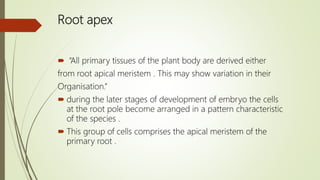
CONTENT
 Root apex
 Theories of root apex
 Apical cell theory
 Histogen theory
 Korper-kappe theory
 Concept of quiescent centre
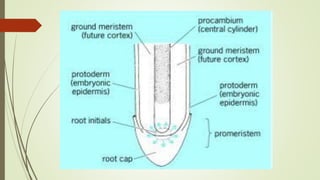
Root apex
 “All primary tissues of the plant body are derived either
from root apical meristem . This may show variation in their
Organisation.”
 during the later stages of development of embryo the cells
at the root pole become arranged in a pattern characteristic
of the species .
 This group of cells comprises the apical meristem of the
primary root .
Root apex organization
Several theories have been proposed to describe the root
apex organization .
1. Apical cell Theory
2. Histogen Theory
3. Korper-Kappe Theory
Apical cell theory
 Nageli (1958) proposed that a single tetrahedral apical cell in
the root apices brings about growth. It fas three cutting faces
for giving rise to the tissues of the body of the root. The root
cap is derived from its base. Such a proposition was not
found true to angiosperms.
 However, different types of root apices have been found in
angiosperms.
Histogen theory
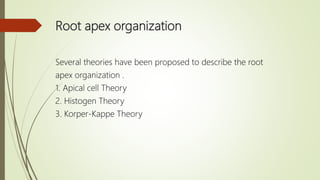
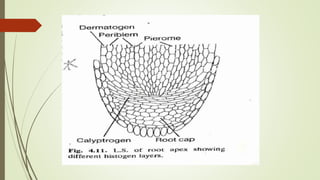
 Hanstein (1868) put forth histogen theory proposing that in
root apex regions, three distinct histogens are found. The
dermatogen that gives rise to epidermis, the periblem to the
cortex and the plerome to’ the vascular cylinder.
 Haberlandt (1914) proposed the terms protoderm, ground
meristem and procambium, respectively for these histogens.
Korper – Kappe Theory
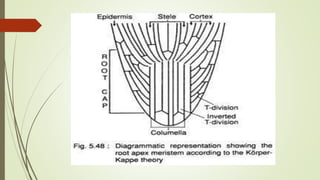
 Schuepp (1917) proposed that the cells at the root apex
divide in two planes.
 The zone with inverted ‘T’ type of division was referred to as
Kérper(cap)
 whereas other with straight ‘T as Kappe (body). The theory
basically recalls the tunica ,corpus concept of shoot apex and
Similarly, it also faiis to explain the differences in behaviour in
different species,
Concept of quiescent centre
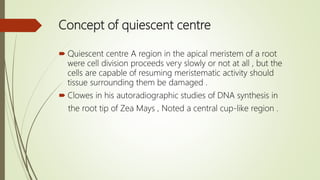
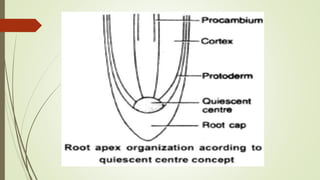
 Quiescent centre A region in the apical meristem of a root
were cell division proceeds very slowly or not at all , but the
cells are capable of resuming meristematic activity should
tissue surrounding them be damaged .
 Clowes in his autoradiographic studies of DNA synthesis in
the root tip of Zea Mays , Noted a central cup-like region .
 The cells of which had fewer mitochondria and ER ,very small
nuclei and low rate of DNA and protein synthesis .
 He referred this inactive region as quiescent centre .
 Since than such regions have been observed in many plants .
 It consists of about 500 cells in Zea mays, 600 in sinapsis .
Root apex organization

Root apex organization

  • 2.
    Name Muhammad Adnan Roll No BBOF18BM010 SubmittedTo Ma’am Rabia Saba Subject Plant Anatomy Topic Root apex organization BS-BOT(6th) University of Sargodha Sub campus Bhakker
  • 3.
    CONTENT  Root apex Theories of root apex  Apical cell theory  Histogen theory  Korper-kappe theory  Concept of quiescent centre
  • 4.
    Root apex  “Allprimary tissues of the plant body are derived either from root apical meristem . This may show variation in their Organisation.”  during the later stages of development of embryo the cells at the root pole become arranged in a pattern characteristic of the species .  This group of cells comprises the apical meristem of the primary root .
  • 6.
    Root apex organization Severaltheories have been proposed to describe the root apex organization . 1. Apical cell Theory 2. Histogen Theory 3. Korper-Kappe Theory
  • 7.
    Apical cell theory Nageli (1958) proposed that a single tetrahedral apical cell in the root apices brings about growth. It fas three cutting faces for giving rise to the tissues of the body of the root. The root cap is derived from its base. Such a proposition was not found true to angiosperms.  However, different types of root apices have been found in angiosperms.
  • 8.
    Histogen theory  Hanstein(1868) put forth histogen theory proposing that in root apex regions, three distinct histogens are found. The dermatogen that gives rise to epidermis, the periblem to the cortex and the plerome to’ the vascular cylinder.  Haberlandt (1914) proposed the terms protoderm, ground meristem and procambium, respectively for these histogens.
  • 10.
    Korper – KappeTheory  Schuepp (1917) proposed that the cells at the root apex divide in two planes.  The zone with inverted ‘T’ type of division was referred to as Kérper(cap)  whereas other with straight ‘T as Kappe (body). The theory basically recalls the tunica ,corpus concept of shoot apex and Similarly, it also faiis to explain the differences in behaviour in different species,
  • 12.
    Concept of quiescentcentre  Quiescent centre A region in the apical meristem of a root were cell division proceeds very slowly or not at all , but the cells are capable of resuming meristematic activity should tissue surrounding them be damaged .  Clowes in his autoradiographic studies of DNA synthesis in the root tip of Zea Mays , Noted a central cup-like region .
  • 14.
     The cellsof which had fewer mitochondria and ER ,very small nuclei and low rate of DNA and protein synthesis .  He referred this inactive region as quiescent centre .  Since than such regions have been observed in many plants .  It consists of about 500 cells in Zea mays, 600 in sinapsis .