STUDY OF TISSUE: HOW TO DIFFER CELL
WITH TISSUE
Spread the love
STUDY OF TISSUE
INTRODUCTION:
A tissue is a group of cells which have a common origin, similar shape, size and structure and
perform the same function. Cells in a tissue are usually held together by a cementing substance
and form a tissue system. ( what is tissue)
Different types of tissues are : Tissue present in plant( Plant tissue) and Tissue present in
animal (Animal tissue).
Plant tissues are divided into two main categories based on the ability of their cells to
divide: Meristematic tissue and Permanent tissue.
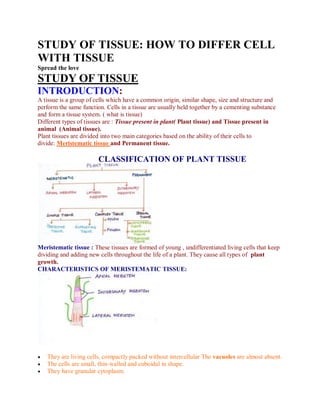
CLASSIFICATION OF PLANT TISSUE
Meristematic tissue : These tissues are formed of young , undifferentiated living cells that keep
dividing and adding new cells throughout the life of a plant. They cause all types of plant
growth.
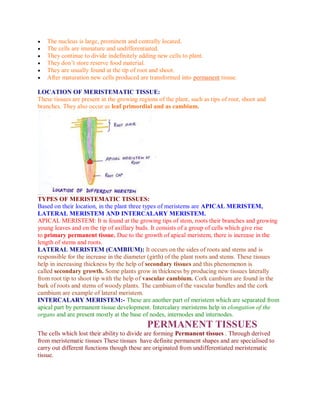
CHARACTERISTICS OF MERISTEMATIC TISSUE:
 They are living cells, compactly packed without intercellular The vacuoles are almost absent.
 The cells are small, thin-walled and cuboidal in shape.
 They have granular cytoplasm.
 The nucleus is large, prominent and centrally located.
 The cells are immature and undifferentiated.
 They continue to divide indefinitely adding new cells to plant.
 They don’t store reserve food material.
 They are usually found at the tip of root and shoot.
 After maturation new cells produced are transformed into permanent tissue.
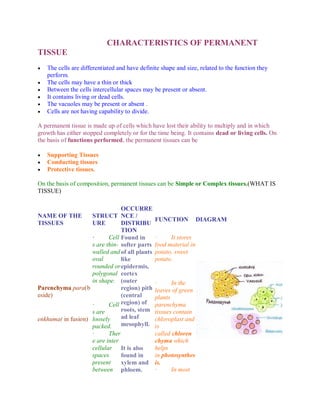
LOCATION OF MERISTEMATIC TISSUE:
These tissues are present in the growing regions of the plant, such as tips of root, shoot and
branches. They also occur as leaf primordial and as cambium.
TYPES OF MERISTEMATIC TISSUES:
Based on their location, in the plant three types of meristems are APICAL MERISTEM,
LATERAL MERISTEM AND INTERCALARY MERISTEM.
APICAL MERISTEM: It is found at the growing tips of stem, roots their branches and growing
young leaves and on the tip of axillary buds. It consists of a group of cells which give rise
to primary permanent tissue. Due to the growth of apical meristem, there is increase in the
length of stems and roots.
LATERAL MERISTEM (CAMBIUM): It occurs on the sides of roots and stems and is
responsible for the increase in the diameter (girth) of the plant roots and stems. These tissues
help in increasing thickness by the help of secondary tissues and this phenomenon is
called secondary growth. Some plants grow in thickness by producing new tissues laterally
from root tip to shoot tip with the help of vascular cambium. Cork cambium are found in the
bark of roots and stems of woody plants. The cambium of the vascular bundles and the cork
cambium are example of lateral meristem.
INTERCALARY MERISTEM:- These are another part of meristem which are separated from
apical part by permanent tissue development. Intercalary meristems help in elongation of the
organs and are present mostly at the base of nodes, internodes and internodes.
PERMANENT TISSUES
The cells which lost their ability to divide are forming Permanent tissues . Through derived
from meristematic tissues These tissues have definite permanent shapes and are specialised to
carry out different functions though these are originated from undifferentiated meristematic
tissue.
CHARACTERISTICS OF PERMANENT
TISSUE
 The cells are differentiated and have definite shape and size, related to the function they
perform.
 The cells may have a thin or thick
 Between the cells intercellular spaces may be present or absent.
 It contains living or dead cells.
 The vacuoles may be present or absent .
 Cells are not having capability to divide.
A permanent tissue is made up of cells which have lost their ability to multiply and in which
growth has either stopped completely or for the time being. It contains dead or living cells. On
the basis of functions performed, the permanent tissues can be
 Supporting Tissues
 Conducting tissues
 Protective tissues.
On the basis of composition, permanent tissues can be Simple or Complex tissues.(WHAT IS
TISSUE)
NAME OF THE
TISSUES
STRUCT
URE
OCCURRE
NCE /
DISTRIBU
TION
FUNCTION DIAGRAM
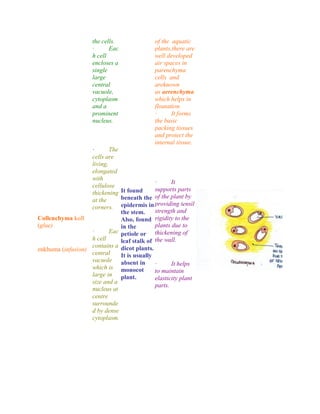
Parenchyma para(b
eside)
enkhuma( in fusion)
· Cell
s are thin-
walled and
oval
rounded or
polygonal
in shape.
· Cell
s are
loosely
packed.
· Ther
e are inter
cellular
spaces
present
between
Found in
softer parts
of all plants
like
epidermis,
cortex
(outer
region) pith
(central
region) of
roots, stem
ad leaf
mesophyll.
It is also
found in
xylem and
phloem.
· It stores
food material in
potato, sweet
potato.
· In the
leaves of green
plants
parenchyma
tissues contain
chloroplast and
is
called chloren
chyma which
helps
in photosynthes
is.
· In most
the cells.
· Eac
h cell
encloses a
single
large
central
vacuole,
cytoplasm
and a
prominent
nucleus.
of the aquatic
plants,there are
well developed
air spaces in
parenchyma
cells and
areknown
as aerenchyma
which helps in
floatation.
· It forms
the basic
packing tissues
and protect the
internal tissue.
Collenchyma koll
(glue)
enkhuma (infusion)
· The
cells are
living,
elongated
with
cellulose
thickening
at the
corners.
· Eac
h cell
contains a
central
vacuole
which is
large in
size and a
nucleus at
centre
surrounde
d by dense
cytoplasm.
It found
beneath the
epidermis in
the stem.
Also, found
in the
petiole or
leaf stalk of
dicot plants.
It is usually
absent in
monocot
plant.
· It
supports parts
of the plant by
providing tensil
strength and
rigidity to the
plants due to
thickening of
the wall.
· It helps
to maintain
elasticity plant
parts.
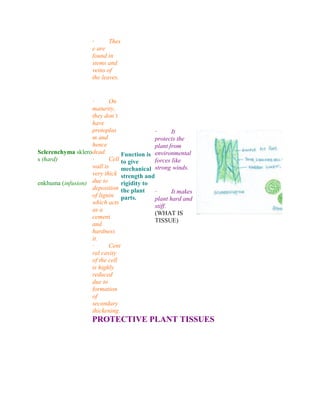
Sclerenchyma sklero
s (hard)
enkhuma (infusion)
· Thes
e are
found in
stems and
veins of
the leaves.
· On
maturity,
they don’t
have
protoplas
m and
hence
dead.
· Cell
wall is
very thick
due to
deposition
of lignin
which acts
as a
cement
and
hardness
it.
· Cent
ral cavity
of the cell
is highly
reduced
due to
formation
of
secondary
thickening.
Function is
to give
mechanical
strength and
rigidity to
the plant
parts.
· It
protects the
plant from
environmental
forces like
strong winds.
· It makes
plant hard and
stiff.
(WHAT IS
TISSUE)
PROTECTIVE PLANT TISSUES
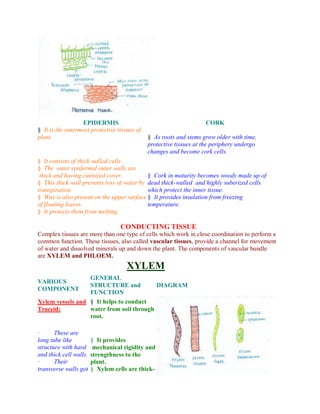
EPIDERMIS CORK
§ It is the outermost protective tissues of
plant.
§ It consists of thick walled cells .
§ The outer epidermal outer walls are
thick and having cutinized cover.
§ This thick wall prevents loss of water by
transpiration.
§ Wax is also present on the upper surface
of floating leaves.
§ It protects them from melting.
§ As roots and stems grow older with time,
protective tissues at the periphery undergo
changes and become cork cells.
§ Cork in maturity becomes woody made up of
dead thick-walled and highly suberized cells
which protect the inner tissue.
§ It provides insulation from freezing
temperature.
CONDUCTING TISSUE
Complex tissues are more than one type of cells which work in close coordination to perform a
common function. These tissues, also called vascular tissues, provide a channel for movement
of water and dissolved minerals up and down the plant. The components of vascular bundle
are XYLEM and PHLOEM.
XYLEM
VARIOUS
COMPONENT
GENERAL
STRUCTURE and
FUNCTION
DIAGRAM
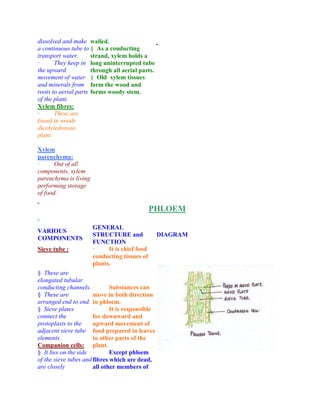
Xylem vessels and
Traceid:
· These are
long tube like
structure with hard
and thick cell walls.
· Their
transverse walls got
§ It helps to conduct
water from soil through
root.
§ It provides
mechanical rigidity and
strengthness to the
plant.
§ Xylem cells are thick-
dissolved and make
a continuous tube to
transport water.
· They keep in
the upward
movement of water
and minerals from
roots to aerial parts
of the plant.
Xylem fibres:
· These are
found in woody
dicotyledonous
plant.
Xylem
parenchyma:
· Out of all
components, xylem
parenchyma is living
performing storage
of food.
walled.
§ As a conducting
strand, xylem holds a
long uninterrupted tube
through all aerial parts.
§ Old xylem tissues
form the wood and
forms woody stem.
PHLOEM
VARIOUS
COMPONENTS
GENERAL
STRUCTURE and
FUNCTION
DIAGRAM
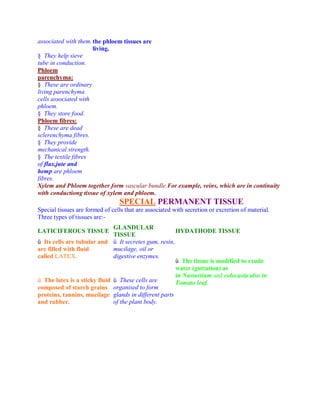
Sieve tube :
§ These are
elongated tubular
conducting channels.
§ These are
arranged end to end.
§ Sieve plates
connect the
protoplasts to the
adjacent sieve tube
elements.
Companion cells:
§ It lies on the side
of the sieve tubes and
are closely
· It is chief food
conducting tissues of
plants.
· Substances can
move in both direction
in phloem.
· It is responsible
for downward and
upward movement of
food prepared in leaves
to other parts of the
plant.
· Except phloem
fibres which are dead,
all other members of
associated with them.
§ They help sieve
tube in conduction.
Phloem
parenchyma:
§ These are ordinary
living parenchyma
cells associated with
phloem.
§ They store food.
Phloem fibres:
§ These are dead
sclerenchyma fibres.
§ They provide
mechanical strength.
§ The textile fibres
of flax,jute and
hemp are phloem
fibres.
the phloem tissues are
living.
Xylem and Phloem together form vascular bundle.For example, veins, which are in continuity
with conductiong tissue of xylem and phloem.
SPECIAL PERMANENT TISSUE
Special tissues are formed of cells that are associated with secretion or excretion of material.
Three types of tissues are:-
LATICIFEROUS TISSUE
GLANDULAR
TISSUE
HYDATHODE TISSUE
ü Its cells are tubular and
are filled with fluid
called LATEX.
ü The latex is a sticky fluid
composed of starch grains
proteins, tannins, mucilage
and rubber.
ü It secretes gum, resin,
mucilage, oil or
digestive enzymes.
ü These cells are
organised to form
glands in different parts
of the plant body.
ü The tissue is modified to exude
water (guttation) as
in Nasturtium and colocasia also in
Tomato leaf.