
CLOROPLAST
STRUCTURE AND FUNCTIONS
DR. DILIP V. HANDE
ASSOCIATE PROFESSOR, DEPT OF BOTANY
SHRI SHIVAJI SCIENCE COLLEGE, AMRAVATI MS.
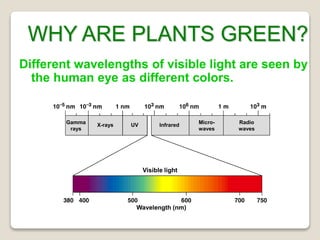
Different wavelengths of visible light are seen by
the human eye as different colors.
WHY ARE PLANTS GREEN?
Gamma
rays
X-rays UV Infrared
Micro-
waves
Radio
waves
Visible light
Wavelength (nm)
WHY ARE PLANTS GREEN?
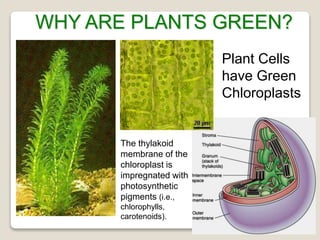
Plant Cells
have Green
Chloroplasts
The thylakoid
membrane of the
chloroplast is
impregnated with
photosynthetic
pigments (i.e.,
chlorophylls,
carotenoids).
Morphology
 Chloroplasts are the most common and
familiar plastids of most plant cells and
they are of greatest biological importance.
 They can be readily seen in most plant
cells at low magnification under light
microscope.
 The chloroplasts remain homogeneously
distributed in the groundplasm of plant
cells.
.
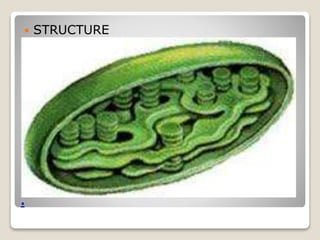
 STRUCTURE
Morphology
 In some plant cells they are found
concentrated around the nucleus and in
some they may be found just beneath the
plasma membrane.
 The shape, size, and distribution of
chloroplasts may vary in different cells
within a plant.
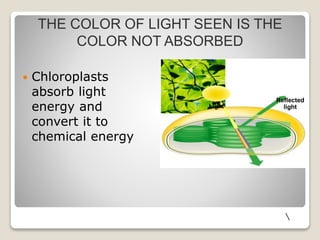
 Chloroplasts
absorb light
energy and
convert it to
chemical energy
Light
Reflected
light
THE COLOR OF LIGHT SEEN IS THE
COLOR NOT ABSORBED
Shape:
 Plastids in the cells of higher plants show a great
deal of variation in shape, the cells of leaves contain
many chloroplasts of spheroid, ovoid or discoidal
shape.
 Some may be club shaped having narrow middle
zone and bulging ends.
 They may be vesicular with a colorless centre in
some cells.
 In algae, cells often possess a single large chloroplast
which may be star-shaped, band-shaped, cup-
shaped, discoidal or reticulate.
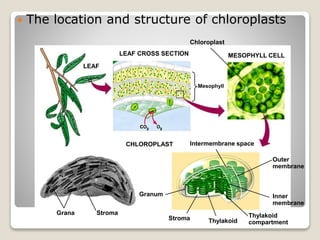
 The location and structure of chloroplasts
LEAF CROSS SECTION MESOPHYLL CELL
LEAF
Chloroplast
Mesophyll
CHLOROPLAST Intermembrane space
Outer
membrane
Inner
membrane
Thylakoid
compartmentThylakoidStroma
Granum
StromaGrana
Size:
 Chloroplasts show considerable variation in size.
 The average diameter of chloroplasts of higher plant
is 4 to 6  and thickness 1 to 3 .
 The size is, more or less, constant for a given cell
type in a plant but in polyploid cells, they are
comparatively larger than those in the
corresponding diploid cells.
 Plants growing in shade have chloroplasts that are
larger in size and contain more chlorophylls than
the chloroplasts found in plants growing in sunlight.
 It is a type of plastids
 Plastids: A group of plant and algal membrane-
bound organelles that include
 Amyloplasts,
 Chromoplasts and
 Chloroplasts.
Chloroplasts
Plastids
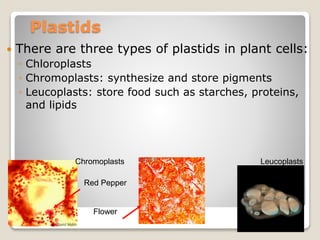
 There are three types of plastids in plant cells:
◦ Chloroplasts
◦ Chromoplasts: synthesize and store pigments
◦ Leucoplasts: store food such as starches, proteins,
and lipids
Chromoplasts
Red Pepper
Flower
Leucoplasts
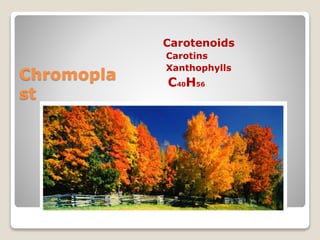
Chromopla
st
Carotenoids
Carotins
Xanthophylls
C40H56
:
 The number of chloroplasts appears to be relatively
constant in different plants and the variation in
number .
 The cells in most algae possess only a single
chloroplast.
 The cells of the higher plants may have 20 to 40
chloroplasts, an average 36 chloroplasts in each
palisade cell and 20 in each spongy parenchyma
cell.
 In moss genus Mnium, cells have been found to
possess an average of about 106 chloroplasts each.
Chloroplasts
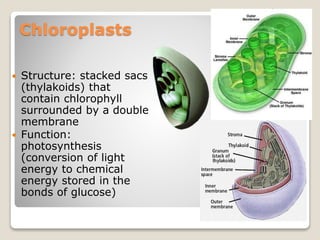
 Structure: stacked sacs
(thylakoids) that
contain chlorophyll
surrounded by a double
membrane
 Function:
photosynthesis
(conversion of light
energy to chemical
energy stored in the
bonds of glucose)
Chloroplasts
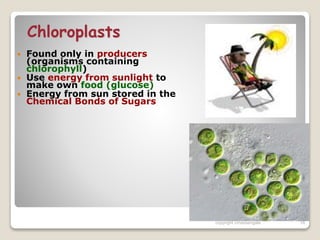
 Found only in producers
(organisms containing
chlorophyll)
 Use energy from sunlight to
make own food (glucose)
 Energy from sun stored in the
Chemical Bonds of Sugars
copyright cmassengale 16
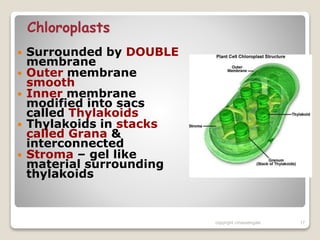
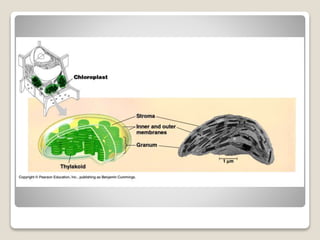
Chloroplasts
 Surrounded by DOUBLE
membrane
 Outer membrane
smooth
 Inner membrane
modified into sacs
called Thylakoids
 Thylakoids in stacks
called Grana &
interconnected
 Stroma – gel like
material surrounding
thylakoids
copyright cmassengale 17
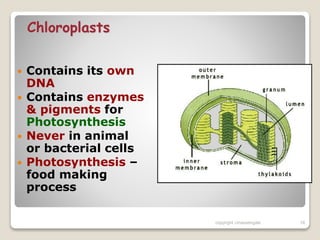
Chloroplasts
 Contains its own
DNA
 Contains enzymes
& pigments for
Photosynthesis
 Never in animal
or bacterial cells
 Photosynthesis –
food making
process
copyright cmassengale 18
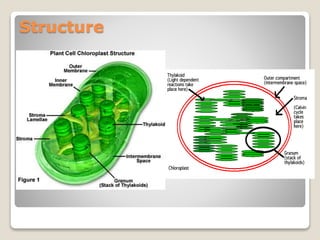
Structure
 (a) Lamellate chloroplasts.
 (b) chloroplasts with grana.
 Lamellate chloroplasts are commonly
found in algae and in some cells of lower
plants.
 They are disc-shaped, primitive type of
chloroplasts bounded by two differentially
permeable unit membranes of
lipoproteins.
 In section it appears like a pair of parallel
membranes joined at each end.
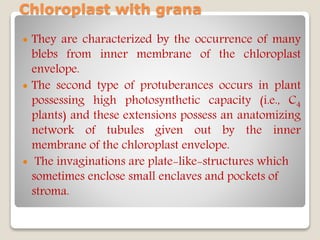
Chloroplast with grana
 They are characterized by the occurrence of many
blebs from inner membrane of the chloroplast
envelope.
 The second type of protuberances occurs in plant
possessing high photosynthetic capacity (i.e., C4
plants) and these extensions possess an anatomizing
network of tubules given out by the inner
membrane of the chloroplast envelope.
 The invaginations are plate-like-structures which
sometimes enclose small enclaves and pockets of
stroma.
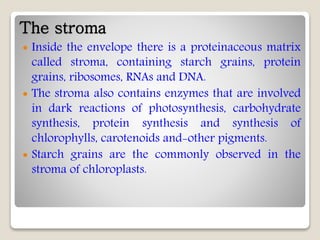
The stroma
 Inside the envelope there is a proteinaceous matrix
called stroma, containing starch grains, protein
grains, ribosomes, RNAs and DNA.
 The stroma also contains enzymes that are involved
in dark reactions of photosynthesis, carbohydrate
synthesis, protein synthesis and synthesis of
chlorophylls, carotenoids and-other pigments.
 Starch grains are the commonly observed in the
stroma of chloroplasts.
Functions
 Chloroplasts are organelle produce their energy
from the sun.
 Chloroplasts are involved in synthesis of organic
molecules from carbon dioxide and water, with
oxygen released as a by-product.
 Chloroplasts absorb light and use it in conjunction
with water and carbon dioxide to produce sugars,
 The raw material for energy and biomass
production in all green plants and the animals that
depend on them, directly or indirectly, for food.
 Chloroplasts capture light energy to conserve free
energy in the form of ATP and reduce NADP to
NADPH through a complex set of processes.
Chloroplast

Chloroplast

  • 1.
    CLOROPLAST STRUCTURE AND FUNCTIONS DR.DILIP V. HANDE ASSOCIATE PROFESSOR, DEPT OF BOTANY SHRI SHIVAJI SCIENCE COLLEGE, AMRAVATI MS.
  • 2.
    Different wavelengths ofvisible light are seen by the human eye as different colors. WHY ARE PLANTS GREEN? Gamma rays X-rays UV Infrared Micro- waves Radio waves Visible light Wavelength (nm)
  • 3.
    WHY ARE PLANTSGREEN? Plant Cells have Green Chloroplasts The thylakoid membrane of the chloroplast is impregnated with photosynthetic pigments (i.e., chlorophylls, carotenoids).
  • 4.
    Morphology  Chloroplasts arethe most common and familiar plastids of most plant cells and they are of greatest biological importance.  They can be readily seen in most plant cells at low magnification under light microscope.  The chloroplasts remain homogeneously distributed in the groundplasm of plant cells.
  • 5.
  • 6.
    Morphology  In someplant cells they are found concentrated around the nucleus and in some they may be found just beneath the plasma membrane.  The shape, size, and distribution of chloroplasts may vary in different cells within a plant.
  • 7.
     Chloroplasts absorb light energyand convert it to chemical energy Light Reflected light THE COLOR OF LIGHT SEEN IS THE COLOR NOT ABSORBED
  • 8.
    Shape:  Plastids inthe cells of higher plants show a great deal of variation in shape, the cells of leaves contain many chloroplasts of spheroid, ovoid or discoidal shape.  Some may be club shaped having narrow middle zone and bulging ends.  They may be vesicular with a colorless centre in some cells.  In algae, cells often possess a single large chloroplast which may be star-shaped, band-shaped, cup- shaped, discoidal or reticulate.
  • 9.
     The locationand structure of chloroplasts LEAF CROSS SECTION MESOPHYLL CELL LEAF Chloroplast Mesophyll CHLOROPLAST Intermembrane space Outer membrane Inner membrane Thylakoid compartmentThylakoidStroma Granum StromaGrana
  • 10.
    Size:  Chloroplasts showconsiderable variation in size.  The average diameter of chloroplasts of higher plant is 4 to 6  and thickness 1 to 3 .  The size is, more or less, constant for a given cell type in a plant but in polyploid cells, they are comparatively larger than those in the corresponding diploid cells.  Plants growing in shade have chloroplasts that are larger in size and contain more chlorophylls than the chloroplasts found in plants growing in sunlight.
  • 11.
     It isa type of plastids  Plastids: A group of plant and algal membrane- bound organelles that include  Amyloplasts,  Chromoplasts and  Chloroplasts. Chloroplasts
  • 12.
    Plastids  There arethree types of plastids in plant cells: ◦ Chloroplasts ◦ Chromoplasts: synthesize and store pigments ◦ Leucoplasts: store food such as starches, proteins, and lipids Chromoplasts Red Pepper Flower Leucoplasts
  • 13.
  • 14.
    :  The numberof chloroplasts appears to be relatively constant in different plants and the variation in number .  The cells in most algae possess only a single chloroplast.  The cells of the higher plants may have 20 to 40 chloroplasts, an average 36 chloroplasts in each palisade cell and 20 in each spongy parenchyma cell.  In moss genus Mnium, cells have been found to possess an average of about 106 chloroplasts each.
  • 15.
    Chloroplasts  Structure: stackedsacs (thylakoids) that contain chlorophyll surrounded by a double membrane  Function: photosynthesis (conversion of light energy to chemical energy stored in the bonds of glucose)
  • 16.
    Chloroplasts  Found onlyin producers (organisms containing chlorophyll)  Use energy from sunlight to make own food (glucose)  Energy from sun stored in the Chemical Bonds of Sugars copyright cmassengale 16
  • 17.
    Chloroplasts  Surrounded byDOUBLE membrane  Outer membrane smooth  Inner membrane modified into sacs called Thylakoids  Thylakoids in stacks called Grana & interconnected  Stroma – gel like material surrounding thylakoids copyright cmassengale 17
  • 18.
    Chloroplasts  Contains itsown DNA  Contains enzymes & pigments for Photosynthesis  Never in animal or bacterial cells  Photosynthesis – food making process copyright cmassengale 18
  • 19.
  • 20.
     (a) Lamellatechloroplasts.  (b) chloroplasts with grana.  Lamellate chloroplasts are commonly found in algae and in some cells of lower plants.  They are disc-shaped, primitive type of chloroplasts bounded by two differentially permeable unit membranes of lipoproteins.  In section it appears like a pair of parallel membranes joined at each end.
  • 22.
    Chloroplast with grana They are characterized by the occurrence of many blebs from inner membrane of the chloroplast envelope.  The second type of protuberances occurs in plant possessing high photosynthetic capacity (i.e., C4 plants) and these extensions possess an anatomizing network of tubules given out by the inner membrane of the chloroplast envelope.  The invaginations are plate-like-structures which sometimes enclose small enclaves and pockets of stroma.
  • 23.
    The stroma  Insidethe envelope there is a proteinaceous matrix called stroma, containing starch grains, protein grains, ribosomes, RNAs and DNA.  The stroma also contains enzymes that are involved in dark reactions of photosynthesis, carbohydrate synthesis, protein synthesis and synthesis of chlorophylls, carotenoids and-other pigments.  Starch grains are the commonly observed in the stroma of chloroplasts.
  • 24.
    Functions  Chloroplasts areorganelle produce their energy from the sun.  Chloroplasts are involved in synthesis of organic molecules from carbon dioxide and water, with oxygen released as a by-product.  Chloroplasts absorb light and use it in conjunction with water and carbon dioxide to produce sugars,  The raw material for energy and biomass production in all green plants and the animals that depend on them, directly or indirectly, for food.  Chloroplasts capture light energy to conserve free energy in the form of ATP and reduce NADP to NADPH through a complex set of processes.