

PHARMACOGNOSY
Lecture-5
(Introduction)
Dr. Ahmed Metwaly
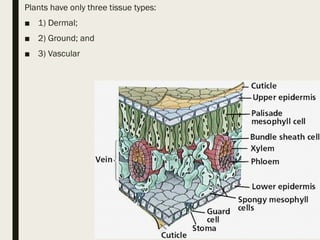
Plants have only three tissue types:
■ 1) Dermal;
■ 2) Ground; and
■ 3) Vascular
■ Dermal tissue covers the outer surface of herbaceous plants.
Dermal tissue is composed of epidermal cells, closely packed
cells that secrete a waxy cuticle that aids in the prevention of
water loss.
■ Protect plants
■ Contains stomata for gas exchange
■ Called periderm in bark
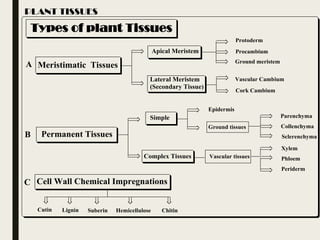
PLANT TISSUES
Types of plant Tissues
Meristimatic Tissues
Apical Meristem
Lateral Meristem
(Secondary Tissue)
Permanent Tissues
Cell Wall Chemical Impregnations
Procambium
Cork Cambium
Protoderm
Ground meristem
Vascular Cambium
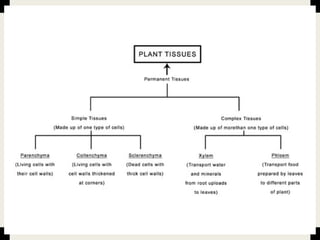
Simple
Complex Tissues
Epidermis
Ground tissues
Parenchyma
Collenchyma
Sclerenchyma
Vascular tissues
Xylem
Phloem
Periderm
Cutin Lignin Suberin Hemicellulose Chitin
A
B
C
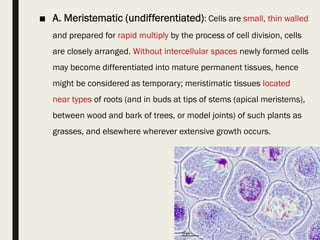
■ A. Meristematic (undifferentiated): Cells are small, thin walled
and prepared for rapid multiply by the process of cell division, cells
are closely arranged. Without intercellular spaces newly formed cells
may become differentiated into mature permanent tissues, hence
might be considered as temporary; meristimatic tissues located
near types of roots (and in buds at tips of stems (apical meristems),
between wood and bark of trees, or model joints) of such plants as
grasses, and elsewhere wherever extensive growth occurs.
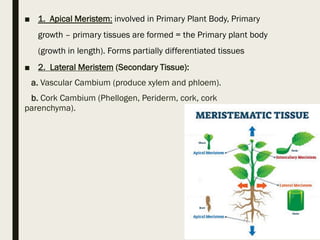
■ 1. Apical Meristem: involved in Primary Plant Body, Primary
growth – primary tissues are formed = the Primary plant body
(growth in length). Forms partially differentiated tissues
■ 2. Lateral Meristem (Secondary Tissue):
a. Vascular Cambium (produce xylem and phloem).
b. Cork Cambium (Phellogen, Periderm, cork, cork
parenchyma).
■ II. Permanent Tissues:
Permanent tissues usually do not change into other kind of
tissues and in most cases retain their structure and functional
characteristics throughout life.
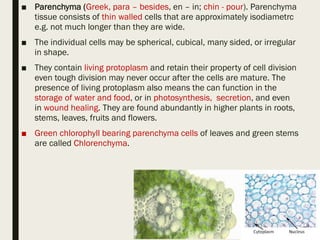
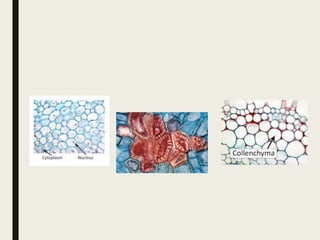
■ Parenchyma (Greek, para – besides, en – in; chin - pour). Parenchyma
tissue consists of thin walled cells that are approximately isodiametrc
e.g. not much longer than they are wide.
■ The individual cells may be spherical, cubical, many sided, or irregular
in shape.
■ They contain living protoplasm and retain their property of cell division
even tough division may never occur after the cells are mature. The
presence of living protoplasm also means the can function in the
storage of water and food, or in photosynthesis, secretion, and even
in wound healing. They are found abundantly in higher plants in roots,
stems, leaves, fruits and flowers.
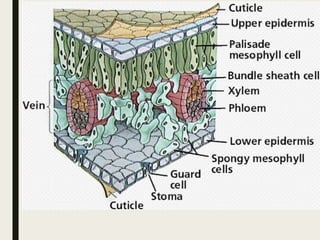
■ Green chlorophyll bearing parenchyma cells of leaves and green stems
are called Chlorenchyma.
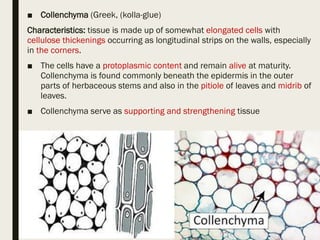
■ Collenchyma (Greek, (kolla-glue)
Characteristics: tissue is made up of somewhat elongated cells with
cellulose thickenings occurring as longitudinal strips on the walls, especially
in the corners.
■ The cells have a protoplasmic content and remain alive at maturity.
Collenchyma is found commonly beneath the epidermis in the outer
parts of herbaceous stems and also in the pitiole of leaves and midrib of
leaves.
■ Collenchyma serve as supporting and strengthening tissue
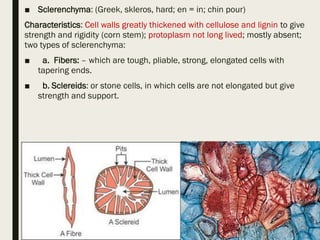
■ Sclerenchyma: (Greek, skleros, hard; en = in; chin pour)
Characteristics: Cell walls greatly thickened with cellulose and lignin to give
strength and rigidity (corn stem); protoplasm not long lived; mostly absent;
two types of sclerenchyma:
■ a. Fibers: – which are tough, pliable, strong, elongated cells with
tapering ends.
■ b. Sclereids: or stone cells, in which cells are not elongated but give
strength and support.
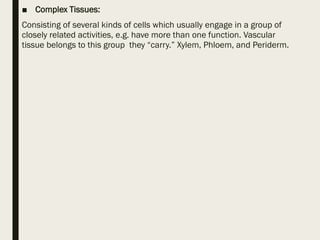
■ Complex Tissues:
Consisting of several kinds of cells which usually engage in a group of
closely related activities, e.g. have more than one function. Vascular
tissue belongs to this group they “carry.” Xylem, Phloem, and Periderm.
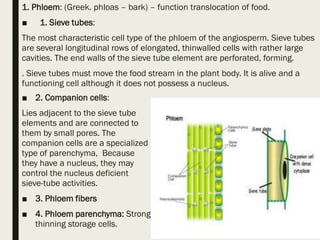
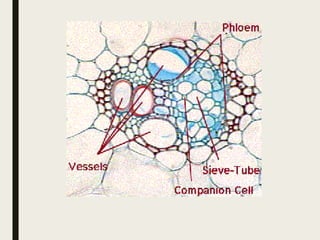
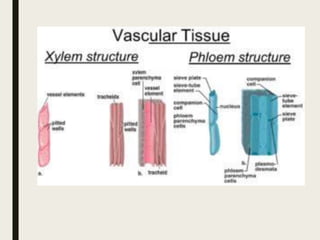
1. Phloem: (Greek. phloas – bark) – function translocation of food.
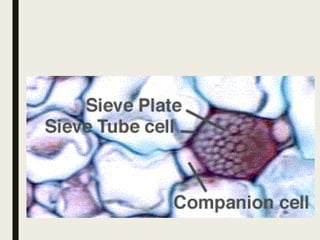
■ 1. Sieve tubes:
The most characteristic cell type of the phloem of the angiosperm. Sieve tubes
are several longitudinal rows of elongated, thinwalled cells with rather large
cavities. The end walls of the sieve tube element are perforated, forming.
. Sieve tubes must move the food stream in the plant body. It is alive and a
functioning cell although it does not possess a nucleus.
■ 2. Companion cells:
Lies adjacent to the sieve tube
elements and are connected to
them by small pores. The
companion cells are a specialized
type of parenchyma, Because
they have a nucleus, they may
control the nucleus deficient
sieve-tube activities.
■ 3. Phloem fibers
■ 4. Phloem parenchyma: Strong
thinning storage cells.
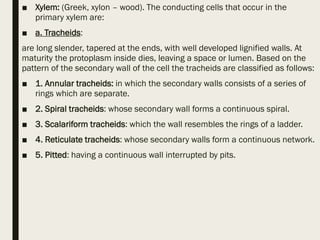
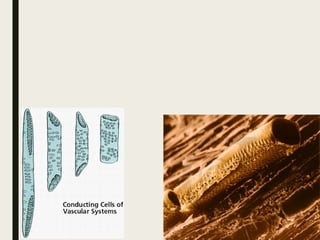
■ Xylem: (Greek, xylon – wood). The conducting cells that occur in the
primary xylem are:
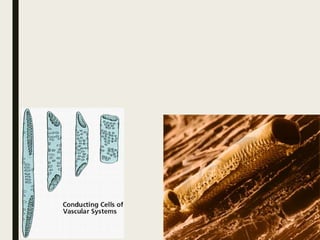
■ a. Tracheids:
are long slender, tapered at the ends, with well developed lignified walls. At
maturity the protoplasm inside dies, leaving a space or lumen. Based on the
pattern of the secondary wall of the cell the tracheids are classified as follows:
■ 1. Annular tracheids: in which the secondary walls consists of a series of
rings which are separate.
■ 2. Spiral tracheids: whose secondary wall forms a continuous spiral.
■ 3. Scalariform tracheids: which the wall resembles the rings of a ladder.
■ 4. Reticulate tracheids: whose secondary walls form a continuous network.
■ 5. Pitted: having a continuous wall interrupted by pits.
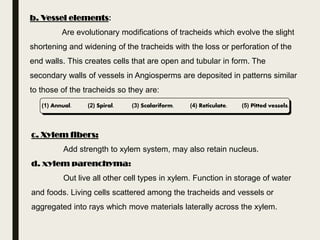
(1) Annual. (2) Spiral. (3) Scalariform. (4) Reticulate. (5) Pitted vessels.
b. Vessel elements:
Are evolutionary modifications of tracheids which evolve the slight
shortening and widening of the tracheids with the loss or perforation of the
end walls. This creates cells that are open and tubular in form. The
secondary walls of vessels in Angiosperms are deposited in patterns similar
to those of the tracheids so they are:
c. Xylem fibers:
Add strength to xylem system, may also retain nucleus.
d. xylem parenchyma:
Out live all other cell types in xylem. Function in storage of water
and foods. Living cells scattered among the tracheids and vessels or
aggregated into rays which move materials laterally across the xylem.
QUESTIONS?

Introduction 5

  • 1.
  • 2.
    Plants have onlythree tissue types: ■ 1) Dermal; ■ 2) Ground; and ■ 3) Vascular
  • 3.
    ■ Dermal tissuecovers the outer surface of herbaceous plants. Dermal tissue is composed of epidermal cells, closely packed cells that secrete a waxy cuticle that aids in the prevention of water loss. ■ Protect plants ■ Contains stomata for gas exchange ■ Called periderm in bark
  • 4.
    PLANT TISSUES Types ofplant Tissues Meristimatic Tissues Apical Meristem Lateral Meristem (Secondary Tissue) Permanent Tissues Cell Wall Chemical Impregnations Procambium Cork Cambium Protoderm Ground meristem Vascular Cambium Simple Complex Tissues Epidermis Ground tissues Parenchyma Collenchyma Sclerenchyma Vascular tissues Xylem Phloem Periderm Cutin Lignin Suberin Hemicellulose Chitin A B C
  • 5.
    ■ A. Meristematic(undifferentiated): Cells are small, thin walled and prepared for rapid multiply by the process of cell division, cells are closely arranged. Without intercellular spaces newly formed cells may become differentiated into mature permanent tissues, hence might be considered as temporary; meristimatic tissues located near types of roots (and in buds at tips of stems (apical meristems), between wood and bark of trees, or model joints) of such plants as grasses, and elsewhere wherever extensive growth occurs.
  • 6.
    ■ 1. ApicalMeristem: involved in Primary Plant Body, Primary growth – primary tissues are formed = the Primary plant body (growth in length). Forms partially differentiated tissues ■ 2. Lateral Meristem (Secondary Tissue): a. Vascular Cambium (produce xylem and phloem). b. Cork Cambium (Phellogen, Periderm, cork, cork parenchyma).
  • 7.
    ■ II. PermanentTissues: Permanent tissues usually do not change into other kind of tissues and in most cases retain their structure and functional characteristics throughout life.
  • 9.
    ■ Parenchyma (Greek,para – besides, en – in; chin - pour). Parenchyma tissue consists of thin walled cells that are approximately isodiametrc e.g. not much longer than they are wide. ■ The individual cells may be spherical, cubical, many sided, or irregular in shape. ■ They contain living protoplasm and retain their property of cell division even tough division may never occur after the cells are mature. The presence of living protoplasm also means the can function in the storage of water and food, or in photosynthesis, secretion, and even in wound healing. They are found abundantly in higher plants in roots, stems, leaves, fruits and flowers. ■ Green chlorophyll bearing parenchyma cells of leaves and green stems are called Chlorenchyma.
  • 11.
    ■ Collenchyma (Greek,(kolla-glue) Characteristics: tissue is made up of somewhat elongated cells with cellulose thickenings occurring as longitudinal strips on the walls, especially in the corners. ■ The cells have a protoplasmic content and remain alive at maturity. Collenchyma is found commonly beneath the epidermis in the outer parts of herbaceous stems and also in the pitiole of leaves and midrib of leaves. ■ Collenchyma serve as supporting and strengthening tissue
  • 12.
    ■ Sclerenchyma: (Greek,skleros, hard; en = in; chin pour) Characteristics: Cell walls greatly thickened with cellulose and lignin to give strength and rigidity (corn stem); protoplasm not long lived; mostly absent; two types of sclerenchyma: ■ a. Fibers: – which are tough, pliable, strong, elongated cells with tapering ends. ■ b. Sclereids: or stone cells, in which cells are not elongated but give strength and support.
  • 14.
    ■ Complex Tissues: Consistingof several kinds of cells which usually engage in a group of closely related activities, e.g. have more than one function. Vascular tissue belongs to this group they “carry.” Xylem, Phloem, and Periderm.
  • 15.
    1. Phloem: (Greek.phloas – bark) – function translocation of food. ■ 1. Sieve tubes: The most characteristic cell type of the phloem of the angiosperm. Sieve tubes are several longitudinal rows of elongated, thinwalled cells with rather large cavities. The end walls of the sieve tube element are perforated, forming. . Sieve tubes must move the food stream in the plant body. It is alive and a functioning cell although it does not possess a nucleus. ■ 2. Companion cells: Lies adjacent to the sieve tube elements and are connected to them by small pores. The companion cells are a specialized type of parenchyma, Because they have a nucleus, they may control the nucleus deficient sieve-tube activities. ■ 3. Phloem fibers ■ 4. Phloem parenchyma: Strong thinning storage cells.
  • 19.
    ■ Xylem: (Greek,xylon – wood). The conducting cells that occur in the primary xylem are: ■ a. Tracheids: are long slender, tapered at the ends, with well developed lignified walls. At maturity the protoplasm inside dies, leaving a space or lumen. Based on the pattern of the secondary wall of the cell the tracheids are classified as follows: ■ 1. Annular tracheids: in which the secondary walls consists of a series of rings which are separate. ■ 2. Spiral tracheids: whose secondary wall forms a continuous spiral. ■ 3. Scalariform tracheids: which the wall resembles the rings of a ladder. ■ 4. Reticulate tracheids: whose secondary walls form a continuous network. ■ 5. Pitted: having a continuous wall interrupted by pits.
  • 20.
    (1) Annual. (2)Spiral. (3) Scalariform. (4) Reticulate. (5) Pitted vessels. b. Vessel elements: Are evolutionary modifications of tracheids which evolve the slight shortening and widening of the tracheids with the loss or perforation of the end walls. This creates cells that are open and tubular in form. The secondary walls of vessels in Angiosperms are deposited in patterns similar to those of the tracheids so they are: c. Xylem fibers: Add strength to xylem system, may also retain nucleus. d. xylem parenchyma: Out live all other cell types in xylem. Function in storage of water and foods. Living cells scattered among the tracheids and vessels or aggregated into rays which move materials laterally across the xylem.
  • 23.