The document provides an overview of the root system in plants, explaining its structure, functions, and differences between monocots and dicots. It details the anatomy of dicot roots, including the epidermis, cortex, endodermis, pericycle, vascular bundles, and pith. Additionally, it highlights the variances in root structure and function between monocotyledons and dicotyledons.
DR. C. BEULAHJAYARANI
M.Sc., M.A, M.Ed, M.Phil (Edn), M.Phil (ZOO), NET, Ph.D (Edn)
ASST. PROFESSOR,
LOYOLA COLLEGE OF EDUCATION, CHENNAI - 34
2.
ROOT SYSTEM
Theroot system is the
descending (growing downwards)
portion of the plant axis.
It elongates to form primary or
the tap root.
It gives off lateral branches
(secondary and tertiary roots) and
thus forms the root system.
It branches through large and
deep areas in the soil and
anchors the plant very firmly.
7/18/2021 Dr. C. Beulah Jayarani 2
3.
Contd.,
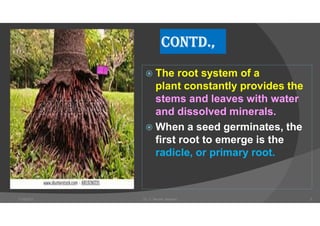
The rootsystem of a
plant constantly provides the
stems and leaves with water
and dissolved minerals.
When a seed germinates, the
first root to emerge is the
radicle, or primary root.
7/18/2021 Dr. C. Beulah Jayarani 3
4.
DICOTS
Dicotyledon –
Monocotyledon
differences
MONOCOTS
In seeds,two
cotyledons (part
of the embryo)
Usually four or
five floral parts (or
multiples of these)
Usually a
netlike array
of leaf veins
Basically, three
pores of furrows
in pollen grain
In seeds
only one
cotyledon
Usually three
floral parts (or
multiples of
three)
Usually a parallel
array of leaf veins
Basically, one pore
or furrow in pollen
grain
Vascular bundles
distributed
ground tissue of
stem
Vascular
bundles
arrayed as a
ring in stem
vascular
bundle
There are two classes of flowering plants, Monocotyledons and Dicotyledons
4
5.
FUnCtIonS oF RootSYStEM
Anchoring: Roots are the
reason plants remain attached
to the ground.
Support: They support the
plant body, ensuring that it
stands erect.
Absorption: Primary function
of the roots is to absorb water
and dissolved minerals from
the soil.
7/18/2021 Dr. C. Beulah Jayarani 5
6.
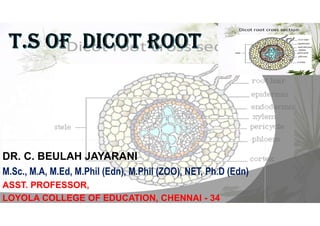
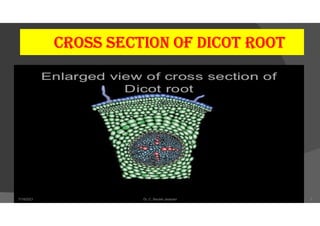
t.S oF dICotRoot
ANATOMY
OF DICOT
ROOT
Epidermis Cortex Endodermis Pericycle Vascular
bundles Pith
7/18/2021 Dr. C. Beulah Jayarani 6
EPIdERMIS
The wordepidermis come from the
Greek origin, epi-upon - derma-
skin “outer layer of the cell”
Role : to protect the cells from the
dangers of the outside world.
The epidermis consist of loosely
packed elongated cells with this
walls-cuticle
7/18/2021 Dr. C. Beulah Jayarani 8
9.
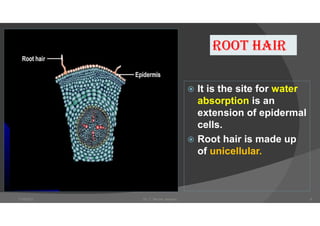
It isthe site for water
absorption is an
extension of epidermal
cells.
Root hair is made up
of unicellular.
Root haIR
7/18/2021 Dr. C. Beulah Jayarani 9
10.
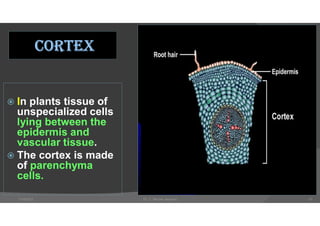
CoRtEX
In plantstissue of
unspecialized cells
lying between the
epidermis and
vascular tissue.
The cortex is made
of parenchyma
cells.
7/18/2021 Dr. C. Beulah Jayarani 10
11.
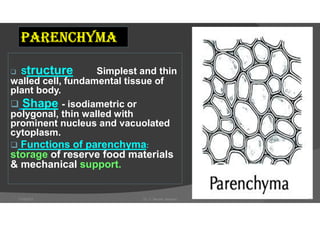
Structure Simplestand thin
walled cell, fundamental tissue of
plant body.
Shape - isodiametric or
polygonal, thin walled with
prominent nucleus and vacuolated
cytoplasm.
Functions of parenchyma:
storage of reserve food materials
& mechanical support.
PaREnChYMa
7/18/2021 Dr. C. Beulah Jayarani 11
12.
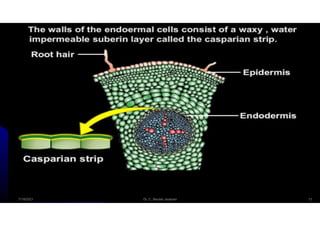
ENDODERMIS
The wordendodermis is Latin
origin , endo-within dermis –
skin
The endodermis is the
cylindrical boundary of vascular
tissue-single layer.
Functions : regulate the water
and other substance that get
into the plant.
7/18/2021 Dr. C. Beulah Jayarani 12
PERICYCLE
It isa thin layer of
plant tissue.
It is present between
the phloem and
endodermis.
7/18/2021 Dr. C. Beulah Jayarani 14
15.
VaSCULaR BUndLE
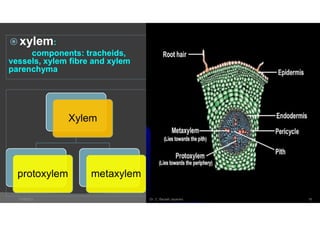
Itis a strand of conducting vessels in
the root of a plant, typically with phloem
on the outside and xylem on the inside.
They are also called as “fascicle”
Vascular bundle consists of two main
parts.
xylem: the water conducting
tissue.
phloem: the food conducting
tissue
7/18/2021 Dr. C. Beulah Jayarani 15
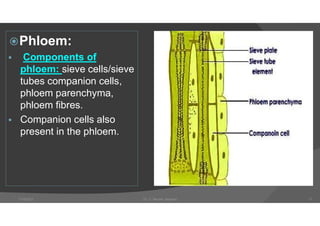
Phloem:
Components of
phloem:sieve cells/sieve
tubes companion cells,
phloem parenchyma,
phloem fibres.
Companion cells also
present in the phloem.
7/18/2021 Dr. C. Beulah Jayarani 17
18.
PIth
It issoft and spongy.
New pith growth appear
white but as it matures it
usually turns brown.
7/18/2021 Dr. C. Beulah Jayarani 18
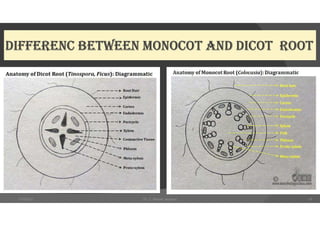
dIFFEREnC BEtWEEn MonoCotand dICot Root
Dicot root Monocot root
The cortex area is narrow.
Pericycle: Gives rise to cork
cambium, parts of the vascular
cambium, and lateral roots
Has a limited number of Xylem and
Phloem
Xylem is Angular or Polygonal
Pith is Absent or very small and
undeveloped
Cambium is Present and formed by
the Conjunctive parenchyma
The cortex region is wide.
Pericycle: Gives rise to lateral roots
only
Has a higher number of Xylem and
Phloem
Xylem isRound or Oval
Pith isLarger and well developed
Cambium is absent
7/18/2021 Dr. C. Beulah Jayarani 20
 Most read







 Most read
 Most read