DR. DILIP V. HANDE
ASSOCIATE PROFESSOR, DEPT OF BOTANY
SHRI SHIVAJI SCIENCE COLLEGE, AMRAVATI MS.
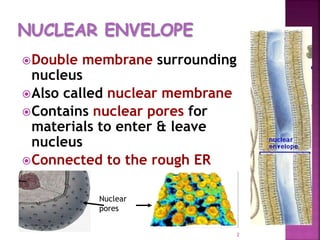
Double membrane surrounding
nucleus
Also called nuclear membrane
Contains nuclear pores for
materials to enter & leave
nucleus
Connected to the rough ER
2
Nuclear
pores
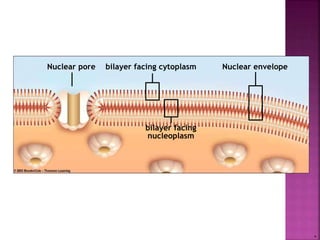
Nuclear pore bilayer facing cytoplasm Nuclear envelope
bilayer facing
nucleoplasm
.
 The protoplast of eukaryotic cell contains prominent
spherical or sub spherical body called the nucleus (PI.-
nuclei) which controls all the life activities.
 It was discovered by Brown in 1835. As a rule, there is
only one nucleus in one cell, but there are certain
exceptions to this general rule.
 There may be many nuclei in Syncytium which is formed
by fusion of many uninucleate cells. Multinucleate cells
(coenocytes) are commonly found in plants.
 Coenocytic condition results due to repeated nuclear
division without cytokinesis.
 Sieve cells (phloem) of angiosperms and mammalian
red blood cells lose their nuclei during the process
of maturation.
 The anucleated cells are incapable of growth and
division.
 The cells of bacteria and blue-green algae do not
possess organized nuclei.
 The nuclei in some cells may be seen in the centre
but in the majority of cells they may occur at any
place in the cytoplasm.
 The following are the principal components
of the interphase nucleus.
 (a) Nuclear envelope
 (b) Nuclear sap
 (c) Nuclear reticulum or chromatic
reticulum
 (d) Nucleolus
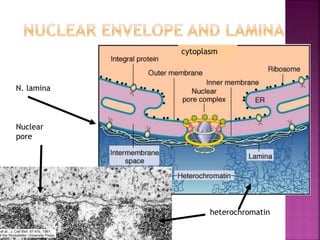
Nuclear
pore
N. lamina
cytoplasm
heterochromatin
 The nuclear membrane or karyotheca is the
outer boundary of the nucleus. It is found in
the nuclei of all the eukaryotic cells.
 Electron microscopy has revealed that it is
composed of two concentric unit membranes,
an outer membrane and an inner membrane of
lipoproteins.
 Each membrane is about 80-100 A thick.
 The outer and inner membranes is separated
by a clear space of 100 to 150 A.
 The space between the two unit membranes is
known as perinuclear space or perinuclear
cisterna.
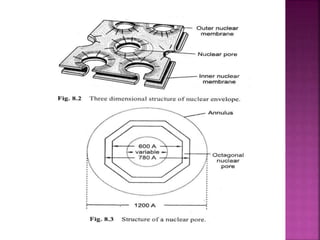
 Outer nuclear membrane is rough surfaced due to
attached ribosome.
 Sometimes it becomes out folded to give rise to
endoplasmic reticulum.
 The inner nuclear membrane is free from
ribosomes and sometimes it is associated with
chromatin.
 In many vertebrate cells there is a layer of densely
packed fibers just inside the inner nuclear
membrane forming a third concentric sheath of
uniform thickness (about 300 A).
 This is known as fibrous lamina. It is not known
whether these layers have any special function
other than mechanical support.
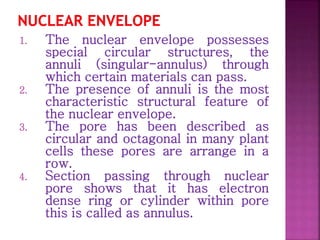
1. The nuclear envelope possesses
special circular structures, the
annuli (singular-annulus) through
which certain materials can pass.
2. The presence of annuli is the most
characteristic structural feature of
the nuclear envelope.
3. The pore has been described as
circular and octagonal in many plant
cells these pores are arrange in a
row.
4. Section passing through nuclear
pore shows that it has electron
dense ring or cylinder within pore
this is called as annulus.
1. The nuclear membrane can easily be
observed in the metabolic nucleus.
2. It disappears at certain stage of nuclear
division and reappears on the completion
of the division process.
3. There is no well defined nuclear
envelope in the prokaryotic cells.
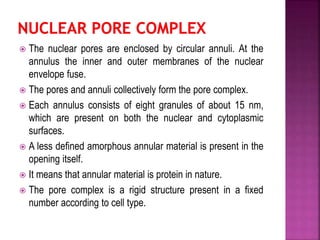
 In small nucleus like yeast there are about
200 pores per nucleus, while in higher
plants like onion there are about 3000
pores per nucleus.
 In lower plants like fungi during the division
of nucleus, nuclear envelopes remains
intact and it divides at the time of
Cytokinesis.
 In higher plants nuclear envelope starts
dividing at the end of prophase and fully
divided in the telophase.
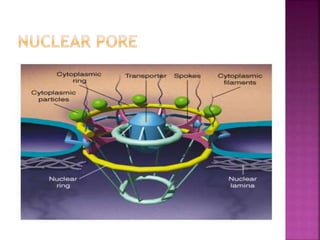
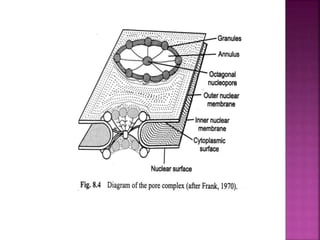
 The nuclear pores are enclosed by circular annuli. At the
annulus the inner and outer membranes of the nuclear
envelope fuse.
 The pores and annuli collectively form the pore complex.
 Each annulus consists of eight granules of about 15 nm,
which are present on both the nuclear and cytoplasmic
surfaces.
 A less defined amorphous annular material is present in the
opening itself.
 It means that annular material is protein in nature.
 The pore complex is a rigid structure present in a fixed
number according to cell type.
.
 In some cases, the pore complex is covered
by a thin membrane.
 It has been suggested that the annulus may
serve, alternately decreasing and increasing
the size of the pore with varying conditions.
 The lumen of the cylinder is 500 A0 in
diameter representing the nuclear pore.
 The wall of the cylinder consists of eight
evenly placed microtubules or
microcylinders.
 Each microtubule is about 200 A0 in
diameters.
 The materials exchanged between nucleus and
cytoplasm must traverse the nuclear pore complexes.
 Thus, annuli or pores control the passage of some
molecules and particles, even some ribosome
components, between nucleus and cytoplasm.
 On the other hand, very large structure such as
ribosomal subunits, which are assembled in the
nucleolus are able to leave the nucleus through the
nuclear pore complexes.
 The unit membranes of karyotheca are composed of
protein and lipid, like plasma membrane.
 The nuclear membrane separates the nucleus
and cytoplasm. It provide protection to DNA
against cytoplasm enzymes.
 The transport of substances from nucleus to
cytoplasm and vice versa takes place through
the pore of envelope.
 The presence of many electron transport
enzymes has been reported within the
nuclear envelope of liver cells. It helps in
oxidative photo phosphorylation and electron
transport.
 The undifferentiated protoplasm or ground
substance present inside the nuclear envelope is
called nuclear sap or nucleoplasm or karyolymph.
 The nucleoplasm seems to contain granules of
various sizes and densities and is yet of unknown
composition and function.
 During nuclear division, the nucleoplasm is of
course continuous with cytoplasmic matrix.
 The other nuclear components such as the
chromatic reticulum and nucleolus remain
suspended in the nucleoplasm.
 Nucleoplasm contains nucleoproteins and many
other inorganic and organic substances, such as,
nucleic acids, proteins, enzymes, lipids and
minerals.
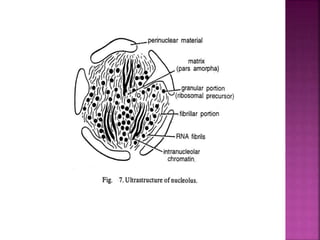
 It is an intra nuclear organelle of eukaryotes. The
term nucleolus was coined by Bowman (1840).
 It occurs as a spherical; acidophilous structure
suspended in the nucleoplasm either in central or
eccentric position.
 The nucleolus is found in close association of a
specific chromosome at a fixed point called
nucleolus-organizing region.
 The number of nucleoli present in each nucleus is
fixed for the cells of a particular species of plant
or animal and it depends upon the number of
chromosomes or set of chromosomes.
 In many plants and animals, there is only
one nucleolus for each haploid set of
chromosomes.
 In Vicia faba, for example, each diploid
nucleus contains two nucleoli.
 The nuclei of polyploids may have more
nucleoli than those of diploids.
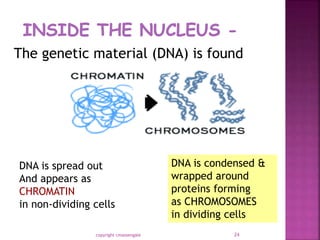
copyright cmassengale 24
The genetic material (DNA) is found
DNA is spread out
And appears as
CHROMATIN
in non-dividing cells
DNA is condensed &
wrapped around
proteins forming
as CHROMOSOMES
in dividing cells
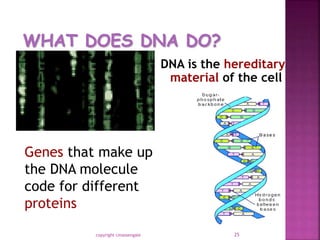
DNA is the hereditary
material of the cell
copyright cmassengale 25
Genes that make up
the DNA molecule
code for different
proteins
 RNA production. The nucleolus is
one of the most active sites of RNA
synthesis.
 The main function of the cell
nucleus is to control gene expression
and mediate the replication of DNA
during the cell cycle.
 They help the chromosomes of the cell
(mainly diploid, but sometimes haploid or
even triploid), which carry the genetic
material of the cell.
 In the case of plant cells they are
totipotent, meaning that under the control
of the nucleus a single cell has the ability to
regenerate all of the organs and tissues of
the plant from a single cell.
 The nucleus is responsible for controlling/
regulating the metabolic functions of the
cell.
Nucleus

Nucleus

  • 1.
    DR. DILIP V.HANDE ASSOCIATE PROFESSOR, DEPT OF BOTANY SHRI SHIVAJI SCIENCE COLLEGE, AMRAVATI MS.
  • 2.
    Double membrane surrounding nucleus Alsocalled nuclear membrane Contains nuclear pores for materials to enter & leave nucleus Connected to the rough ER 2 Nuclear pores
  • 3.
    Nuclear pore bilayerfacing cytoplasm Nuclear envelope bilayer facing nucleoplasm .
  • 4.
     The protoplastof eukaryotic cell contains prominent spherical or sub spherical body called the nucleus (PI.- nuclei) which controls all the life activities.  It was discovered by Brown in 1835. As a rule, there is only one nucleus in one cell, but there are certain exceptions to this general rule.  There may be many nuclei in Syncytium which is formed by fusion of many uninucleate cells. Multinucleate cells (coenocytes) are commonly found in plants.  Coenocytic condition results due to repeated nuclear division without cytokinesis.
  • 5.
     Sieve cells(phloem) of angiosperms and mammalian red blood cells lose their nuclei during the process of maturation.  The anucleated cells are incapable of growth and division.  The cells of bacteria and blue-green algae do not possess organized nuclei.  The nuclei in some cells may be seen in the centre but in the majority of cells they may occur at any place in the cytoplasm.
  • 6.
     The followingare the principal components of the interphase nucleus.  (a) Nuclear envelope  (b) Nuclear sap  (c) Nuclear reticulum or chromatic reticulum  (d) Nucleolus
  • 7.
  • 8.
     The nuclearmembrane or karyotheca is the outer boundary of the nucleus. It is found in the nuclei of all the eukaryotic cells.  Electron microscopy has revealed that it is composed of two concentric unit membranes, an outer membrane and an inner membrane of lipoproteins.  Each membrane is about 80-100 A thick.  The outer and inner membranes is separated by a clear space of 100 to 150 A.  The space between the two unit membranes is known as perinuclear space or perinuclear cisterna.
  • 9.
     Outer nuclearmembrane is rough surfaced due to attached ribosome.  Sometimes it becomes out folded to give rise to endoplasmic reticulum.  The inner nuclear membrane is free from ribosomes and sometimes it is associated with chromatin.  In many vertebrate cells there is a layer of densely packed fibers just inside the inner nuclear membrane forming a third concentric sheath of uniform thickness (about 300 A).  This is known as fibrous lamina. It is not known whether these layers have any special function other than mechanical support.
  • 11.
    1. The nuclearenvelope possesses special circular structures, the annuli (singular-annulus) through which certain materials can pass. 2. The presence of annuli is the most characteristic structural feature of the nuclear envelope. 3. The pore has been described as circular and octagonal in many plant cells these pores are arrange in a row. 4. Section passing through nuclear pore shows that it has electron dense ring or cylinder within pore this is called as annulus.
  • 12.
    1. The nuclearmembrane can easily be observed in the metabolic nucleus. 2. It disappears at certain stage of nuclear division and reappears on the completion of the division process. 3. There is no well defined nuclear envelope in the prokaryotic cells.
  • 13.
     In smallnucleus like yeast there are about 200 pores per nucleus, while in higher plants like onion there are about 3000 pores per nucleus.  In lower plants like fungi during the division of nucleus, nuclear envelopes remains intact and it divides at the time of Cytokinesis.  In higher plants nuclear envelope starts dividing at the end of prophase and fully divided in the telophase.
  • 14.
     The nuclearpores are enclosed by circular annuli. At the annulus the inner and outer membranes of the nuclear envelope fuse.  The pores and annuli collectively form the pore complex.  Each annulus consists of eight granules of about 15 nm, which are present on both the nuclear and cytoplasmic surfaces.  A less defined amorphous annular material is present in the opening itself.  It means that annular material is protein in nature.  The pore complex is a rigid structure present in a fixed number according to cell type.
  • 15.
  • 17.
     In somecases, the pore complex is covered by a thin membrane.  It has been suggested that the annulus may serve, alternately decreasing and increasing the size of the pore with varying conditions.  The lumen of the cylinder is 500 A0 in diameter representing the nuclear pore.  The wall of the cylinder consists of eight evenly placed microtubules or microcylinders.  Each microtubule is about 200 A0 in diameters.
  • 18.
     The materialsexchanged between nucleus and cytoplasm must traverse the nuclear pore complexes.  Thus, annuli or pores control the passage of some molecules and particles, even some ribosome components, between nucleus and cytoplasm.  On the other hand, very large structure such as ribosomal subunits, which are assembled in the nucleolus are able to leave the nucleus through the nuclear pore complexes.  The unit membranes of karyotheca are composed of protein and lipid, like plasma membrane.
  • 19.
     The nuclearmembrane separates the nucleus and cytoplasm. It provide protection to DNA against cytoplasm enzymes.  The transport of substances from nucleus to cytoplasm and vice versa takes place through the pore of envelope.  The presence of many electron transport enzymes has been reported within the nuclear envelope of liver cells. It helps in oxidative photo phosphorylation and electron transport.
  • 20.
     The undifferentiatedprotoplasm or ground substance present inside the nuclear envelope is called nuclear sap or nucleoplasm or karyolymph.  The nucleoplasm seems to contain granules of various sizes and densities and is yet of unknown composition and function.  During nuclear division, the nucleoplasm is of course continuous with cytoplasmic matrix.  The other nuclear components such as the chromatic reticulum and nucleolus remain suspended in the nucleoplasm.  Nucleoplasm contains nucleoproteins and many other inorganic and organic substances, such as, nucleic acids, proteins, enzymes, lipids and minerals.
  • 21.
     It isan intra nuclear organelle of eukaryotes. The term nucleolus was coined by Bowman (1840).  It occurs as a spherical; acidophilous structure suspended in the nucleoplasm either in central or eccentric position.  The nucleolus is found in close association of a specific chromosome at a fixed point called nucleolus-organizing region.  The number of nucleoli present in each nucleus is fixed for the cells of a particular species of plant or animal and it depends upon the number of chromosomes or set of chromosomes.
  • 23.
     In manyplants and animals, there is only one nucleolus for each haploid set of chromosomes.  In Vicia faba, for example, each diploid nucleus contains two nucleoli.  The nuclei of polyploids may have more nucleoli than those of diploids.
  • 24.
    copyright cmassengale 24 Thegenetic material (DNA) is found DNA is spread out And appears as CHROMATIN in non-dividing cells DNA is condensed & wrapped around proteins forming as CHROMOSOMES in dividing cells
  • 25.
    DNA is thehereditary material of the cell copyright cmassengale 25 Genes that make up the DNA molecule code for different proteins
  • 26.
     RNA production.The nucleolus is one of the most active sites of RNA synthesis.  The main function of the cell nucleus is to control gene expression and mediate the replication of DNA during the cell cycle.
  • 27.
     They helpthe chromosomes of the cell (mainly diploid, but sometimes haploid or even triploid), which carry the genetic material of the cell.  In the case of plant cells they are totipotent, meaning that under the control of the nucleus a single cell has the ability to regenerate all of the organs and tissues of the plant from a single cell.  The nucleus is responsible for controlling/ regulating the metabolic functions of the cell.