DR. DILIP V. HANDE
PROFESSOR
DEPT OF BOTANY
SHRI SHIVAJI SCIENCE COLLEGE AMRAVATI
SEM- III
2020-2021
Normal secondary
growth in Dicot stem
 B. Sc. II
Normal secondary
growth in Dicot
stem
Stem anatomy
Secondary growth
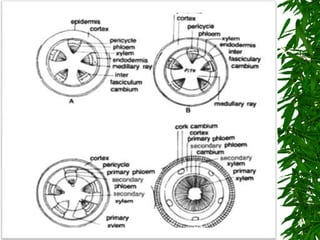
In the process of secondary growth
the first step is the formation of
cambium ring.
In the vascular bundle of a dicot
stem the xylem and phloem are
separated by cambium called
intrafascicular cambium.
It becomes active and meristematic.
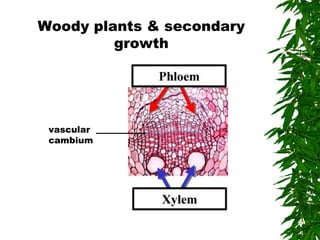
vascular
cambium
Woody plants & secondary
growth
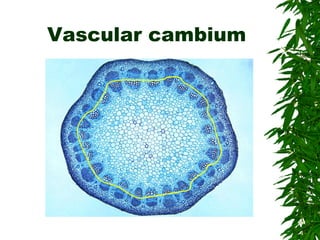
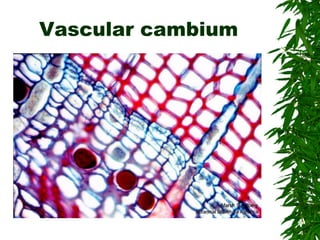
Vascular cambium
During secondary growth, the
parenchymatous cells in
between the vascular bundles
become meristematic and form
the strips of interfascicular
cambium.
These two cambium join from
sides to forms a continuous
ring of vascular cambium.
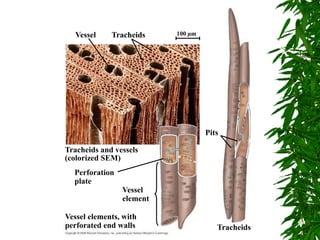
Perforation
plate
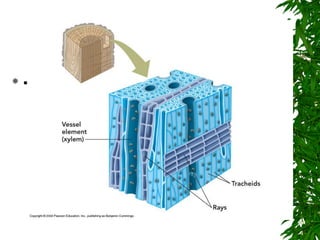
Vessel
element
Vessel elements, with
perforated end walls Tracheids
Pits
Tracheids and vessels
(colorized SEM)
Vessel Tracheids 100 µm
Sieve-tube element (left)
and companion cell:
cross section (TEM)
3 µm
Sieve-tube elements:
longitudinal view (LM)
Sieve plate
Companion
cells
Sieve-tube
elements
Plasmodesma
Sieve
plate
Nucleus of
companion
cells
Sieve-tube elements:
longitudinal view Sieve plate with pores (SEM)
10 µm
30 µm
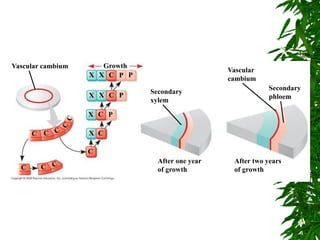
Vascular cambium Growth
Secondary
xylem
After one year
of growth
After two years
of growth
Secondary
phloem
Vascular
cambium
X X
X X
X
X
P P
P
P
C
C
C
C
C
C
C
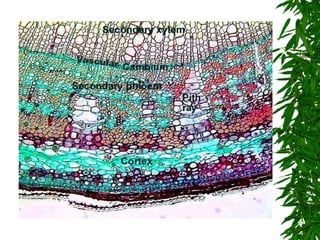
Secondary vascular tissue:
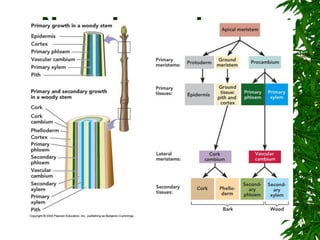
 Secondary vascular tissues are
formed by the activity of
cambium.
 Cambium ring undergoes
tangential division to form new
cells outside and inside.
Vascular cambium
.
 The cells formed towards outer
side facing primary phloem
gradually modified into elements of
secondary phloem.
 while those towards inner side,
facing primary xylem modified into
elements of secondary xylem.
 At certain points the cambium
forms parenchyma, which
separates secondary xylem and
secondary phloem to form
secondary medullary rays.
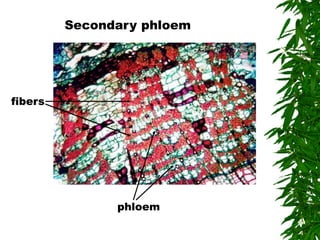
Secondary phloem:
It consists of sieve tubes, sieve
plate, companion cells, phloem
parenchyma, and phloem
fibres.
The phloem elements are
arranged in two systems, the
vertical system and horizontal.
Vertical system helps in
conduction of food materials.
springwood
Autumn wood
.
 Horizontal system consists of
ray parenchyma. Fibers provide
mechanical strength to the
plants.
Secondary xylem:
Xylem elements formed by the
activity of cambium are collectively
called secondary xylem.
It consists of tracheids, vessels,
fibres, xylem parenchyma.
The secondary xylem has two system
of tissue i.e. vertical system and
radial system, which is absent in
primary xylem.
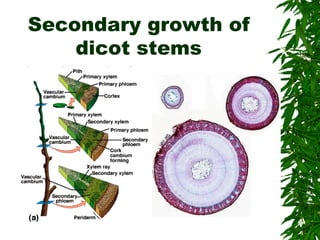
Secondary growth of
dicot stems
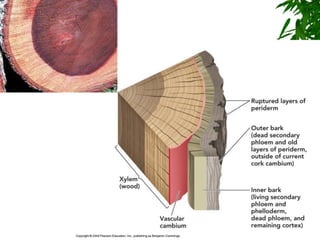
Secondary xylem
 tracheids, vessels, fibres, and
wood parenchyma. The radial
systems consist of rows of
parenchymatous cells oriented
right angle to the longitudinal
axis of plant.
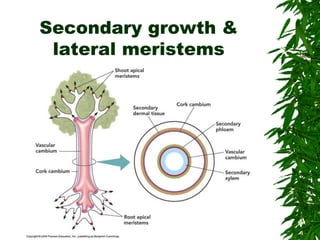
Secondary growth &
lateral meristems
Vascular cambium
 .
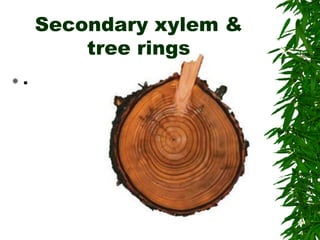
Secondary xylem &
tree rings
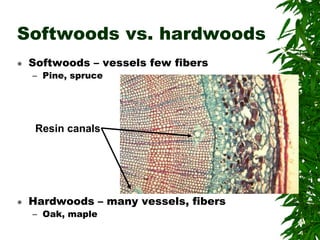
Softwoods vs. hardwoods
 Softwoods – vessels few fibers
– Pine, spruce
 Hardwoods – many vessels, fibers
– Oak, maple
Resin canals
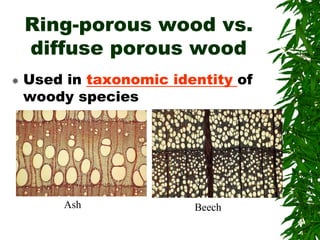
Ring-porous wood vs.
diffuse porous wood
 Used in taxonomic identity of
woody species
Ash Beech
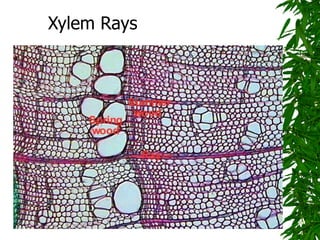
Xylem Rays
.
 .
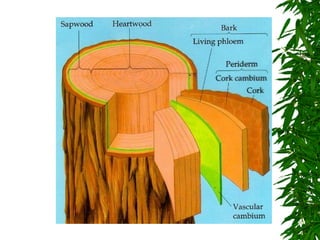
Woody stem, l.s.
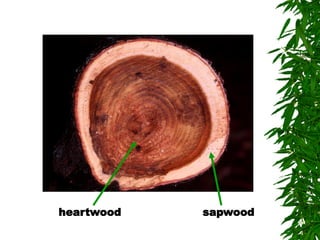
heartwood sapwood
.
Secondary phloem
phloem
fibers
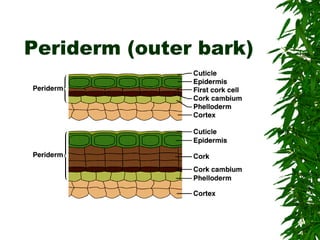
Outer bark (periderm)
Periderm (outer bark)
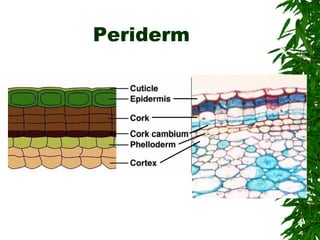
Periderm
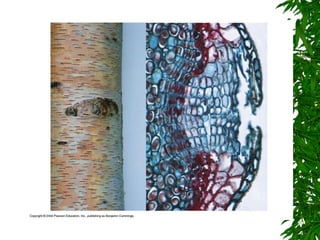
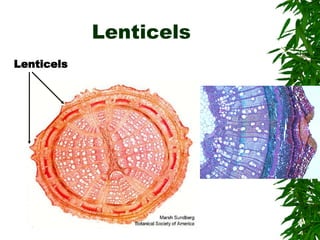
Lenticels
Lenticels

Stem secondary growth