DR. DILIP V. HANDE
ASSOCIATE PROFESSOR, DEPT OF BOTANY
SHRI SHIVAJI SCIENCE COLLEGE, AMRAVATI MS.
MITOCHONDRIA
STRUCTURE AND FUNCTIONS
Introduction :
 Like other cell organelles which found in eukaryotic
cells the mitochondria are most important cell
organelles.
 These are lacking in bacterial cells.
 Mitochondria(mito=thread chondrion=granule) are
thread like or granular structures are also called as
“power house” of cells one associated with aerobic
respiration.
 These are the sites of cellular respiration, primarily
concerned with the oxidation of organic acids and
transformation of their potential energy into
chemical energy stored in high energy ATP
(adenosine triphosphate) molecules.
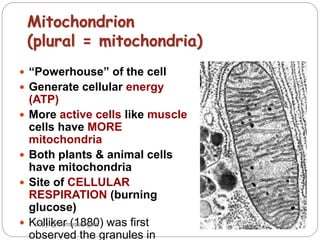
Mitochondrion
(plural = mitochondria)
 “Powerhouse” of the cell
 Generate cellular energy
(ATP)
 More active cells like muscle
cells have MORE
mitochondria
 Both plants & animal cells
have mitochondria
 Site of CELLULAR
RESPIRATION (burning
glucose)
 Kolliker (1880) was first
observed the granules in
copyright cmassengale3
Shape ,Size & Number :
 The shape, size & number of
mitochondria are variable in cells.
 Usually these are filamentous or
granular.
 They can change their shape like
club, tennis racket or vesicular.
 Size is averagely 0.5 µ to 1.0 µ in
diameter and about 2-8 µ in length.
 The number per cell is about 300 to
800.
Structure
F1 particles
Structure
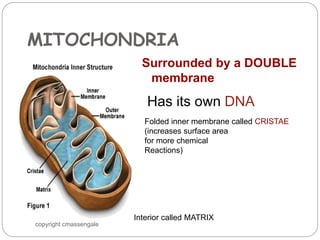
MITOCHONDRIA
Surrounded by a DOUBLE
membrane
copyright cmassengale8
Folded inner membrane called CRISTAE
(increases surface area
for more chemical
Reactions)
Has its own DNA
Interior called MATRIX
Interesting Fact ---
copyright cmassengale9
 Mitochondria
Come from
cytoplasm in the
EGG cell during
fertilization
Therefore …
 You inherit your
mitochondria
from your mother!
Structure :
 A mitochondrion consist of mainly two
parts-
 Limiting membrane
 Inner mass or matrix
 Each mitochondrion is enclosed by two
membranes, made up of lipo-protein.
 Outer membrane :-
 The outer membrane is 6 nm thick, it is
smooth and permeable in nature.
Cell Powerhouse
copyright cmassengale11
Rod shape
Mitochondrion
( mitochondria )
STRUCTU
RE
 Inner membrane :
 It is 50 to 70 A0 thick and show many infoldings (plate-
like) into the cavity of mitochondrion these are called
mitochondrial crests or cristae.
 They penetrate the matrix of mitochondrion.
 The cristae may be branched, complete or incomplete,
straight or zigzag.
 The cristae is usually run as right angles to the axis of
mitochondrion.
 The space between two membrane is called peri
mitochondrial space (60-80 A0 thick).
 The inner membrane of mitochondria is the site of
electron transport system.
 The enzymes involved in fatty acid synthesis and ATP-
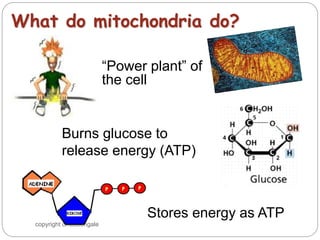
What do mitochondria do?
copyright cmassengale13
Burns glucose to
release energy (ATP)
Stores energy as ATP
“Power plant” of
the cell
Mitochondria: Organelles which are the sites of
cellular respiration, a catabolic oxygen-
requiring process that uses energy extracted
from organic macromolecules to produce ATP.
 Found in nearly all eukaryotic cells.
 Number of mitochondria per cell varies and
directly correlates with the cell’s metabolic
activity.
 Are about 1µm in diameter and 1-10 µm in
length.
 Are dynamic structure that move, change
their shapes and divide.Copyright © 2002 Pearson Education, Inc., publishing as Benjamin Cummings
Mitochondria
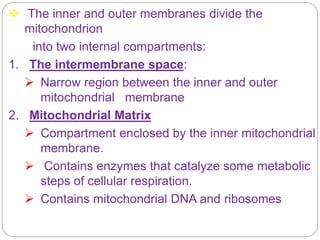
 The inner and outer membranes divide the
mitochondrion
into two internal compartments:
1. The intermembrane space:
 Narrow region between the inner and outer
mitochondrial membrane
2. Mitochondrial Matrix
 Compartment enclosed by the inner mitochondrial
membrane.
 Contains enzymes that catalyze some metabolic
steps of cellular respiration.
 Contains mitochondrial DNA and ribosomes
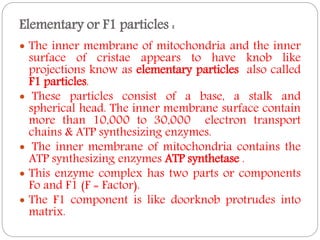
Elementary or F1 particles :
 The inner membrane of mitochondria and the inner
surface of cristae appears to have knob like
projections know as elementary particles also called
F1 particles.
 These particles consist of a base, a stalk and
spherical head. The inner membrane surface contain
more than 10,000 to 30,000 electron transport
chains & ATP synthesizing enzymes.
 The inner membrane of mitochondria contains the
ATP synthesizing enzymes ATP synthetase .
 This enzyme complex has two parts or components
Fo and F1 (F = Factor).
 The F1 component is like doorknob protrudes into
matrix.
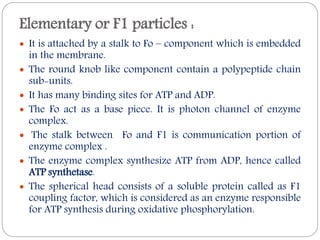
Elementary or F1 particles :
 It is attached by a stalk to Fo – component which is embedded
in the membrane.
 The round knob like component contain a polypeptide chain
sub-units.
 It has many binding sites for ATP and ADP.
 The Fo act as a base piece. It is photon channel of enzyme
complex.
 The stalk between Fo and F1 is communication portion of
enzyme complex .
 The enzyme complex synthesize ATP from ADP, hence called
ATP synthetase.
 The spherical head consists of a soluble protein called as F1
coupling factor, which is considered as an enzyme responsible
for ATP synthesis during oxidative phosphorylation.
Matrix:
 It is present in the mitochondrial cavity.
 It is dense homogenous gel- like substance
containing lipids, proteins, and certain granules.
 It contains most of the enzymes of citric acid cycle,
fatty acid oxidation & pyruvate dehydrogenase
system.
 It also contains coenzymes like ATP ADP, NAD,
NADP and several ions like mg++,K, and Ca++.
Functions:
 Mitochondria catalyze the reactions of
Krebs cycle and perform oxidative
phosphorylation to release high grade
energy in the form of ATP, NADH2, FADH2.
 The energy of ATP is utilized by metabolic
activities.
 It play an important role in the oxidation of
long chain fatty acids to carbon dioxide
H2O.
 They are “power house of cell” as about
90% of total energy (ATP)is formed in
Mitochondria

Mitochondria

  • 1.
    DR. DILIP V.HANDE ASSOCIATE PROFESSOR, DEPT OF BOTANY SHRI SHIVAJI SCIENCE COLLEGE, AMRAVATI MS. MITOCHONDRIA STRUCTURE AND FUNCTIONS
  • 2.
    Introduction :  Likeother cell organelles which found in eukaryotic cells the mitochondria are most important cell organelles.  These are lacking in bacterial cells.  Mitochondria(mito=thread chondrion=granule) are thread like or granular structures are also called as “power house” of cells one associated with aerobic respiration.  These are the sites of cellular respiration, primarily concerned with the oxidation of organic acids and transformation of their potential energy into chemical energy stored in high energy ATP (adenosine triphosphate) molecules.
  • 3.
    Mitochondrion (plural = mitochondria) “Powerhouse” of the cell  Generate cellular energy (ATP)  More active cells like muscle cells have MORE mitochondria  Both plants & animal cells have mitochondria  Site of CELLULAR RESPIRATION (burning glucose)  Kolliker (1880) was first observed the granules in copyright cmassengale3
  • 4.
    Shape ,Size &Number :  The shape, size & number of mitochondria are variable in cells.  Usually these are filamentous or granular.  They can change their shape like club, tennis racket or vesicular.  Size is averagely 0.5 µ to 1.0 µ in diameter and about 2-8 µ in length.  The number per cell is about 300 to 800.
  • 5.
  • 6.
  • 7.
  • 8.
    MITOCHONDRIA Surrounded by aDOUBLE membrane copyright cmassengale8 Folded inner membrane called CRISTAE (increases surface area for more chemical Reactions) Has its own DNA Interior called MATRIX
  • 9.
    Interesting Fact --- copyrightcmassengale9  Mitochondria Come from cytoplasm in the EGG cell during fertilization Therefore …  You inherit your mitochondria from your mother!
  • 10.
    Structure :  Amitochondrion consist of mainly two parts-  Limiting membrane  Inner mass or matrix  Each mitochondrion is enclosed by two membranes, made up of lipo-protein.  Outer membrane :-  The outer membrane is 6 nm thick, it is smooth and permeable in nature.
  • 11.
    Cell Powerhouse copyright cmassengale11 Rodshape Mitochondrion ( mitochondria )
  • 12.
    STRUCTU RE  Inner membrane:  It is 50 to 70 A0 thick and show many infoldings (plate- like) into the cavity of mitochondrion these are called mitochondrial crests or cristae.  They penetrate the matrix of mitochondrion.  The cristae may be branched, complete or incomplete, straight or zigzag.  The cristae is usually run as right angles to the axis of mitochondrion.  The space between two membrane is called peri mitochondrial space (60-80 A0 thick).  The inner membrane of mitochondria is the site of electron transport system.  The enzymes involved in fatty acid synthesis and ATP-
  • 13.
    What do mitochondriado? copyright cmassengale13 Burns glucose to release energy (ATP) Stores energy as ATP “Power plant” of the cell
  • 14.
    Mitochondria: Organelles whichare the sites of cellular respiration, a catabolic oxygen- requiring process that uses energy extracted from organic macromolecules to produce ATP.  Found in nearly all eukaryotic cells.  Number of mitochondria per cell varies and directly correlates with the cell’s metabolic activity.  Are about 1µm in diameter and 1-10 µm in length.  Are dynamic structure that move, change their shapes and divide.Copyright © 2002 Pearson Education, Inc., publishing as Benjamin Cummings Mitochondria
  • 15.
     The innerand outer membranes divide the mitochondrion into two internal compartments: 1. The intermembrane space:  Narrow region between the inner and outer mitochondrial membrane 2. Mitochondrial Matrix  Compartment enclosed by the inner mitochondrial membrane.  Contains enzymes that catalyze some metabolic steps of cellular respiration.  Contains mitochondrial DNA and ribosomes
  • 16.
    Elementary or F1particles :  The inner membrane of mitochondria and the inner surface of cristae appears to have knob like projections know as elementary particles also called F1 particles.  These particles consist of a base, a stalk and spherical head. The inner membrane surface contain more than 10,000 to 30,000 electron transport chains & ATP synthesizing enzymes.  The inner membrane of mitochondria contains the ATP synthesizing enzymes ATP synthetase .  This enzyme complex has two parts or components Fo and F1 (F = Factor).  The F1 component is like doorknob protrudes into matrix.
  • 17.
    Elementary or F1particles :  It is attached by a stalk to Fo – component which is embedded in the membrane.  The round knob like component contain a polypeptide chain sub-units.  It has many binding sites for ATP and ADP.  The Fo act as a base piece. It is photon channel of enzyme complex.  The stalk between Fo and F1 is communication portion of enzyme complex .  The enzyme complex synthesize ATP from ADP, hence called ATP synthetase.  The spherical head consists of a soluble protein called as F1 coupling factor, which is considered as an enzyme responsible for ATP synthesis during oxidative phosphorylation.
  • 18.
    Matrix:  It ispresent in the mitochondrial cavity.  It is dense homogenous gel- like substance containing lipids, proteins, and certain granules.  It contains most of the enzymes of citric acid cycle, fatty acid oxidation & pyruvate dehydrogenase system.  It also contains coenzymes like ATP ADP, NAD, NADP and several ions like mg++,K, and Ca++.
  • 19.
    Functions:  Mitochondria catalyzethe reactions of Krebs cycle and perform oxidative phosphorylation to release high grade energy in the form of ATP, NADH2, FADH2.  The energy of ATP is utilized by metabolic activities.  It play an important role in the oxidation of long chain fatty acids to carbon dioxide H2O.  They are “power house of cell” as about 90% of total energy (ATP)is formed in