PLANTS
TISSUE
A report made by Felmar
Agunos
What is plant tissue?
 A cellular organization between a single cell
and a complete organism is controlled by the
tissue. They are the collection of similar cells,
with specific function. A collection of tissue
gives rise to an organ. A tissue is a simple,
which may be single celled type or a complex
cell type.
A plant tissue can be defined as a cell
or a group of cells dividing, to give rise
to large number of cell, which is
collectively referred as tissues. They
are structurally and functionally similar
to these cells.
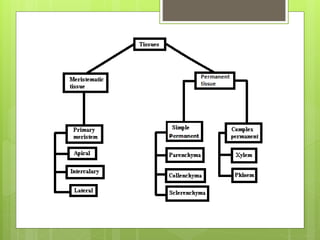
The two types of plant
tissue:
Meristematic
Permanent
Meristematic Tissues
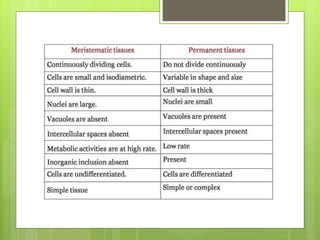
 Meristematic tissues are cells or group of cells
that have the ability to divide. These tissues in
a plant consist of small, densely packed cells
that can keep dividing to form new cells.
Meristems give rise to permanent tissues.
Characteristics of Meristematic
tissues :
 the cells are small,
 the cells walls are thin,
 cells have large nuclei,
 vacuoles are absent or very small, and
 there are no intercellular spaces.
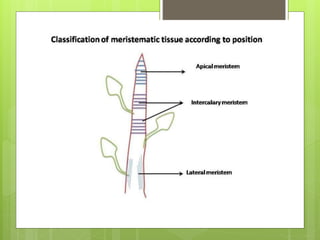
Types of Meristematic tissues:
Terminal or Apical meristems
Intercalary meristems
Lateral meristems
Terminal or Apical Meristem
Located at the tips of roots and stems.
Responsible for establishing patterns
and producing new, genetically healthy
cells.
Intercalary Meristem
 Portions of apical meristem separated from
the apex during development.
 Lies below the node and at the base of stem
of grasses.
 Disappear when transformed into Permanent
tissue.
Lateral Meristem
Composed of initial cells that
divided chiefly in one place.
Increase the diameter of the
organ.
Permanent Tissues
 These tissues are derived from meristematic
tissues. They have lost the power of dividing,
having attained their definite form and size. In
their earlier stages the cells are more or less
similar in structure but slowly they become
specialized and form permanent tissues. They
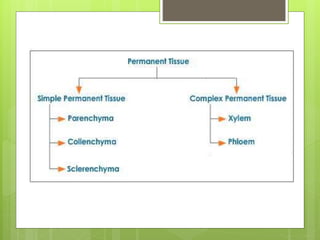
can be classified into simple and complex.
The 3 types of simple
permanent tissues:
Surface or Protective / Dermis
Fundamental or Supportive /
Epidermis or Periderm
Vascular / Conductive
Surface or Protective / Dermis
Covers the body of the plant.
Responsible for absorption of
water and minerals, secretion of
cuticle, protection against
Herbivores, controls gas
exchange.
Have few intercellular spaces.
Composition of Protective or
Dermis :
1. Cuticle
 Composed of fatty materials, water proof cutin.
 Covered by Epicuticular wax
 Outer covering of leaves, particularly the upper
surface.
 Protects the plant for Dessication and microbes.
2. Epidermal cells
 In leaves and young green stems, the only
intercellular spaces are the stomata surrounded
by guard cells.
3. Trichomes

 Unicellular or Multicellular outgrowths from the
epidermal
 Responsible for nutrition and absorption and
protection from herbivores and humans.

Fundamental / Supportive
Form the bulk of the softer part of
plants.
Includes the pith and cortex of stem,

Leaf tissues except for epidermis and
the major portion of fruits.
Responsible for storage, basic
metabolism and support.
3 types of Fundamental /
Supportive :
Parenchyma
Collenchyma
Sclerenchyma
Parenchyma
Greek,para, beside; en+chein, to pour
in.
Most common and most abundant
plant tissues.
Occur in all organs of higher plants.
Have long-protoplast, large vacuoles,
and thin walls.
Types of Parenchyma Cells:
1. Clorenchyma cells
 Contains chloroplast for photosynthesis.
2. Aerenchyma cells
 Parenchyma with prominent intercellular
spaces to improve gas exchange and
provide maximum support.
 Found in spongy layer of the leaf.
3. Transfer Cells
Parenchyma specialized for short-
distance transport of solutes.
Occur in areas of high solute
transport along the conducting cells
of xylem and phloem.
Collenchyma
 Greek, kolla, glue
 Composed of elongated cells with unevenly
thickened stretchable cell walls.
 Cells are often in strands or as cylinders
beneath the Epidermis.
 Support the growing regions of the shoot –
expanding the leaves, petiole and elongating
stems.
Sclerenchyma
 Greek, skleros, hard
 Composed of rigid cells with thick
unstretchable cell walls.
 Occur in all mature type of plants, usually
dead at maturity.
 Support the non-extending regions of plant.
Types of Sclerenchyma:
1. Sclereids
 Relatively short cells with variable shapes.
 Usually occur in singly or in small groups.
2. Fibers
 Long, slender cells with sufficient tensile strength.
 Occur in strands or in bundles.
Vascular / Conductive
Composed of several kinds of cells that
differ in structure and in function.
Specialized for long-distance transport
of water and dissolved solutes.
Contains transfer cells, secretory cells
and fibers.
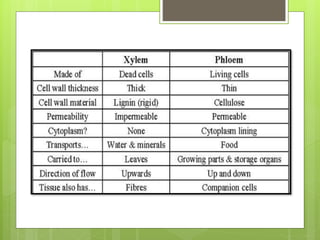
Phloem
 Greek, phlois, bark
 Principal food conductive tissue in vascular
plants.
 Transports dissolved organic materials in all
directions throughout the plant.
 Materials move under a positive pressure.
Composition of Phloem
1. Primary Phloem
 Differentiates from procambium.
 Have primary cell wall that are not highly
modified.
 Could be protophloem (located in elongating
region) or metaphloem (located in non-
elongating region)
2. Secondary Phloem
 Constitutes he inner layer of the bark.
3. Conductive cells in phloem
 Called sieves elements.
 Lack nucleus and alive at maturity.
 Have thin primary cell wall provided with sieve
areas perforated by sieve pores.
 Sieve cells, more primitive that sieve tube
members, long and have tapered, overlapping
ends.
 sieve tubes members, more
evolutionary advanced; shorter and
wider, arranged from end-to-end,
have larger sieve areas, associated
with at least one companion cell
which helps regulate the loading and
unloading of carbohydrates.
Xylem
 Greek, xylos, wood
 Principal water conducting tissue in vascular
plant.
 Transports water upward from the roots up to
the leaves.
 Water moves under a negative pressure.
Composition of Xylem
1. Primary xylem
 Differentiates from procambium
 Have secondary cell that are highly modified
 Could be protoxylem(located in elongating region) or
metaxylem (located in non-elongating region)
2. Secondary xylem
 Commonly called “wood”
 Cells are more abundant and in different
frequencies.
3. Conducting cells in xylem
 Elongated, dead cells with thick, lignified cell wall
 Tracheid, the most primitive and least specialized;
long slender cells with tapered, overlapping ends,
have fiber-tracheids (fiber-like cells) for support, the
only water-conducting cells in gymnospserms.
 Vessel elements, more evolutionary advanced than
tracheids; shorter and wider, arranged end-to-end,
found in angiosperms.
Thank you for
listening !
Members:
Agunos, Felmar J.
Per, Danica
Linco, Mary Margaret
Briones, Rechelle
Berganio, Marivic
Special thanks to:
Google.com
Google Images
General Biology Compedium by
Johnny A. Ching
XD
Plant tissues
Plant tissues

Plant tissues

  • 1.
  • 2.
    What is planttissue?  A cellular organization between a single cell and a complete organism is controlled by the tissue. They are the collection of similar cells, with specific function. A collection of tissue gives rise to an organ. A tissue is a simple, which may be single celled type or a complex cell type.
  • 3.
    A plant tissuecan be defined as a cell or a group of cells dividing, to give rise to large number of cell, which is collectively referred as tissues. They are structurally and functionally similar to these cells.
  • 4.
    The two typesof plant tissue: Meristematic Permanent
  • 5.
    Meristematic Tissues  Meristematictissues are cells or group of cells that have the ability to divide. These tissues in a plant consist of small, densely packed cells that can keep dividing to form new cells. Meristems give rise to permanent tissues.
  • 6.
    Characteristics of Meristematic tissues:  the cells are small,  the cells walls are thin,  cells have large nuclei,  vacuoles are absent or very small, and  there are no intercellular spaces.
  • 8.
    Types of Meristematictissues: Terminal or Apical meristems Intercalary meristems Lateral meristems
  • 9.
    Terminal or ApicalMeristem Located at the tips of roots and stems. Responsible for establishing patterns and producing new, genetically healthy cells.
  • 10.
    Intercalary Meristem  Portionsof apical meristem separated from the apex during development.  Lies below the node and at the base of stem of grasses.  Disappear when transformed into Permanent tissue.
  • 11.
    Lateral Meristem Composed ofinitial cells that divided chiefly in one place. Increase the diameter of the organ.
  • 12.
    Permanent Tissues  Thesetissues are derived from meristematic tissues. They have lost the power of dividing, having attained their definite form and size. In their earlier stages the cells are more or less similar in structure but slowly they become specialized and form permanent tissues. They can be classified into simple and complex.
  • 14.
    The 3 typesof simple permanent tissues: Surface or Protective / Dermis Fundamental or Supportive / Epidermis or Periderm Vascular / Conductive
  • 15.
    Surface or Protective/ Dermis Covers the body of the plant. Responsible for absorption of water and minerals, secretion of cuticle, protection against Herbivores, controls gas exchange. Have few intercellular spaces.
  • 16.
    Composition of Protectiveor Dermis : 1. Cuticle  Composed of fatty materials, water proof cutin.  Covered by Epicuticular wax  Outer covering of leaves, particularly the upper surface.  Protects the plant for Dessication and microbes.
  • 17.
    2. Epidermal cells In leaves and young green stems, the only intercellular spaces are the stomata surrounded by guard cells. 3. Trichomes  Unicellular or Multicellular outgrowths from the epidermal  Responsible for nutrition and absorption and protection from herbivores and humans.
  • 18.
    Fundamental / Supportive Formthe bulk of the softer part of plants. Includes the pith and cortex of stem, Leaf tissues except for epidermis and the major portion of fruits. Responsible for storage, basic metabolism and support.
  • 19.
    3 types ofFundamental / Supportive : Parenchyma Collenchyma Sclerenchyma
  • 20.
    Parenchyma Greek,para, beside; en+chein,to pour in. Most common and most abundant plant tissues. Occur in all organs of higher plants. Have long-protoplast, large vacuoles, and thin walls.
  • 21.
    Types of ParenchymaCells: 1. Clorenchyma cells  Contains chloroplast for photosynthesis. 2. Aerenchyma cells  Parenchyma with prominent intercellular spaces to improve gas exchange and provide maximum support.  Found in spongy layer of the leaf.
  • 22.
    3. Transfer Cells Parenchymaspecialized for short- distance transport of solutes. Occur in areas of high solute transport along the conducting cells of xylem and phloem.
  • 23.
    Collenchyma  Greek, kolla,glue  Composed of elongated cells with unevenly thickened stretchable cell walls.  Cells are often in strands or as cylinders beneath the Epidermis.  Support the growing regions of the shoot – expanding the leaves, petiole and elongating stems.
  • 24.
    Sclerenchyma  Greek, skleros,hard  Composed of rigid cells with thick unstretchable cell walls.  Occur in all mature type of plants, usually dead at maturity.  Support the non-extending regions of plant.
  • 25.
    Types of Sclerenchyma: 1.Sclereids  Relatively short cells with variable shapes.  Usually occur in singly or in small groups. 2. Fibers  Long, slender cells with sufficient tensile strength.  Occur in strands or in bundles.
  • 26.
    Vascular / Conductive Composedof several kinds of cells that differ in structure and in function. Specialized for long-distance transport of water and dissolved solutes. Contains transfer cells, secretory cells and fibers.
  • 27.
    Phloem  Greek, phlois,bark  Principal food conductive tissue in vascular plants.  Transports dissolved organic materials in all directions throughout the plant.  Materials move under a positive pressure.
  • 28.
    Composition of Phloem 1.Primary Phloem  Differentiates from procambium.  Have primary cell wall that are not highly modified.  Could be protophloem (located in elongating region) or metaphloem (located in non- elongating region)
  • 29.
    2. Secondary Phloem Constitutes he inner layer of the bark. 3. Conductive cells in phloem  Called sieves elements.  Lack nucleus and alive at maturity.  Have thin primary cell wall provided with sieve areas perforated by sieve pores.  Sieve cells, more primitive that sieve tube members, long and have tapered, overlapping ends.
  • 30.
     sieve tubesmembers, more evolutionary advanced; shorter and wider, arranged from end-to-end, have larger sieve areas, associated with at least one companion cell which helps regulate the loading and unloading of carbohydrates.
  • 31.
    Xylem  Greek, xylos,wood  Principal water conducting tissue in vascular plant.  Transports water upward from the roots up to the leaves.  Water moves under a negative pressure.
  • 32.
    Composition of Xylem 1.Primary xylem  Differentiates from procambium  Have secondary cell that are highly modified  Could be protoxylem(located in elongating region) or metaxylem (located in non-elongating region) 2. Secondary xylem  Commonly called “wood”  Cells are more abundant and in different frequencies.
  • 33.
    3. Conducting cellsin xylem  Elongated, dead cells with thick, lignified cell wall  Tracheid, the most primitive and least specialized; long slender cells with tapered, overlapping ends, have fiber-tracheids (fiber-like cells) for support, the only water-conducting cells in gymnospserms.  Vessel elements, more evolutionary advanced than tracheids; shorter and wider, arranged end-to-end, found in angiosperms.
  • 37.
    Thank you for listening! Members: Agunos, Felmar J. Per, Danica Linco, Mary Margaret Briones, Rechelle Berganio, Marivic
  • 38.
    Special thanks to: Google.com GoogleImages General Biology Compedium by Johnny A. Ching XD