


PLANT
TAXONOMIC KEYS
Dr. Joby Paul
Research and Post Graduate Department of Botany
St. Thomas' College [Autonomous], Thrissur, Kerala
Why Botany ?
Botany is the scienceand artof studying plants, that carry
out photosynthesis. Botany includes a wide range of scientific sub disciplines
t h a t s t u d y t h e structure, growth, reproduction,
metabolism, development, diseases, ecology and
evolution of plants. The study of plants is important because they are a
fundamental part of life on Earth, generating food, oxygen, fuel,
medicine and fibers that allow other life forms to exist. Through
photosynthesis they absorb carbon dioxide, a waste
product generated by most animals and a greenhouse gas that
contributes to global warming.
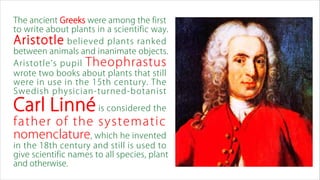
The ancient Greeks were among the first
to write about plants in a scientific way.
Aristotle believed plants ranked
between animals and inanimate objects.
Aristotle’s pupil Theophrastus
wrote two books about plants that still
were in use in the 15th century. The
Swedish physician-turned-botanist
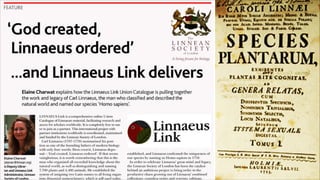
Carl Linnéis considered the
father of the systematic
nomenclature, which he invented
in the 18th century and still is used to
give scientific names to all species, plant
and otherwise.
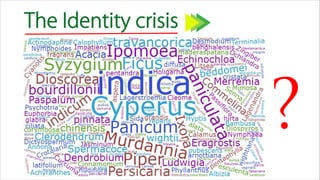
The Identity crisis
?
Two contrasting phases
We are now in a phase of critical evaluation of
methodology, choice of data, assumptions, etc.
because we are in the middle of two contrasting
phases:
►Development in Molecular phylogeny by
advance technology.
►High estimates of Biodiversity, Number of
unidentified and misidentified species.
Are we equipped to face this challenge ?
All we need
Plant specimen
Dissection microscope
Flora
Dedication
Differentiate these flowers
A B C D E
Flower Red ------------ A
Flower Blue ----------- B
Flower Yellow -------- C
Flower Pink ----------- D
Flower Cyan ---------- E
A B C D
Flowers Red ------------ A and D [Group 1]
Flowers Blue ----------- B and C [Group 2]
Petals 5 ------------------A
Petals 8 ------------------D
Petals 5 ------------------B
Petals 8 ------------------C
A B C D
Petals 5 ------------------A and B [Group 1]
Petals 8 ------------------C and D [Group 2]
Flowers Red ------------ A
Flowers Blue ----------- B
Flowers Blue ----------- C
Flowers Red ------------ D
A B C D
Leaves opposite ------------------------------------ A and C [Group 1]
Leaves alternate ------------------------------------ B and D [Group 2]
Flowers Red, Petals 5 ------------------------------A
Flowers Blue, Petals 8 -----------------------------C
Flowers Blue, Petals 5 -----------------------------B
Flowers Red, Petals 5 ------------------------------D
What is a Taxonomic Key ?
A key is a device, which when properly constructed and used, enables a user to
identify an organism. Keys are devices consisting of a series of
contrasting or contradictory statements or propositions
requiring the identifier to make comparisons and decisions based on statements in
the key as related to the material to be identified.
The key consists of a series of choices, based on observed features of the plant
specimen. It provides a choice between two contradictory statements resulting in
the acceptance of one and the rejection of the other.
A single pair of contradictory statements is called a
couplet and each statement of a couplet is termed a
lead. By making the correct choice at each level of the key, one can eventually
arrive at the name of the unknown plant.
Types of Taxonomic Keys
Dichotomous Keys: Keys in which the choices allow only two
(mutually exclusive) alternative couplets are known as dichotomous
keys. In constructing a key, contrasting characters are chosen that divide the full
set of possible species into smaller and smaller groups i.e. the statements
typically begin with broad characteristics and become narrower as more choices
are required. Dichotomous comes from the Greek root dich meaning “two” and
temnein meaning “to cut“.
Each time a choice is made, a number of species are eliminated from
consideration and the range of possible species to which the unknown
specimen may belong is narrowed. Eventually, after sufficient choices have been
made, their range reduces to a single species and the identity of the unknown
plant is revealed.
Types of Dichotomous Keys
Indented Keys (also called yoked): Indents the
choices (leads) of the couplet an equal distance
from the left margin. The two choices of the couplet are
usually labelled 1 and 1′or 1a and 1b. It is not necessary that the
choices are numbered, but it helps. The user goes to the next
indented couplet following the lead that was selected.
Bracketed Keys: Provides both choices side-by-side.
The choices of the couplet must be numbered (or
lettered). It is very helpful if the previous couplet is given. This key has
exactly the same choices as the first example. The choices are
separated, but it is easy to see the relationships. While this key might
be more difficult to construct, it gives more information to the user.
Poly Clave Keys: Another type of key, which is relatively a new
alternative to dichotomous keys and becoming increasingly popular,
especially because of the ease of computerizing them, is termed
multiple access or poly clave or synoptic key. The
advantage of these keys is that they allow the user to enter the key at any
point.
This key is based on the identification of organisms by a process of
elimination. In a written poly clave key there is a series of characters
and character states. Each state is followed by a number or code for the
species that possess that feature.
The user needs to select any character and then copy down the
list of species that possess the feature. Then the user has to select
another character and eliminate any species that is not common to both
lists. This process has to be continued until the specimen is identified.
Websites:
• http://www.discoverlife.org/mp/20q?guide=Trees
• http://eekwi.org/veg/treekey/
• http://webikey.agron.iastate.edu/SelectCategories.aspx
• https://gobotany.newenglandwild.org/full/
• http://delta-intkey.com/angio/
• https://plants.usda.gov/java/
• https://www.wildflower.org/plants/
Apps:
Leafsnap Tree ID Virginia Tech Tree ID
The tree app PlantSnapp
Realtime time Taxonomic Key construction
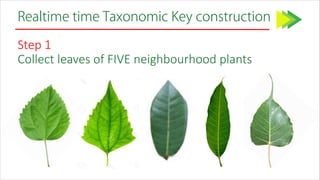
Step 1
Collect leaves of FIVE neighbourhood plants
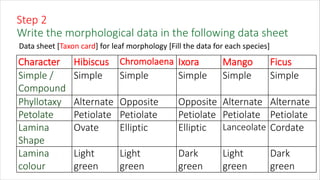
Step 2
Write the morphological data in the following data sheet
Data sheet [Taxon card] for leaf morphology [Fill the data for each species]
Character Hibiscus Chromolaena Ixora Mango Ficus
Simple /
Compound
Simple Simple Simple Simple Simple
Phyllotaxy Alternate Opposite Opposite Alternate Alternate
Petolate Petiolate Petiolate Petiolate Petiolate Petiolate
Lamina
Shape
Ovate Elliptic Elliptic Lanceolate Cordate
Lamina
colour
Light
green
Light
green
Dark
green
Light
green
Dark
green
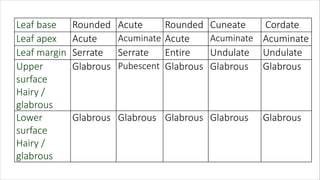
Leaf base Rounded Acute Rounded Cuneate Cordate
Leaf apex Acute Acuminate Acute Acuminate Acuminate
Leaf margin Serrate Serrate Entire Undulate Undulate
Upper
surface
Hairy /
glabrous
Glabrous Pubescent Glabrous Glabrous Glabrous
Lower
surface
Hairy /
glabrous
Glabrous Glabrous Glabrous Glabrous Glabrous
Step 3
Compare the species for similarities as follows. [Highlight
with colour or underline with color for similar characters]
Character Hibiscus Chromolaena Ixora Mango Ficus
Simple /
Compound
Simple Simple Simple Simple Simple
Phyllotaxy Alternate Opposite Opposite Alternate Alternate
Petolate Petiolate Petiolate Petiolate Petiolate Petiolate
Lamina
Shape
Ovate Elliptic Elliptic Lanceolate Cordate
Lamina
colour
Light
green
Light
green
Dark
green
Light
green
Dark
green
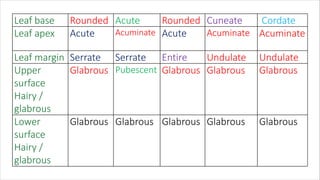
Leaf base Rounded Acute Rounded Cuneate Cordate
Leaf apex Acute Acuminate Acute Acuminate Acuminate
Leaf margin Serrate Serrate Entire Undulate Undulate
Upper
surface
Hairy /
glabrous
Glabrous Pubescent Glabrous Glabrous Glabrous
Lower
surface
Hairy /
glabrous
Glabrous Glabrous Glabrous Glabrous Glabrous
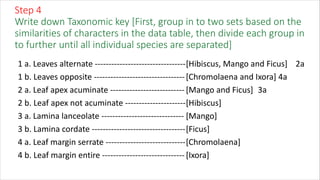
Step 4
Write down Taxonomic key [First, group in to two sets based on the
similarities of characters in the data table, then divide each group in
to further until all individual species are separated]
1 a. Leaves alternate ---------------------------------[Hibiscus, Mango and Ficus] 2a
1 b. Leaves opposite ---------------------------------[Chromolaena and Ixora] 4a
2 a. Leaf apex acuminate --------------------------- [Mango and Ficus] 3a
2 b. Leaf apex not acuminate ----------------------[Hibiscus]
3 a. Lamina lanceolate ------------------------------ [Mango]
3 b. Lamina cordate ----------------------------------[Ficus]
4 a. Leaf margin serrate -----------------------------[Chromolaena]
4 b. Leaf margin entire ------------------------------[Ixora]
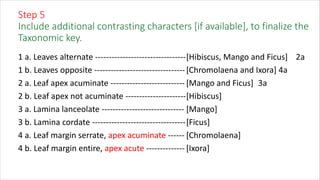
Step 5
Include additional contrasting characters [if available], to finalize the
Taxonomic key.
1 a. Leaves alternate ---------------------------------[Hibiscus, Mango and Ficus] 2a
1 b. Leaves opposite ---------------------------------[Chromolaena and Ixora] 4a
2 a. Leaf apex acuminate --------------------------- [Mango and Ficus] 3a
2 b. Leaf apex not acuminate ----------------------[Hibiscus]
3 a. Lamina lanceolate ------------------------------ [Mango]
3 b. Lamina cordate ----------------------------------[Ficus]
4 a. Leaf margin serrate, apex acuminate ------ [Chromolaena]
4 b. Leaf margin entire, apex acute -------------- [Ixora]
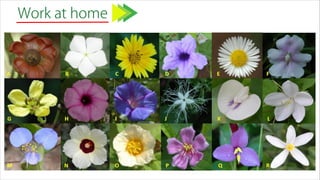
Work at home
Basic requisites for a good taxonomist
Knowledge of classics
Knowledge of Latin
Ability to describe neatly and clearly (Language skill)
Good illustrations
Good photographs
Common sense
What we need is
NETWORK WITH EXPERTS AND INSTITUTIONS
DO THINGS USEFUL TO A LARGE NUMBER OF PEOPLE AND NEEDED BY THE
COUNTRY: MONOGRAPHS AND REVISIONS
BETTER BE A FIRST RATE CLASSICAL TAXONOMIST
YOUR INTEGRITY, COMMITTMENT AND COMPETANCE ARE THE KEY TO THE
USEFULNESS AND LONGEVITY OF YOUR CONTRIBUTION TO SCIENCE
Taxonomy is the Servant and Queen of Biology
Provides basic information regarding
identification, close relatives etc of plant species that are in
need
It is a synthetic discipline constructing a
system of classification based on analysis of all
type of evidences from the entire life cycle of organisms
Plant taxonomic keys - Botany