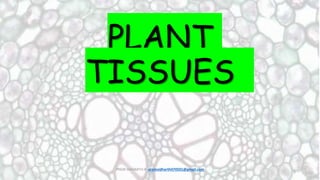
PLANT
TISSUES
PREM SIDHARTH R premsidharth070501@gmail.com
1
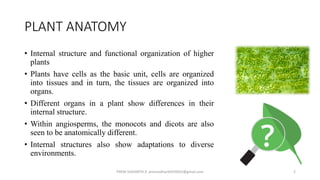
PLANT ANATOMY
• Internal structure and functional organization of higher
plants
• Plants have cells as the basic unit, cells are organized
into tissues and in turn, the tissues are organized into
organs.
• Different organs in a plant show differences in their
internal structure.
• Within angiosperms, the monocots and dicots are also
seen to be anatomically different.
• Internal structures also show adaptations to diverse
environments.
PREM SIDHARTH R premsidharth070501@gmail.com 2
TISSUE
• A tissue is a group of cells having a
common origin and usually performing a
common function.
• A plant is made up of different kinds of
tissues.
• Tissues are classified into two main
groups, namely, meristematic and
permanent tissues based on whether the
cells being formed are capable of dividing
or not.
PREM SIDHARTH R premsidharth070501@gmail.com 3
1. MERISTEMATIC TISSUES
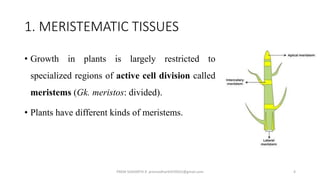
• Growth in plants is largely restricted to
specialized regions of active cell division called
meristems (Gk. meristos: divided).
• Plants have different kinds of meristems.
PREM SIDHARTH R premsidharth070501@gmail.com 4
a) APICAL MERISTEMS
• The meristems which occur at the tips of roots and shoots and
produce primary tissues are called apical meristems
• Root apical meristem occupies the tip of a root while the shoot
apical meristem occupies the distant region of the stem axis.
• During the formation of leaves and elongation of the stem, some
cells ‘left behind’ from the shoot apical meristem, constitute the
axillary bud.
• Such buds are present in the axils of leaves and are capable of
forming a branch or a flower.
PREM SIDHARTH R premsidharth070501@gmail.com 5
APICAL MERISTEM
PREM SIDHARTH R premsidharth070501@gmail.com 6
b) INTERCALARY MERISTEM
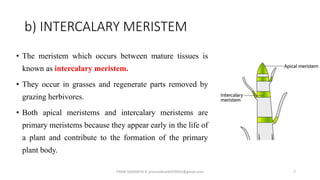
• The meristem which occurs between mature tissues is
known as intercalary meristem.
• They occur in grasses and regenerate parts removed by
grazing herbivores.
• Both apical meristems and intercalary meristems are
primary meristems because they appear early in the life of
a plant and contribute to the formation of the primary
plant body.
PREM SIDHARTH R premsidharth070501@gmail.com 7
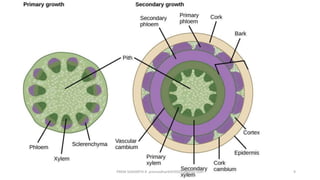
c) LATERAL MERISTEMS
• The meristem that occurs in the mature regions of roots
and shoots of many plants
• Produce woody axis
• Appear later than primary meristem
• secondary meristem.
• They are cylindrical meristems.
• Fascicular vascular cambium, interfascicular cambium
and cork-cambium are examples of lateral meristems.
• These are responsible for producing secondary tissues.
PREM SIDHARTH R premsidharth070501@gmail.com 8
PREM SIDHARTH R premsidharth070501@gmail.com 9
PERMANENT TISSUES
• Following divisions of cells in both primary and as well as secondary meristems, the newly formed
cells become structurally and functionally specialised and lose the ability to divide.
• Such cells are termed permanent or mature cells and constitute permanent tissues.
• During the formation of the primary plant body, specific regions of the apical meristem produce
dermal tissues, ground tissues, and vascular tissues.
PREM SIDHARTH R premsidharth070501@gmail.com 10
PERMANENT TISSUES
• The cells of the permanent tissues do not generally divide
further.
• Permanent tissues having all cells similar in structure and
function are called simple tissues.
• Permanent tissues having many different types of cells are
called complex tissues.
PREM SIDHARTH R premsidharth070501@gmail.com 11
a) SIMPLE PERMANENT TISSUE
• Permanent tissues having all cells similar in structure and function
are called simple tissues.
• 3 Types:
a) Parenchyma
b) Collenchyma
c) Sclerenchyma
PREM SIDHARTH R premsidharth070501@gmail.com 12
i) PARENCHYMA
• Forms the major component within organs.
• cells are generally isodiametric.
• They may be spherical, oval, round, polygonal, or elongated in
shape.
• Their walls are thin and made up of cellulose.
• They may either be closely packed or have small intercellular
spaces.
• The parenchyma performs various functions like photosynthesis,
storage, and secretion.
PREM SIDHARTH R premsidharth070501@gmail.com 13
ii) COLLENCHYMA
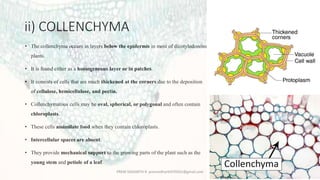
• The collenchyma occurs in layers below the epidermis in most of dicotyledonous
plants.
• It is found either as a homogeneous layer or in patches.
• It consists of cells that are much thickened at the corners due to the deposition
of cellulose, hemicellulose, and pectin.
• Collenchymatous cells may be oval, spherical, or polygonal and often contain
chloroplasts.
• These cells assimilate food when they contain chloroplasts.
• Intercellular spaces are absent.
• They provide mechanical support to the growing parts of the plant such as the
young stem and petiole of a leaf.
PREM SIDHARTH R premsidharth070501@gmail.com 14
iii)Sclerenchyma
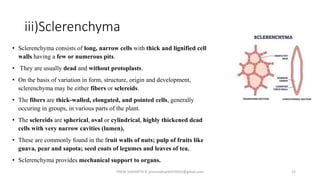
• Sclerenchyma consists of long, narrow cells with thick and lignified cell
walls having a few or numerous pits.
• They are usually dead and without protoplasts.
• On the basis of variation in form, structure, origin and development,
sclerenchyma may be either fibers or sclereids.
• The fibers are thick-walled, elongated, and pointed cells, generally
occuring in groups, in various parts of the plant.
• The sclereids are spherical, oval or cylindrical, highly thickened dead
cells with very narrow cavities (lumen).
• These are commonly found in the fruit walls of nuts; pulp of fruits like
guava, pear and sapota; seed coats of legumes and leaves of tea.
• Sclerenchyma provides mechanical support to organs.
PREM SIDHARTH R premsidharth070501@gmail.com 15
b) COMPLEX PERMANENT TISSUES
• The complex tissues are made of more than one type of cells and
these work together as a unit.
• Xylem and phloem constitute the complex tissues in plants
PREM SIDHARTH R premsidharth070501@gmail.com 16
i) XYLEM
• Xylem functions as a conducting tissue for water and minerals from roots to the
stem and leaves.
• It also provides mechanical strength to the plant parts.
• It is composed of four different kinds of elements, namely,
a) Tracheids
b) Vessels
c) xylem fibres
d) xylem parenchyma.
• Gymnosperms lack vessels in their xylem.
PREM SIDHARTH R premsidharth070501@gmail.com 17
XYLARY ELEMENTS
a) Tracheids:
• Elongated or tube-like cells with thick and lignified walls and tapering ends.
• Dead- without protoplasm.
• The inner layers of the cell walls have thickenings that vary in form.
• In flowering plants, tracheids and vessels are the main water-transporting
elements..
b) Vessel:
• Long cylindrical tube-like structure made up of many cells called vessel
members
• lignified walls and a large central cavity.
• The vessel cells are also devoid of protoplasm
• Vessel members are interconnected through perforations in their common walls.
• The presence of vessels is a characteristic feature of angiosperms.
PREM SIDHARTH R premsidharth070501@gmail.com 18
XYLARY ELEMENTS
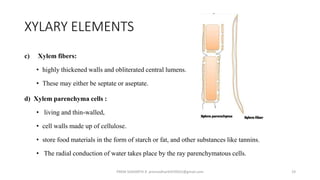
c) Xylem fibers:
• highly thickened walls and obliterated central lumens.
• These may either be septate or aseptate.
d) Xylem parenchyma cells :
• living and thin-walled,
• cell walls made up of cellulose.
• store food materials in the form of starch or fat, and other substances like tannins.
• The radial conduction of water takes place by the ray parenchymatous cells.
PREM SIDHARTH R premsidharth070501@gmail.com 19
PROTOXYLEM AND METAXYLEM
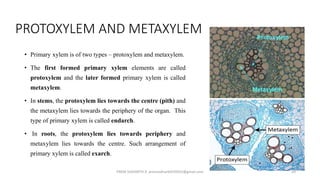
• Primary xylem is of two types – protoxylem and metaxylem.
• The first formed primary xylem elements are called
protoxylem and the later formed primary xylem is called
metaxylem.
• In stems, the protoxylem lies towards the centre (pith) and
the metaxylem lies towards the periphery of the organ. This
type of primary xylem is called endarch.
• In roots, the protoxylem lies towards periphery and
metaxylem lies towards the centre. Such arrangement of
primary xylem is called exarch.
PREM SIDHARTH R premsidharth070501@gmail.com 20
PREM SIDHARTH R premsidharth070501@gmail.com 21
PHLOEM
• Phloem transports food materials, usually from leaves to
other parts of the plant.
• Phloem in angiosperms is composed of sieve tube
elements, companion cells, phloem parenchyma, and
phloem fibers.
• Gymnosperms have albuminous cells and sieve cells.
• They lack sieve tubes and companion cells.
PREM SIDHARTH R premsidharth070501@gmail.com 22
PHLOEM ELEMENTS
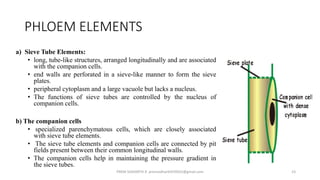
a) Sieve Tube Elements:
• long, tube-like structures, arranged longitudinally and are associated
with the companion cells.
• end walls are perforated in a sieve-like manner to form the sieve
plates.
• peripheral cytoplasm and a large vacuole but lacks a nucleus.
• The functions of sieve tubes are controlled by the nucleus of
companion cells.
b) The companion cells
• specialized parenchymatous cells, which are closely associated
with sieve tube elements.
• The sieve tube elements and companion cells are connected by pit
fields present between their common longitudinal walls.
• The companion cells help in maintaining the pressure gradient in
the sieve tubes.
PREM SIDHARTH R premsidharth070501@gmail.com 23
PHLOEM ELEMENTS
c) Phloem Parenchyma:
• made up of elongated, tapering cylindrical cells which have dense cytoplasm and nucleus.
• The cell wall is composed of cellulose and has pits through which plasmodesmatal
connections exist between the cells.
• stores food material and other substances like resins, latex and mucilage.
• Phloem parenchyma is absent in most of the monocotyledons.
d) Phloem fibres (bast fibres)
• made up of sclerenchymatous cells.
• generally absent in the primary phloem but are found in the secondary phloem.
• These are much elongated, unbranched and have pointed, needle like apices.
• The cell wall of phloem fibres is quite thick.
• At maturity, these fibres lose their protoplasm and become dead.
• Phloem fibres of jute, flax and hemp are used commercially.
PREM SIDHARTH R premsidharth070501@gmail.com 24
PROTOPHLOEM AND METAPHLOEM
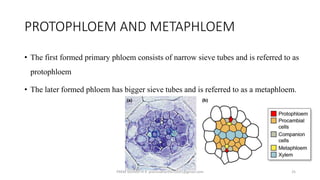
• The first formed primary phloem consists of narrow sieve tubes and is referred to as
protophloem
• The later formed phloem has bigger sieve tubes and is referred to as a metaphloem.
PREM SIDHARTH R premsidharth070501@gmail.com 25
WHAT HAVE WE DISCUSSED
• What are plant tissues?
• Classification of Plant Tissue: Meristematic and Permanent
• Types of Meristematic Tissues: Apical, Intercalary, Lateral
• Types of Permanent Tissues: Simple and Complex
• Types of Simple Tissues: Parenchyma, Collenchyma, and Sclerenchyma
• Types of Complex Tissues: Xylem and Phloem
PREM SIDHARTH R premsidharth070501@gmail.com 26
Types of Plant Tissue
PREM SIDHARTH R premsidharth070501@gmail.com 27

PLANT TISSUES.pptx

  • 1.
    PLANT TISSUES PREM SIDHARTH Rpremsidharth070501@gmail.com 1
  • 2.
    PLANT ANATOMY • Internalstructure and functional organization of higher plants • Plants have cells as the basic unit, cells are organized into tissues and in turn, the tissues are organized into organs. • Different organs in a plant show differences in their internal structure. • Within angiosperms, the monocots and dicots are also seen to be anatomically different. • Internal structures also show adaptations to diverse environments. PREM SIDHARTH R premsidharth070501@gmail.com 2
  • 3.
    TISSUE • A tissueis a group of cells having a common origin and usually performing a common function. • A plant is made up of different kinds of tissues. • Tissues are classified into two main groups, namely, meristematic and permanent tissues based on whether the cells being formed are capable of dividing or not. PREM SIDHARTH R premsidharth070501@gmail.com 3
  • 4.
    1. MERISTEMATIC TISSUES •Growth in plants is largely restricted to specialized regions of active cell division called meristems (Gk. meristos: divided). • Plants have different kinds of meristems. PREM SIDHARTH R premsidharth070501@gmail.com 4
  • 5.
    a) APICAL MERISTEMS •The meristems which occur at the tips of roots and shoots and produce primary tissues are called apical meristems • Root apical meristem occupies the tip of a root while the shoot apical meristem occupies the distant region of the stem axis. • During the formation of leaves and elongation of the stem, some cells ‘left behind’ from the shoot apical meristem, constitute the axillary bud. • Such buds are present in the axils of leaves and are capable of forming a branch or a flower. PREM SIDHARTH R premsidharth070501@gmail.com 5
  • 6.
    APICAL MERISTEM PREM SIDHARTHR premsidharth070501@gmail.com 6
  • 7.
    b) INTERCALARY MERISTEM •The meristem which occurs between mature tissues is known as intercalary meristem. • They occur in grasses and regenerate parts removed by grazing herbivores. • Both apical meristems and intercalary meristems are primary meristems because they appear early in the life of a plant and contribute to the formation of the primary plant body. PREM SIDHARTH R premsidharth070501@gmail.com 7
  • 8.
    c) LATERAL MERISTEMS •The meristem that occurs in the mature regions of roots and shoots of many plants • Produce woody axis • Appear later than primary meristem • secondary meristem. • They are cylindrical meristems. • Fascicular vascular cambium, interfascicular cambium and cork-cambium are examples of lateral meristems. • These are responsible for producing secondary tissues. PREM SIDHARTH R premsidharth070501@gmail.com 8
  • 9.
    PREM SIDHARTH Rpremsidharth070501@gmail.com 9
  • 10.
    PERMANENT TISSUES • Followingdivisions of cells in both primary and as well as secondary meristems, the newly formed cells become structurally and functionally specialised and lose the ability to divide. • Such cells are termed permanent or mature cells and constitute permanent tissues. • During the formation of the primary plant body, specific regions of the apical meristem produce dermal tissues, ground tissues, and vascular tissues. PREM SIDHARTH R premsidharth070501@gmail.com 10
  • 11.
    PERMANENT TISSUES • Thecells of the permanent tissues do not generally divide further. • Permanent tissues having all cells similar in structure and function are called simple tissues. • Permanent tissues having many different types of cells are called complex tissues. PREM SIDHARTH R premsidharth070501@gmail.com 11
  • 12.
    a) SIMPLE PERMANENTTISSUE • Permanent tissues having all cells similar in structure and function are called simple tissues. • 3 Types: a) Parenchyma b) Collenchyma c) Sclerenchyma PREM SIDHARTH R premsidharth070501@gmail.com 12
  • 13.
    i) PARENCHYMA • Formsthe major component within organs. • cells are generally isodiametric. • They may be spherical, oval, round, polygonal, or elongated in shape. • Their walls are thin and made up of cellulose. • They may either be closely packed or have small intercellular spaces. • The parenchyma performs various functions like photosynthesis, storage, and secretion. PREM SIDHARTH R premsidharth070501@gmail.com 13
  • 14.
    ii) COLLENCHYMA • Thecollenchyma occurs in layers below the epidermis in most of dicotyledonous plants. • It is found either as a homogeneous layer or in patches. • It consists of cells that are much thickened at the corners due to the deposition of cellulose, hemicellulose, and pectin. • Collenchymatous cells may be oval, spherical, or polygonal and often contain chloroplasts. • These cells assimilate food when they contain chloroplasts. • Intercellular spaces are absent. • They provide mechanical support to the growing parts of the plant such as the young stem and petiole of a leaf. PREM SIDHARTH R premsidharth070501@gmail.com 14
  • 15.
    iii)Sclerenchyma • Sclerenchyma consistsof long, narrow cells with thick and lignified cell walls having a few or numerous pits. • They are usually dead and without protoplasts. • On the basis of variation in form, structure, origin and development, sclerenchyma may be either fibers or sclereids. • The fibers are thick-walled, elongated, and pointed cells, generally occuring in groups, in various parts of the plant. • The sclereids are spherical, oval or cylindrical, highly thickened dead cells with very narrow cavities (lumen). • These are commonly found in the fruit walls of nuts; pulp of fruits like guava, pear and sapota; seed coats of legumes and leaves of tea. • Sclerenchyma provides mechanical support to organs. PREM SIDHARTH R premsidharth070501@gmail.com 15
  • 16.
    b) COMPLEX PERMANENTTISSUES • The complex tissues are made of more than one type of cells and these work together as a unit. • Xylem and phloem constitute the complex tissues in plants PREM SIDHARTH R premsidharth070501@gmail.com 16
  • 17.
    i) XYLEM • Xylemfunctions as a conducting tissue for water and minerals from roots to the stem and leaves. • It also provides mechanical strength to the plant parts. • It is composed of four different kinds of elements, namely, a) Tracheids b) Vessels c) xylem fibres d) xylem parenchyma. • Gymnosperms lack vessels in their xylem. PREM SIDHARTH R premsidharth070501@gmail.com 17
  • 18.
    XYLARY ELEMENTS a) Tracheids: •Elongated or tube-like cells with thick and lignified walls and tapering ends. • Dead- without protoplasm. • The inner layers of the cell walls have thickenings that vary in form. • In flowering plants, tracheids and vessels are the main water-transporting elements.. b) Vessel: • Long cylindrical tube-like structure made up of many cells called vessel members • lignified walls and a large central cavity. • The vessel cells are also devoid of protoplasm • Vessel members are interconnected through perforations in their common walls. • The presence of vessels is a characteristic feature of angiosperms. PREM SIDHARTH R premsidharth070501@gmail.com 18
  • 19.
    XYLARY ELEMENTS c) Xylemfibers: • highly thickened walls and obliterated central lumens. • These may either be septate or aseptate. d) Xylem parenchyma cells : • living and thin-walled, • cell walls made up of cellulose. • store food materials in the form of starch or fat, and other substances like tannins. • The radial conduction of water takes place by the ray parenchymatous cells. PREM SIDHARTH R premsidharth070501@gmail.com 19
  • 20.
    PROTOXYLEM AND METAXYLEM •Primary xylem is of two types – protoxylem and metaxylem. • The first formed primary xylem elements are called protoxylem and the later formed primary xylem is called metaxylem. • In stems, the protoxylem lies towards the centre (pith) and the metaxylem lies towards the periphery of the organ. This type of primary xylem is called endarch. • In roots, the protoxylem lies towards periphery and metaxylem lies towards the centre. Such arrangement of primary xylem is called exarch. PREM SIDHARTH R premsidharth070501@gmail.com 20
  • 21.
    PREM SIDHARTH Rpremsidharth070501@gmail.com 21
  • 22.
    PHLOEM • Phloem transportsfood materials, usually from leaves to other parts of the plant. • Phloem in angiosperms is composed of sieve tube elements, companion cells, phloem parenchyma, and phloem fibers. • Gymnosperms have albuminous cells and sieve cells. • They lack sieve tubes and companion cells. PREM SIDHARTH R premsidharth070501@gmail.com 22
  • 23.
    PHLOEM ELEMENTS a) SieveTube Elements: • long, tube-like structures, arranged longitudinally and are associated with the companion cells. • end walls are perforated in a sieve-like manner to form the sieve plates. • peripheral cytoplasm and a large vacuole but lacks a nucleus. • The functions of sieve tubes are controlled by the nucleus of companion cells. b) The companion cells • specialized parenchymatous cells, which are closely associated with sieve tube elements. • The sieve tube elements and companion cells are connected by pit fields present between their common longitudinal walls. • The companion cells help in maintaining the pressure gradient in the sieve tubes. PREM SIDHARTH R premsidharth070501@gmail.com 23
  • 24.
    PHLOEM ELEMENTS c) PhloemParenchyma: • made up of elongated, tapering cylindrical cells which have dense cytoplasm and nucleus. • The cell wall is composed of cellulose and has pits through which plasmodesmatal connections exist between the cells. • stores food material and other substances like resins, latex and mucilage. • Phloem parenchyma is absent in most of the monocotyledons. d) Phloem fibres (bast fibres) • made up of sclerenchymatous cells. • generally absent in the primary phloem but are found in the secondary phloem. • These are much elongated, unbranched and have pointed, needle like apices. • The cell wall of phloem fibres is quite thick. • At maturity, these fibres lose their protoplasm and become dead. • Phloem fibres of jute, flax and hemp are used commercially. PREM SIDHARTH R premsidharth070501@gmail.com 24
  • 25.
    PROTOPHLOEM AND METAPHLOEM •The first formed primary phloem consists of narrow sieve tubes and is referred to as protophloem • The later formed phloem has bigger sieve tubes and is referred to as a metaphloem. PREM SIDHARTH R premsidharth070501@gmail.com 25
  • 26.
    WHAT HAVE WEDISCUSSED • What are plant tissues? • Classification of Plant Tissue: Meristematic and Permanent • Types of Meristematic Tissues: Apical, Intercalary, Lateral • Types of Permanent Tissues: Simple and Complex • Types of Simple Tissues: Parenchyma, Collenchyma, and Sclerenchyma • Types of Complex Tissues: Xylem and Phloem PREM SIDHARTH R premsidharth070501@gmail.com 26
  • 27.
    Types of PlantTissue PREM SIDHARTH R premsidharth070501@gmail.com 27