ENDOPLASMIC RETICULUM
STRUCTURE AND FUNCTIONS
DR. DILIP V. HANDE
ASSOCIATE PROFESSOR, DEPT OF BOTANY
SHRI SHIVAJI SCIENCE COLLEGE, AMRAVATI MS.
INTRODUCTION
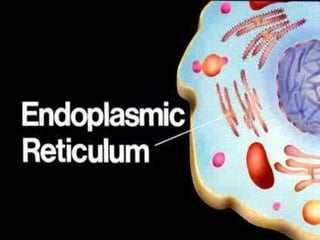
 Endoplasmic reticulum is double membrane
network system observed for the first time by
Porter, Claude & Fullan (1945) in the
cytoplasm.
 Later on in 1953 Porter & Kallmon termed it
as Endoplasmic Reticulum .
 It is an finely divided complex vascular
system extending from the outer nuclear
membrane passing through cytoplasm to
plasma-membrane.
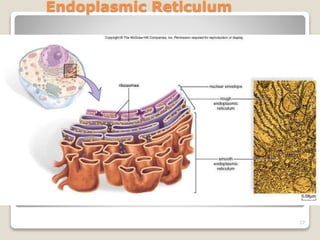
 It is a network of cisternae, tubules &
vesicles.
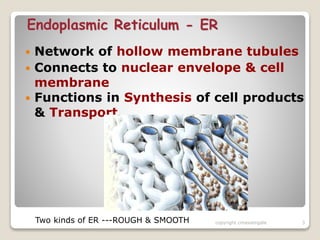
Endoplasmic Reticulum - ER
 Network of hollow membrane tubules
 Connects to nuclear envelope & cell
membrane
 Functions in Synthesis of cell products
& Transport
copyright cmassengale 3Two kinds of ER ---ROUGH & SMOOTH
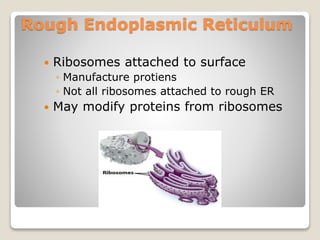
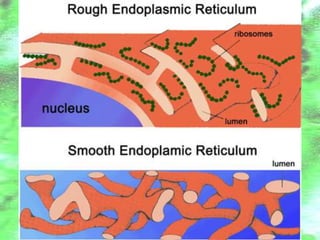
Rough Endoplasmic Reticulum
 Ribosomes attached to surface
◦ Manufacture protiens
◦ Not all ribosomes attached to rough ER
 May modify proteins from ribosomes
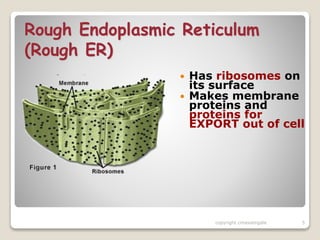
Rough Endoplasmic Reticulum
(Rough ER)
 Has ribosomes on
its surface
 Makes membrane
proteins and
proteins for
EXPORT out of cell
copyright cmassengale 5
Rough Endoplasmic Reticulum (Rough
ER)
 Proteins are made
by ribosomes on
ER surface
 They are then
threaded into the
interior of the
Rough ER to be
modified and
transported
copyright cmassengale 6
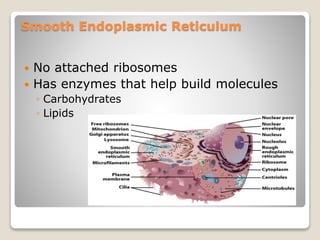
Smooth Endoplasmic Reticulum
 No attached ribosomes
 Has enzymes that help build molecules
◦ Carbohydrates
◦ Lipids
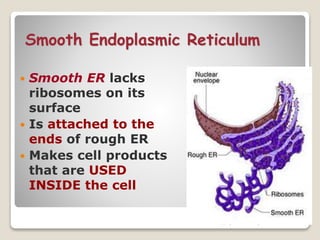
Smooth Endoplasmic Reticulum
 Smooth ER lacks
ribosomes on its
surface
 Is attached to the
ends of rough ER
 Makes cell products
that are USED
INSIDE the cell
copyright cmassengale 8
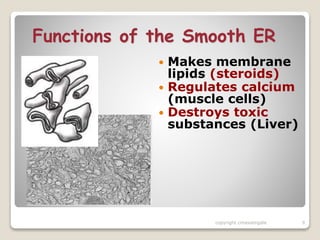
Functions of the Smooth ER
 Makes membrane
lipids (steroids)
 Regulates calcium
(muscle cells)
 Destroys toxic
substances (Liver)
copyright cmassengale 9
Endomembrane System
copyright cmassengale 10
Includes nuclear membrane connected to ER
connected to cell membrane (transport)
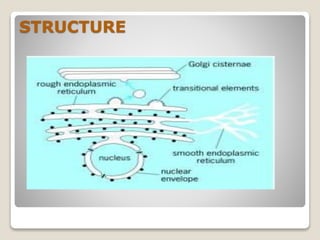
STRUCTURE
Occurrence
 It is almost found in all Eukaryotic
cells and more distinct in young
meristematic cells, the amount of
E.R. varies from cell to cell.
 It is found more in amount in those
cells which are active for protein
synthesis.
Types
Smooth or Agranular E.R. (SER):-
 The membrane of smooth E.R. are not granular
due to absence of ribosomes .
 It is more abundant near the peripheral part of
the cytoplasm & may found attached to the
plasma-membrane.
 It forms the transport vesicles in which large
molecules (protein & lipid) are transported from
one cell to other through plasmodesmata.
 Rough or granular E.R.(RER )
 The rough E.R. has granular surface due to the
presence of large number of ribosomes attached
to it.
 These are found more abundant in deeper part of
cytoplasm near the nucleus where it is connected
to outer nuclear membrane. It is active protein
synthesis.
Structure :
 Morphologically the E.R. consist of three
types of structures. i.e. cisternae. vesicles
and tubules.
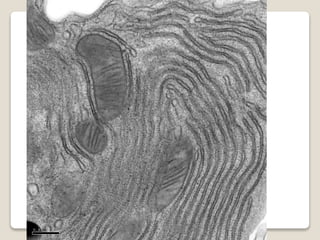
 Cisternae :
 The cisternae are elongated, cylindrical,
unbranched flattened sac like lie parallel
to each other.
 These are interconnected with each other
and 40-50 A0 diameter.
 Generally they bears ribosomes on their
cytoplasmic faces and found in cell active
in protein synthesis.
Endoplasmic Reticulum
17
STRUCTURE
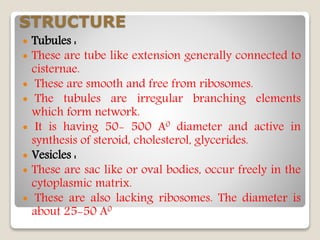
 Tubules :
 These are tube like extension generally connected to
cisternae.
 These are smooth and free from ribosomes.
 The tubules are irregular branching elements
which form network.
 It is having 50- 500 A0 diameter and active in
synthesis of steroid, cholesterol, glycerides.
 Vesicles :
 These are sac like or oval bodies, occur freely in the
cytoplasmic matrix.
 These are also lacking ribosomes. The diameter is
about 25-50 A0
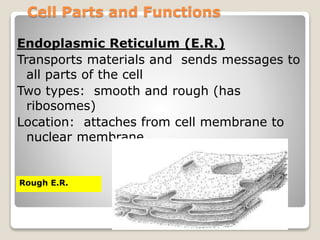
Cell Parts and Functions
Endoplasmic Reticulum (E.R.)
Transports materials and sends messages to
all parts of the cell
Two types: smooth and rough (has
ribosomes)
Location: attaches from cell membrane to
nuclear membrane
Rough E.R.
STRUCTURE
 E.R. membrane :- The membrane is lipo-
proteinous in nature which encloses the
matrix of E.R.
 It is 50-60 A0 in thickness.
 Various enzymes are associated with E.R.
are stearases, NADH- cytochrome. C-
reductase, Mg++ activated ATPase & other
enzymes like of glycerides, fatty acids, L-
ascorbic acid and steroid metabolism.
Endoplasmic Reticulum
 Structure: a system of membranous tubules
and sacs
 Function: intercellular highway (a path along
which molecules move from one part of the cell
to another)
 Two types:
◦ Rough Endoplasmic Reticulum
◦ Smooth Endoplasmic Reticulum
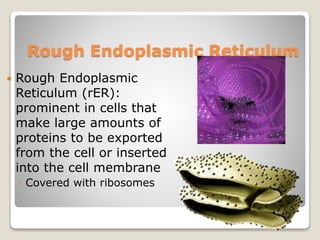
Rough Endoplasmic Reticulum
 Rough Endoplasmic
Reticulum (rER):
prominent in cells that
make large amounts of
proteins to be exported
from the cell or inserted
into the cell membrane
◦ Covered with ribosomes
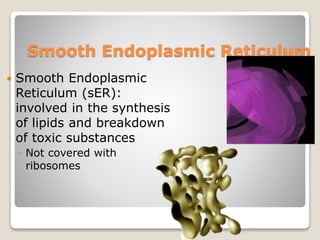
Smooth Endoplasmic Reticulum
 Smooth Endoplasmic
Reticulum (sER):
involved in the synthesis
of lipids and breakdown
of toxic substances
◦ Not covered with
ribosomes
Functions :
 The network of E.R. separates cytoplasm into
several small compartments which helps the
cell to perform specific activities by providing
enzymes and metabolites within specific
chambers excluding others.
 E.R. given mechanical support to cytoplasm
to provides a kind of inter cellular
cytoskeleton to maintain the form of cell and
keeps cell organelles distributed properly in
relation to one another.
 E.R. has osmotic properties and it is involved
in intra- cellular exchange of materials
particularly between the cytoplasm and the
nucleus.
 E.R. helps in membrane formation in
eukaryotic cell. It play a role in synthesis of
new nuclear membrane using cell division.
Functions :
 E.R. serves as circular system for the
transportation of cellular molecules and helps
in the storage of synthesized molecules.
 The enzymes of smooth E.R. involve in the
synthesis of cholesterol their conversion into
the steroid hormone.
 Rough E.R. play a role in protein synthesis
and some specific proteins synthesized by
ribosome when enter into E.R. lumen and
they get modified.
 Some enzymes of E.R. e.g. cytochrome P
450 convert lipid soluble molecules of drugs
into the water soluble molecules.
THANKS

ENDOPLASMIC RETICULUM

  • 1.
    ENDOPLASMIC RETICULUM STRUCTURE ANDFUNCTIONS DR. DILIP V. HANDE ASSOCIATE PROFESSOR, DEPT OF BOTANY SHRI SHIVAJI SCIENCE COLLEGE, AMRAVATI MS.
  • 2.
    INTRODUCTION  Endoplasmic reticulumis double membrane network system observed for the first time by Porter, Claude & Fullan (1945) in the cytoplasm.  Later on in 1953 Porter & Kallmon termed it as Endoplasmic Reticulum .  It is an finely divided complex vascular system extending from the outer nuclear membrane passing through cytoplasm to plasma-membrane.  It is a network of cisternae, tubules & vesicles.
  • 3.
    Endoplasmic Reticulum -ER  Network of hollow membrane tubules  Connects to nuclear envelope & cell membrane  Functions in Synthesis of cell products & Transport copyright cmassengale 3Two kinds of ER ---ROUGH & SMOOTH
  • 4.
    Rough Endoplasmic Reticulum Ribosomes attached to surface ◦ Manufacture protiens ◦ Not all ribosomes attached to rough ER  May modify proteins from ribosomes
  • 5.
    Rough Endoplasmic Reticulum (RoughER)  Has ribosomes on its surface  Makes membrane proteins and proteins for EXPORT out of cell copyright cmassengale 5
  • 6.
    Rough Endoplasmic Reticulum(Rough ER)  Proteins are made by ribosomes on ER surface  They are then threaded into the interior of the Rough ER to be modified and transported copyright cmassengale 6
  • 7.
    Smooth Endoplasmic Reticulum No attached ribosomes  Has enzymes that help build molecules ◦ Carbohydrates ◦ Lipids
  • 8.
    Smooth Endoplasmic Reticulum Smooth ER lacks ribosomes on its surface  Is attached to the ends of rough ER  Makes cell products that are USED INSIDE the cell copyright cmassengale 8
  • 9.
    Functions of theSmooth ER  Makes membrane lipids (steroids)  Regulates calcium (muscle cells)  Destroys toxic substances (Liver) copyright cmassengale 9
  • 10.
    Endomembrane System copyright cmassengale10 Includes nuclear membrane connected to ER connected to cell membrane (transport)
  • 11.
  • 12.
    Occurrence  It isalmost found in all Eukaryotic cells and more distinct in young meristematic cells, the amount of E.R. varies from cell to cell.  It is found more in amount in those cells which are active for protein synthesis.
  • 14.
    Types Smooth or AgranularE.R. (SER):-  The membrane of smooth E.R. are not granular due to absence of ribosomes .  It is more abundant near the peripheral part of the cytoplasm & may found attached to the plasma-membrane.  It forms the transport vesicles in which large molecules (protein & lipid) are transported from one cell to other through plasmodesmata.  Rough or granular E.R.(RER )  The rough E.R. has granular surface due to the presence of large number of ribosomes attached to it.  These are found more abundant in deeper part of cytoplasm near the nucleus where it is connected to outer nuclear membrane. It is active protein synthesis.
  • 16.
    Structure :  Morphologicallythe E.R. consist of three types of structures. i.e. cisternae. vesicles and tubules.  Cisternae :  The cisternae are elongated, cylindrical, unbranched flattened sac like lie parallel to each other.  These are interconnected with each other and 40-50 A0 diameter.  Generally they bears ribosomes on their cytoplasmic faces and found in cell active in protein synthesis.
  • 17.
  • 18.
    STRUCTURE  Tubules : These are tube like extension generally connected to cisternae.  These are smooth and free from ribosomes.  The tubules are irregular branching elements which form network.  It is having 50- 500 A0 diameter and active in synthesis of steroid, cholesterol, glycerides.  Vesicles :  These are sac like or oval bodies, occur freely in the cytoplasmic matrix.  These are also lacking ribosomes. The diameter is about 25-50 A0
  • 21.
    Cell Parts andFunctions Endoplasmic Reticulum (E.R.) Transports materials and sends messages to all parts of the cell Two types: smooth and rough (has ribosomes) Location: attaches from cell membrane to nuclear membrane Rough E.R.
  • 22.
    STRUCTURE  E.R. membrane:- The membrane is lipo- proteinous in nature which encloses the matrix of E.R.  It is 50-60 A0 in thickness.  Various enzymes are associated with E.R. are stearases, NADH- cytochrome. C- reductase, Mg++ activated ATPase & other enzymes like of glycerides, fatty acids, L- ascorbic acid and steroid metabolism.
  • 23.
    Endoplasmic Reticulum  Structure:a system of membranous tubules and sacs  Function: intercellular highway (a path along which molecules move from one part of the cell to another)  Two types: ◦ Rough Endoplasmic Reticulum ◦ Smooth Endoplasmic Reticulum
  • 24.
    Rough Endoplasmic Reticulum Rough Endoplasmic Reticulum (rER): prominent in cells that make large amounts of proteins to be exported from the cell or inserted into the cell membrane ◦ Covered with ribosomes
  • 25.
    Smooth Endoplasmic Reticulum Smooth Endoplasmic Reticulum (sER): involved in the synthesis of lipids and breakdown of toxic substances ◦ Not covered with ribosomes
  • 26.
    Functions :  Thenetwork of E.R. separates cytoplasm into several small compartments which helps the cell to perform specific activities by providing enzymes and metabolites within specific chambers excluding others.  E.R. given mechanical support to cytoplasm to provides a kind of inter cellular cytoskeleton to maintain the form of cell and keeps cell organelles distributed properly in relation to one another.  E.R. has osmotic properties and it is involved in intra- cellular exchange of materials particularly between the cytoplasm and the nucleus.  E.R. helps in membrane formation in eukaryotic cell. It play a role in synthesis of new nuclear membrane using cell division.
  • 27.
    Functions :  E.R.serves as circular system for the transportation of cellular molecules and helps in the storage of synthesized molecules.  The enzymes of smooth E.R. involve in the synthesis of cholesterol their conversion into the steroid hormone.  Rough E.R. play a role in protein synthesis and some specific proteins synthesized by ribosome when enter into E.R. lumen and they get modified.  Some enzymes of E.R. e.g. cytochrome P 450 convert lipid soluble molecules of drugs into the water soluble molecules.
  • 28.