V.Kanthasamy
M.Sc.,LifeScience
Bharathidasan University
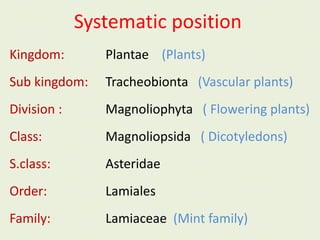
Systematic position
Kingdom: Plantae (Plants)
Sub kingdom: Tracheobionta (Vascular plants)
Division : Magnoliophyta ( Flowering plants)
Class: Magnoliopsida ( Dicotyledons)
S.class: Asteridae
Order: Lamiales
Family: Lamiaceae (Mint family)
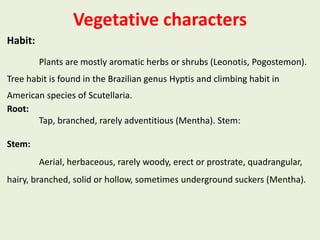
Vegetative characters
Habit:
Plants are mostly aromatic herbs or shrubs (Leonotis, Pogostemon).
Tree habit is found in the Brazilian genus Hyptis and climbing habit in
American species of Scutellaria.
Root:
Tap, branched, rarely adventitious (Mentha). Stem:
Stem:
Aerial, herbaceous, rarely woody, erect or prostrate, quadrangular,
hairy, branched, solid or hollow, sometimes underground suckers (Mentha).
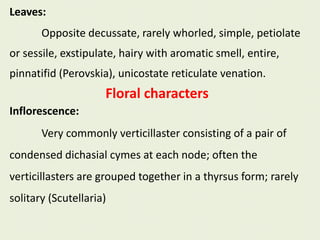
Leaves:
Opposite decussate, rarely whorled, simple, petiolate
or sessile, exstipulate, hairy with aromatic smell, entire,
pinnatifid (Perovskia), unicostate reticulate venation.
Floral characters
Inflorescence:
Very commonly verticillaster consisting of a pair of
condensed dichasial cymes at each node; often the
verticillasters are grouped together in a thyrsus form; rarely
solitary (Scutellaria)
Flower:
Pedicellate or sessile, bracteate, complete,
zygomorphic rarely actinomorphic (Mentha, Elsholtzia),
hermaphrodite, rarely unisexual (Nepeta, Thymus),
pentamerous hypogynous.
calyx:
Sepals 5, gamosepalous, bilabiate (Salvia, Thymus)
campanulate (Teucrium), persistent, valvate or imbricate
aestivation. When a bilabiate calyx is present the
arrangement of the sepals may be (1/4) as in Ocimum or
(2/3) as in Calamintha.
Corolla:
• Petals generally 5, gamopetalous and the five
teeth are sub-equal and mostly bilabiate.
• In Mentha a four lobed corolla arises due to the
fusion of two upper teeth. When a distinct bilabiate
condition is found the arrangement of the petals may
be gamopetalous 2/3 .
Ex:- Two petals in the posterior upper lip and three in
the anterior lower lip (Salvia, Nepeta, Leucas etc.).
In Ocimum, Coleus, Plectranthus etc. the
petals arrangement is gamopetalous 4/1.
Ex:-i.e. Four petals in the posterior upper lip and
only one petal in the anterior lower lip.
Aestivation :
Aestivation in the petals is valvate or
imbricate.
Androecium:
Typically only 4 stamens, didynamous (2+2)
and posterior stamen is reduced or represented by a
staminode .
In Salvia only two stamens on the anterior side
are found; they are characterised by peculiarly long
connectives which help in insect pollination stamens
generally introrse and dithecous.
Gynoecium:
Bicarpellary, syncarpous, superior,hypogynous honey secreting
disc; bilocular becomes tetralocular by the formation of false septum;
axile placentation, one ovule in each loculus; style gynobasic (arising
from the base of the ovary), stigma bilobed. The gynoecium character
is thus uniform without any variation.
Fruit:
Usually schizocarpic carcerulus or achenes or nutlets
rarely drupaceous.
Seed:
Non-endospermic.
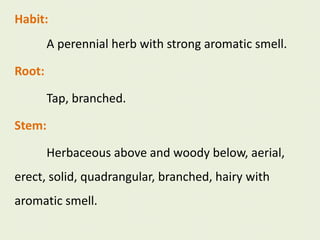
Ex . Of species - Ocimum santcum
Habit:
A perennial herb with strong aromatic smell.
Root:
Tap, branched.
Stem:
Herbaceous above and woody below, aerial,
erect, solid, quadrangular, branched, hairy with
aromatic smell.
Leaves:
Opposite decussate, simple, petiolate,
exstipulate, ovate, serrate, acute, hairy, unicostate
reticulate.
Inflorescence:
A verticillaster.
Flower:
Bracteate and bracteolate, pedicellate,
complete, hermaphrodite, zygomorphic,
pentamerous, hypogynous bilabiate, small and pink.
Calyx:
Sepals 5, gamosepalous, bilabiate (1/4),
posterior or upper lip broad and lower or anterior lip
with small sepals; gland dotted, violet green, imbricate
aestivation.
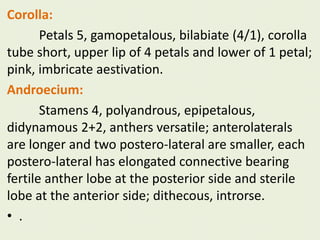
Corolla:
Petals 5, gamopetalous, bilabiate (4/1), corolla
tube short, upper lip of 4 petals and lower of 1 petal;
pink, imbricate aestivation.
Androecium:
Stamens 4, polyandrous, epipetalous,
didynamous 2+2, anthers versatile; anterolaterals
are longer and two postero-lateral are smaller, each
postero-lateral has elongated connective bearing
fertile anther lobe at the posterior side and sterile
lobe at the anterior side; dithecous, introrse.
• .
Gynoecium:
Bicarpellary, syncarpous, superior, bilocular but
becoming tetralocular, axile placentation, one ovule
in each loculus; style gynobasic; stigma bifid
Fruit:
Carcerulus.
Seed:
Non-endospermic.
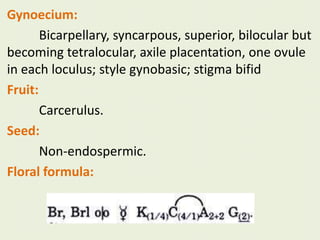
Floral formula:
FLORALDIAGRAM
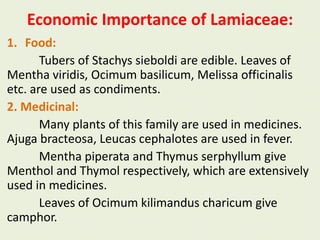
Economic Importance of Lamiaceae:
1. Food:
Tubers of Stachys sieboldi are edible. Leaves of
Mentha viridis, Ocimum basilicum, Melissa officinalis
etc. are used as condiments.
2. Medicinal:
Many plants of this family are used in medicines.
Ajuga bracteosa, Leucas cephalotes are used in fever.
Mentha piperata and Thymus serphyllum give
Menthol and Thymol respectively, which are extensively
used in medicines.
Leaves of Ocimum kilimandus charicum give
camphor.
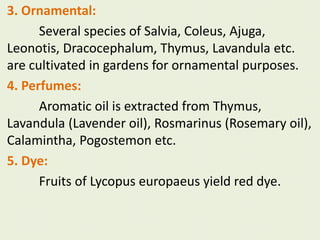
3. Ornamental:
Several species of Salvia, Coleus, Ajuga,
Leonotis, Dracocephalum, Thymus, Lavandula etc.
are cultivated in gardens for ornamental purposes.
4. Perfumes:
Aromatic oil is extracted from Thymus,
Lavandula (Lavender oil), Rosmarinus (Rosemary oil),
Calamintha, Pogostemon etc.
5. Dye:
Fruits of Lycopus europaeus yield red dye.
Family lamiaceae

Family lamiaceae

  • 1.
  • 2.
    Systematic position Kingdom: Plantae(Plants) Sub kingdom: Tracheobionta (Vascular plants) Division : Magnoliophyta ( Flowering plants) Class: Magnoliopsida ( Dicotyledons) S.class: Asteridae Order: Lamiales Family: Lamiaceae (Mint family)
  • 3.
    Vegetative characters Habit: Plants aremostly aromatic herbs or shrubs (Leonotis, Pogostemon). Tree habit is found in the Brazilian genus Hyptis and climbing habit in American species of Scutellaria. Root: Tap, branched, rarely adventitious (Mentha). Stem: Stem: Aerial, herbaceous, rarely woody, erect or prostrate, quadrangular, hairy, branched, solid or hollow, sometimes underground suckers (Mentha).
  • 4.
    Leaves: Opposite decussate, rarelywhorled, simple, petiolate or sessile, exstipulate, hairy with aromatic smell, entire, pinnatifid (Perovskia), unicostate reticulate venation. Floral characters Inflorescence: Very commonly verticillaster consisting of a pair of condensed dichasial cymes at each node; often the verticillasters are grouped together in a thyrsus form; rarely solitary (Scutellaria)
  • 5.
    Flower: Pedicellate or sessile,bracteate, complete, zygomorphic rarely actinomorphic (Mentha, Elsholtzia), hermaphrodite, rarely unisexual (Nepeta, Thymus), pentamerous hypogynous. calyx: Sepals 5, gamosepalous, bilabiate (Salvia, Thymus) campanulate (Teucrium), persistent, valvate or imbricate aestivation. When a bilabiate calyx is present the arrangement of the sepals may be (1/4) as in Ocimum or (2/3) as in Calamintha.
  • 6.
    Corolla: • Petals generally5, gamopetalous and the five teeth are sub-equal and mostly bilabiate. • In Mentha a four lobed corolla arises due to the fusion of two upper teeth. When a distinct bilabiate condition is found the arrangement of the petals may be gamopetalous 2/3 . Ex:- Two petals in the posterior upper lip and three in the anterior lower lip (Salvia, Nepeta, Leucas etc.).
  • 7.
    In Ocimum, Coleus,Plectranthus etc. the petals arrangement is gamopetalous 4/1. Ex:-i.e. Four petals in the posterior upper lip and only one petal in the anterior lower lip. Aestivation : Aestivation in the petals is valvate or imbricate.
  • 8.
    Androecium: Typically only 4stamens, didynamous (2+2) and posterior stamen is reduced or represented by a staminode . In Salvia only two stamens on the anterior side are found; they are characterised by peculiarly long connectives which help in insect pollination stamens generally introrse and dithecous.
  • 9.
    Gynoecium: Bicarpellary, syncarpous, superior,hypogynoushoney secreting disc; bilocular becomes tetralocular by the formation of false septum; axile placentation, one ovule in each loculus; style gynobasic (arising from the base of the ovary), stigma bilobed. The gynoecium character is thus uniform without any variation. Fruit: Usually schizocarpic carcerulus or achenes or nutlets rarely drupaceous. Seed: Non-endospermic.
  • 10.
    Ex . Ofspecies - Ocimum santcum
  • 11.
    Habit: A perennial herbwith strong aromatic smell. Root: Tap, branched. Stem: Herbaceous above and woody below, aerial, erect, solid, quadrangular, branched, hairy with aromatic smell.
  • 12.
    Leaves: Opposite decussate, simple,petiolate, exstipulate, ovate, serrate, acute, hairy, unicostate reticulate. Inflorescence: A verticillaster. Flower: Bracteate and bracteolate, pedicellate, complete, hermaphrodite, zygomorphic, pentamerous, hypogynous bilabiate, small and pink. Calyx: Sepals 5, gamosepalous, bilabiate (1/4), posterior or upper lip broad and lower or anterior lip with small sepals; gland dotted, violet green, imbricate aestivation.
  • 13.
    Corolla: Petals 5, gamopetalous,bilabiate (4/1), corolla tube short, upper lip of 4 petals and lower of 1 petal; pink, imbricate aestivation. Androecium: Stamens 4, polyandrous, epipetalous, didynamous 2+2, anthers versatile; anterolaterals are longer and two postero-lateral are smaller, each postero-lateral has elongated connective bearing fertile anther lobe at the posterior side and sterile lobe at the anterior side; dithecous, introrse. • .
  • 14.
    Gynoecium: Bicarpellary, syncarpous, superior,bilocular but becoming tetralocular, axile placentation, one ovule in each loculus; style gynobasic; stigma bifid Fruit: Carcerulus. Seed: Non-endospermic. Floral formula:
  • 15.
  • 16.
    Economic Importance ofLamiaceae: 1. Food: Tubers of Stachys sieboldi are edible. Leaves of Mentha viridis, Ocimum basilicum, Melissa officinalis etc. are used as condiments. 2. Medicinal: Many plants of this family are used in medicines. Ajuga bracteosa, Leucas cephalotes are used in fever. Mentha piperata and Thymus serphyllum give Menthol and Thymol respectively, which are extensively used in medicines. Leaves of Ocimum kilimandus charicum give camphor.
  • 17.
    3. Ornamental: Several speciesof Salvia, Coleus, Ajuga, Leonotis, Dracocephalum, Thymus, Lavandula etc. are cultivated in gardens for ornamental purposes. 4. Perfumes: Aromatic oil is extracted from Thymus, Lavandula (Lavender oil), Rosmarinus (Rosemary oil), Calamintha, Pogostemon etc. 5. Dye: Fruits of Lycopus europaeus yield red dye.