Prepared by - Dr. Sangeeta Das, Assistant Professor
Department of Botany, Bahona College, Jorhat, Assam, India.
Documentation in Plant Taxonomy:
Documentation:
The word ‘Documentation’ refers to the creation of scientific information, and bringing out the same in the form of a
scientific publication. Documentation in plant taxonomy and systematics thus refers to the publication or documentation
of taxonomic results in different forms such as floras, monographs, in journals (traditionally printed offline as well as
in online journals also). This enables in dissemination of taxonomic information to various users, and its reproduction
and retrieval. This may be available as hard or soft version, as e-document (or e-resources) and can be referred to by a
wide range of users. The following important documents are discussed in detail:
1. Floras:
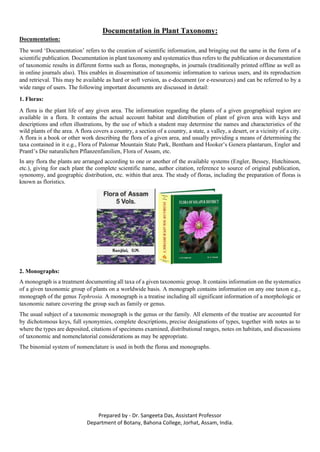
A flora is the plant life of any given area. The information regarding the plants of a given geographical region are
available in a flora. It contains the actual account habitat and distribution of plant of given area with keys and
descriptions and often illustrations, by the use of which a student may determine the names and characteristics of the
wild plants of the area. A flora covers a country, a section of a country, a state, a valley, a desert, or a vicinity of a city.
A flora is a book or other work describing the flora of a given area, and usually providing a means of determining the
taxa contained in it e.g., Flora of Palomar Mountain State Park, Bentham and Hooker’s Genera plantarum, Engler and
Prantl’s Die naturalichen Pflanzenfamilien, Flora of Assam, etc.
In any flora the plants are arranged according to one or another of the available systems (Engler, Bessey, Hutchinson,
etc.), giving for each plant the complete scientific name, author citation, reference to source of original publication,
synonomy, and geographic distribution, etc. within that area. The study of floras, including the preparation of floras is
known as floristics.
2. Monographs:
A monograph is a treatment documenting all taxa of a given taxonomic group. It contains information on the systematics
of a given taxonomic group of plants on a worldwide basis. A monograph contains information on any one taxon e.g.,
monograph of the genus Tephrosia. A monograph is a treatise including all significant information of a morphologic or
taxonomic nature covering the group such as family or genus.
The usual subject of a taxonomic monograph is the genus or the family. All elements of the treatise are accounted for
by dichotomous keys, full synonymies, complete descriptions, precise designations of types, together with notes as to
where the types are deposited, citations of specimens examined, distributional ranges, notes on habitats, and discussions
of taxonomic and nomenclatorial considerations as may be appropriate.
The binomial system of nomenclature is used in both the floras and monographs.
Prepared by - Dr. Sangeeta Das, Assistant Professor
Department of Botany, Bahona College, Jorhat, Assam, India.
3. Taxonomic revision:
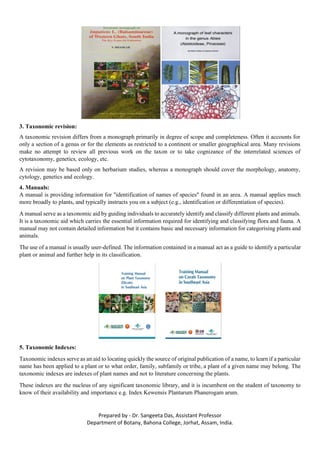
A taxonomic revision differs from a monograph primarily in degree of scope and completeness. Often it accounts for
only a section of a genus or for the elements as restricted to a continent or smaller geographical area. Many revisions
make no attempt to review all previous work on the taxon or to take cognizance of the interrelated sciences of
cytotaxonomy, genetics, ecology, etc.
A revision may be based only on herbarium studies, whereas a monograph should cover the morphology, anatomy,
cytology, genetics and ecology.
4. Manuals:
A manual is providing information for "identification of names of species" found in an area. A manual applies much
more broadly to plants, and typically instructs you on a subject (e.g., identification or differentiation of species).
A manual serve as a taxonomic aid by guiding individuals to accurately identify and classify different plants and animals.
It is a taxonomic aid which carries the essential information required for identifying and classifying flora and fauna. A
manual may not contain detailed information but it contains basic and necessary information for categorising plants and
animals.
The use of a manual is usually user-defined. The information contained in a manual act as a guide to identify a particular
plant or animal and further help in its classification.
5. Taxonomic Indexes:
Taxonomic indexes serve as an aid to locating quickly the source of original publication of a name, to learn if a particular
name has been applied to a plant or to what order, family, subfamily or tribe, a plant of a given name may belong. The
taxonomic indexes are indexes of plant names and not to literature concerning the plants.
These indexes are the nucleus of any significant taxonomic library, and it is incumbent on the student of taxonomy to
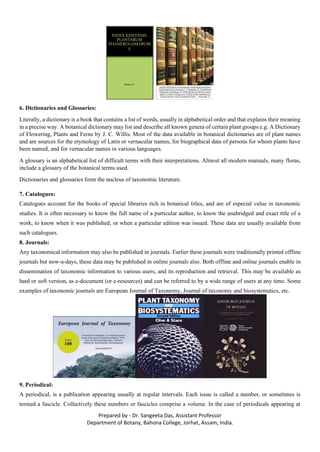
know of their availability and importance e.g. Index Kewensis Plantarum Phanerogam arum.
Prepared by - Dr. Sangeeta Das, Assistant Professor
Department of Botany, Bahona College, Jorhat, Assam, India.
6. Dictionaries and Glossaries:
Literally, a dictionary is a book that contains a list of words, usually in alphabetical order and that explains their meaning
in a precise way. A botanical dictionary may list and describe all known genera of certain plant groups e.g. A Dictionary
of Flowering, Plants and Ferns by J. C. Willis. Most of the data available in botanical dictionaries are of plant names
and are sources for the etymology of Latin or vernacular names, for biographical data of persons for whom plants have
been named, and for vernacular names in various languages.
A glossary is an alphabetical list of difficult terms with their interpretations. Almost all modern manuals, many floras,
include a glossary of the botanical terms used.
Dictionaries and glossaries form the nucleus of taxonomic literature.
7. Catalogues:
Catalogues account for the books of special libraries rich in botanical titles, and are of especial value in taxonomic
studies. It is often necessary to know the full name of a particular author, to know the unabridged and exact title of a
work, to know when it was published, or when a particular edition was issued. These data are usually available from
such catalogues.
8. Journals:
Any taxonomical information may also be published in journals. Earlier these journals were traditionally printed offline
journals but now-a-days, these data may be published in online journals also. Both offline and online journals enable in
dissemination of taxonomic information to various users, and its reproduction and retrieval. This may be available as
hard or soft version, as e-document (or e-resources) and can be referred to by a wide range of users at any time. Some
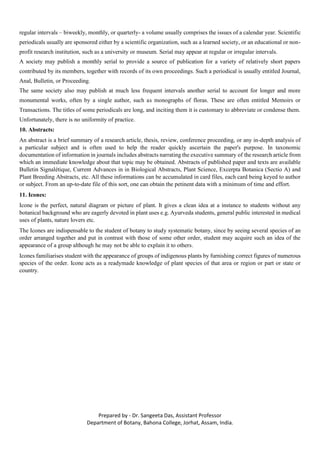
examples of taxonomic journals are European Journal of Taxonomy, Journal of taxonomy and biosystematics, etc.
9. Periodical:
A periodical, is a publication appearing usually at regular intervals. Each issue is called a number, or sometimes is
termed a fascicle. Collectively these numbers or fascicles comprise a volume. In the case of periodicals appearing at
Prepared by - Dr. Sangeeta Das, Assistant Professor
Department of Botany, Bahona College, Jorhat, Assam, India.
regular intervals – biweekly, monthly, or quarterly- a volume usually comprises the issues of a calendar year. Scientific
periodicals usually are sponsored either by a scientific organization, such as a learned society, or an educational or non-
profit research institution, such as a university or museum. Serial may appear at regular or irregular intervals.
A society may publish a monthly serial to provide a source of publication for a variety of relatively short papers
contributed by its members, together with records of its own proceedings. Such a periodical is usually entitled Journal,
Anal, Bulletin, or Proceeding.
The same society also may publish at much less frequent intervals another serial to account for longer and more
monumental works, often by a single author, such as monographs of floras. These are often entitled Memoirs or
Transactions. The titles of some periodicals are long, and inciting them it is customary to abbreviate or condense them.
Unfortunately, there is no uniformity of practice.
10. Abstracts:
An abstract is a brief summary of a research article, thesis, review, conference proceeding, or any in-depth analysis of
a particular subject and is often used to help the reader quickly ascertain the paper's purpose. In taxonomic
documentation of information in journals includes abstracts narrating the executive summary of the research article from
which an immediate knowledge about that topic may be obtained. Abstracts of published paper and texts are available
Bulletin Signalétique, Current Advances in in Biological Abstracts, Plant Science, Excerpta Botanica (Sectio A) and
Plant Breeding Abstracts, etc. All these informations can be accumulated in card files, each card being keyed to author
or subject. From an up-to-date file of this sort, one can obtain the petinent data with a minimum of time and effort.
11. Icones:
Icone is the perfect, natural diagram or picture of plant. It gives a clean idea at a instance to students without any
botanical background who are eagerly devoted in plant uses e.g. Ayurveda students, general public interested in medical
uses of plants, nature lovers etc.
The Icones are indispensable to the student of botany to study systematic botany, since by seeing several species of an
order arranged together and put in contrast with those of some other order, student may acquire such an idea of the
appearance of a group although he may not be able to explain it to others.
Icones familiarises student with the appearance of groups of indigenous plants by furnishing correct figures of numerous
species of the order. Icone acts as a readymade knowledge of plant species of that area or region or part or state or
country.