PHARMACEUTICA
L PACKAGING
UNIT - III
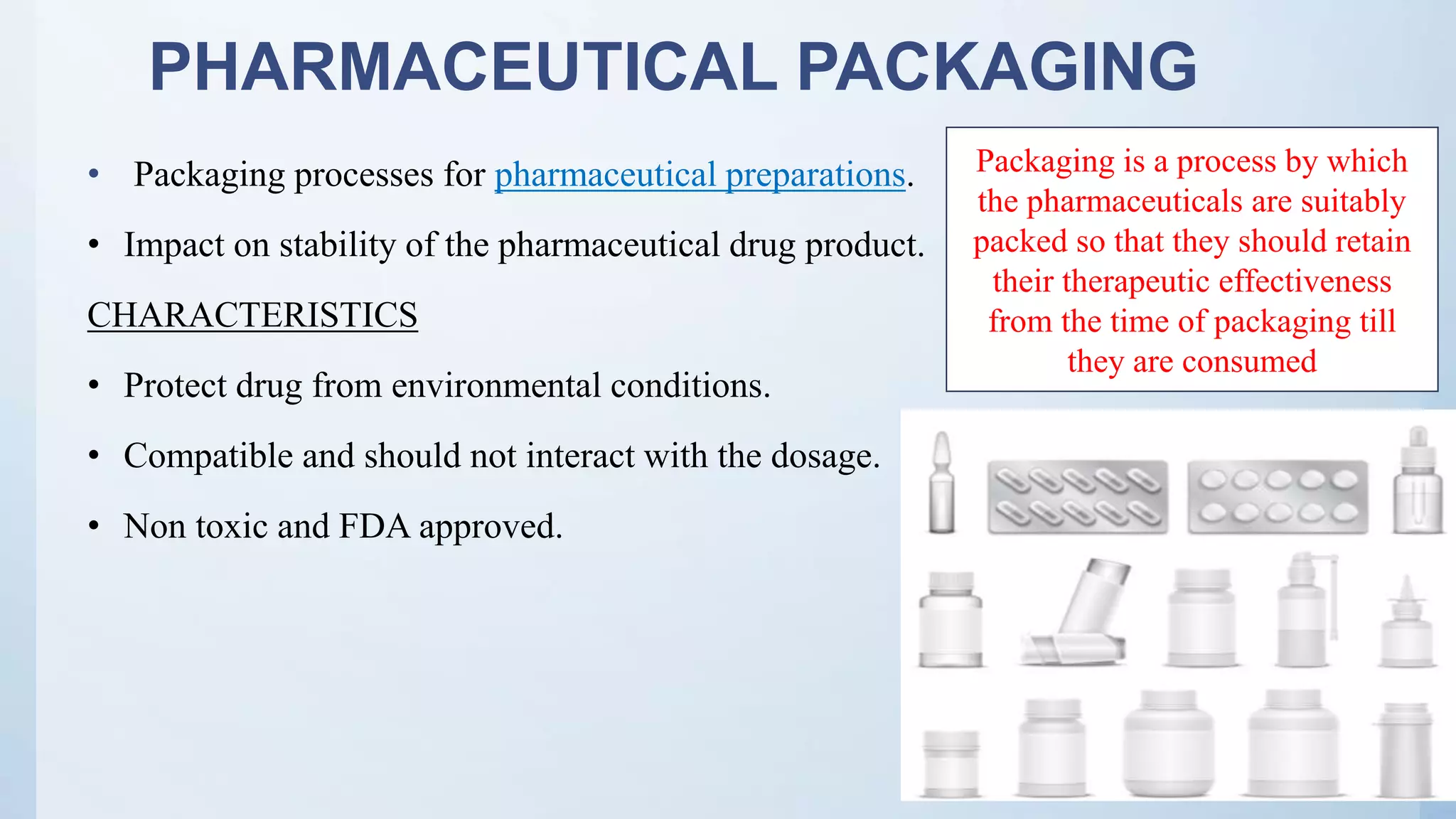
PHARMACEUTICAL PACKAGING
• Packaging processes for pharmaceutical preparations.
• Impact on stability of the pharmaceutical drug product.
CHARACTERISTICS
• Protect drug from environmental conditions.
• Compatible and should not interact with the dosage.
• Non toxic and FDA approved.
Packaging is a process by which
the pharmaceuticals are suitably
packed so that they should retain
their therapeutic effectiveness
from the time of packaging till
they are consumed
COMPOSITION OF PACKAGE
I. Container
II. Closure
III. Carton or Outer
IV. Box
A container :
a) Should not absorb the medicament
b) Should not alter the stability
c) Should withstand sterilization procedure
d) Should facilitate easy handling and withdrawal
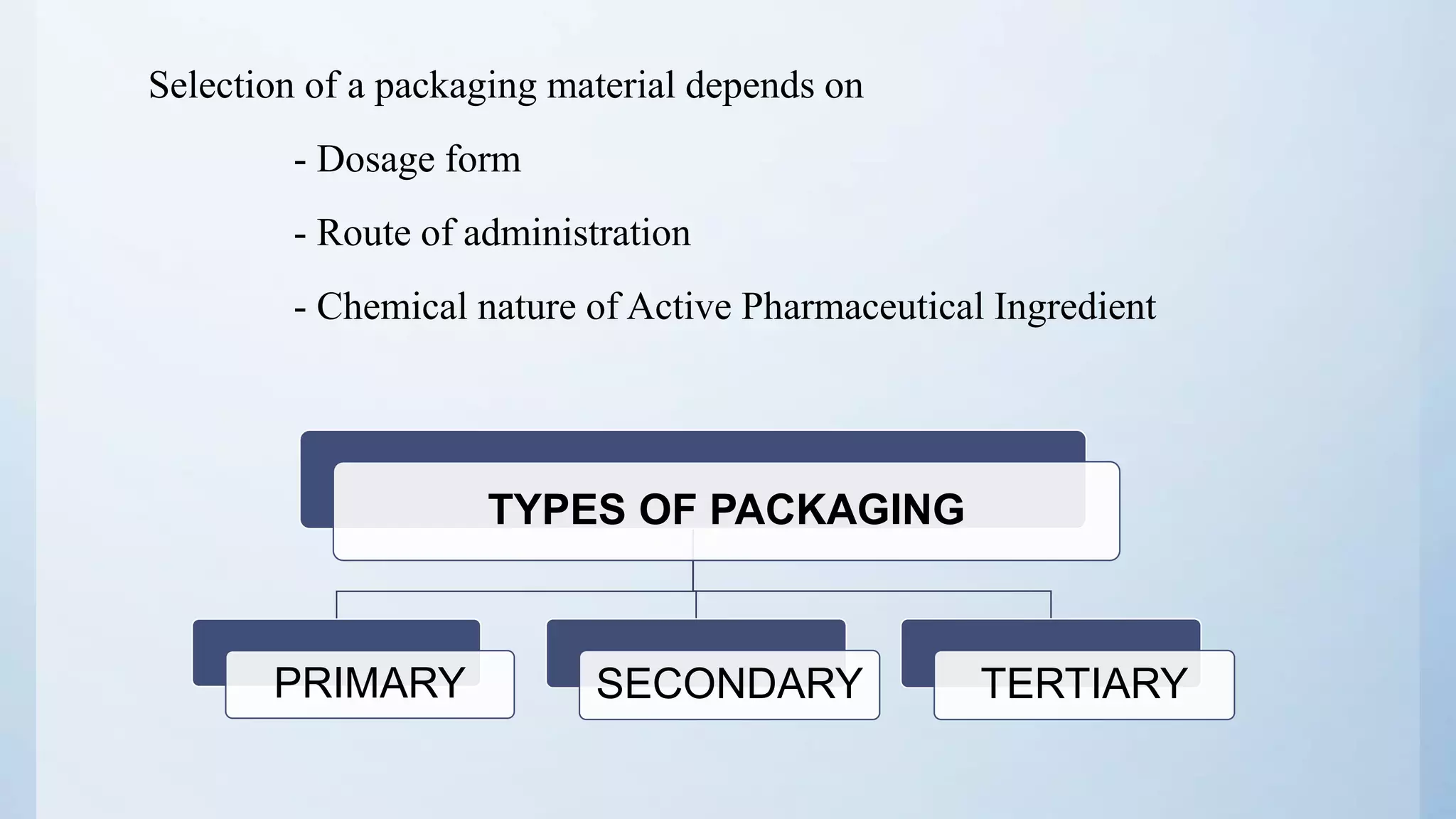
Selection of a packaging material depends on
- Dosage form
- Route of administration
- Chemical nature of Active Pharmaceutical Ingredient
TYPES OF PACKAGING
PRIMARY SECONDARY TERTIARY
PRIMARY
TERTIARY
SECONDARY
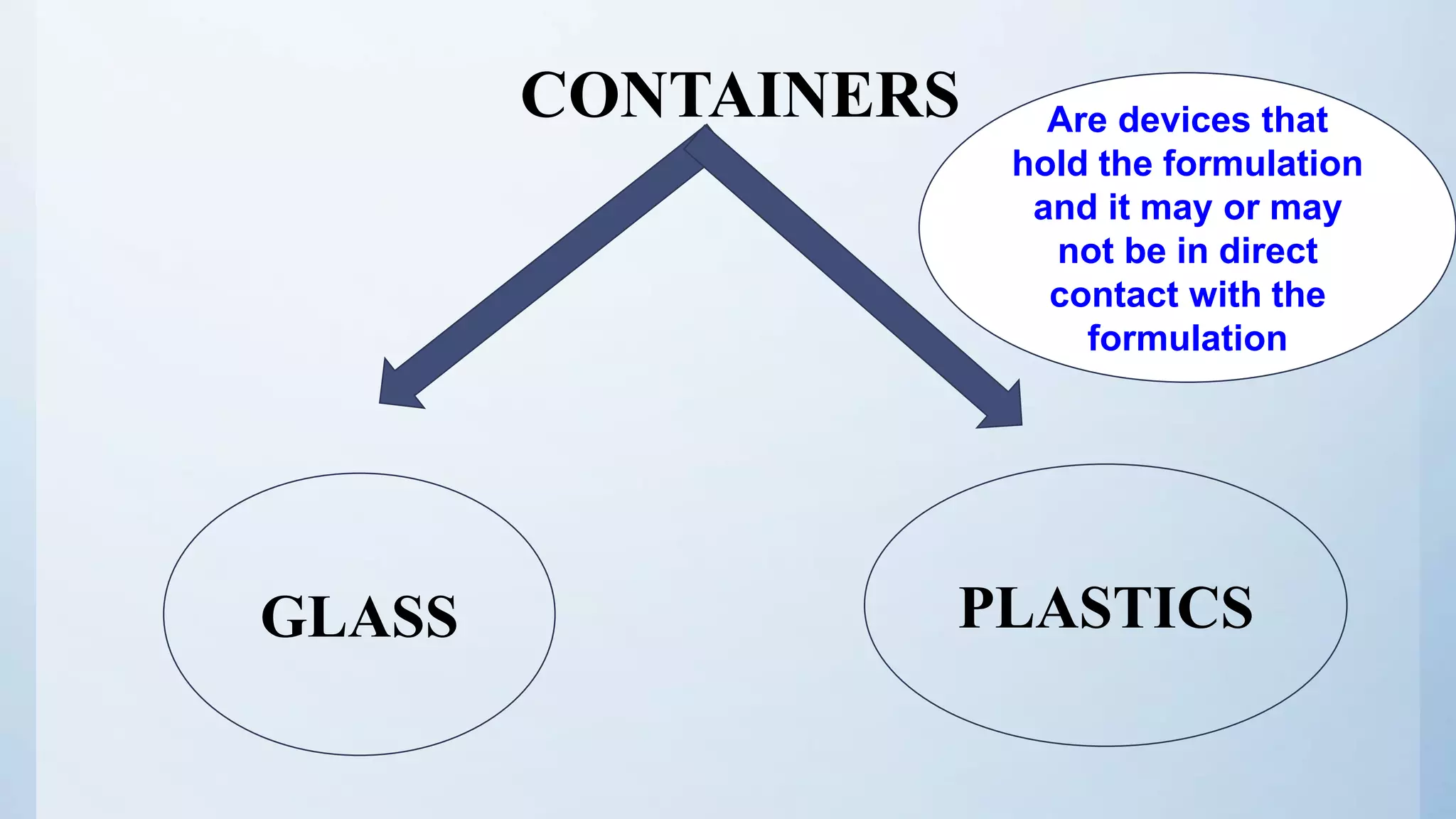
CONTAINERS
GLASS PLASTICS
Are devices that
hold the formulation
and it may or may
not be in direct
contact with the
formulation
GLASS
• Most commonly used, FDA approved, of high strength
• Ability to modify into different shapes
• Resistivity towards various chemicals
• Should be sufficiently strong to tolerate high pressure and
protect degradation from UV rays.
• 4 Types –
- type 1 – borosilicate glass
- type 2 – treated soda lime glass
- type 3 – soda lime glass
- type 4 – NP glass
QUALITY
CONTROL
OF GLASS
POWDERED
GLASS TEST
WATER
ATTACK
TEST
SURFACE
TREATMENT
TEST
LEAKAGE TEST
THERMAL
ATTACK TEST
HYDROLYTIC
RESISTANCE
TEST
ARSENIC
TEST
LIGHT
TRANSMISSION
INTERNAL
BURSTING
PRESSURE TEST
1. HYDROLYTIC RESISTANCE TEST - TEST A
Wash the containers with distilled water for the prevention of
entry of air bubbles and then dried properly
Fill containers with CO2 free water and wrap
with aluminum foil
Place containers in the autoclave and close the container
Displace air by passage of steam of air for 10 minutes. Raise
the temperature from 100-121°C over 20 mints, maintain the
temperature of 121°C for 60mints, and reduce the temperature
from 121-100°C over 40mints, vent to prevent vacuum
Remove containers from auto clave and cool them in a
bath of running tap water. Conduct a titration using HCl in
burette and compare the endpoint with CO2 free water as
blank using methyl red as indicator.
•evaluate
quality of outer
surface of the
container
•Under
controlled
conditions with
help of
autoclave and
thermocouples
Capacity of container corresponding
to 90% of average overflow
volume (ml)
Volume of 0.01M
Hcl/100ml
Type I/ II Type III
Not More Than (NMT) 1 2.0 20.0
More than 1 but NMT 2 1.8 17.6
More than 2 but NMT 5 1.3 13.2
More than 5 but NMT 10 1.0 10.2
More than 10 but NMT 20 0.8 8.1
More than 20 but NMT 50 0.6 6.1
More than 50 but NMT 100 0.5 4.8
More than 100 but NMT 200 0.4 3.8
More than 200 but NMT 500 0.3 2.9
More than 500 0.2 2.2
2. POWDERED GLASS TEST - TEST B
Take three containers, rinse and dry
Crush it into coarse fragments. Pass through 725μm and
425μm sieve.
Glass fragments on 425μm are checked for metal
impurities and if present they are removed.
The glass pieces are kept in conical flask, containing
CO2 free water
Conduct a titration using HCl in burette and compare the
endpoint with CO2 free water as blank using methyl red as
indicator.
Limits are
same as
TEST A
3. SURFACE TREATMENT TEST - TEST C
Select and rinse containers with distilled water,
hydrofluoric acid and hydrochloric acid in ratio 1:9
Wash containers with water several times
Conduct a titration using HCl in burette and compare
the endpoint with CO2 free water as blank using
methyl red as indicator.
If the limits exceeds the values of TEST A –
TREATED GLASS
•Test whether
surface of glass is
treated
•Differentiates
Type II and III
glass
4. WATER ATTACK TEST
Fill containers with purified CO2 free
water and seal with aluminum foils.
Autoclave for 60 minutes at 120°C.
100ml of the content is taken into
250ml conical flask. Add methyl red
solution as indicator
Conduct a titration using 0.02N
Sulphuric Acid and observe the
endpoint
Volume limits of 0.02 H2SO4 for
type II glass should not exceed
0.7ml
Done to determine the alkali
leached from the surface is under
specified limits or not.
Test is used only for glass treated
with sulphur dioxide fumes under
controlled conditions.
The amount of acid required to
neutralize the alkali released from
the surface is estimated
5. INTERNAL BURSTING PRESSURE TEST
Fill containers with purified CO2 free water and place in the
testing chamber.
A scaling head is placed an the internal pressure is increased in
increments each of which is held for specific time
Container is checked for predetermined pressure level and the test
continues till the container bursts.
6. THERMAL ATTACK TEST
Place samples in upright position in a tray
Immerse the tray into hot water for given time and
transfer to cold water bath
Examine the cracks or breaks before and after the test
“ Small bottle withstands the temperature different of 60 to
80°c and a pint bottle 30 to 40°c”
7. LEAKAGE TEST TEST
Drug filled container is placed in a container filed with
coloured solution.
Coloured solution is at high pressure than the pressure inside
the glass container.
Coloured solution enters the glass container if any
breakage or crack is present.
8. ARSENIC TEST
Wash inner and outer side of container 5 times
Prepare test solution.
Pipette out 10 ml solution from the combined
contents
Add 10 ml nitric acid, evaporated to dryness
Dry the residue at 130°c for 30 minute and cool
Add 10 ml of Hydrogen molybdate reagent
Heat on water bath and reflux for 25 minute
Cool and determine absorbance at 840 nm
Prepare blank with 10 ml Hydrogen molybdate
Absorbance of
the test solution
does not exceed
the absorbance
obtained by
repeating the
determination
using 0.1 ml
arsenic standard
solution
9. LIGHT TRANSMISSION TEST
Break the glass container
Select section suitable for mounting in a spectrophotometer
Place the specimen in the spectrophotometer
ABSORBANCE MAXIMUM % OF LIGHT
WAVELENGTH BETWEEN
TRANSMISSION AT ANY
290 TO 450 nm
FLAME SEALED
CONTAINERS
CONTAINER WITH
CLOSURE
Upto 1 50 25
Above 1 and upto 2 45 20
Above 2 and upto 5 40 15
Above 5 and upto 10 35 13
Above 10 and upto 20 30 12
Above 20 15 10
PLASTIC
• Cross linking of synthetic or semi synthetic long chain polymer
• Addictives are added to improve physicochemical property.
• Addictives – antistatic agents
- fillers
- antioxidants
- antimicrobial agents
• Antistatic agents – plastic develop static charge on surface
responsible for the attraction of dust particles on the surface,
which males it dull and contaminated. This can be avoided by
adding antistatic agents like phosphate esters.
• Fillers – increase the bulk quantity and the strength of the
plastic.
• Antioxidants – plastics tend to permeate oxygen by breaking
the long chain polymer structure leading to oxidation.
Antioxidants like phenolic compounds can be used to prevent
oxidation.
• Antimicrobial agents- to prevent microbial attack.
ADVANTAGES
• Lighter than glass
• Flexible
• Variety of sizes and shapes
• Chemically inert, strong,
rigid
• Extremely resistant to
breakage.
DISADVANTAGES
• Absorption of moisture
• Thermostatic change
Types of plastic materials
A.Thermosetting
B.Thermoplastic
PLASTIC MATERIALS
• POLYETHYLENE – excellent barrier to moisture, resistance to attack of acids and
alkali.
• NYLON – resistance to strong acid and alkali, strong barrier to oxygen and moisture,
not preferred to long term use due to interaction
• POLYVINYLCHLORIDE – construction of plastic bottles and lamination of inner
side of the glass bottle.
PROPERTIES OF PLASTIC TO BE CONSIDERED
• SORPTION
• PHOTO DEGRADATION
• DESORPTION / LEACHING
• PERMEATION
• CHEMICAL REACTIVITY
SORPTION
• Loss of formulation constituents due to the interaction with
packaging materials.
• Significant decrease in the drug content, and the therapeutic
efficacy.
• Diazepam showed significant sorption of drugs when stored
at room temp. in the dark in a PVC bag whereas no sorption
was observed when stored in glass containers.
DESORPTION / LEACHING
• One or more addictives are added in the plastic materials when
they are needed to impart specific properties to the plastic.
• Migration of the contents from the plastic into the formulation –
desorption or leaching
• Can occur due to the effect of change in pH, temp., solvent type
and type of plastic and additive present.
PERMEATION
• Plastic can permeate gases or vapours or water vapour –
this leads to instability of the formulation.
• Oxygen permeation can lead to oxidation of the product
• Water vapour permeation can lead to hydrolysis
• Storage conditions, type of plastic material or addictive,
method of manufacture can be the causes of permeation.
PHOTODEGRADATION
• Formulation ingredients when exposed to UV light can lead to
photo degradation.
• Also some functional groups of the polymers present in the plastic
are prone to absorb UV radiation and hence transmits UV rays
through the plastic container.
• Change in the physical or chemical properties of plastic.
• Subsequently affect the stability of the drugs
• Opacifying agents can be used prevent photo degradation.
CHEMICAL REACTIVITY
• Incompatibility between the ingredient and the plastic material.
• Leads to modification of the drug product.
• Which makes the drug improper for consumption.
QUALITY
CONTROL OF PLASTIC
CONTAINERS
QC TEST
OF
PLASTIC
LEAKAGE
TEST
COLLAPSIBILITY
TEST
CLARITY
TEST
NON
VOLATILE
RESIDUE
BACTERIOLOGICAL
TEST
WATER VAPOUR
PERMEABILITY
TRANSPARENCY
1. LEAKAGE TEST
Fill 10 containers with distilled water and fit
closures
Keep inverted at room temperature for 24
hours
No sign of leakage should be there
2. COLLAPSIBILITY TEST
Take containers with
required contents.
Squeeze the contents with
optimum force.
90% of the content should be
extruded at an optimum force and
temperature.
Indicates the
squeezing property of
the container
3. CLARITY TEST
Cut several strips of 20cmsq. area from both sided from
container to be tested.
Strips taken from area of container that is unlabelled,
unmarked and non laminated.
Select 60-65 strips, wash and transfer to the 250ml
conical flask. Add water and autoclave for 121℃ for
30mints.
Carry out same procedure with blank
Cool the strips, and compare the aqueous extract of the
test and the blank for clarity
4. NON VOLATILE RESIDUE TEST
100ml of the extract from clarity test taken
Heated to dryness till constant weight
Residue should not be more than 12.5mg
5. TRANSPARENCY TEST
• Fill test containers with diluted suspensions of a sample
• Fill standard containers with distilled water
• The cloudiness of the diluted suspension should be
observed with in the container to prove the transparency
of the plastic material
6a. BIOLOGICAL TEST
Inject sample and blank in 5 mice
each.
Observe the animals immediately,
after 4hour, and then at 24, 48, and 72
hours.
If animals show abnormal behaviour like
convulsions or body weight loss is greater
than 2gm, the sample does not meet the
requirements.
Animal taken –
Albino Mice
6b. INTRACUTANEOUS TEST
Take 3 rabbits for each sample. Remove
hairs from surface to be examined and
clean with dilute ethanol.
Inject sample and blank at two
different sites on same animal
Observe and compare the local area for
edema, erythema and necrosis
Animal taken –
Rabbit
6c. EYE IRRITATION TEST
Inject 100 μl of sterile WFI in one
eye as the blank. Inject the sample in
another eye
Observe the animals immediately, 24,
48, and 72 hours.
Inspect for eye irritation and compare the
sample and test.
Animal taken –
RABBIT
7. WATER VAPOUR PERMEABILITY TEST
Fill 5 containers with water and seal. Weigh
each container and note down the weight.
Allow to stand for 14 days @ relative
humidity of 60±5 and temperature of 20-25℃
Reweigh each of the containers and the loss of
weight should not be more than 0.2%
CLOSURES
• Packaging component which is in direct contact with the
drug.
• Provides a barrier to dirt, oxygen, moisture, etc
• Retains the contents.
• Keeps the product secure from undesired and premature
opening.
• Minimises the effect of change in humidity, temp. or
pressure.
• Assists in dispensing and using of product.
CAP TYPE
ROLL ON TYPE
PLUG TYPE
CROWN TYPE OVER CAP TYPE
MATERIALS USED FOR CLOSURES
• METAL
• RUBBER
• PLASTIC
• GLASS
RUBBER CLOSURES
• Made from materials obtained by vulcanisation of
elastomers with appropriate addictives.
• Do not pose a problem and can be used in contact with
large number of drug preparations.
• Types of rubber used – butyl rubber, nitrile rubber,
neoprene rubber, silicon rubber
CHARACTERISTICS
• Should not become sticky upon storage
• Should not become hard on exposure to atmosphere
• Should not become dark on exposure to air and light.
• Ease of penetrability and elasticity in case of vials.
• Ease in sterilisation. Must withstand at least about 120℃
• Should not allow permeation of water vapour and air. Free from leaching and
sorption.
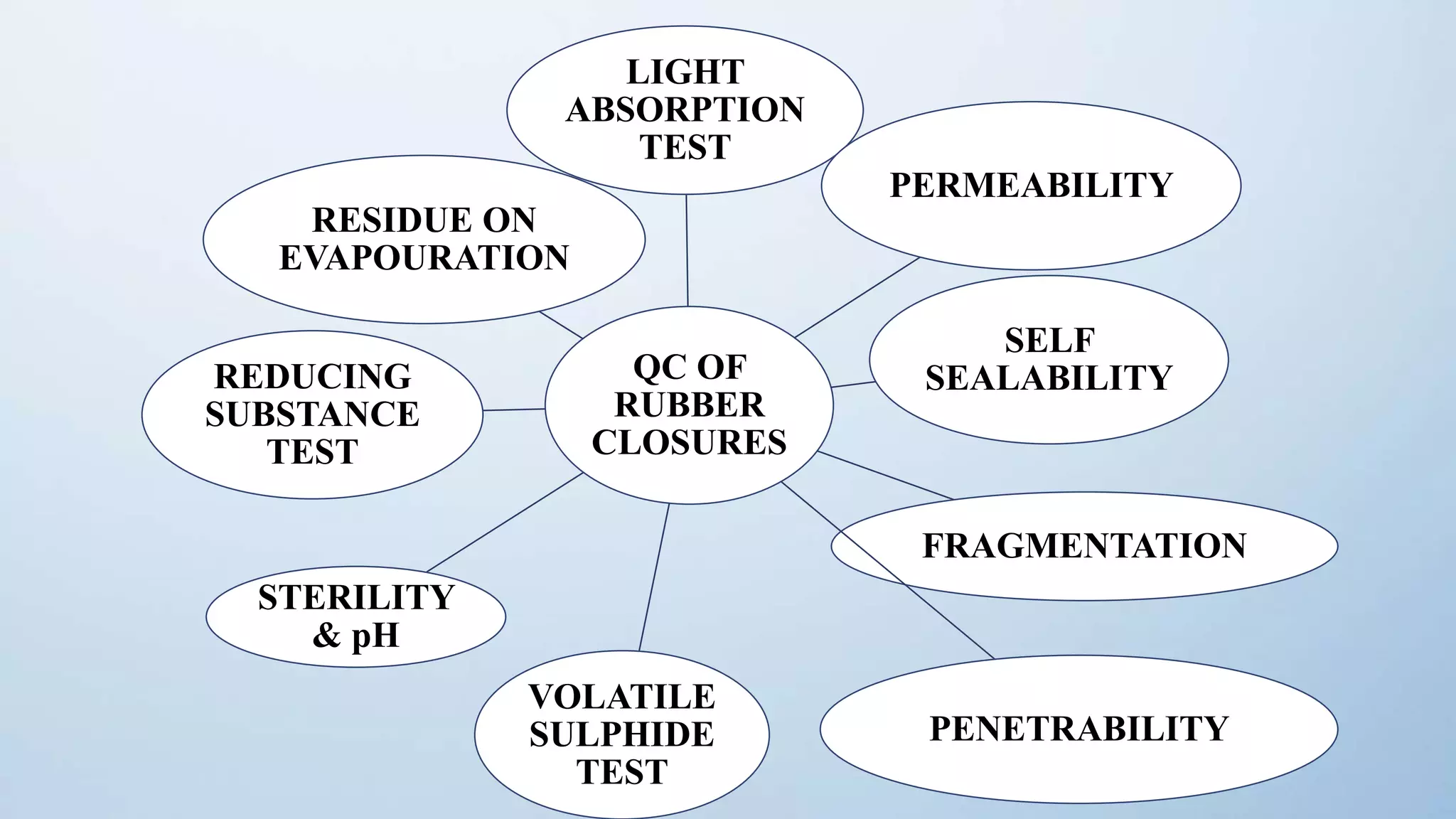
QC OF
RUBBER
CLOSURES
LIGHT
ABSORPTION
TEST
PERMEABILITY
SELF
SEALABILITY
FRAGMENTATION
PENETRABILITY
VOLATILE
SULPHIDE
TEST
STERILITY
& pH
REDUCING
SUBSTANCE
TEST
RESIDUE ON
EVAPOURATION
PREPARATION OF A SAMPLE
• Closures are washed in 0.2% w/v surface active agents
for 5 mints.
• Rinse 5 times with distilled water and 200ml water is
added.
• Autoclave at 119-123℃ for 20-30mints covering with
aluminium foil.
• Cooled and solution is separated from closures –
Solution A
1. RESIDUE ON EVAPOURATION
• 50ml of Solution A is evaporated to dryness on a water bath and dried at 105℃.
• Residue weight should not be more than 4mg.
2. pH of AQEOUS EXTRACT
• 20ml of Solution A + 0.1ml bromothymol blue solution
• Not more than 0.3ml 0.01M NaOH or 0.8ml of 0.01M HCl is
required to change the colour of the solution to blue or yellow
respectively.
3. STERILITY TEST
• Closures are subjected for sterilization, by autoclaving at 64-66℃ and pressure
0.7kPa
• Closures should not soften or tacky
• No visual change in the closure.
4. LIGHT ABSORPTION TEST
• Must be done within 4hr of preparing sample solution
• Filtered and absorbance is measured at 220-360nm.
• Absorbance should not be more than 2.0
5. REDUCING SUBSTANCE
• 20ml of Solution A + 1ml of sulphuric acid + 20ml of
0.002M potassium permagnate –> boil for 3mints
• Cool, add 1gm of potassium iodide
• Titrate immediately with 0.01M sodium thiosulphate using
0.25ml starch solution. As indicator added towards the end of
titration.
• Repeat the operation using blank
• Difference between the titration volume should NMT 7.0ml
6. VOLATILE SULPHIDES TEST
• Place closure of surface area 20cmsq. in a 100ml conical flask
• Add 50ml of 2% w/v citric acid solution.
• Place a piece of lead acetate paper over the mouth of the flask. Maintain
the paper in position by placing an inverted weighing bottle.
• Heat in autoclave for 121℃ for 30 mints
• Any black stain on the paper
• The stain should not be more intense than that of the standard using
0.154mg sodium sulphide and 50ml of 2% w/v citric acid solution.
7. SELF SEALABILITY TEST
Fill 10suitable vials with water to the volume, close the
vials with closures and secure with a cap.
Using a hypodermic needle with external diameter of 0.8mm
and pierce the closure 10 times at different sites.
Immerse the vials upright in a solution of methylene blue
with an atmospheric pressure and leave for 30 mints.
None of the vials contain any trace of coloured
solution
8. FRAGMENATION TEST
9. PENETRABILITY
• Measures the force required to make a hypodermic
needle penetrate easily through a closure
• Measured by using a piercing machine
• Piercing force should not exceed the standard value
• Hypodermic needle can get damage as a result of
undesirable hardness of closure.
10. PERMEABILITY TO WATER
Put calcium chloride in vial and close with rubber
closure and seal it with aluminium seal
Weigh the seal. Place it for a limited time period.
Weigh the vial again.
If the weight difference is more than the initial weight, the
rubber closures fail the test as the weight is increased due to
absorption of water vapours.
SECONDARY PACKING
• Secondarypackaging is out sidethe primary packaging - usedto group
primary packages together.
• Designates the packaging used to group pre-packed products together.
• Not in direct contact with actual product.
• Two central functions - Branding and logistics.
• Branding – marketing strategy surrounding the display.
• Logistics – grouping of products for ease of handling transport and storage.
DIFFERENT TYPES OF SECONDARY
PACKING
• Paper and boards.
• Cartons
• Corrugated fibreboard
IDEAL PROPERTIES
• Dimensions should be appropriate to withstand the stress during
transportation.
• Should not affect the primary packaging
• Should have sufficient strength to hold material
• Thickness should be appropriate to have mechanical strength.
Dimensions
Thephysical dimensionsof the given paperboard is takenand recorded
Grammage
A test piece of suitable size
(10cm×10cm) is cut and weighed.
The grammage of the sampleisdetermined by
Grammage=(104×w)/ (a×b)
w - weight in grams
a- length
b- breadth
TESTING OF PAPER AND BOARD
pH after
extraction
Cut1gmofpaperandplaceina100ml flask,fittedwithacondenser. Add 20
ml of boiling distilled water in small portions till the paper is wet.
Add 50 ml of distilled water. Reflux and digest with occasional shaking
at 95- 1000c for 1 hr. Cool to 40-450c, remove the condenser and shake,
cool in water bath.Determine the pH of the supernatant with pH meter.
Surface pH
• Acidity in paper may be causedby the presenceof residual chemical
left in the pulp.
• Adrop of distilled water is placed on the top of the test piece and the
electrodeof pH meterisplacedin the drop touching the paper.
• Thereading istaken after 2 min.
Moisture Content
Conditioned specimen is weighed and heated to a constant weight to
expel the moisture. The difference of the two weights gives the
moisture content of the paper.
Percentagemoisture=100(A-B) /B
A- Originalweight
B- Weight afterdrying.
Ash
Content
Take about 1g of specimen and make it in to shreds and place in a previously weighed
crucible (C). Heat carefully over a burner till completely charred. Transfer the
crucible in to amuffle furnace at 8000C. until all the carbonaceous matter are burnt
off. Coolin dessicator,weighandrepeat the experiment to a constant
weight (D)
%Ash=100(C-D)/D
Alkalinity
Place about 5g (w) of accurately weighed sample, cut into pieces in a stoppered
flask containing 250 ml of 0.02N HCl. Allow to stand for 1 hr with occasional
shaking. Decant and titrate a measured quantity (v) against 0.1 N NaOH using
methyl orangeasindicator. Carry out blank (B).
%alkalinity={1250 (B-A) * N}/ (V* W)
A- Samplereading
N- Normality ofNaOH
Cobb
Test
This measures the mass of water absorbed by 1cm2 of the test piece in a specified time
under aheadof 1 cm of water. It is determined by weighing before and after exposure
to the water, andusually quotedin g/m2
Folding endurance Fold the test piece back and forth until rupture occurs.
Tensile strength The maximum tensile force per unit width that a paper or
board will withstand breaking
Wet tensile strength Tensile strength determination when immersed in water.
Burst strength The maximum uniformly distributed pressure, applied at
right angle to surface that at test piece of paper and board
will stand under condition of test
Wet burst strength Determine bursting strength when immersed in water.
Tear strength Mean force required to continue the tearing of an initial cut
in a single paper.
Density For measuring the rigidity.
Rub resistance Resistance of printed test piece to with stand rubbing against
another test piece.
Puncture resistance Energy required to make initial puncture.
Pick test A specified amount of oil is added to the printing system and
printed on the test piece. The surface is then examined for signs of
pick.
Roughness/
smoothness
Ensures the printability on a paper and board.
Air permeability Light weighted uncoated paper on machine having vacuum pick up
system.
Creasability Determine creasing quality of board.
Stiffness of board Degree of resistance offered by paper or board when it is bent.
Ink absorbancy Determine the absorbing power of ink.
QUALITY CONTROL TESTS OF CARTON
Compression Assess the strength of an erected package.
Carton opening force To hold the carton flat as delivered, and open its creases between
thumb and first finger press.
Coefficient of friction Both static and kinetic coefficients of friction are determined by
sliding the specimen over itself under specific test conditions.
Crease stiffness Test a carton board piece, fold it through 90⁰. It will then try to
recover to its original after the bending force is removed.
Joint shear strength Test the glued lap seam on the side of a carton for the strength of
the adhesive using tensile testing machine.
THANK YOU

Pharmaceutical packaging

  • 1.
  • 2.
    PHARMACEUTICAL PACKAGING • Packagingprocesses for pharmaceutical preparations. • Impact on stability of the pharmaceutical drug product. CHARACTERISTICS • Protect drug from environmental conditions. • Compatible and should not interact with the dosage. • Non toxic and FDA approved. Packaging is a process by which the pharmaceuticals are suitably packed so that they should retain their therapeutic effectiveness from the time of packaging till they are consumed
  • 3.
    COMPOSITION OF PACKAGE I.Container II. Closure III. Carton or Outer IV. Box A container : a) Should not absorb the medicament b) Should not alter the stability c) Should withstand sterilization procedure d) Should facilitate easy handling and withdrawal
  • 4.
    Selection of apackaging material depends on - Dosage form - Route of administration - Chemical nature of Active Pharmaceutical Ingredient TYPES OF PACKAGING PRIMARY SECONDARY TERTIARY
  • 5.
  • 6.
    CONTAINERS GLASS PLASTICS Are devicesthat hold the formulation and it may or may not be in direct contact with the formulation
  • 7.
    GLASS • Most commonlyused, FDA approved, of high strength • Ability to modify into different shapes • Resistivity towards various chemicals • Should be sufficiently strong to tolerate high pressure and protect degradation from UV rays. • 4 Types – - type 1 – borosilicate glass - type 2 – treated soda lime glass - type 3 – soda lime glass - type 4 – NP glass
  • 8.
    QUALITY CONTROL OF GLASS POWDERED GLASS TEST WATER ATTACK TEST SURFACE TREATMENT TEST LEAKAGETEST THERMAL ATTACK TEST HYDROLYTIC RESISTANCE TEST ARSENIC TEST LIGHT TRANSMISSION INTERNAL BURSTING PRESSURE TEST
  • 9.
    1. HYDROLYTIC RESISTANCETEST - TEST A Wash the containers with distilled water for the prevention of entry of air bubbles and then dried properly Fill containers with CO2 free water and wrap with aluminum foil Place containers in the autoclave and close the container Displace air by passage of steam of air for 10 minutes. Raise the temperature from 100-121°C over 20 mints, maintain the temperature of 121°C for 60mints, and reduce the temperature from 121-100°C over 40mints, vent to prevent vacuum Remove containers from auto clave and cool them in a bath of running tap water. Conduct a titration using HCl in burette and compare the endpoint with CO2 free water as blank using methyl red as indicator. •evaluate quality of outer surface of the container •Under controlled conditions with help of autoclave and thermocouples
  • 10.
    Capacity of containercorresponding to 90% of average overflow volume (ml) Volume of 0.01M Hcl/100ml Type I/ II Type III Not More Than (NMT) 1 2.0 20.0 More than 1 but NMT 2 1.8 17.6 More than 2 but NMT 5 1.3 13.2 More than 5 but NMT 10 1.0 10.2 More than 10 but NMT 20 0.8 8.1 More than 20 but NMT 50 0.6 6.1 More than 50 but NMT 100 0.5 4.8 More than 100 but NMT 200 0.4 3.8 More than 200 but NMT 500 0.3 2.9 More than 500 0.2 2.2
  • 11.
    2. POWDERED GLASSTEST - TEST B Take three containers, rinse and dry Crush it into coarse fragments. Pass through 725μm and 425μm sieve. Glass fragments on 425μm are checked for metal impurities and if present they are removed. The glass pieces are kept in conical flask, containing CO2 free water Conduct a titration using HCl in burette and compare the endpoint with CO2 free water as blank using methyl red as indicator. Limits are same as TEST A
  • 12.
    3. SURFACE TREATMENTTEST - TEST C Select and rinse containers with distilled water, hydrofluoric acid and hydrochloric acid in ratio 1:9 Wash containers with water several times Conduct a titration using HCl in burette and compare the endpoint with CO2 free water as blank using methyl red as indicator. If the limits exceeds the values of TEST A – TREATED GLASS •Test whether surface of glass is treated •Differentiates Type II and III glass
  • 13.
    4. WATER ATTACKTEST Fill containers with purified CO2 free water and seal with aluminum foils. Autoclave for 60 minutes at 120°C. 100ml of the content is taken into 250ml conical flask. Add methyl red solution as indicator Conduct a titration using 0.02N Sulphuric Acid and observe the endpoint Volume limits of 0.02 H2SO4 for type II glass should not exceed 0.7ml Done to determine the alkali leached from the surface is under specified limits or not. Test is used only for glass treated with sulphur dioxide fumes under controlled conditions. The amount of acid required to neutralize the alkali released from the surface is estimated
  • 14.
    5. INTERNAL BURSTINGPRESSURE TEST Fill containers with purified CO2 free water and place in the testing chamber. A scaling head is placed an the internal pressure is increased in increments each of which is held for specific time Container is checked for predetermined pressure level and the test continues till the container bursts.
  • 15.
    6. THERMAL ATTACKTEST Place samples in upright position in a tray Immerse the tray into hot water for given time and transfer to cold water bath Examine the cracks or breaks before and after the test “ Small bottle withstands the temperature different of 60 to 80°c and a pint bottle 30 to 40°c”
  • 16.
    7. LEAKAGE TESTTEST Drug filled container is placed in a container filed with coloured solution. Coloured solution is at high pressure than the pressure inside the glass container. Coloured solution enters the glass container if any breakage or crack is present.
  • 17.
    8. ARSENIC TEST Washinner and outer side of container 5 times Prepare test solution. Pipette out 10 ml solution from the combined contents Add 10 ml nitric acid, evaporated to dryness Dry the residue at 130°c for 30 minute and cool Add 10 ml of Hydrogen molybdate reagent Heat on water bath and reflux for 25 minute Cool and determine absorbance at 840 nm Prepare blank with 10 ml Hydrogen molybdate Absorbance of the test solution does not exceed the absorbance obtained by repeating the determination using 0.1 ml arsenic standard solution
  • 18.
    9. LIGHT TRANSMISSIONTEST Break the glass container Select section suitable for mounting in a spectrophotometer Place the specimen in the spectrophotometer ABSORBANCE MAXIMUM % OF LIGHT WAVELENGTH BETWEEN TRANSMISSION AT ANY 290 TO 450 nm FLAME SEALED CONTAINERS CONTAINER WITH CLOSURE Upto 1 50 25 Above 1 and upto 2 45 20 Above 2 and upto 5 40 15 Above 5 and upto 10 35 13 Above 10 and upto 20 30 12 Above 20 15 10
  • 19.
    PLASTIC • Cross linkingof synthetic or semi synthetic long chain polymer • Addictives are added to improve physicochemical property. • Addictives – antistatic agents - fillers - antioxidants - antimicrobial agents
  • 20.
    • Antistatic agents– plastic develop static charge on surface responsible for the attraction of dust particles on the surface, which males it dull and contaminated. This can be avoided by adding antistatic agents like phosphate esters. • Fillers – increase the bulk quantity and the strength of the plastic. • Antioxidants – plastics tend to permeate oxygen by breaking the long chain polymer structure leading to oxidation. Antioxidants like phenolic compounds can be used to prevent oxidation. • Antimicrobial agents- to prevent microbial attack.
  • 21.
    ADVANTAGES • Lighter thanglass • Flexible • Variety of sizes and shapes • Chemically inert, strong, rigid • Extremely resistant to breakage. DISADVANTAGES • Absorption of moisture • Thermostatic change Types of plastic materials A.Thermosetting B.Thermoplastic
  • 22.
    PLASTIC MATERIALS • POLYETHYLENE– excellent barrier to moisture, resistance to attack of acids and alkali. • NYLON – resistance to strong acid and alkali, strong barrier to oxygen and moisture, not preferred to long term use due to interaction • POLYVINYLCHLORIDE – construction of plastic bottles and lamination of inner side of the glass bottle.
  • 23.
    PROPERTIES OF PLASTICTO BE CONSIDERED • SORPTION • PHOTO DEGRADATION • DESORPTION / LEACHING • PERMEATION • CHEMICAL REACTIVITY
  • 24.
    SORPTION • Loss offormulation constituents due to the interaction with packaging materials. • Significant decrease in the drug content, and the therapeutic efficacy. • Diazepam showed significant sorption of drugs when stored at room temp. in the dark in a PVC bag whereas no sorption was observed when stored in glass containers.
  • 25.
    DESORPTION / LEACHING •One or more addictives are added in the plastic materials when they are needed to impart specific properties to the plastic. • Migration of the contents from the plastic into the formulation – desorption or leaching • Can occur due to the effect of change in pH, temp., solvent type and type of plastic and additive present.
  • 26.
    PERMEATION • Plastic canpermeate gases or vapours or water vapour – this leads to instability of the formulation. • Oxygen permeation can lead to oxidation of the product • Water vapour permeation can lead to hydrolysis • Storage conditions, type of plastic material or addictive, method of manufacture can be the causes of permeation.
  • 27.
    PHOTODEGRADATION • Formulation ingredientswhen exposed to UV light can lead to photo degradation. • Also some functional groups of the polymers present in the plastic are prone to absorb UV radiation and hence transmits UV rays through the plastic container. • Change in the physical or chemical properties of plastic. • Subsequently affect the stability of the drugs • Opacifying agents can be used prevent photo degradation.
  • 28.
    CHEMICAL REACTIVITY • Incompatibilitybetween the ingredient and the plastic material. • Leads to modification of the drug product. • Which makes the drug improper for consumption.
  • 29.
  • 30.
  • 31.
    1. LEAKAGE TEST Fill10 containers with distilled water and fit closures Keep inverted at room temperature for 24 hours No sign of leakage should be there
  • 32.
    2. COLLAPSIBILITY TEST Takecontainers with required contents. Squeeze the contents with optimum force. 90% of the content should be extruded at an optimum force and temperature. Indicates the squeezing property of the container
  • 33.
    3. CLARITY TEST Cutseveral strips of 20cmsq. area from both sided from container to be tested. Strips taken from area of container that is unlabelled, unmarked and non laminated. Select 60-65 strips, wash and transfer to the 250ml conical flask. Add water and autoclave for 121℃ for 30mints. Carry out same procedure with blank Cool the strips, and compare the aqueous extract of the test and the blank for clarity
  • 34.
    4. NON VOLATILERESIDUE TEST 100ml of the extract from clarity test taken Heated to dryness till constant weight Residue should not be more than 12.5mg
  • 35.
    5. TRANSPARENCY TEST •Fill test containers with diluted suspensions of a sample • Fill standard containers with distilled water • The cloudiness of the diluted suspension should be observed with in the container to prove the transparency of the plastic material
  • 36.
    6a. BIOLOGICAL TEST Injectsample and blank in 5 mice each. Observe the animals immediately, after 4hour, and then at 24, 48, and 72 hours. If animals show abnormal behaviour like convulsions or body weight loss is greater than 2gm, the sample does not meet the requirements. Animal taken – Albino Mice
  • 37.
    6b. INTRACUTANEOUS TEST Take3 rabbits for each sample. Remove hairs from surface to be examined and clean with dilute ethanol. Inject sample and blank at two different sites on same animal Observe and compare the local area for edema, erythema and necrosis Animal taken – Rabbit
  • 38.
    6c. EYE IRRITATIONTEST Inject 100 μl of sterile WFI in one eye as the blank. Inject the sample in another eye Observe the animals immediately, 24, 48, and 72 hours. Inspect for eye irritation and compare the sample and test. Animal taken – RABBIT
  • 39.
    7. WATER VAPOURPERMEABILITY TEST Fill 5 containers with water and seal. Weigh each container and note down the weight. Allow to stand for 14 days @ relative humidity of 60±5 and temperature of 20-25℃ Reweigh each of the containers and the loss of weight should not be more than 0.2%
  • 40.
    CLOSURES • Packaging componentwhich is in direct contact with the drug. • Provides a barrier to dirt, oxygen, moisture, etc • Retains the contents. • Keeps the product secure from undesired and premature opening. • Minimises the effect of change in humidity, temp. or pressure. • Assists in dispensing and using of product.
  • 42.
    CAP TYPE ROLL ONTYPE PLUG TYPE CROWN TYPE OVER CAP TYPE
  • 43.
    MATERIALS USED FORCLOSURES • METAL • RUBBER • PLASTIC • GLASS
  • 44.
    RUBBER CLOSURES • Madefrom materials obtained by vulcanisation of elastomers with appropriate addictives. • Do not pose a problem and can be used in contact with large number of drug preparations. • Types of rubber used – butyl rubber, nitrile rubber, neoprene rubber, silicon rubber
  • 47.
    CHARACTERISTICS • Should notbecome sticky upon storage • Should not become hard on exposure to atmosphere • Should not become dark on exposure to air and light. • Ease of penetrability and elasticity in case of vials. • Ease in sterilisation. Must withstand at least about 120℃ • Should not allow permeation of water vapour and air. Free from leaching and sorption.
  • 48.
  • 49.
    PREPARATION OF ASAMPLE • Closures are washed in 0.2% w/v surface active agents for 5 mints. • Rinse 5 times with distilled water and 200ml water is added. • Autoclave at 119-123℃ for 20-30mints covering with aluminium foil. • Cooled and solution is separated from closures – Solution A
  • 50.
    1. RESIDUE ONEVAPOURATION • 50ml of Solution A is evaporated to dryness on a water bath and dried at 105℃. • Residue weight should not be more than 4mg. 2. pH of AQEOUS EXTRACT • 20ml of Solution A + 0.1ml bromothymol blue solution • Not more than 0.3ml 0.01M NaOH or 0.8ml of 0.01M HCl is required to change the colour of the solution to blue or yellow respectively.
  • 51.
    3. STERILITY TEST •Closures are subjected for sterilization, by autoclaving at 64-66℃ and pressure 0.7kPa • Closures should not soften or tacky • No visual change in the closure. 4. LIGHT ABSORPTION TEST • Must be done within 4hr of preparing sample solution • Filtered and absorbance is measured at 220-360nm. • Absorbance should not be more than 2.0
  • 52.
    5. REDUCING SUBSTANCE •20ml of Solution A + 1ml of sulphuric acid + 20ml of 0.002M potassium permagnate –> boil for 3mints • Cool, add 1gm of potassium iodide • Titrate immediately with 0.01M sodium thiosulphate using 0.25ml starch solution. As indicator added towards the end of titration. • Repeat the operation using blank • Difference between the titration volume should NMT 7.0ml
  • 53.
    6. VOLATILE SULPHIDESTEST • Place closure of surface area 20cmsq. in a 100ml conical flask • Add 50ml of 2% w/v citric acid solution. • Place a piece of lead acetate paper over the mouth of the flask. Maintain the paper in position by placing an inverted weighing bottle. • Heat in autoclave for 121℃ for 30 mints • Any black stain on the paper • The stain should not be more intense than that of the standard using 0.154mg sodium sulphide and 50ml of 2% w/v citric acid solution.
  • 54.
    7. SELF SEALABILITYTEST Fill 10suitable vials with water to the volume, close the vials with closures and secure with a cap. Using a hypodermic needle with external diameter of 0.8mm and pierce the closure 10 times at different sites. Immerse the vials upright in a solution of methylene blue with an atmospheric pressure and leave for 30 mints. None of the vials contain any trace of coloured solution
  • 55.
  • 56.
    9. PENETRABILITY • Measuresthe force required to make a hypodermic needle penetrate easily through a closure • Measured by using a piercing machine • Piercing force should not exceed the standard value • Hypodermic needle can get damage as a result of undesirable hardness of closure.
  • 57.
    10. PERMEABILITY TOWATER Put calcium chloride in vial and close with rubber closure and seal it with aluminium seal Weigh the seal. Place it for a limited time period. Weigh the vial again. If the weight difference is more than the initial weight, the rubber closures fail the test as the weight is increased due to absorption of water vapours.
  • 59.
    SECONDARY PACKING • Secondarypackagingis out sidethe primary packaging - usedto group primary packages together. • Designates the packaging used to group pre-packed products together. • Not in direct contact with actual product. • Two central functions - Branding and logistics. • Branding – marketing strategy surrounding the display. • Logistics – grouping of products for ease of handling transport and storage.
  • 60.
    DIFFERENT TYPES OFSECONDARY PACKING • Paper and boards. • Cartons • Corrugated fibreboard
  • 61.
    IDEAL PROPERTIES • Dimensionsshould be appropriate to withstand the stress during transportation. • Should not affect the primary packaging • Should have sufficient strength to hold material • Thickness should be appropriate to have mechanical strength.
  • 62.
    Dimensions Thephysical dimensionsof thegiven paperboard is takenand recorded Grammage A test piece of suitable size (10cm×10cm) is cut and weighed. The grammage of the sampleisdetermined by Grammage=(104×w)/ (a×b) w - weight in grams a- length b- breadth TESTING OF PAPER AND BOARD
  • 63.
    pH after extraction Cut1gmofpaperandplaceina100ml flask,fittedwithacondenser.Add 20 ml of boiling distilled water in small portions till the paper is wet. Add 50 ml of distilled water. Reflux and digest with occasional shaking at 95- 1000c for 1 hr. Cool to 40-450c, remove the condenser and shake, cool in water bath.Determine the pH of the supernatant with pH meter. Surface pH • Acidity in paper may be causedby the presenceof residual chemical left in the pulp. • Adrop of distilled water is placed on the top of the test piece and the electrodeof pH meterisplacedin the drop touching the paper. • Thereading istaken after 2 min.
  • 64.
    Moisture Content Conditioned specimenis weighed and heated to a constant weight to expel the moisture. The difference of the two weights gives the moisture content of the paper. Percentagemoisture=100(A-B) /B A- Originalweight B- Weight afterdrying. Ash Content Take about 1g of specimen and make it in to shreds and place in a previously weighed crucible (C). Heat carefully over a burner till completely charred. Transfer the crucible in to amuffle furnace at 8000C. until all the carbonaceous matter are burnt off. Coolin dessicator,weighandrepeat the experiment to a constant weight (D) %Ash=100(C-D)/D
  • 65.
    Alkalinity Place about 5g(w) of accurately weighed sample, cut into pieces in a stoppered flask containing 250 ml of 0.02N HCl. Allow to stand for 1 hr with occasional shaking. Decant and titrate a measured quantity (v) against 0.1 N NaOH using methyl orangeasindicator. Carry out blank (B). %alkalinity={1250 (B-A) * N}/ (V* W) A- Samplereading N- Normality ofNaOH Cobb Test This measures the mass of water absorbed by 1cm2 of the test piece in a specified time under aheadof 1 cm of water. It is determined by weighing before and after exposure to the water, andusually quotedin g/m2
  • 66.
    Folding endurance Foldthe test piece back and forth until rupture occurs. Tensile strength The maximum tensile force per unit width that a paper or board will withstand breaking Wet tensile strength Tensile strength determination when immersed in water. Burst strength The maximum uniformly distributed pressure, applied at right angle to surface that at test piece of paper and board will stand under condition of test Wet burst strength Determine bursting strength when immersed in water. Tear strength Mean force required to continue the tearing of an initial cut in a single paper. Density For measuring the rigidity.
  • 67.
    Rub resistance Resistanceof printed test piece to with stand rubbing against another test piece. Puncture resistance Energy required to make initial puncture. Pick test A specified amount of oil is added to the printing system and printed on the test piece. The surface is then examined for signs of pick. Roughness/ smoothness Ensures the printability on a paper and board. Air permeability Light weighted uncoated paper on machine having vacuum pick up system. Creasability Determine creasing quality of board. Stiffness of board Degree of resistance offered by paper or board when it is bent. Ink absorbancy Determine the absorbing power of ink.
  • 68.
    QUALITY CONTROL TESTSOF CARTON Compression Assess the strength of an erected package. Carton opening force To hold the carton flat as delivered, and open its creases between thumb and first finger press. Coefficient of friction Both static and kinetic coefficients of friction are determined by sliding the specimen over itself under specific test conditions. Crease stiffness Test a carton board piece, fold it through 90⁰. It will then try to recover to its original after the bending force is removed. Joint shear strength Test the glued lap seam on the side of a carton for the strength of the adhesive using tensile testing machine.
  • 69.