CAPSULES
Ms. TENY SARA THOMAS
MOUNT ZION COLLEGE OF PHARMACEUTICAL
SCIENCES AND RESEARCH, ADOOR, KERALA
ASSISTANT PROFESSOR
B.PHARM FIFTH SEMESTER
FORMULATIVE & INDUSTRIAL PHARMACY
UNIT III
CONTENTS
•INTRODUCTION
•HARD GELATIN CAPSULES
•SOFT GELATIN CAPSULES
INTRODUCTION
Capsules are solid dosage form in which the
drug substance is enclosed within a hard or soft
soluble shell made of gelatine or suitable material.
• The word capsule is derived from the latin word
“capsula” that means small box.
• Capsules are formulated for carrying fixed dose of
any active pharmaceutical ingredient.
• It is a unit solid dosage form meant for oral use in
which medicament and inert substances are enclosed.
Advantages of Capsules
• Easy to manufacture because there are lesser step wise
operations.
• Liquids can be administered.
• Bioavailability of poorly soluble drugs can be
improved
• Taste of bitter drugs can be masked
• Elegant in appearance
• Smooth and slippery surface facilitates swallowing
• Minimum excipients are only required.
• Rapid solubility of gelatine allows faster release of
drugs.
• Pressure required during the manufacturer is lesser than
that required during tablet production.
Disadvantages of Capsules
• Capsules are not suitable for drugs that are highly
soluble like, potassium chloride, ammonium chloride
etc.
• Not a suitable dosage form for formulating drugs which
are highly efflorescent (that loses water to atmosphere)
or highly deliquescent (that absorbs water vapour).
• Efflorescence leads to a more softer capsule, while
deliquescence leads to forming a more dry capsule.
• Concentrated preparations that require dilution prior to
administration will not be possible to formulate as
capsules.
GELATIN
Gelatin is a heterogeneous product derived by
irreversible hydrolytic extraction of collagen.
Common sources of collagen :- animal bones, skin of
ox and pigs etc. Gelatin’s chemical, physical, and
physiological properties make it an ideal substances
for the capsulation of pharmaceutical products.
Gelatin is available in mainly two forms :-
• Type A :- derived from acid catalysed hydrolysis and
exhibit an isoeletric point in the ph range 9.
• Type B :- derived from alkali catalysed hydrolysis
and exhibit an isoeletric point in the ph range 4.7.
Preparation of Gelatine
• Inspection and Cutting :- animal parts are checked
for quality and the rotten parts are discarded. Bones,
tissues, and skins are cut into smaller pieces which are
about 12.7cm through chopping machines.
• Degreasing and Roasting :- The animal parts are
passed under high-pressure water sprays to wash away
debris. They are then degreased by soaking them in hot
water to reduce the fat content to about 2%. A conveyer
belt moves the degreased bones and skins to an
industrial dryer where they are roasted for
approximately 30 minutes at about 200° F (100° C).
• Acid and alkali treatment :- The animal parts are
soaked in vats of lime or some other type of acid or
akali for approximately five days. This process
removes most of the minerals and bacteria and
facilitates the release of collagen. The acid wash is
typically a 4% hydrochloric acid with a pH of less than
1.5. The alkaline wash is a potassium or sodium
carbonate with a pH above pH 7.
• Boiling :- The pieces of bone, tissue, and skin are
loaded into large aluminum extractors and boiled in
distilled water. A tube running from the extractor
allows workers to draw off the liquid that now contains
gelatin. The liquid is sterilized by flash-heating it to
about 375° F (140° C) for approximately 4 seconds.
• Evaporating and Grinding :- From the extractor, the
liquid is piped through filters to separate out bits of
bone, tissue or skin that are still attached. The liquid is
passed through evaporators. The gelatin is press into
sheets and passed through a grinder to get fine powder.
• Flavouring and colouring :- preset amount of
addictives are thoroughly mixed into the powdered
gelatin as required.
Properties of Gelatine
The gelatin to be used in the pharmaceutical
manufacture should be of the USP Grade, along
with the further properties :-
• Bloom or Gel Strength of Gelatin
• Viscosity of Gelatin
• Iron Content in Gelatin
• Bloom or Gel Strength :- is the measure of the
cohesive strength of the cross linking that occurs
between gelatin molecules. This cohesive strength is
directly proportional to the molecular weight of the
gelatin.
Bloom strength is measured using standard
plunger and this determines the weight in grams taken
to penetrate the gel surface by 4mm deep without
breaking the gel at 10℃. The number of grams is called
the bloom value. Bloom value ranges from 150 -
250gm.
Higher the bloom strength of the gelatin, the more
physically stable is the resulting capsule shell. Cost of
the gelatin is directly proportional to the gel strength.
Hence, higher bloom value gelatin is majorly used
when greater physical stability is required or in the
manufacture of larger capsule shells.
• Viscosity of the Gelatin :- is the measure of the
molecular chain length and determines the
manufacturing characteristics of the gelatin film.
Viscosity is determined using a U – Tube
viscometer with a 6% gelatin solution at 60℃. The
viscosity varies from 25-45millipoise. Higher the
bloom value, greater the viscosity.
• Iron Content :- is always present in gelatin, and its
concentration usually depends on the large amount of
water required for washing during the manufacture of
gelatin. Therefore, the iron content in gelatine should
not exceed 15ppm.
HARD GELATIN
CAPSULES
CONTENTS
• INTRODUCTION
• PRODUCTION OF HARD GELATIN CAPSULES
• SIZE OF HARD GELATIN CAPSULES
• FILLING OF CAPSULES
• FINISHING
• SPECIAL TECHNIQUES OF FORMULATION OF
HARD GELATIN CAPSULES
• QUALITY CONTROL TESTS OF HARD GELATIN
CAPSULES
INTRODUCTION
Hard gelatin capsules consists of two pieces in the
form of cylinders closed at one end. The shorter piece
is called the cap. This cap fits over the open end of
longer piece called body. The drug substance is placed
in the body and the caps are slided over it, hence
enclosing the drug substance.
BODY
CAP
PRODUCTION OF HARD GELATIN CAPSULE
SHELL
All raw materials required for the
production of a capsule shell are collected
and weighed. A solution of gelatin with a
concentration of about 45-60% is prepared
by mixing of gelatin in demineralised hot
water at 60-70℃ in jacketed pressure vessels.
Vacuum can be applied to remove entrapped
air bubbles. Gelatin solution is transferred to
stainless steel feed tanks. Dyes, opacifants,
preservatives and any water needed are
added to the gelatin solution.
Finally the viscosity is adjusted
according to required thickness of the
capsule shell.
Stainless steel mold pins are those on
Steps in the Production of Hard Gelatin
Capsule Shell
• Dipping
• Spinning
• Drying
• Stripping
• Trimming
• Joining
• Polishing
• Dipping :- 150 pairs of stainless steel mold pins are
dipped in to the prepared gelatin solution of controlled
viscosity to form caps and bodies simultaneously. This
results in the formation of film on the surface of the
mold pins.
• Spinning :- The mold pins are rotated so as to provide
uniform distribution of gelatin.
• Drying :- The gelatin is dried at the blast of cool air to
form the hard shell. The pins are moved through a
series of air drying kilns which help in removing any
water content present.
• Stripping :- A series of bronze jaw strips the cap and
body portion of the capsules from the mold pins.
• Trimming :- the stripped cap and body portion of the
capsule are trimmed to the required length using
stationary knives.
• Joining :- After trimming, the cap and body sections
are joined and ejected from the machine.
• Polishing :- is done using Accela cota pans and then
rubbed with clothes.
The entire cycle of the machine lasts for
approximately 45 minutes. Inspection processes are
done finally to remove the imperfect capsules.
Capsules are then ready for sterilisation and
packaging.
SIZE OF CAPSULES
For Human Use, empty capsule shells are
available in different sizes. Based on capacity of the
granules, capsule size are numbered and ranges
from 000 to 5. 000 being the largest and 5 being the
smallest size.
SIZE VOLUME IN ml SIZE IN mm
000 (largest) 1.37 2.6
00 0.95 2.3
0 0.68 2.1
1 0.5 1.9
2 0.37 1.8
3 0.30 1.5
4 0.21 1.4
5 (smallest) 0.15 1.1
CAPSULE FILLING
The hard two – piece capsule can be filled with
materials that have a wide range of physical
properties.
Types of dosage forms for filling into hard capsules :-
Solid Semi – Solid Liquid
•Powders
•Granules
•Pellets
•Tablets
•Paste
•Thermo
softening
mixtures
•Thixo-tropic
mixtures
•Non – aqueous
solutions
•Oily liquids
• Powdered formulations often require excipients such as
fillers, lubricants, glidants, to facilitate their
encapsulation. This influences the rate of release.
Addition of wetting agents is needed in case of
hydrophobic drugs.
• In case of powders that have a chance to liquefy ,
adsorbents like colloidal silica, magnesium carbonate
must be used.
Capsule Filling Machines
HAND OPERATED
CAPSULE FILLING
MACHINE
SEMI – AUTOMATIC
CAPSULE FILLING
MACHINE
AUTOMATIC
CAPSULE FILLING
MACHINE
PUNCH
METHOD
Hand Operated Capsule Filling Machine
Pharmacists that
prepare capsules on
a regular or
extensive basis may
use hand operated
capsule machines.
These machines are
also called Feton
capsule filling
machine.
The machine has the
following parts :-
• Capsule bed with 200-
300 holes
• Loading tray
• Powder tray
• Pin plate with 200-
300pins
• Sealing plate with
rubber top
• Lever
• Cam handle
• Tighten the cam handle and placed lever in the
position. The machine is ready for capsule filling.
• Place the empty capsules onto the loading tray with the
body end of the capsules oriented downwards and the
cap oriented upwards.
• Placed the filled loading tray over the capsule bed.
• The cam handle is used to lock the body part of the
capsules at their place while of the cap of the capsule is
separated.
• Powder tray is placed in position, and the powder is
placed on to the surface. Using a spatula, spread the
powder uniformly to fill the bodies of the capsules.
Remove the excess powder.
Working of Hand Operated Capsule Filling Machine
• The pin plate is then lowered to press the filled powder.
Again raise the pin plate.
• Remove the powder tray after filling.
• The cap holding plate is then repositioned over the
body.
• The capsules are rejoined then by manual pressure.
• Remove the loading tray and collect the filled capsules.
Semi Automatic Capsule Filling Machine
Semi automatic capsule filling machine are
employed when smaller batches sizes are
required. Production capacities can range from
6000 – 8000 capsules per hour. Semi automatic
capsule filling machines always require an
operator in attendance at all times of the
operation.
Semi automatic machines use the Auger
Filling Principle.
The machine has the
following parts :-
A. Capsule fill
B. Stirrer
C. Auger
D. Capsule body holder
E. Turn table
F. Capsule ring
• Peg ring
• Capsule hopper
• Turntables
• Rectifier
Capsule ring
Auger
Peg Ring
There are 3 stages of how the capsule filling
machine works :-
1. Orientation of capsule :- The capsule ring is
placed on a turntable under the Rectifier (they
orient the capsule in such a way that the body part
is oriented downwards and cap part is oriented
upwards). Empty capsule shells in the capsule
hopper are descended by the rectifier in to the
capsule ring. As the ring rotates on the turntable,
vacuum pulls the capsules bodies in to the lower
part of the capsule ring, leaving the caps behind in
the upper ring.
Working of Semi Automatic Capsule Filling Machine
2. Powder filling of capsule :- After capsule
separation, the operator separates the rings of the
capsule ring and places the body ring on another
turntable that rotates beneath the foot of the powder
hopper. The auger in the hopper rotates to provide
constant downward flow of the formulation while
the filling ring rotates. The amount of formulation
delivered to the capsule bodies depends on the
dwell time of the bodies under the foot of the
hopper, i.e., the speed of rotation of the body ring.
3. Capsule Closing :- Upper and the lower holding
ring of the capsule ring is joined together and
positioned in front of the peg ring holding pins.
Pneumatic pressure is applied to the peg ring which
finally pushes the caps and the bodies together
inside the holes of the capsule ring. Filled capsules
are then removed from the capsule ring.
Automatic Capsule Filling Machine
Automatic capsule filling machine are
designed and developed to fill hard gelatin
capsules with powders or pellets. It is an
extremely durable and reliable machine that fills
dosages to the highest accuracy. It can be
applicable to the widest range of capsules at all
sizes.
Automatic filling machines employ pistons, or
tamping pins that lightly compress the powder
into slugs, and eject the plugs into the empty
capsule bodies. Automatic machines use the
Dosing Disc Principle and Dosator Principle.
Dosing disc Principle
Working of a Automatic Capsule Filling Machine
• The dosing disc rotates continuously in a circular
manner. The stop plate closes the holes on the dosing
plate. The dosing disc rotates below the powder bed,
the material flows into each hole. The pins which are in
the station compress the powder to a controlled depth.
• The process of filling and compression continues till
reaching the last compressing pin, where the machine
ejects a compressed powder through the dosing plate
into the capsule.
• This is a continuous process and the production speed
will depend on the preset machine conditions.
Dosator Principle
Working of a Automatic Capsule Filling Machine
Diagram of a dosator or dosing tube system:
(A) compression force platen; (B) piston; (C) dosing tube; (D)
powder hopper; (E) plug ejection platen; (F) capsule body in
bush; and (G) powder plug
• A dosator machine has two segments :- powder bed on
one side while the empty capsule body on the opposite
side.
• As the dosing tube goes down, penetrates the powder
bed, powder enters the open end of the dosator.
• A plug is formed inside the dosing tube with a movable
piston that controls the dosing volume and applies a
force to form the plug.
• Dosage tube then moves up, takes a 180⁰ rotation, and
press powder plug into the capsule body to complete
capsule filling.
Punch Method (Manual Filling)
To hand fill capsules, the pharmacist generally uses
the Punch Method.
• Ingredients are triturated an mixed. The powder is placed
on a powder paper or ointment slab and smoothed with a
spatula to a height approximately half the length of the
capsule body.
• The body of the capsule is held vertically and the open end
is pushed or punched into the powder until the capsule is
filled.
• The capsule is replaced to close the capsule.
• Each filled capsule is weighed after filling. Powder is
added and removed until the correct weight has been
placed in the capsule.
All the capsule filling machines have the 4 steps in
common.
• Rectification of the empty capsule shell :- orientation of
the capsule – body oriented downwards and caps oriented
upwards.
• Separation of cap and body of empty capsule shell.
• Dosing of a fill material :- eg. Auger Principle, Dosing
disc Principle, Dosator fill principle, Punch Principle etc.
• Replacement of the caps over the body and Ejection of
the filled capsules.
Famous companies manufacturing different
capsule filling machines :-
• Lilly and Parke – Davis
• Farmatic
• Hofliger and Karg
• Macofar
• mG2
• Osaka
• Perry
• Zanasi
CAPSULE FINISHING
Filled capsules from the capsule equipment
require dusting or polishing operation before the
remaining operations of inspection, bottling, and
labeling are completed.
Dusting or polishing operations vary according to
the type of the filling equipment used, the type of
powder used for filling, and the individual
requirements for the finished appearance of the
completed capsules.
Capsule Finishing Machines
PAN POLISHING
BRUSHING
CLOTH DUSTING
Pan Polishing
Because of the unique design, especially primary
in the area of airflow, the Accela Cota Tablet
Coating Pan is used to dust and polish capsules. A
polyurethane or cheese cloth liner is placed in the
pan, and the liner is used to trap the removed dust as
well as impart a gloss to the capsules.
Cloth Dusting
In this method, the filled capsules are rubbed
with a cloth that may or may not be impregnated
with an inert oil. This procedure is a hand operation
and gives a shine to the capsules. Also it results in a
positive method for removal of resistant materials.
Brushing
In this method, the filled capsules are fed under
rotating soft brushes, which serve to remove the dust
from the capsule shell. This operation must be
accomplished by application of vacuum for dust
removal.
There are mainly 3 commercial equipments :-
1. Rotosort :- is a mechanical sorting device that removes loose
powder, unfilled joined capsules, filled or unfilled capsule
bodies, and loose capsule caps. This machine can handle up
to 15000 capsules per hour
2. Erweka KEA :- is designed to handle the output from any
type of capsule filling machine. It moves the capsules
between soft plastic tassels against a perforated plastic sleeve,
under vacuum. Any residual powder is removed by the
vacuum.
3. PM60 :- the equipment has two units that may be used in the
finishing process of capsules, which may be used separately
or combined. A belt is available that presents capsules for
visual inspection, and it may include vacuum system that
removes the unfilled capsules. The machine has lamb wool
belts moving in opposite directions.
Commercial Capsule Dust or Polish Equipments
SPECIAL TECHNIQUES OF FORMULATION OF
HARD GELATIN CAPSULES
• Decreasing Solubility
• Formulating Incompatible Materials
• Filling of Semisolids
• Filling of Liquids
• HPMC Capsules
• Starch Capsules
• Cross Linked Dextran Capsules
Decrease of Solubility
• Solubility is retarded in this technique of formulating a special
type capsule.
• Done in an attempt delay absorption of the active ingredient or to
provide enteric properties.
• Solubility is assured in two ways here:-
a) Water resistance – failure to dissolve in water in 15 mints at 20-
30℃.
b) Acid solubility – dissolve in less than 5 mints in 0.5% aq. HCl
at 36 - 80℃
• Two ways of formulating capsules with decreased solubility are :-
a) Formalin treatment :- exposure of the gelatin film to formalin
vapours decrease the solubility of gelatin due to the cross
linking of molecules in gelatin initiated by aldehyde.
b) Coating of the gelatin capsules with coating materials like
shellac, cellulose acetate phthallate etc., by usual pan coating
Formulation of Incompatible Materials
• Formulation of Incompatible materials is carried out by the use of
a two phase fill in the capsule
• One phase :- consists of a soft capsule, or smaller hard capsule
or a pill that is filled into the capsule.
• Other phase :- powder fill is added in the usual manner.
• Changes should be made to the equipment for the machine
operation to allow the two filling.
Filling of Semisolids
• Semisolids are melted to allow the filling of the
material in the capsules at ambient temperature.
Filling of Liquids
• Liquids in the form of thermosetting or thixotropic
mixture are filled in the capsule.
• Gelatin banding is required for the sealing of the
capsules to prevent leakage.
• Two bands of gelatin solution are applied around the
centre of the filled capsules and this then dried using
air ate ambient conditions.
HPMC Capsules
• Developed as an alternative to hard gelatin capsules.
• Odourless and flexible, low moisture content, chemically
inert, stable under low moisture conditions.
• HPMC Capsules :- manufactured using 18-28% HPMC,
carrageenan (0.01 – 0,09% w/w) and potassium or calcium
ions (0.05-0.6% w/w)
• Carrageenan and potassium or calcium ions are used as co
gelling agents to facilitate the gelling of HPMC.
Cross Linked Dextran Capsules
• Capsule shell are prepared by reacting dextran. Magnesium
chloride, glutaraldehyde, and polyethylene glycol 400 in
water.
Starch Capsules
• Capsule shell are prepared by starch obtained from potato.
• Dissolution is independent of pH.
• Usually used for manufacture of enteric coated capsules.
QUALITY CONTROL TESTS OF HARD
GELATIN CAPSULE
• Weight variation test
• Content uniformity test
• Disintegration test
• Dissolution test
• Moisture permeation test
Weight Variation Test
Weigh 20 capsules individually and find the
average weight.
Individual weights should be within 90% - 110% of
the average weight.
If this is requirement is not fulfilled, then the
weight of contents of each individual capsule is
determined and compared with the average weight
of the contents. The difference between the
individual content weight and average content
weight are determined. The contents of the shell
are removed with the help of a small brush.
The requirements are met,
:- if not more than 2 of the individual differences are
greater than 10% of the average content weight, or,
:- when no capsule content weight is greater than 25%
If more than 2 but less than 6 of the individual differences
deviate from the requirements said before,
• Individual content weight, is determined for another 40
capsules.
• Average of 60 capsules content weight are taken.
• The difference of the individual content weight of the previous
20 capsules and the next 40 capsules are determined from the
new average content weight of 60 capsules.
• For the test to pass :-
a) Difference should not exceed 10% of the new average content
weight of 60 capsules for a minimum of 6 capsules.
b) when no capsule content weight is greater than 25%
• Rotoweigh and Vericap 1200 determines the
weight of individual capsules automatically and
also rejects the under filled or overfilled
capsules.
Content Uniformity Test
• 30 capsules are selected, 10 of which are assayed as per
the procedure mentioned in the specific monograph.
• The requirements are met :-
a) If 9 out of 10 are in the range of 85 – 115% potency.
b) 10th capsule is not outside 75 – 125%.
• if more than 1 but less than 3 fall outside 85 – 115%,
then the rest of the 20 capsules are assayed.
• In that case, the test passes, when all the 30 capsules,
are within 75-125% potency, and not less than 27 of
the 30 capsules are within 85-115% potency.
Disintegration Test
• Same apparatus as used in the evaluation of disintegration in
tablets.
• To test the disintegration time, one capsule is placed in each tube
of the basket assembly, and the basket rack is position in a
medium at 37℃. Perforated plastic discs are placed on top of the
capsules.
• The capsules complies with the test, if all the capsules
disintegrate, and all the particles pass through the mesh screen in
the specified time. If any residue remains, it must have only a soft
mass with no firm core.
• If 1 or 2 fails to disintegrate, the test is repeated with 12
additional tablets.
• According to the IP, hard shell capsules take only a maximum of
30 minutes to disintegrate.
Dissolution Test
• Same apparatus as used in the evaluation of dissolution
in tablets.
• To test the dissolution or drug release from the capsule,
USP Apparatus II – the rotating paddle type is used
mainly.
• As the capsule comes in contact with the aqueous media
at 37℃, capsule shell absorb water and swell.
• The rate of water penetration is inversely proportional to
the thickness of the capsule shell. The shell ruptures at
the shoulder of the cap an the body part.
• Rate of gelatin solubility is dependent on the
temperature of the solution. As the temperature
decreases, the solubility of the gelatin decreases.
Moisture Penetration Test
• Degree and rate of moisture penetration is determined
by packing the capsules together. Expose the packaged
unit to a known relative humidity over a specified time.
• The change in initial and final weight is determined.
SOFT GELATIN CAPSULES
CONTENTS
• INTRODUCTION
• SIZE AND SHAPE OF SOFT GELATIN CAPSULES
• NATURE OF SHELL
• NATURE OF CAPSULE CONTENT
• BASE ADSORPTION & MINIM / GRAM FACTOR
• PRODUCTION OF SOFT GELATIN CAPSULES
• IN PROCESS AND FINAL PRODUCT QUALITY
CONTROL TESTS
• STABILITY TESTING
• PACKAGING AND STORAGE OF CAPSULES
INTRODUCTIONSoft gelatin capsules, also called as softgels, are
one piece solid capsule, hermetically sealed, soft
gelatin shells (outer shell) containing a liquid, a
suspension, or a semi – solid (inner fill). An active
ingredient may be incorporated in the outer shell,
inner fill or both.
Advantages
• Easy to swallow, tasteless, available in different
variety of shapes, colours, and sizes.
• Unit dose delivery system and tamper proof.
• Accuracy and uniformity of dosage, capsule to capsule
and lot to lot, are predominant advantages.
• Permit liquid medications to become easily portable
and increases the bioavailability.
• Low melting point drugs can also be easily
incorporated.
• Safer handling of highly potent or cytotoxic drug
compounds.
• Dissolution rate or disintegration time are better, so
they show an advantage over other solid dosage
formulations.
Disadvantages
• Need special type of equipments for the manufacture
• Not suitable to formulate water soluble compounds.
• Not suitable to formulate highly efflorescent drugs as
they may cause leaking, or softening of shell.
• Not suitable to formulate deliquescent drugs as they
may cause hardening of shell or production of brittle
capsules.
• Higher manufacturing costs compared to tablets
Applications of Soft Gelatin Shell Capsules
• As an oral dosage form for human or veterinary use.
• As a suppository dosage form for rectal or vaginal use
• As a speciality package in the tube shape, for human
or veterinary use of topical, ophthalmic, otic (ear)
preparations.
• In the cosmetic industry, these can be formulated as a
speciality package for breath fresheners, perfumes,
bath oils, various skin creams etc.
Size and Shape of Soft Gelatin Shell Capsules
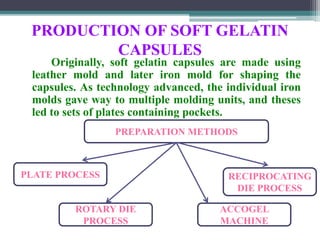
PRODUCTION OF SOFT GELATIN
CAPSULES
Originally, soft gelatin capsules are made using
leather mold and later iron mold for shaping the
capsules. As technology advanced, the individual iron
molds gave way to multiple molding units, and theses
led to sets of plates containing pockets.
PREPARATION METHODS
PLATE PROCESS
ROTARY DIE
PROCESS
ACCOGEL
MACHINE
RECIPROCATING
DIE PROCESS
Plate Process
• Oldest commercial method of manufacture.
• Involves pressing two sheets of wet gelatin together
between two molds provided with die pockets.
• One of the gelatin sheet is placed over the first mold and
application of vacuum produce depressions in the gelatin
sheet into which the active fill is placed.
• A second gelatin sheet is laid over the first gelatin sheet,
and both the gelatin sheet were pressed together with the
fill material sandwiched in between.
Rotary Die Process
• Gelatin mass is fed in to air cooled rotating drums.
Gelatin ribbons of controlled thickness are formed from
the rotating drums. Thicker shells are used on products
requiring greater gelatin strength. The cost of the product
is directly proportional to the shell thickness.
• Gelatin ribbons are then passed through a mineral oil bath
over oil rolls, and then down between the wedge and the
die rolls with die pockets.
• Material to be capsulated flows by gravity into a pump
that accurately meters the material through the wedge into
the gelatin ribbon between the die rolls. Bottom of the
wedge contains small orifices lined up with the die
pockets.
• Filled capsules shaped, hermetically sealed, and cut from
the gelatin ribbons. Capsule sealing is achieved by using
pressure and heat.
• Immediately after manufacture, capsules are
automatically conveyed through a naptha wash unit to
remove the mineral oil lubricant. The washed capsules
are subjected to drying.
• The capsules are then spread on a tray and allowed to
come to equilibrium with forced air conditions :– 20-30%
RH and temperature of 21-24℃.
Reciprocating Die Process
• Similar to Rotary Die Process.
• Gelatin ribbons are fed into die rolls that continuously
open and close to form rows and pockets in the gelatin
ribbon.
• Pockets are filled with medication, and are sealed,
shaped, and cut out of the film as they progress through
the machine.
• As the capsules are cut from the ribbon, they fall in to
refrigerated tanks which prevent the capsules from
adhering to one another.
Accogel Machine
• This is the only machine that formulates dry powder in to
soft gelatin capsule.
• Rest of the features are same as rotary die machine.
NATURE OF CAPSULE SHELL
Capsule shell is composed of gelatin, plasticizers, water,
preservatives, opacifiers, colouring agent, flavours, sugars, and
active ingredient.
• Gelatin :- 150-200 bloom strength, 2.8-4.5 millipoise at 60℃.
• Plasticizers :- added to make the shell elastic, and flexible and to
minimise brittleness and cracking. E.g., polyethylene glycol,
glycerine and sorbitol.
• Water :- demineralised water is used as solvent. Ratio of water to
gelatin is about 0.7-1.3 (water) : 1.0 (gelatin), depending on the
viscosity of gelatin used.
• Preservatives :- added in concentration of 0.2%. Eg. methyl
paraben and propyl paraben.
• Opacifying agent :- titanium oxide used in 0.2 – 1.2%
• Flavouring agent :- used in concentration of 0.1-2%. Eg. ethyl
vanillin.
NATURE OF CAPSULE CONTENT
Capsule content is individually developed to fulfil the
specifications and requirements of the product. The content of a
soft gelatin capsule can be a liquid, a combination of miscible
liquids, a solution or suspension of solid in a liquid.
All such materials are formulated for capsulation to produce
the smallest possible capsule with maximum ingredient and
physical stability, therapeutic effectiveness and production
efficiency. The maximum capsule size for convenient oral use in
humans is 20 minim oblong, 16 minim oval, 9 minim round.
Liquids that are water miscible and volatile cannot be
formulated as a major constituent of the capsule content since they
can migrate into the hydrophilic shell and volatalize from its
surface. Eg. water, ethyl alcohol etc. but they can be used as co –
solvents in the preparation of solutions.
Liquids like aromatic and aliphatic hydrocarbons, chlorinated
hydrocarbons, esters, organic acids can be formulated as active
ingredient. The most widely used liquids for human use are oily
active ingredients, vegetable oils, mineral oils, no ionic surfactants
and polyethylene glycols.
All liquid solutions, suspensions, for capsulation should be
homogenous and air free, should flow by gravity at room
temperature. Preparations for encapsulation should have a pH
between 2.5 -7.5, since preparations that are more acidic can cause
hydrolysis, and leakage of gelatin shell, and preparations that are
more alkaline can tan the gelatin and thus affect the solubility of the
shell.
Combination of miscible liquids often are used to produce
desired physiological actions ( increased or more rapid absorption
of active ingredient) or physiochemical actions (improved
solubility and flow property).
Except for Accogel process (where solids are formulated as dry
powders), solids are filled into soft gelatin capsules in the form of
solution or suspension. Solids should be 80 mesh size or finer
particles. A solution is more easily capsulated and exhibits better
uniformity, stability and biopharmaceutical properties than a
suspension.
In formulation of a suspension, minimum capsule size should
be determined. The final formulation also requires a suspending
agent to prevent the settling of solids and to maintain homogeneity.
Suspending agent used is melted in a suitable portion of the liquid
base, and the hot melt is added slowly with the stirring in to the
bulk portion of the liquid base.
Two important factors that affect the calculation of
the minimum capsule size are :-
• Base Adsorption Factor
• Minim / Gram Factor
BASE ADSORPTION FACTOR (BA)
Base adsorption is defined as the number of grams of
liquid base required to produce the capsulated mixture when
mixed with 1 gm of solid(s). BA of a solid is influenced by its
particle size and shape, its physical state ( fibrous, amorphous or
crystalline), its density, its moisture content, and its oleophilic or
hyrophilic nature.
In determination of a BA factor, the solid must be wetted
thoroughly by the liquid base, and in case of solids that are not
easily done, a wetting agent is required.
Procedure :-
Two 150 ml beakers are taken. Weigh a definite amount of
solid (40gm) into one beaker, and 100g of the liquid base in the
other. Add small increments of the liquid base to the solid, and
using a spatula, stir the base into the solid, until the solid is
thoroughly wetted and uniformly coated with the base. This
produces a mixture that has a soft ointment like consistency.
Continue to add liquid and stir until the mixture flows steadily
from the spatula when held at a 45⁰ angle. As the mixture tends to
stop flowing, note down the weight of the added liquid base.
Formula of finding BA Factor :-
BA = weight of the liquid base added / weight of the solid
Lower the BA of the solid, higher the density of the
mixture, smaller the capsule size.
MINIM / GRAM FACTOR (M/G)
BA factor is used to determine the minim/ gram factor of the solid.
M/G factor is the volume in minims that is occupied by one
gram of solid plus the weight of the liquid base required to
make the capsulated mixture.
M/G factor is calculated by the following formula,
M/G = {( BA + S ) x V } / W
S = gram of solid
W = weight of the mixture
V = minim
Problem :-
A soft gelatin capsule (4gm mixture ) of drug (1gm)
by using vegetable oil (liquid base) is to be prepared. If
BA = 0.75 gm and M/G = 25, then find the volume to be
capsulated.
Solution :-
M/G = {( BA + S ) x V } / W
25 = {( 0.75 + 1 ) x V } / 4
V = 3.52 ml or 57.14 minims
( 1 minim = 0.062 ml)
IN PROCESS AND FINAL PRODUCT
QUALITY CONTROL TESTS
During the process, capsules are taken periodically for
checking :-
• Seal thickness
• Fill weight check
• Capsule diameter sorter
• Capsule colour sorter
• Capsule counting
• Seal thickness :- is measured under a microscope and
changes in gelatin ribbon thickness, heat or pressure are made
if necessary. Acceptable seal thickness is ½ - 2/3 of the ribbon
thickness.
• Fill weight check :- are made by weighing the whole fresh
capsule, slitting it open, and the contents are removed. The
shell is then washed in a suitable solvent, and the empty shell
is reweighed. If there is weight variation, then necessary
changes are made in the pump that measure the weight of the
material to be filled.
• Capsule diameter sorter :- allows to sort and check the
capsules are within the range of ± 0.020 inch of the theoretical
diameter of the capsules. Overfills, underfills, or foreign
capsules are discarded.
• Capsule colour sorter :- capsules are fed into the colour
sorter automatically from the diameter sorter. Any capsule
whose colour does not conform to the standard for that
particular product is discarded, while other capsules that pass
the test are accepted.
• Capsule counting :- here the capsules are counted, and about
8000 capsules can be counted per minute. They are then,
moved to further quality control tests of the finished product.
Appearance
Weight
variation
tests
Disintegration
tests
Dissolution
tests
Content
uniformity
tests
Moisture
permeation
tests Soft gelatin
capsules are
subjected for
following tests
during quality
control:-
Average net
weight
Deviation (%) No. of Capsules
Less than 300
mg
±10 Min 18
±20 Max 2
300mg and more
±7.5 Min 18
±15 Max 2
Weight variation testing conditions
Disintegration testing condition and interpretation
Type of
capsule
Disintegr
ation
medium
Temperature Limit
Hard
gelatin
capsule
Water/
buffer
37 ℃ ± 2℃ 30 min
Soft
gelatin
capsule
Water
37 ℃ ± 2℃
60 min
Enteric
coated
capsule
0.1 M HCl
mixed
phosphate
buffer pH
6.8
37 ℃ ± 2℃
2 hr in HCl – no
disintegation
1 hr in buffer -
disintegrate
Difference between Hard and Soft Gelatin Capsule
Hard gelatin capsules Soft gelatin capsules
Cylindrical in shape Round, oval and tube like shapes
Two piece :- body and cap One piece
Plasticizer to gelatin ratio :- 0.4:1 Plasticizer to gelatin ratio :- 0.8:1
Boundary wall firm and rigid Boundary wall soft and flexible
Volatile drug substance is not suitable
for filling
Volatile drug substance is suitable for
filling
Preservative less Preservative more than hard capsules
Amount of plasticizer is less
Amount of plasticizer is more than
hard capsules
STABILITY TESTING
Stability testing of capsules is performed to determine the
physicochemical stability of the drug substance in the finished
drug product under specified package and recommended storage
conditions and the influence of environmental factors.
Unprotected capsules rapidly reach equilibrium with
atmospheric conditions under which they are stored. Due to this
property, effect of humidity and temperature, storage and
packing conditions, effect of capsule content on the gelatin shell
should be studied and the standards should be established.
Stability studies should be conducted by comparing test
capsules and control capsule (capsule with just mineral oil). The
capsules must be set to an equilibrium conditions with 20 – 30%
RH at 21 -24℃ before starting a stability study. The physical
stability of soft gelatin capsules is associated primarily with the
pick up or loss of water by the capsule shell.
If the capsules have protected packaging, the capsules
should have satisfactory physical stability at temperatures
ranging from the freezing point to as high as 60℃.
For unprotected capsules, stability test should be
conducted as the following :-
Condition 1 Observation
RH lower than 20%, temperature
lower than 2℃ and greater than
38℃ . Such a condition has only
transient effects.
The transient effects are
brittleness, susceptibility to
mechanical shock. The capsule
can return to normal when
optimum storage conditions are
provided. On returning to
normal, capsule can become dull
or may stick together.
Condition 2 Observation
RH greater than 45%, and
temperature greater than 24℃
Capsule melts and fuse together
Condition 3 Observation
RH greater than 60%, and a
reasonable temperature 21-24℃
Capsule shell picks up moisture.
The capsule becomes softer,
tackier, and bloated. The
capsules do not leak unless any
ingredient in the capsule attacks
the gelatin under the influence
of the moisture picked.
Manufacturer also conducts accelerated physical stability
study. The results of the study are then taken as a guide for
reformulation of capsule content or capsule shell or for selection
of retail package. The tests are done in the following conditions
for two weeks :-
Tests conditions Observation
Condition 1 :- 80% RH at room
temperature in an open container The results show a change in :-
disintegration, leakage, unusual
brittleness or softening of the
capsule shell, loss of volatile
ingredients from the capsule,
widening of the corners of the
capsule etc.
Condition 2 :- 40℃ in an open
container
Condition 3 :- 40℃ in a closed
container (glass bottle with tight
screw cap)
• Such defects observed in the results can be further corrected
by changing the capsule content, gelatin content, colorants
used, or the machine speed or machine dies.
• The control capsule should not undergo any changes other
than Condition 1, as in such condition capsules have the
effect of high humidity, and undergo picking up of moisture in
the capsule shell.
• The stability studies and accelerated studies should be
further conducted with capsules in its retail package.
PACKAGING & STORAGE OF CAPSULES
When bulk shipments of capsules are made by the
manufacturer, they are temporarily protected from the
normal changes in humidity by a suitable barrier such as
0.003 inch polyethylene bag within a standard fibre board
carton. The bulk capsules should be stored in an air
conditioned area in which the humidity does not exceed
45% RH at 21-24℃.
Retail packaging of capsules in the bulk
shipment should be done in the similar
conditions as soon as the shipments are
opened, for the maximum physical and
chemical stability of the product.
Capsules should be stored in glass or
plastic containers or maybe strip or blister
packaged, and stored at temperature not
exceeding 30℃.
If the content in the capsules in glass or
plastic container, are hygroscopic in nature, a
packet of dessicant (eg. silica gel) is added to
absorb any excess moisture present.
In strip packaging, capsules are tight
sealed in aluminum or plastic film. In blister
packaging, capsules are pushed out of the
package, by a force given on any blister in the
package.

Capsules

  • 1.
    CAPSULES Ms. TENY SARATHOMAS MOUNT ZION COLLEGE OF PHARMACEUTICAL SCIENCES AND RESEARCH, ADOOR, KERALA ASSISTANT PROFESSOR B.PHARM FIFTH SEMESTER FORMULATIVE & INDUSTRIAL PHARMACY UNIT III
  • 2.
  • 3.
    INTRODUCTION Capsules are soliddosage form in which the drug substance is enclosed within a hard or soft soluble shell made of gelatine or suitable material. • The word capsule is derived from the latin word “capsula” that means small box. • Capsules are formulated for carrying fixed dose of any active pharmaceutical ingredient. • It is a unit solid dosage form meant for oral use in which medicament and inert substances are enclosed.
  • 4.
    Advantages of Capsules •Easy to manufacture because there are lesser step wise operations. • Liquids can be administered. • Bioavailability of poorly soluble drugs can be improved • Taste of bitter drugs can be masked • Elegant in appearance • Smooth and slippery surface facilitates swallowing • Minimum excipients are only required. • Rapid solubility of gelatine allows faster release of drugs. • Pressure required during the manufacturer is lesser than that required during tablet production.
  • 5.
    Disadvantages of Capsules •Capsules are not suitable for drugs that are highly soluble like, potassium chloride, ammonium chloride etc. • Not a suitable dosage form for formulating drugs which are highly efflorescent (that loses water to atmosphere) or highly deliquescent (that absorbs water vapour). • Efflorescence leads to a more softer capsule, while deliquescence leads to forming a more dry capsule. • Concentrated preparations that require dilution prior to administration will not be possible to formulate as capsules.
  • 6.
    GELATIN Gelatin is aheterogeneous product derived by irreversible hydrolytic extraction of collagen. Common sources of collagen :- animal bones, skin of ox and pigs etc. Gelatin’s chemical, physical, and physiological properties make it an ideal substances for the capsulation of pharmaceutical products. Gelatin is available in mainly two forms :- • Type A :- derived from acid catalysed hydrolysis and exhibit an isoeletric point in the ph range 9. • Type B :- derived from alkali catalysed hydrolysis and exhibit an isoeletric point in the ph range 4.7.
  • 7.
    Preparation of Gelatine •Inspection and Cutting :- animal parts are checked for quality and the rotten parts are discarded. Bones, tissues, and skins are cut into smaller pieces which are about 12.7cm through chopping machines. • Degreasing and Roasting :- The animal parts are passed under high-pressure water sprays to wash away debris. They are then degreased by soaking them in hot water to reduce the fat content to about 2%. A conveyer belt moves the degreased bones and skins to an industrial dryer where they are roasted for approximately 30 minutes at about 200° F (100° C).
  • 8.
    • Acid andalkali treatment :- The animal parts are soaked in vats of lime or some other type of acid or akali for approximately five days. This process removes most of the minerals and bacteria and facilitates the release of collagen. The acid wash is typically a 4% hydrochloric acid with a pH of less than 1.5. The alkaline wash is a potassium or sodium carbonate with a pH above pH 7. • Boiling :- The pieces of bone, tissue, and skin are loaded into large aluminum extractors and boiled in distilled water. A tube running from the extractor allows workers to draw off the liquid that now contains gelatin. The liquid is sterilized by flash-heating it to about 375° F (140° C) for approximately 4 seconds.
  • 9.
    • Evaporating andGrinding :- From the extractor, the liquid is piped through filters to separate out bits of bone, tissue or skin that are still attached. The liquid is passed through evaporators. The gelatin is press into sheets and passed through a grinder to get fine powder. • Flavouring and colouring :- preset amount of addictives are thoroughly mixed into the powdered gelatin as required.
  • 11.
    Properties of Gelatine Thegelatin to be used in the pharmaceutical manufacture should be of the USP Grade, along with the further properties :- • Bloom or Gel Strength of Gelatin • Viscosity of Gelatin • Iron Content in Gelatin
  • 12.
    • Bloom orGel Strength :- is the measure of the cohesive strength of the cross linking that occurs between gelatin molecules. This cohesive strength is directly proportional to the molecular weight of the gelatin. Bloom strength is measured using standard plunger and this determines the weight in grams taken to penetrate the gel surface by 4mm deep without breaking the gel at 10℃. The number of grams is called the bloom value. Bloom value ranges from 150 - 250gm. Higher the bloom strength of the gelatin, the more physically stable is the resulting capsule shell. Cost of the gelatin is directly proportional to the gel strength. Hence, higher bloom value gelatin is majorly used when greater physical stability is required or in the manufacture of larger capsule shells.
  • 13.
    • Viscosity ofthe Gelatin :- is the measure of the molecular chain length and determines the manufacturing characteristics of the gelatin film. Viscosity is determined using a U – Tube viscometer with a 6% gelatin solution at 60℃. The viscosity varies from 25-45millipoise. Higher the bloom value, greater the viscosity. • Iron Content :- is always present in gelatin, and its concentration usually depends on the large amount of water required for washing during the manufacture of gelatin. Therefore, the iron content in gelatine should not exceed 15ppm.
  • 14.
  • 15.
    CONTENTS • INTRODUCTION • PRODUCTIONOF HARD GELATIN CAPSULES • SIZE OF HARD GELATIN CAPSULES • FILLING OF CAPSULES • FINISHING • SPECIAL TECHNIQUES OF FORMULATION OF HARD GELATIN CAPSULES • QUALITY CONTROL TESTS OF HARD GELATIN CAPSULES
  • 16.
    INTRODUCTION Hard gelatin capsulesconsists of two pieces in the form of cylinders closed at one end. The shorter piece is called the cap. This cap fits over the open end of longer piece called body. The drug substance is placed in the body and the caps are slided over it, hence enclosing the drug substance. BODY CAP
  • 17.
    PRODUCTION OF HARDGELATIN CAPSULE SHELL All raw materials required for the production of a capsule shell are collected and weighed. A solution of gelatin with a concentration of about 45-60% is prepared by mixing of gelatin in demineralised hot water at 60-70℃ in jacketed pressure vessels. Vacuum can be applied to remove entrapped air bubbles. Gelatin solution is transferred to stainless steel feed tanks. Dyes, opacifants, preservatives and any water needed are added to the gelatin solution. Finally the viscosity is adjusted according to required thickness of the capsule shell. Stainless steel mold pins are those on
  • 18.
    Steps in theProduction of Hard Gelatin Capsule Shell • Dipping • Spinning • Drying • Stripping • Trimming • Joining • Polishing
  • 19.
    • Dipping :-150 pairs of stainless steel mold pins are dipped in to the prepared gelatin solution of controlled viscosity to form caps and bodies simultaneously. This results in the formation of film on the surface of the mold pins. • Spinning :- The mold pins are rotated so as to provide uniform distribution of gelatin. • Drying :- The gelatin is dried at the blast of cool air to form the hard shell. The pins are moved through a series of air drying kilns which help in removing any water content present.
  • 20.
    • Stripping :-A series of bronze jaw strips the cap and body portion of the capsules from the mold pins. • Trimming :- the stripped cap and body portion of the capsule are trimmed to the required length using stationary knives. • Joining :- After trimming, the cap and body sections are joined and ejected from the machine. • Polishing :- is done using Accela cota pans and then rubbed with clothes. The entire cycle of the machine lasts for approximately 45 minutes. Inspection processes are done finally to remove the imperfect capsules. Capsules are then ready for sterilisation and packaging.
  • 22.
    SIZE OF CAPSULES ForHuman Use, empty capsule shells are available in different sizes. Based on capacity of the granules, capsule size are numbered and ranges from 000 to 5. 000 being the largest and 5 being the smallest size.
  • 23.
    SIZE VOLUME INml SIZE IN mm 000 (largest) 1.37 2.6 00 0.95 2.3 0 0.68 2.1 1 0.5 1.9 2 0.37 1.8 3 0.30 1.5 4 0.21 1.4 5 (smallest) 0.15 1.1
  • 24.
    CAPSULE FILLING The hardtwo – piece capsule can be filled with materials that have a wide range of physical properties. Types of dosage forms for filling into hard capsules :- Solid Semi – Solid Liquid •Powders •Granules •Pellets •Tablets •Paste •Thermo softening mixtures •Thixo-tropic mixtures •Non – aqueous solutions •Oily liquids
  • 25.
    • Powdered formulationsoften require excipients such as fillers, lubricants, glidants, to facilitate their encapsulation. This influences the rate of release. Addition of wetting agents is needed in case of hydrophobic drugs. • In case of powders that have a chance to liquefy , adsorbents like colloidal silica, magnesium carbonate must be used.
  • 26.
    Capsule Filling Machines HANDOPERATED CAPSULE FILLING MACHINE SEMI – AUTOMATIC CAPSULE FILLING MACHINE AUTOMATIC CAPSULE FILLING MACHINE PUNCH METHOD
  • 27.
    Hand Operated CapsuleFilling Machine Pharmacists that prepare capsules on a regular or extensive basis may use hand operated capsule machines. These machines are also called Feton capsule filling machine. The machine has the following parts :- • Capsule bed with 200- 300 holes • Loading tray • Powder tray • Pin plate with 200- 300pins • Sealing plate with rubber top • Lever • Cam handle
  • 30.
    • Tighten thecam handle and placed lever in the position. The machine is ready for capsule filling. • Place the empty capsules onto the loading tray with the body end of the capsules oriented downwards and the cap oriented upwards. • Placed the filled loading tray over the capsule bed. • The cam handle is used to lock the body part of the capsules at their place while of the cap of the capsule is separated. • Powder tray is placed in position, and the powder is placed on to the surface. Using a spatula, spread the powder uniformly to fill the bodies of the capsules. Remove the excess powder. Working of Hand Operated Capsule Filling Machine
  • 31.
    • The pinplate is then lowered to press the filled powder. Again raise the pin plate. • Remove the powder tray after filling. • The cap holding plate is then repositioned over the body. • The capsules are rejoined then by manual pressure. • Remove the loading tray and collect the filled capsules.
  • 32.
    Semi Automatic CapsuleFilling Machine Semi automatic capsule filling machine are employed when smaller batches sizes are required. Production capacities can range from 6000 – 8000 capsules per hour. Semi automatic capsule filling machines always require an operator in attendance at all times of the operation. Semi automatic machines use the Auger Filling Principle.
  • 33.
    The machine hasthe following parts :- A. Capsule fill B. Stirrer C. Auger D. Capsule body holder E. Turn table F. Capsule ring • Peg ring • Capsule hopper • Turntables • Rectifier
  • 34.
  • 36.
    There are 3stages of how the capsule filling machine works :- 1. Orientation of capsule :- The capsule ring is placed on a turntable under the Rectifier (they orient the capsule in such a way that the body part is oriented downwards and cap part is oriented upwards). Empty capsule shells in the capsule hopper are descended by the rectifier in to the capsule ring. As the ring rotates on the turntable, vacuum pulls the capsules bodies in to the lower part of the capsule ring, leaving the caps behind in the upper ring. Working of Semi Automatic Capsule Filling Machine
  • 37.
    2. Powder fillingof capsule :- After capsule separation, the operator separates the rings of the capsule ring and places the body ring on another turntable that rotates beneath the foot of the powder hopper. The auger in the hopper rotates to provide constant downward flow of the formulation while the filling ring rotates. The amount of formulation delivered to the capsule bodies depends on the dwell time of the bodies under the foot of the hopper, i.e., the speed of rotation of the body ring.
  • 38.
    3. Capsule Closing:- Upper and the lower holding ring of the capsule ring is joined together and positioned in front of the peg ring holding pins. Pneumatic pressure is applied to the peg ring which finally pushes the caps and the bodies together inside the holes of the capsule ring. Filled capsules are then removed from the capsule ring.
  • 39.
    Automatic Capsule FillingMachine Automatic capsule filling machine are designed and developed to fill hard gelatin capsules with powders or pellets. It is an extremely durable and reliable machine that fills dosages to the highest accuracy. It can be applicable to the widest range of capsules at all sizes. Automatic filling machines employ pistons, or tamping pins that lightly compress the powder into slugs, and eject the plugs into the empty capsule bodies. Automatic machines use the Dosing Disc Principle and Dosator Principle.
  • 42.
    Dosing disc Principle Workingof a Automatic Capsule Filling Machine
  • 44.
    • The dosingdisc rotates continuously in a circular manner. The stop plate closes the holes on the dosing plate. The dosing disc rotates below the powder bed, the material flows into each hole. The pins which are in the station compress the powder to a controlled depth. • The process of filling and compression continues till reaching the last compressing pin, where the machine ejects a compressed powder through the dosing plate into the capsule. • This is a continuous process and the production speed will depend on the preset machine conditions.
  • 45.
    Dosator Principle Working ofa Automatic Capsule Filling Machine Diagram of a dosator or dosing tube system: (A) compression force platen; (B) piston; (C) dosing tube; (D) powder hopper; (E) plug ejection platen; (F) capsule body in bush; and (G) powder plug
  • 46.
    • A dosatormachine has two segments :- powder bed on one side while the empty capsule body on the opposite side. • As the dosing tube goes down, penetrates the powder bed, powder enters the open end of the dosator. • A plug is formed inside the dosing tube with a movable piston that controls the dosing volume and applies a force to form the plug. • Dosage tube then moves up, takes a 180⁰ rotation, and press powder plug into the capsule body to complete capsule filling.
  • 47.
    Punch Method (ManualFilling) To hand fill capsules, the pharmacist generally uses the Punch Method. • Ingredients are triturated an mixed. The powder is placed on a powder paper or ointment slab and smoothed with a spatula to a height approximately half the length of the capsule body. • The body of the capsule is held vertically and the open end is pushed or punched into the powder until the capsule is filled. • The capsule is replaced to close the capsule. • Each filled capsule is weighed after filling. Powder is added and removed until the correct weight has been placed in the capsule.
  • 49.
    All the capsulefilling machines have the 4 steps in common. • Rectification of the empty capsule shell :- orientation of the capsule – body oriented downwards and caps oriented upwards. • Separation of cap and body of empty capsule shell. • Dosing of a fill material :- eg. Auger Principle, Dosing disc Principle, Dosator fill principle, Punch Principle etc. • Replacement of the caps over the body and Ejection of the filled capsules.
  • 50.
    Famous companies manufacturingdifferent capsule filling machines :- • Lilly and Parke – Davis • Farmatic • Hofliger and Karg • Macofar • mG2 • Osaka • Perry • Zanasi
  • 51.
    CAPSULE FINISHING Filled capsulesfrom the capsule equipment require dusting or polishing operation before the remaining operations of inspection, bottling, and labeling are completed. Dusting or polishing operations vary according to the type of the filling equipment used, the type of powder used for filling, and the individual requirements for the finished appearance of the completed capsules.
  • 52.
    Capsule Finishing Machines PANPOLISHING BRUSHING CLOTH DUSTING
  • 53.
    Pan Polishing Because ofthe unique design, especially primary in the area of airflow, the Accela Cota Tablet Coating Pan is used to dust and polish capsules. A polyurethane or cheese cloth liner is placed in the pan, and the liner is used to trap the removed dust as well as impart a gloss to the capsules.
  • 54.
    Cloth Dusting In thismethod, the filled capsules are rubbed with a cloth that may or may not be impregnated with an inert oil. This procedure is a hand operation and gives a shine to the capsules. Also it results in a positive method for removal of resistant materials.
  • 55.
    Brushing In this method,the filled capsules are fed under rotating soft brushes, which serve to remove the dust from the capsule shell. This operation must be accomplished by application of vacuum for dust removal.
  • 56.
    There are mainly3 commercial equipments :- 1. Rotosort :- is a mechanical sorting device that removes loose powder, unfilled joined capsules, filled or unfilled capsule bodies, and loose capsule caps. This machine can handle up to 15000 capsules per hour 2. Erweka KEA :- is designed to handle the output from any type of capsule filling machine. It moves the capsules between soft plastic tassels against a perforated plastic sleeve, under vacuum. Any residual powder is removed by the vacuum. 3. PM60 :- the equipment has two units that may be used in the finishing process of capsules, which may be used separately or combined. A belt is available that presents capsules for visual inspection, and it may include vacuum system that removes the unfilled capsules. The machine has lamb wool belts moving in opposite directions. Commercial Capsule Dust or Polish Equipments
  • 57.
    SPECIAL TECHNIQUES OFFORMULATION OF HARD GELATIN CAPSULES • Decreasing Solubility • Formulating Incompatible Materials • Filling of Semisolids • Filling of Liquids • HPMC Capsules • Starch Capsules • Cross Linked Dextran Capsules
  • 58.
    Decrease of Solubility •Solubility is retarded in this technique of formulating a special type capsule. • Done in an attempt delay absorption of the active ingredient or to provide enteric properties. • Solubility is assured in two ways here:- a) Water resistance – failure to dissolve in water in 15 mints at 20- 30℃. b) Acid solubility – dissolve in less than 5 mints in 0.5% aq. HCl at 36 - 80℃ • Two ways of formulating capsules with decreased solubility are :- a) Formalin treatment :- exposure of the gelatin film to formalin vapours decrease the solubility of gelatin due to the cross linking of molecules in gelatin initiated by aldehyde. b) Coating of the gelatin capsules with coating materials like shellac, cellulose acetate phthallate etc., by usual pan coating
  • 59.
    Formulation of IncompatibleMaterials • Formulation of Incompatible materials is carried out by the use of a two phase fill in the capsule • One phase :- consists of a soft capsule, or smaller hard capsule or a pill that is filled into the capsule. • Other phase :- powder fill is added in the usual manner. • Changes should be made to the equipment for the machine operation to allow the two filling.
  • 60.
    Filling of Semisolids •Semisolids are melted to allow the filling of the material in the capsules at ambient temperature. Filling of Liquids • Liquids in the form of thermosetting or thixotropic mixture are filled in the capsule. • Gelatin banding is required for the sealing of the capsules to prevent leakage. • Two bands of gelatin solution are applied around the centre of the filled capsules and this then dried using air ate ambient conditions.
  • 61.
    HPMC Capsules • Developedas an alternative to hard gelatin capsules. • Odourless and flexible, low moisture content, chemically inert, stable under low moisture conditions. • HPMC Capsules :- manufactured using 18-28% HPMC, carrageenan (0.01 – 0,09% w/w) and potassium or calcium ions (0.05-0.6% w/w) • Carrageenan and potassium or calcium ions are used as co gelling agents to facilitate the gelling of HPMC.
  • 62.
    Cross Linked DextranCapsules • Capsule shell are prepared by reacting dextran. Magnesium chloride, glutaraldehyde, and polyethylene glycol 400 in water. Starch Capsules • Capsule shell are prepared by starch obtained from potato. • Dissolution is independent of pH. • Usually used for manufacture of enteric coated capsules.
  • 63.
    QUALITY CONTROL TESTSOF HARD GELATIN CAPSULE • Weight variation test • Content uniformity test • Disintegration test • Dissolution test • Moisture permeation test
  • 64.
    Weight Variation Test Weigh20 capsules individually and find the average weight. Individual weights should be within 90% - 110% of the average weight. If this is requirement is not fulfilled, then the weight of contents of each individual capsule is determined and compared with the average weight of the contents. The difference between the individual content weight and average content weight are determined. The contents of the shell are removed with the help of a small brush. The requirements are met, :- if not more than 2 of the individual differences are greater than 10% of the average content weight, or, :- when no capsule content weight is greater than 25%
  • 65.
    If more than2 but less than 6 of the individual differences deviate from the requirements said before, • Individual content weight, is determined for another 40 capsules. • Average of 60 capsules content weight are taken. • The difference of the individual content weight of the previous 20 capsules and the next 40 capsules are determined from the new average content weight of 60 capsules. • For the test to pass :- a) Difference should not exceed 10% of the new average content weight of 60 capsules for a minimum of 6 capsules. b) when no capsule content weight is greater than 25% • Rotoweigh and Vericap 1200 determines the weight of individual capsules automatically and also rejects the under filled or overfilled capsules.
  • 66.
    Content Uniformity Test •30 capsules are selected, 10 of which are assayed as per the procedure mentioned in the specific monograph. • The requirements are met :- a) If 9 out of 10 are in the range of 85 – 115% potency. b) 10th capsule is not outside 75 – 125%. • if more than 1 but less than 3 fall outside 85 – 115%, then the rest of the 20 capsules are assayed. • In that case, the test passes, when all the 30 capsules, are within 75-125% potency, and not less than 27 of the 30 capsules are within 85-115% potency.
  • 67.
    Disintegration Test • Sameapparatus as used in the evaluation of disintegration in tablets. • To test the disintegration time, one capsule is placed in each tube of the basket assembly, and the basket rack is position in a medium at 37℃. Perforated plastic discs are placed on top of the capsules. • The capsules complies with the test, if all the capsules disintegrate, and all the particles pass through the mesh screen in the specified time. If any residue remains, it must have only a soft mass with no firm core. • If 1 or 2 fails to disintegrate, the test is repeated with 12 additional tablets. • According to the IP, hard shell capsules take only a maximum of 30 minutes to disintegrate.
  • 68.
    Dissolution Test • Sameapparatus as used in the evaluation of dissolution in tablets. • To test the dissolution or drug release from the capsule, USP Apparatus II – the rotating paddle type is used mainly. • As the capsule comes in contact with the aqueous media at 37℃, capsule shell absorb water and swell. • The rate of water penetration is inversely proportional to the thickness of the capsule shell. The shell ruptures at the shoulder of the cap an the body part. • Rate of gelatin solubility is dependent on the temperature of the solution. As the temperature decreases, the solubility of the gelatin decreases.
  • 69.
    Moisture Penetration Test •Degree and rate of moisture penetration is determined by packing the capsules together. Expose the packaged unit to a known relative humidity over a specified time. • The change in initial and final weight is determined.
  • 70.
  • 71.
    CONTENTS • INTRODUCTION • SIZEAND SHAPE OF SOFT GELATIN CAPSULES • NATURE OF SHELL • NATURE OF CAPSULE CONTENT • BASE ADSORPTION & MINIM / GRAM FACTOR • PRODUCTION OF SOFT GELATIN CAPSULES • IN PROCESS AND FINAL PRODUCT QUALITY CONTROL TESTS • STABILITY TESTING • PACKAGING AND STORAGE OF CAPSULES
  • 72.
    INTRODUCTIONSoft gelatin capsules,also called as softgels, are one piece solid capsule, hermetically sealed, soft gelatin shells (outer shell) containing a liquid, a suspension, or a semi – solid (inner fill). An active ingredient may be incorporated in the outer shell, inner fill or both.
  • 73.
    Advantages • Easy toswallow, tasteless, available in different variety of shapes, colours, and sizes. • Unit dose delivery system and tamper proof. • Accuracy and uniformity of dosage, capsule to capsule and lot to lot, are predominant advantages. • Permit liquid medications to become easily portable and increases the bioavailability. • Low melting point drugs can also be easily incorporated. • Safer handling of highly potent or cytotoxic drug compounds. • Dissolution rate or disintegration time are better, so they show an advantage over other solid dosage formulations.
  • 74.
    Disadvantages • Need specialtype of equipments for the manufacture • Not suitable to formulate water soluble compounds. • Not suitable to formulate highly efflorescent drugs as they may cause leaking, or softening of shell. • Not suitable to formulate deliquescent drugs as they may cause hardening of shell or production of brittle capsules. • Higher manufacturing costs compared to tablets
  • 75.
    Applications of SoftGelatin Shell Capsules • As an oral dosage form for human or veterinary use. • As a suppository dosage form for rectal or vaginal use • As a speciality package in the tube shape, for human or veterinary use of topical, ophthalmic, otic (ear) preparations. • In the cosmetic industry, these can be formulated as a speciality package for breath fresheners, perfumes, bath oils, various skin creams etc.
  • 76.
    Size and Shapeof Soft Gelatin Shell Capsules
  • 79.
    PRODUCTION OF SOFTGELATIN CAPSULES Originally, soft gelatin capsules are made using leather mold and later iron mold for shaping the capsules. As technology advanced, the individual iron molds gave way to multiple molding units, and theses led to sets of plates containing pockets. PREPARATION METHODS PLATE PROCESS ROTARY DIE PROCESS ACCOGEL MACHINE RECIPROCATING DIE PROCESS
  • 80.
    Plate Process • Oldestcommercial method of manufacture. • Involves pressing two sheets of wet gelatin together between two molds provided with die pockets. • One of the gelatin sheet is placed over the first mold and application of vacuum produce depressions in the gelatin sheet into which the active fill is placed. • A second gelatin sheet is laid over the first gelatin sheet, and both the gelatin sheet were pressed together with the fill material sandwiched in between.
  • 81.
    Rotary Die Process •Gelatin mass is fed in to air cooled rotating drums. Gelatin ribbons of controlled thickness are formed from the rotating drums. Thicker shells are used on products requiring greater gelatin strength. The cost of the product is directly proportional to the shell thickness. • Gelatin ribbons are then passed through a mineral oil bath over oil rolls, and then down between the wedge and the die rolls with die pockets. • Material to be capsulated flows by gravity into a pump that accurately meters the material through the wedge into the gelatin ribbon between the die rolls. Bottom of the wedge contains small orifices lined up with the die pockets.
  • 82.
    • Filled capsulesshaped, hermetically sealed, and cut from the gelatin ribbons. Capsule sealing is achieved by using pressure and heat. • Immediately after manufacture, capsules are automatically conveyed through a naptha wash unit to remove the mineral oil lubricant. The washed capsules are subjected to drying. • The capsules are then spread on a tray and allowed to come to equilibrium with forced air conditions :– 20-30% RH and temperature of 21-24℃.
  • 84.
    Reciprocating Die Process •Similar to Rotary Die Process. • Gelatin ribbons are fed into die rolls that continuously open and close to form rows and pockets in the gelatin ribbon. • Pockets are filled with medication, and are sealed, shaped, and cut out of the film as they progress through the machine. • As the capsules are cut from the ribbon, they fall in to refrigerated tanks which prevent the capsules from adhering to one another.
  • 85.
    Accogel Machine • Thisis the only machine that formulates dry powder in to soft gelatin capsule. • Rest of the features are same as rotary die machine.
  • 86.
    NATURE OF CAPSULESHELL Capsule shell is composed of gelatin, plasticizers, water, preservatives, opacifiers, colouring agent, flavours, sugars, and active ingredient. • Gelatin :- 150-200 bloom strength, 2.8-4.5 millipoise at 60℃. • Plasticizers :- added to make the shell elastic, and flexible and to minimise brittleness and cracking. E.g., polyethylene glycol, glycerine and sorbitol. • Water :- demineralised water is used as solvent. Ratio of water to gelatin is about 0.7-1.3 (water) : 1.0 (gelatin), depending on the viscosity of gelatin used. • Preservatives :- added in concentration of 0.2%. Eg. methyl paraben and propyl paraben. • Opacifying agent :- titanium oxide used in 0.2 – 1.2% • Flavouring agent :- used in concentration of 0.1-2%. Eg. ethyl vanillin.
  • 87.
    NATURE OF CAPSULECONTENT Capsule content is individually developed to fulfil the specifications and requirements of the product. The content of a soft gelatin capsule can be a liquid, a combination of miscible liquids, a solution or suspension of solid in a liquid. All such materials are formulated for capsulation to produce the smallest possible capsule with maximum ingredient and physical stability, therapeutic effectiveness and production efficiency. The maximum capsule size for convenient oral use in humans is 20 minim oblong, 16 minim oval, 9 minim round. Liquids that are water miscible and volatile cannot be formulated as a major constituent of the capsule content since they can migrate into the hydrophilic shell and volatalize from its surface. Eg. water, ethyl alcohol etc. but they can be used as co – solvents in the preparation of solutions.
  • 88.
    Liquids like aromaticand aliphatic hydrocarbons, chlorinated hydrocarbons, esters, organic acids can be formulated as active ingredient. The most widely used liquids for human use are oily active ingredients, vegetable oils, mineral oils, no ionic surfactants and polyethylene glycols. All liquid solutions, suspensions, for capsulation should be homogenous and air free, should flow by gravity at room temperature. Preparations for encapsulation should have a pH between 2.5 -7.5, since preparations that are more acidic can cause hydrolysis, and leakage of gelatin shell, and preparations that are more alkaline can tan the gelatin and thus affect the solubility of the shell. Combination of miscible liquids often are used to produce desired physiological actions ( increased or more rapid absorption of active ingredient) or physiochemical actions (improved solubility and flow property).
  • 89.
    Except for Accogelprocess (where solids are formulated as dry powders), solids are filled into soft gelatin capsules in the form of solution or suspension. Solids should be 80 mesh size or finer particles. A solution is more easily capsulated and exhibits better uniformity, stability and biopharmaceutical properties than a suspension. In formulation of a suspension, minimum capsule size should be determined. The final formulation also requires a suspending agent to prevent the settling of solids and to maintain homogeneity. Suspending agent used is melted in a suitable portion of the liquid base, and the hot melt is added slowly with the stirring in to the bulk portion of the liquid base.
  • 90.
    Two important factorsthat affect the calculation of the minimum capsule size are :- • Base Adsorption Factor • Minim / Gram Factor
  • 91.
    BASE ADSORPTION FACTOR(BA) Base adsorption is defined as the number of grams of liquid base required to produce the capsulated mixture when mixed with 1 gm of solid(s). BA of a solid is influenced by its particle size and shape, its physical state ( fibrous, amorphous or crystalline), its density, its moisture content, and its oleophilic or hyrophilic nature. In determination of a BA factor, the solid must be wetted thoroughly by the liquid base, and in case of solids that are not easily done, a wetting agent is required.
  • 92.
    Procedure :- Two 150ml beakers are taken. Weigh a definite amount of solid (40gm) into one beaker, and 100g of the liquid base in the other. Add small increments of the liquid base to the solid, and using a spatula, stir the base into the solid, until the solid is thoroughly wetted and uniformly coated with the base. This produces a mixture that has a soft ointment like consistency. Continue to add liquid and stir until the mixture flows steadily from the spatula when held at a 45⁰ angle. As the mixture tends to stop flowing, note down the weight of the added liquid base. Formula of finding BA Factor :- BA = weight of the liquid base added / weight of the solid Lower the BA of the solid, higher the density of the mixture, smaller the capsule size.
  • 93.
    MINIM / GRAMFACTOR (M/G) BA factor is used to determine the minim/ gram factor of the solid. M/G factor is the volume in minims that is occupied by one gram of solid plus the weight of the liquid base required to make the capsulated mixture. M/G factor is calculated by the following formula, M/G = {( BA + S ) x V } / W S = gram of solid W = weight of the mixture V = minim
  • 94.
    Problem :- A softgelatin capsule (4gm mixture ) of drug (1gm) by using vegetable oil (liquid base) is to be prepared. If BA = 0.75 gm and M/G = 25, then find the volume to be capsulated. Solution :- M/G = {( BA + S ) x V } / W 25 = {( 0.75 + 1 ) x V } / 4 V = 3.52 ml or 57.14 minims ( 1 minim = 0.062 ml)
  • 95.
    IN PROCESS ANDFINAL PRODUCT QUALITY CONTROL TESTS During the process, capsules are taken periodically for checking :- • Seal thickness • Fill weight check • Capsule diameter sorter • Capsule colour sorter • Capsule counting
  • 96.
    • Seal thickness:- is measured under a microscope and changes in gelatin ribbon thickness, heat or pressure are made if necessary. Acceptable seal thickness is ½ - 2/3 of the ribbon thickness. • Fill weight check :- are made by weighing the whole fresh capsule, slitting it open, and the contents are removed. The shell is then washed in a suitable solvent, and the empty shell is reweighed. If there is weight variation, then necessary changes are made in the pump that measure the weight of the material to be filled. • Capsule diameter sorter :- allows to sort and check the capsules are within the range of ± 0.020 inch of the theoretical diameter of the capsules. Overfills, underfills, or foreign capsules are discarded.
  • 97.
    • Capsule coloursorter :- capsules are fed into the colour sorter automatically from the diameter sorter. Any capsule whose colour does not conform to the standard for that particular product is discarded, while other capsules that pass the test are accepted. • Capsule counting :- here the capsules are counted, and about 8000 capsules can be counted per minute. They are then, moved to further quality control tests of the finished product.
  • 98.
  • 99.
    Average net weight Deviation (%)No. of Capsules Less than 300 mg ±10 Min 18 ±20 Max 2 300mg and more ±7.5 Min 18 ±15 Max 2 Weight variation testing conditions
  • 100.
    Disintegration testing conditionand interpretation Type of capsule Disintegr ation medium Temperature Limit Hard gelatin capsule Water/ buffer 37 ℃ ± 2℃ 30 min Soft gelatin capsule Water 37 ℃ ± 2℃ 60 min Enteric coated capsule 0.1 M HCl mixed phosphate buffer pH 6.8 37 ℃ ± 2℃ 2 hr in HCl – no disintegation 1 hr in buffer - disintegrate
  • 101.
    Difference between Hardand Soft Gelatin Capsule Hard gelatin capsules Soft gelatin capsules Cylindrical in shape Round, oval and tube like shapes Two piece :- body and cap One piece Plasticizer to gelatin ratio :- 0.4:1 Plasticizer to gelatin ratio :- 0.8:1 Boundary wall firm and rigid Boundary wall soft and flexible Volatile drug substance is not suitable for filling Volatile drug substance is suitable for filling Preservative less Preservative more than hard capsules Amount of plasticizer is less Amount of plasticizer is more than hard capsules
  • 102.
    STABILITY TESTING Stability testingof capsules is performed to determine the physicochemical stability of the drug substance in the finished drug product under specified package and recommended storage conditions and the influence of environmental factors. Unprotected capsules rapidly reach equilibrium with atmospheric conditions under which they are stored. Due to this property, effect of humidity and temperature, storage and packing conditions, effect of capsule content on the gelatin shell should be studied and the standards should be established. Stability studies should be conducted by comparing test capsules and control capsule (capsule with just mineral oil). The capsules must be set to an equilibrium conditions with 20 – 30% RH at 21 -24℃ before starting a stability study. The physical stability of soft gelatin capsules is associated primarily with the pick up or loss of water by the capsule shell.
  • 103.
    If the capsuleshave protected packaging, the capsules should have satisfactory physical stability at temperatures ranging from the freezing point to as high as 60℃. For unprotected capsules, stability test should be conducted as the following :- Condition 1 Observation RH lower than 20%, temperature lower than 2℃ and greater than 38℃ . Such a condition has only transient effects. The transient effects are brittleness, susceptibility to mechanical shock. The capsule can return to normal when optimum storage conditions are provided. On returning to normal, capsule can become dull or may stick together.
  • 104.
    Condition 2 Observation RHgreater than 45%, and temperature greater than 24℃ Capsule melts and fuse together Condition 3 Observation RH greater than 60%, and a reasonable temperature 21-24℃ Capsule shell picks up moisture. The capsule becomes softer, tackier, and bloated. The capsules do not leak unless any ingredient in the capsule attacks the gelatin under the influence of the moisture picked.
  • 105.
    Manufacturer also conductsaccelerated physical stability study. The results of the study are then taken as a guide for reformulation of capsule content or capsule shell or for selection of retail package. The tests are done in the following conditions for two weeks :- Tests conditions Observation Condition 1 :- 80% RH at room temperature in an open container The results show a change in :- disintegration, leakage, unusual brittleness or softening of the capsule shell, loss of volatile ingredients from the capsule, widening of the corners of the capsule etc. Condition 2 :- 40℃ in an open container Condition 3 :- 40℃ in a closed container (glass bottle with tight screw cap)
  • 106.
    • Such defectsobserved in the results can be further corrected by changing the capsule content, gelatin content, colorants used, or the machine speed or machine dies. • The control capsule should not undergo any changes other than Condition 1, as in such condition capsules have the effect of high humidity, and undergo picking up of moisture in the capsule shell. • The stability studies and accelerated studies should be further conducted with capsules in its retail package.
  • 107.
    PACKAGING & STORAGEOF CAPSULES When bulk shipments of capsules are made by the manufacturer, they are temporarily protected from the normal changes in humidity by a suitable barrier such as 0.003 inch polyethylene bag within a standard fibre board carton. The bulk capsules should be stored in an air conditioned area in which the humidity does not exceed 45% RH at 21-24℃.
  • 108.
    Retail packaging ofcapsules in the bulk shipment should be done in the similar conditions as soon as the shipments are opened, for the maximum physical and chemical stability of the product. Capsules should be stored in glass or plastic containers or maybe strip or blister packaged, and stored at temperature not exceeding 30℃. If the content in the capsules in glass or plastic container, are hygroscopic in nature, a packet of dessicant (eg. silica gel) is added to absorb any excess moisture present. In strip packaging, capsules are tight sealed in aluminum or plastic film. In blister packaging, capsules are pushed out of the package, by a force given on any blister in the package.