QUALITY CONTROL TEST FOR
PHARMACEUTICAL PACKING MATERIALS
By : Kirankumar
Solanki
PACKING MATERIALS
 Any material that is used for packaging of
products for their distribution and sale is said
to be the packing material.
 Packaging is the science and technology of
enclosing or protecting products for
distribution, storage, sale, and use.
FUNCTIONS OF PACKING MATERIALS
1. Containment :
 Product should not leak.
 Not allow diffusion and permeation.
 Not alter the ingredients in the formulation.
 Should be strong enough to hold the content during normal
handling.
2. Protection :
 Protection against light, moisture, oxygen, biological
contamination and mechanical damage without affecting the
quality and potency of the product.
3. Stability :
 The container should be compatible with the product or
material
 Should retain the stability of the product throughout its shelf
life.
 It should not have any physical or chemical effect on product
altering its appearance, release or stability.
PACKING MATERIALS
 There are 3 types of packing materials used
in pharmaceutical industries:
 Primary packing materials
 Secondary packing materials
 Tertiary packing materials
PACKING MATERIALS
 Primary packing material:
 Comes in direct contact with the product e.g.
blister, strips, bottles, vials, ampoules,
syringes, collapsible tubes, tin, etc.
PACKING MATERIALS
 Secondary packing material :
 Used to cover primary packs e.g. cartons, boxes,
etc.
PACKING MATERIALS
 Tertiary packing materials :
 Used to cover the secondary packing materials to protect
from external impact. e.g. Shippers, brown cardboard
boxes etc.
 Tertiary packaging is not seen by consumers as the this
packaging material is often removed by retailers before
showcasing the product for sale.
QC TESTS FOR PACKING MATERIALS
 Following types of tests are performed :
 1. QC Test for Containers
 2. QC Test for Closures
 3. QC Test for Secondary Packaging
Materials
TYPES OF CONTAINERS
 Containers are primary packing materials.
 Different types of materials are used to
prepare containers :
1. Glass Container
2. Plastic Container
3. Metal Container
4. Rubber
GLASS CONTAINERS
 Glass has been widely used as a drug packaging
material specially for sterile products.
 Types of Glass:
 Type I – Highly resistant borosilicate glass.
(commonly known as neutral glass)
 Offers a high hydrolytic resistance due to its
chemical composition.
 Type II – Treated soda lime glass.
 High hydrolytic resistance due to an appropriate
surface treatment.
 Both types of glass may be used for different types
of injectable preparations, depending on their
physicochemical properties.
GLASS CONTAINERS
 Type III – Soda lime glass
 Offers only a moderate hydrolytic resistance and
should be used only for non-aqueous liquid
preparations or for powders for injection.
 For injectable preparation where adequate
suitability tests have indicated.
 NP – Soda glass (Non- parenteral use)
 Not for parenteral use.
GLASS CONTAINERS
 Advantages :
 They are transparent.
 Have good protection power.
 They can be easily labeled.
 Economical.
 Variety of sizes & shapes.
 Disadvantages :
 They are fragile.
 Release alkali to aqueous preparation.
QUALITY CONTROL TEST FOR GLASS CONTAINERS
1. Chemical Resistance Test
a) Powdered Glass Test
b) Water Attack Test
2. Hydrolytic Resistance Test
3. Surface Etching Test
4. Arsenic Test
5. Thermal Shock Test
6. Internal Bursting Pressure Test
7. Light Transmission Test
CHEMICAL RESISTANCE TEST
 1. Powdered glass test/Glass grain test
 It is done to estimate the amount of alkali leached
from the powdered glass, which usually happens
at elevated temperatures.
Sample containers are rinsed with purified water
and dried.
↓
The containers are grinded in a mortar to a fine
powder and passed through sieve no. 20 and 50.
↓
10gm of the sample is washed with acetone and
dried.
↓
POWDERED GLASS TEST (CONTINUE)
50 ml of purified water is added to the dried sample and
autoclaved at 121°C for 30 mins and cooled and
decanted.
↓
The decanted liquid is titrated with 0.02 N H2SO4 using
methyl red as indicator.
 Limits:
CHEMICAL RESISTANCE TEST
 2. Water Attack Test:
 It is only used for Type 2 glass and is
performed on the whole container.
Rinse thoroughly container with high purity
water.
↓
Fill it by 90% of it’s capacity with water.
↓
WATER ATTACK TEST (CONTINUE)
Autoclave it at 121̊C for 30 minutes. Then it is
cooled and liquid is decanted.
↓
Decanted liquid is titrated with 0.02N Sulphuric
acid using methyl red as an indicator
↓
The volume of sulphuric acid consumed is
recorded and compare with limits.
WATER ATTACK TEST (CONTINUE)
Limits:
HYDROLYTIC RESISTANCE TEST
 This test is used to differentiate between type
I,II and type III glass.
 This test is only for unused glass container.
Each container is rinsed at least three times with
CO2 free water and filled with the same to their
filling volume.
↓
Vials and bottles are covered and autoclaved at
100°C for 10 mins.
↓
HYDROLYTIC RESISTANCE TEST (CONTINUE)
The temp. is risen from 100°C to 121°C over 20
mins.
↓
The temp. is maintained at 121°C to 122°C for 60
mins.
↓
The containers are cooled and the liquids are
combined and volume measured.
↓
It is titrated with 0.01M HCl using methyl red as an
indicator.
HYDROLYTIC RESISTANCE TEST (CONTINUE)
 Limits:
SURFACE ETCHING TEST
 This test is similar to hydrolytic resistance
test as per Indian Pharmacopoeia.
Rinse the containers and fill the containers till the
brim with 1 part of hydro fluoric acid and 9 parts
of hydrochloric acid.
↓
Allow to stand for 10 min
↓
Empty the container and rinse several times with
water.
↓
SURFACE ETCHING TEST
Autoclave the containers.
↓
Titrate the water after cooling against 0. 01 M
HCI using methyl red as a Indicator.
↓
Limits are same as hydrolytic resistance test .
ARSENIC TEST
 This test is for glass containers intended for
aqueous parenterals.
The inner and outer surface of container is washed with
fresh distilled water for 5 min.
↓
Then similar steps are followed as performed in the
hydrolytic test, previously described, till obtaining the
final combined solution.
↓
10ml from the final combined volume is pipetted out and
to it 10 ml of HNO3 is added and dried in an oven at
130°C.
↓
ARSENIC TEST (CONTINUE)
10ml of hydrogen molybdate is added and
refluxed for 25 mins.
↓
It is cooled and absorbance is measured at
840nm.
Limit:
 The absorbance of the test solution should
be less than the absorbance obtained using
0.1ml of arsenic standard solution (10ppm).
THERMAL SHOCK TEST
This test is used to determine the effect of
rapid change in temperature on the glass
container.
Samples are placed in upright position in a
tray.
↓
Immerse it into hot water bath for given time.
↓
Transfer it in cold water bath.
↓
INTERNAL BURSTING PRESSURE TEST
 Instrument used for the test is :
American glass research
increment pressure tester.
The test bottle is filled with water
and placed inside test chamber.
↓
The internal pressure
automatically raised by series of
increment at set time.
↓
Bottle are checked at preselected
pressure level until container
finally burst.
LIGHT TRANSMISSION TEST
 This test is designed to measure the amount of
light transmitted by either transparent or
translucent glass.
 Preparation of Specimen
 Break the container and cut and trim the
segments so that they can be conveniently
mounted in a spectrophotometer.
 Wash and dry the specimen.
 Mount the specimen in the spectrophotometer
holder.
LIGHT TRANSMISSION TEST
 Procedure
 Place the section in a spectrophotometer
with its cylindrical axis parallel to the plane of
the slit so that the light beam is normal to the
surface of the section.
 Measure the transmittance at intervals of
about 20 nm in the region of 290-450 nm
LIGHT TRANSMISSION TEST
 Limit
PLASTIC CONTAINERS
 Plastics are any group of substances of
natural and synthetic origin consisting mainly
polymers of high molecular weight.
 Plastic is made from one or more polymers
together with certain additives.
 The polymers commonly used are
polyethylene, polypropylene, polyvinyl
chloride, polystyrene, etc.
TYPES OF PLASTICS
 Thermosetting type –
 When heated they may become flexible but they do not
melt.
 e.g. Urea formaldehyde (UF),Phenol formaldehyde
,Melamine formaldehyde (MF), Epoxy resins (epoxides),
Polyurethanes (PURs)
 Thermoplastics type-
 On heating they are soften to viscous fluid which harden
again on cooling.
 e.g. Polyethylene{HDPE – LDPE},
Polyvinylchloride(PVC),Polystyrene Polypropylene,
Nylon(PA),
 Polyethylene terepthalate(PET) ,Polyvinylidene
chloride(PVdC), Polycarbonate Acrylonitrile butadiene
styrene(ABS)
ADVANTAGES OF PLASTICS
 Less weight than glass.
 Flexible.
 Strong, rigid & extremely resistant to breakage.
 They are poor conductor of heat.
 Sufficient mechanical strength.
 Can be transported easily.
 They are available in various shapes and sizes.
 They are resistant to inorganic chemicals.
 They have good protection power.
DISADVANTAGES OF PLASTICS
 They are permeable to water vapor and
atmosphere gases.
 They cannot withstand heat without softening
or distorting.
 They may interact with certain chemical to
cause softening or distortion.
 They may absorb chemical substances, such
as preservatives for solution.
 Printing cannot be done properly.
QC TESTS FOR PLASTIC CONTAINERS FOR NON-
PARENTERALPREPARATIONS (I.P. 2018)
1.Leakage test
2.Collapsibility test
3.Clarity of aqueous extract
4. Non volatile residue
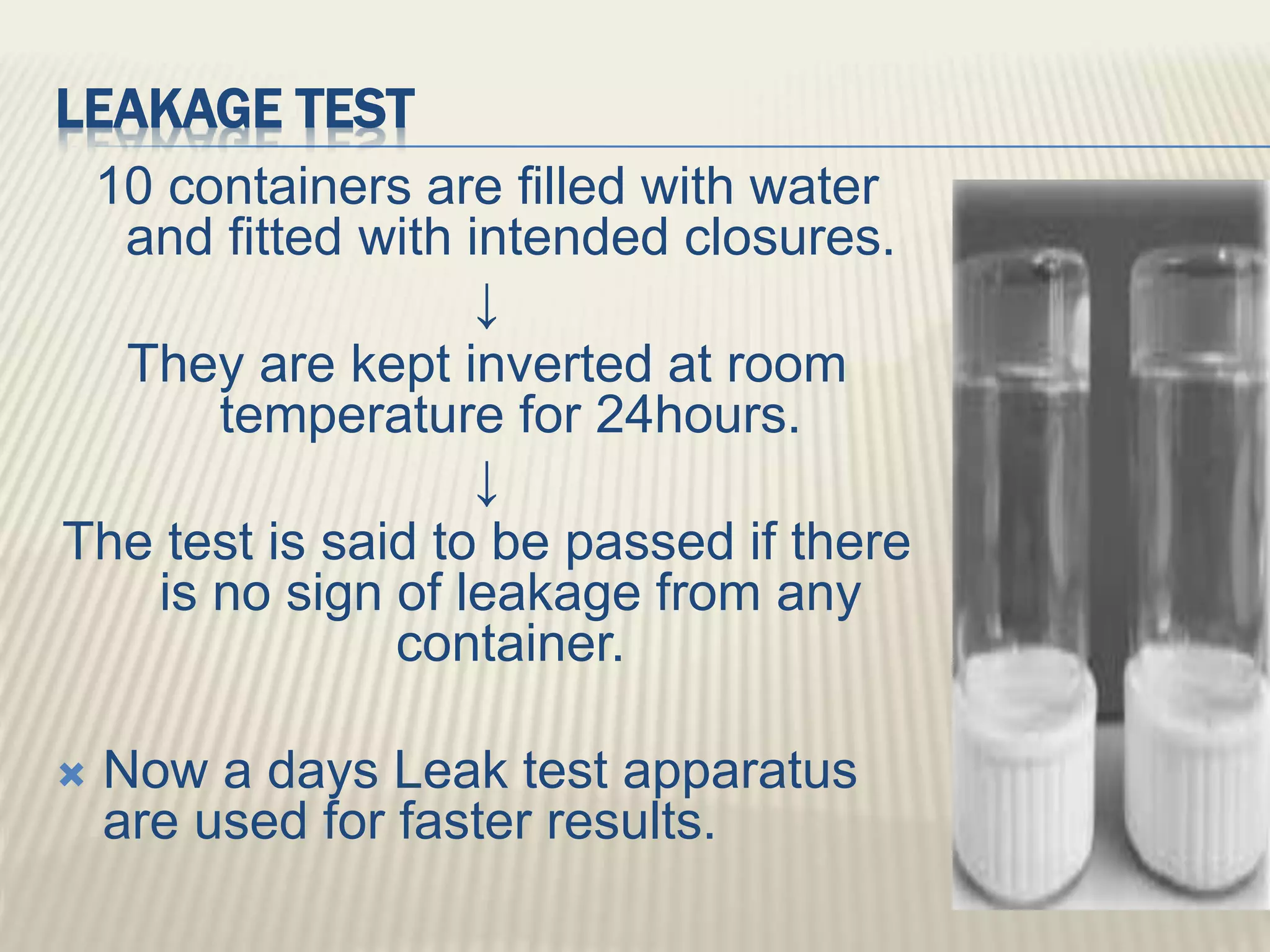
LEAKAGE TEST
10 containers are filled with water
and fitted with intended closures.
↓
They are kept inverted at room
temperature for 24hours.
↓
The test is said to be passed if there
is no sign of leakage from any
container.
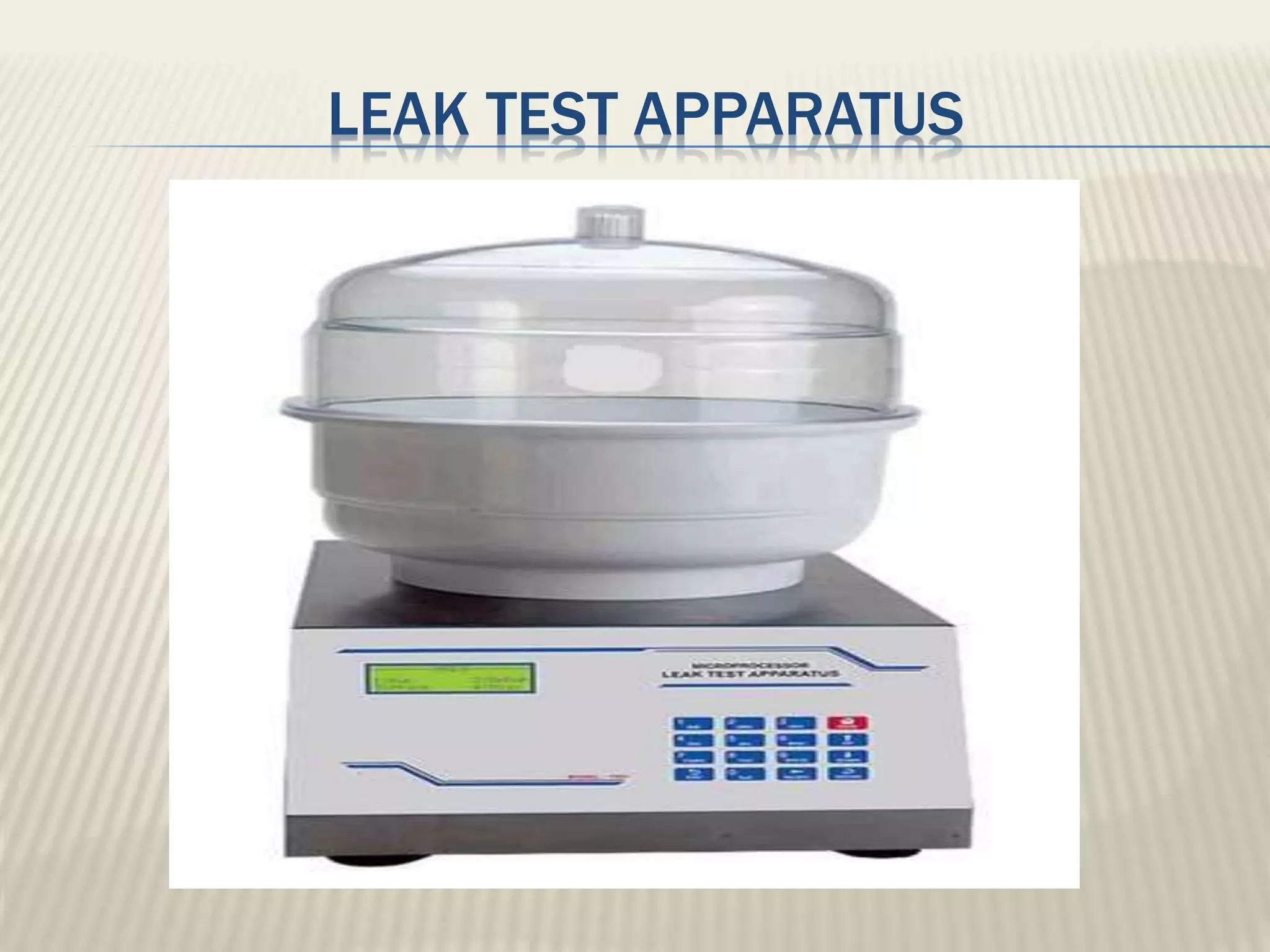
 Now a days Leak test apparatus
are used for faster results.
LEAK TEST APPARATUS
COLLAPSIBILITY TEST
 This test is applicable to
containers which are to be
squeezed in order to remove the
contents. eg: plastic laminated
tubes, eye drops bottles etc.
 A container by collapsing inward
during use, yield at least 90% of
its normal contents at the
required rate of flow at ambient
temperature.
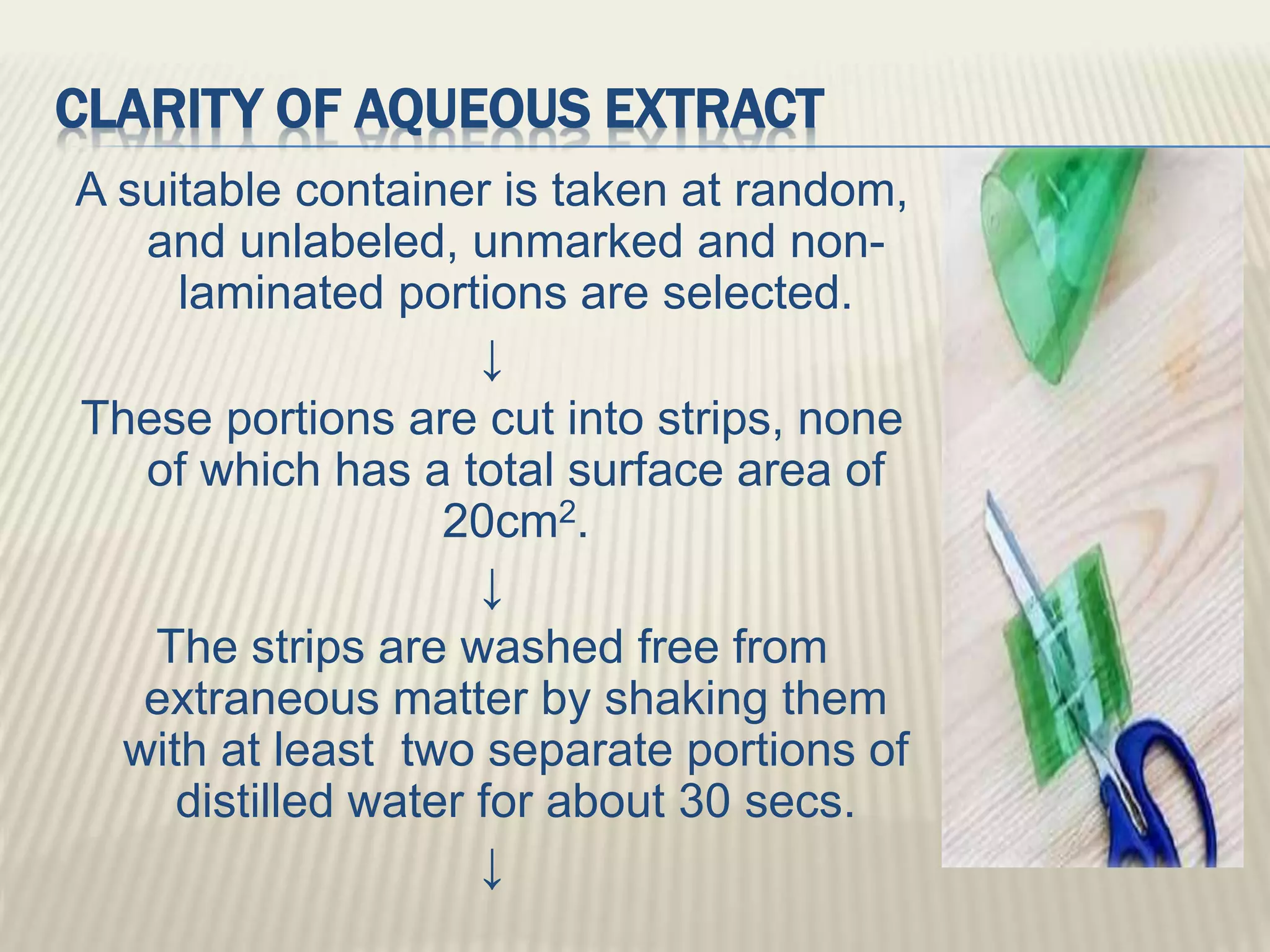
CLARITY OF AQUEOUS EXTRACT
A suitable container is taken at random,
and unlabeled, unmarked and non-
laminated portions are selected.
↓
These portions are cut into strips, none
of which has a total surface area of
20cm2.
↓
The strips are washed free from
extraneous matter by shaking them
with at least two separate portions of
distilled water for about 30 secs.
↓
CLARITY OF AQUEOUS EXTRACT
The processed sample is taken in to the flask,
previously cleaned with chromic acid and
rinsed with distilled water.
↓
250ml of distilled water is added to the flask,
covered and autoclaved at 121°C for 30mins.
↓
The extract is cooled and examined. It should
be colorless and free from turbidity.
NON VOLATILE RESIDUE
Evaporate 100 ml of the extract obtained in the
test for clarity of aqueous extract to dryness
and dry to constant weight at 105°C.
↓
The residue should weigh not more than 12.
5mg.
QC TESTS FOR PLASTIC CONTAINERS FOR
PARENTERALPREPARATIONS (I.P. 2018)
1.Leakage test
2.Collapsibility test
3.Clarity & color of solution
4.Acidity & alkalinity
5.Light absorption
6.Reducing substances
7. Transparency
8. Water vapour permeation.
CLARITY AND COLOR OF THE SOLUTION
 Test is conducted with special solution “S”
 Solution-S : Fill a container to its nominal
capacity with water and close it.
 Heat in autoclave so that a temperature of
121 ±2°C is reached within 20 to 30 minutes
and maintained at this temperature for 30
minutes.
 Use solution S within 4 hours of preparation.
 Prepared solution S should be clear and
colorless.
ACIDITY & ALKALINITY
 Take solution S equivalent to 4% of the
volume of the container and add 0. I ml of
phenolphthalein solution.
 The solution should be colorless.
 When 0. 4 ml of 0. 01M sodium hydroxide is
added to this solution, the solution should
turn pink.
 When 0. 8 ml of 0. 01M hydrochloric acid and
0. 1 ml of methyl red solution is added, the
solution becomes orange-red or red.
LIGHT ABSORPTION
 Prepare a blank by heating the water in
borosilicate glass container.
 Measure the absorbance in UV.
 The light absorption in the range 230 nm to
360 nm of solution S using a blank should
not more than 0. 20.
REDUCING SUBSTANCES
To 20.0 ml of solution S add 1 ml of dilute
sulphuric acid and 20. 0 ml of 0. 002 M
potassium permanganate.
↓
Boil for 3 minutes and cool immediately.
↓
Add 1 g of potassium iodide and titrate
immediately with 0. 01 M sodium
thiosulphate, using 0. 25 ml of starch solution
as indicator.
REDUCING SUBSTANCES
Carry out a titration using 20. 0 ml of the blank.
↓
The difference between the titration volumes
should not more than 1. 5 ml.
TRANSPARENCY
 Fill the container previously used for the
preparation of solution S to its nominal capacity
with a 1 in 200 dilution of the standard
suspension(as described in IP) for a container
made from polyethylene or polypropylene.
 For containers of other materials, use a 1 in 400
dilution.
 The cloudiness of the suspension is perceptible
when viewed through the container and
compared with a similar container filled with
water.
WATER VAPOUR PERMEATION
Select 10 bottles of uniform size and shape.
↓
Clean the sealing surface of bottles.
↓
Close and open each bottle 30 times.
↓
Apply the closure firmly and uniformly each time.
↓
Weigh the empty bottle and closure and determine
the average bottle volume with water.
WATER VAPOUR PERMEATION
Fill the bottles with water adjusting its level.
↓
Apply closure and store the bottles at 25°C and
relative humidity of 50% for 7 days.
↓
Weigh the bottles.
↓
Return the bottles to storage for further 7 days
and record the weight again.
↓
Calculate the water vapour permeation rate in
mg/day/L for each bottle as follows
WATER VAPOUR PERMEATION
 Calculate the water vapour permeation rate
in mg/day/L for each bottle as follows:
 Where:
 Wi is the weight of individual bottle after 7 days.
 Wf is weight after 14 days.
 Va is average bottle volume
WATER VAPOUR PERMEATION
 Limit:
 The bottle will meet requirements
 If not more than 1 of 10 test bottles show
water rate more than 100 mg/day / L.
 None shows more than vapour permeation
200 mg/day/L.
QUALITY CONTROL TEST FOR METAL CONTAINER
 Take 50 empty tubes filled with ointment
base, sealed & kept overnight.
 A metal bacteriological filter assembly fitted
with filter paper & heated to melting range of
ointment base.
 Base from all tubes squeezed at certain rate
& passed through filter under vacuum.
 Further wash with CHCL3 and observed for
particles.
QUALITY CONTROL TEST FOR METAL CONTAINER
 Observations:
 Limits :
 Lot of tube passes test if total score is less than
100.
 Lot of tubes fails if total score is above 150
 If it is between 100 – 150 test is repeated again
with 50 more tubes
QUALITY CONTROL TEST FOR RUBBER CLOSURES
 Appearance of solution
 pH of aqueous extract
 Light absorption
 Reducing substances
 Residue on evaporation
 Sterilization test
 Fragmentation test
 Self-sealability
 Biological test
PREPARATION OF SAMPLE FOR TESTS
 The closures are washed in 0.2% w/v of anionic
surface active agents for 5 mins.
 Rinsed five times with distilled water and 200ml
water is added.
 Subjected to autoclave at 119°C to 123°C for
20-30 mins covering with aluminum foil.
 Cooled and solution is separated from closures
(Solution A).
 Dry the treated closure at 64 to 66 deg C at
pressure not exceeding 0.7 kPa for 24 hrs.
(prepared closures)
PH OF AQUEOUS EXTRACT
To 20ml of solution A, 0.1ml of bromothymol
blue solution is added.
↓
NMT 0.3ml of 0.01M NaOH or 0.8ml of 0.01M
HCl is required to change the color of the
solution to blue or yellow respectively.
LIGHT ABSORPTION TEST
 It must be done within 4 hr of preparing
sample solution.
 It is filtered and its absorbance is measured
at 220nm to 360nm.
 Blank is done without closure and
absorbance must be NMT 2.0
FRAGMENTATION TEST
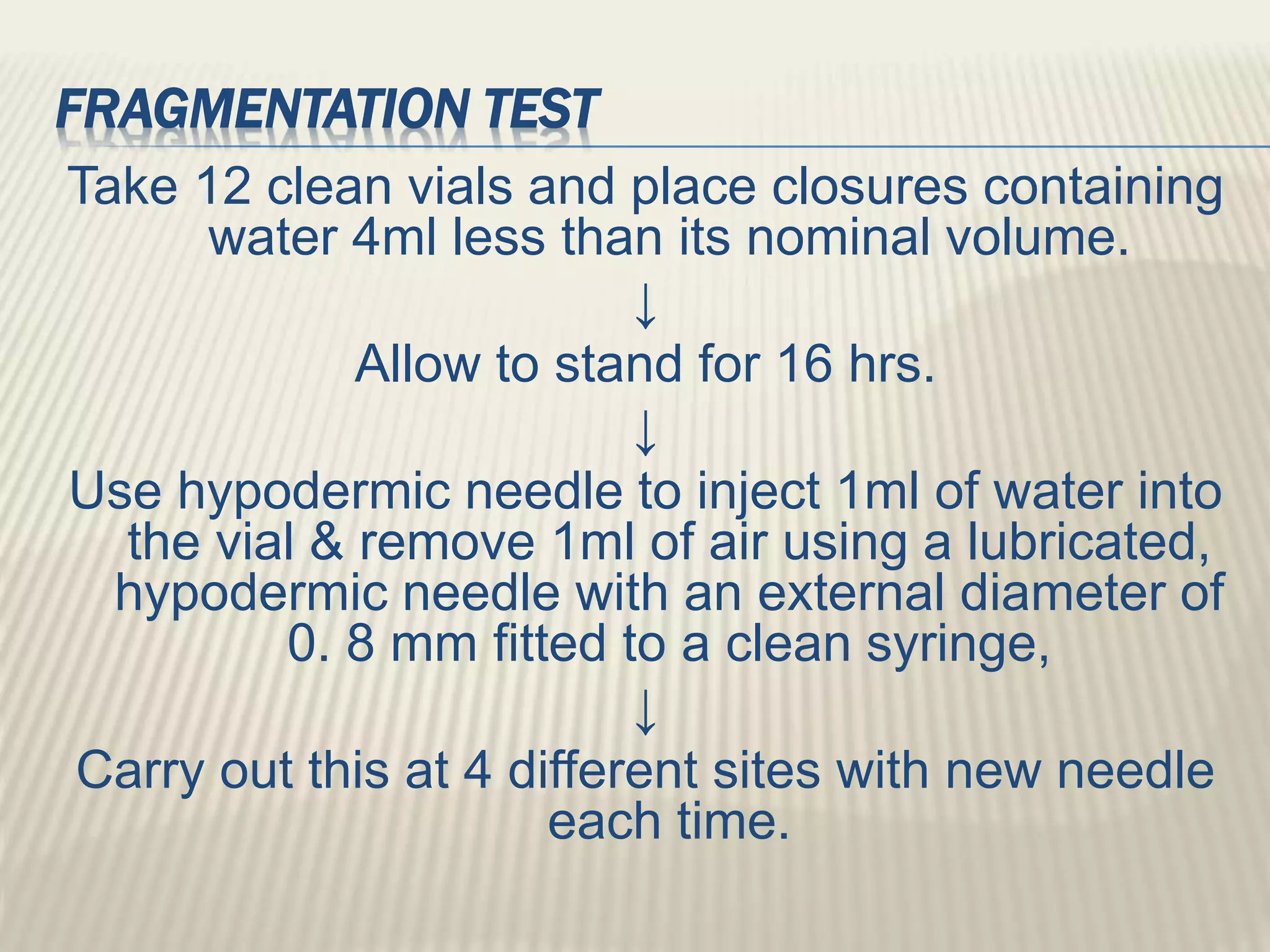
Take 12 clean vials and place closures containing
water 4ml less than its nominal volume.
↓
Allow to stand for 16 hrs.
↓
Use hypodermic needle to inject 1ml of water into
the vial & remove 1ml of air using a lubricated,
hypodermic needle with an external diameter of
0. 8 mm fitted to a clean syringe,
↓
Carry out this at 4 different sites with new needle
each time.
FRAGMENTATION TEST
Pass the water present in vial through a filter
with pore size of 0.5μm.
↓
No. of fragments of closure retain should be as
per the limits.
 Limit:
 No. of fragments – NMT 10(in case of butyl
rubber)
 No. of fragments –NMT 15
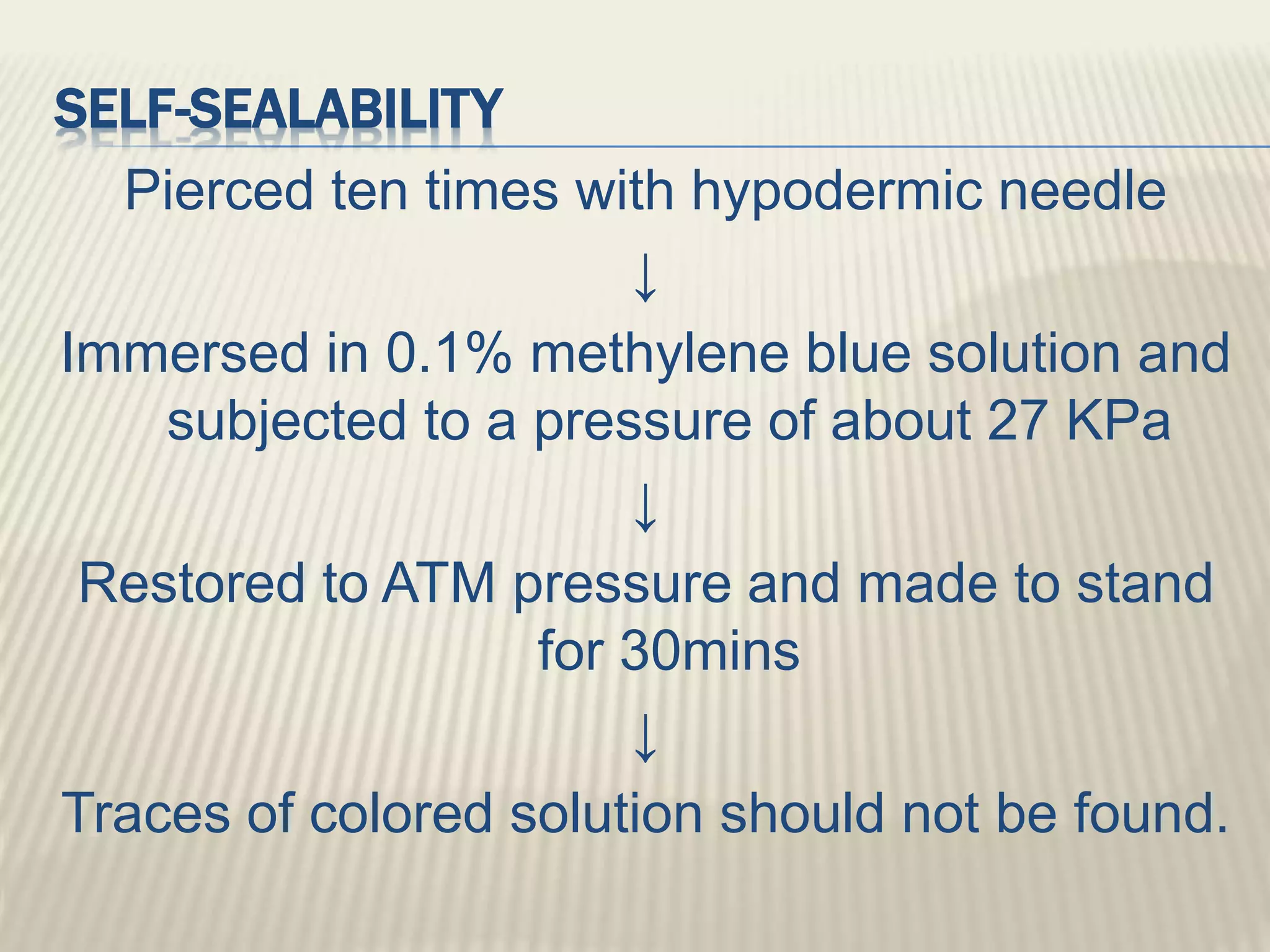
SELF-SEALABILITY
Pierced ten times with hypodermic needle
↓
Immersed in 0.1% methylene blue solution and
subjected to a pressure of about 27 KPa
↓
Restored to ATM pressure and made to stand
for 30mins
↓
Traces of colored solution should not be found.
MAJOR QC TESTS FOR PAPERBOARDS (SECONDARY PM)
 Grammage (wt/area)
 Thickness
 Moisture content
 Folding endurance
 Bursting strength
 Water absorption test (Cobb test)
 Tear resistance test
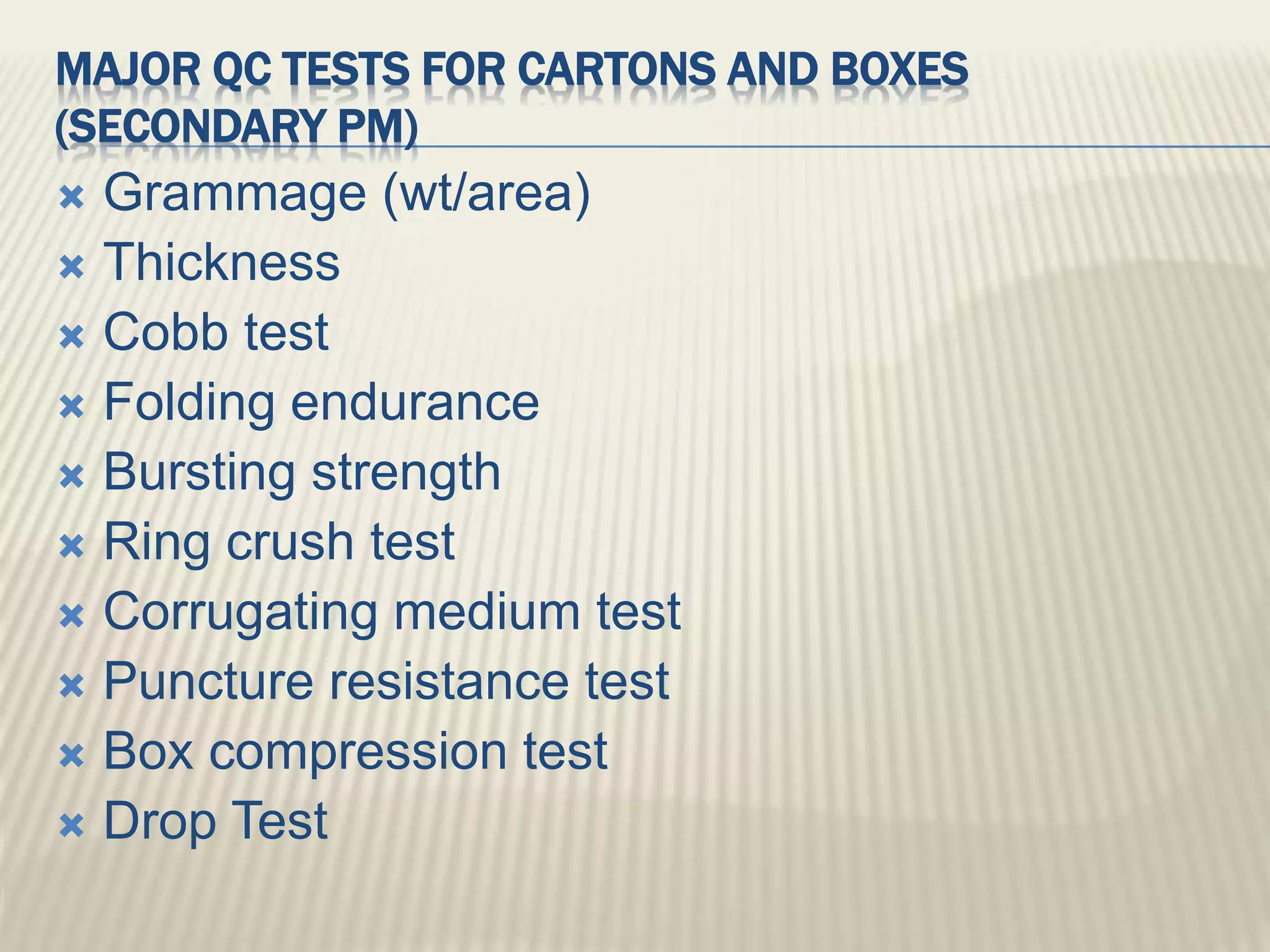
MAJOR QC TESTS FOR CARTONS AND BOXES
(SECONDARY PM)
 Grammage (wt/area)
 Thickness
 Cobb test
 Folding endurance
 Bursting strength
 Ring crush test
 Corrugating medium test
 Puncture resistance test
 Box compression test
 Drop Test
Quality control tests pm

Quality control tests pm

  • 1.
    QUALITY CONTROL TESTFOR PHARMACEUTICAL PACKING MATERIALS By : Kirankumar Solanki
  • 2.
    PACKING MATERIALS  Anymaterial that is used for packaging of products for their distribution and sale is said to be the packing material.  Packaging is the science and technology of enclosing or protecting products for distribution, storage, sale, and use.
  • 3.
    FUNCTIONS OF PACKINGMATERIALS 1. Containment :  Product should not leak.  Not allow diffusion and permeation.  Not alter the ingredients in the formulation.  Should be strong enough to hold the content during normal handling. 2. Protection :  Protection against light, moisture, oxygen, biological contamination and mechanical damage without affecting the quality and potency of the product. 3. Stability :  The container should be compatible with the product or material  Should retain the stability of the product throughout its shelf life.  It should not have any physical or chemical effect on product altering its appearance, release or stability.
  • 4.
    PACKING MATERIALS  Thereare 3 types of packing materials used in pharmaceutical industries:  Primary packing materials  Secondary packing materials  Tertiary packing materials
  • 5.
    PACKING MATERIALS  Primarypacking material:  Comes in direct contact with the product e.g. blister, strips, bottles, vials, ampoules, syringes, collapsible tubes, tin, etc.
  • 6.
    PACKING MATERIALS  Secondarypacking material :  Used to cover primary packs e.g. cartons, boxes, etc.
  • 7.
    PACKING MATERIALS  Tertiarypacking materials :  Used to cover the secondary packing materials to protect from external impact. e.g. Shippers, brown cardboard boxes etc.  Tertiary packaging is not seen by consumers as the this packaging material is often removed by retailers before showcasing the product for sale.
  • 8.
    QC TESTS FORPACKING MATERIALS  Following types of tests are performed :  1. QC Test for Containers  2. QC Test for Closures  3. QC Test for Secondary Packaging Materials
  • 9.
    TYPES OF CONTAINERS Containers are primary packing materials.  Different types of materials are used to prepare containers : 1. Glass Container 2. Plastic Container 3. Metal Container 4. Rubber
  • 10.
    GLASS CONTAINERS  Glasshas been widely used as a drug packaging material specially for sterile products.  Types of Glass:  Type I – Highly resistant borosilicate glass. (commonly known as neutral glass)  Offers a high hydrolytic resistance due to its chemical composition.  Type II – Treated soda lime glass.  High hydrolytic resistance due to an appropriate surface treatment.  Both types of glass may be used for different types of injectable preparations, depending on their physicochemical properties.
  • 11.
    GLASS CONTAINERS  TypeIII – Soda lime glass  Offers only a moderate hydrolytic resistance and should be used only for non-aqueous liquid preparations or for powders for injection.  For injectable preparation where adequate suitability tests have indicated.  NP – Soda glass (Non- parenteral use)  Not for parenteral use.
  • 12.
    GLASS CONTAINERS  Advantages:  They are transparent.  Have good protection power.  They can be easily labeled.  Economical.  Variety of sizes & shapes.  Disadvantages :  They are fragile.  Release alkali to aqueous preparation.
  • 13.
    QUALITY CONTROL TESTFOR GLASS CONTAINERS 1. Chemical Resistance Test a) Powdered Glass Test b) Water Attack Test 2. Hydrolytic Resistance Test 3. Surface Etching Test 4. Arsenic Test 5. Thermal Shock Test 6. Internal Bursting Pressure Test 7. Light Transmission Test
  • 14.
    CHEMICAL RESISTANCE TEST 1. Powdered glass test/Glass grain test  It is done to estimate the amount of alkali leached from the powdered glass, which usually happens at elevated temperatures. Sample containers are rinsed with purified water and dried. ↓ The containers are grinded in a mortar to a fine powder and passed through sieve no. 20 and 50. ↓ 10gm of the sample is washed with acetone and dried. ↓
  • 15.
    POWDERED GLASS TEST(CONTINUE) 50 ml of purified water is added to the dried sample and autoclaved at 121°C for 30 mins and cooled and decanted. ↓ The decanted liquid is titrated with 0.02 N H2SO4 using methyl red as indicator.  Limits:
  • 16.
    CHEMICAL RESISTANCE TEST 2. Water Attack Test:  It is only used for Type 2 glass and is performed on the whole container. Rinse thoroughly container with high purity water. ↓ Fill it by 90% of it’s capacity with water. ↓
  • 17.
    WATER ATTACK TEST(CONTINUE) Autoclave it at 121̊C for 30 minutes. Then it is cooled and liquid is decanted. ↓ Decanted liquid is titrated with 0.02N Sulphuric acid using methyl red as an indicator ↓ The volume of sulphuric acid consumed is recorded and compare with limits.
  • 18.
    WATER ATTACK TEST(CONTINUE) Limits:
  • 19.
    HYDROLYTIC RESISTANCE TEST This test is used to differentiate between type I,II and type III glass.  This test is only for unused glass container. Each container is rinsed at least three times with CO2 free water and filled with the same to their filling volume. ↓ Vials and bottles are covered and autoclaved at 100°C for 10 mins. ↓
  • 20.
    HYDROLYTIC RESISTANCE TEST(CONTINUE) The temp. is risen from 100°C to 121°C over 20 mins. ↓ The temp. is maintained at 121°C to 122°C for 60 mins. ↓ The containers are cooled and the liquids are combined and volume measured. ↓ It is titrated with 0.01M HCl using methyl red as an indicator.
  • 21.
    HYDROLYTIC RESISTANCE TEST(CONTINUE)  Limits:
  • 22.
    SURFACE ETCHING TEST This test is similar to hydrolytic resistance test as per Indian Pharmacopoeia. Rinse the containers and fill the containers till the brim with 1 part of hydro fluoric acid and 9 parts of hydrochloric acid. ↓ Allow to stand for 10 min ↓ Empty the container and rinse several times with water. ↓
  • 23.
    SURFACE ETCHING TEST Autoclavethe containers. ↓ Titrate the water after cooling against 0. 01 M HCI using methyl red as a Indicator. ↓ Limits are same as hydrolytic resistance test .
  • 24.
    ARSENIC TEST  Thistest is for glass containers intended for aqueous parenterals. The inner and outer surface of container is washed with fresh distilled water for 5 min. ↓ Then similar steps are followed as performed in the hydrolytic test, previously described, till obtaining the final combined solution. ↓ 10ml from the final combined volume is pipetted out and to it 10 ml of HNO3 is added and dried in an oven at 130°C. ↓
  • 25.
    ARSENIC TEST (CONTINUE) 10mlof hydrogen molybdate is added and refluxed for 25 mins. ↓ It is cooled and absorbance is measured at 840nm. Limit:  The absorbance of the test solution should be less than the absorbance obtained using 0.1ml of arsenic standard solution (10ppm).
  • 26.
    THERMAL SHOCK TEST Thistest is used to determine the effect of rapid change in temperature on the glass container. Samples are placed in upright position in a tray. ↓ Immerse it into hot water bath for given time. ↓ Transfer it in cold water bath. ↓
  • 27.
    INTERNAL BURSTING PRESSURETEST  Instrument used for the test is : American glass research increment pressure tester. The test bottle is filled with water and placed inside test chamber. ↓ The internal pressure automatically raised by series of increment at set time. ↓ Bottle are checked at preselected pressure level until container finally burst.
  • 28.
    LIGHT TRANSMISSION TEST This test is designed to measure the amount of light transmitted by either transparent or translucent glass.  Preparation of Specimen  Break the container and cut and trim the segments so that they can be conveniently mounted in a spectrophotometer.  Wash and dry the specimen.  Mount the specimen in the spectrophotometer holder.
  • 29.
    LIGHT TRANSMISSION TEST Procedure  Place the section in a spectrophotometer with its cylindrical axis parallel to the plane of the slit so that the light beam is normal to the surface of the section.  Measure the transmittance at intervals of about 20 nm in the region of 290-450 nm
  • 30.
  • 31.
    PLASTIC CONTAINERS  Plasticsare any group of substances of natural and synthetic origin consisting mainly polymers of high molecular weight.  Plastic is made from one or more polymers together with certain additives.  The polymers commonly used are polyethylene, polypropylene, polyvinyl chloride, polystyrene, etc.
  • 32.
    TYPES OF PLASTICS Thermosetting type –  When heated they may become flexible but they do not melt.  e.g. Urea formaldehyde (UF),Phenol formaldehyde ,Melamine formaldehyde (MF), Epoxy resins (epoxides), Polyurethanes (PURs)  Thermoplastics type-  On heating they are soften to viscous fluid which harden again on cooling.  e.g. Polyethylene{HDPE – LDPE}, Polyvinylchloride(PVC),Polystyrene Polypropylene, Nylon(PA),  Polyethylene terepthalate(PET) ,Polyvinylidene chloride(PVdC), Polycarbonate Acrylonitrile butadiene styrene(ABS)
  • 33.
    ADVANTAGES OF PLASTICS Less weight than glass.  Flexible.  Strong, rigid & extremely resistant to breakage.  They are poor conductor of heat.  Sufficient mechanical strength.  Can be transported easily.  They are available in various shapes and sizes.  They are resistant to inorganic chemicals.  They have good protection power.
  • 34.
    DISADVANTAGES OF PLASTICS They are permeable to water vapor and atmosphere gases.  They cannot withstand heat without softening or distorting.  They may interact with certain chemical to cause softening or distortion.  They may absorb chemical substances, such as preservatives for solution.  Printing cannot be done properly.
  • 35.
    QC TESTS FORPLASTIC CONTAINERS FOR NON- PARENTERALPREPARATIONS (I.P. 2018) 1.Leakage test 2.Collapsibility test 3.Clarity of aqueous extract 4. Non volatile residue
  • 36.
    LEAKAGE TEST 10 containersare filled with water and fitted with intended closures. ↓ They are kept inverted at room temperature for 24hours. ↓ The test is said to be passed if there is no sign of leakage from any container.  Now a days Leak test apparatus are used for faster results.
  • 37.
  • 38.
    COLLAPSIBILITY TEST  Thistest is applicable to containers which are to be squeezed in order to remove the contents. eg: plastic laminated tubes, eye drops bottles etc.  A container by collapsing inward during use, yield at least 90% of its normal contents at the required rate of flow at ambient temperature.
  • 39.
    CLARITY OF AQUEOUSEXTRACT A suitable container is taken at random, and unlabeled, unmarked and non- laminated portions are selected. ↓ These portions are cut into strips, none of which has a total surface area of 20cm2. ↓ The strips are washed free from extraneous matter by shaking them with at least two separate portions of distilled water for about 30 secs. ↓
  • 40.
    CLARITY OF AQUEOUSEXTRACT The processed sample is taken in to the flask, previously cleaned with chromic acid and rinsed with distilled water. ↓ 250ml of distilled water is added to the flask, covered and autoclaved at 121°C for 30mins. ↓ The extract is cooled and examined. It should be colorless and free from turbidity.
  • 41.
    NON VOLATILE RESIDUE Evaporate100 ml of the extract obtained in the test for clarity of aqueous extract to dryness and dry to constant weight at 105°C. ↓ The residue should weigh not more than 12. 5mg.
  • 42.
    QC TESTS FORPLASTIC CONTAINERS FOR PARENTERALPREPARATIONS (I.P. 2018) 1.Leakage test 2.Collapsibility test 3.Clarity & color of solution 4.Acidity & alkalinity 5.Light absorption 6.Reducing substances 7. Transparency 8. Water vapour permeation.
  • 43.
    CLARITY AND COLOROF THE SOLUTION  Test is conducted with special solution “S”  Solution-S : Fill a container to its nominal capacity with water and close it.  Heat in autoclave so that a temperature of 121 ±2°C is reached within 20 to 30 minutes and maintained at this temperature for 30 minutes.  Use solution S within 4 hours of preparation.  Prepared solution S should be clear and colorless.
  • 44.
    ACIDITY & ALKALINITY Take solution S equivalent to 4% of the volume of the container and add 0. I ml of phenolphthalein solution.  The solution should be colorless.  When 0. 4 ml of 0. 01M sodium hydroxide is added to this solution, the solution should turn pink.  When 0. 8 ml of 0. 01M hydrochloric acid and 0. 1 ml of methyl red solution is added, the solution becomes orange-red or red.
  • 45.
    LIGHT ABSORPTION  Preparea blank by heating the water in borosilicate glass container.  Measure the absorbance in UV.  The light absorption in the range 230 nm to 360 nm of solution S using a blank should not more than 0. 20.
  • 46.
    REDUCING SUBSTANCES To 20.0ml of solution S add 1 ml of dilute sulphuric acid and 20. 0 ml of 0. 002 M potassium permanganate. ↓ Boil for 3 minutes and cool immediately. ↓ Add 1 g of potassium iodide and titrate immediately with 0. 01 M sodium thiosulphate, using 0. 25 ml of starch solution as indicator.
  • 47.
    REDUCING SUBSTANCES Carry outa titration using 20. 0 ml of the blank. ↓ The difference between the titration volumes should not more than 1. 5 ml.
  • 48.
    TRANSPARENCY  Fill thecontainer previously used for the preparation of solution S to its nominal capacity with a 1 in 200 dilution of the standard suspension(as described in IP) for a container made from polyethylene or polypropylene.  For containers of other materials, use a 1 in 400 dilution.  The cloudiness of the suspension is perceptible when viewed through the container and compared with a similar container filled with water.
  • 49.
    WATER VAPOUR PERMEATION Select10 bottles of uniform size and shape. ↓ Clean the sealing surface of bottles. ↓ Close and open each bottle 30 times. ↓ Apply the closure firmly and uniformly each time. ↓ Weigh the empty bottle and closure and determine the average bottle volume with water.
  • 50.
    WATER VAPOUR PERMEATION Fillthe bottles with water adjusting its level. ↓ Apply closure and store the bottles at 25°C and relative humidity of 50% for 7 days. ↓ Weigh the bottles. ↓ Return the bottles to storage for further 7 days and record the weight again. ↓ Calculate the water vapour permeation rate in mg/day/L for each bottle as follows
  • 51.
    WATER VAPOUR PERMEATION Calculate the water vapour permeation rate in mg/day/L for each bottle as follows:  Where:  Wi is the weight of individual bottle after 7 days.  Wf is weight after 14 days.  Va is average bottle volume
  • 52.
    WATER VAPOUR PERMEATION Limit:  The bottle will meet requirements  If not more than 1 of 10 test bottles show water rate more than 100 mg/day / L.  None shows more than vapour permeation 200 mg/day/L.
  • 53.
    QUALITY CONTROL TESTFOR METAL CONTAINER  Take 50 empty tubes filled with ointment base, sealed & kept overnight.  A metal bacteriological filter assembly fitted with filter paper & heated to melting range of ointment base.  Base from all tubes squeezed at certain rate & passed through filter under vacuum.  Further wash with CHCL3 and observed for particles.
  • 54.
    QUALITY CONTROL TESTFOR METAL CONTAINER  Observations:  Limits :  Lot of tube passes test if total score is less than 100.  Lot of tubes fails if total score is above 150  If it is between 100 – 150 test is repeated again with 50 more tubes
  • 55.
    QUALITY CONTROL TESTFOR RUBBER CLOSURES  Appearance of solution  pH of aqueous extract  Light absorption  Reducing substances  Residue on evaporation  Sterilization test  Fragmentation test  Self-sealability  Biological test
  • 56.
    PREPARATION OF SAMPLEFOR TESTS  The closures are washed in 0.2% w/v of anionic surface active agents for 5 mins.  Rinsed five times with distilled water and 200ml water is added.  Subjected to autoclave at 119°C to 123°C for 20-30 mins covering with aluminum foil.  Cooled and solution is separated from closures (Solution A).  Dry the treated closure at 64 to 66 deg C at pressure not exceeding 0.7 kPa for 24 hrs. (prepared closures)
  • 57.
    PH OF AQUEOUSEXTRACT To 20ml of solution A, 0.1ml of bromothymol blue solution is added. ↓ NMT 0.3ml of 0.01M NaOH or 0.8ml of 0.01M HCl is required to change the color of the solution to blue or yellow respectively.
  • 58.
    LIGHT ABSORPTION TEST It must be done within 4 hr of preparing sample solution.  It is filtered and its absorbance is measured at 220nm to 360nm.  Blank is done without closure and absorbance must be NMT 2.0
  • 59.
    FRAGMENTATION TEST Take 12clean vials and place closures containing water 4ml less than its nominal volume. ↓ Allow to stand for 16 hrs. ↓ Use hypodermic needle to inject 1ml of water into the vial & remove 1ml of air using a lubricated, hypodermic needle with an external diameter of 0. 8 mm fitted to a clean syringe, ↓ Carry out this at 4 different sites with new needle each time.
  • 60.
    FRAGMENTATION TEST Pass thewater present in vial through a filter with pore size of 0.5μm. ↓ No. of fragments of closure retain should be as per the limits.  Limit:  No. of fragments – NMT 10(in case of butyl rubber)  No. of fragments –NMT 15
  • 61.
    SELF-SEALABILITY Pierced ten timeswith hypodermic needle ↓ Immersed in 0.1% methylene blue solution and subjected to a pressure of about 27 KPa ↓ Restored to ATM pressure and made to stand for 30mins ↓ Traces of colored solution should not be found.
  • 62.
    MAJOR QC TESTSFOR PAPERBOARDS (SECONDARY PM)  Grammage (wt/area)  Thickness  Moisture content  Folding endurance  Bursting strength  Water absorption test (Cobb test)  Tear resistance test
  • 63.
    MAJOR QC TESTSFOR CARTONS AND BOXES (SECONDARY PM)  Grammage (wt/area)  Thickness  Cobb test  Folding endurance  Bursting strength  Ring crush test  Corrugating medium test  Puncture resistance test  Box compression test  Drop Test