QUALITY CONTROL OF
PACKAGING MATERIALS
CONTENTS
INTRODUCTION
ADVANTAGES
TYPES OF PACKAGING USED
FOR PHARMACEUTICAL
PRODUCTS
TAMPER RESISTANT
PACKAGING
QUALITY CONTROL AND
TESTING STANDARDS
QUALITY CONTROL OF
SECONDARY COMPONENTS
INTRODUCTION
Packaging is an integral part of any
pharmaceutical industry.
It provides degree of protection,
minimize the loss
of constituents and should not
interact with the contents in a
way that will not alter the quality to
an extent beyond the limits given in
the individual monograph.
ADVANTAGES
Protects the
product.
Prevents the
product
from degradation.
Decreases costs.
Provides
information.
Provides hygiene. Means economy.
Packaging is a
preventive
measure.
TYPE OF PACKAGING
TYPE OF PACKAGING
• PRIMARY PACKAGING - is the material that envelopes the product and
hold it. Ex: Aerosol spray can, blister packs, bottle ampoules, vials and etc.
• SECONDARY PACKAGING – is outside the primary packaging perhaps
used to group primary package together. Ex: boxes, cartons, labels, leaflets.
• TERTIARY PACKAGING - is used for bulk handling and shipping. Ex:
barrel, container, edge protector.
CHOICE OF PACKAGING MATERIALS
WILL DEPENDS UPON
• Degree of protection required
• Compatibility with the dosage form
• Customer convenience ex : size, weight of dosage form
• Filling method
• Sterilization methods to be employed and cost
COMPOSITION OF PACKAGES
• Container
• Closure
• Carton or outer
• Box
TYPE OF PACKAGING MATERIALS USED
FOR PHARMACEUTICALS PRODUCTS
• Glass
• Plastic
• Metals
• Rubber
• Paper/card boards
GLASS
Composition of glass :
• Sand(silicon dioxide), soda ash, limestone(calcium carbonate), cullet(broken
glass)
• Amber : light yellowish to deep reddish brown, carbon, sulphur and iron and
manganese dioxide
• Yellow : cadmium and sulphur
• Blue : cobalt oxide and copper oxide
• Green : iron oxide, magnesium dioxide, chromium dioxide.
TYPES AND MANUFACTURING
METHODS
• TYPE I – highly resistant borosilicate glass
• TYPE II – treated soda lime glass
• TYPE III – soda lime glass
• TYPE IV – soda glass (non parenteral usage)
MANUFACTURING METHODS :
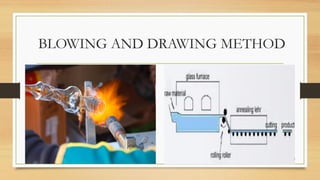
• Blowing method
• Drawing method
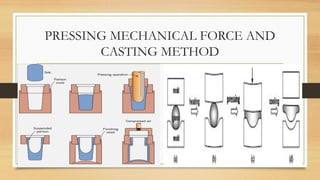
• Pressing mechanical force
• Casting using gravity
BLOWING AND DRAWING METHOD
PRESSING MECHANICAL FORCE AND
CASTING METHOD
PLASTIC
• Is defined as any group of substance of natural or synthetic origins,
consisting chiefly of polymers of high molecular weight that can be molded
into a shape or form by heat and pressure
• Types : Thermosetting type do not become liquid Ex : melamine
formaldehyde, urea formaldehyde and etc. and thermoplastics type become
liquid HDPE, LDPE, PVC and etc.
METALS
• For the pharmaceutical purpose metals like aluminum, tin plated steel,
stainless steel, tin and lead.
• Collapsible tubes metal - consist of good reclosure, adequate protection,
light in weight, unbreakable mostly are tin, aluminum and lead.
• Tin - food, pharmaceutical products which requires high purity.
• Aluminum - since it is light weight easily portable and transportable
• Lead - non-food products because of poisoning nature. Inks, paints and
lubricants
RUBBER
• Construction of closure meant for vials, transfusion fluid bottles,
dropping bottles
• Butyl rubber – water absorption is low, cheaper compared to other
rubbers
• Nitrile rubber – oil and heat resistant.
• Chloroprene rubbers - oil resistant and good heat resistant too.
• Silicon rubber - permeability of water, heat resistant, low absorption.
Quality Control Test for Glass Containers
1. Chemical Resistance Test
a) Powered Glass Test
b) Water Attack Test
2. Hydrolytic Resistance Test
3. Arsenic Test
4. Thermal Shock Test
5. Internal Bursting Pressure Test
Chemical Resistant Test
a) Powdered Glass Test: It is done to estimate the amount of alkali from powdered
glass with happen at elevated temperature. When glass is powdered, leaching of
alkali is enhanced, which can be titrated with 0.02N sulfuric acid using methyl red
as an indicator.
Step 1 •Preparation of glass specimen
Step 2 •Washing the specimen
Titrate the decant solution with 0.02N sulphuric acid using indicator and record
the volume
Cool it and deacant solution in another flask again add 15ml water and decant
solution
10g of specimen/sample + 50ml of highly purified water. Autoclave it at 121 C
Limits:
Test Container Vol. of 0.02N H2S04 (ml)
Powdered Glass Test Type I
Type III
Type N.P
1.0
8.5
15
b) Water Attack Test: This test is for Type II glass. The principle involve in this is
whether the alkali leaches from surface of container.
The volume of Sulphuric acid consumed is recorded and compare with limits
Decanted liquid is titrated with 0.02N Sulphuric acid using methylred as an indicator
Autoclave it at 121 C for 30 minutes. Then it is cooled and liquid is decanted
Rinse thoroughly container with high purity water. Fill it by 90% of it’s capacity
with water
• Limits:
Test Container
Vol. of 0.02N H2S04 (ml)
Water Attack Test
Type II
Size( ml) – 100
Less than 100
1.0
0.7
0.2
Leakage Test
• Drug filled container is placed in contained filled with colored solution
(methylene blue) and autoclave at 121C for 1o min. under pressure.
• Later on the container are observed whether colored get entered in container or
not.
3. Hydrolytic Resistant Test
This test is only for unused glass container
Rinse the container with
CO2 free water for 3
times. Fill till a
particular vol. autoclave
it
At 100C for 10 min.
allow to rise temp. to
121C for 60 min. Low
down temp. at 100C.
Cool it
Specific amount of
liquid solution is titrated
with 0.01N HCL using
methylred as an
indicator.
Perform the blank with
water and difference
between the titration
represents vol. of HCL
consumed by test liquid.
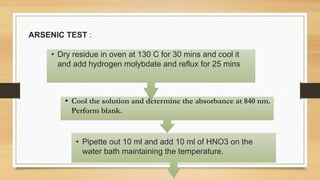
ARSENIC TEST :
• Pipette out 10 ml and add 10 ml of HNO3 on the
water bath maintaining the temperature.
• Cool the solution and determine the absorbance at 840 nm.
Perform blank.
• Dry residue in oven at 130 C for 30 mins and cool it
and add hydrogen molybdate and reflux for 25 mins
ARSENIC TEST :
• Test solution is same as that of hydrolytic resistant
test (50ml)
• Wash inner and outer surface of container with
D.W for 5 minutes
The absorbance of the test solution should be
less than absorbance obtained using 0.1 ml of
arsenic standard solution (10ppm)
INTERNAL BURSTING PRESSURE TEST :
• The internal pressure is automatically raised by
series of increment at set time
• the test bottle is filled with bater and placed inside
the test chamber
Bottles are checked at preselected pressure level until
container finally burst
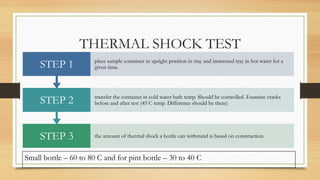
THERMAL SHOCK TEST
STEP 3 the amount of thermal shock a bottle can withstand is based on construction.
STEP 2 transfer the container in cold water bath temp. Should be controlled. Examine cracks
before and after test (45 C temp. Difference should be there)
STEP 1 place sample container in upright position in tray and immersed tray in hot water for a
given time.
Small bottle – 60 to 80 C and for pint bottle – 30 to 40 C
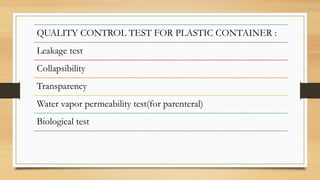
QUALITY CONTROL TEST FOR PLASTIC CONTAINER :
Leakage test
Collapsibility
Transparency
Water vapor permeability test(for parenteral)
Biological test
LEAKAGE TEST AND COLLAPSABILITY
TEST
• Fill ten containers with water and fit with intended closures and keep
them inverted at room temp for 24 hours there are no sign of leakage
then the test passes.
COLLAPSABILITY TEST
The containers are squeezed in order to remove the contents. A container
by collapsing inside inward during use yields at least 90% of its nominal
content at the required rate of flow at ambient temperature.
TRANSPARENCY
• Fill five empty containers to their nominal capacity with diluted
suspension as described in IP 1966. The cloudiness of the diluted
suspension in each container is detectable when viewed through the
containers as compared with a container of the same type filled with
water.
WATER VAPOUR PERMEABILITY
• Fill five containers with nominal volume of water and heat seal the
bottles with aluminum foil poly ethylene laminate or other suitable
seal.
• Weigh accurately each container and allow to stand for 14 days at a
relative humidity of 60 + 5% and a temperature between the 20 –
25 C and reweigh the containers.
• The loss in weight in each container is not more than 0.2 %
BIOLOGICAL TEST
• USP provided the essentially three phases :
• IMPLANTATION TEST : implantation of small piece of plastic material intramuscularly
in rabbits.
• SYSTEMIC INJECTION TEST : inject using sodium chloride and with or
without alcohol intravenously in mice and injecting eluates using PEG 400 and sesame
oil intraperitoneally in mice.
• INTRACUTANEOUS TEST : all four injection are injected in subcutaneously in rabbits.
• NOTE : the test reaction must not be significantly greater than non-reactive control
samples.
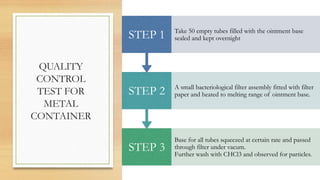
QUALITY
CONTROL
TEST FOR
METAL
CONTAINER
STEP 3
Base for all tubes squeezed at certain rate and passed
through filter under vacum.
Further wash with CHCl3 and observed for particles.
STEP 2 A small bacteriological filter assembly fitted with filter
paper and heated to melting range of ointment base.
STEP 1 Take 50 empty tubes filled with the ointment base
sealed and kept overnight
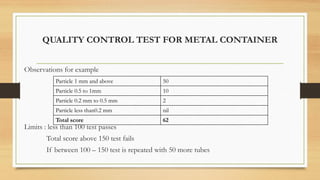
QUALITY CONTROL TEST FOR METAL CONTAINER
Observations for example
Limits : less than 100 test passes
Total score above 150 test fails
If between 100 – 150 test is repeated with 50 more tubes
Particle 1 mm and above 50
Particle 0.5 to 1mm 10
Particle 0.2 mm to 0.5 mm 2
Particle less than0.2 mm nil
Total score 62
QUALITY CONTROL TEST FOR
COLLAPSIBLE TUBES
• Leakage test
• Power of adhesion
• Flexibility
• Product compatibility
QUALITY
CONTROL TEST
FOR STRIP AND
BLISTER
PACKING
STEP 4 If there is no leakage content will not be wetted. It
indicates perfect sealing
STEP 3 The content of strips and blisters were removed and
presence of moisture was checked
STEP 2 Later on strips, blister were taken out. Water present
over the outer surface were wiped out.
STEP 1 th of water is poured in desicator. Strip and blister
were placed inside desicator and vacum is applied.
QUALITY CONTROL TEST FOR
CLOSURES
• STERILITY
• FRAGMENTATION TEST
• SELF SEALABILITY TEST
• pH OF AQUEOUS EXTRACT
• LIGHT ABSORPTION TEST
• REDUCING SUBSTANCE
• RESIDUE ON EVAPORATION
• PENETRABILITY
PREPARATION OF SAMPLE SOLUTION :
• Further subjected to autoclave and covering with
aluminium foil
• Rinse 5 times with D.W and add 200ml water
• Wash closure in 0.2 % w/v of anionic surfactant for 5
min.
Allow to cool and separate solution from closure.
STERILITY TEST
Closures are
subjected to
sterilization
1
By autoclaving at
64 – 66 C and
pressure at 0.7kPa.
2
Further testing is
carried out by using
culture media
3
FRAGMENTATION TEST
Take clean 12 vials and
place closure
containing 4 ml of
water.
allow to stand for 16
hrs.
use
hypodermic needles to
inject 1 ml of water
into the vial and
remove 1 ml of air.
carry this operation for
4 times with
new needle each time.
pass the water present
in vial through a filter
with pore size of 0.5
micro meter
No. Of fragments of
closure retain should
be as per the limits
LIMIT : NO OF FRAMENTS – NMT 10 INCASE OF BUTYL RUBBER NORMALLY 15
SELF SEALABILITY
Fill
Fill 10 vials with
nominal volume
of water and
place closure
Pierce
Pierce cap for 10
times at different
sites with
hypodermic
needles.
Immerse
Immerse vials in
0.1% w/v
solution of
methylene blue
under pressure.
Keep
Keep the
container
immersed for 30
minutes.
Wash
wash the vials
and none of
vials should
contain traces
of color solution
pH OF AQUEOUS EXTRACT
Add 0.01M of NaOH till color change from pink to
yellowvolume required is measured
• Take 20 ml of sample solution and add 0.1 ml of
bromothymol blue.
LIMITS : VOL OF NaOH : NMT 0.3 ml
If HCl used : NMT 0.8 ml
LIGHT ABSORPTION TEST
• Must be done within 4 hrs from preparing sample solution
• It is filtered and its absorbance is measured at 220 nm to 360 nm.
• Blank is done without closure and absorbance must be NMT - 2.0
RESIDUE ON EVAPORATION AND
PENETRABILITY
• The 50 ml of sample solution is evaporated at 105 C
• Residue obtained should not be NMT 4 mg
PENETRABILITY
• This is to measure the force required to make a hypodermic needle
penetrate easily through closure.
• It is measured by using piercing machine.
• The piercing force must not exceed a stated value, the hypodermic needle
can get damaged as a result of undesirable hardness of closure.
QC TEST FOR SECONDARY PACKAGING
MATERIALS
• Test pieces of paper and board are taken for test to be carried out in standard
condition
Temp: 22 – 24 C
Relative humidity: 48% - 52 %
• Moisture content
• Folding endurance
• Air permeability
• Tensile strength
• Stiffness
• Burst resistance
QUALITY CONTROL TEST FOR SECONDARY PACKAGING
MATERIALS
Quality control test for cartons
Compressions
Carton opening force
Quality control test for paper and board
QUALITY CONTROL TESTS FOR CARTONS
COMPRESSION
Used to assess the strength of erected package there by estimating the degree of
protection that it confers on the contents.
This is useful for products with no inherent strength in one plane or another.
Compression test machines
CARTON OPENING FORCE
The carton should spring open in to its original shape without a need for unreasonable
force.
If the carton does not spring open buckles in on itself, it may cause problem in cartoning
machine.
Carton opening force tester
QUALITY CONTROL TEST FOR PAPER AND BOARD
Test conditions :
Temperature : 22 - 24 C relative humidity : 48 - 52 %
1. Moisture content
2. Folding endurance
3. Air permeability
4. Tensile strength
5. Tear strength
6. Stiffness
7. Bursting strength
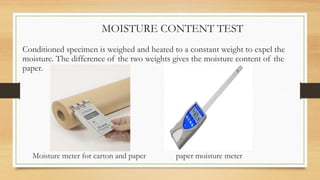
MOISTURE CONTENT TEST
Conditioned specimen is weighed and heated to a constant weight to expel the
moisture. The difference of the two weights gives the moisture content of the
paper.
Moisture meter for carton and paper paper moisture meter
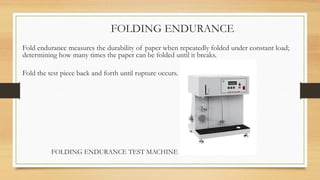
FOLDING ENDURANCE
Fold endurance measures the durability of paper when repeatedly folded under constant load;
determining how many times the paper can be folded until it breaks.
Fold the test piece back and forth until rupture occurs.
FOLDING ENDURANCE TEST MACHINE
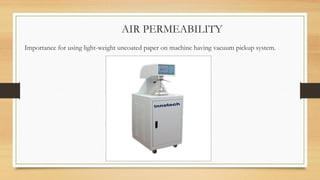
AIR PERMEABILITY
Importance for using light-weight uncoated paper on machine having vacuum pickup system.
TENSILE STRENGTH
Maximum load that a material can support without fracture when being stretched, divided by the original cross
section area of the material
Tensile strength have dimensions of force per unit area.
These test provides measurement of attributes we can see and feel : strength, stiffness and resistance to stretching.
TENSILE STRENGTH FORMULA :
S = F/A
WHERE, S = breaking strength
F = Force that caused the failure
A = least cross sectional area of material
TEAR STRENGTH
● The mean force required to continue the tearing of an initial cut in a single
sheet of paper.
● Tearing test is a simple method developed in 1940s, usually known as
Elmendorf test, for evaluating a particular type of paper strength, the tear
strength.
● In this test method an impact load is applied to pull paper apart
perpendicular to its faces. According to Van Den Akkers tear strength
theory, it is dependent of two phenomena.
● The work associated with breaking of fibres and then pulling fibres out of
the fibre network. These two phenomenon of course dependent on the
degrees of fibre bonding, fibre strength and fibre length in the paper sheet.
●
●
●
●
STIFFNESS
● Degree of resistance offered by paper when it is bent.
● This involves testing a board piece and folding it through 90
degree.
● It will then try to recover its position when bending force is
removed.
STIFFNESS TEST MACHINES
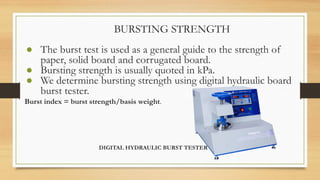
BURSTING STRENGTH
● The burst test is used as a general guide to the strength of
paper, solid board and corrugated board.
● Bursting strength is usually quoted in kPa.
● We determine bursting strength using digital hydraulic board
burst tester.
Burst index = burst strength/basis weight.
DIGITAL HYDRAULIC BURST TESTER
THANK YOU

Quality control for packaging materials.pdf

  • 1.
    QUALITY CONTROL OF PACKAGINGMATERIALS CONTENTS INTRODUCTION ADVANTAGES TYPES OF PACKAGING USED FOR PHARMACEUTICAL PRODUCTS TAMPER RESISTANT PACKAGING QUALITY CONTROL AND TESTING STANDARDS QUALITY CONTROL OF SECONDARY COMPONENTS
  • 2.
    INTRODUCTION Packaging is anintegral part of any pharmaceutical industry. It provides degree of protection, minimize the loss of constituents and should not interact with the contents in a way that will not alter the quality to an extent beyond the limits given in the individual monograph.
  • 3.
    ADVANTAGES Protects the product. Prevents the product fromdegradation. Decreases costs. Provides information. Provides hygiene. Means economy. Packaging is a preventive measure.
  • 4.
  • 5.
    TYPE OF PACKAGING •PRIMARY PACKAGING - is the material that envelopes the product and hold it. Ex: Aerosol spray can, blister packs, bottle ampoules, vials and etc. • SECONDARY PACKAGING – is outside the primary packaging perhaps used to group primary package together. Ex: boxes, cartons, labels, leaflets. • TERTIARY PACKAGING - is used for bulk handling and shipping. Ex: barrel, container, edge protector.
  • 6.
    CHOICE OF PACKAGINGMATERIALS WILL DEPENDS UPON • Degree of protection required • Compatibility with the dosage form • Customer convenience ex : size, weight of dosage form • Filling method • Sterilization methods to be employed and cost
  • 7.
    COMPOSITION OF PACKAGES •Container • Closure • Carton or outer • Box
  • 8.
    TYPE OF PACKAGINGMATERIALS USED FOR PHARMACEUTICALS PRODUCTS • Glass • Plastic • Metals • Rubber • Paper/card boards
  • 9.
    GLASS Composition of glass: • Sand(silicon dioxide), soda ash, limestone(calcium carbonate), cullet(broken glass) • Amber : light yellowish to deep reddish brown, carbon, sulphur and iron and manganese dioxide • Yellow : cadmium and sulphur • Blue : cobalt oxide and copper oxide • Green : iron oxide, magnesium dioxide, chromium dioxide.
  • 10.
    TYPES AND MANUFACTURING METHODS •TYPE I – highly resistant borosilicate glass • TYPE II – treated soda lime glass • TYPE III – soda lime glass • TYPE IV – soda glass (non parenteral usage) MANUFACTURING METHODS : • Blowing method • Drawing method • Pressing mechanical force • Casting using gravity
  • 11.
  • 12.
    PRESSING MECHANICAL FORCEAND CASTING METHOD
  • 13.
    PLASTIC • Is definedas any group of substance of natural or synthetic origins, consisting chiefly of polymers of high molecular weight that can be molded into a shape or form by heat and pressure • Types : Thermosetting type do not become liquid Ex : melamine formaldehyde, urea formaldehyde and etc. and thermoplastics type become liquid HDPE, LDPE, PVC and etc.
  • 14.
    METALS • For thepharmaceutical purpose metals like aluminum, tin plated steel, stainless steel, tin and lead. • Collapsible tubes metal - consist of good reclosure, adequate protection, light in weight, unbreakable mostly are tin, aluminum and lead. • Tin - food, pharmaceutical products which requires high purity. • Aluminum - since it is light weight easily portable and transportable • Lead - non-food products because of poisoning nature. Inks, paints and lubricants
  • 15.
    RUBBER • Construction ofclosure meant for vials, transfusion fluid bottles, dropping bottles • Butyl rubber – water absorption is low, cheaper compared to other rubbers • Nitrile rubber – oil and heat resistant. • Chloroprene rubbers - oil resistant and good heat resistant too. • Silicon rubber - permeability of water, heat resistant, low absorption.
  • 16.
    Quality Control Testfor Glass Containers 1. Chemical Resistance Test a) Powered Glass Test b) Water Attack Test 2. Hydrolytic Resistance Test 3. Arsenic Test 4. Thermal Shock Test 5. Internal Bursting Pressure Test
  • 17.
    Chemical Resistant Test a)Powdered Glass Test: It is done to estimate the amount of alkali from powdered glass with happen at elevated temperature. When glass is powdered, leaching of alkali is enhanced, which can be titrated with 0.02N sulfuric acid using methyl red as an indicator. Step 1 •Preparation of glass specimen Step 2 •Washing the specimen
  • 18.
    Titrate the decantsolution with 0.02N sulphuric acid using indicator and record the volume Cool it and deacant solution in another flask again add 15ml water and decant solution 10g of specimen/sample + 50ml of highly purified water. Autoclave it at 121 C Limits: Test Container Vol. of 0.02N H2S04 (ml) Powdered Glass Test Type I Type III Type N.P 1.0 8.5 15
  • 19.
    b) Water AttackTest: This test is for Type II glass. The principle involve in this is whether the alkali leaches from surface of container. The volume of Sulphuric acid consumed is recorded and compare with limits Decanted liquid is titrated with 0.02N Sulphuric acid using methylred as an indicator Autoclave it at 121 C for 30 minutes. Then it is cooled and liquid is decanted Rinse thoroughly container with high purity water. Fill it by 90% of it’s capacity with water
  • 20.
    • Limits: Test Container Vol.of 0.02N H2S04 (ml) Water Attack Test Type II Size( ml) – 100 Less than 100 1.0 0.7 0.2 Leakage Test • Drug filled container is placed in contained filled with colored solution (methylene blue) and autoclave at 121C for 1o min. under pressure. • Later on the container are observed whether colored get entered in container or not.
  • 21.
    3. Hydrolytic ResistantTest This test is only for unused glass container Rinse the container with CO2 free water for 3 times. Fill till a particular vol. autoclave it At 100C for 10 min. allow to rise temp. to 121C for 60 min. Low down temp. at 100C. Cool it Specific amount of liquid solution is titrated with 0.01N HCL using methylred as an indicator. Perform the blank with water and difference between the titration represents vol. of HCL consumed by test liquid.
  • 22.
    ARSENIC TEST : •Pipette out 10 ml and add 10 ml of HNO3 on the water bath maintaining the temperature. • Cool the solution and determine the absorbance at 840 nm. Perform blank. • Dry residue in oven at 130 C for 30 mins and cool it and add hydrogen molybdate and reflux for 25 mins
  • 23.
    ARSENIC TEST : •Test solution is same as that of hydrolytic resistant test (50ml) • Wash inner and outer surface of container with D.W for 5 minutes The absorbance of the test solution should be less than absorbance obtained using 0.1 ml of arsenic standard solution (10ppm)
  • 24.
    INTERNAL BURSTING PRESSURETEST : • The internal pressure is automatically raised by series of increment at set time • the test bottle is filled with bater and placed inside the test chamber Bottles are checked at preselected pressure level until container finally burst
  • 25.
    THERMAL SHOCK TEST STEP3 the amount of thermal shock a bottle can withstand is based on construction. STEP 2 transfer the container in cold water bath temp. Should be controlled. Examine cracks before and after test (45 C temp. Difference should be there) STEP 1 place sample container in upright position in tray and immersed tray in hot water for a given time. Small bottle – 60 to 80 C and for pint bottle – 30 to 40 C
  • 26.
    QUALITY CONTROL TESTFOR PLASTIC CONTAINER : Leakage test Collapsibility Transparency Water vapor permeability test(for parenteral) Biological test
  • 27.
    LEAKAGE TEST ANDCOLLAPSABILITY TEST • Fill ten containers with water and fit with intended closures and keep them inverted at room temp for 24 hours there are no sign of leakage then the test passes. COLLAPSABILITY TEST The containers are squeezed in order to remove the contents. A container by collapsing inside inward during use yields at least 90% of its nominal content at the required rate of flow at ambient temperature.
  • 28.
    TRANSPARENCY • Fill fiveempty containers to their nominal capacity with diluted suspension as described in IP 1966. The cloudiness of the diluted suspension in each container is detectable when viewed through the containers as compared with a container of the same type filled with water.
  • 29.
    WATER VAPOUR PERMEABILITY •Fill five containers with nominal volume of water and heat seal the bottles with aluminum foil poly ethylene laminate or other suitable seal. • Weigh accurately each container and allow to stand for 14 days at a relative humidity of 60 + 5% and a temperature between the 20 – 25 C and reweigh the containers. • The loss in weight in each container is not more than 0.2 %
  • 30.
    BIOLOGICAL TEST • USPprovided the essentially three phases : • IMPLANTATION TEST : implantation of small piece of plastic material intramuscularly in rabbits. • SYSTEMIC INJECTION TEST : inject using sodium chloride and with or without alcohol intravenously in mice and injecting eluates using PEG 400 and sesame oil intraperitoneally in mice. • INTRACUTANEOUS TEST : all four injection are injected in subcutaneously in rabbits. • NOTE : the test reaction must not be significantly greater than non-reactive control samples.
  • 31.
    QUALITY CONTROL TEST FOR METAL CONTAINER STEP 3 Basefor all tubes squeezed at certain rate and passed through filter under vacum. Further wash with CHCl3 and observed for particles. STEP 2 A small bacteriological filter assembly fitted with filter paper and heated to melting range of ointment base. STEP 1 Take 50 empty tubes filled with the ointment base sealed and kept overnight
  • 32.
    QUALITY CONTROL TESTFOR METAL CONTAINER Observations for example Limits : less than 100 test passes Total score above 150 test fails If between 100 – 150 test is repeated with 50 more tubes Particle 1 mm and above 50 Particle 0.5 to 1mm 10 Particle 0.2 mm to 0.5 mm 2 Particle less than0.2 mm nil Total score 62
  • 33.
    QUALITY CONTROL TESTFOR COLLAPSIBLE TUBES • Leakage test • Power of adhesion • Flexibility • Product compatibility
  • 34.
    QUALITY CONTROL TEST FOR STRIPAND BLISTER PACKING STEP 4 If there is no leakage content will not be wetted. It indicates perfect sealing STEP 3 The content of strips and blisters were removed and presence of moisture was checked STEP 2 Later on strips, blister were taken out. Water present over the outer surface were wiped out. STEP 1 th of water is poured in desicator. Strip and blister were placed inside desicator and vacum is applied.
  • 35.
    QUALITY CONTROL TESTFOR CLOSURES • STERILITY • FRAGMENTATION TEST • SELF SEALABILITY TEST • pH OF AQUEOUS EXTRACT • LIGHT ABSORPTION TEST • REDUCING SUBSTANCE • RESIDUE ON EVAPORATION • PENETRABILITY
  • 36.
    PREPARATION OF SAMPLESOLUTION : • Further subjected to autoclave and covering with aluminium foil • Rinse 5 times with D.W and add 200ml water • Wash closure in 0.2 % w/v of anionic surfactant for 5 min. Allow to cool and separate solution from closure.
  • 37.
    STERILITY TEST Closures are subjectedto sterilization 1 By autoclaving at 64 – 66 C and pressure at 0.7kPa. 2 Further testing is carried out by using culture media 3
  • 38.
    FRAGMENTATION TEST Take clean12 vials and place closure containing 4 ml of water. allow to stand for 16 hrs. use hypodermic needles to inject 1 ml of water into the vial and remove 1 ml of air. carry this operation for 4 times with new needle each time. pass the water present in vial through a filter with pore size of 0.5 micro meter No. Of fragments of closure retain should be as per the limits LIMIT : NO OF FRAMENTS – NMT 10 INCASE OF BUTYL RUBBER NORMALLY 15
  • 39.
    SELF SEALABILITY Fill Fill 10vials with nominal volume of water and place closure Pierce Pierce cap for 10 times at different sites with hypodermic needles. Immerse Immerse vials in 0.1% w/v solution of methylene blue under pressure. Keep Keep the container immersed for 30 minutes. Wash wash the vials and none of vials should contain traces of color solution
  • 40.
    pH OF AQUEOUSEXTRACT Add 0.01M of NaOH till color change from pink to yellowvolume required is measured • Take 20 ml of sample solution and add 0.1 ml of bromothymol blue. LIMITS : VOL OF NaOH : NMT 0.3 ml If HCl used : NMT 0.8 ml
  • 41.
    LIGHT ABSORPTION TEST •Must be done within 4 hrs from preparing sample solution • It is filtered and its absorbance is measured at 220 nm to 360 nm. • Blank is done without closure and absorbance must be NMT - 2.0
  • 42.
    RESIDUE ON EVAPORATIONAND PENETRABILITY • The 50 ml of sample solution is evaporated at 105 C • Residue obtained should not be NMT 4 mg PENETRABILITY • This is to measure the force required to make a hypodermic needle penetrate easily through closure. • It is measured by using piercing machine. • The piercing force must not exceed a stated value, the hypodermic needle can get damaged as a result of undesirable hardness of closure.
  • 43.
    QC TEST FORSECONDARY PACKAGING MATERIALS • Test pieces of paper and board are taken for test to be carried out in standard condition Temp: 22 – 24 C Relative humidity: 48% - 52 % • Moisture content • Folding endurance • Air permeability • Tensile strength • Stiffness • Burst resistance
  • 44.
    QUALITY CONTROL TESTFOR SECONDARY PACKAGING MATERIALS Quality control test for cartons Compressions Carton opening force Quality control test for paper and board
  • 45.
    QUALITY CONTROL TESTSFOR CARTONS COMPRESSION Used to assess the strength of erected package there by estimating the degree of protection that it confers on the contents. This is useful for products with no inherent strength in one plane or another. Compression test machines
  • 46.
    CARTON OPENING FORCE Thecarton should spring open in to its original shape without a need for unreasonable force. If the carton does not spring open buckles in on itself, it may cause problem in cartoning machine. Carton opening force tester
  • 47.
    QUALITY CONTROL TESTFOR PAPER AND BOARD Test conditions : Temperature : 22 - 24 C relative humidity : 48 - 52 % 1. Moisture content 2. Folding endurance 3. Air permeability 4. Tensile strength 5. Tear strength 6. Stiffness 7. Bursting strength
  • 48.
    MOISTURE CONTENT TEST Conditionedspecimen is weighed and heated to a constant weight to expel the moisture. The difference of the two weights gives the moisture content of the paper. Moisture meter for carton and paper paper moisture meter
  • 49.
    FOLDING ENDURANCE Fold endurancemeasures the durability of paper when repeatedly folded under constant load; determining how many times the paper can be folded until it breaks. Fold the test piece back and forth until rupture occurs. FOLDING ENDURANCE TEST MACHINE
  • 50.
    AIR PERMEABILITY Importance forusing light-weight uncoated paper on machine having vacuum pickup system.
  • 51.
    TENSILE STRENGTH Maximum loadthat a material can support without fracture when being stretched, divided by the original cross section area of the material Tensile strength have dimensions of force per unit area. These test provides measurement of attributes we can see and feel : strength, stiffness and resistance to stretching. TENSILE STRENGTH FORMULA : S = F/A WHERE, S = breaking strength F = Force that caused the failure A = least cross sectional area of material
  • 52.
    TEAR STRENGTH ● Themean force required to continue the tearing of an initial cut in a single sheet of paper. ● Tearing test is a simple method developed in 1940s, usually known as Elmendorf test, for evaluating a particular type of paper strength, the tear strength. ● In this test method an impact load is applied to pull paper apart perpendicular to its faces. According to Van Den Akkers tear strength theory, it is dependent of two phenomena. ● The work associated with breaking of fibres and then pulling fibres out of the fibre network. These two phenomenon of course dependent on the degrees of fibre bonding, fibre strength and fibre length in the paper sheet. ● ● ● ●
  • 53.
    STIFFNESS ● Degree ofresistance offered by paper when it is bent. ● This involves testing a board piece and folding it through 90 degree. ● It will then try to recover its position when bending force is removed. STIFFNESS TEST MACHINES
  • 54.
    BURSTING STRENGTH ● Theburst test is used as a general guide to the strength of paper, solid board and corrugated board. ● Bursting strength is usually quoted in kPa. ● We determine bursting strength using digital hydraulic board burst tester. Burst index = burst strength/basis weight. DIGITAL HYDRAULIC BURST TESTER
  • 55.