M.Pharm Sem 2 Presentation
Container and Closures For Pharmaceutical
SUBJECT- Pharmaceutical Manufacturing Technology
Bubal Knowledge City,
MET’s Institute of
Pharmacy,
Adgaon, Nashik, 422003.
Maharashtra, India
Presented By-
Mr. Abhishek R. Jadhav
(QAT)
SEM-II
ROLL NO. 06
Guided By-
Dr. S.P. Ahirrao
mam
Academic Year-2021-22
Definition
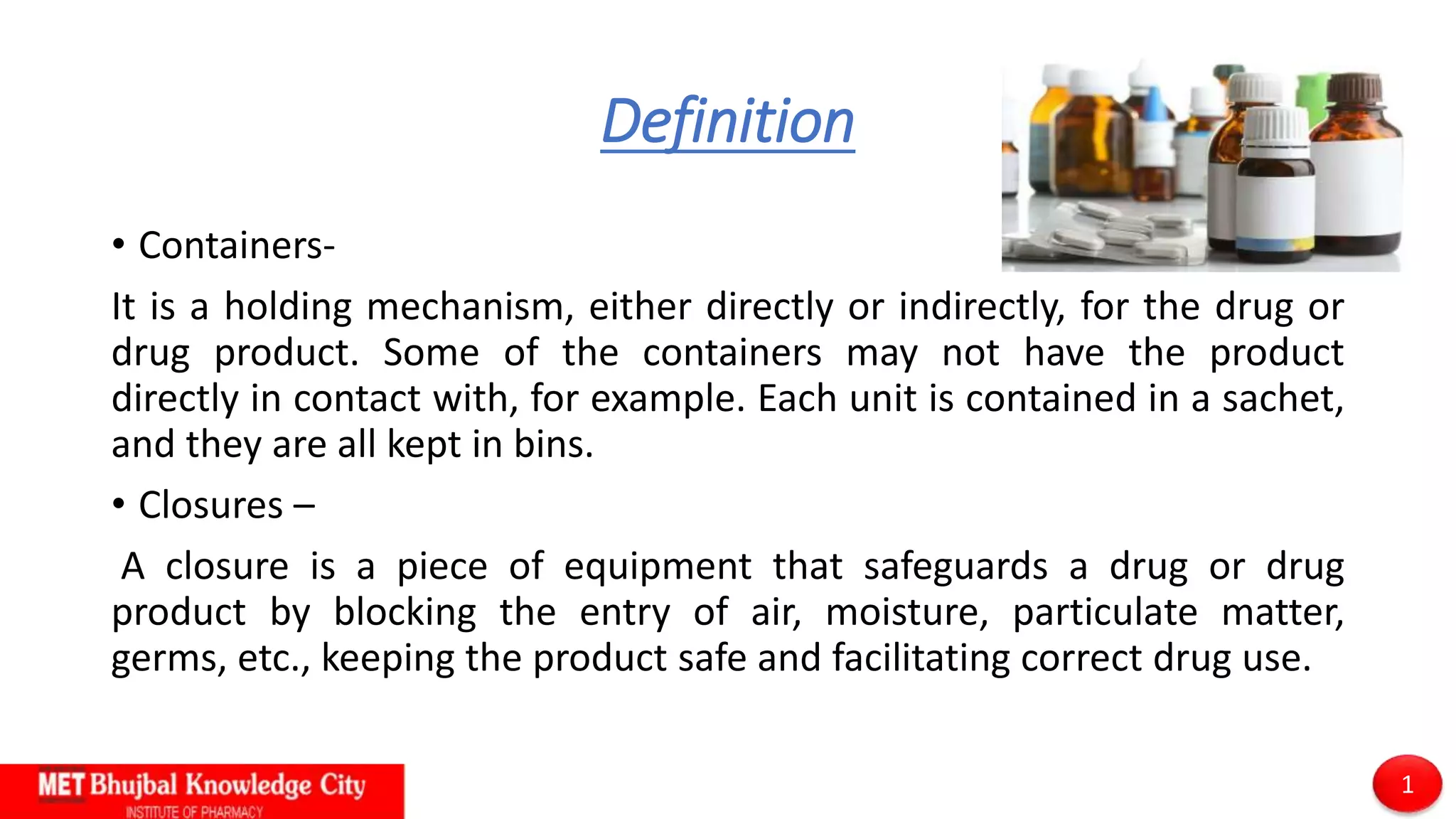
• Containers-
It is a holding mechanism, either directly or indirectly, for the drug or
drug product. Some of the containers may not have the product
directly in contact with, for example. Each unit is contained in a sachet,
and they are all kept in bins.
• Closures –
A closure is a piece of equipment that safeguards a drug or drug
product by blocking the entry of air, moisture, particulate matter,
germs, etc., keeping the product safe and facilitating correct drug use.
1
Types Of Containers
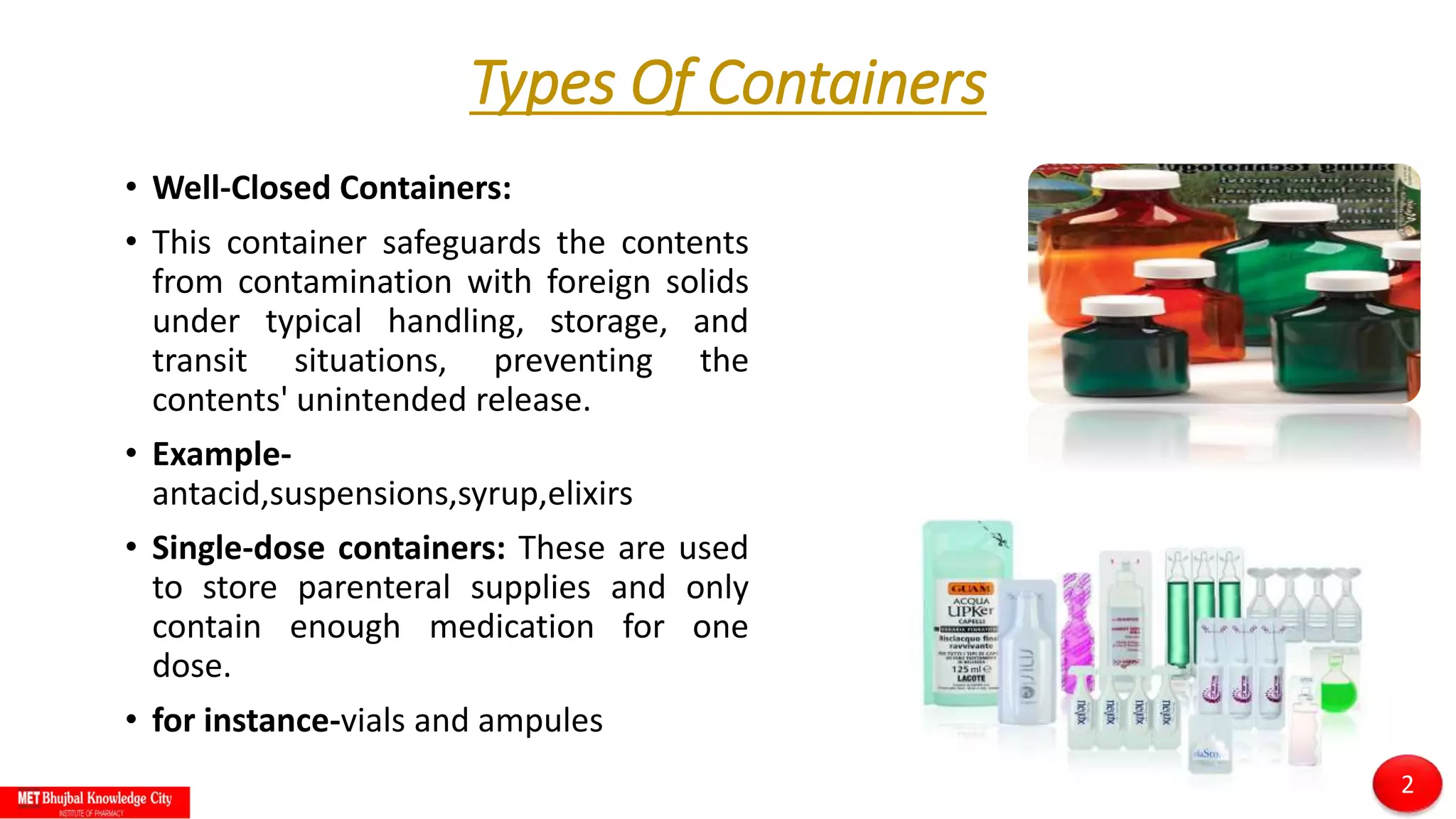
• Well-Closed Containers:
• This container safeguards the contents
from contamination with foreign solids
under typical handling, storage, and
transit situations, preventing the
contents' unintended release.
• Example-
antacid,suspensions,syrup,elixirs
• Single-dose containers: These are used
to store parenteral supplies and only
contain enough medication for one
dose.
• for instance-vials and ampules
2
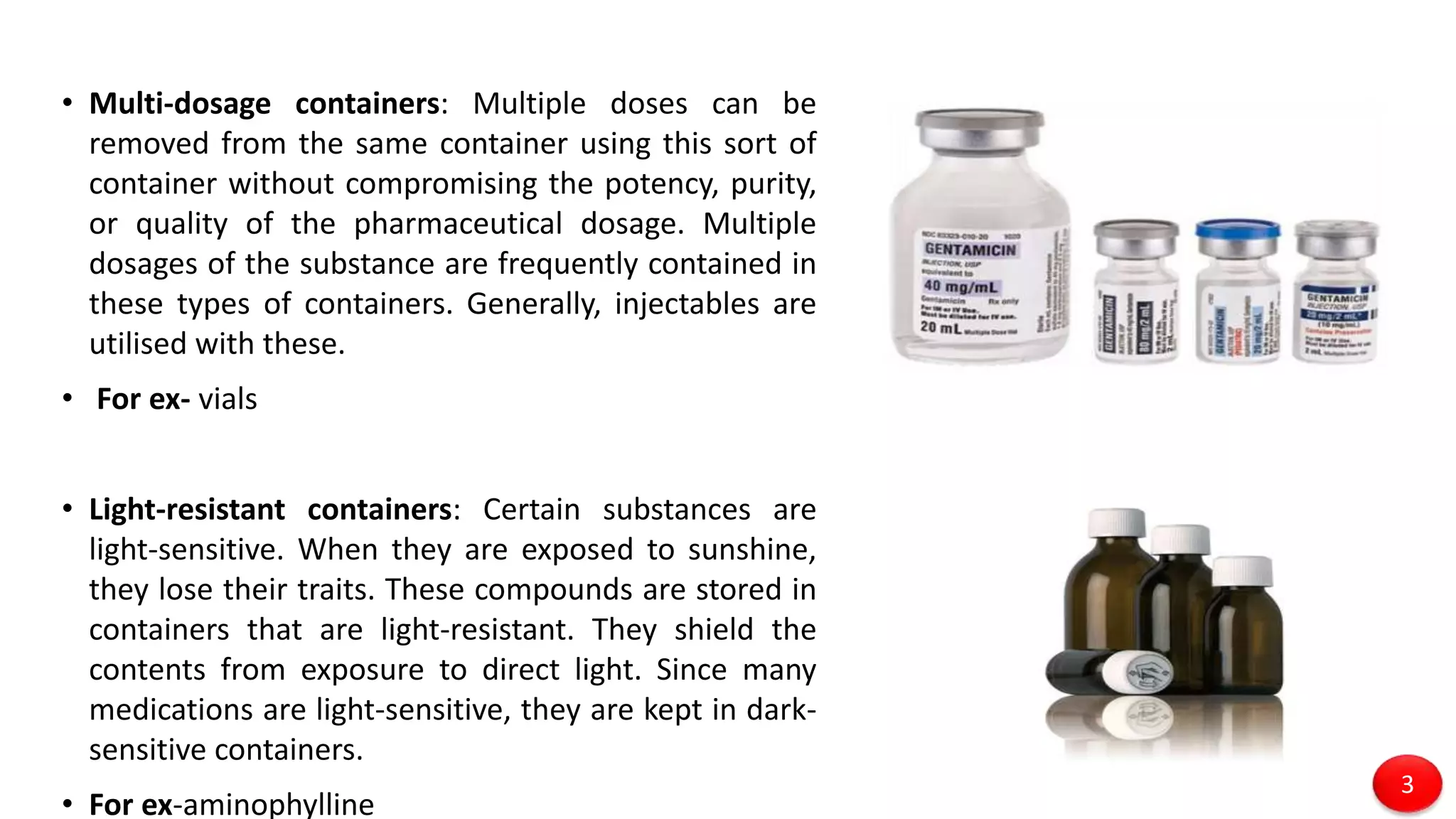
• Multi-dosage containers: Multiple doses can be
removed from the same container using this sort of
container without compromising the potency, purity,
or quality of the pharmaceutical dosage. Multiple
dosages of the substance are frequently contained in
these types of containers. Generally, injectables are
utilised with these.
• For ex- vials
• Light-resistant containers: Certain substances are
light-sensitive. When they are exposed to sunshine,
they lose their traits. These compounds are stored in
containers that are light-resistant. They shield the
contents from exposure to direct light. Since many
medications are light-sensitive, they are kept in dark-
sensitive containers.
• For ex-aminophylline
3
• Air tight containers- They go by the name
hermetic containers as well. These containers
have an airtight seal. Under typical handling,
storage, and transportation conditions, this
container protects external solids, liquids, and
vapors and inhibits changes brought on by
efflorescence, deliquescence, and evaporation.
• Example: Glass Ampoule sealed by infusion
• Aerosol containers- The pressure of the
aerosol packing can be supported by the
mechanical strength of these containers.
4
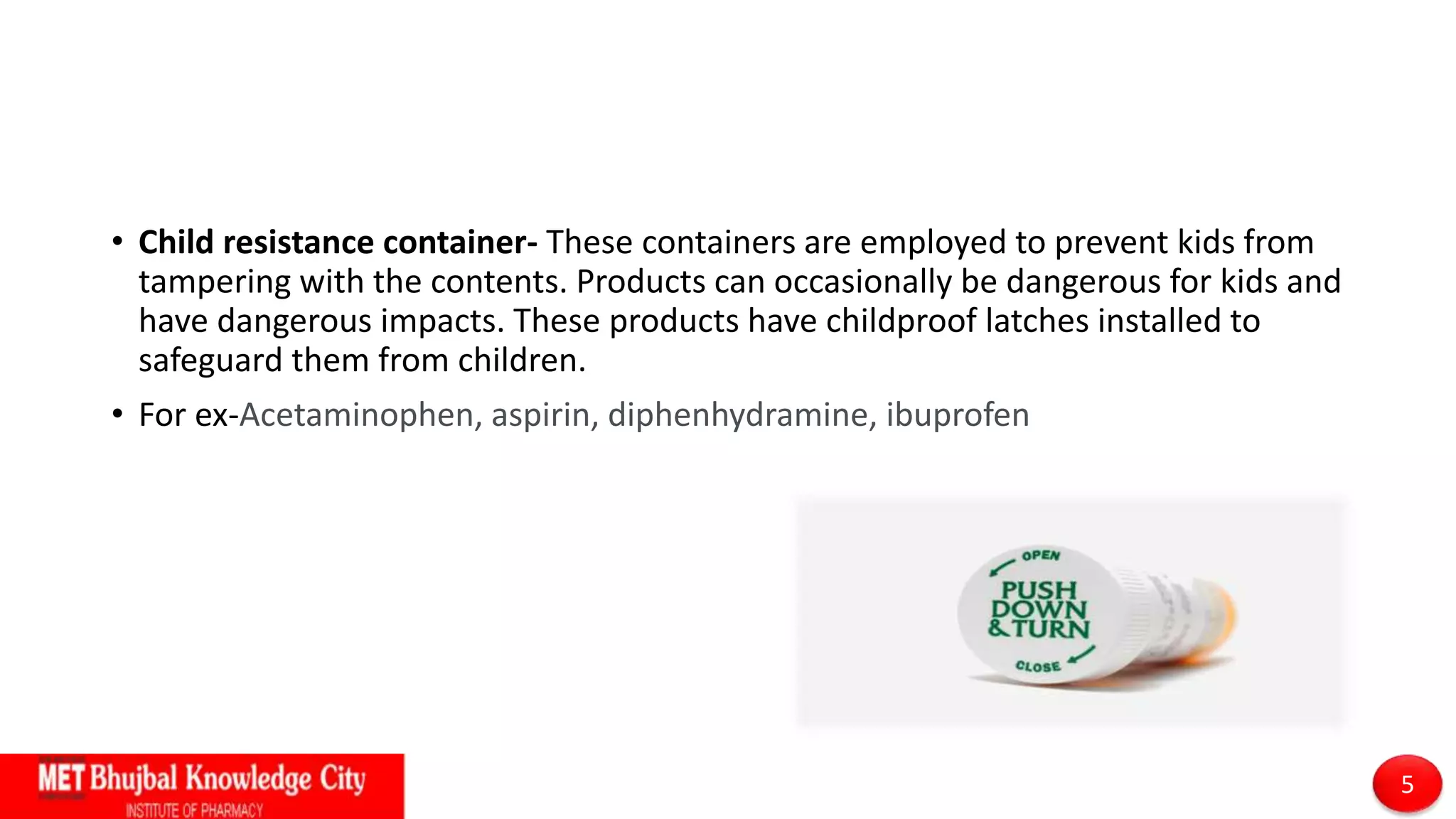
• Child resistance container- These containers are employed to prevent kids from
tampering with the contents. Products can occasionally be dangerous for kids and
have dangerous impacts. These products have childproof latches installed to
safeguard them from children.
• For ex-Acetaminophen, aspirin, diphenhydramine, ibuprofen
5
Type Name Properties Use and Limitation Type of Test
Ⅰ Highly
Resistant
Borosilicate
Glass
Highly hydrolytic resistance. More
chemically inert than soda-lime glass.
Alkalinity is removed by using boric oxide
to neutralize the oxides of potassium and
sodium
Used to contains strong acid alkalis as
well as all types of solvents. Used for
parenteral preparation. Buffered and
unbuffered aqueous solution.
Powdered glass
Ⅱ Treated Soda
Lime Glass
High hydrolytic resistance. Made of
commercial soda lime glass. De-alkalized
or treated to remove surface alkali
(sulphur treatment sulphur dioxide/
ammonium sulphate)
Suitable for acidic and neutral aqueous
preparations. Buffered aqueous solution
pH below 7 (parenteral preparation) Water attack test
Ⅲ Soda-Lime
Glass
Moderate hydrolytic resistance. Untreated
made of commercial soda lime glass. It is
an alkaline glass having high percentage of
lime and no boric oxide.
Suitable for non aqueous preparations.
(Dry powder and oleaginous solution)
Limitation= Not generally used for
parenteral preparation
Powdered glass
Ⅳ General
Purpose
Soda Lime
Glass
It has a similar composition to that of type
Ⅲ glass but there is no guarantee of
similar properties.
Supplied for Non-parenteral product
(Tablet, Oral or Topical use).
Limitation= Not used for parenteral
preparation.
Powdered glass
1)Powdered glass test Prepare glass sample,wash it,10 gm sample +50 ml
purified water.Autoclave it at 121°C
Cool it and decant in another flask add 15 ml water
and decant it again
Titrate decant solution with 0.02 N sulphuric acid
using methyl red as an indicator, the volume of titrant
used is recorded.
7
2)Water attack test Rinse the container thoroughly with water, fill it
with 90% water
Autoclave it at 121°C for 30 min then cool it
and decant.
The decanted liquid is titrated with 0.02 N
sulphuric acid using methyl red as an indicator
and the volume of titrant used is recorded.
8
• On heating, they soften to viscous
fluid ,hardens again on cooling
• PVC, nylon polyethylene
Thermoplastic Type
• on heating becomes flexible but do
not become liquid (high degree of
cross-linking)
• Phenol-formaldehyde , urea
formaldehyde
Thermosetting Type
Types of Plastic containers
9
Drug Plastic Interaction
• Until the last dose is withdrawn, a packaging method must protect
the medicine without change.
• The following are the five categories of drug-plastic considerations:
1. Permeation
2. Leaching
3. Sorption
4. Chemical reaction
5. Modification
10
Permeation
• the transfer of liquids, gases, or both through the plastic.
• A drug's shelf life may be harmed by its packaging.
• It may be problematic if oxygen and water vapor seep into the
medication through the plastic wall.
• Temperature and humidity are significant factors if the dosage form is
susceptible to hydrolysis and oxidation.
• The permeability of a gas increases with increasing temperature.
Example-Two polyethylenes may give different permeability values at
various temperatures
11
Leaching
• It is the procedure by which the drug or product is exposed to alkali
that has been released from the glass container's surface.
• Alkali may be released, causing the product to become unstable and
changing the drug's pH.
• Finally, medications may decompose, become poisonous, impotent,
or become inactive.
• Example- If kept for a long time in a glass container, insulin will
eventually reach pH 3.5.
• As a result of its interaction with glass, alkali is released. When pH
exceeds 7, it becomes inert and has no effect.
12
• Sorption:- This process comprises taking the drug product's
components out of the packaging.
• The therapeutic effectiveness of the substance can be lessened as a
result of sorption.
• The concentration of the active substance, temperature, solvent
system and chemical structure are only a few of the things that
sorption can change.
• Chemical reactivity:- Even in minute levels, certain compounds in
plastic formulations may chemically interact with one or more
elements of a drug product to change the way the plastic or drug
product looks.
13
• Modification- It is described as the drug product's physical and
chemical change of the packaging material.
The mechanical properties of the polymers underwent significant
modifications as a result of some solvent systems.
For instance, While PVC and polyethylene are destroyed by
hydrocarbons, oils soften polyethylene.
14
BIOLOGICAL TESTS
Systemic Injection Test:-
This test is designed to evaluate systemic responses to the extracts of
materials under test following injection into mice.
• Limit- The sample does not fulfill the standards if aberrant behavior
such as convulsions or prostration occurs, or if bodyweight loss is
higher than 2g.
15
Albino Mice were used as test animals. Inject a sample into each of the 5 mice in the test group and monitor
the animals immediately, after 4 hours, and then at 24, 48, and 72 hours.
If none of the animals have significantly higher biological reactivity than the blank, the sample is acceptable.
Intra Cutaneous Test
This test is designed to evaluate local response to the extracts of
materials being examined following intracutaneous injection into
rabbits.
• Limit:- The difference between the sample and blank scores should
be smaller than 1.0.
16
Examine the sites of injection for any tissue reaction such as erythema, or
edema, at 24, 48, and 72 hours.
Rabbit Eye Irritation Test
This test is designed to evaluate responses to the installation of extracts of
material under examination in the eye of a rabbit.
Test animal - albino rabbits
• Limit – The sample extract demonstrates no significant irritating response
during the observation period when compared to a blank extract.
17
The substance to be tested is applied in a single dose to one of the eyes of
an experimental animal.
The untreated eye serves as the control. The eyes of the test animals a
washed after 24hours following the installation of the test substance.
Conclusion
From that we conclude that the different types of dosage forms have
different properties so according to their handling and storage
conditions we have to select containers accordingly, so on that basis,
different containers and closures are required and are selected.
REFERENCE
• "Containers for a pharmaceutical products." Indian Pharmacopoeia. Sixth
Edition ed., vol. 1, 2010. p. 683,684,685,688,690
• https://pharmacampus.co.in/container-and-types-of-
containers/?v=6c8403f93333
• https://www.chpa.org/public-policy-regulatory/regulation/regulation-otc-
medicines/child-resistant-packaging
• Good Manufacturing Practices for Pharmaceuticals a plan for total quality
control , 4th edition , revised and expanded , volume 78, By Sidney H. Willig
James R. Stoker , page no. 112 – 129
• https://oaji.net/pdf.html?n=2016/1210-1472707834.
• https://lnct.ac.in/wp-content/uploads/2020/03/container-n-closure-
ppt.pdf
18

containers and closures.pptx

  • 1.
    M.Pharm Sem 2Presentation Container and Closures For Pharmaceutical SUBJECT- Pharmaceutical Manufacturing Technology Bubal Knowledge City, MET’s Institute of Pharmacy, Adgaon, Nashik, 422003. Maharashtra, India Presented By- Mr. Abhishek R. Jadhav (QAT) SEM-II ROLL NO. 06 Guided By- Dr. S.P. Ahirrao mam Academic Year-2021-22
  • 2.
    Definition • Containers- It isa holding mechanism, either directly or indirectly, for the drug or drug product. Some of the containers may not have the product directly in contact with, for example. Each unit is contained in a sachet, and they are all kept in bins. • Closures – A closure is a piece of equipment that safeguards a drug or drug product by blocking the entry of air, moisture, particulate matter, germs, etc., keeping the product safe and facilitating correct drug use. 1
  • 3.
    Types Of Containers •Well-Closed Containers: • This container safeguards the contents from contamination with foreign solids under typical handling, storage, and transit situations, preventing the contents' unintended release. • Example- antacid,suspensions,syrup,elixirs • Single-dose containers: These are used to store parenteral supplies and only contain enough medication for one dose. • for instance-vials and ampules 2
  • 4.
    • Multi-dosage containers:Multiple doses can be removed from the same container using this sort of container without compromising the potency, purity, or quality of the pharmaceutical dosage. Multiple dosages of the substance are frequently contained in these types of containers. Generally, injectables are utilised with these. • For ex- vials • Light-resistant containers: Certain substances are light-sensitive. When they are exposed to sunshine, they lose their traits. These compounds are stored in containers that are light-resistant. They shield the contents from exposure to direct light. Since many medications are light-sensitive, they are kept in dark- sensitive containers. • For ex-aminophylline 3
  • 5.
    • Air tightcontainers- They go by the name hermetic containers as well. These containers have an airtight seal. Under typical handling, storage, and transportation conditions, this container protects external solids, liquids, and vapors and inhibits changes brought on by efflorescence, deliquescence, and evaporation. • Example: Glass Ampoule sealed by infusion • Aerosol containers- The pressure of the aerosol packing can be supported by the mechanical strength of these containers. 4
  • 6.
    • Child resistancecontainer- These containers are employed to prevent kids from tampering with the contents. Products can occasionally be dangerous for kids and have dangerous impacts. These products have childproof latches installed to safeguard them from children. • For ex-Acetaminophen, aspirin, diphenhydramine, ibuprofen 5
  • 7.
    Type Name PropertiesUse and Limitation Type of Test Ⅰ Highly Resistant Borosilicate Glass Highly hydrolytic resistance. More chemically inert than soda-lime glass. Alkalinity is removed by using boric oxide to neutralize the oxides of potassium and sodium Used to contains strong acid alkalis as well as all types of solvents. Used for parenteral preparation. Buffered and unbuffered aqueous solution. Powdered glass Ⅱ Treated Soda Lime Glass High hydrolytic resistance. Made of commercial soda lime glass. De-alkalized or treated to remove surface alkali (sulphur treatment sulphur dioxide/ ammonium sulphate) Suitable for acidic and neutral aqueous preparations. Buffered aqueous solution pH below 7 (parenteral preparation) Water attack test Ⅲ Soda-Lime Glass Moderate hydrolytic resistance. Untreated made of commercial soda lime glass. It is an alkaline glass having high percentage of lime and no boric oxide. Suitable for non aqueous preparations. (Dry powder and oleaginous solution) Limitation= Not generally used for parenteral preparation Powdered glass Ⅳ General Purpose Soda Lime Glass It has a similar composition to that of type Ⅲ glass but there is no guarantee of similar properties. Supplied for Non-parenteral product (Tablet, Oral or Topical use). Limitation= Not used for parenteral preparation. Powdered glass
  • 8.
    1)Powdered glass testPrepare glass sample,wash it,10 gm sample +50 ml purified water.Autoclave it at 121°C Cool it and decant in another flask add 15 ml water and decant it again Titrate decant solution with 0.02 N sulphuric acid using methyl red as an indicator, the volume of titrant used is recorded. 7
  • 9.
    2)Water attack testRinse the container thoroughly with water, fill it with 90% water Autoclave it at 121°C for 30 min then cool it and decant. The decanted liquid is titrated with 0.02 N sulphuric acid using methyl red as an indicator and the volume of titrant used is recorded. 8
  • 10.
    • On heating,they soften to viscous fluid ,hardens again on cooling • PVC, nylon polyethylene Thermoplastic Type • on heating becomes flexible but do not become liquid (high degree of cross-linking) • Phenol-formaldehyde , urea formaldehyde Thermosetting Type Types of Plastic containers 9
  • 11.
    Drug Plastic Interaction •Until the last dose is withdrawn, a packaging method must protect the medicine without change. • The following are the five categories of drug-plastic considerations: 1. Permeation 2. Leaching 3. Sorption 4. Chemical reaction 5. Modification 10
  • 12.
    Permeation • the transferof liquids, gases, or both through the plastic. • A drug's shelf life may be harmed by its packaging. • It may be problematic if oxygen and water vapor seep into the medication through the plastic wall. • Temperature and humidity are significant factors if the dosage form is susceptible to hydrolysis and oxidation. • The permeability of a gas increases with increasing temperature. Example-Two polyethylenes may give different permeability values at various temperatures 11
  • 13.
    Leaching • It isthe procedure by which the drug or product is exposed to alkali that has been released from the glass container's surface. • Alkali may be released, causing the product to become unstable and changing the drug's pH. • Finally, medications may decompose, become poisonous, impotent, or become inactive. • Example- If kept for a long time in a glass container, insulin will eventually reach pH 3.5. • As a result of its interaction with glass, alkali is released. When pH exceeds 7, it becomes inert and has no effect. 12
  • 14.
    • Sorption:- Thisprocess comprises taking the drug product's components out of the packaging. • The therapeutic effectiveness of the substance can be lessened as a result of sorption. • The concentration of the active substance, temperature, solvent system and chemical structure are only a few of the things that sorption can change. • Chemical reactivity:- Even in minute levels, certain compounds in plastic formulations may chemically interact with one or more elements of a drug product to change the way the plastic or drug product looks. 13
  • 15.
    • Modification- Itis described as the drug product's physical and chemical change of the packaging material. The mechanical properties of the polymers underwent significant modifications as a result of some solvent systems. For instance, While PVC and polyethylene are destroyed by hydrocarbons, oils soften polyethylene. 14
  • 16.
    BIOLOGICAL TESTS Systemic InjectionTest:- This test is designed to evaluate systemic responses to the extracts of materials under test following injection into mice. • Limit- The sample does not fulfill the standards if aberrant behavior such as convulsions or prostration occurs, or if bodyweight loss is higher than 2g. 15 Albino Mice were used as test animals. Inject a sample into each of the 5 mice in the test group and monitor the animals immediately, after 4 hours, and then at 24, 48, and 72 hours. If none of the animals have significantly higher biological reactivity than the blank, the sample is acceptable.
  • 17.
    Intra Cutaneous Test Thistest is designed to evaluate local response to the extracts of materials being examined following intracutaneous injection into rabbits. • Limit:- The difference between the sample and blank scores should be smaller than 1.0. 16 Examine the sites of injection for any tissue reaction such as erythema, or edema, at 24, 48, and 72 hours.
  • 18.
    Rabbit Eye IrritationTest This test is designed to evaluate responses to the installation of extracts of material under examination in the eye of a rabbit. Test animal - albino rabbits • Limit – The sample extract demonstrates no significant irritating response during the observation period when compared to a blank extract. 17 The substance to be tested is applied in a single dose to one of the eyes of an experimental animal. The untreated eye serves as the control. The eyes of the test animals a washed after 24hours following the installation of the test substance.
  • 19.
    Conclusion From that weconclude that the different types of dosage forms have different properties so according to their handling and storage conditions we have to select containers accordingly, so on that basis, different containers and closures are required and are selected.
  • 20.
    REFERENCE • "Containers fora pharmaceutical products." Indian Pharmacopoeia. Sixth Edition ed., vol. 1, 2010. p. 683,684,685,688,690 • https://pharmacampus.co.in/container-and-types-of- containers/?v=6c8403f93333 • https://www.chpa.org/public-policy-regulatory/regulation/regulation-otc- medicines/child-resistant-packaging • Good Manufacturing Practices for Pharmaceuticals a plan for total quality control , 4th edition , revised and expanded , volume 78, By Sidney H. Willig James R. Stoker , page no. 112 – 129 • https://oaji.net/pdf.html?n=2016/1210-1472707834. • https://lnct.ac.in/wp-content/uploads/2020/03/container-n-closure- ppt.pdf 18