PELLETS
Ms. TENY SARA THOMAS
MOUNT ZION COLLEGE OF PHARMACEUTICAL SCIENCES AND
RESEARCH, ADOOR, KERALA
ASSISTANT PROFESSOR
B.PHARM FIFTH SEMESTER
FORMULATIVE & INDUSTRIAL PHARMACY
CONTENTS
• INTRODUCTION
• ADVANTAGES & DISADVANTAGES
• MECHANISM OF PELLET FORMATION &
GROWTH
• PELLETIZATION TECHNIQUES
• FORMULATION REQUIREMENTS
• EQUIPMENTS FOR MANUFACTURE OF
PELLETS
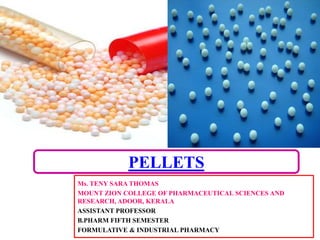
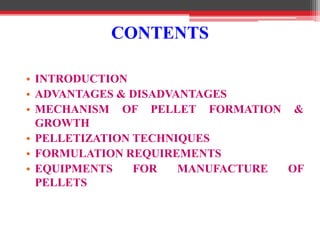
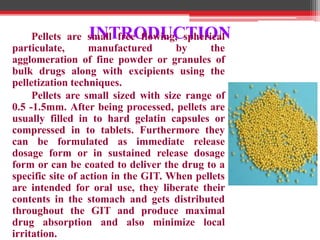
INTRODUCTIONPellets are small free flowing, spherical
particulate, manufactured by the
agglomeration of fine powder or granules of
bulk drugs along with excipients using the
pelletization techniques.
Pellets are small sized with size range of
0.5 -1.5mm. After being processed, pellets are
usually filled in to hard gelatin capsules or
compressed in to tablets. Furthermore they
can be formulated as immediate release
dosage form or in sustained release dosage
form or can be coated to deliver the drug to a
specific site of action in the GIT. When pellets
are intended for oral use, they liberate their
contents in the stomach and gets distributed
throughout the GIT and produce maximal
drug absorption and also minimize local
irritation.
Advantages
• Uniformity of dose
• Pellets composed of different drugs can be blended and
formulated in single unit dosage form that facilitates
delivery of two or more chemically compatible or
incompatible drugs at the same or different site in the GIT
• Excellent flow properties
• Prevention of contamination due to dust formation.
• Pellets are recommended for patients with difficulty in
swallowing.
• Improves aesthetic appearance of products
• Bitter taste masking can be obtained.
• Pellets disperse freely in the GIT and hence greater
absorption of the active drug occurs.
• Reduced risk of dose dumping (premature or exaggerated
release of drug)
Disadvantages
• Preparation of pellets is a complicated and time
consuming process.
• Requires highly specialized equipment.
• Trained or skilled personal needed for manufacturing
• Higher cost of production
• Lack of manufacturing reproducibility and efficacy.
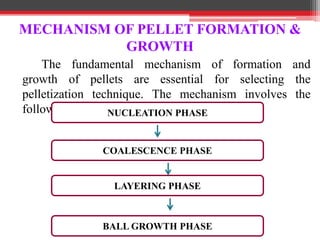
MECHANISM OF PELLET FORMATION &
GROWTH
The fundamental mechanism of formation and
growth of pellets are essential for selecting the
pelletization technique. The mechanism involves the
following steps:-NUCLEATION PHASE
COALESCENCE PHASE
LAYERING PHASE
BALL GROWTH PHASE
Nucleation Phase
Nucleation is process in which the powder is wetted initially
with a solvent system i.e. a binding solution.
• This phase involves adhering of the solid particles or fine powders
to each other due to attractive forces like :- molecular forces,
magnetic forces, and electrostatic forces.
• The void spaces between the particles are being occupied by the
binder solution.
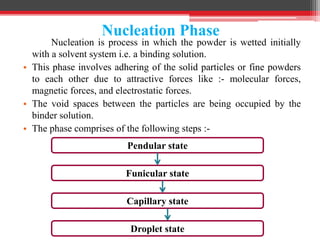
• The phase comprises of the following steps :-
Pendular state
Funicular state
Capillary state
Droplet state
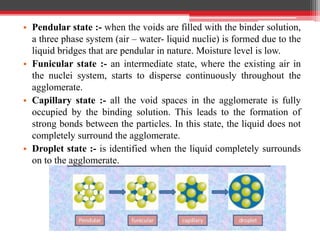
• Pendular state :- when the voids are filled with the binder solution,
a three phase system (air – water- liquid nuclie) is formed due to the
liquid bridges that are pendular in nature. Moisture level is low.
• Funicular state :- an intermediate state, where the existing air in
the nuclei system, starts to disperse continuously throughout the
agglomerate.
• Capillary state :- all the void spaces in the agglomerate is fully
occupied by the binding solution. This leads to the formation of
strong bonds between the particles. In this state, the liquid does not
completely surround the agglomerate.
• Droplet state :- is identified when the liquid completely surrounds
on to the agglomerate.
Coalescence Phase
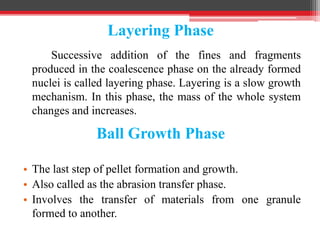
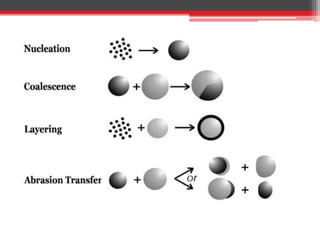
Coalescence is defined as process of the formation of
large sized particles due to random collision of well
formed nuclie. The total mass of the system remains, as
the number of nuclie is reduced due to the collision, but
fines and fragments of particles are produced.
Layering Phase
Successive addition of the fines and fragments
produced in the coalescence phase on the already formed
nuclei is called layering phase. Layering is a slow growth
mechanism. In this phase, the mass of the whole system
changes and increases.
Ball Growth Phase
• The last step of pellet formation and growth.
• Also called as the abrasion transfer phase.
• Involves the transfer of materials from one granule
formed to another.
• Pelletisation is an agglomeration process in which
the fine powders or particles of bulk drugs and
excipients are converted into small, free-flowing,
and roughly spherical units called pellets.
• Pelletisation is often referred to as a size-
enlargement process that involves the manufacture
of agglomerates or pellets having a relatively narrow
size range (mean size from 0.5-2.0mm).
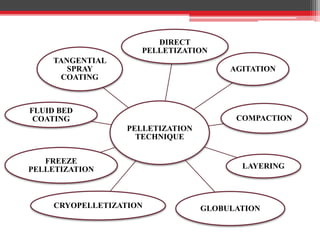
PELLETIZATION TECHNIQUES
PELLETIZATION
TECHNIQUE
DIRECT
PELLETIZATION
AGITATION
COMPACTION
LAYERING
GLOBULATIONCRYOPELLETIZATION
FREEZE
PELLETIZATION
FLUID BED
COATING
TANGENTIAL
SPRAY
COATING
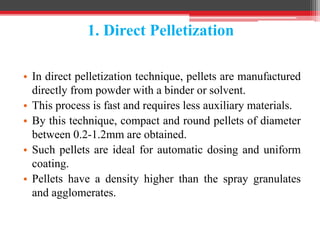
1. Direct Pelletization
• In direct pelletization technique, pellets are manufactured
directly from powder with a binder or solvent.
• This process is fast and requires less auxiliary materials.
• By this technique, compact and round pellets of diameter
between 0.2-1.2mm are obtained.
• Such pellets are ideal for automatic dosing and uniform
coating.
• Pellets have a density higher than the spray granulates
and agglomerates.
2. Agitation
• Agitation is also known as spherical agglomeration.
• In spherical agglomeration process, suitable quantity of
liquid is added before or during agitation to the finely
divided particles to convert into spherical particles by a
continuous rolling or tumbling action.
• Spherical agglomeration can be divided into liquid-
induced and melt induced agglomeration.
• Since many years spherical agglomeration is carried out
in horizontal drum pelletiser, inclined dish pelletiser, and
tumbling blenders.
3. Cryopelletization
• In the process of cryopelletisation, liquid nitrogen is used as a
fixing medium to convert the droplets of liquid formulations
into solid spherical particles or pellets.
• The technology initially developed for lyophilisation can be
used to produce drug-loaded pellets in liquid nitrogen at
160°C temperature.
• The procedure allows instantaneous and uniform freezing of
the processed material due to the rapid heat transfer between
the droplets, and thus the large surface area facilitates the
drying process.
• The amount of liquid nitrogen required for manufacturing a
given quantity depends on the solid content and temperature of
the solution or suspension being processed.
4. Layering
Powder layering
Suspension or Solution layering
Drug is layered onto a nuclei during this stage. The
resulting pellet consist of an inner core region and an
outer shell region of a different composition. There are
two different types of layering pelletization.
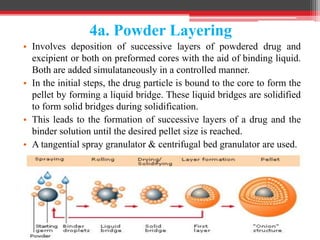
4a. Powder Layering
• Involves deposition of successive layers of powdered drug and
excipient or both on preformed cores with the aid of binding liquid.
Both are added simulataneously in a controlled manner.
• In the initial steps, the drug particle is bound to the core to form the
pellet by forming a liquid bridge. These liquid bridges are solidified
to form solid bridges during solidification.
• This leads to the formation of successive layers of a drug and the
binder solution until the desired pellet size is reached.
• A tangential spray granulator & centrifugal bed granulator are used.
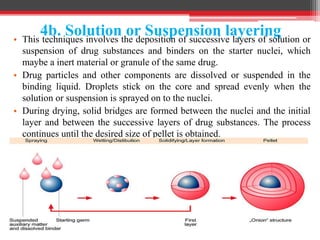
4b. Solution or Suspension layering• This techniques involves the deposition of successive layers of solution or
suspension of drug substances and binders on the starter nuclei, which
maybe a inert material or granule of the same drug.
• Drug particles and other components are dissolved or suspended in the
binding liquid. Droplets stick on the core and spread evenly when the
solution or suspension is sprayed on to the nuclei.
• During drying, solid bridges are formed between the nuclei and the initial
layer and between the successive layers of drug substances. The process
continues until the desired size of pellet is obtained.
5. Compaction
Compression
Extrusion – Spheronization
Compaction is a technique where a force is exerted to a
produce a product that is more dense. Mainly two types
of compaction technique are used for pelletization
5a. Compression
• Compression, a compaction technique, a mixture or
blend of active ingredients and excipients are
compacted under pressure to obtain pellets of desired
size and shapes.
• Quality parameters to be checked in this technique
are similar to those used in tablet manufacturing.
5b. Extrusion – Spheronization
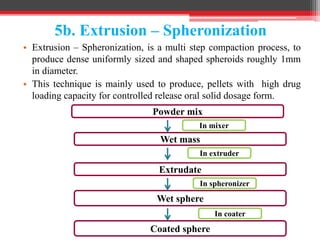
• Extrusion – Spheronization, is a multi step compaction process, to
produce dense uniformly sized and shaped spheroids roughly 1mm
in diameter.
• This technique is mainly used to produce, pellets with high drug
loading capacity for controlled release oral solid dosage form.
Powder mix
Wet mass
Extrudate
Wet sphere
Coated sphere
In mixer
In extruder
In spheronizer
In coater
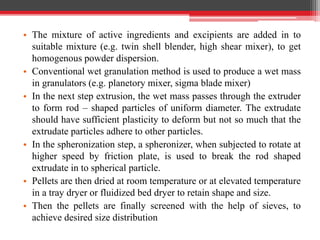
• The mixture of active ingredients and excipients are added in to
suitable mixture (e.g. twin shell blender, high shear mixer), to get
homogenous powder dispersion.
• Conventional wet granulation method is used to produce a wet mass
in granulators (e.g. planetory mixer, sigma blade mixer)
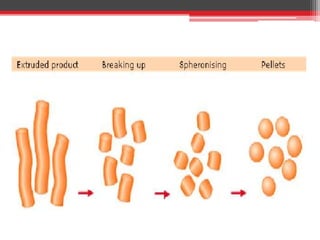
• In the next step extrusion, the wet mass passes through the extruder
to form rod – shaped particles of uniform diameter. The extrudate
should have sufficient plasticity to deform but not so much that the
extrudate particles adhere to other particles.
• In the spheronization step, a spheronizer, when subjected to rotate at
higher speed by friction plate, is used to break the rod shaped
extrudate in to spherical particle.
• Pellets are then dried at room temperature or at elevated temperature
in a tray dryer or fluidized bed dryer to retain shape and size.
• Then the pellets are finally screened with the help of sieves, to
achieve desired size distribution
6. Globulation or Droplet Formation
In the process of globulation, two processes are
involved i.e.,
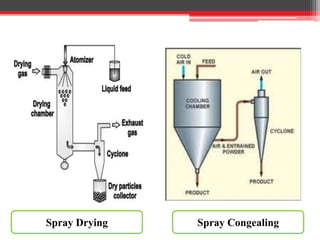
• Spray drying :- is a process in which drug (in solution
or suspension), with or without excipients are sprayed
into a stream of hot air to generate dry, highly spherical
particles. This process is used to enhance the
dissolution rates and bioavailability of poorly soluble
drugs.
• Spray congealing :- is the process in which a drug is
allowed to melt, disperse or dissolve in hot melts of
gums, waxes, fatty acids etc. then it is sprayed into an
air chamber where the temperature below the melting
points of the formulation. No source of heat is used
here.
Spray Drying Spray Congealing
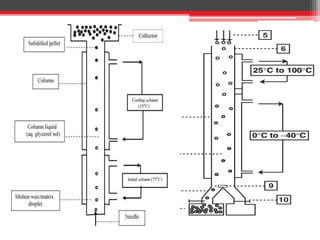
7. Freeze Pelletization
A molten solid carrier or matrix is introduced in
the form of droplets into an inert column containing
a liquid in which the molten solid carrier is
immiscible. The molten solid carrier move upward
or downward in the liquid column depending on the
density of the molten solid carrier with respect to
the liquid in the column, and then solidify into
pellets.
• If the density of the carrier is less than the liquid, the
carriers are introduced as droplets from the top of the
column and the pellets are formed at the bottom.
• If the density of the carrier is more than the liquid, the
carriers are introduced as droplets from the bottom of
the column and the pellets are formed at the top.
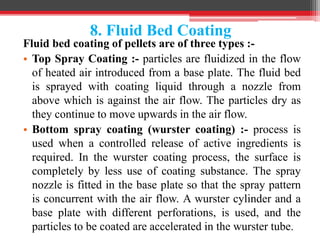
8. Fluid Bed Coating
Fluid bed coating of pellets are of three types :-
• Top Spray Coating :- particles are fluidized in the flow
of heated air introduced from a base plate. The fluid bed
is sprayed with coating liquid through a nozzle from
above which is against the air flow. The particles dry as
they continue to move upwards in the air flow.
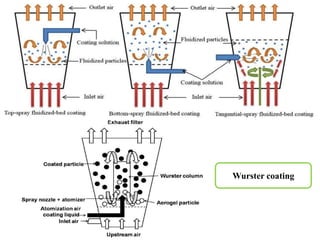
• Bottom spray coating (wurster coating) :- process is
used when a controlled release of active ingredients is
required. In the wurster coating process, the surface is
completely by less use of coating substance. The spray
nozzle is fitted in the base plate so that the spray pattern
is concurrent with the air flow. A wurster cylinder and a
base plate with different perforations, is used, and the
particles to be coated are accelerated in the wurster tube.
• Bottom Spray Coating (continuous fluid bed) :- the
product is continuously fed into one side of the machine
and by means of air flow is transported forward via the
sieve bottom. The dry and coated particles are
continuosly extracted.
9. Tangential Spray Coating
In this process, the product is set into a spiral motion
by means of a rotating base plate which has air fed in to
the powder bed at its edge. The spray nozzle is arranged
tangentially to the rotating disc and is sprayed
simultaneously in to the powder bed.
Wurster coating
Formulation aids or excipients are added to
pharmaceutical dosage forms for satisfactory delivery
of the drug to the target site, to impact favorable
features to the dosage form, and to facilitate product
manufacture. Since pellets are meant for oral
administration the excipients used are same as those
used in the formulation of tablets or capsules.
FORMULATION REQUIREMENTS
Excipients used during manufacture are :-
• Fillers :- are used to add bulk or weight to the products. E.g.
MCC, starch, sucrose.
• Binders :- added to bind powder and makes the pellet
integrity. E.g. HPMC, HPC, gelatin.
• Lubricants :- added to reduce friction between particles and
surface of equipment. E.g. Glycerine, PEG, Mg or Ca stearate.
• Separating agents:- during manufacture, pellets may develop
surface charge and get attracted to each other. Separating
agents promote separation of pellets into separate unit. E.g.
kaolin, talc, silicon dioxide.
• Disintegrating agents :- break down of pellets when ingested.
E.g. alginate, cross carmellose sodium.
• pH adjuster :- E.g. Citrate, Phosphate
• Surfactant :- are added to the liquid to improve wettability by
lowering the interfacial tension between the liquid and drug
particles. E.g. Sodium lauryl sulphate, polysorbates
• Glidant :- reduces the friction between the die wall and
material either during the compression force or during ejection
phase. E.g. talc, starch, magnesium stearate.
• Spheronization enhancer :- impart plasticity to the
formulation, and also impart binding properties that are
essential for pellets strength and integrity. E.g. MCC, NaCMC.
• Release modifier :- added to the change release kinetcis
profile into either enhancing drug release or by retarding the
drug release. E.g. water soluble low molecular weight
compounds, surfactants, disintegrants for enhanced release,
and water insoluble polymers, hydrophobic polymers to retard
the drug release.
• Others :- sweetening, coloring and flavoring agents
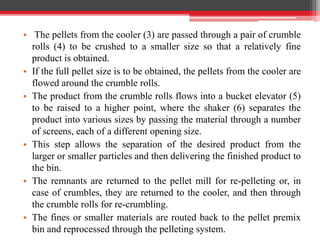
• A pelleting system is made up of different
machines designed to efficiently complete the
task of pelletisation.
• An arrangement of a pelleting system showing
all the equipments is represented in figure.
• The process of pelleting starts in the bin (1)
storing the mixture of mash, which flows into
the pellet mill (2) under gravity.
• The hot, extruded mash (now called pellets)
from the pellet mill now flows into a cooler (3)
under gravity.
• Here it is cooled and dried by a flow of air for
3-6 minutes.
• This air is drawn through the mass of pellets
and passed into a dust collecting device, such as
a cyclone collector (7).
• The dust from the outlet of the collector (8) is
returned to the pellet mill (2) to be compacted
again into a pellet.
EQUIPMENTS FOR MANUFACTURE OF
PELLETS
• The pellets from the cooler (3) are passed through a pair of crumble
rolls (4) to be crushed to a smaller size so that a relatively fine
product is obtained.
• If the full pellet size is to be obtained, the pellets from the cooler are
flowed around the crumble rolls.
• The product from the crumble rolls flows into a bucket elevator (5)
to be raised to a higher point, where the shaker (6) separates the
product into various sizes by passing the material through a number
of screens, each of a different opening size.
• This step allows the separation of the desired product from the
larger or smaller particles and then delivering the finished product to
the bin.
• The remnants are returned to the pellet mill for re-pelleting or, in
case of crumbles, they are returned to the cooler, and then through
the crumble rolls for re-crumbling.
• The fines or smaller materials are routed back to the pellet premix
bin and reprocessed through the pelleting system.
1. Supply Bins
• The supply bins located ahead of the pellet mill, should
store a sufficient quantity of feed to provide a continuous
operation of the pelleting unit and also a continuous
operation of the mixer which provides mash to the
pelleting unit.
• The supply bin constructed from stainless steel should
have at least two bins, results in an efficient mixing as
well as pelleting.
2. Pellet Mills
• The thoroughly mixed ingredients (now called mash or
meal) flow into a flow rate regulator called a feeder
under gravity.
• It is equipped with speed controlling devices, provides
a constant, controlled and uniform flow of feed to the
mixing and pelleting operation, and variation in this
flow leads to poor conditioning and a variable product.
• The feeder delivers a constant and prescribed amount
of the mash to a conditioning chamber in the pellet mill
to be thoroughly mixed with steam (heat and water)
and other desirable liquids, such as molasses.
• The conditioned mash now flows under gravity into
the pellet mill die chamber where the softened mash is
pressed by the rollers through the holes in a circular
die .
• Stationary knives equipped outside the die cut off the
shaped, dense pellet in desired length.
• In the modern pellet mills, a ring type die and rollers
are mounted in a vertical plane with the die turning
about the two fixed rollers. In some mills, the dies and
rollers are mounted in a horizontal plane with the
rollers turning within the stationary die
3. Coolers
• The pellets from the pellet mill flow under gravity into a
device for cooling and drying.
• When the pellets leave the pellet mill, they are at very high
temperatures (190°F) and also have high moisture content (17-
18%).
• Proper storage and handling of the pellets demand their
moisture content to be reduced to 10-12% and their
temperature to be maintained at 15°F above atmospheric
temperature.
• This can be accomplished by passing an air stream through a
bed of pellets, which evaporates the excess moisture and cools
down the pellets (by evaporating the water from the pellets
and also by contact with them).
• The capacity of air to hold water increases two folds with
every 20° rise in temperature.
• Thus, warmer the air, the more moisture it should remove
from the pellets.
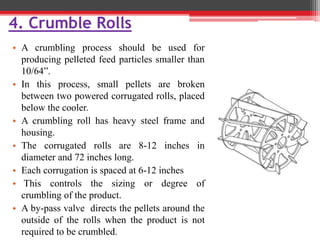
4. Crumble Rolls
• A crumbling process should be used for
producing pelleted feed particles smaller than
10/64”.
• In this process, small pellets are broken
between two powered corrugated rolls, placed
below the cooler.
• A crumbling roll has heavy steel frame and
housing.
• The corrugated rolls are 8-12 inches in
diameter and 72 inches long.
• Each corrugation is spaced at 6-12 inches
• This controls the sizing or degree of
crumbling of the product.
• A by-pass valve directs the pellets around the
outside of the rolls when the product is not
required to be crumbled.
5. Shaker
• The product (either whole or crumblised) from the crumbling device
is passed to a shaker (screening device) that extracts the undesirable
undersized portions of the product from the correctly sized material.
• The undersized product is returned to the pellet mill for repelletisation
and is termed recycle or fines.
• When a product is being crumblised, some pellets may not properly
break to a specific size and remain oversized.
• These particles are removed by screening and returned to the original
crumbler roll for reprocessing and are again screened.
• Around 25-30% of fine materials are returned through the crumbling
process for reworking.
• The screening devices used today are mainly oscillating, vibrating, or
gyrating wire or metal screens with appropriate opening sizes.
• An oscillating pellet screen has a steel or wood frame from which the
screens are supported or suspended.
• The screen frames are oscillated by an eccentrically weighed drive
unit powered by an electric motor .
6. Pellet Elevating Systems
• The correct sized product in its finished form is obtained from the
shaker and is ready for packaging or shipment.
• In many mills, the pellet shaker is located on the upper floors of the
unit so that the screened product, the oversize crumbles, and the fines
flow under gravity to their correct destination.
• This requires that the unscreened pellets are conveyed vertically
(elevated) from the cooler to the shaker.
• In other mills, the shaker is located below the cooler and the sized
finished product is conveyed to the packaging or bulk shipping point.
• In both the cases, an elevating system (vertical conveyor) is required.
• This can be done either mechanically by using a bucket elevator or
pneumatically by using an air conveying system.
• Air systems are used for conveying the hot pellets because they are
not as subject to the build-up of hot, wet material as is a bucket
elevator.
• Bucket elevators are used as they are less expensive, and their
installation, maintenance and working is easy.
Pellets

Pellets

  • 1.
    PELLETS Ms. TENY SARATHOMAS MOUNT ZION COLLEGE OF PHARMACEUTICAL SCIENCES AND RESEARCH, ADOOR, KERALA ASSISTANT PROFESSOR B.PHARM FIFTH SEMESTER FORMULATIVE & INDUSTRIAL PHARMACY
  • 2.
    CONTENTS • INTRODUCTION • ADVANTAGES& DISADVANTAGES • MECHANISM OF PELLET FORMATION & GROWTH • PELLETIZATION TECHNIQUES • FORMULATION REQUIREMENTS • EQUIPMENTS FOR MANUFACTURE OF PELLETS
  • 3.
    INTRODUCTIONPellets are smallfree flowing, spherical particulate, manufactured by the agglomeration of fine powder or granules of bulk drugs along with excipients using the pelletization techniques. Pellets are small sized with size range of 0.5 -1.5mm. After being processed, pellets are usually filled in to hard gelatin capsules or compressed in to tablets. Furthermore they can be formulated as immediate release dosage form or in sustained release dosage form or can be coated to deliver the drug to a specific site of action in the GIT. When pellets are intended for oral use, they liberate their contents in the stomach and gets distributed throughout the GIT and produce maximal drug absorption and also minimize local irritation.
  • 4.
    Advantages • Uniformity ofdose • Pellets composed of different drugs can be blended and formulated in single unit dosage form that facilitates delivery of two or more chemically compatible or incompatible drugs at the same or different site in the GIT • Excellent flow properties • Prevention of contamination due to dust formation. • Pellets are recommended for patients with difficulty in swallowing. • Improves aesthetic appearance of products • Bitter taste masking can be obtained. • Pellets disperse freely in the GIT and hence greater absorption of the active drug occurs. • Reduced risk of dose dumping (premature or exaggerated release of drug)
  • 5.
    Disadvantages • Preparation ofpellets is a complicated and time consuming process. • Requires highly specialized equipment. • Trained or skilled personal needed for manufacturing • Higher cost of production • Lack of manufacturing reproducibility and efficacy.
  • 6.
    MECHANISM OF PELLETFORMATION & GROWTH The fundamental mechanism of formation and growth of pellets are essential for selecting the pelletization technique. The mechanism involves the following steps:-NUCLEATION PHASE COALESCENCE PHASE LAYERING PHASE BALL GROWTH PHASE
  • 7.
    Nucleation Phase Nucleation isprocess in which the powder is wetted initially with a solvent system i.e. a binding solution. • This phase involves adhering of the solid particles or fine powders to each other due to attractive forces like :- molecular forces, magnetic forces, and electrostatic forces. • The void spaces between the particles are being occupied by the binder solution. • The phase comprises of the following steps :- Pendular state Funicular state Capillary state Droplet state
  • 8.
    • Pendular state:- when the voids are filled with the binder solution, a three phase system (air – water- liquid nuclie) is formed due to the liquid bridges that are pendular in nature. Moisture level is low. • Funicular state :- an intermediate state, where the existing air in the nuclei system, starts to disperse continuously throughout the agglomerate. • Capillary state :- all the void spaces in the agglomerate is fully occupied by the binding solution. This leads to the formation of strong bonds between the particles. In this state, the liquid does not completely surround the agglomerate. • Droplet state :- is identified when the liquid completely surrounds on to the agglomerate.
  • 9.
    Coalescence Phase Coalescence isdefined as process of the formation of large sized particles due to random collision of well formed nuclie. The total mass of the system remains, as the number of nuclie is reduced due to the collision, but fines and fragments of particles are produced.
  • 10.
    Layering Phase Successive additionof the fines and fragments produced in the coalescence phase on the already formed nuclei is called layering phase. Layering is a slow growth mechanism. In this phase, the mass of the whole system changes and increases. Ball Growth Phase • The last step of pellet formation and growth. • Also called as the abrasion transfer phase. • Involves the transfer of materials from one granule formed to another.
  • 12.
    • Pelletisation isan agglomeration process in which the fine powders or particles of bulk drugs and excipients are converted into small, free-flowing, and roughly spherical units called pellets. • Pelletisation is often referred to as a size- enlargement process that involves the manufacture of agglomerates or pellets having a relatively narrow size range (mean size from 0.5-2.0mm). PELLETIZATION TECHNIQUES
  • 13.
  • 14.
    1. Direct Pelletization •In direct pelletization technique, pellets are manufactured directly from powder with a binder or solvent. • This process is fast and requires less auxiliary materials. • By this technique, compact and round pellets of diameter between 0.2-1.2mm are obtained. • Such pellets are ideal for automatic dosing and uniform coating. • Pellets have a density higher than the spray granulates and agglomerates.
  • 15.
    2. Agitation • Agitationis also known as spherical agglomeration. • In spherical agglomeration process, suitable quantity of liquid is added before or during agitation to the finely divided particles to convert into spherical particles by a continuous rolling or tumbling action. • Spherical agglomeration can be divided into liquid- induced and melt induced agglomeration. • Since many years spherical agglomeration is carried out in horizontal drum pelletiser, inclined dish pelletiser, and tumbling blenders.
  • 16.
    3. Cryopelletization • Inthe process of cryopelletisation, liquid nitrogen is used as a fixing medium to convert the droplets of liquid formulations into solid spherical particles or pellets. • The technology initially developed for lyophilisation can be used to produce drug-loaded pellets in liquid nitrogen at 160°C temperature. • The procedure allows instantaneous and uniform freezing of the processed material due to the rapid heat transfer between the droplets, and thus the large surface area facilitates the drying process. • The amount of liquid nitrogen required for manufacturing a given quantity depends on the solid content and temperature of the solution or suspension being processed.
  • 17.
    4. Layering Powder layering Suspensionor Solution layering Drug is layered onto a nuclei during this stage. The resulting pellet consist of an inner core region and an outer shell region of a different composition. There are two different types of layering pelletization.
  • 18.
    4a. Powder Layering •Involves deposition of successive layers of powdered drug and excipient or both on preformed cores with the aid of binding liquid. Both are added simulataneously in a controlled manner. • In the initial steps, the drug particle is bound to the core to form the pellet by forming a liquid bridge. These liquid bridges are solidified to form solid bridges during solidification. • This leads to the formation of successive layers of a drug and the binder solution until the desired pellet size is reached. • A tangential spray granulator & centrifugal bed granulator are used.
  • 19.
    4b. Solution orSuspension layering• This techniques involves the deposition of successive layers of solution or suspension of drug substances and binders on the starter nuclei, which maybe a inert material or granule of the same drug. • Drug particles and other components are dissolved or suspended in the binding liquid. Droplets stick on the core and spread evenly when the solution or suspension is sprayed on to the nuclei. • During drying, solid bridges are formed between the nuclei and the initial layer and between the successive layers of drug substances. The process continues until the desired size of pellet is obtained.
  • 20.
    5. Compaction Compression Extrusion –Spheronization Compaction is a technique where a force is exerted to a produce a product that is more dense. Mainly two types of compaction technique are used for pelletization
  • 21.
    5a. Compression • Compression,a compaction technique, a mixture or blend of active ingredients and excipients are compacted under pressure to obtain pellets of desired size and shapes. • Quality parameters to be checked in this technique are similar to those used in tablet manufacturing.
  • 22.
    5b. Extrusion –Spheronization • Extrusion – Spheronization, is a multi step compaction process, to produce dense uniformly sized and shaped spheroids roughly 1mm in diameter. • This technique is mainly used to produce, pellets with high drug loading capacity for controlled release oral solid dosage form. Powder mix Wet mass Extrudate Wet sphere Coated sphere In mixer In extruder In spheronizer In coater
  • 23.
    • The mixtureof active ingredients and excipients are added in to suitable mixture (e.g. twin shell blender, high shear mixer), to get homogenous powder dispersion. • Conventional wet granulation method is used to produce a wet mass in granulators (e.g. planetory mixer, sigma blade mixer) • In the next step extrusion, the wet mass passes through the extruder to form rod – shaped particles of uniform diameter. The extrudate should have sufficient plasticity to deform but not so much that the extrudate particles adhere to other particles. • In the spheronization step, a spheronizer, when subjected to rotate at higher speed by friction plate, is used to break the rod shaped extrudate in to spherical particle. • Pellets are then dried at room temperature or at elevated temperature in a tray dryer or fluidized bed dryer to retain shape and size. • Then the pellets are finally screened with the help of sieves, to achieve desired size distribution
  • 25.
    6. Globulation orDroplet Formation In the process of globulation, two processes are involved i.e., • Spray drying :- is a process in which drug (in solution or suspension), with or without excipients are sprayed into a stream of hot air to generate dry, highly spherical particles. This process is used to enhance the dissolution rates and bioavailability of poorly soluble drugs. • Spray congealing :- is the process in which a drug is allowed to melt, disperse or dissolve in hot melts of gums, waxes, fatty acids etc. then it is sprayed into an air chamber where the temperature below the melting points of the formulation. No source of heat is used here.
  • 26.
  • 27.
    7. Freeze Pelletization Amolten solid carrier or matrix is introduced in the form of droplets into an inert column containing a liquid in which the molten solid carrier is immiscible. The molten solid carrier move upward or downward in the liquid column depending on the density of the molten solid carrier with respect to the liquid in the column, and then solidify into pellets. • If the density of the carrier is less than the liquid, the carriers are introduced as droplets from the top of the column and the pellets are formed at the bottom. • If the density of the carrier is more than the liquid, the carriers are introduced as droplets from the bottom of the column and the pellets are formed at the top.
  • 29.
    8. Fluid BedCoating Fluid bed coating of pellets are of three types :- • Top Spray Coating :- particles are fluidized in the flow of heated air introduced from a base plate. The fluid bed is sprayed with coating liquid through a nozzle from above which is against the air flow. The particles dry as they continue to move upwards in the air flow. • Bottom spray coating (wurster coating) :- process is used when a controlled release of active ingredients is required. In the wurster coating process, the surface is completely by less use of coating substance. The spray nozzle is fitted in the base plate so that the spray pattern is concurrent with the air flow. A wurster cylinder and a base plate with different perforations, is used, and the particles to be coated are accelerated in the wurster tube.
  • 30.
    • Bottom SprayCoating (continuous fluid bed) :- the product is continuously fed into one side of the machine and by means of air flow is transported forward via the sieve bottom. The dry and coated particles are continuosly extracted. 9. Tangential Spray Coating In this process, the product is set into a spiral motion by means of a rotating base plate which has air fed in to the powder bed at its edge. The spray nozzle is arranged tangentially to the rotating disc and is sprayed simultaneously in to the powder bed.
  • 31.
  • 32.
    Formulation aids orexcipients are added to pharmaceutical dosage forms for satisfactory delivery of the drug to the target site, to impact favorable features to the dosage form, and to facilitate product manufacture. Since pellets are meant for oral administration the excipients used are same as those used in the formulation of tablets or capsules. FORMULATION REQUIREMENTS
  • 33.
    Excipients used duringmanufacture are :- • Fillers :- are used to add bulk or weight to the products. E.g. MCC, starch, sucrose. • Binders :- added to bind powder and makes the pellet integrity. E.g. HPMC, HPC, gelatin. • Lubricants :- added to reduce friction between particles and surface of equipment. E.g. Glycerine, PEG, Mg or Ca stearate. • Separating agents:- during manufacture, pellets may develop surface charge and get attracted to each other. Separating agents promote separation of pellets into separate unit. E.g. kaolin, talc, silicon dioxide. • Disintegrating agents :- break down of pellets when ingested. E.g. alginate, cross carmellose sodium. • pH adjuster :- E.g. Citrate, Phosphate
  • 34.
    • Surfactant :-are added to the liquid to improve wettability by lowering the interfacial tension between the liquid and drug particles. E.g. Sodium lauryl sulphate, polysorbates • Glidant :- reduces the friction between the die wall and material either during the compression force or during ejection phase. E.g. talc, starch, magnesium stearate. • Spheronization enhancer :- impart plasticity to the formulation, and also impart binding properties that are essential for pellets strength and integrity. E.g. MCC, NaCMC. • Release modifier :- added to the change release kinetcis profile into either enhancing drug release or by retarding the drug release. E.g. water soluble low molecular weight compounds, surfactants, disintegrants for enhanced release, and water insoluble polymers, hydrophobic polymers to retard the drug release. • Others :- sweetening, coloring and flavoring agents
  • 35.
    • A pelletingsystem is made up of different machines designed to efficiently complete the task of pelletisation. • An arrangement of a pelleting system showing all the equipments is represented in figure. • The process of pelleting starts in the bin (1) storing the mixture of mash, which flows into the pellet mill (2) under gravity. • The hot, extruded mash (now called pellets) from the pellet mill now flows into a cooler (3) under gravity. • Here it is cooled and dried by a flow of air for 3-6 minutes. • This air is drawn through the mass of pellets and passed into a dust collecting device, such as a cyclone collector (7). • The dust from the outlet of the collector (8) is returned to the pellet mill (2) to be compacted again into a pellet. EQUIPMENTS FOR MANUFACTURE OF PELLETS
  • 36.
    • The pelletsfrom the cooler (3) are passed through a pair of crumble rolls (4) to be crushed to a smaller size so that a relatively fine product is obtained. • If the full pellet size is to be obtained, the pellets from the cooler are flowed around the crumble rolls. • The product from the crumble rolls flows into a bucket elevator (5) to be raised to a higher point, where the shaker (6) separates the product into various sizes by passing the material through a number of screens, each of a different opening size. • This step allows the separation of the desired product from the larger or smaller particles and then delivering the finished product to the bin. • The remnants are returned to the pellet mill for re-pelleting or, in case of crumbles, they are returned to the cooler, and then through the crumble rolls for re-crumbling. • The fines or smaller materials are routed back to the pellet premix bin and reprocessed through the pelleting system.
  • 37.
    1. Supply Bins •The supply bins located ahead of the pellet mill, should store a sufficient quantity of feed to provide a continuous operation of the pelleting unit and also a continuous operation of the mixer which provides mash to the pelleting unit. • The supply bin constructed from stainless steel should have at least two bins, results in an efficient mixing as well as pelleting.
  • 38.
    2. Pellet Mills •The thoroughly mixed ingredients (now called mash or meal) flow into a flow rate regulator called a feeder under gravity. • It is equipped with speed controlling devices, provides a constant, controlled and uniform flow of feed to the mixing and pelleting operation, and variation in this flow leads to poor conditioning and a variable product. • The feeder delivers a constant and prescribed amount of the mash to a conditioning chamber in the pellet mill to be thoroughly mixed with steam (heat and water) and other desirable liquids, such as molasses.
  • 39.
    • The conditionedmash now flows under gravity into the pellet mill die chamber where the softened mash is pressed by the rollers through the holes in a circular die . • Stationary knives equipped outside the die cut off the shaped, dense pellet in desired length. • In the modern pellet mills, a ring type die and rollers are mounted in a vertical plane with the die turning about the two fixed rollers. In some mills, the dies and rollers are mounted in a horizontal plane with the rollers turning within the stationary die
  • 40.
    3. Coolers • Thepellets from the pellet mill flow under gravity into a device for cooling and drying. • When the pellets leave the pellet mill, they are at very high temperatures (190°F) and also have high moisture content (17- 18%). • Proper storage and handling of the pellets demand their moisture content to be reduced to 10-12% and their temperature to be maintained at 15°F above atmospheric temperature. • This can be accomplished by passing an air stream through a bed of pellets, which evaporates the excess moisture and cools down the pellets (by evaporating the water from the pellets and also by contact with them). • The capacity of air to hold water increases two folds with every 20° rise in temperature. • Thus, warmer the air, the more moisture it should remove from the pellets.
  • 41.
    4. Crumble Rolls •A crumbling process should be used for producing pelleted feed particles smaller than 10/64”. • In this process, small pellets are broken between two powered corrugated rolls, placed below the cooler. • A crumbling roll has heavy steel frame and housing. • The corrugated rolls are 8-12 inches in diameter and 72 inches long. • Each corrugation is spaced at 6-12 inches • This controls the sizing or degree of crumbling of the product. • A by-pass valve directs the pellets around the outside of the rolls when the product is not required to be crumbled.
  • 42.
    5. Shaker • Theproduct (either whole or crumblised) from the crumbling device is passed to a shaker (screening device) that extracts the undesirable undersized portions of the product from the correctly sized material. • The undersized product is returned to the pellet mill for repelletisation and is termed recycle or fines. • When a product is being crumblised, some pellets may not properly break to a specific size and remain oversized. • These particles are removed by screening and returned to the original crumbler roll for reprocessing and are again screened. • Around 25-30% of fine materials are returned through the crumbling process for reworking. • The screening devices used today are mainly oscillating, vibrating, or gyrating wire or metal screens with appropriate opening sizes. • An oscillating pellet screen has a steel or wood frame from which the screens are supported or suspended. • The screen frames are oscillated by an eccentrically weighed drive unit powered by an electric motor .
  • 43.
    6. Pellet ElevatingSystems • The correct sized product in its finished form is obtained from the shaker and is ready for packaging or shipment. • In many mills, the pellet shaker is located on the upper floors of the unit so that the screened product, the oversize crumbles, and the fines flow under gravity to their correct destination. • This requires that the unscreened pellets are conveyed vertically (elevated) from the cooler to the shaker. • In other mills, the shaker is located below the cooler and the sized finished product is conveyed to the packaging or bulk shipping point. • In both the cases, an elevating system (vertical conveyor) is required. • This can be done either mechanically by using a bucket elevator or pneumatically by using an air conveying system. • Air systems are used for conveying the hot pellets because they are not as subject to the build-up of hot, wet material as is a bucket elevator. • Bucket elevators are used as they are less expensive, and their installation, maintenance and working is easy.