Plastic : Pharmaceutical
Packaging Material
• Presenter: Miss.
Vaishnavi S. Pakhare
•M. Pharmacy (PQA)
•Sem. : 2nd
•Rollno. 03
•Date : 10th june 2021
•Guide : Mrs.
Archana Dhole
(Assistant Professor)
• Rajarambapu College
Of Pharmacy
kasegaon, sangli.
Packaging is an integral part of
pharmaceutical product.
• Types of plastics used :
• Plastic packaging system can broadly be divided into two categories:
thermoplastics (thermosoftening plastics) and thermosets (thermosetting
plastics).
a. Thermoplastics (Thermosoftening plastics)
• These are heat softening materials which are usually rigid at operating
temperatures but can be remelted and remoulded when exposed to high
temperature and pressure. When frozen, however, thermoplastics
become glass-like and subject to fracture. Examples of thermoplastics
include but are not limited to the five most economical plastics –
polyvinylchloride, polystyrene, polypropylenes, polyethylenes, and
polyester. Others include nylon, polyvinylidene chloride, polycarbonate
etc.
b. Thermosets (Thermosetting plastics)
They are called thermosets because they get distinctly infusible or
insoluble when exposed to high temperature/ heat, and thus cannot be
remelted and remoulded after their initial heat forming.
Further heating leads to the decomposition of the plastic. Thermosets
usually contain additional additives (fillers and reinforcing agents) to
obtain best quality. These materials are used as packaging material when
good dimensional and heat stability are required. Examples of thermoset
resins include phenol formaldehyde (originally known as bakelite), urea
formaldehyde, melamine formaldehyde, epoxy resins (expoxies), and
certain polyesters and polyurethanes.
• Drug plastic interactions
• Drug (Product) -Plastic interactions have been divided into five
separate categories:
1. permeation,
2. leaching,
3. sorption,
4. chemical reaction, and
5. alteration in the physical properties of plastics or products.
1. PERMEATION
• Transmission of gases,vapours and liquids through PACKAGING
MATERIAL.
• Permeation of oxygen and water vapour may cause oxidation Or
hydrolysis of sensitive drugs.
• Increase in temperature and humidity will make the condition still
worst.
2. LEACHING
• Migration of Contents of the container to the drug product.
• Problems will be with the coloring agents used in the plastic.
3. Sorption
• Removal of constituents of the drug products by Packing material.
• This may cause serious problems like loss of potency of the drug.
• A common problem is loss of preservatives.
• Factors influencing :
• chemical structure
• pH
• solvent system
• Temperature
• Length and area of contact.
4. Chemical reaction
• Some ingredients of plastic container may chemically react with
the drug product or vice versa.
• Even micro-quantities of chemically incompatible substances can
alter the appearance of the plastic or the drug product
• Biological test
• The USP has provided its procedures for evaluating the toxicity of plastic
materials Essentially the tests consist of three phases:
1. Implantation test: Implanting small pieces of plastic material
intramuscularly in rabbits.
2. Systemic injection test: Injecting eluates using sodium chloride
injection, with and without alcohol intravenously in mice and injecting
eluates using poly ethylene glycol 400 and sesame oil intraperitoneally
in mice.
3. Intracutaneous test: Injecting all four eluates subcutaneously in
rabbits. The reaction from test samples must not be significantly
greater than nonreactive control samples.
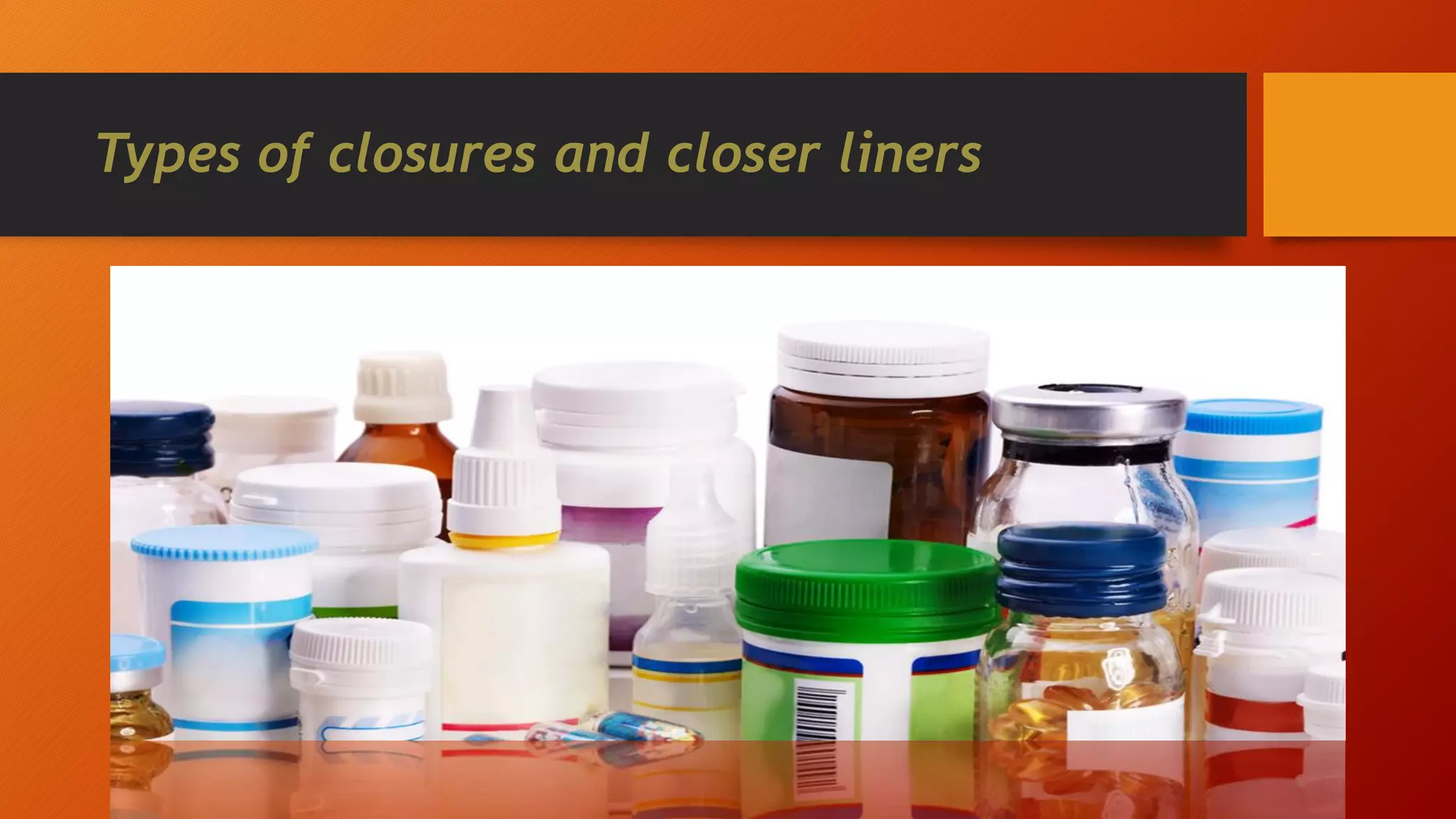
Types of closures and closer liners
•Different types of closures and closure
liners
•A closure is that part of a package which
prevents the contents from escaping And
allow no substance to enter the container
•There are 5 basic designs of closures:
1. Screw-on, threaded Or lug
2. Crimp on (crowns)
3. Press on (snap)
4. Roll-on
5. Friction
Many variations of these basic types
exist including vacuum, tamper proof,
safety, child resistant, and linerless
types and dispenser application.
1.Threaded screw cap
A screw cap is a metal cap that screws onto
threads on the neck of a bottle, generally
with a metal skirt down the neck to
resemble the traditional wine capsule
("foil"). A layer of plastic (often PVDC), cork,
rubber, or other soft material is used as wad
to make a seal with the mouth of the bottle.
2. Lug cap
• It is similar to screw cap in
principle.
• It is simply an interrupted thread on
the glass finish instead of
continuous thread.
• Uses : its is used for both
atmospheric pressure and vacuum
pressure closing. Widely used in
food industry
3. Crimp on (crowns)
• This type of cap is commonly used as a
crimped closures for beverages bottles
and remains unchanged for more than
50 year’s
• Crown caps are made up of metals
4. Press-on
• The cap is applied by the application
of pressure from the top.
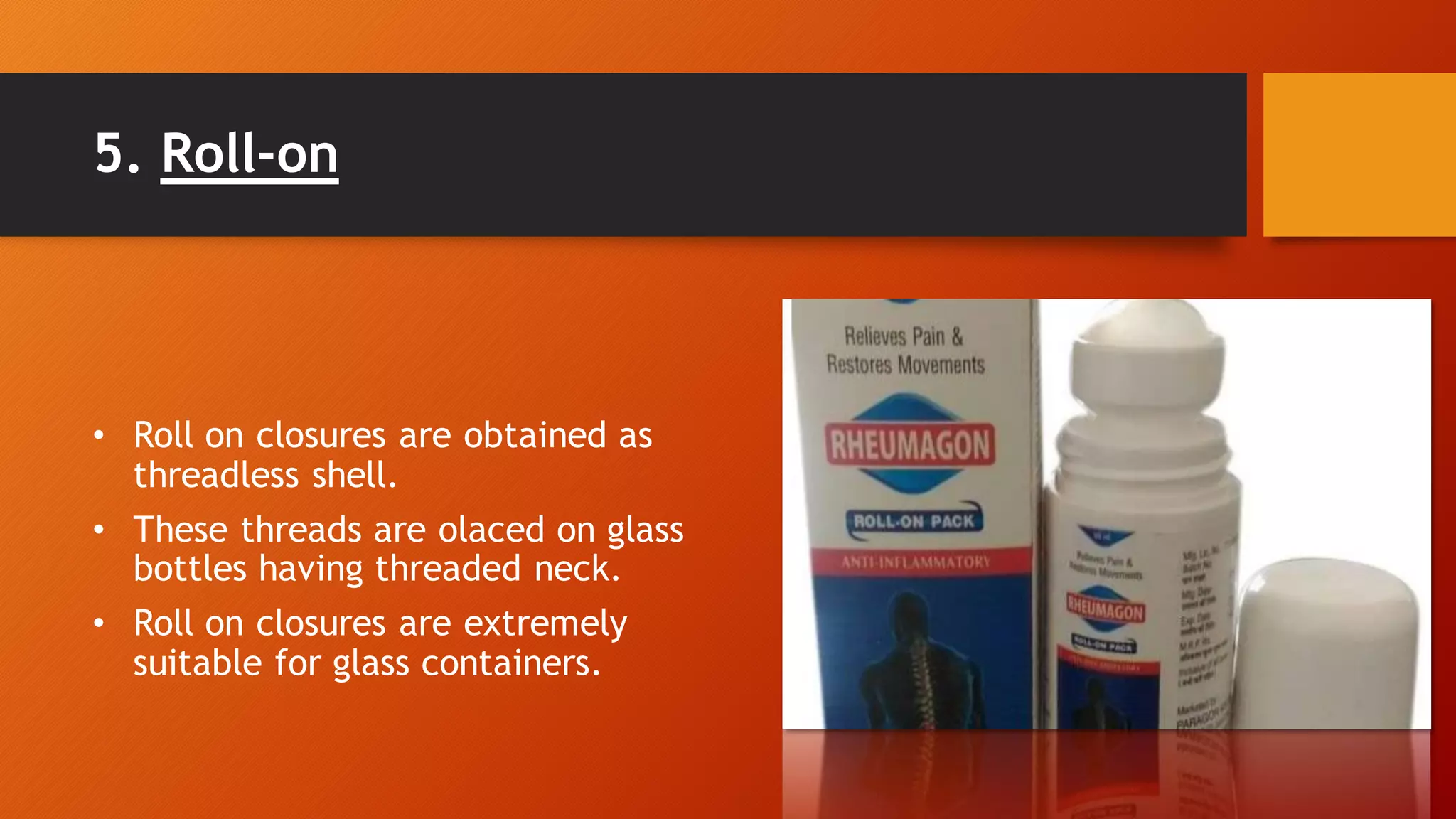
5. Roll-on
• Roll on closures are obtained as
threadless shell.
• These threads are olaced on glass
bottles having threaded neck.
• Roll on closures are extremely
suitable for glass containers.
6. Friction caps
Some containers have a loose lid for a
closure. Laboratory glassware often has
ground glass joints that allow the
pieces to be fitted together easily.
An Interference fit or friction fit
requires some force to close and open,
providing additional security. Paint cans
often have a friction fit plug.
Closure liners :
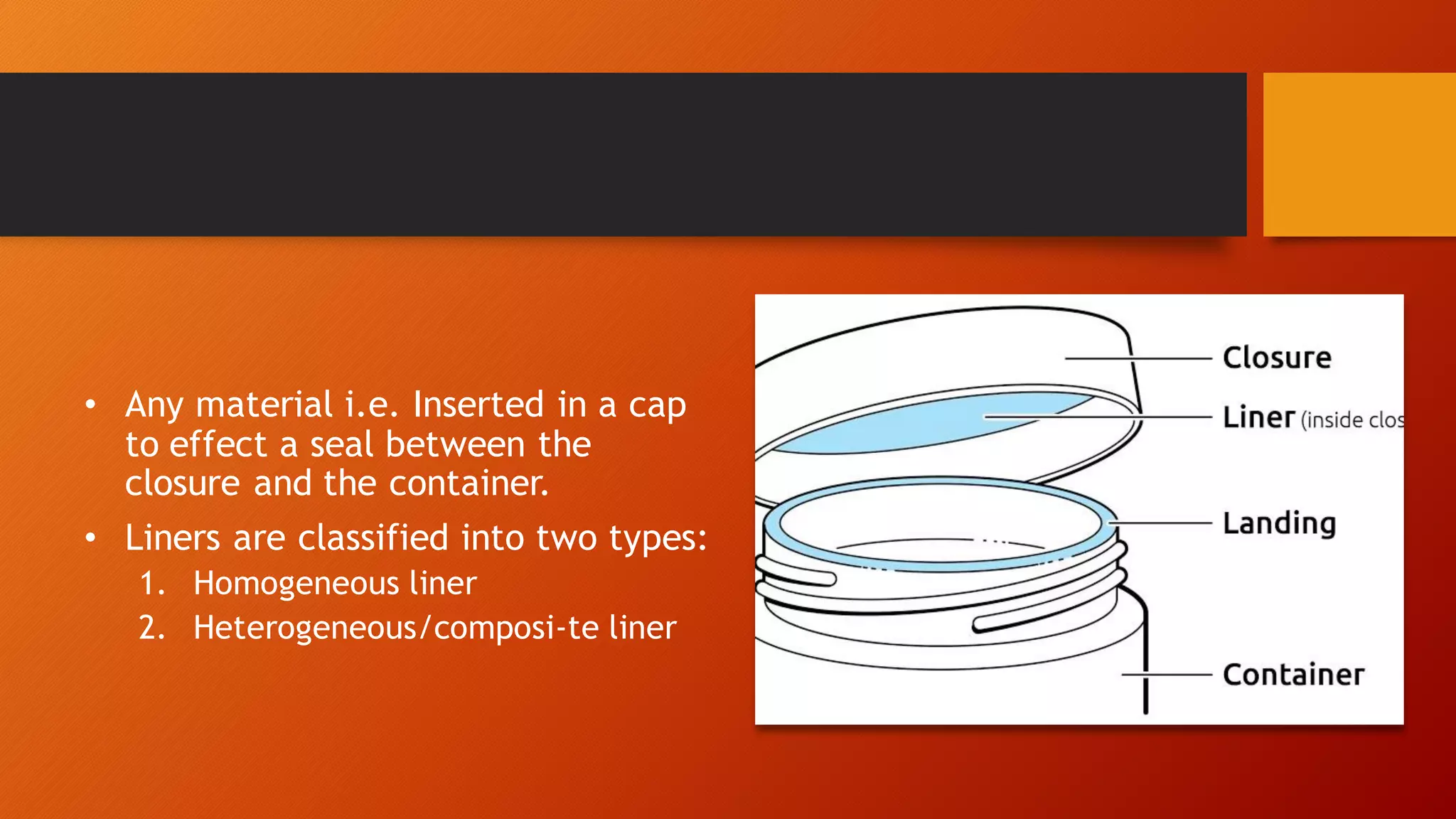
• Any material i.e. Inserted in a cap
to effect a seal between the
closure and the container.
• Liners are classified into two types:
1. Homogeneous liner
2. Heterogeneous/composi-te liner
• TAMPER RESISTANT PACKAGING
• Tamper-resistance is more self-explanatory, it is packaging that is
designed to resist access to the product contained within the package.
• Tamper-evident packaging helps contain the product and prevent the
accidental opening of a package, which in turn prevents wasted products
and lost revenue.
• In brief, a tamper-evident seal cannot be removed without leaving clear
visual evidence, whereas tamper resistant packaging may deter
tampering but does not necessarily leave indicate obvious signs of
tampering if such has taken place.
• Following packages are approved by FDA
as tamper resistant packaging systems:
1. Film wrappers
2. Blister packages
3. Strip packages
4. Bubble pack
5. Shrink seals
6. Foils, Paper or plastic pouches
7. Bottle seals
8. Tape seals
9. Breakable caps
10. Sealed tubes
11. Aerosol containers
12. Sealed cartons.
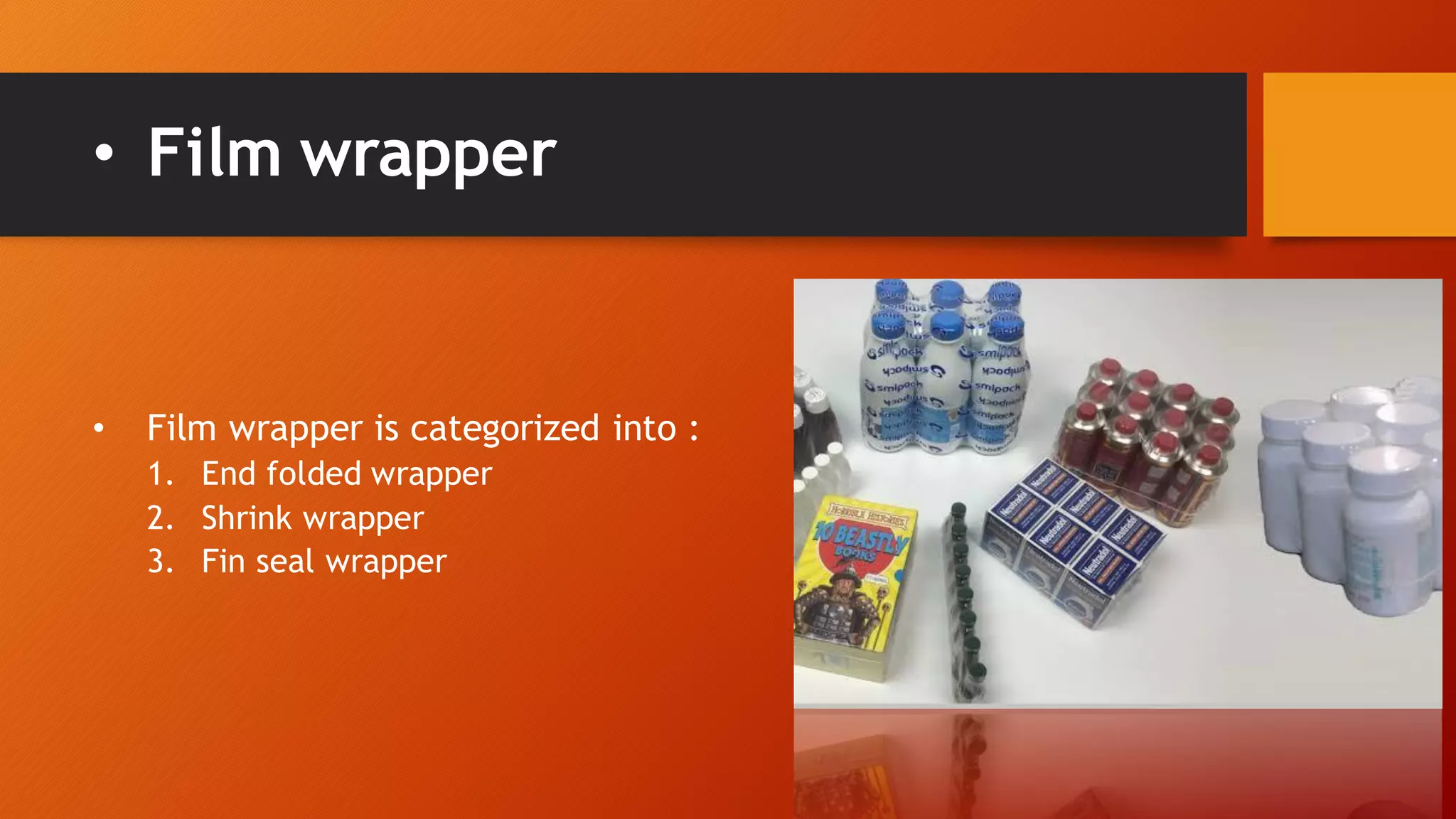
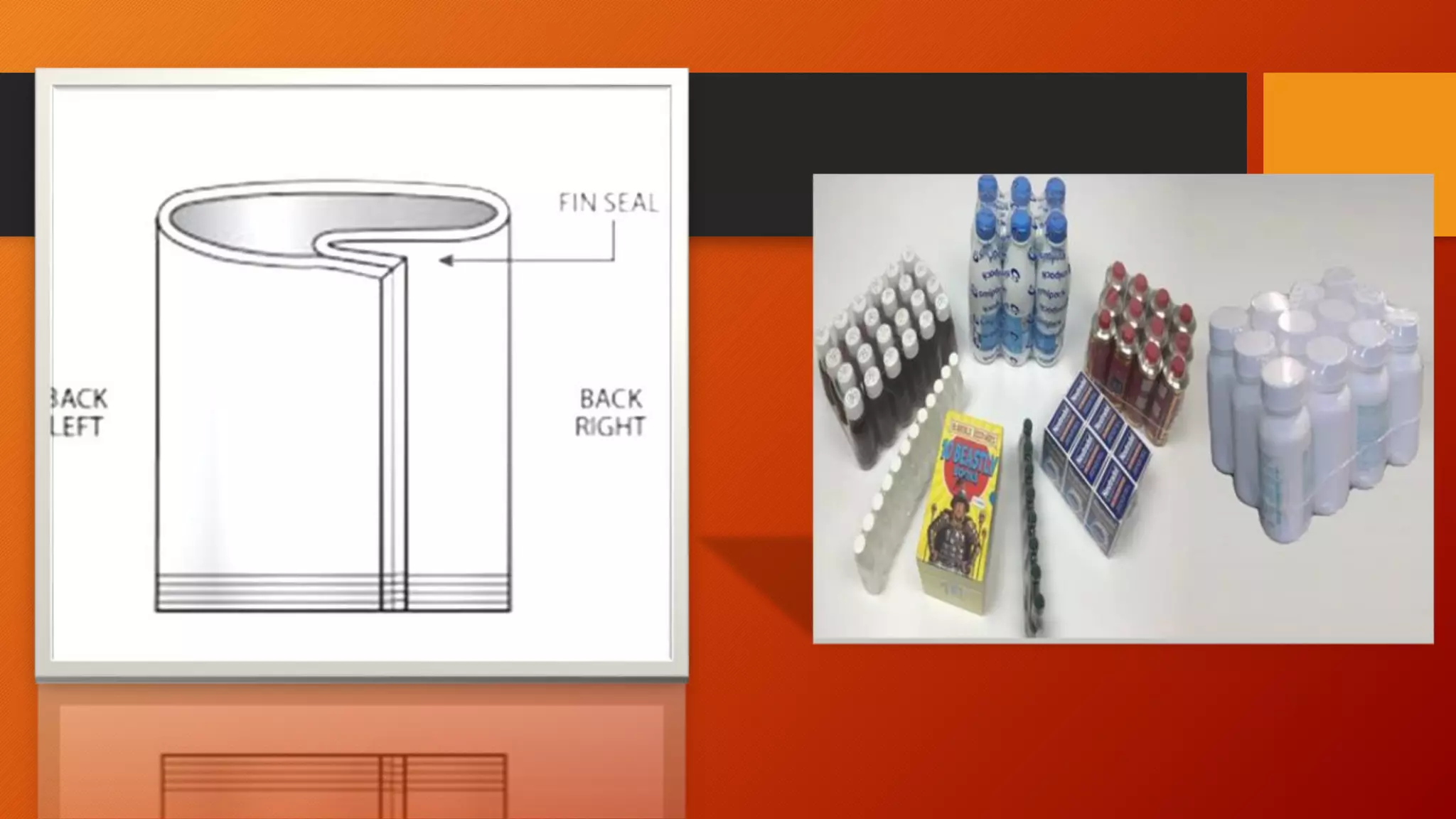
• Film wrapper
• Film wrapper is categorized into :
1. End folded wrapper
2. Shrink wrapper
3. Fin seal wrapper
• Blister packs :
• The primary component of a blister pack is a cavity
or pocket made from a formable web, usually a
thermoformed plastic. This usually has a backing of
paperboard or a lidding seal of aluminum foil or
plastic. A blister that folds onto itself is often
called a clamshell.
• Blister packs are useful for protecting products
against external factors, such as humidity and
contamination for extended periods of time.
Opaque blisters also protect light-sensitive
products against UV rays.
• Bubble packs
• The bubble pack can be made In saveral ways but it is usually
formed by sandwiching the product between a thermoplastic film
and a rigid backing material similar to as an blister.
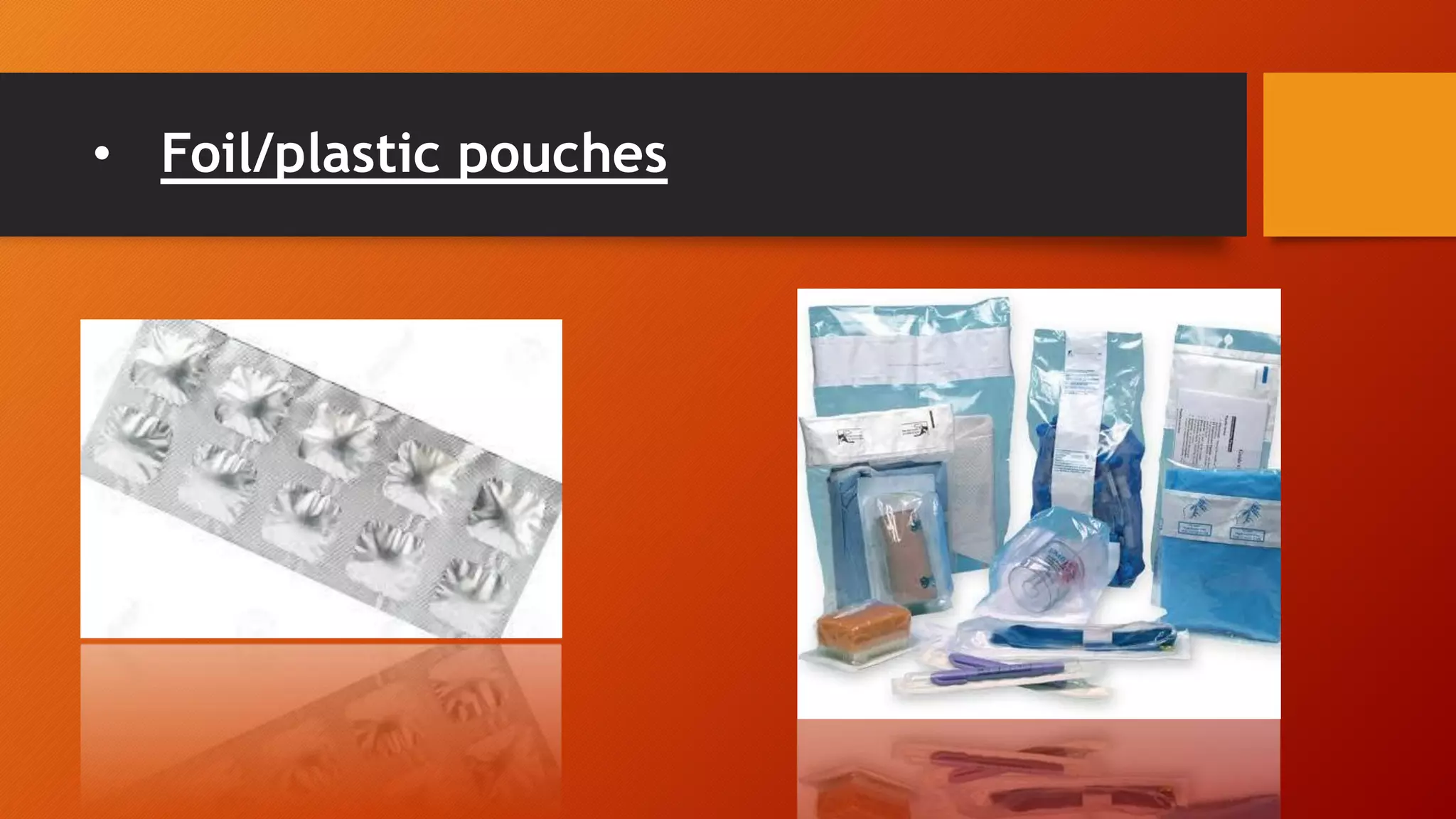
• Foil/plastic pouches
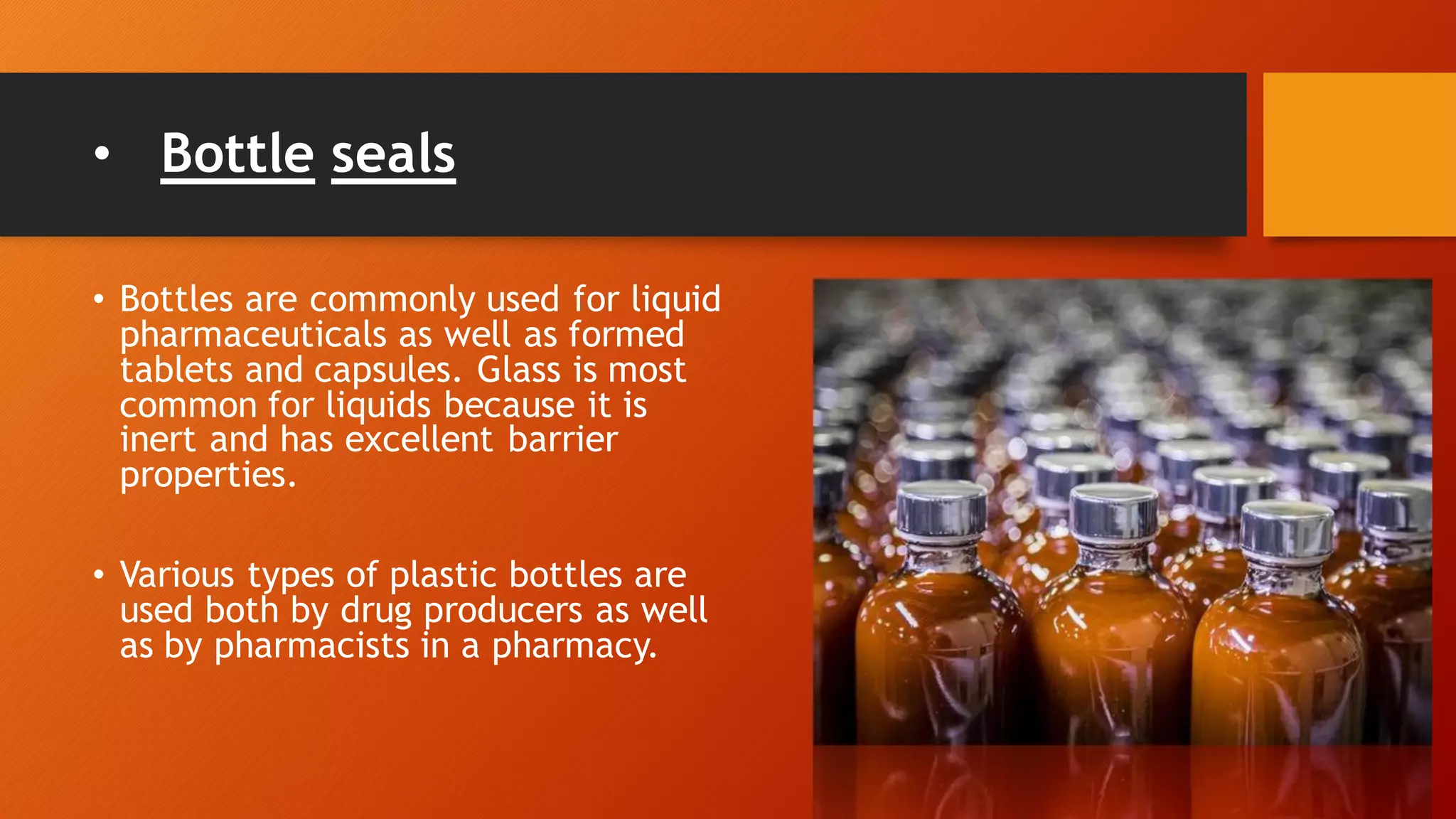
• Bottle seals
• Bottles are commonly used for liquid
pharmaceuticals as well as formed
tablets and capsules. Glass is most
common for liquids because it is
inert and has excellent barrier
properties.
• Various types of plastic bottles are
used both by drug producers as well
as by pharmacists in a pharmacy.
• Tape seals
• It involves application of glued or pressure sensitive tapes or label
around or over the cover of the package which is to be destroyed
to obtain the product
• The paper used must often Is ahigh density light weight paper with
poor test strength.
SYMBOLS USED ON PACKAGING
Plastic : Pharmaceutical Packaging Material

Plastic : Pharmaceutical Packaging Material

  • 1.
    Plastic : Pharmaceutical PackagingMaterial • Presenter: Miss. Vaishnavi S. Pakhare •M. Pharmacy (PQA) •Sem. : 2nd •Rollno. 03 •Date : 10th june 2021 •Guide : Mrs. Archana Dhole (Assistant Professor) • Rajarambapu College Of Pharmacy kasegaon, sangli.
  • 2.
    Packaging is anintegral part of pharmaceutical product.
  • 3.
    • Types ofplastics used : • Plastic packaging system can broadly be divided into two categories: thermoplastics (thermosoftening plastics) and thermosets (thermosetting plastics). a. Thermoplastics (Thermosoftening plastics) • These are heat softening materials which are usually rigid at operating temperatures but can be remelted and remoulded when exposed to high temperature and pressure. When frozen, however, thermoplastics become glass-like and subject to fracture. Examples of thermoplastics include but are not limited to the five most economical plastics – polyvinylchloride, polystyrene, polypropylenes, polyethylenes, and polyester. Others include nylon, polyvinylidene chloride, polycarbonate etc.
  • 4.
    b. Thermosets (Thermosettingplastics) They are called thermosets because they get distinctly infusible or insoluble when exposed to high temperature/ heat, and thus cannot be remelted and remoulded after their initial heat forming. Further heating leads to the decomposition of the plastic. Thermosets usually contain additional additives (fillers and reinforcing agents) to obtain best quality. These materials are used as packaging material when good dimensional and heat stability are required. Examples of thermoset resins include phenol formaldehyde (originally known as bakelite), urea formaldehyde, melamine formaldehyde, epoxy resins (expoxies), and certain polyesters and polyurethanes.
  • 6.
    • Drug plasticinteractions • Drug (Product) -Plastic interactions have been divided into five separate categories: 1. permeation, 2. leaching, 3. sorption, 4. chemical reaction, and 5. alteration in the physical properties of plastics or products.
  • 7.
    1. PERMEATION • Transmissionof gases,vapours and liquids through PACKAGING MATERIAL. • Permeation of oxygen and water vapour may cause oxidation Or hydrolysis of sensitive drugs. • Increase in temperature and humidity will make the condition still worst.
  • 8.
    2. LEACHING • Migrationof Contents of the container to the drug product. • Problems will be with the coloring agents used in the plastic.
  • 9.
    3. Sorption • Removalof constituents of the drug products by Packing material. • This may cause serious problems like loss of potency of the drug. • A common problem is loss of preservatives. • Factors influencing : • chemical structure • pH • solvent system • Temperature • Length and area of contact.
  • 10.
    4. Chemical reaction •Some ingredients of plastic container may chemically react with the drug product or vice versa. • Even micro-quantities of chemically incompatible substances can alter the appearance of the plastic or the drug product
  • 11.
    • Biological test •The USP has provided its procedures for evaluating the toxicity of plastic materials Essentially the tests consist of three phases: 1. Implantation test: Implanting small pieces of plastic material intramuscularly in rabbits. 2. Systemic injection test: Injecting eluates using sodium chloride injection, with and without alcohol intravenously in mice and injecting eluates using poly ethylene glycol 400 and sesame oil intraperitoneally in mice. 3. Intracutaneous test: Injecting all four eluates subcutaneously in rabbits. The reaction from test samples must not be significantly greater than nonreactive control samples.
  • 12.
    Types of closuresand closer liners
  • 13.
    •Different types ofclosures and closure liners •A closure is that part of a package which prevents the contents from escaping And allow no substance to enter the container •There are 5 basic designs of closures: 1. Screw-on, threaded Or lug 2. Crimp on (crowns) 3. Press on (snap)
  • 14.
    4. Roll-on 5. Friction Manyvariations of these basic types exist including vacuum, tamper proof, safety, child resistant, and linerless types and dispenser application.
  • 15.
    1.Threaded screw cap Ascrew cap is a metal cap that screws onto threads on the neck of a bottle, generally with a metal skirt down the neck to resemble the traditional wine capsule ("foil"). A layer of plastic (often PVDC), cork, rubber, or other soft material is used as wad to make a seal with the mouth of the bottle.
  • 16.
    2. Lug cap •It is similar to screw cap in principle. • It is simply an interrupted thread on the glass finish instead of continuous thread. • Uses : its is used for both atmospheric pressure and vacuum pressure closing. Widely used in food industry
  • 17.
    3. Crimp on(crowns) • This type of cap is commonly used as a crimped closures for beverages bottles and remains unchanged for more than 50 year’s • Crown caps are made up of metals
  • 18.
    4. Press-on • Thecap is applied by the application of pressure from the top.
  • 19.
    5. Roll-on • Rollon closures are obtained as threadless shell. • These threads are olaced on glass bottles having threaded neck. • Roll on closures are extremely suitable for glass containers.
  • 20.
    6. Friction caps Somecontainers have a loose lid for a closure. Laboratory glassware often has ground glass joints that allow the pieces to be fitted together easily. An Interference fit or friction fit requires some force to close and open, providing additional security. Paint cans often have a friction fit plug.
  • 21.
  • 22.
    • Any materiali.e. Inserted in a cap to effect a seal between the closure and the container. • Liners are classified into two types: 1. Homogeneous liner 2. Heterogeneous/composi-te liner
  • 24.
    • TAMPER RESISTANTPACKAGING • Tamper-resistance is more self-explanatory, it is packaging that is designed to resist access to the product contained within the package. • Tamper-evident packaging helps contain the product and prevent the accidental opening of a package, which in turn prevents wasted products and lost revenue. • In brief, a tamper-evident seal cannot be removed without leaving clear visual evidence, whereas tamper resistant packaging may deter tampering but does not necessarily leave indicate obvious signs of tampering if such has taken place.
  • 25.
    • Following packagesare approved by FDA as tamper resistant packaging systems: 1. Film wrappers 2. Blister packages 3. Strip packages 4. Bubble pack 5. Shrink seals 6. Foils, Paper or plastic pouches 7. Bottle seals 8. Tape seals 9. Breakable caps 10. Sealed tubes 11. Aerosol containers 12. Sealed cartons.
  • 26.
    • Film wrapper •Film wrapper is categorized into : 1. End folded wrapper 2. Shrink wrapper 3. Fin seal wrapper
  • 31.
    • Blister packs: • The primary component of a blister pack is a cavity or pocket made from a formable web, usually a thermoformed plastic. This usually has a backing of paperboard or a lidding seal of aluminum foil or plastic. A blister that folds onto itself is often called a clamshell. • Blister packs are useful for protecting products against external factors, such as humidity and contamination for extended periods of time. Opaque blisters also protect light-sensitive products against UV rays.
  • 32.
    • Bubble packs •The bubble pack can be made In saveral ways but it is usually formed by sandwiching the product between a thermoplastic film and a rigid backing material similar to as an blister.
  • 33.
  • 34.
    • Bottle seals •Bottles are commonly used for liquid pharmaceuticals as well as formed tablets and capsules. Glass is most common for liquids because it is inert and has excellent barrier properties. • Various types of plastic bottles are used both by drug producers as well as by pharmacists in a pharmacy.
  • 35.
    • Tape seals •It involves application of glued or pressure sensitive tapes or label around or over the cover of the package which is to be destroyed to obtain the product • The paper used must often Is ahigh density light weight paper with poor test strength.
  • 41.
    SYMBOLS USED ONPACKAGING