UNIT II
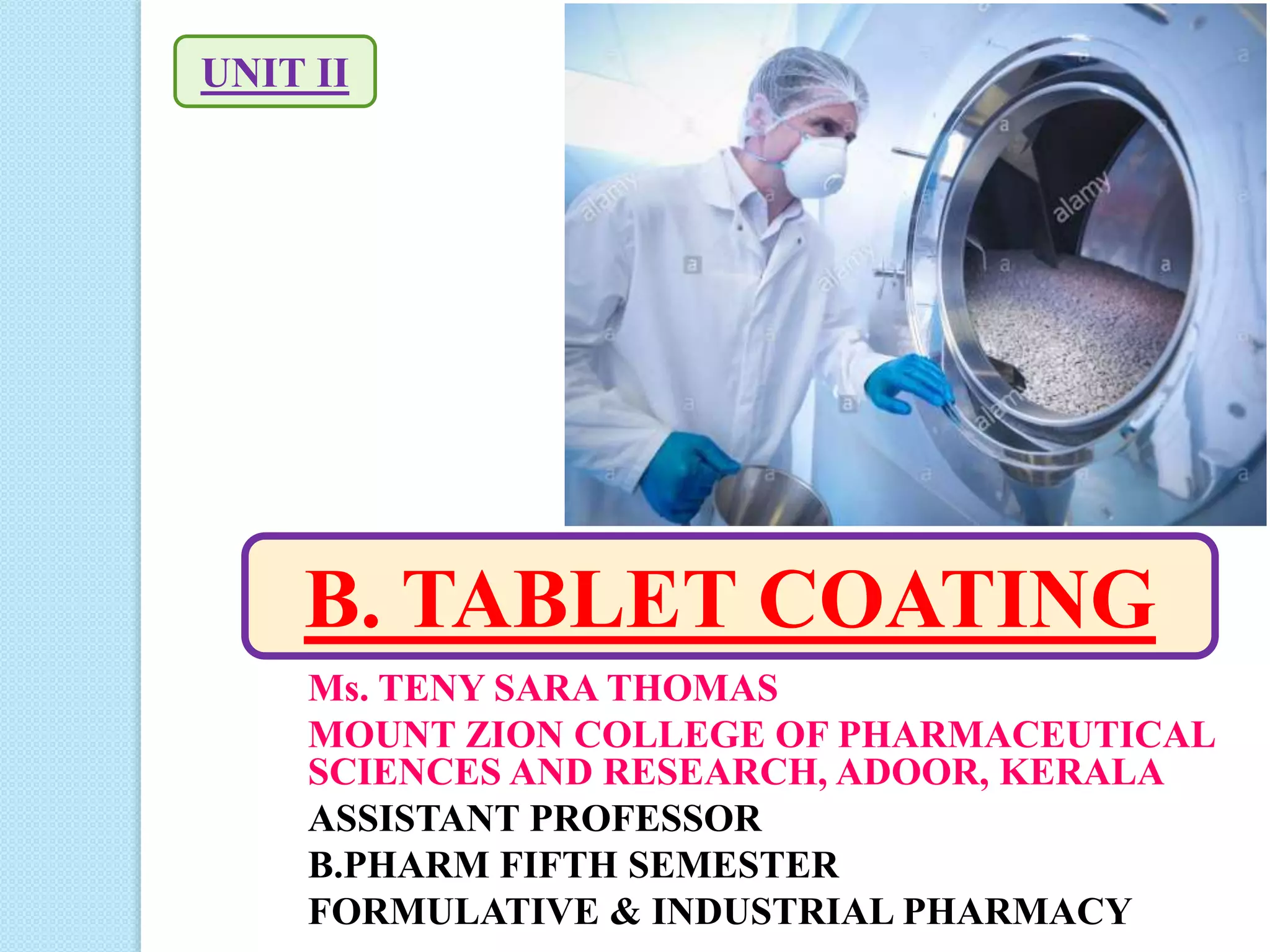
B. TABLET COATING
Ms. TENY SARA THOMAS
MOUNT ZION COLLEGE OF PHARMACEUTICAL
SCIENCES AND RESEARCH, ADOOR, KERALA
ASSISTANT PROFESSOR
B.PHARM FIFTH SEMESTER
FORMULATIVE & INDUSTRIAL PHARMACY
CONTENTS
 Introduction
 Types of Tablet Coating
 Coating Materials
 Coating Composition
 Coating Equipments
 Coating Defects
INTRODUCTION
Tablet Coating :- is the last critical step in the
Tablet Production Cycle. Tablet coating is the
process in which the tablet surfaces become
covered with a tacky polymeric film to achieve
specific benefits. The successful application of
coating to tablet provides the visual
characteristics for the product, thus the
quality of the product may be judged on this
final production step.
Need of Tablet Coating
This additional step of tablet coating in the tablet
manufacturing process, increases the cost of the product.
Therefore, the decision to coat a tablet can be based on the
following reasons :-
Mask unpleasant taste, odour, or colour of a drug.
Provide physical and chemical protection for the drug.
Improve pharmaceutical elegance by use of special
colours and contrasting printing.
Control the release of the drug from the tablet.
Protect the drug from gastric environment of the stomach
with an acid resistant enteric coating.
Incorporate another drug in the coating to avoid chemical
incompatibilities or to provide sequential drug release.
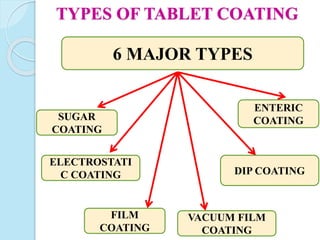
TYPES OF TABLET COATING
6 MAJOR TYPES
SUGAR
COATING
FILM
COATING
ENTERIC
COATING
VACUUM FILM
COATING
ELECTROSTATI
C COATING DIP COATING
SUGAR COATING
Sugar coating :- is the process of depositing
layer that an be either coloured or uncoloured to the
tablets. This process is a step wise process. The
operator determines :-
the quantity of the coating solution to add,
the method and the rate of pouring of coating
solution,
when to apply the dry air and
how long or how fast the tablets should be tumbled
in the coating pan.
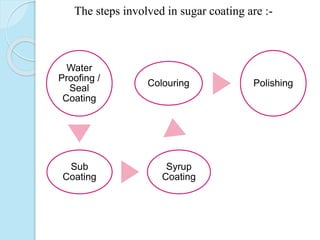
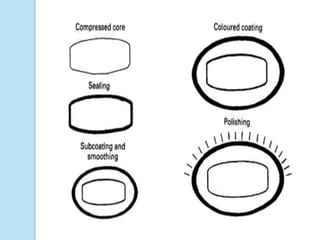
The steps involved in sugar coating are :-
Water
Proofing /
Seal
Coating
Sub
Coating
Syrup
Coating
Colouring Polishing
1. WATER PROOFING / SEAL COATING
Seal Coating :- done to provide moisture
barrier to the core tablet and harden the tablet
surface.
Helps to maintain physical and chemical
stability of the finished product.
Materials used in Seal coating :- Shellac ,
Zein
Shellac :- effective sealant but it may slow
down the disintegration & dissolution time
which affects the therapeutic release.
Zein :- an alcohol soluble protein derivative
from corn is another effective sealant.
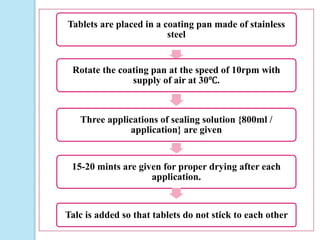
Tablets are placed in a coating pan made of stainless
steel
Rotate the coating pan at the speed of 10rpm with
supply of air at 30℃.
Three applications of sealing solution {800ml /
application} are given
15-20 mints are given for proper drying after each
application.
Talc is added so that tablets do not stick to each other
2. SUB COATING
Sub Coating :- applied to round the edges and
build up the tablet size. Two methods are used for
this sub coating.
Applying a sticky binder solution to the tablets
followed by dusting of sub coating powder and
then drying. This is repeated until the desired size
is achieved. Sub coating powders include :-
calcium carbonate, powdered sucrose,
powdered dry gum acacia.
Another method, is the spraying process, where
a sub coating powder suspension containing both
the binder and the insoluble powder is sprayed
intermittently on the tablet bed
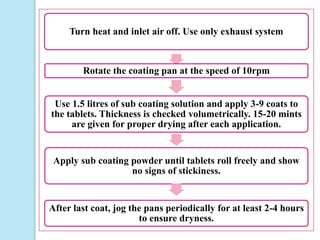
Turn heat and inlet air off. Use only exhaust system
Rotate the coating pan at the speed of 10rpm
Use 1.5 litres of sub coating solution and apply 3-9 coats to
the tablets. Thickness is checked volumetrically. 15-20 mints
are given for proper drying after each application.
Apply sub coating powder until tablets roll freely and show
no signs of stickiness.
After last coat, jog the pans periodically for at least 2-4 hours
to ensure dryness.
3. SYRUP COATING or SMOOTH COATING
Syrup coating or Smooth Coating :- done to
cover and fill the imperfections in the tablet
surface caused by the sub coating step, so as to
increase the tablet dimension to a predetermined
level.
Several coats of simple syrup solution (60-
70%) are applied.
Syrup solution contains pigments, starch, gelatin,
or acacia.
Syrup solutions are also called grossing syrups.
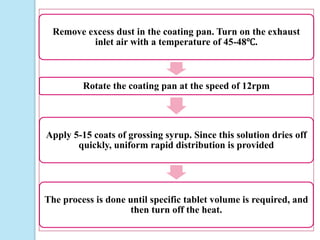
Remove excess dust in the coating pan. Turn on the exhaust
inlet air with a temperature of 45-48℃.
Rotate the coating pan at the speed of 12rpm
Apply 5-15 coats of grossing syrup. Since this solution dries off
quickly, uniform rapid distribution is provided
The process is done until specific tablet volume is required, and
then turn off the heat.
4. COLOURING
Colouring :- gives colour an finished size of the
tablet.
A thin sucrose solution containing the requisite
colouring materials is used for the process.
Water soluble dyes or water insoluble pigments
can be used.
Water insoluble dyes are preferred over water
soluble dyes as water soluble dyes may cause
mottling.
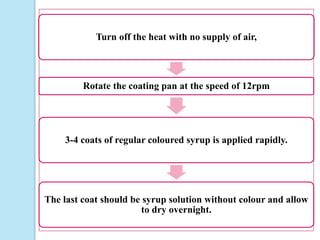
Turn off the heat with no supply of air,
Rotate the coating pan at the speed of 12rpm
3-4 coats of regular coloured syrup is applied rapidly.
The last coat should be syrup solution without colour and allow
to dry overnight.
5. POLISHING
Polishing :- Tablets after colouring, they are
polished to give desired luster to the tablet.
Polished by carefully applying, powdered wax
{ beeswax or carnauba} or warm solutions of
these waxes in naphtha or suitable volatile
solvents.
Cleaned canvas lined coating pans are used. Air is supplied
with exhaust air.
Turn off heat and rotate coating pan at speed of 12rpm.
Apply 3 - 4 coats of warm polishing solution, approximately
300ml per application. Let the solvent evaporate between each
coats
FILM COATING
Film coating :- is the process of placing a thin,
skin tight coating of plastic like material or polymer
over the compressed tablet. Film coating solutions can
be non – aqueous or aqueous. Volatility of the solvent
enables the film to adhere quickly to the surface of
tablets.
Ideal Characteristics of a Film Coating
Material
Adequate solubility in coating solvent and in the
GI fluid.
Stability in presence of heat, light, moisture, air,
etc.
Compatibility with addictives present, non –
toxic, inert, resistant to cracking, withstand
normal handling.
Compatibility to obtain a elegant product.
Ease of printing procedure on high speed
equipment.
Film Coating Materials
Film formers
Alloying substance
Solvent system
Plasticizer
Opaquant extenders
Colourants
Glossants
Anti – Oxidants
Flavours & Sweetners
Surfactants
Anti – Microbials
1. FILM FORMERS
oCapable of producing smooth thin film
reproducible under conventional coating
conditions and applicable to variety of tablet
shapes.
oPolymers are mainly used as film formers.
oE.g – cellulose acetate phthallate, hydroxy
propyl methyl cellulose, sodium carboxy
methyl cellulose.
2. ALLOYING SUBSTANCE
oProvides water solubility or permeability to the
film to ensure penetration by body fluids and
therapeutic availability of the drug.
oE.g – polyethylene glycol
3. SOLVENT SYSTEM
oIs mainly used for the dissolving of solvent and
to allow the spread of other components over the
tablets while allowing rapid evaporation to permit
speedy operation.
oE.g – ethanol, methanol, chlorinated
hydrocarbons, methylene chloride.
4. PLASTICIZER
oGives elasticity and flexibility to the coat
material that increases the durability. Plasticizers
act by breaking down the polymer – polymer bond
and reducing the films brittleness.
oE.g – castor oil, propylene glycol, polyethylene
glycol.
5. OPAQUANT EXTENDERS
oAdded to give more pastel colours and enhance
film coverage.
oE.g – titanium dioxide, talc, magnesium
carbonate.
6. COLOURANTS
oAdded to enhance visual appeal of the product
and identify the product.
oE.g – sunset yellow, tartrazine, erythrosine.
7. GLOSSANTS
oAdded to give luster to the tablet without
polishing.
oE.g – beeswax.
8. ANTI - OXIDANTS
oAdded to stabilize a dye system.
oE.g – oximes, phenols.
9. FLAVOURS & SWEETNERS
oAdded to mask unpleasant taste and odour.
oE.g – aspartame, water soluble pineapple
flavour.
10. SURFACTANTS
oAdded to solubilise insoluble ingredients in the
coating.
oE.g – spans and tweens.
11. ANTI - MICROBIALS
oAdded to prevent microbial growth in coating
composition.
oE.g – alkylisothiazolinone, carbamates.
ENTERIC COATING
Enteric coating :- is the process of coating done to
the tablet to protect from the acidity of stomach and
usually disintegrate the tablet in the intestine.
Reasons of Enteric Coating :-
Protect acid labile drugs from GI fluid.
Prevent gastric distress or nausea due to irritation
from a drug.
Deliver drugs intended for local action in the
intestines.
Deliver drugs that are optimised to absorb in the
small intestine.
Provide delayed release
Ideal Characteristics of a Enteric Coating
Material
Resistant to gastric fluids
Ready susceptibility or permeability to intestinal
fluids.
Compatibility with coating solutions.
Formation of continuous film
Non toxicity, low cost, ease of application
Enteric coating materials :- cellulose acid phtahllate,
shellac and its derivatives
ELECTROSTATIC COATING
Electrostatic coating :- used to apply coat
conductive substances.
Coating material contains conductive ionic species
of opposite charge is sprayed on to the charged
substrate.
DIP COATING
Dip coating :- coating is applied to the tablet cores
by dipping them into the coating solution.
Wet tablets are dried in an conventional manner in
coating pans
VACUUM FILM COATING
Vacuum Film Coating :- is a coating procedure that
employs a specially designed baffled pans.
Pan is water jacketed.
Sealed to achieve a vacuum system.
Tablets are placed in the sealed pan.
Coating solution is then applied to tablets with an
airless spray system.
The coating materials is a physical deposition
of the material on the tablet substrate, or they form a
continuous film with a wide variety of properties
depending on the composition of the coating
formulations.
Examples of physical deposition of the coating
materials are the techniques of sugar, shellac, wax or
polymer coatings
TABLET COATING MATERIALS
Coating Materials
1. Hydroxypropyl methylcellulose USP {HPMC}
2. Methyl hydroxyethylcellulose {MHEC}
3. Hydroxypropylcellulose {HPC}
4. Ethylcellulose {EC}
5. Sodium carboxymethylcellulose {Na CMC}
6. Povidone USP
7. Polyethylene glycol {PEG}
8. Acrylate polymers
9. Polyvinyl acetate phthalate {PVAP}
10. Cellulose acetate phthalate {CAP}
11. HPMC Phthalate
1. HYDROXYPROPYL
METHYLCELLULOSE USP
oPrepared by reacting alkali treated cellulose with
methyl chloride to introduce methoxy groups and
then react with propylene glycol ether groups
oAvailable in different viscosity grades
oSoluble in GI fluid and other solvents.
oCauses no change in disintegration and
bioavailability.
oStable in presence of heat, light, moisture or air
oEasily able to incorporate or other addictives.
2. METHYL HYDROXYETHYLCELLULOSE
oPrepared by reacting alkali treated cellulose with
methyl chloride to introduce methoxy groups and
then react with ethylene oxide.
oAvailable in different grades
oStructural similarity of MHEC with that of
HPMC, shows that MHEC shares the same
properties of HPMC.
3. HYDROXY PROPYLCELLULOSE
oPrepared by reacting cellulose with sodium
hydroxide and then react with propylene oxide at
an elevated temperature and pressure.
oYield flexible films
oSoluble in water below 40℃, GI fluid, polar
organic solvents.
oUsually used in combination with other polymers
4. ETHYLCELLULOSE
oPrepared by reacting ethyl chloride or ethyl
sulfate with cellulose dissolved in sodium
hydroxide.
oAvailable in different viscosity grades
oInsoluble in water below 40℃ & GI fluid. Hence,
used in combination with a water soluble
addictives.
oUnplasticized EC films are brittle and require
film modifiers to obtain an acceptable film.
5. SODIUM CARBOXY
METHYLCELLULOSE
oSodium salt of carboxymethylcellulose
oPrepared by reacting soda cellulose with sodium
salt of monochloroacetic acid.
oAvailable in different viscosity grades
oInsoluble in organic solvents but soluble in water
to form colloidal solutions.
oFilms are brittle but adhere well to the tablets.
6. POVIDONE USP
oSynthetic polymer consisting of linear 1-vinyl 2-
pyrrolidinone groups.
oAvailable in 4 different viscosity grades
identified with a “K” value – povidone K 15, K30,
K60, and K90
oK30 is the most used povidone grade in tablet
coating.
7. POLYETHYLENE GLYCOLS
oManufactured by the reaction of ethylene glycol
with ethylene oxide in presence of sodium
hydroxide at an elevated temperature and
pressure.
oPEG of lower molecular weight are liquid at
room temperature and used as plasticizer.
oPEG of higher molecular weight are white, waxy
solids at room temperature and used as a coating
material.
8. ACRYLATE POLYMERS
oAre set of polymers commercially under the
trademark EUDRAGIT.
oEudragit are available in different forms.
oEUDRAGIT E :- cationic polymer, which is the
only form of eudragit which is soluble in GI fluid.
oEUDRAGIT RL & RS :- copolymers available
only as organic solutions and solid materials.
These are mainly used as coating material in
delayed release tablets.
oEUDRAGIT L & S :- polymers that are mainly
used in coating of enteric coated tablets. They are
soluble only in pH 6 & pH 7 respectively.
9. CELLULOSE ACETATE PHTHALATE
oWidely used as enteric coating material.
oDissolves only in pH > 6
oHygroscopic, relatively permeable to water and
GI fluids
oProduces brittle films, hence, combined with
hydrophobic film forming materials to achieve a
better enteric film.
10. POLYVINYL ACETATE PHTHALATE
oManufactured by esterification of partially
hydrolysed polyvinyl acetate with phthallic
anhydride.
oMainly used in coating of enteric tablets.
11. HPMC PHTHALATE
oDerived from HPMC by esterification with
phthalic anhydride.
oDissolve at a lower pH than CAP or Acrylate
polymers, hence can increase the bioavailability of
some drugs.
The basic or starting composition of a tablet coating is
obtained from the past experience or various sources of literature.
The composition of a tablet coating material includes :-
Coat or film formers
 Alloying substance
Solvent system
Plasticizer
Opaquant extenders
Colourants
Glossants
Anti – Oxidants
Flavours & Sweetners
Surfactants
Anti – Microbials
TABLET COATING COMPOSITION
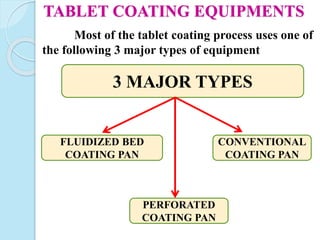
Most of the tablet coating process uses one of
the following 3 major types of equipment
TABLET COATING EQUIPMENTS
3 MAJOR TYPES
PERFORATED
COATING PAN
CONVENTIONAL
COATING PAN
FLUIDIZED BED
COATING PAN
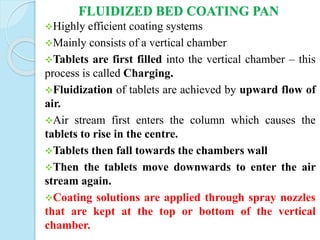
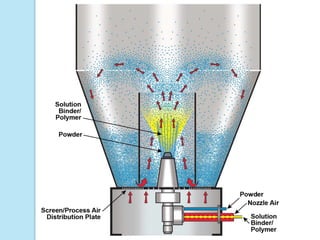
FLUIDIZED BED COATING PAN
Highly efficient coating systems
Mainly consists of a vertical chamber
Tablets are first filled into the vertical chamber – this
process is called Charging.
Fluidization of tablets are achieved by upward flow of
air.
Air stream first enters the column which causes the
tablets to rise in the centre.
Tablets then fall towards the chambers wall
Then the tablets move downwards to enter the air
stream again.
Coating solutions are applied through spray nozzles
that are kept at the top or bottom of the vertical
chamber.
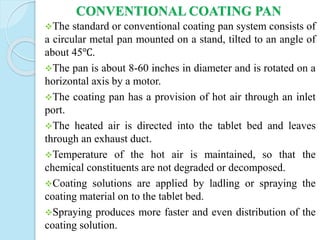
CONVENTIONAL COATING PAN
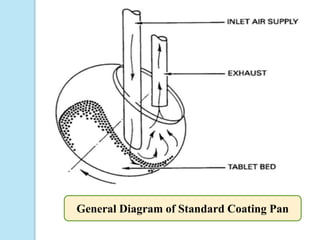
The standard or conventional coating pan system consists of
a circular metal pan mounted on a stand, tilted to an angle of
about 45℃.
The pan is about 8-60 inches in diameter and is rotated on a
horizontal axis by a motor.
The coating pan has a provision of hot air through an inlet
port.
The heated air is directed into the tablet bed and leaves
through an exhaust duct.
Temperature of the hot air is maintained, so that the
chemical constituents are not degraded or decomposed.
Coating solutions are applied by ladling or spraying the
coating material on to the tablet bed.
Spraying produces more faster and even distribution of the
coating solution.
General Diagram of Standard Coating Pan
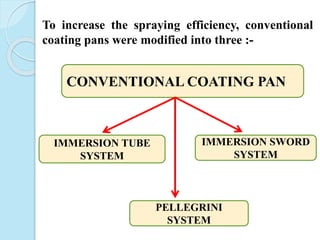
To increase the spraying efficiency, conventional
coating pans were modified into three :-
CONVENTIONAL COATING PAN
PELLEGRINI
SYSTEM
IMMERSION SWORD
SYSTEM
IMMERSION TUBE
SYSTEM
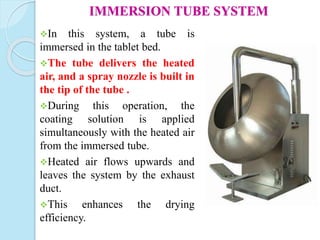
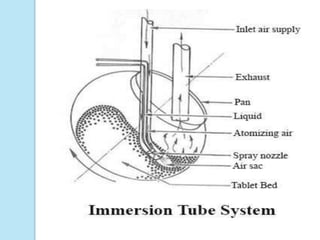
IMMERSION TUBE SYSTEM
In this system, a tube is
immersed in the tablet bed.
The tube delivers the heated
air, and a spray nozzle is built in
the tip of the tube .
During this operation, the
coating solution is applied
simultaneously with the heated air
from the immersed tube.
Heated air flows upwards and
leaves the system by the exhaust
duct.
This enhances the drying
efficiency.
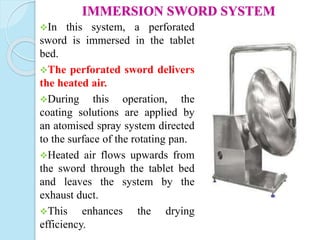
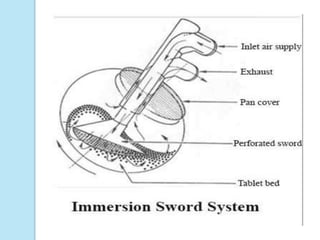
IMMERSION SWORD SYSTEM
In this system, a perforated
sword is immersed in the tablet
bed.
The perforated sword delivers
the heated air.
During this operation, the
coating solutions are applied by
an atomised spray system directed
to the surface of the rotating pan.
Heated air flows upwards from
the sword through the tablet bed
and leaves the system by the
exhaust duct.
This enhances the drying
efficiency.
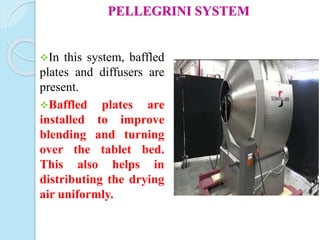
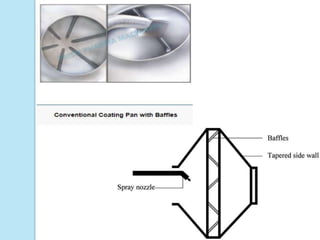
PELLEGRINI SYSTEM
In this system, baffled
plates and diffusers are
present.
Baffled plates are
installed to improve
blending and turning
over the tablet bed.
This also helps in
distributing the drying
air uniformly.
PERFORATED COATING PAN
In this system, all equipments of this type, consists of
perforated or partially perforated drum that is rotated
on its horizontal axis in an enclosed housing.
Drying air is applied to the tablet bed through
different ways in different types of perforated
coating pans.
In all the types of perforated coating pans, the
coating solutions are applied to the surface of the
rotating tablet bed through spraying nozzles that
are positioned inside the drum.
Perforated pan coaters are efficient drying systems
with high coating capacity, and can be completely
automated for both sugar coating and film coating
processes.
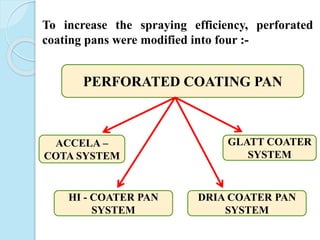
To increase the spraying efficiency, perforated
coating pans were modified into four :-
PERFORATED COATING PAN
DRIA COATER PAN
SYSTEM
GLATT COATER
SYSTEM
ACCELA –
COTA SYSTEM
HI - COATER PAN
SYSTEM
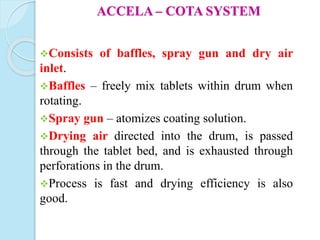
ACCELA – COTA SYSTEM
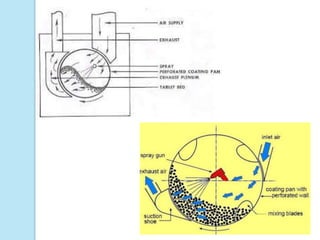
Consists of baffles, spray gun and dry air
inlet.
Baffles – freely mix tablets within drum when
rotating.
Spray gun – atomizes coating solution.
Drying air directed into the drum, is passed
through the tablet bed, and is exhausted through
perforations in the drum.
Process is fast and drying efficiency is also
good.
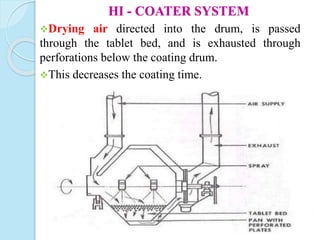
HI - COATER SYSTEM
Drying air directed into the drum, is passed
through the tablet bed, and is exhausted through
perforations below the coating drum.
This decreases the coating time.
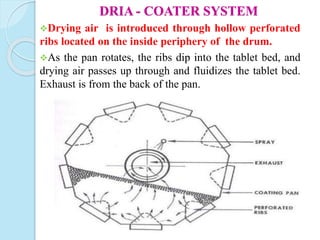
DRIA - COATER SYSTEM
Drying air is introduced through hollow perforated
ribs located on the inside periphery of the drum.
As the pan rotates, the ribs dip into the tablet bed, and
drying air passes up through and fluidizes the tablet bed.
Exhaust is from the back of the pan.
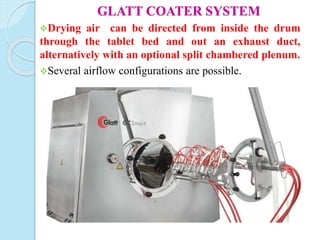
GLATT COATER SYSTEM
Drying air can be directed from inside the drum
through the tablet bed and out an exhaust duct,
alternatively with an optional split chambered plenum.
Several airflow configurations are possible.
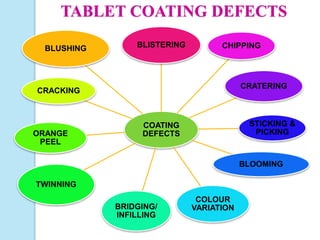
COATING
DEFECTS
BLISTERING CHIPPING
CRATERING
STICKING &
PICKING
BLOOMING
COLOUR
VARIATIONBRIDGING/
INFILLING
TWINNING
ORANGE
PEEL
CRACKING
BLUSHING
TABLET COATING DEFECTS
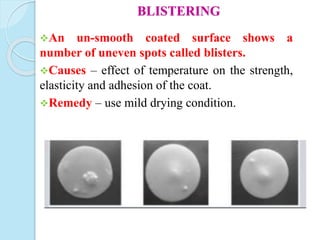
BLISTERING
An un-smooth coated surface shows a
number of uneven spots called blisters.
Causes – effect of temperature on the strength,
elasticity and adhesion of the coat.
Remedy – use mild drying condition.
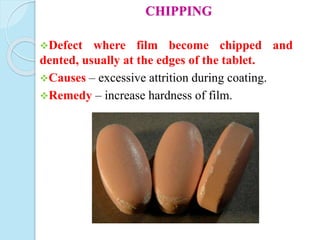
CHIPPING
Defect where film become chipped and
dented, usually at the edges of the tablet.
Causes – excessive attrition during coating.
Remedy – increase hardness of film.
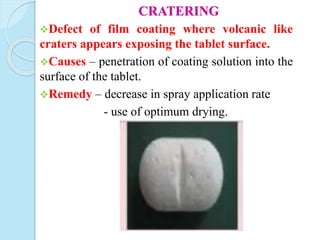
CRATERING
Defect of film coating where volcanic like
craters appears exposing the tablet surface.
Causes – penetration of coating solution into the
surface of the tablet.
Remedy – decrease in spray application rate
- use of optimum drying.
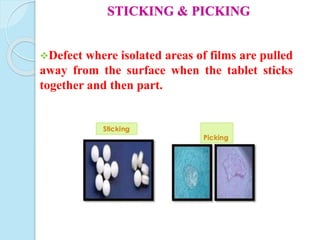
STICKING & PICKING
Defect where isolated areas of films are pulled
away from the surface when the tablet sticks
together and then part.
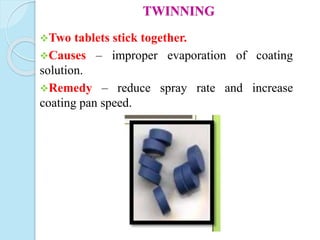
TWINNING
Two tablets stick together.
Causes – improper evaporation of coating
solution.
Remedy – reduce spray rate and increase
coating pan speed.
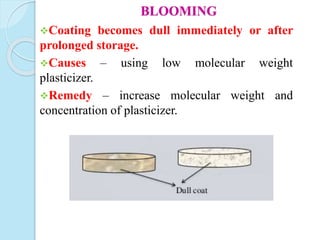
BLOOMING
Coating becomes dull immediately or after
prolonged storage.
Causes – using low molecular weight
plasticizer.
Remedy – increase molecular weight and
concentration of plasticizer.
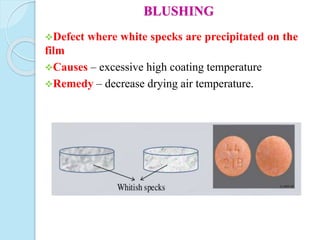
BLUSHING
Defect where white specks are precipitated on the
film
Causes – excessive high coating temperature
Remedy – decrease drying air temperature.
COLOUR VARIATION
Either individual tablet colour variation or
whole batch colour variation.
Causes – improper mixing, uneven spray attern,
insufficient coating, mottling of dyes, plasticizer
etc.
Remedy – use of lake dyes eliminates mottlin,
reformulation with different plasticizer and other
addictives.
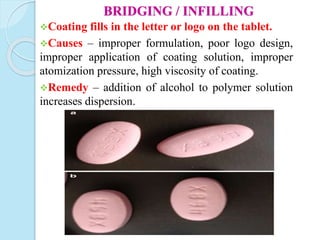
BRIDGING / INFILLING
Coating fills in the letter or logo on the tablet.
Causes – improper formulation, poor logo design,
improper application of coating solution, improper
atomization pressure, high viscosity of coating.
Remedy – addition of alcohol to polymer solution
increases dispersion.
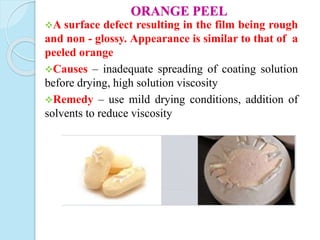
ORANGE PEEL
A surface defect resulting in the film being rough
and non - glossy. Appearance is similar to that of a
peeled orange
Causes – inadequate spreading of coating solution
before drying, high solution viscosity
Remedy – use mild drying conditions, addition of
solvents to reduce viscosity
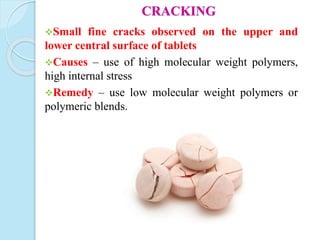
CRACKING
Small fine cracks observed on the upper and
lower central surface of tablets
Causes – use of high molecular weight polymers,
high internal stress
Remedy – use low molecular weight polymers or
polymeric blends.

TABLET COATING

  • 1.
    UNIT II B. TABLETCOATING Ms. TENY SARA THOMAS MOUNT ZION COLLEGE OF PHARMACEUTICAL SCIENCES AND RESEARCH, ADOOR, KERALA ASSISTANT PROFESSOR B.PHARM FIFTH SEMESTER FORMULATIVE & INDUSTRIAL PHARMACY
  • 2.
    CONTENTS  Introduction  Typesof Tablet Coating  Coating Materials  Coating Composition  Coating Equipments  Coating Defects
  • 3.
    INTRODUCTION Tablet Coating :-is the last critical step in the Tablet Production Cycle. Tablet coating is the process in which the tablet surfaces become covered with a tacky polymeric film to achieve specific benefits. The successful application of coating to tablet provides the visual characteristics for the product, thus the quality of the product may be judged on this final production step.
  • 4.
    Need of TabletCoating This additional step of tablet coating in the tablet manufacturing process, increases the cost of the product. Therefore, the decision to coat a tablet can be based on the following reasons :- Mask unpleasant taste, odour, or colour of a drug. Provide physical and chemical protection for the drug. Improve pharmaceutical elegance by use of special colours and contrasting printing. Control the release of the drug from the tablet. Protect the drug from gastric environment of the stomach with an acid resistant enteric coating. Incorporate another drug in the coating to avoid chemical incompatibilities or to provide sequential drug release.
  • 5.
    TYPES OF TABLETCOATING 6 MAJOR TYPES SUGAR COATING FILM COATING ENTERIC COATING VACUUM FILM COATING ELECTROSTATI C COATING DIP COATING
  • 6.
    SUGAR COATING Sugar coating:- is the process of depositing layer that an be either coloured or uncoloured to the tablets. This process is a step wise process. The operator determines :- the quantity of the coating solution to add, the method and the rate of pouring of coating solution, when to apply the dry air and how long or how fast the tablets should be tumbled in the coating pan.
  • 7.
    The steps involvedin sugar coating are :- Water Proofing / Seal Coating Sub Coating Syrup Coating Colouring Polishing
  • 8.
    1. WATER PROOFING/ SEAL COATING Seal Coating :- done to provide moisture barrier to the core tablet and harden the tablet surface. Helps to maintain physical and chemical stability of the finished product. Materials used in Seal coating :- Shellac , Zein Shellac :- effective sealant but it may slow down the disintegration & dissolution time which affects the therapeutic release. Zein :- an alcohol soluble protein derivative from corn is another effective sealant.
  • 9.
    Tablets are placedin a coating pan made of stainless steel Rotate the coating pan at the speed of 10rpm with supply of air at 30℃. Three applications of sealing solution {800ml / application} are given 15-20 mints are given for proper drying after each application. Talc is added so that tablets do not stick to each other
  • 10.
    2. SUB COATING SubCoating :- applied to round the edges and build up the tablet size. Two methods are used for this sub coating. Applying a sticky binder solution to the tablets followed by dusting of sub coating powder and then drying. This is repeated until the desired size is achieved. Sub coating powders include :- calcium carbonate, powdered sucrose, powdered dry gum acacia. Another method, is the spraying process, where a sub coating powder suspension containing both the binder and the insoluble powder is sprayed intermittently on the tablet bed
  • 11.
    Turn heat andinlet air off. Use only exhaust system Rotate the coating pan at the speed of 10rpm Use 1.5 litres of sub coating solution and apply 3-9 coats to the tablets. Thickness is checked volumetrically. 15-20 mints are given for proper drying after each application. Apply sub coating powder until tablets roll freely and show no signs of stickiness. After last coat, jog the pans periodically for at least 2-4 hours to ensure dryness.
  • 12.
    3. SYRUP COATINGor SMOOTH COATING Syrup coating or Smooth Coating :- done to cover and fill the imperfections in the tablet surface caused by the sub coating step, so as to increase the tablet dimension to a predetermined level. Several coats of simple syrup solution (60- 70%) are applied. Syrup solution contains pigments, starch, gelatin, or acacia. Syrup solutions are also called grossing syrups.
  • 13.
    Remove excess dustin the coating pan. Turn on the exhaust inlet air with a temperature of 45-48℃. Rotate the coating pan at the speed of 12rpm Apply 5-15 coats of grossing syrup. Since this solution dries off quickly, uniform rapid distribution is provided The process is done until specific tablet volume is required, and then turn off the heat.
  • 14.
    4. COLOURING Colouring :-gives colour an finished size of the tablet. A thin sucrose solution containing the requisite colouring materials is used for the process. Water soluble dyes or water insoluble pigments can be used. Water insoluble dyes are preferred over water soluble dyes as water soluble dyes may cause mottling.
  • 15.
    Turn off theheat with no supply of air, Rotate the coating pan at the speed of 12rpm 3-4 coats of regular coloured syrup is applied rapidly. The last coat should be syrup solution without colour and allow to dry overnight.
  • 16.
    5. POLISHING Polishing :-Tablets after colouring, they are polished to give desired luster to the tablet. Polished by carefully applying, powdered wax { beeswax or carnauba} or warm solutions of these waxes in naphtha or suitable volatile solvents.
  • 17.
    Cleaned canvas linedcoating pans are used. Air is supplied with exhaust air. Turn off heat and rotate coating pan at speed of 12rpm. Apply 3 - 4 coats of warm polishing solution, approximately 300ml per application. Let the solvent evaporate between each coats
  • 19.
    FILM COATING Film coating:- is the process of placing a thin, skin tight coating of plastic like material or polymer over the compressed tablet. Film coating solutions can be non – aqueous or aqueous. Volatility of the solvent enables the film to adhere quickly to the surface of tablets.
  • 20.
    Ideal Characteristics ofa Film Coating Material Adequate solubility in coating solvent and in the GI fluid. Stability in presence of heat, light, moisture, air, etc. Compatibility with addictives present, non – toxic, inert, resistant to cracking, withstand normal handling. Compatibility to obtain a elegant product. Ease of printing procedure on high speed equipment.
  • 21.
    Film Coating Materials Filmformers Alloying substance Solvent system Plasticizer Opaquant extenders Colourants Glossants Anti – Oxidants Flavours & Sweetners Surfactants Anti – Microbials
  • 22.
    1. FILM FORMERS oCapableof producing smooth thin film reproducible under conventional coating conditions and applicable to variety of tablet shapes. oPolymers are mainly used as film formers. oE.g – cellulose acetate phthallate, hydroxy propyl methyl cellulose, sodium carboxy methyl cellulose.
  • 23.
    2. ALLOYING SUBSTANCE oProvideswater solubility or permeability to the film to ensure penetration by body fluids and therapeutic availability of the drug. oE.g – polyethylene glycol
  • 24.
    3. SOLVENT SYSTEM oIsmainly used for the dissolving of solvent and to allow the spread of other components over the tablets while allowing rapid evaporation to permit speedy operation. oE.g – ethanol, methanol, chlorinated hydrocarbons, methylene chloride.
  • 25.
    4. PLASTICIZER oGives elasticityand flexibility to the coat material that increases the durability. Plasticizers act by breaking down the polymer – polymer bond and reducing the films brittleness. oE.g – castor oil, propylene glycol, polyethylene glycol.
  • 26.
    5. OPAQUANT EXTENDERS oAddedto give more pastel colours and enhance film coverage. oE.g – titanium dioxide, talc, magnesium carbonate. 6. COLOURANTS oAdded to enhance visual appeal of the product and identify the product. oE.g – sunset yellow, tartrazine, erythrosine.
  • 27.
    7. GLOSSANTS oAdded togive luster to the tablet without polishing. oE.g – beeswax. 8. ANTI - OXIDANTS oAdded to stabilize a dye system. oE.g – oximes, phenols.
  • 28.
    9. FLAVOURS &SWEETNERS oAdded to mask unpleasant taste and odour. oE.g – aspartame, water soluble pineapple flavour. 10. SURFACTANTS oAdded to solubilise insoluble ingredients in the coating. oE.g – spans and tweens. 11. ANTI - MICROBIALS oAdded to prevent microbial growth in coating composition. oE.g – alkylisothiazolinone, carbamates.
  • 29.
    ENTERIC COATING Enteric coating:- is the process of coating done to the tablet to protect from the acidity of stomach and usually disintegrate the tablet in the intestine. Reasons of Enteric Coating :- Protect acid labile drugs from GI fluid. Prevent gastric distress or nausea due to irritation from a drug. Deliver drugs intended for local action in the intestines. Deliver drugs that are optimised to absorb in the small intestine. Provide delayed release
  • 30.
    Ideal Characteristics ofa Enteric Coating Material Resistant to gastric fluids Ready susceptibility or permeability to intestinal fluids. Compatibility with coating solutions. Formation of continuous film Non toxicity, low cost, ease of application Enteric coating materials :- cellulose acid phtahllate, shellac and its derivatives
  • 31.
    ELECTROSTATIC COATING Electrostatic coating:- used to apply coat conductive substances. Coating material contains conductive ionic species of opposite charge is sprayed on to the charged substrate.
  • 32.
    DIP COATING Dip coating:- coating is applied to the tablet cores by dipping them into the coating solution. Wet tablets are dried in an conventional manner in coating pans
  • 33.
    VACUUM FILM COATING VacuumFilm Coating :- is a coating procedure that employs a specially designed baffled pans. Pan is water jacketed. Sealed to achieve a vacuum system. Tablets are placed in the sealed pan. Coating solution is then applied to tablets with an airless spray system.
  • 34.
    The coating materialsis a physical deposition of the material on the tablet substrate, or they form a continuous film with a wide variety of properties depending on the composition of the coating formulations. Examples of physical deposition of the coating materials are the techniques of sugar, shellac, wax or polymer coatings TABLET COATING MATERIALS
  • 35.
    Coating Materials 1. Hydroxypropylmethylcellulose USP {HPMC} 2. Methyl hydroxyethylcellulose {MHEC} 3. Hydroxypropylcellulose {HPC} 4. Ethylcellulose {EC} 5. Sodium carboxymethylcellulose {Na CMC} 6. Povidone USP 7. Polyethylene glycol {PEG} 8. Acrylate polymers 9. Polyvinyl acetate phthalate {PVAP} 10. Cellulose acetate phthalate {CAP} 11. HPMC Phthalate
  • 36.
    1. HYDROXYPROPYL METHYLCELLULOSE USP oPreparedby reacting alkali treated cellulose with methyl chloride to introduce methoxy groups and then react with propylene glycol ether groups oAvailable in different viscosity grades oSoluble in GI fluid and other solvents. oCauses no change in disintegration and bioavailability. oStable in presence of heat, light, moisture or air oEasily able to incorporate or other addictives.
  • 37.
    2. METHYL HYDROXYETHYLCELLULOSE oPreparedby reacting alkali treated cellulose with methyl chloride to introduce methoxy groups and then react with ethylene oxide. oAvailable in different grades oStructural similarity of MHEC with that of HPMC, shows that MHEC shares the same properties of HPMC.
  • 38.
    3. HYDROXY PROPYLCELLULOSE oPreparedby reacting cellulose with sodium hydroxide and then react with propylene oxide at an elevated temperature and pressure. oYield flexible films oSoluble in water below 40℃, GI fluid, polar organic solvents. oUsually used in combination with other polymers
  • 39.
    4. ETHYLCELLULOSE oPrepared byreacting ethyl chloride or ethyl sulfate with cellulose dissolved in sodium hydroxide. oAvailable in different viscosity grades oInsoluble in water below 40℃ & GI fluid. Hence, used in combination with a water soluble addictives. oUnplasticized EC films are brittle and require film modifiers to obtain an acceptable film.
  • 40.
    5. SODIUM CARBOXY METHYLCELLULOSE oSodiumsalt of carboxymethylcellulose oPrepared by reacting soda cellulose with sodium salt of monochloroacetic acid. oAvailable in different viscosity grades oInsoluble in organic solvents but soluble in water to form colloidal solutions. oFilms are brittle but adhere well to the tablets.
  • 41.
    6. POVIDONE USP oSyntheticpolymer consisting of linear 1-vinyl 2- pyrrolidinone groups. oAvailable in 4 different viscosity grades identified with a “K” value – povidone K 15, K30, K60, and K90 oK30 is the most used povidone grade in tablet coating.
  • 42.
    7. POLYETHYLENE GLYCOLS oManufacturedby the reaction of ethylene glycol with ethylene oxide in presence of sodium hydroxide at an elevated temperature and pressure. oPEG of lower molecular weight are liquid at room temperature and used as plasticizer. oPEG of higher molecular weight are white, waxy solids at room temperature and used as a coating material.
  • 43.
    8. ACRYLATE POLYMERS oAreset of polymers commercially under the trademark EUDRAGIT. oEudragit are available in different forms. oEUDRAGIT E :- cationic polymer, which is the only form of eudragit which is soluble in GI fluid. oEUDRAGIT RL & RS :- copolymers available only as organic solutions and solid materials. These are mainly used as coating material in delayed release tablets. oEUDRAGIT L & S :- polymers that are mainly used in coating of enteric coated tablets. They are soluble only in pH 6 & pH 7 respectively.
  • 44.
    9. CELLULOSE ACETATEPHTHALATE oWidely used as enteric coating material. oDissolves only in pH > 6 oHygroscopic, relatively permeable to water and GI fluids oProduces brittle films, hence, combined with hydrophobic film forming materials to achieve a better enteric film.
  • 45.
    10. POLYVINYL ACETATEPHTHALATE oManufactured by esterification of partially hydrolysed polyvinyl acetate with phthallic anhydride. oMainly used in coating of enteric tablets.
  • 46.
    11. HPMC PHTHALATE oDerivedfrom HPMC by esterification with phthalic anhydride. oDissolve at a lower pH than CAP or Acrylate polymers, hence can increase the bioavailability of some drugs.
  • 47.
    The basic orstarting composition of a tablet coating is obtained from the past experience or various sources of literature. The composition of a tablet coating material includes :- Coat or film formers  Alloying substance Solvent system Plasticizer Opaquant extenders Colourants Glossants Anti – Oxidants Flavours & Sweetners Surfactants Anti – Microbials TABLET COATING COMPOSITION
  • 48.
    Most of thetablet coating process uses one of the following 3 major types of equipment TABLET COATING EQUIPMENTS 3 MAJOR TYPES PERFORATED COATING PAN CONVENTIONAL COATING PAN FLUIDIZED BED COATING PAN
  • 49.
    FLUIDIZED BED COATINGPAN Highly efficient coating systems Mainly consists of a vertical chamber Tablets are first filled into the vertical chamber – this process is called Charging. Fluidization of tablets are achieved by upward flow of air. Air stream first enters the column which causes the tablets to rise in the centre. Tablets then fall towards the chambers wall Then the tablets move downwards to enter the air stream again. Coating solutions are applied through spray nozzles that are kept at the top or bottom of the vertical chamber.
  • 51.
    CONVENTIONAL COATING PAN Thestandard or conventional coating pan system consists of a circular metal pan mounted on a stand, tilted to an angle of about 45℃. The pan is about 8-60 inches in diameter and is rotated on a horizontal axis by a motor. The coating pan has a provision of hot air through an inlet port. The heated air is directed into the tablet bed and leaves through an exhaust duct. Temperature of the hot air is maintained, so that the chemical constituents are not degraded or decomposed. Coating solutions are applied by ladling or spraying the coating material on to the tablet bed. Spraying produces more faster and even distribution of the coating solution.
  • 52.
    General Diagram ofStandard Coating Pan
  • 53.
    To increase thespraying efficiency, conventional coating pans were modified into three :- CONVENTIONAL COATING PAN PELLEGRINI SYSTEM IMMERSION SWORD SYSTEM IMMERSION TUBE SYSTEM
  • 54.
    IMMERSION TUBE SYSTEM Inthis system, a tube is immersed in the tablet bed. The tube delivers the heated air, and a spray nozzle is built in the tip of the tube . During this operation, the coating solution is applied simultaneously with the heated air from the immersed tube. Heated air flows upwards and leaves the system by the exhaust duct. This enhances the drying efficiency.
  • 56.
    IMMERSION SWORD SYSTEM Inthis system, a perforated sword is immersed in the tablet bed. The perforated sword delivers the heated air. During this operation, the coating solutions are applied by an atomised spray system directed to the surface of the rotating pan. Heated air flows upwards from the sword through the tablet bed and leaves the system by the exhaust duct. This enhances the drying efficiency.
  • 58.
    PELLEGRINI SYSTEM In thissystem, baffled plates and diffusers are present. Baffled plates are installed to improve blending and turning over the tablet bed. This also helps in distributing the drying air uniformly.
  • 60.
    PERFORATED COATING PAN Inthis system, all equipments of this type, consists of perforated or partially perforated drum that is rotated on its horizontal axis in an enclosed housing. Drying air is applied to the tablet bed through different ways in different types of perforated coating pans. In all the types of perforated coating pans, the coating solutions are applied to the surface of the rotating tablet bed through spraying nozzles that are positioned inside the drum. Perforated pan coaters are efficient drying systems with high coating capacity, and can be completely automated for both sugar coating and film coating processes.
  • 61.
    To increase thespraying efficiency, perforated coating pans were modified into four :- PERFORATED COATING PAN DRIA COATER PAN SYSTEM GLATT COATER SYSTEM ACCELA – COTA SYSTEM HI - COATER PAN SYSTEM
  • 62.
    ACCELA – COTASYSTEM Consists of baffles, spray gun and dry air inlet. Baffles – freely mix tablets within drum when rotating. Spray gun – atomizes coating solution. Drying air directed into the drum, is passed through the tablet bed, and is exhausted through perforations in the drum. Process is fast and drying efficiency is also good.
  • 64.
    HI - COATERSYSTEM Drying air directed into the drum, is passed through the tablet bed, and is exhausted through perforations below the coating drum. This decreases the coating time.
  • 65.
    DRIA - COATERSYSTEM Drying air is introduced through hollow perforated ribs located on the inside periphery of the drum. As the pan rotates, the ribs dip into the tablet bed, and drying air passes up through and fluidizes the tablet bed. Exhaust is from the back of the pan.
  • 66.
    GLATT COATER SYSTEM Dryingair can be directed from inside the drum through the tablet bed and out an exhaust duct, alternatively with an optional split chambered plenum. Several airflow configurations are possible.
  • 67.
  • 68.
    BLISTERING An un-smooth coatedsurface shows a number of uneven spots called blisters. Causes – effect of temperature on the strength, elasticity and adhesion of the coat. Remedy – use mild drying condition.
  • 69.
    CHIPPING Defect where filmbecome chipped and dented, usually at the edges of the tablet. Causes – excessive attrition during coating. Remedy – increase hardness of film.
  • 70.
    CRATERING Defect of filmcoating where volcanic like craters appears exposing the tablet surface. Causes – penetration of coating solution into the surface of the tablet. Remedy – decrease in spray application rate - use of optimum drying.
  • 71.
    STICKING & PICKING Defectwhere isolated areas of films are pulled away from the surface when the tablet sticks together and then part.
  • 72.
    TWINNING Two tablets sticktogether. Causes – improper evaporation of coating solution. Remedy – reduce spray rate and increase coating pan speed.
  • 73.
    BLOOMING Coating becomes dullimmediately or after prolonged storage. Causes – using low molecular weight plasticizer. Remedy – increase molecular weight and concentration of plasticizer.
  • 74.
    BLUSHING Defect where whitespecks are precipitated on the film Causes – excessive high coating temperature Remedy – decrease drying air temperature.
  • 75.
    COLOUR VARIATION Either individualtablet colour variation or whole batch colour variation. Causes – improper mixing, uneven spray attern, insufficient coating, mottling of dyes, plasticizer etc. Remedy – use of lake dyes eliminates mottlin, reformulation with different plasticizer and other addictives.
  • 76.
    BRIDGING / INFILLING Coatingfills in the letter or logo on the tablet. Causes – improper formulation, poor logo design, improper application of coating solution, improper atomization pressure, high viscosity of coating. Remedy – addition of alcohol to polymer solution increases dispersion.
  • 77.
    ORANGE PEEL A surfacedefect resulting in the film being rough and non - glossy. Appearance is similar to that of a peeled orange Causes – inadequate spreading of coating solution before drying, high solution viscosity Remedy – use mild drying conditions, addition of solvents to reduce viscosity
  • 78.
    CRACKING Small fine cracksobserved on the upper and lower central surface of tablets Causes – use of high molecular weight polymers, high internal stress Remedy – use low molecular weight polymers or polymeric blends.