PRESENTED BY:
SOURAV KR SHAH
M.PHARM(PHARMACEUTICS) 1ST YEAR
SB & BT, DEPARTMENT OF PHARMACEUTICAL SCIENCES
BABASAHEB BHIMRAO AMBEDKAR UNIVERSITY, LUCKNOW
 INTRODUCTION
 NEED OF PACKAGING
 SELECTION CRITERIA & PROPERTIES
 TYPES OF PACKAGING MATERIALS AND THEIR
EVALUATIONS
 GLASS
 PLASTICS
 METALS
 FILM, FOILS , LAMINATES
 ELASTOMERIC CLOSURES
 SECONDARY PACKAGING MATERIALS
 TERTIARY PACKAGING MATERIALS
 REFERENCES
 Pharmaceutical packaging is the means of
providing protection, presentation,
identification and information, containment,
and convenience to compliance with a course
of therapy.
 Packaging is as vital as formulation. If
unsatisfactory packaging permits
deterioration to set before patient uses it.
 Physical protection- eg: shock, vibration
 Barrier protection- eg: Oxygen, light
 Containment
 Information transmission
 Marketing
 Security
 Convenience- eg: distribution, handling, sale
 Portion Control- eg: single dose pack
 Pharmaceutical Properties- dosage form,
route of administration, stability of product
 Mechanical Properties- adequately strong,
heat stable, impermeable
 Physico-chemical properties: non-reactive,
inert, F.D.A Approved
 Biological properties: non-toxic, resistant to
micro-organisms
 Economical aspect- reasonable cost
 1. PRIMARY PACKING MATERIALS:
 a. Glass
 b. Plastics
 c. Metals
 d. Films, Foils & Laminates
 e. Elastomeric closures
 2. SECONDARY PACKING MATERIALS: eg- paper
and board packaging materials etc.
 3. TERTIARY PACKING MATERIALS: eg- barrel,
crate container, edge protector etc.
 Glass has been the container of choice for
pharmaceutical dosage form because of its
resistance to decomposition by atmospheric
conditions or by solid or liquid contents of
different chemical composition
 Furthermore by varying the chemical
composition of glass, it is possible to adjust
the chemical behavior and radiation
protective properties of glass.
ADVANTAGES:
• Chemically inert
• Non-corrosive
• Impermeable to vapours
• Possess FDA approval
• Do not deteriorate with age
DISADVANTAGE:
• Fragile and heavier
• Less pressure safety
• Less impact resistance
• Expensive machinability
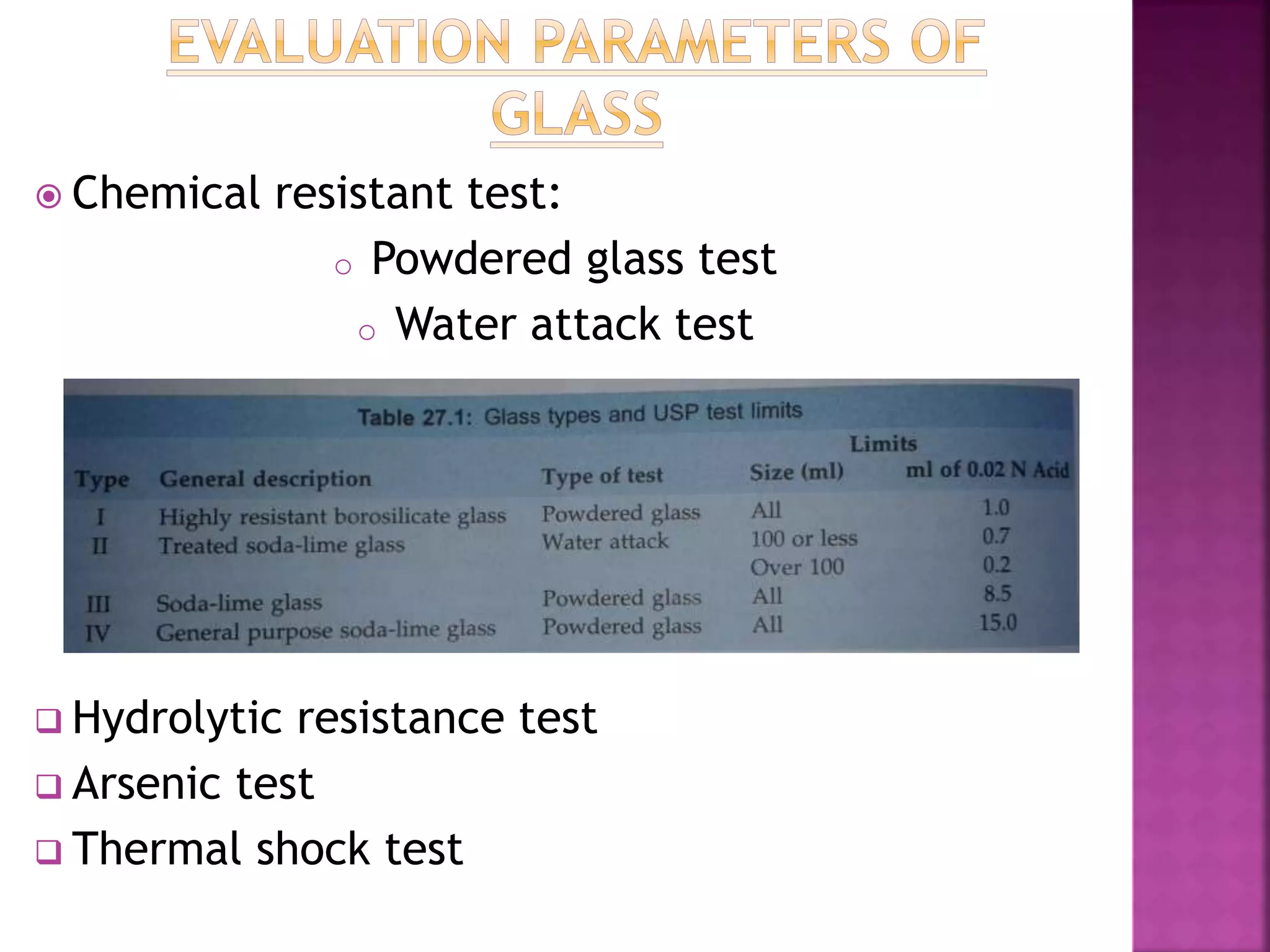
As per USP mainly four types:
 Type-I: Highly resistant borosilicate glass
 Type-II: Treated Soda-lime glass
 TYPE-III: Soda-lime glass
 Type-NP: General purpose Soda-lime glass
Type I releases the less amount of alkali and
type NP releases the most. TYPE II glass has
been de-alkalized by surface treatment of the
finished container. The bulk composition of
type-II container is equivalent to type-III. Type-
NP are fabricated from general purpose soda-
lime glass and used for non- parenterals.
 Composition: sand, soda ash, limestone,
cullet's, lead, alumina
 Color composition: flint, amber
 Manufacturing Techniques:
• Blowing
• Drawing
• Pressing
• Casting
 Chemical resistant test:
o Powdered glass test
o Water attack test
 Hydrolytic resistance test
 Arsenic test
 Thermal shock test
 Plastics include a group of natural or synthetic
origin consisting mainly polymers of high
melting point, capable of being moulded into
variety of shapes or forms by utilizing heat or
pressure.
 Advantages:
a. Good mechanical strength
b. Non-breakable, light, available
c. Poor conductor of heat
Disadvantages:
a. Permeable
b. Additives can cause interaction
c. Majority of plastics are heat sensitive
1. Thermosetting polymers: a polymerization process
involving a curing or vulcanization stage during which
material becomes set to a permanent state by heat or
pressure produces thermoset polymers. These comprise of
phenolics, melamine, urea, epoxies etc.
2. Thermoplastics polymers: are heat softening materials,
which can be repeatedly heated, made mobile and then
reset to a solid state by cooling. Eg: polyethylene , PVC, PS,
PP, Nylon(PA), polycarbonates etc.
Drug plastics considerations have been divided
into five separate categories:
 PERMEATION
 LEACHING
 SORPTION
 CHEMICAL REACTION
 ALTERATION OR MODIFICATION IN THE PHYSICAL
PROPERTIES OF PLASTICS OR PRODUCTS.
 NEGATIVE FEATURES: cavitation panelling,
stress cracking, crazing, poor printability, poor
impact resistance.
 LEAKAGE TEST
 CLARITY TEST
 NON-VOLATILE RESIDUE
 WATER VAPOR PERMEABILITY TEST
 Collapsibility test
 MECHANICAL TESTS: impact strength, tensile
strength, stiffness, tear strength, flex
resistance, coefficient of friction of slip,
fatigue resistance.
 Other tests- melting point, heat sealability,
sterilizability etc.
 Metal is strong, opaque, and impermeable to
moisture, gases, light, bacteria etc. It is
resistant to high and low temperatures.
 Disadvantage: metal is not inert it can be
attacked by acids and alkalies. It will corrode
unless coated or lacquered.
Different metals used are:
 Aluminum
 Aluminium foil
 Tin
 Lead
 Collapsible metal tubes
 If the product is not compatible with bare
metal, the interior can be flushed with wax
type formulation or with resin solutions
 In tins – phenolics, epoxides
 In aluminiums: vinyls
 Lead test
 Evaluation for metal containers for eye
ointments
 Various Inhouse tests
 Film, foils and laminates perform different
roles, such as supportive, barrier, heat seal
and decorative.
 Films:
 Regenerated cellulose films
 Films and coatings based on plastics
 Special films
 Foils: aluminium foils
 Laminates: eg: papers, pVdc, LDPE etc.
 An elastomeric closure forms the most critical
components of a container as far as the
stability and compatibility of a product are
concerned.
 Functions as safety, security, prevent hazards
from pilferage, leakage, contamination
 Types:
 Rubber closures
 Caps and overseals
 Special types: tamper evident, child resistant
 For rubber closures:
 Fragmentation test
 Self sealability test
 Sterility test
 Closure efficiency
 Paper and board are broadly cellulose 
natural fiber materials.
 Used for bulk handling and shipping
 Visual inspection of surfaces
 Principal instrumental techniques:
 Spectrophotometry
 Chromatographic methods
 Thermal analysis techniques
 Gas transmission analysis
 Physical test methods
 Miscellaneous techniques
 Lachman L, Lieberman H.A. & Kanig J.L.
‘The Theory & Practice of Industrial
Pharmacy.’ Varghese Publishing Home.
 Banker GS & Rhodes C.T., Modern
Pharmaceutics, Marcel Dekker, New York.
 Gennaro A.R., ‘Remington, The Science &
Practice of Pharmacy,’ Lippincott. Williams &
Wilkins.
 Jain UK, Goupale DC, Nayak S,
‘Pharmaceutical Packaging Technology’,
PharmaMed press, Hyderabad.
THANK YOU.

Packaging materials and its evaluation

  • 1.
    PRESENTED BY: SOURAV KRSHAH M.PHARM(PHARMACEUTICS) 1ST YEAR SB & BT, DEPARTMENT OF PHARMACEUTICAL SCIENCES BABASAHEB BHIMRAO AMBEDKAR UNIVERSITY, LUCKNOW
  • 2.
     INTRODUCTION  NEEDOF PACKAGING  SELECTION CRITERIA & PROPERTIES  TYPES OF PACKAGING MATERIALS AND THEIR EVALUATIONS  GLASS  PLASTICS  METALS  FILM, FOILS , LAMINATES  ELASTOMERIC CLOSURES  SECONDARY PACKAGING MATERIALS  TERTIARY PACKAGING MATERIALS  REFERENCES
  • 3.
     Pharmaceutical packagingis the means of providing protection, presentation, identification and information, containment, and convenience to compliance with a course of therapy.  Packaging is as vital as formulation. If unsatisfactory packaging permits deterioration to set before patient uses it.
  • 4.
     Physical protection-eg: shock, vibration  Barrier protection- eg: Oxygen, light  Containment  Information transmission  Marketing  Security  Convenience- eg: distribution, handling, sale  Portion Control- eg: single dose pack
  • 5.
     Pharmaceutical Properties-dosage form, route of administration, stability of product  Mechanical Properties- adequately strong, heat stable, impermeable  Physico-chemical properties: non-reactive, inert, F.D.A Approved  Biological properties: non-toxic, resistant to micro-organisms  Economical aspect- reasonable cost
  • 6.
     1. PRIMARYPACKING MATERIALS:  a. Glass  b. Plastics  c. Metals  d. Films, Foils & Laminates  e. Elastomeric closures  2. SECONDARY PACKING MATERIALS: eg- paper and board packaging materials etc.  3. TERTIARY PACKING MATERIALS: eg- barrel, crate container, edge protector etc.
  • 7.
     Glass hasbeen the container of choice for pharmaceutical dosage form because of its resistance to decomposition by atmospheric conditions or by solid or liquid contents of different chemical composition  Furthermore by varying the chemical composition of glass, it is possible to adjust the chemical behavior and radiation protective properties of glass.
  • 8.
    ADVANTAGES: • Chemically inert •Non-corrosive • Impermeable to vapours • Possess FDA approval • Do not deteriorate with age DISADVANTAGE: • Fragile and heavier • Less pressure safety • Less impact resistance • Expensive machinability
  • 9.
    As per USPmainly four types:  Type-I: Highly resistant borosilicate glass  Type-II: Treated Soda-lime glass  TYPE-III: Soda-lime glass  Type-NP: General purpose Soda-lime glass Type I releases the less amount of alkali and type NP releases the most. TYPE II glass has been de-alkalized by surface treatment of the finished container. The bulk composition of type-II container is equivalent to type-III. Type- NP are fabricated from general purpose soda- lime glass and used for non- parenterals.
  • 10.
     Composition: sand,soda ash, limestone, cullet's, lead, alumina  Color composition: flint, amber  Manufacturing Techniques: • Blowing • Drawing • Pressing • Casting
  • 11.
     Chemical resistanttest: o Powdered glass test o Water attack test  Hydrolytic resistance test  Arsenic test  Thermal shock test
  • 12.
     Plastics includea group of natural or synthetic origin consisting mainly polymers of high melting point, capable of being moulded into variety of shapes or forms by utilizing heat or pressure.  Advantages: a. Good mechanical strength b. Non-breakable, light, available c. Poor conductor of heat Disadvantages: a. Permeable b. Additives can cause interaction c. Majority of plastics are heat sensitive
  • 13.
    1. Thermosetting polymers:a polymerization process involving a curing or vulcanization stage during which material becomes set to a permanent state by heat or pressure produces thermoset polymers. These comprise of phenolics, melamine, urea, epoxies etc. 2. Thermoplastics polymers: are heat softening materials, which can be repeatedly heated, made mobile and then reset to a solid state by cooling. Eg: polyethylene , PVC, PS, PP, Nylon(PA), polycarbonates etc.
  • 15.
    Drug plastics considerationshave been divided into five separate categories:  PERMEATION  LEACHING  SORPTION  CHEMICAL REACTION  ALTERATION OR MODIFICATION IN THE PHYSICAL PROPERTIES OF PLASTICS OR PRODUCTS.  NEGATIVE FEATURES: cavitation panelling, stress cracking, crazing, poor printability, poor impact resistance.
  • 17.
     LEAKAGE TEST CLARITY TEST  NON-VOLATILE RESIDUE  WATER VAPOR PERMEABILITY TEST  Collapsibility test  MECHANICAL TESTS: impact strength, tensile strength, stiffness, tear strength, flex resistance, coefficient of friction of slip, fatigue resistance.  Other tests- melting point, heat sealability, sterilizability etc.
  • 18.
     Metal isstrong, opaque, and impermeable to moisture, gases, light, bacteria etc. It is resistant to high and low temperatures.  Disadvantage: metal is not inert it can be attacked by acids and alkalies. It will corrode unless coated or lacquered. Different metals used are:  Aluminum  Aluminium foil  Tin  Lead  Collapsible metal tubes
  • 19.
     If theproduct is not compatible with bare metal, the interior can be flushed with wax type formulation or with resin solutions  In tins – phenolics, epoxides  In aluminiums: vinyls
  • 20.
     Lead test Evaluation for metal containers for eye ointments  Various Inhouse tests
  • 21.
     Film, foilsand laminates perform different roles, such as supportive, barrier, heat seal and decorative.  Films:  Regenerated cellulose films  Films and coatings based on plastics  Special films  Foils: aluminium foils  Laminates: eg: papers, pVdc, LDPE etc.
  • 22.
     An elastomericclosure forms the most critical components of a container as far as the stability and compatibility of a product are concerned.  Functions as safety, security, prevent hazards from pilferage, leakage, contamination  Types:  Rubber closures  Caps and overseals  Special types: tamper evident, child resistant
  • 25.
     For rubberclosures:  Fragmentation test  Self sealability test  Sterility test  Closure efficiency
  • 26.
     Paper andboard are broadly cellulose natural fiber materials.
  • 27.
     Used forbulk handling and shipping
  • 28.
     Visual inspectionof surfaces  Principal instrumental techniques:  Spectrophotometry  Chromatographic methods  Thermal analysis techniques  Gas transmission analysis  Physical test methods  Miscellaneous techniques
  • 29.
     Lachman L,Lieberman H.A. & Kanig J.L. ‘The Theory & Practice of Industrial Pharmacy.’ Varghese Publishing Home.  Banker GS & Rhodes C.T., Modern Pharmaceutics, Marcel Dekker, New York.  Gennaro A.R., ‘Remington, The Science & Practice of Pharmacy,’ Lippincott. Williams & Wilkins.  Jain UK, Goupale DC, Nayak S, ‘Pharmaceutical Packaging Technology’, PharmaMed press, Hyderabad.
  • 30.