Malla reddy college of 
pharmacy 
Industrial pharmacy seminar 
By 
D. Himabindu 
H.T.NO: 256213886006
INTRODUCTION: 
parenteral preparations are sterile, 
pyrogen-free liquids (solutions, emulsions, or 
suspensions) or solid dosage forms containing one 
or more active ingredients, packaged in either 
single-dose or multi-dose containers. 
They are intended for administration by injection, 
infusion, or implementation into the body. 
Parenteral drugs are administrated directly into 
veins, muscles or under the skin or more specialized 
tissues such as the spinal cord.
TYPES: there are four main forms of parenteral 
preparations: 
• injections, 
• intravenous infusions (large volume parenterals), 
• powders for injections, and 
• implants 
certain injections and intravenous infusions may be 
presented in the form of sterile concentrated 
solutions, which must be suitably diluted before use.
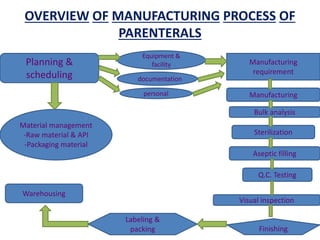
OVERVIEW OF MANUFACTURING PROCESS OF 
PARENTERALS 
Planning & 
scheduling 
Material management 
-Raw material & API 
-Packaging material 
Warehousing 
Equipment & 
facility Manufacturing 
requirement 
documentation 
personal 
Manufacturing 
Bulk analysis 
Sterilization 
Aseptic filling 
Q.C. Testing 
Visual inspection 
Finishing 
Labeling & 
packing
FLOW OF MATERIALS:- 
Ingredients 
vehicle 
salute 
Processing 
equipment 
Container 
component 
Compounding 
of product 
Cleaning 
Cleaning 
Filteration of 
solutes 
Sterilization 
Sterilization 
Filling Sealing Packaging 
Product 
storage 
Diagram of flow of materials through the production department
[QUALITATIVE LAYOUT OF PARENTERAL MANUFACTURING] 
Function 
Area 
Square meter Percentage 
Production 11,094 45.1 
Warehouse 7,606 30.9 
Utility 1,716 4.1 
Quality control 1,716 7.0 
Administration 1,018 4.1 
Maintenance 1,014 4.5 
Employee services 1,014 4.1 
Security 39 0.9 
Total 24,607 100.0
1.AREA PLANING AND ENVIRONMENTAL CONTROL:- 
Area planning may be addressed by functional 
groups ground this critical area with particular 
attention given to maintaining cleanliness. 
Functional groupings:- 
Warehousing:- 
o The storage of spare parts, air filters, change parts, 
water treatment chemicals, office supplier, janitorial 
supplies, uniforms, an so on may be handled as 
central storage or individually by department. 
o Finished product and certain raw materials need 
special environmental storage conditions, such as, 
temperature and humidity control.
Administrative areas :- 
1) Administrative area planning requires careful 
analysis of the direct and indirect 
administrative requirements of a particular 
plant. 
2) Successively higher levels of supervision are 
usually provided successively larger office 
areas. 
3) Some offices are individual, while some are 
grouped in an “open area concept”,
ZONES AS PER GAZZETE OF INDIA: 
1st.zones as per gazette of India 
WHITE 
GRAY BLACK 
• White zone:- final step (filling of parenteral) 
• Grey zone:- weighing, dissolution & filtration. 
• Black zone:- storage, worst area from 
contamination view point.
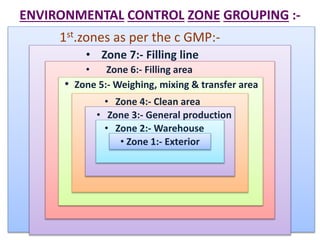
ENVIRONMENTAL CONTROL ZONE GROUPING :- 
1st.zones as per the c GMP:- 
• Zone 7:- Filling line 
• Zone 6:- Filling area 
• Zone 5:-Weighing, mixing & transfer area 
• Zone 4:- Clean area 
• Zone 3:- General production 
• Zone 2:- Warehouse 
• Zone 1:- Exterior
Zone 7:- filling line:- 
The walls of the filling area are the last physical barrier to 
the ingress of contamination, but within the filling area a 
technique of contamination control known as laminar flow 
may be considered as the barrier to contamination. 
For aseptic filling 
process 
Sterilization and 
Depyrogenation of containers 
before filling, normally hot air 
oven or autoclave. 
Provision must be 
made for 
Filling requires 
An aseptic environment with the 
Inspection and packaging attendant support rooms
Zone 6:- filling area:- 
Zone 6 is a distinct zone of the controlled 
environment area for an aseptic filling process but 
may not be distinct zone for non-aseptic filling 
process. 
Zone 5:- weighing, mixing, and transfer area:- 
Zone 5 encompasses activities of “weighing, 
mixing, filling or transfer operations” addressed by c 
GMP section 212.81 which are not handled as zone 
6 but which require a controlled environment. 
Zone 4:- clean area:- 
Activities in this may include washing and 
preparations of equipment or accumulation and 
sampling of filled product.
Zone 3:- general production and administration 
:- 
area:- 
The third zone of environmental controls is formed 
by the periphery of the general production area. 
Only essential materials-handling equipment and 
personnel. 
Zone 2:- plant exterior:- 
It is a base point from which to work in 
determining the requirements for the various 
control barriers. 
Control zone 1 might include the maintenance of 
sterile areas around the facility.
2. WALL & FLOOR TREATMENT: 
The design of filling areas or more generally, 
controlled environment areas involves attention to 
many seemingly minor details. The basic 
cleanlability requirement includes smooth, 
celanable walls, floors, ceilings, fixtures, and 
partition exposed columns, wall studs, bracing, 
pipes, and so on are unacceptable. 
The need for cleanability also eliminates the 
open floor system commonly used in the 
microelectronics industry for laminar airflow rooms.
The goal of the designer, when creating the 
details for the architectural finishes and joining 
methods, is to eliminate all edges or surfaces within 
the room where dirt may accumulate. 
All inside walls must be finished; 
Example: common methods of finish are block, 
plaster, or gypsum board.
3. LIGHTNING FIXTURES : 
Lighting fixtures should be reduced flush with 
the ceiling. Areas having a full HEPA ceiling 
obviously cannot accommodate recessed lighting 
fixtures. In these areas, fixtures are of a special 
“tear drop” shape which minimizes disruption to 
the laminar airflow pattern. 
4. CHANGE ROOMS : 
Personnel access to all controlled areas should 
be through change rooms. Change rooms concepts 
and layouts vary from single closet size rooms to 
expensive multi-room complexes.
Entrance to a change area is normally 
through vestibules whose doors are electrically 
interlocked so that both cannot be opened 
simultaneously, thus maintaining the necessary air 
pressure differential to prevent the entry of 
airborne contamination. 
Upon entry into the change room wash skins 
are provided for scrubbing hands and forearms. 
Further control may be achieved by using 
filtered and heated compressed air for drying to 
reduce further particular potential.
After hands are dry, garments are taken 
from dispensers and donned while moving across a 
dressing bench. 
As a final growing step, aseptic gloves are 
put on and sanitized. Exit from the change room to 
the controlled area is, like entrance, through an 
interlocked vestibule.
Clothing dispenser hand dryer hand wash 
Exit Glove dispenser Change bench entrance 
Change room
5. Personnel flow :- 
The movement of personnel should be 
planned during the design of individual plant areas. 
Each individual production area may have a smooth 
and efficient personnel flow pattern, a 
discontinuous or crowded pattern may develop 
when several individual production area plants are 
combined. 
The flow of material and personnel through 
corridors are inefficient and unsafe paths for 
moving materials, particularly if heavy forklifts are 
required.
x Design / Design 
1 3 
4 2 
1 2 
4 3 
Discontinuous and crowed flow patterns 
can decrease production efficiency, increase 
security problems, and increase the problem of 
maintaining a clean environment.
6. UTILITES AND UTILITY EQUIPMENT LOCATION :- 
Utilities :- 
Piping system in particular, must be initially 
and often periodically cleaned and serviced. 
Exposed overhead piping is not acceptable from a 
cleanliness or contamination stand point since it 
collects dirt, is difficult to clean and may leak. 
Buried or concealed pipe may require unacceptable 
demolition for cleaning or repair. 
Utilities equipment location :- 
Public utilities require space for metering. In 
addition to meeting, electrical power system 
require for switchgear and transformer.
Water systems usually require treatment to 
ensure consistent quality. Plant generated utilities 
typically require steam boilers, air compressors, and 
distillation, the typical “boiler room” approach. 
Proper equipment maintenance is difficult in foul 
weather, especially winter. 
Heavy equipment may damage the roof-structure, 
particularly if the equipment location 
requires numerous penetrations through the roof 
which, coupled with equipment vibration, will 
invariable lead to leakage.
7.Engineering and maintenance :- 
From an engineering stand point, even a 
location outside the plant can serve well if access to 
the production area by engineers for field work is 
not too difficult often particularly in small or less 
complex plants, maintenance or other plant service 
functions such as utilities or combined with 
engineering, making an in-plant location desirable. 
Maintenance responsibilities cover all areas 
of the plant and can generally be grouped into two 
categories: plant maintenance and production 
maintenance.
1) production maintenance is a direct production 
support function and all the routine and recurring 
operating maintenance work. Production 
maintenance facilities are usually minimal, often 
only a place to store a tool box, and seldom have 
more than a small workbench. 
2) plant maintenance operations, in contrast, are 
more diverse. They vary from heavy maintenance 
on production equipment to cosmetic work on the 
building exterior and often include plant service 
functions such as sanitation, ground sweeping, or 
waste disposal.
LIST OF EQUIPMENTS (as per schedule-M): 
The following equipments is recommended: 
a)Manufacturing area :- 
1. Storage equipment for ampoules, vials bottles and 
closures. 
2. Washing and drying equipment. 
3. Dust proof storage cabinet. 
4. Water still. 
5. Mixing and preparation tanks or other containers. 
6. Mixing equipment where necessary. 
7. Filtering equipment. 
8. Hot air sterilizer.
b) Aseptic filling and sealing room:- 
9. Benches for filling and sealing. 
10. Bacteriological filters. 
11. Filling and sealing unit under laminar flow work 
station. 
C) General room:- 
12. Inspection table 
13. Leak testing table. 
14. Labeling and packing benches. 
15. Storage of equipment including cold storage and 
refrigerators if necessary.
CONCLUSION 
The parenteral route of 
administration is the most effective route for the 
delivery of the active pharmaceutical substances 
with narrow therapeutic index, poor bioavailability 
especially for those drugs, prescribed to 
unconscious patients. 
The present article describes that area 
planning, facilities, design, construction and 
manufacturing of sterile products. It is more 
impartment to produce good quality of parenteral.
Parenterals are the pyrogen free liquids 
these are manufactured and stored according to 
cGMP guidelines. Proper area, environmental 
control, personnel observation will gives excellent 
parenteral products and attain their described 
therapeutic effect.
REFERENCES 
1. Industrial pharmacy (sterile products) by leon lachman, 
657-659 
2. Good manufacturing practices for pharmaceuticals 6th 
edition, joseph D.nally, page no-37-113 
3. Pharmaceutical science by remington, 12th edition, vol.1, 
page.no-814-828 
4. American journal of hospital pharmacy, vol.38, issue 8, 
1144-114710. dispensing for pharmaceutical students; 
5. www.fda.gov. 
6. Drugs and cosmetics Act 1940. 
7. www.GMP.online.coms 
8. www.ispc.org
Thank you

Parenteral production

  • 1.
    Malla reddy collegeof pharmacy Industrial pharmacy seminar By D. Himabindu H.T.NO: 256213886006
  • 3.
    INTRODUCTION: parenteral preparationsare sterile, pyrogen-free liquids (solutions, emulsions, or suspensions) or solid dosage forms containing one or more active ingredients, packaged in either single-dose or multi-dose containers. They are intended for administration by injection, infusion, or implementation into the body. Parenteral drugs are administrated directly into veins, muscles or under the skin or more specialized tissues such as the spinal cord.
  • 4.
    TYPES: there arefour main forms of parenteral preparations: • injections, • intravenous infusions (large volume parenterals), • powders for injections, and • implants certain injections and intravenous infusions may be presented in the form of sterile concentrated solutions, which must be suitably diluted before use.
  • 5.
    OVERVIEW OF MANUFACTURINGPROCESS OF PARENTERALS Planning & scheduling Material management -Raw material & API -Packaging material Warehousing Equipment & facility Manufacturing requirement documentation personal Manufacturing Bulk analysis Sterilization Aseptic filling Q.C. Testing Visual inspection Finishing Labeling & packing
  • 6.
    FLOW OF MATERIALS:- Ingredients vehicle salute Processing equipment Container component Compounding of product Cleaning Cleaning Filteration of solutes Sterilization Sterilization Filling Sealing Packaging Product storage Diagram of flow of materials through the production department
  • 7.
    [QUALITATIVE LAYOUT OFPARENTERAL MANUFACTURING] Function Area Square meter Percentage Production 11,094 45.1 Warehouse 7,606 30.9 Utility 1,716 4.1 Quality control 1,716 7.0 Administration 1,018 4.1 Maintenance 1,014 4.5 Employee services 1,014 4.1 Security 39 0.9 Total 24,607 100.0
  • 8.
    1.AREA PLANING ANDENVIRONMENTAL CONTROL:- Area planning may be addressed by functional groups ground this critical area with particular attention given to maintaining cleanliness. Functional groupings:- Warehousing:- o The storage of spare parts, air filters, change parts, water treatment chemicals, office supplier, janitorial supplies, uniforms, an so on may be handled as central storage or individually by department. o Finished product and certain raw materials need special environmental storage conditions, such as, temperature and humidity control.
  • 9.
    Administrative areas :- 1) Administrative area planning requires careful analysis of the direct and indirect administrative requirements of a particular plant. 2) Successively higher levels of supervision are usually provided successively larger office areas. 3) Some offices are individual, while some are grouped in an “open area concept”,
  • 10.
    ZONES AS PERGAZZETE OF INDIA: 1st.zones as per gazette of India WHITE GRAY BLACK • White zone:- final step (filling of parenteral) • Grey zone:- weighing, dissolution & filtration. • Black zone:- storage, worst area from contamination view point.
  • 11.
    ENVIRONMENTAL CONTROL ZONEGROUPING :- 1st.zones as per the c GMP:- • Zone 7:- Filling line • Zone 6:- Filling area • Zone 5:-Weighing, mixing & transfer area • Zone 4:- Clean area • Zone 3:- General production • Zone 2:- Warehouse • Zone 1:- Exterior
  • 12.
    Zone 7:- fillingline:- The walls of the filling area are the last physical barrier to the ingress of contamination, but within the filling area a technique of contamination control known as laminar flow may be considered as the barrier to contamination. For aseptic filling process Sterilization and Depyrogenation of containers before filling, normally hot air oven or autoclave. Provision must be made for Filling requires An aseptic environment with the Inspection and packaging attendant support rooms
  • 13.
    Zone 6:- fillingarea:- Zone 6 is a distinct zone of the controlled environment area for an aseptic filling process but may not be distinct zone for non-aseptic filling process. Zone 5:- weighing, mixing, and transfer area:- Zone 5 encompasses activities of “weighing, mixing, filling or transfer operations” addressed by c GMP section 212.81 which are not handled as zone 6 but which require a controlled environment. Zone 4:- clean area:- Activities in this may include washing and preparations of equipment or accumulation and sampling of filled product.
  • 14.
    Zone 3:- generalproduction and administration :- area:- The third zone of environmental controls is formed by the periphery of the general production area. Only essential materials-handling equipment and personnel. Zone 2:- plant exterior:- It is a base point from which to work in determining the requirements for the various control barriers. Control zone 1 might include the maintenance of sterile areas around the facility.
  • 15.
    2. WALL &FLOOR TREATMENT: The design of filling areas or more generally, controlled environment areas involves attention to many seemingly minor details. The basic cleanlability requirement includes smooth, celanable walls, floors, ceilings, fixtures, and partition exposed columns, wall studs, bracing, pipes, and so on are unacceptable. The need for cleanability also eliminates the open floor system commonly used in the microelectronics industry for laminar airflow rooms.
  • 16.
    The goal ofthe designer, when creating the details for the architectural finishes and joining methods, is to eliminate all edges or surfaces within the room where dirt may accumulate. All inside walls must be finished; Example: common methods of finish are block, plaster, or gypsum board.
  • 17.
    3. LIGHTNING FIXTURES: Lighting fixtures should be reduced flush with the ceiling. Areas having a full HEPA ceiling obviously cannot accommodate recessed lighting fixtures. In these areas, fixtures are of a special “tear drop” shape which minimizes disruption to the laminar airflow pattern. 4. CHANGE ROOMS : Personnel access to all controlled areas should be through change rooms. Change rooms concepts and layouts vary from single closet size rooms to expensive multi-room complexes.
  • 18.
    Entrance to achange area is normally through vestibules whose doors are electrically interlocked so that both cannot be opened simultaneously, thus maintaining the necessary air pressure differential to prevent the entry of airborne contamination. Upon entry into the change room wash skins are provided for scrubbing hands and forearms. Further control may be achieved by using filtered and heated compressed air for drying to reduce further particular potential.
  • 19.
    After hands aredry, garments are taken from dispensers and donned while moving across a dressing bench. As a final growing step, aseptic gloves are put on and sanitized. Exit from the change room to the controlled area is, like entrance, through an interlocked vestibule.
  • 20.
    Clothing dispenser handdryer hand wash Exit Glove dispenser Change bench entrance Change room
  • 21.
    5. Personnel flow:- The movement of personnel should be planned during the design of individual plant areas. Each individual production area may have a smooth and efficient personnel flow pattern, a discontinuous or crowded pattern may develop when several individual production area plants are combined. The flow of material and personnel through corridors are inefficient and unsafe paths for moving materials, particularly if heavy forklifts are required.
  • 22.
    x Design /Design 1 3 4 2 1 2 4 3 Discontinuous and crowed flow patterns can decrease production efficiency, increase security problems, and increase the problem of maintaining a clean environment.
  • 23.
    6. UTILITES ANDUTILITY EQUIPMENT LOCATION :- Utilities :- Piping system in particular, must be initially and often periodically cleaned and serviced. Exposed overhead piping is not acceptable from a cleanliness or contamination stand point since it collects dirt, is difficult to clean and may leak. Buried or concealed pipe may require unacceptable demolition for cleaning or repair. Utilities equipment location :- Public utilities require space for metering. In addition to meeting, electrical power system require for switchgear and transformer.
  • 24.
    Water systems usuallyrequire treatment to ensure consistent quality. Plant generated utilities typically require steam boilers, air compressors, and distillation, the typical “boiler room” approach. Proper equipment maintenance is difficult in foul weather, especially winter. Heavy equipment may damage the roof-structure, particularly if the equipment location requires numerous penetrations through the roof which, coupled with equipment vibration, will invariable lead to leakage.
  • 25.
    7.Engineering and maintenance:- From an engineering stand point, even a location outside the plant can serve well if access to the production area by engineers for field work is not too difficult often particularly in small or less complex plants, maintenance or other plant service functions such as utilities or combined with engineering, making an in-plant location desirable. Maintenance responsibilities cover all areas of the plant and can generally be grouped into two categories: plant maintenance and production maintenance.
  • 26.
    1) production maintenanceis a direct production support function and all the routine and recurring operating maintenance work. Production maintenance facilities are usually minimal, often only a place to store a tool box, and seldom have more than a small workbench. 2) plant maintenance operations, in contrast, are more diverse. They vary from heavy maintenance on production equipment to cosmetic work on the building exterior and often include plant service functions such as sanitation, ground sweeping, or waste disposal.
  • 27.
    LIST OF EQUIPMENTS(as per schedule-M): The following equipments is recommended: a)Manufacturing area :- 1. Storage equipment for ampoules, vials bottles and closures. 2. Washing and drying equipment. 3. Dust proof storage cabinet. 4. Water still. 5. Mixing and preparation tanks or other containers. 6. Mixing equipment where necessary. 7. Filtering equipment. 8. Hot air sterilizer.
  • 28.
    b) Aseptic fillingand sealing room:- 9. Benches for filling and sealing. 10. Bacteriological filters. 11. Filling and sealing unit under laminar flow work station. C) General room:- 12. Inspection table 13. Leak testing table. 14. Labeling and packing benches. 15. Storage of equipment including cold storage and refrigerators if necessary.
  • 29.
    CONCLUSION The parenteralroute of administration is the most effective route for the delivery of the active pharmaceutical substances with narrow therapeutic index, poor bioavailability especially for those drugs, prescribed to unconscious patients. The present article describes that area planning, facilities, design, construction and manufacturing of sterile products. It is more impartment to produce good quality of parenteral.
  • 30.
    Parenterals are thepyrogen free liquids these are manufactured and stored according to cGMP guidelines. Proper area, environmental control, personnel observation will gives excellent parenteral products and attain their described therapeutic effect.
  • 31.
    REFERENCES 1. Industrialpharmacy (sterile products) by leon lachman, 657-659 2. Good manufacturing practices for pharmaceuticals 6th edition, joseph D.nally, page no-37-113 3. Pharmaceutical science by remington, 12th edition, vol.1, page.no-814-828 4. American journal of hospital pharmacy, vol.38, issue 8, 1144-114710. dispensing for pharmaceutical students; 5. www.fda.gov. 6. Drugs and cosmetics Act 1940. 7. www.GMP.online.coms 8. www.ispc.org
  • 32.