M. Pharm Sem-I Seminars
Quality Control Test For Packaging Material And Packaging Operation
SUBMITTED TO
SAVITRIBAI PHULE, PUNE UNIVERSITY, PUNE
FOR
PARTIAL FULFILMENT OF REQUIREMENTS FOR THE AWARD OF
DEGREE OF MASTER OF PHARMACY IN THE SUBJECT
QUALITY ASSURANCE TECHNIQUES
IN THE FACULTY OF SCIENCE AND TECHNOLOGY
Bhujbal Knowledge City,
MET’s Institute of Pharmacy,
Adgaon , Nashik, 422003.
Maharashtra, India
Academic Year- 2022-23
Presented By-
Ms. Mayuri Pawar
(QAT)
SEM I
Roll No. 11
Guided By :
Dr. G.S. Deokar
HOD (QAT Dept.)
1
GOOD PACKAGING
PROTECTS YOUR
PRODUCT
GREAT PACKAGING
PROTECT YOUR BRAND
2
CONTENTS
• DEFINITION
• FUNCTION OF PACKAGING
• TYPES OF PACKAGING MATERIAL
• QULITY CONTROL TEST OF PACKAGING MATERIAL
• PACKAGING CONTAINER AND CLOUSURES SYSTEM
• INNOVATIONS IN PACKAGING TECHNOLOGY
• PACKAGING OPERATIONS
• CONCLUSION
• REFERENCES
3
WHAT IS PACKAGING ?
DEFINITION
Packaging is the science art and technology of enclosing or protecting
products for distribution, storage,sale and use.
packaging also refers to the process of design
And production of packages.
Pharmaceutical packaging defined as the economical
means of providing presentation, protection,
identification,information,convenience, compliance
and the stability of product.
4
FUNCTION
Protection &preservation
Information & presentation
Brand communication&
patient convinience
identification
containment
5
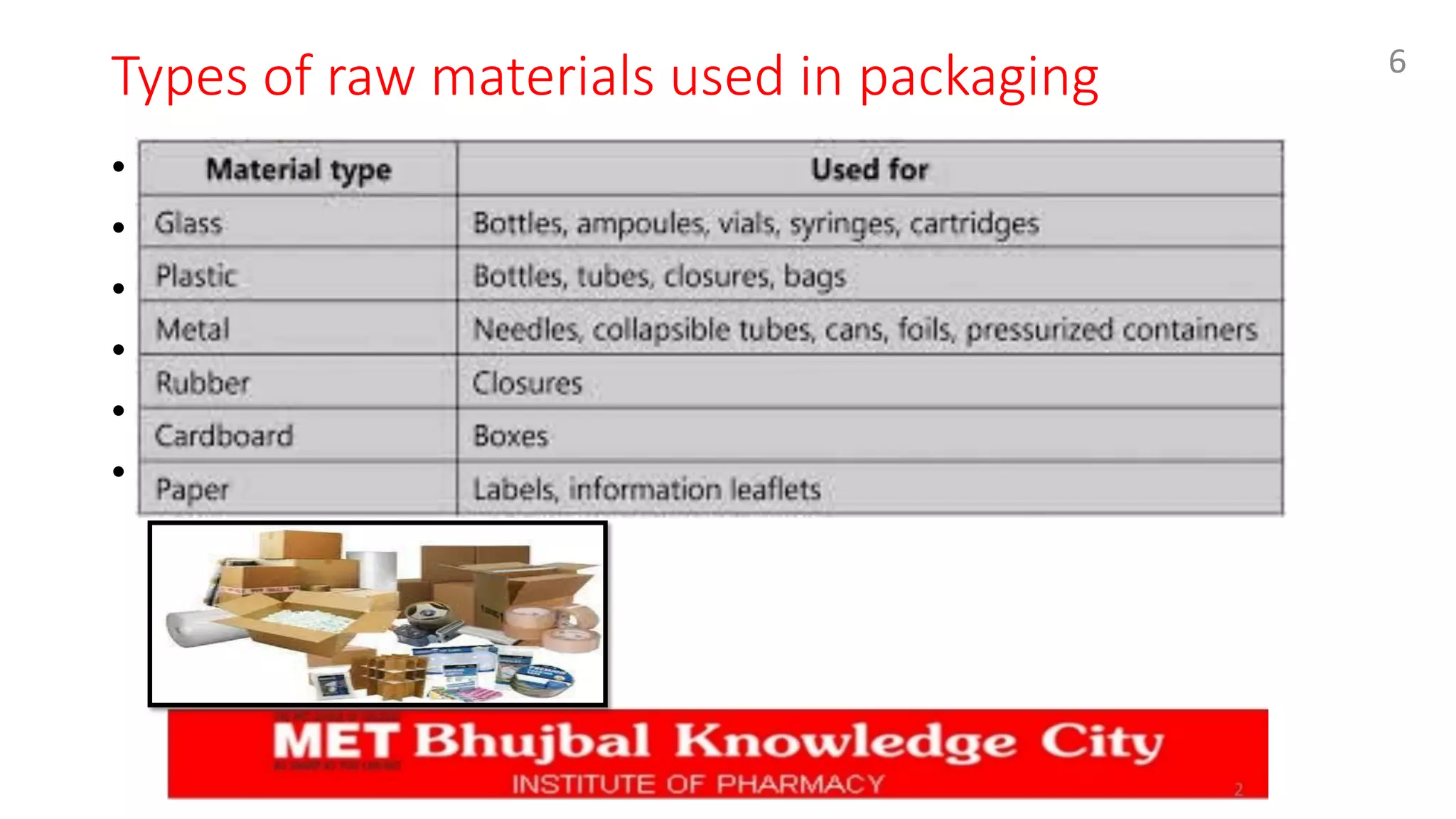
Types of raw materials used in packaging
• Types of materials Uses
• Cardboard : Boxes, Display units, Paper Labels, Leaflets.
• Glass :Ampoules ,Bottles, Vials ,Syringes ,Cartridges .
• Plastic :Closures ,Bottles ,Bags ,Tubes Laminates with paper or foil.
• Metal, e.g. aluminium : Collapsible tubes, Rigid cans Foils .
• Rubber : Closures, including plunger.
6
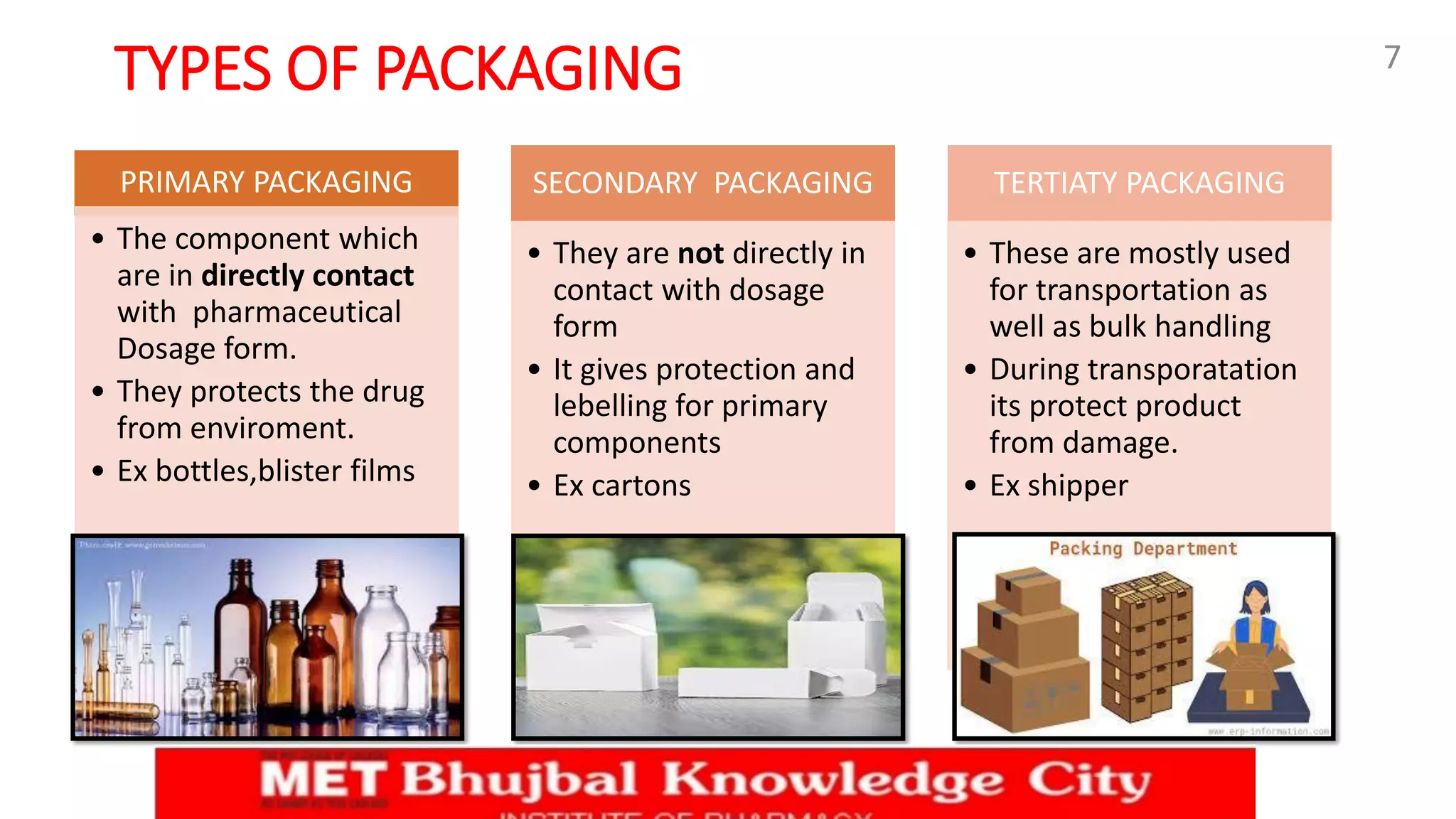
TYPES OF PACKAGING
PRIMARY PACKAGING
• The component which
are in directly contact
with pharmaceutical
Dosage form.
• They protects the drug
from enviroment.
• Ex bottles,blister films
SECONDARY PACKAGING
• They are not directly in
contact with dosage
form
• It gives protection and
lebelling for primary
components
• Ex cartons
TERTIATY PACKAGING
• These are mostly used
for transportation as
well as bulk handling
• During transporatation
its protect product
from damage.
• Ex shipper
7
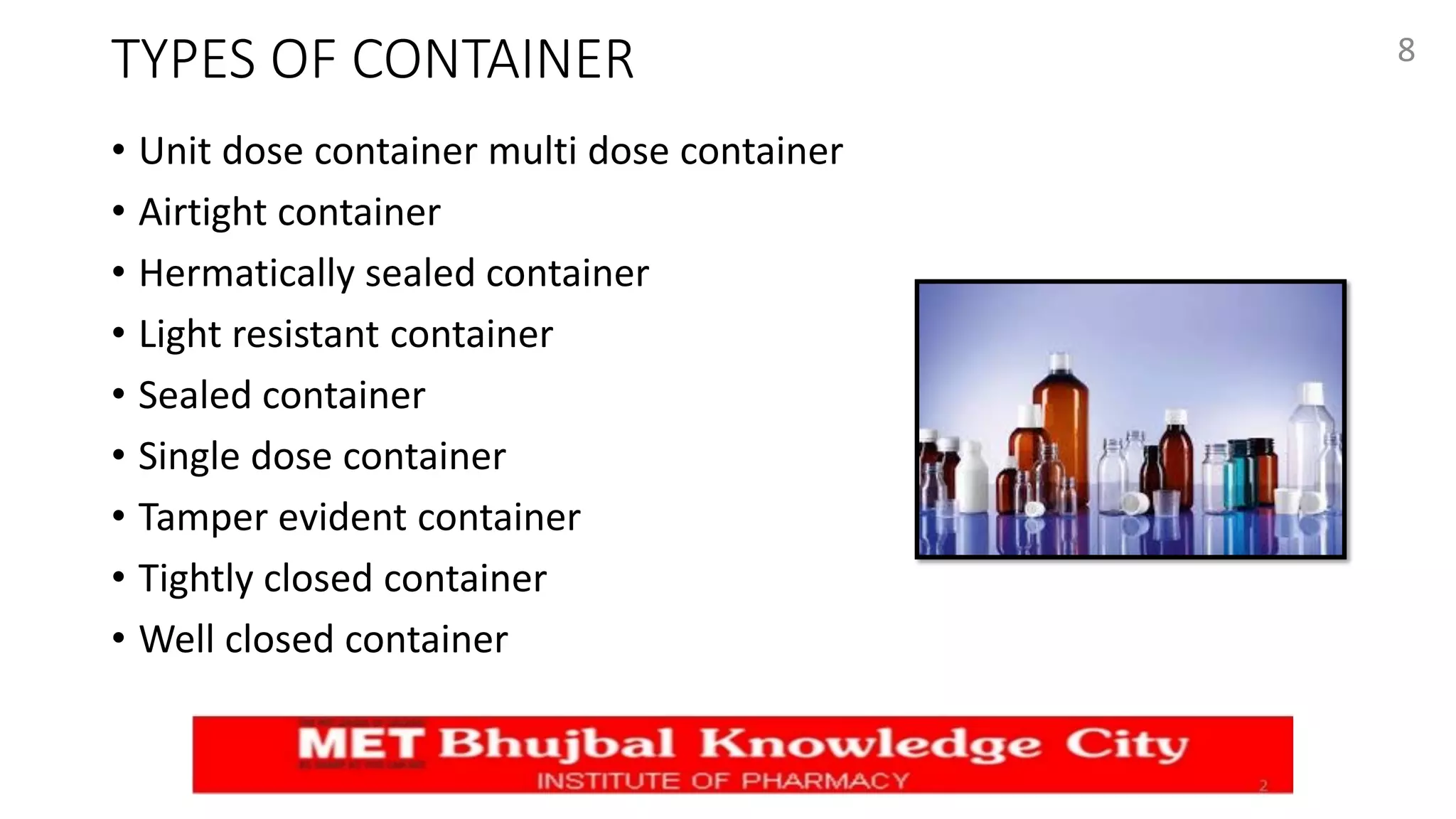
TYPES OF CONTAINER
• Unit dose container multi dose container
• Airtight container
• Hermatically sealed container
• Light resistant container
• Sealed container
• Single dose container
• Tamper evident container
• Tightly closed container
• Well closed container
8
TYPES OF PACKAGING MATERIAL
Glass Plastic Rubber Metal
9
GLASS
Glass is widely used in pharmaceutical industry.
ADVANTAGES
 Its possesses superior protective qualities and readily available in
various shapes and sizes.
 Glass does not detoriate with age gives excellent barrier qualities
aginst every element(except light)
DISADVANTAGES
 Major disadvantage is its fragile nature easily broken.
 Release alkali in preparation.
10
Composition of glass
• Glass is composed of sand(SiO2),soda ash(Na2CO3),Limestone(CaCO3)
Cullet(broken glass)
MANUFACTURING OF GLASS CONTAINERS
BLOWING (by using compressed air moulding takes place)
DRAWING(molten glass is converted into different shapes)
PRESSING(mechanical force used to press the glass)
CASTING (forms the cavity with the help of centrifugal force)
11
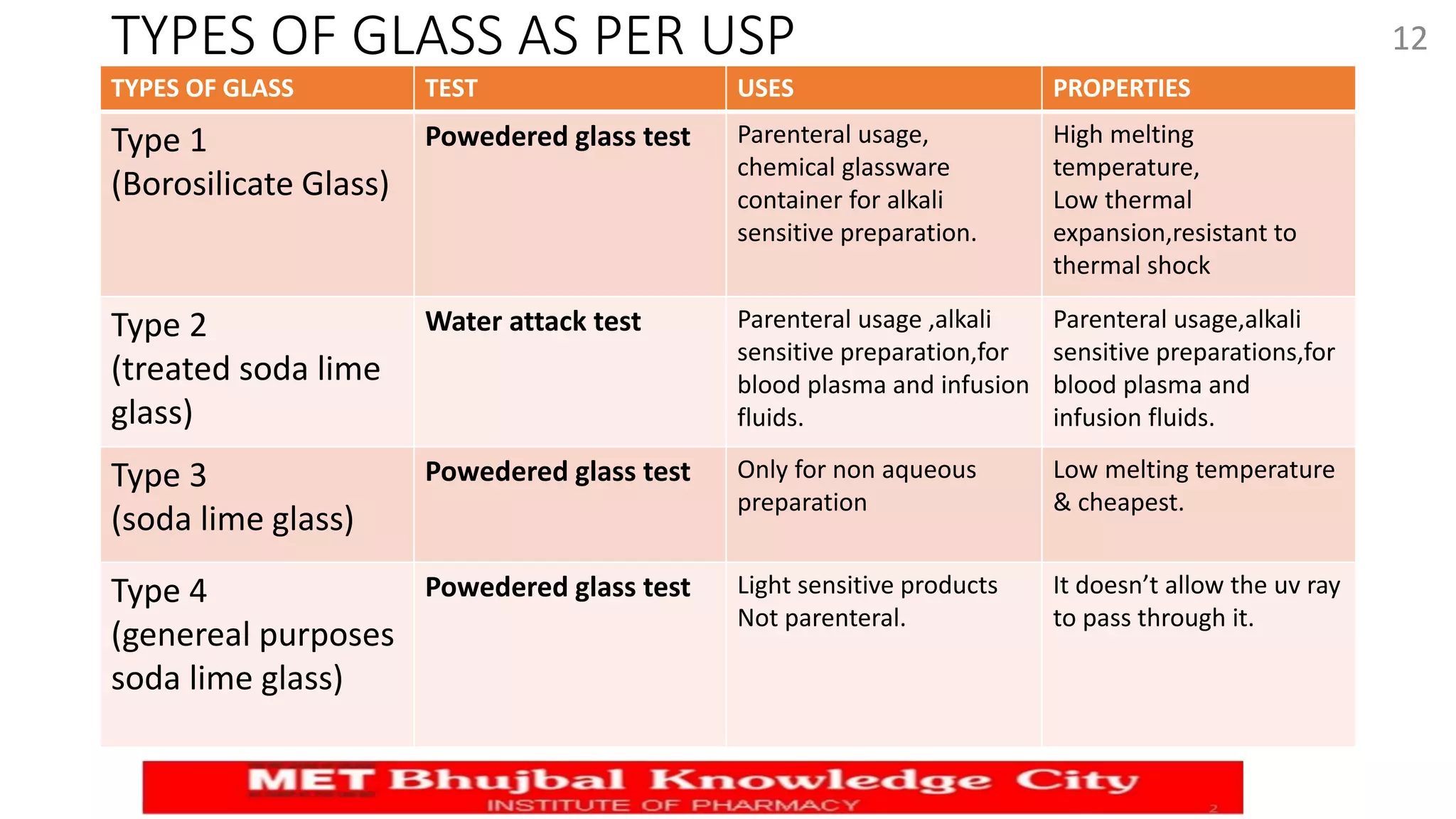
TYPES OF GLASS AS PER USP
TYPES OF GLASS TEST USES PROPERTIES
Type 1
(Borosilicate Glass)
Powedered glass test Parenteral usage,
chemical glassware
container for alkali
sensitive preparation.
High melting
temperature,
Low thermal
expansion,resistant to
thermal shock
Type 2
(treated soda lime
glass)
Water attack test Parenteral usage ,alkali
sensitive preparation,for
blood plasma and infusion
fluids.
Parenteral usage,alkali
sensitive preparations,for
blood plasma and
infusion fluids.
Type 3
(soda lime glass)
Powedered glass test Only for non aqueous
preparation
Low melting temperature
& cheapest.
Type 4
(genereal purposes
soda lime glass)
Powedered glass test Light sensitive products
Not parenteral.
It doesn’t allow the uv ray
to pass through it.
12
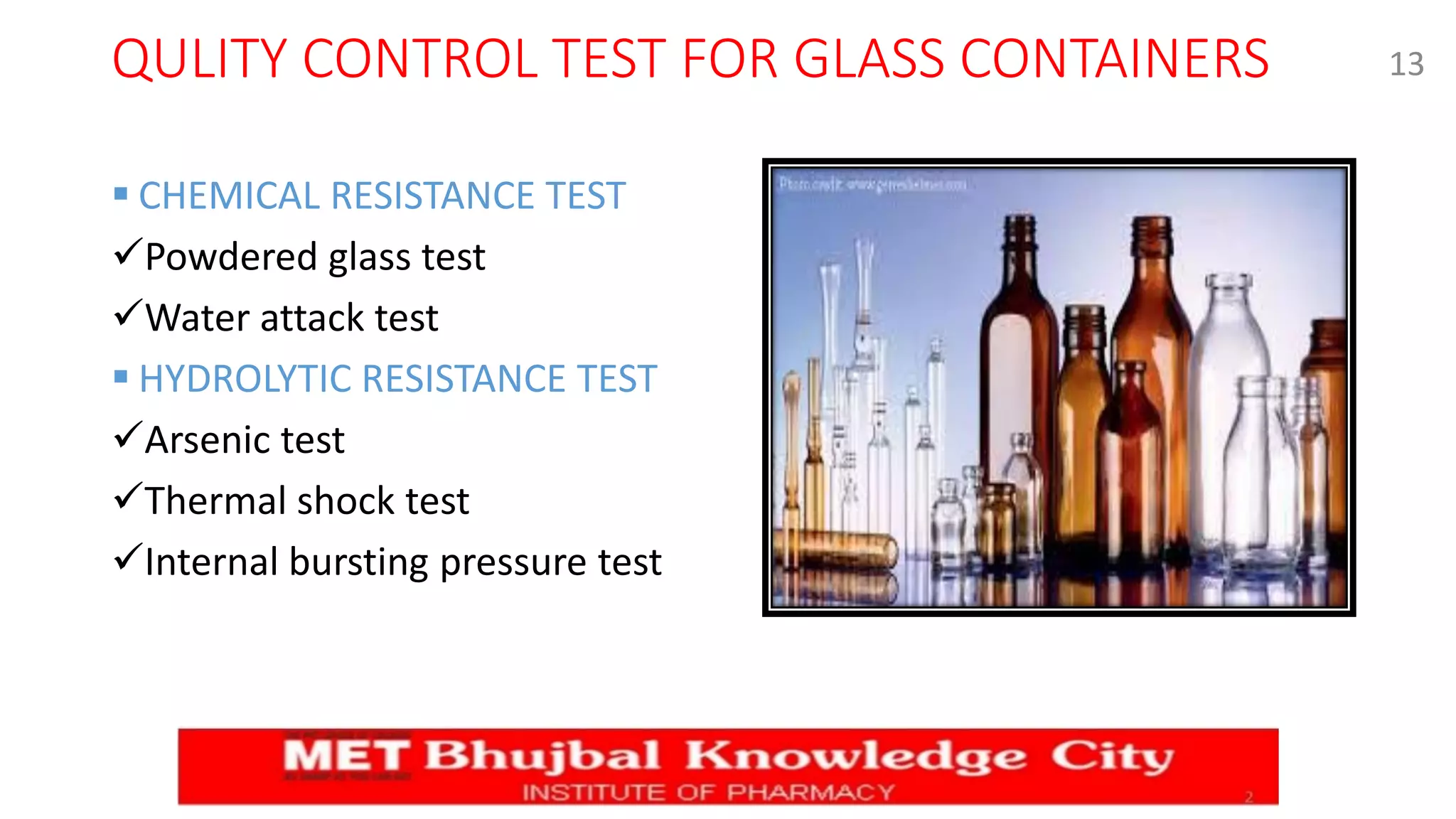
QULITY CONTROL TEST FOR GLASS CONTAINERS
 CHEMICAL RESISTANCE TEST
Powdered glass test
Water attack test
 HYDROLYTIC RESISTANCE TEST
Arsenic test
Thermal shock test
Internal bursting pressure test
13
Powdered glass test
• It done to estimate the amount of alkali from powdered glass at elevated
temperature.
• When glass is powered leaching of alkali is enhanced,which can titrated
with 0.02N sulphuric acid using methylred as indicator.
STEP 1 :PREPARATION OF GLASS SPECIMEN
• Few containers are rinsed thoroughly with purified water and dried with
stream of clean air.
• Grind the container in a mortor to a fine powder and pass through sieve no
20&50.
STEP 2 : WASHING THE SPECIMEN
• 10gm of above specimen is taken into 250ml of conical flask and wash it
with 30ml acetone .
• Reapeat the washing decand the acetone and dry used after 48 hr.
14
POWDERED GLASS TEST
• 10gm of specimen/sample +50ml highly purified water 250ml flask&
atoclave it at 121°C
• Cool it and decant the solution in another flask again and add 15ml of
water and decant solution.
• Titrate the decant solution with 0.02N sulphuric acid using methyl red
and record the volume.
limits
TEST CONTAINER VOL OF 0.02N H2SO4 (ml)
POWDERED GLASS
TEST
TYPE I
TYPE III
TYPE IV
1.0
8.5
15.0
15
WATER ATTACK TEST
Rinse thoroughly container with high purity
water.fill it by 90%of its capacity with water
Atoclave it at 121 °C for 30min then cooled it
liquid is decanted.
Decanted liquid is titrated with 0.02N
sulphuric acid using methyl red as a indicator
Then volume of sulphuric acid consumed is
recorded and compare with limits.
16
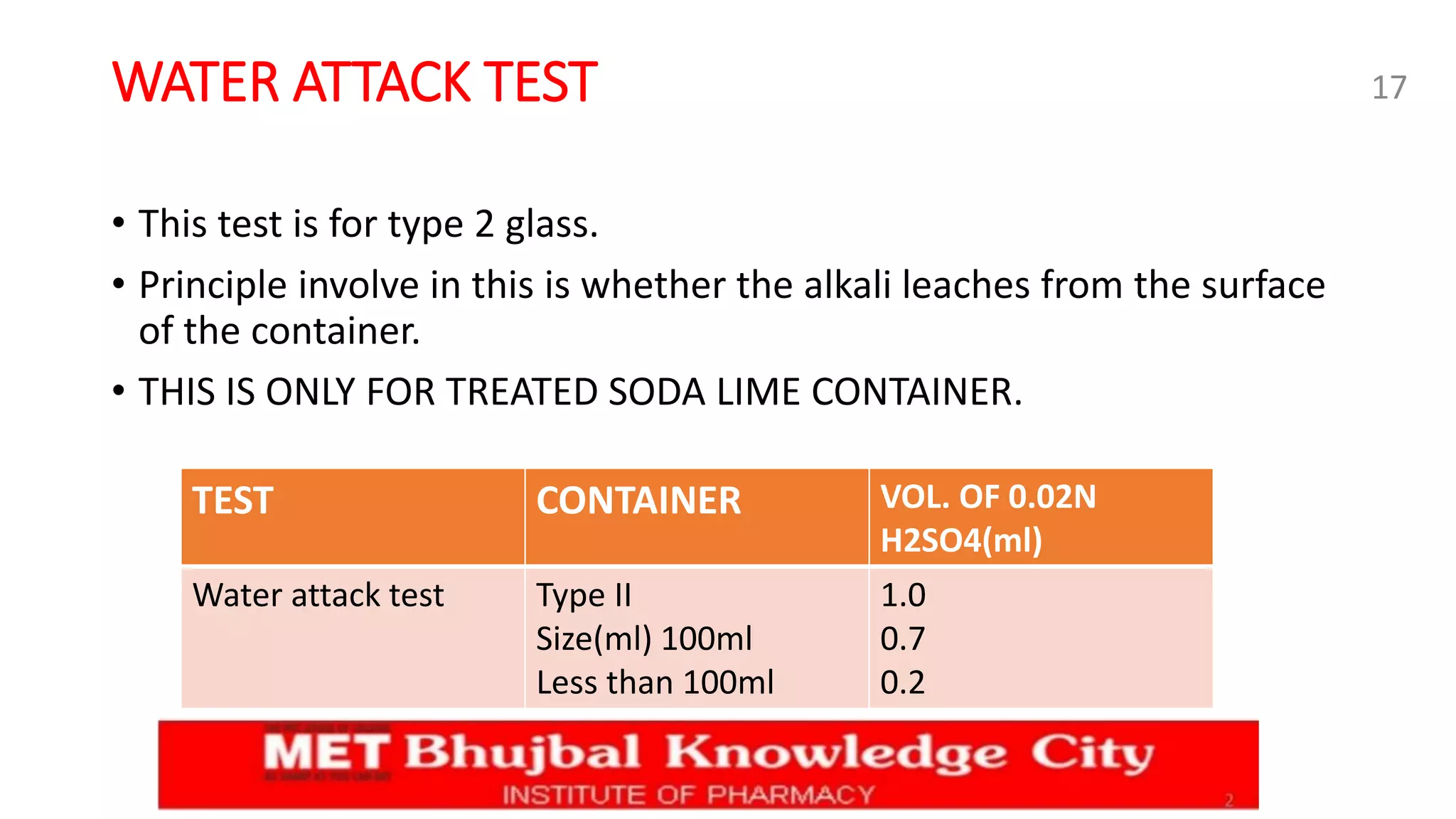
WATER ATTACK TEST
• This test is for type 2 glass.
• Principle involve in this is whether the alkali leaches from the surface
of the container.
• THIS IS ONLY FOR TREATED SODA LIME CONTAINER.
TEST CONTAINER VOL. OF 0.02N
H2SO4(ml)
Water attack test Type II
Size(ml) 100ml
Less than 100ml
1.0
0.7
0.2
17
18
(Whole container)
Water attack test type II
90%of its capacity filled
with water
Powdered glass test
Type I,III,IV
Break container
+powder it +sieve
Atoclave 121°C/30min
Decant & titrate with 0.02N H2SO4
Using methyl red indicator
10 gm of above
sample + 50ml of
distilled water
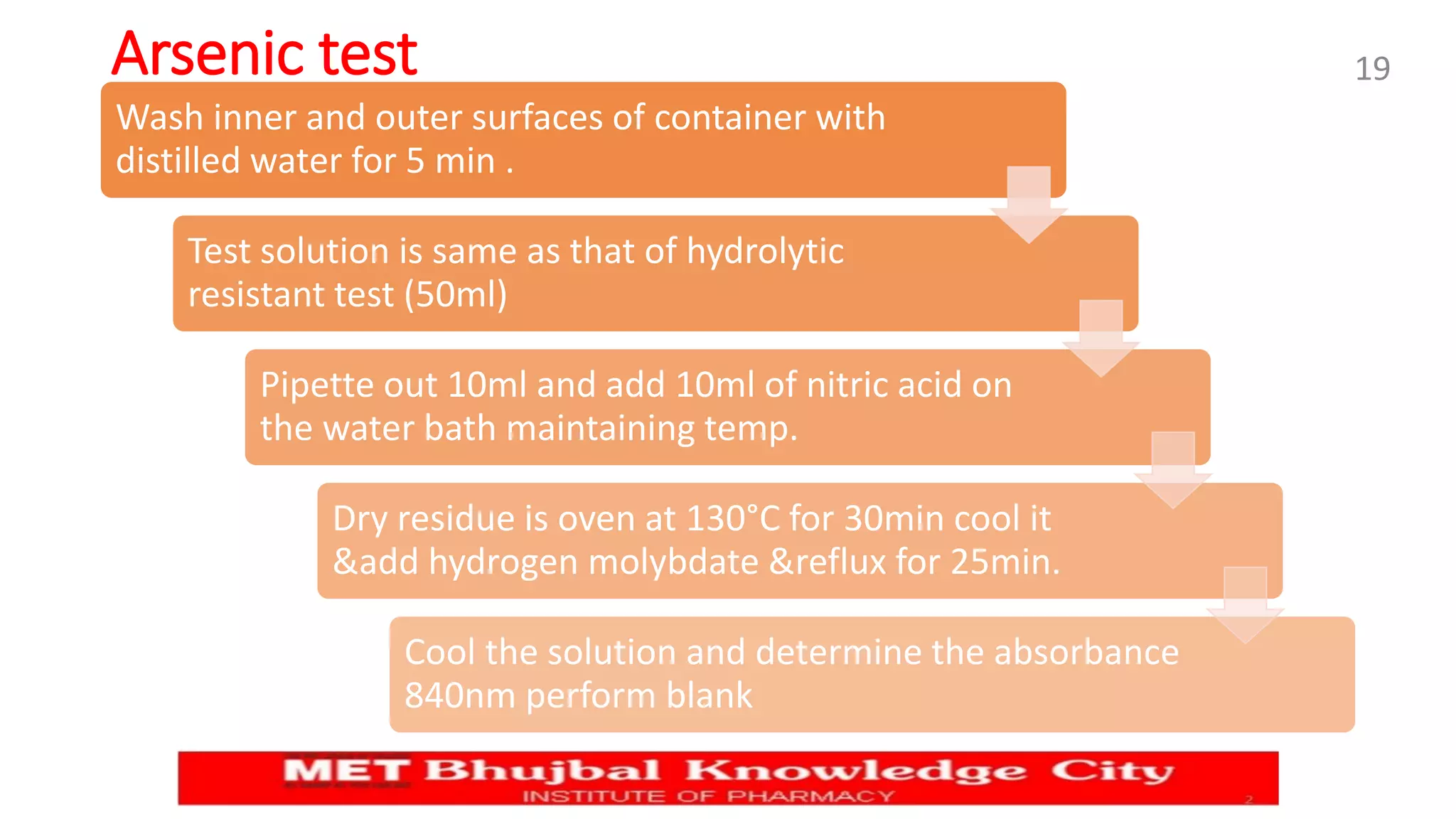
Arsenic test
Wash inner and outer surfaces of container with
distilled water for 5 min .
Test solution is same as that of hydrolytic
resistant test (50ml)
Pipette out 10ml and add 10ml of nitric acid on
the water bath maintaining temp.
Dry residue is oven at 130°C for 30min cool it
&add hydrogen molybdate &reflux for 25min.
Cool the solution and determine the absorbance
840nm perform blank
19
Limits
The absorbance of test solution should not exceed the absorbance of
arsenic std solution 10ppm
THERMAL SHOCK TEST
Place the sample container in upright
position in a try in hot water for given
time .
Transfer the container in cold water bath
temp. should be controlled.examine the
cracks before and after test.
The amount of thermal shocks a bottle can
withstand is based on construction.
20
PLASTIC
• Plastic are group of substances of natural or synthetic origin consisting of
the polymer of high molecular weight that can be moulded into different
shape by means of heat and pressure.
• ADVANTAGES
 Less weight than glass.
 more flexible,extremely resistant to breakage and offer safety to the
consumer.
 Easy to distribution and use.
• DISADVANTAGES
• Absorption permeability to moisture.
• Poor printing property.
21
DRUG PLASTIC CONSIDERATION
Permeation
• The transmission of
gases,vapour,liquid
through plastic
material have
adverse reaction on
shelf life.
leaching
• Most of the plastic
material have one
or ingredients
added in small qty
leaching occurs.
sorption
• The process involve
removal of
constituent from
the product by
packaging material.
22
Plastics
1. POLYETYLENE
2. POLYPROPYLENE(PP)
3. POLYVINYL CHLORIDE(PVC)
4. POLYMONOCHLOROTRIFLUROETHYLENE(PCTFE)
5. POLYSTYRENE
6. NYLON
7. POLYCARBONATE
8. ACRYLIC MULTIPOLYMERS
9. POLYETHYLENE TEREPHTHALATE (PET)
10. ACETAL POLYOXYMETHYLENE(POM)
23
TYPES OF PLASTIC
THERMOPLASTIC THERMOSETTING
Thermoplastics are usually formed by addition of
polymerization.
Thermosetting plastics are often formed by the
condensation polymerization.
It contains long chain linear polymers and held together
by weak vander waal forces.
It contains a 3D network structure constructed with
strong covalent bonds.
Usually becomes soften on heating and stiffen on
cooling .
It does not become soft on heating.
They are expensive. They are cheap.
Thermoplastics is soluble in organic solvents. Thermosetting plastics are insoluble in organic
solvents.
They are usually soft,weak,and less brittle in nature. They are usually hard, strong,more brittle in nature.
Can be remoulded. They cant be remoulded and reprocessed.
recyclable Not recyclable
Ex polythene which changes its shape upon heating
and cooling.
Best ex is Bakelite which once formed does not change
its shape upon further heating.
24
Qulity control test for plastic material
 Leakage test
fill 10 continers with water fit with intended closures.
Keep them inverted at room temperature for 24hrs.
This test said to be passed if there is no sign of leakage from any
container.
 Collapsibility test
This test is applicable to containers which are to be squeezed in order to
remove the content.
Container by collapsing inward during use,yield at least 90percent of its
normal contents at the required rate of flow at ambient temperature.
25
Clarity of aqueous extract
A suitable container is taken at random
,unlabeled,unmarked,and non laminated portion is
selected.
This portions are cut into strips none of each has a total
surface area of 20sq.cm
Strips are washed free from extraneous matter by shaking
them with distilled water for 30sec
The processed sample is taken into a flask previously cleaned
with chromic acid &rinsed with distilled water.
250ml of distilled water is added to the flask ,covered and
autoclaved at 121°C for 30min. The extract is cooled and
examined,it should be colourless and free from turbidity
26
 Water vapour permeability test
Fill 5 containers with normal volume of water and heat seal the
bottles with aluminium foil.
Weigh accurately each container and allowed to stand for 14days at
reative humidity 60 &temp 20°C to 25°C
Reweight the container
The loss of weight in each container NMT 0.2.
 TRANSPERANCY TEST
Standard suspension praparation
1gm hydrazine sulphate in 100ml water and set aside for 6hr.
Take 25ml of this solution and add 25ml of 10 percent W/V hexamine
solution & stand for24hrs.
27
 Test solution preparation
Sample is prepared by 16 fold dilutions of the standard suspension.
Fill the containers &cloudiness detectable when compared to water filled
containers
Absobance is measured at 640nm and range within 0.37 to 0.43
 Resistance to stress
Water is acidified with 2MHCL.
The acidified water is filled with container and apply force on both ends
of the containers
No break or detoriation should occur for sample to comply test.
28
Biological test
 Systemic injection test
The test is perform on albino mice.
In this 5 mice in each group i.e test and blank taken.
The sample is inject in a mice and observe for any significant change
in the activity for 4hrs,24hrs,48hrs,72hrs.
If abnormal behavior such as convulsions occurs the sample does not
meet the requirements.
 Eye irritation test
This test perform on rabbit
Any irritation in eyes due to sample is studied as compare to blank.
29
METAL
• In addition to glass &plastic certain metals are also
employed as containers in pharmaceutical product.
• Metal containers are extremely strong
• Metals offering relatively easy mfg and us ex
collapsible tubes.
• Metals are also fationed into more complex delivery
systems ex dry powder inhalers, aerosol
container,ready to use needles.
• Dispersible system having consistency of sof paste
,gel,cream,ointment can be coveniently packed into
collapsible metal tube .
• primary disadvantage is high cost and qulity control.
30
TEST FOR METAL CONTAINERS (IP)
Select a sample of 50 tubes from the lot to be tested clean each tube by
vibration and blowing.
Filled the tube with a suitable molten ointment base,close the open end
of each tube by a double fold and all the filled tubes overnight at temp
15°C to 20°C
Take a metal bacteriological filter with 4.25cm filter paper suitable
porosity supported on perforated plate and heat it above the melting
range of ointment base.
Remove the cap and apply uniform pressure to the closed end of each
tube in such a manner that time taken to express as much of base as
possible through each nozzle is not less than 20sec.
Collect the extruded base from 50tubes on the heated filter by applying
suction.
31
Wash the walls of filter paper with three sucessive quntities each of
30ml of chloroform all the filter paper to dry.
Examine the filter paper under lightning with magnifying glass with a
graticule 1mm square,one of which sub divided into 0.2mm squares.
Calculate average no of metal particles
Give the score of each metal particle detected as follows and add
together.
Meral particle size
(detected on filter paper)
score
Particles 1mm & above 50
Particles 0.5mm but less than 1mm 10
Particles 0.2mm but less than 0.5mm 2
Particles less than 0.2mm Nil
32
LIMITS
• If total score is less than 100 complies with test
• If total score is more than 150 fails the test
• If score is 100 – 150 repeat the test
33
Rubber
• Rubber of varying composition used in pharmaceuticles and
biologicals as stoppers,cap liners,part of dropper assemblies.
• major use of rubber stopper is that of clousure for multidose vial
solution for injection.
• Disadvsantage
• Rubber stoppers in contact with the liquid in a vial are the sorption of
active ingredient ,antibacterial preservative ,other materials in the
rubber&extraction of one or more components of the rubber into vial
solution.
34
QC TEST FOR RUBBER CLOSURES
• Sterility test
• Fragmentation test
• Self sealability
• Ph of aqueous extract
• Light absorption test
• Reducing substances
• Residue on evaporation
Preparation of solution for tests
wash clousure in 0.2 percent w/v of anionic surfactant for 5min + rinse 5times
with distilled water + 200ml water & atoclave at 119°C to 123°C for 20 to
30min covering with aluminium foil + cool and separate the solution from
closure.
35
 PH of aqueous extract
Take 20ml of solution A,add 0.1ml bromothylmol blue.
Add small amount of 0.01NaOH, after its addition colour changes
from blue to yellow.
The volume of NaOH required to change the colour should not be
more than 0.3ml.
If it is done with HCl the volume of HCl needed should not be more
than 0.8ml.
 Light absorption test
It must be done within 4 hrs of preparing solution A.
Solution A filter and its absorbance is measured at 200 to 360nm.
Similarly take absorbance of blank without closure & absorbance
should not be more than 2.0
36
Self seal ability test
• Close the vial with prepared closures.
• For each closure use a new needle with an external diameter 0.8mm
& pierce the closure different site 10times.
• Immerse the vial upright in a 0.1 w/v solution of methylene blue
&reduce the external pressure by 27kpa for 10min .
• Restore the atmospheric pressure and leave the vial immersed for 30
min.
• Rinse the outside of the vial
• none of the vial contain any trace or coloured solution.
37
closure
 Closures is normally the most
vulnerable and critical
component of container as
stability and compatibility with
the product is concerned.
 Effective closure must prevent
the content from escaping and
allow no substance to enter the
container.
38
TAMPER RESISTANT PACKAGING/CLOSURE
In 1975 USFDA requirement for tamper evident packaging to
be used for opthalmic preparation.
Regulation specifies that the closure must be sealed in such
a manner that the content cannot be used without
destroying the seal.
In 1982 tamper evident packaging for OTC human drug
product.
May 1992 FDA listed a 11technologies capable of satisfying
the defination of tamper evident packaging while 12th added
for sealed carton.
39
requirment of tamer resistant packaging by
FDA regulation 21CFR parts 211,314,700
1. Film wrapper
2. Blister package
3. Strip package
4. Bubble pack
5. Foil,paper,plastic pouches
6. Bottle seal
7. Tape seal
8. Breakable seal
9. Shrink seal and bands
10. Sealed tubes
11. Aerosol container
12. Sealed carton
40
Child resistance closures
Tragic accidents involving the drug
intoxication of children has led to new
legislation making it difficult for drug
packaging to be opened by young
children, while allowing adults easy
access.
Such packaging is designated as child-
resistant.
41
CHILD RESISTANT PACKAGING
• Certain protocols for child-resistant packaging were established in the
USA in 1966. In 1970, the Poison-Prevention Packaging Act was
passed and placed under the jurisdiction of the Food and Drug
Administration.
• This Act was transferred in 1973 to the Consumer Product Safety
Commission, which is responsible for drugs and household
substances .
• The use of child-resistant packaging has proved effective in reducing
child mortality from intoxication by oral prescription drugs, and it is
now recognized worldwide that children must be protected against
such intoxication
42
• The European Committee for Standardization (CEN) has defined a
child-resistant package as one “which makes it difficult for young
children to gain access to the contents, but which is not too difficult
for adults to use properly in accordance with the requirement of this
European standard”.
• The three most common reclosable child-resistant types of closure
are the “press–turn”, the “squeeze–turn” and a combination lock.
• To determine whether a packaging is child-resistant, it must be
subjected to the ISO test procedure for reclosable child-resistant
packaging .
• Most designs that are child-resistant require two hands to open the
closure. Such packaging can cause problems for elderly people, and
can even lead to the deliberate purchase of drugs with packaging.
43
Recent packaging technology
• BLOW FILL SEAL TECHNOLOGY
Is the process by which plastic containers are forms filled with sterile
filter product &sealed in a uniterrupted sequence of operation within
the control sterile enviroment of single machine.
• ADVANTAGES
Robust method reduce personnel intervention for making aseptic
preparations and sterile pharmaceuticals.
There is no need to purchase and stock a range of prefabricated
containers &their closures.
Cleaning and sterilization of prefabricated containers not required so
cost of material transport and storage reduce.
44
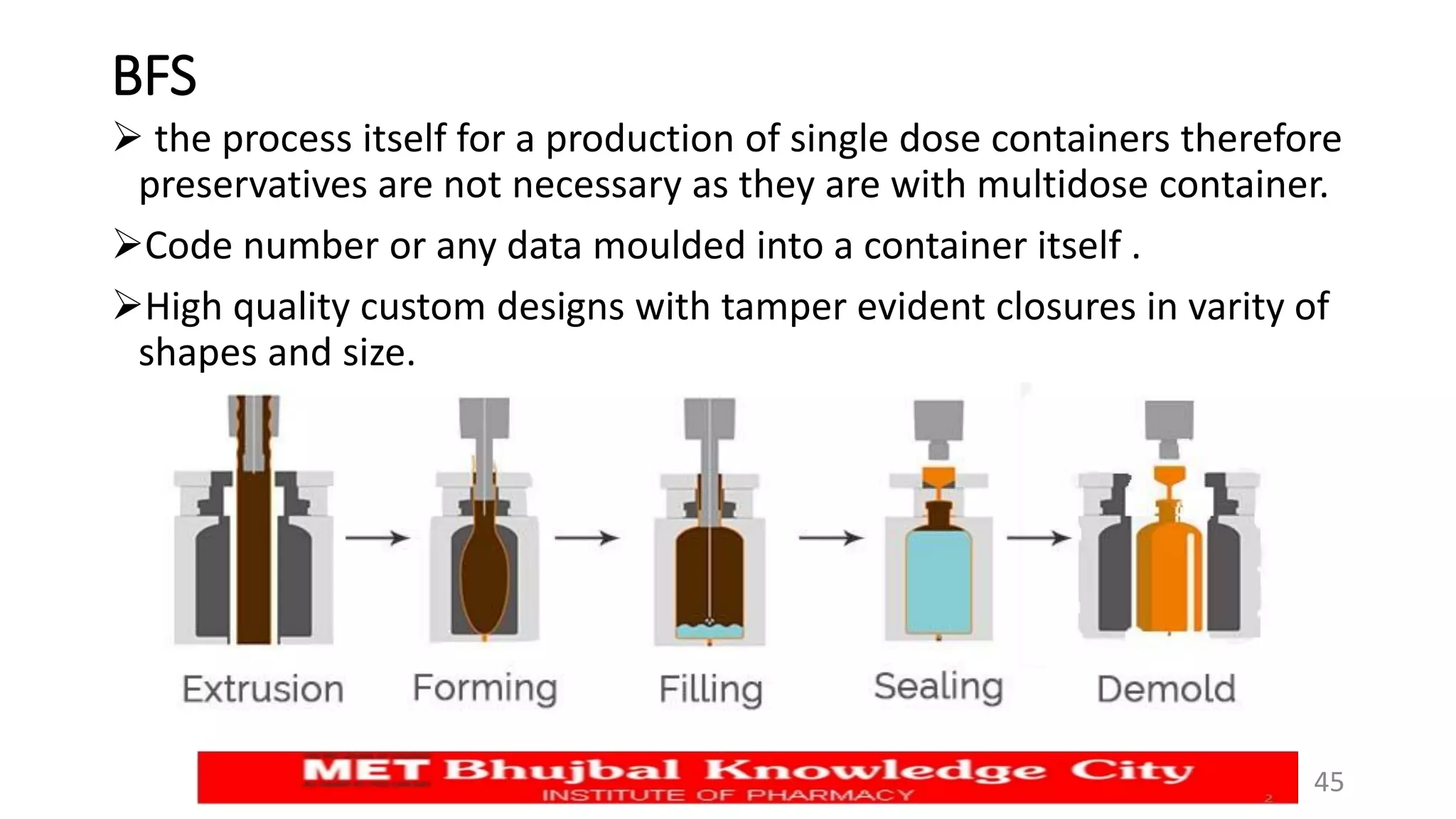
BFS
 the process itself for a production of single dose containers therefore
preservatives are not necessary as they are with multidose container.
Code number or any data moulded into a container itself .
High quality custom designs with tamper evident closures in varity of
shapes and size.
45
Innovative packaging style
Regular Innovative
46
ANTI COUNTERFEIT PACKAGING TECHNOLOGIES
• Counterfeiting means producing products and packaging similar to originals
& selling the fake as authentic products.
• Product security problem
Dublication(copying of lebels,instruction & usage information)
Substitution(placing inferior product)
Tampering (using stolen good in place of real)
• ANTI COUNTERFEITING TECHNOLOGY IN PACKAGING
• Overt features
• RFID
• Hologaphic labels
• Water mark
• Trace track technology
• Safety ampoule breaker
47
OVERT (VISIBLE) FEATURES
• overt features are intended to Enable users to verify the authenticity
of pack.
• This feature normally be promiently visible and difficult expensive to
reproduce.
• They are designed in such a way that they can not be reused or
removed without being defaced or causing damage to the pack.
Covert features
• The purpose of convert features is to enable the brand owner to
identify counterfeited product.(general public is unaware about this )
48
RFID(Radio frequency identification)
• It’s a new concept
• It allows identification of object through the wireless communication
in a fixed frequency band.
• Three important components of any RFID system
THE TAG
integrated circuit containing unique tracking identifier
THE READER
connects tag data with software electronic product code EPC
SOFTWARE
49
BARCODES
• It is a series of parallel, adjecent bars and space use to encode the
strong string of data.
• Bar coding when used with GS I standards permits universal and
unique identification of goods &sevices,assets etc.
• Bar code readers decodes the bar code using intensity of light
reflected.
50
PAKAGING OPERATIONS
• as per WHO,TGA,USFDA
• Before any processing operation is started steps should be taken to
ensure that line should be clean,also the documents previously used
and not required for current operation.
• Equipment under operation have 3 sops operation, cleaning,
maintenance.ex printing machine should be follow.
• Attention should be given when printing by hands should be checked
regular interval.
• Online control of the product during packaging must be there.
• Any significant discrepancy obseved during reconcillation of the
amount of packaging material issued and no of unit produced should
be investigated and satisfactorily accounted.
51
Safety ampoule breaker
• Ampoules are small glass vessels
in which liquids for injection are
hermatically sealed.
• The ampoules neck does not
always break where it intended.
• When the glass is snapped off
glass chips can fly off sharp
edges can cut the hands of
healthworkers and leads to
contamination.
• Snap off ampoule
• Ampoule open safely by using
predetermined breaking point.
52
PAKAGING WORK ORDER 53
VISUAL INSPECTION CHECK
54
55
AS PER cGMP
 Label Issuance and Control
• Access to the label storage areas should be limited to authorised personnel.
• Procedures should be used to reconcile the quantities of labels issued, used, and
returned and to evaluate discrepancies found between the number of containers
labelled and the number of labels issued. Such discrepancies should be investigated, and
the investigation should be approved by the quality unit(s).
• All excess labels bearing batch numbers or other batch-related printing should be
destroyed. Returned labels should be maintained and stored in a manner that prevents
mix-ups and provides proper identification.
• Obsolete and out-dated labels should be destroyed.
• Printing devices used to print labels for packaging operations should be controlled to
ensure that all imprinting conforms to the print specified in the batch production record.
• Printed labels issued for a batch should be carefully examined for proper identity and
conformity to specifications in the master production record. The results of this
examination should be documented.
• A printed label representative of those used should be included in the batch production
record.
56
OVERPRINTING OF PACKAGING MATERIALS
57
OVERPRINTING DETAILS
58
59
PACKAGING RECORD
60
61
62
63
SHIPPER CHECKING RECORD
64
65
• MATERIALS EXAMINATION AND USAGE CRITERIA AS PER cGMP
• (a) There shall be written procedures describing in sufficient the detail of the
receipt, identification, storage, handling, sampling, examination, and/or testing of
labeling, and packaging materials; such written procedures shall be followed.
Labeling and packaging materials shall be representatively sampled, and examined
or tested upon receipt and before use in packaging or labeling of a drug product.
• (b) Any labeling or packaging materials meeting appropriate written specifications
may be approved and released for use. Any labeling or packaging materials that do
not meet such specifications shall be rejected to prevent their use in operations for
which they are unsuitable.
• (c) Records shall be maintained for each shipment received of each different labeling
and packaging material indicating receipt, examination or testing, and whether
accepted or rejected.
• (d) Labels and other labeling materials for each different drug product, strength,
dosage form, or quantity of contents shall be stored separately with suitable
identification. Access to the storage shall be limited to authorized personnel.
• (e) Obsolete and outdated labels, labeling, and other packaging materials shall be
destroyed.
66
• (f) Use of gang printed labeling for different drug products or different strengths
or net contents of the same drug product is prohibited unless the labeling from
gang printed sheets is adequately differentiated by size, shape, or color.
• (g) If cut labeling is used, packaging and labeling operations shall include one of
the following special control procedures:
• (1) Dedication of labeling and packaging lines to each different strength of each
different drug product.
• (2) Use of appropriate electronic or electromechanical equipment to conduct a
100% examination for correct labeling during or after completion of finishing
operations.
• (3) Use of visual inspection to conduct a 100% examination for correct labeling
during or after completion of finishing operations for hand applied labeling. Such
examination shall be performed by one person and independently verified by a
second person.
• (h) Printing devices on, or associated with, manufacturing lines used to imprint
labeling upon the drug product unit label or case shall be monitored to assure
that all imprinting conforms to the print specified in the batch production record.
67
CONCLUSION
In recent decades pharmaceutical packaging technology
is an important techniqe in pharmaceutical industry.as
after formulation next step comes that is packaging of the
product. It gives protection to the product and also
improves patient compliance too.innovations are going
on to reduce the packaging cost without compromising
qulity. Is possible only when the packaging operations are
done according to guidelines given by WHO,USFDA,TGA
etc. FAULTY PACKAGING OF A PHARMACEUTICAL
DOSAGE FORM CAN INVALIDATE THE MOST STABLE
FORMULTION
68
Reference
• D.A.Dean, E.R. Evans,pharmaceutical packaging technology, I.H.Hall.1st
E/d,Taylor and francis ,london and new york page no 210,264,404,443
• Indian pharmacopoeia 2007,Government of Indian Ministry of Health
And Family Welfare,the Indian Pharmacopoeia commision, Ghaziabad
volume 1 page no 599 – 609
• Lachman,Liebermans.The theory and practice of industrial pharmacy,4th
edition CBS Publishers and Distributors pvt Ltd. Page no 1003 – 1035
• Manohar A Potdar CGMP for pharmaceuticals PharmaMed Press
publishers page no 286 – 297,672-681
• WHO Technical Report Series No 902 Annex 9,2002
69
THANK YOU
70

PACKAGING MATERIAL QUALITY CONTROL TEST AND OPERATION.pdf

  • 1.
    M. Pharm Sem-ISeminars Quality Control Test For Packaging Material And Packaging Operation SUBMITTED TO SAVITRIBAI PHULE, PUNE UNIVERSITY, PUNE FOR PARTIAL FULFILMENT OF REQUIREMENTS FOR THE AWARD OF DEGREE OF MASTER OF PHARMACY IN THE SUBJECT QUALITY ASSURANCE TECHNIQUES IN THE FACULTY OF SCIENCE AND TECHNOLOGY Bhujbal Knowledge City, MET’s Institute of Pharmacy, Adgaon , Nashik, 422003. Maharashtra, India Academic Year- 2022-23 Presented By- Ms. Mayuri Pawar (QAT) SEM I Roll No. 11 Guided By : Dr. G.S. Deokar HOD (QAT Dept.) 1
  • 2.
    GOOD PACKAGING PROTECTS YOUR PRODUCT GREATPACKAGING PROTECT YOUR BRAND 2
  • 3.
    CONTENTS • DEFINITION • FUNCTIONOF PACKAGING • TYPES OF PACKAGING MATERIAL • QULITY CONTROL TEST OF PACKAGING MATERIAL • PACKAGING CONTAINER AND CLOUSURES SYSTEM • INNOVATIONS IN PACKAGING TECHNOLOGY • PACKAGING OPERATIONS • CONCLUSION • REFERENCES 3
  • 4.
    WHAT IS PACKAGING? DEFINITION Packaging is the science art and technology of enclosing or protecting products for distribution, storage,sale and use. packaging also refers to the process of design And production of packages. Pharmaceutical packaging defined as the economical means of providing presentation, protection, identification,information,convenience, compliance and the stability of product. 4
  • 5.
    FUNCTION Protection &preservation Information &presentation Brand communication& patient convinience identification containment 5
  • 6.
    Types of rawmaterials used in packaging • Types of materials Uses • Cardboard : Boxes, Display units, Paper Labels, Leaflets. • Glass :Ampoules ,Bottles, Vials ,Syringes ,Cartridges . • Plastic :Closures ,Bottles ,Bags ,Tubes Laminates with paper or foil. • Metal, e.g. aluminium : Collapsible tubes, Rigid cans Foils . • Rubber : Closures, including plunger. 6
  • 7.
    TYPES OF PACKAGING PRIMARYPACKAGING • The component which are in directly contact with pharmaceutical Dosage form. • They protects the drug from enviroment. • Ex bottles,blister films SECONDARY PACKAGING • They are not directly in contact with dosage form • It gives protection and lebelling for primary components • Ex cartons TERTIATY PACKAGING • These are mostly used for transportation as well as bulk handling • During transporatation its protect product from damage. • Ex shipper 7
  • 8.
    TYPES OF CONTAINER •Unit dose container multi dose container • Airtight container • Hermatically sealed container • Light resistant container • Sealed container • Single dose container • Tamper evident container • Tightly closed container • Well closed container 8
  • 9.
    TYPES OF PACKAGINGMATERIAL Glass Plastic Rubber Metal 9
  • 10.
    GLASS Glass is widelyused in pharmaceutical industry. ADVANTAGES  Its possesses superior protective qualities and readily available in various shapes and sizes.  Glass does not detoriate with age gives excellent barrier qualities aginst every element(except light) DISADVANTAGES  Major disadvantage is its fragile nature easily broken.  Release alkali in preparation. 10
  • 11.
    Composition of glass •Glass is composed of sand(SiO2),soda ash(Na2CO3),Limestone(CaCO3) Cullet(broken glass) MANUFACTURING OF GLASS CONTAINERS BLOWING (by using compressed air moulding takes place) DRAWING(molten glass is converted into different shapes) PRESSING(mechanical force used to press the glass) CASTING (forms the cavity with the help of centrifugal force) 11
  • 12.
    TYPES OF GLASSAS PER USP TYPES OF GLASS TEST USES PROPERTIES Type 1 (Borosilicate Glass) Powedered glass test Parenteral usage, chemical glassware container for alkali sensitive preparation. High melting temperature, Low thermal expansion,resistant to thermal shock Type 2 (treated soda lime glass) Water attack test Parenteral usage ,alkali sensitive preparation,for blood plasma and infusion fluids. Parenteral usage,alkali sensitive preparations,for blood plasma and infusion fluids. Type 3 (soda lime glass) Powedered glass test Only for non aqueous preparation Low melting temperature & cheapest. Type 4 (genereal purposes soda lime glass) Powedered glass test Light sensitive products Not parenteral. It doesn’t allow the uv ray to pass through it. 12
  • 13.
    QULITY CONTROL TESTFOR GLASS CONTAINERS  CHEMICAL RESISTANCE TEST Powdered glass test Water attack test  HYDROLYTIC RESISTANCE TEST Arsenic test Thermal shock test Internal bursting pressure test 13
  • 14.
    Powdered glass test •It done to estimate the amount of alkali from powdered glass at elevated temperature. • When glass is powered leaching of alkali is enhanced,which can titrated with 0.02N sulphuric acid using methylred as indicator. STEP 1 :PREPARATION OF GLASS SPECIMEN • Few containers are rinsed thoroughly with purified water and dried with stream of clean air. • Grind the container in a mortor to a fine powder and pass through sieve no 20&50. STEP 2 : WASHING THE SPECIMEN • 10gm of above specimen is taken into 250ml of conical flask and wash it with 30ml acetone . • Reapeat the washing decand the acetone and dry used after 48 hr. 14
  • 15.
    POWDERED GLASS TEST •10gm of specimen/sample +50ml highly purified water 250ml flask& atoclave it at 121°C • Cool it and decant the solution in another flask again and add 15ml of water and decant solution. • Titrate the decant solution with 0.02N sulphuric acid using methyl red and record the volume. limits TEST CONTAINER VOL OF 0.02N H2SO4 (ml) POWDERED GLASS TEST TYPE I TYPE III TYPE IV 1.0 8.5 15.0 15
  • 16.
    WATER ATTACK TEST Rinsethoroughly container with high purity water.fill it by 90%of its capacity with water Atoclave it at 121 °C for 30min then cooled it liquid is decanted. Decanted liquid is titrated with 0.02N sulphuric acid using methyl red as a indicator Then volume of sulphuric acid consumed is recorded and compare with limits. 16
  • 17.
    WATER ATTACK TEST •This test is for type 2 glass. • Principle involve in this is whether the alkali leaches from the surface of the container. • THIS IS ONLY FOR TREATED SODA LIME CONTAINER. TEST CONTAINER VOL. OF 0.02N H2SO4(ml) Water attack test Type II Size(ml) 100ml Less than 100ml 1.0 0.7 0.2 17
  • 18.
    18 (Whole container) Water attacktest type II 90%of its capacity filled with water Powdered glass test Type I,III,IV Break container +powder it +sieve Atoclave 121°C/30min Decant & titrate with 0.02N H2SO4 Using methyl red indicator 10 gm of above sample + 50ml of distilled water
  • 19.
    Arsenic test Wash innerand outer surfaces of container with distilled water for 5 min . Test solution is same as that of hydrolytic resistant test (50ml) Pipette out 10ml and add 10ml of nitric acid on the water bath maintaining temp. Dry residue is oven at 130°C for 30min cool it &add hydrogen molybdate &reflux for 25min. Cool the solution and determine the absorbance 840nm perform blank 19
  • 20.
    Limits The absorbance oftest solution should not exceed the absorbance of arsenic std solution 10ppm THERMAL SHOCK TEST Place the sample container in upright position in a try in hot water for given time . Transfer the container in cold water bath temp. should be controlled.examine the cracks before and after test. The amount of thermal shocks a bottle can withstand is based on construction. 20
  • 21.
    PLASTIC • Plastic aregroup of substances of natural or synthetic origin consisting of the polymer of high molecular weight that can be moulded into different shape by means of heat and pressure. • ADVANTAGES  Less weight than glass.  more flexible,extremely resistant to breakage and offer safety to the consumer.  Easy to distribution and use. • DISADVANTAGES • Absorption permeability to moisture. • Poor printing property. 21
  • 22.
    DRUG PLASTIC CONSIDERATION Permeation •The transmission of gases,vapour,liquid through plastic material have adverse reaction on shelf life. leaching • Most of the plastic material have one or ingredients added in small qty leaching occurs. sorption • The process involve removal of constituent from the product by packaging material. 22
  • 23.
    Plastics 1. POLYETYLENE 2. POLYPROPYLENE(PP) 3.POLYVINYL CHLORIDE(PVC) 4. POLYMONOCHLOROTRIFLUROETHYLENE(PCTFE) 5. POLYSTYRENE 6. NYLON 7. POLYCARBONATE 8. ACRYLIC MULTIPOLYMERS 9. POLYETHYLENE TEREPHTHALATE (PET) 10. ACETAL POLYOXYMETHYLENE(POM) 23
  • 24.
    TYPES OF PLASTIC THERMOPLASTICTHERMOSETTING Thermoplastics are usually formed by addition of polymerization. Thermosetting plastics are often formed by the condensation polymerization. It contains long chain linear polymers and held together by weak vander waal forces. It contains a 3D network structure constructed with strong covalent bonds. Usually becomes soften on heating and stiffen on cooling . It does not become soft on heating. They are expensive. They are cheap. Thermoplastics is soluble in organic solvents. Thermosetting plastics are insoluble in organic solvents. They are usually soft,weak,and less brittle in nature. They are usually hard, strong,more brittle in nature. Can be remoulded. They cant be remoulded and reprocessed. recyclable Not recyclable Ex polythene which changes its shape upon heating and cooling. Best ex is Bakelite which once formed does not change its shape upon further heating. 24
  • 25.
    Qulity control testfor plastic material  Leakage test fill 10 continers with water fit with intended closures. Keep them inverted at room temperature for 24hrs. This test said to be passed if there is no sign of leakage from any container.  Collapsibility test This test is applicable to containers which are to be squeezed in order to remove the content. Container by collapsing inward during use,yield at least 90percent of its normal contents at the required rate of flow at ambient temperature. 25
  • 26.
    Clarity of aqueousextract A suitable container is taken at random ,unlabeled,unmarked,and non laminated portion is selected. This portions are cut into strips none of each has a total surface area of 20sq.cm Strips are washed free from extraneous matter by shaking them with distilled water for 30sec The processed sample is taken into a flask previously cleaned with chromic acid &rinsed with distilled water. 250ml of distilled water is added to the flask ,covered and autoclaved at 121°C for 30min. The extract is cooled and examined,it should be colourless and free from turbidity 26
  • 27.
     Water vapourpermeability test Fill 5 containers with normal volume of water and heat seal the bottles with aluminium foil. Weigh accurately each container and allowed to stand for 14days at reative humidity 60 &temp 20°C to 25°C Reweight the container The loss of weight in each container NMT 0.2.  TRANSPERANCY TEST Standard suspension praparation 1gm hydrazine sulphate in 100ml water and set aside for 6hr. Take 25ml of this solution and add 25ml of 10 percent W/V hexamine solution & stand for24hrs. 27
  • 28.
     Test solutionpreparation Sample is prepared by 16 fold dilutions of the standard suspension. Fill the containers &cloudiness detectable when compared to water filled containers Absobance is measured at 640nm and range within 0.37 to 0.43  Resistance to stress Water is acidified with 2MHCL. The acidified water is filled with container and apply force on both ends of the containers No break or detoriation should occur for sample to comply test. 28
  • 29.
    Biological test  Systemicinjection test The test is perform on albino mice. In this 5 mice in each group i.e test and blank taken. The sample is inject in a mice and observe for any significant change in the activity for 4hrs,24hrs,48hrs,72hrs. If abnormal behavior such as convulsions occurs the sample does not meet the requirements.  Eye irritation test This test perform on rabbit Any irritation in eyes due to sample is studied as compare to blank. 29
  • 30.
    METAL • In additionto glass &plastic certain metals are also employed as containers in pharmaceutical product. • Metal containers are extremely strong • Metals offering relatively easy mfg and us ex collapsible tubes. • Metals are also fationed into more complex delivery systems ex dry powder inhalers, aerosol container,ready to use needles. • Dispersible system having consistency of sof paste ,gel,cream,ointment can be coveniently packed into collapsible metal tube . • primary disadvantage is high cost and qulity control. 30
  • 31.
    TEST FOR METALCONTAINERS (IP) Select a sample of 50 tubes from the lot to be tested clean each tube by vibration and blowing. Filled the tube with a suitable molten ointment base,close the open end of each tube by a double fold and all the filled tubes overnight at temp 15°C to 20°C Take a metal bacteriological filter with 4.25cm filter paper suitable porosity supported on perforated plate and heat it above the melting range of ointment base. Remove the cap and apply uniform pressure to the closed end of each tube in such a manner that time taken to express as much of base as possible through each nozzle is not less than 20sec. Collect the extruded base from 50tubes on the heated filter by applying suction. 31
  • 32.
    Wash the wallsof filter paper with three sucessive quntities each of 30ml of chloroform all the filter paper to dry. Examine the filter paper under lightning with magnifying glass with a graticule 1mm square,one of which sub divided into 0.2mm squares. Calculate average no of metal particles Give the score of each metal particle detected as follows and add together. Meral particle size (detected on filter paper) score Particles 1mm & above 50 Particles 0.5mm but less than 1mm 10 Particles 0.2mm but less than 0.5mm 2 Particles less than 0.2mm Nil 32
  • 33.
    LIMITS • If totalscore is less than 100 complies with test • If total score is more than 150 fails the test • If score is 100 – 150 repeat the test 33
  • 34.
    Rubber • Rubber ofvarying composition used in pharmaceuticles and biologicals as stoppers,cap liners,part of dropper assemblies. • major use of rubber stopper is that of clousure for multidose vial solution for injection. • Disadvsantage • Rubber stoppers in contact with the liquid in a vial are the sorption of active ingredient ,antibacterial preservative ,other materials in the rubber&extraction of one or more components of the rubber into vial solution. 34
  • 35.
    QC TEST FORRUBBER CLOSURES • Sterility test • Fragmentation test • Self sealability • Ph of aqueous extract • Light absorption test • Reducing substances • Residue on evaporation Preparation of solution for tests wash clousure in 0.2 percent w/v of anionic surfactant for 5min + rinse 5times with distilled water + 200ml water & atoclave at 119°C to 123°C for 20 to 30min covering with aluminium foil + cool and separate the solution from closure. 35
  • 36.
     PH ofaqueous extract Take 20ml of solution A,add 0.1ml bromothylmol blue. Add small amount of 0.01NaOH, after its addition colour changes from blue to yellow. The volume of NaOH required to change the colour should not be more than 0.3ml. If it is done with HCl the volume of HCl needed should not be more than 0.8ml.  Light absorption test It must be done within 4 hrs of preparing solution A. Solution A filter and its absorbance is measured at 200 to 360nm. Similarly take absorbance of blank without closure & absorbance should not be more than 2.0 36
  • 37.
    Self seal abilitytest • Close the vial with prepared closures. • For each closure use a new needle with an external diameter 0.8mm & pierce the closure different site 10times. • Immerse the vial upright in a 0.1 w/v solution of methylene blue &reduce the external pressure by 27kpa for 10min . • Restore the atmospheric pressure and leave the vial immersed for 30 min. • Rinse the outside of the vial • none of the vial contain any trace or coloured solution. 37
  • 38.
    closure  Closures isnormally the most vulnerable and critical component of container as stability and compatibility with the product is concerned.  Effective closure must prevent the content from escaping and allow no substance to enter the container. 38
  • 39.
    TAMPER RESISTANT PACKAGING/CLOSURE In1975 USFDA requirement for tamper evident packaging to be used for opthalmic preparation. Regulation specifies that the closure must be sealed in such a manner that the content cannot be used without destroying the seal. In 1982 tamper evident packaging for OTC human drug product. May 1992 FDA listed a 11technologies capable of satisfying the defination of tamper evident packaging while 12th added for sealed carton. 39
  • 40.
    requirment of tamerresistant packaging by FDA regulation 21CFR parts 211,314,700 1. Film wrapper 2. Blister package 3. Strip package 4. Bubble pack 5. Foil,paper,plastic pouches 6. Bottle seal 7. Tape seal 8. Breakable seal 9. Shrink seal and bands 10. Sealed tubes 11. Aerosol container 12. Sealed carton 40
  • 41.
    Child resistance closures Tragicaccidents involving the drug intoxication of children has led to new legislation making it difficult for drug packaging to be opened by young children, while allowing adults easy access. Such packaging is designated as child- resistant. 41
  • 42.
    CHILD RESISTANT PACKAGING •Certain protocols for child-resistant packaging were established in the USA in 1966. In 1970, the Poison-Prevention Packaging Act was passed and placed under the jurisdiction of the Food and Drug Administration. • This Act was transferred in 1973 to the Consumer Product Safety Commission, which is responsible for drugs and household substances . • The use of child-resistant packaging has proved effective in reducing child mortality from intoxication by oral prescription drugs, and it is now recognized worldwide that children must be protected against such intoxication 42
  • 43.
    • The EuropeanCommittee for Standardization (CEN) has defined a child-resistant package as one “which makes it difficult for young children to gain access to the contents, but which is not too difficult for adults to use properly in accordance with the requirement of this European standard”. • The three most common reclosable child-resistant types of closure are the “press–turn”, the “squeeze–turn” and a combination lock. • To determine whether a packaging is child-resistant, it must be subjected to the ISO test procedure for reclosable child-resistant packaging . • Most designs that are child-resistant require two hands to open the closure. Such packaging can cause problems for elderly people, and can even lead to the deliberate purchase of drugs with packaging. 43
  • 44.
    Recent packaging technology •BLOW FILL SEAL TECHNOLOGY Is the process by which plastic containers are forms filled with sterile filter product &sealed in a uniterrupted sequence of operation within the control sterile enviroment of single machine. • ADVANTAGES Robust method reduce personnel intervention for making aseptic preparations and sterile pharmaceuticals. There is no need to purchase and stock a range of prefabricated containers &their closures. Cleaning and sterilization of prefabricated containers not required so cost of material transport and storage reduce. 44
  • 45.
    BFS  the processitself for a production of single dose containers therefore preservatives are not necessary as they are with multidose container. Code number or any data moulded into a container itself . High quality custom designs with tamper evident closures in varity of shapes and size. 45
  • 46.
  • 47.
    ANTI COUNTERFEIT PACKAGINGTECHNOLOGIES • Counterfeiting means producing products and packaging similar to originals & selling the fake as authentic products. • Product security problem Dublication(copying of lebels,instruction & usage information) Substitution(placing inferior product) Tampering (using stolen good in place of real) • ANTI COUNTERFEITING TECHNOLOGY IN PACKAGING • Overt features • RFID • Hologaphic labels • Water mark • Trace track technology • Safety ampoule breaker 47
  • 48.
    OVERT (VISIBLE) FEATURES •overt features are intended to Enable users to verify the authenticity of pack. • This feature normally be promiently visible and difficult expensive to reproduce. • They are designed in such a way that they can not be reused or removed without being defaced or causing damage to the pack. Covert features • The purpose of convert features is to enable the brand owner to identify counterfeited product.(general public is unaware about this ) 48
  • 49.
    RFID(Radio frequency identification) •It’s a new concept • It allows identification of object through the wireless communication in a fixed frequency band. • Three important components of any RFID system THE TAG integrated circuit containing unique tracking identifier THE READER connects tag data with software electronic product code EPC SOFTWARE 49
  • 50.
    BARCODES • It isa series of parallel, adjecent bars and space use to encode the strong string of data. • Bar coding when used with GS I standards permits universal and unique identification of goods &sevices,assets etc. • Bar code readers decodes the bar code using intensity of light reflected. 50
  • 51.
    PAKAGING OPERATIONS • asper WHO,TGA,USFDA • Before any processing operation is started steps should be taken to ensure that line should be clean,also the documents previously used and not required for current operation. • Equipment under operation have 3 sops operation, cleaning, maintenance.ex printing machine should be follow. • Attention should be given when printing by hands should be checked regular interval. • Online control of the product during packaging must be there. • Any significant discrepancy obseved during reconcillation of the amount of packaging material issued and no of unit produced should be investigated and satisfactorily accounted. 51
  • 52.
    Safety ampoule breaker •Ampoules are small glass vessels in which liquids for injection are hermatically sealed. • The ampoules neck does not always break where it intended. • When the glass is snapped off glass chips can fly off sharp edges can cut the hands of healthworkers and leads to contamination. • Snap off ampoule • Ampoule open safely by using predetermined breaking point. 52
  • 53.
  • 54.
  • 55.
  • 56.
    AS PER cGMP Label Issuance and Control • Access to the label storage areas should be limited to authorised personnel. • Procedures should be used to reconcile the quantities of labels issued, used, and returned and to evaluate discrepancies found between the number of containers labelled and the number of labels issued. Such discrepancies should be investigated, and the investigation should be approved by the quality unit(s). • All excess labels bearing batch numbers or other batch-related printing should be destroyed. Returned labels should be maintained and stored in a manner that prevents mix-ups and provides proper identification. • Obsolete and out-dated labels should be destroyed. • Printing devices used to print labels for packaging operations should be controlled to ensure that all imprinting conforms to the print specified in the batch production record. • Printed labels issued for a batch should be carefully examined for proper identity and conformity to specifications in the master production record. The results of this examination should be documented. • A printed label representative of those used should be included in the batch production record. 56
  • 57.
  • 58.
  • 59.
  • 60.
  • 61.
  • 62.
  • 63.
  • 64.
  • 65.
  • 66.
    • MATERIALS EXAMINATIONAND USAGE CRITERIA AS PER cGMP • (a) There shall be written procedures describing in sufficient the detail of the receipt, identification, storage, handling, sampling, examination, and/or testing of labeling, and packaging materials; such written procedures shall be followed. Labeling and packaging materials shall be representatively sampled, and examined or tested upon receipt and before use in packaging or labeling of a drug product. • (b) Any labeling or packaging materials meeting appropriate written specifications may be approved and released for use. Any labeling or packaging materials that do not meet such specifications shall be rejected to prevent their use in operations for which they are unsuitable. • (c) Records shall be maintained for each shipment received of each different labeling and packaging material indicating receipt, examination or testing, and whether accepted or rejected. • (d) Labels and other labeling materials for each different drug product, strength, dosage form, or quantity of contents shall be stored separately with suitable identification. Access to the storage shall be limited to authorized personnel. • (e) Obsolete and outdated labels, labeling, and other packaging materials shall be destroyed. 66
  • 67.
    • (f) Useof gang printed labeling for different drug products or different strengths or net contents of the same drug product is prohibited unless the labeling from gang printed sheets is adequately differentiated by size, shape, or color. • (g) If cut labeling is used, packaging and labeling operations shall include one of the following special control procedures: • (1) Dedication of labeling and packaging lines to each different strength of each different drug product. • (2) Use of appropriate electronic or electromechanical equipment to conduct a 100% examination for correct labeling during or after completion of finishing operations. • (3) Use of visual inspection to conduct a 100% examination for correct labeling during or after completion of finishing operations for hand applied labeling. Such examination shall be performed by one person and independently verified by a second person. • (h) Printing devices on, or associated with, manufacturing lines used to imprint labeling upon the drug product unit label or case shall be monitored to assure that all imprinting conforms to the print specified in the batch production record. 67
  • 68.
    CONCLUSION In recent decadespharmaceutical packaging technology is an important techniqe in pharmaceutical industry.as after formulation next step comes that is packaging of the product. It gives protection to the product and also improves patient compliance too.innovations are going on to reduce the packaging cost without compromising qulity. Is possible only when the packaging operations are done according to guidelines given by WHO,USFDA,TGA etc. FAULTY PACKAGING OF A PHARMACEUTICAL DOSAGE FORM CAN INVALIDATE THE MOST STABLE FORMULTION 68
  • 69.
    Reference • D.A.Dean, E.R.Evans,pharmaceutical packaging technology, I.H.Hall.1st E/d,Taylor and francis ,london and new york page no 210,264,404,443 • Indian pharmacopoeia 2007,Government of Indian Ministry of Health And Family Welfare,the Indian Pharmacopoeia commision, Ghaziabad volume 1 page no 599 – 609 • Lachman,Liebermans.The theory and practice of industrial pharmacy,4th edition CBS Publishers and Distributors pvt Ltd. Page no 1003 – 1035 • Manohar A Potdar CGMP for pharmaceuticals PharmaMed Press publishers page no 286 – 297,672-681 • WHO Technical Report Series No 902 Annex 9,2002 69
  • 70.