Packaging and Stability
Requirements for Pharmaceuticals
By
Dr. Basavaraj K. Nanjwade M.Pharm., PhD
Principal Scientist
Trroy Life Sciences Pvt Ltd
BANGALORE-560064
13/12/2019 1Tatyasaheb Kore College of Pharmacy, Warananagar.
Packaging
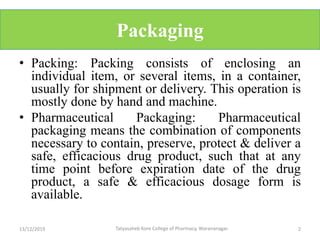
• Packing: Packing consists of enclosing an

individual item, or several items, in a container,
usually for shipment or delivery. This operation is
mostly done by hand and machine.
• Pharmaceutical Packaging: Pharmaceutical
packaging means the combination of components
necessary to contain, preserve, protect & deliver a
safe, efficacious drug product, such that at any
time point before expiration date of the drug
product, a safe & efficacious dosage form is
available.
13/12/2019 2Tatyasaheb Kore College of Pharmacy, Warananagar.
General principles
• The purpose of stability testing is to provide evidence
of how the quality of an API or FPP varies with time
under the influence of a variety of environmental
factors such as temperature, humidity and light.
• The stability testing programme also includes the study
of product-related factors that influence its quality, for
example, interaction of the API with excipients,
container-closure systems and packaging materials.
• In fixed-dose combination FPPs (fixed-dose
combinations (FDCs)) the interaction between two or
more APIs also has to be considered.
13/12/2019 3Tatyasaheb Kore College of Pharmacy, Warananagar.
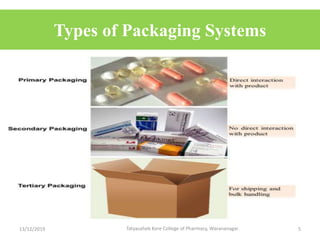
Types of Packaging Systems
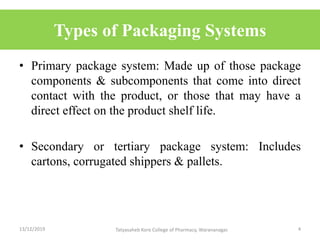
• Primary package system: Made up of those package
components & subcomponents that come into direct
contact with the product, or those that may have a
direct effect on the product shelf life.
• Secondary or tertiary package system: Includes
cartons, corrugated shippers & pallets.
13/12/2019 4Tatyasaheb Kore College of Pharmacy, Warananagar.
13/12/2019 Tatyasaheb Kore College of Pharmacy, Warananagar. 5
Types of Packaging Systems
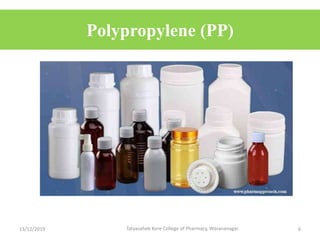
Polypropylene (PP)
13/12/2019 Tatyasaheb Kore College of Pharmacy, Warananagar. 6
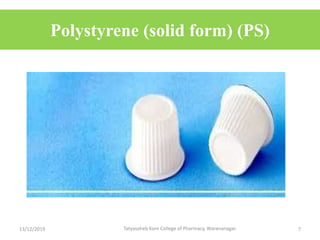
Polystyrene (solid form) (PS)
13/12/2019 Tatyasaheb Kore College of Pharmacy, Warananagar. 7
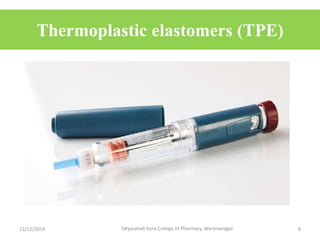
Thermoplastic elastomers (TPE)
13/12/2019 Tatyasaheb Kore College of Pharmacy, Warananagar. 8
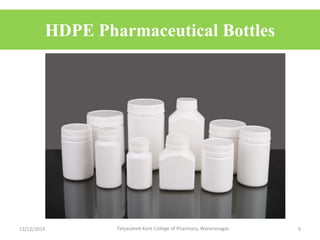
HDPE Pharmaceutical Bottles
13/12/2019 9Tatyasaheb Kore College of Pharmacy, Warananagar.
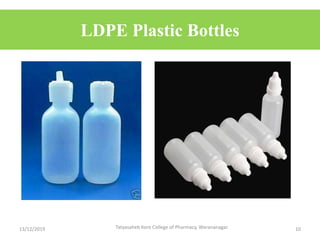
LDPE Plastic Bottles
13/12/2019 10Tatyasaheb Kore College of Pharmacy, Warananagar.
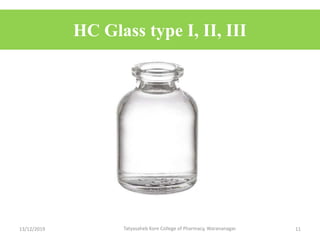
HC Glass type I, II, III
13/12/2019 Tatyasaheb Kore College of Pharmacy, Warananagar. 11
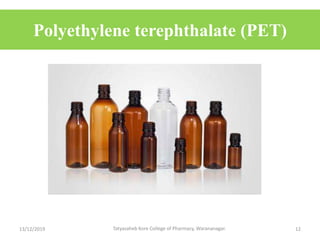
Polyethylene terephthalate (PET)
13/12/2019 12Tatyasaheb Kore College of Pharmacy, Warananagar.
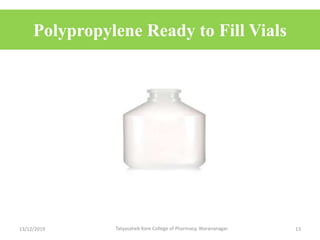
Polypropylene Ready to Fill Vials
13/12/2019 13Tatyasaheb Kore College of Pharmacy, Warananagar.
Quality Control
• Quality control of primary pharmaceutical
packaging materials for companies is vital to
assure safety standards for the patient using the
medical product.
• Packaging meets Good Manufacturing Practice
(GMP) for deliverables, pharmaceutical
international standard ISO 15378, and
environmental commitments standard ISO
14001.
13/12/2019 14Tatyasaheb Kore College of Pharmacy, Warananagar.
Packaging must meet the following
Requirements
• Protect the preparation from environmental conditions.
• Non-reactive with the product and so does not alter the
identity of the product
• Does not impart tastes or odors to the product
• Nontoxic
• FDA approved
• Protect the dosage form from damage or breakage
• Meet tamper-resistance requirements, wherever
applicable.
• Adaptable to commonly employed high-speed packaging
equipments.
13/12/2019 15Tatyasaheb Kore College of Pharmacy, Warananagar.
Selection of package material
• Stability
• Compatibility with the contents
• Strength of container and the degree of protection required
• Moisture-proofness
• Resistance to corrosion by Acids or Alkalis
• Resistance to grease
• Protection against salt
• Resistance to microorganisms
• Resistance to insects and rodents
• Resistance to differences in temperature
• Protection against light, fire and pilferage
• Odor retention and transmission
• Aesthetic effect
• Cost
• Machine suitability of packaging and the filling method
• Convenience of the packaging for the physician, pharmacist and finally the patient
(size, weight, method of opening/re-closing, legibility of printing)
13/12/2019 16Tatyasaheb Kore College of Pharmacy, Warananagar.
Packaging materials & closures
• Glass
• Plastic
• Metals
• Paper and Board
• Rubber
• Cotton
• Adhesives and Inks
• Closures
13/12/2019 17Tatyasaheb Kore College of Pharmacy, Warananagar.
Types of Glass
• Type I – Borosilicate Glass
• Type II – Treated Soda-Lime Glass
• Type III – Regular Soda-Lime Glass
• Type NP – General Purpose Soda-Lime Glass
13/12/2019 18Tatyasaheb Kore College of Pharmacy, Warananagar.
Closures
• Depending upon the type of container, closures
may have different shapes & sizes.
• Closures, which form a part of the primary
packaging system.
• They form essential component of the
container & an integral part of the drug
preparation.
13/12/2019 19Tatyasaheb Kore College of Pharmacy, Warananagar.
Functions of a closure
• Hermetic seal: Permits no exchange between the
contents & the outside of the pack, e.g. a fused glass
ampoule.
• Effective microbiological seal e.g. rubber cork &
metal overseal.
• Effective seal, acceptable to the product.
13/12/2019 20Tatyasaheb Kore College of Pharmacy, Warananagar.
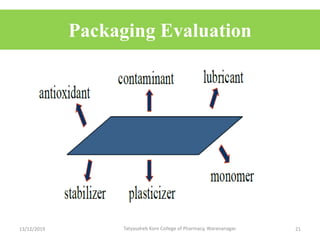
Packaging Evaluation
13/12/2019 21Tatyasaheb Kore College of Pharmacy, Warananagar.
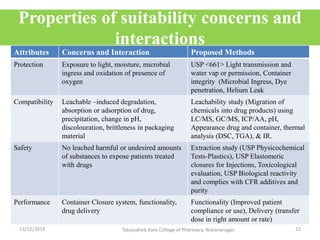
Properties of suitability concerns and
interactions
Attributes Concerns and Interaction Proposed Methods
Protection Exposure to light, moisture, microbial
ingress and oxidation of presence of
oxygen
USP <661> Light transmission and
water vap or permission, Container
integrity (Microbial Ingress, Dye
penetration, Helium Leak
Compatibility Leachable –induced degradation,
absorption or adsorption of drug,
precipitation, change in pH,
discolouration, brittleness in packaging
material
Leachability study (Migration of
chemicals into drug products) using
LC/MS, GC/MS, ICP/AA, pH,
Appearance drug and container, thermal
analysis (DSC, TGA), & IR.
Safety No leached harmful or undesired amounts
of substances to expose patients treated
with drugs
Extraction study (USP Physicochemical
Tests-Plastics), USP Elastomeric
closures for Injections, Toxicological
evaluation, USP Biological reactivity
and complies with CFR additives and
purity
Performance Container Closure system, functionality,
drug delivery
Functionality (Improved patient
compliance or use), Delivery (transfer
dose in right amount or rate)
13/12/2019 22Tatyasaheb Kore College of Pharmacy, Warananagar.
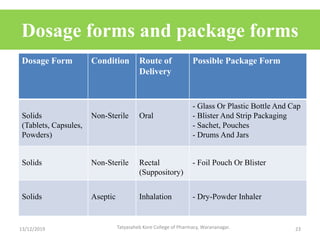
Dosage forms and package forms
Dosage Form Condition Route of
Delivery
Possible Package Form
Solids
(Tablets, Capsules,
Powders)
Non-Sterile Oral
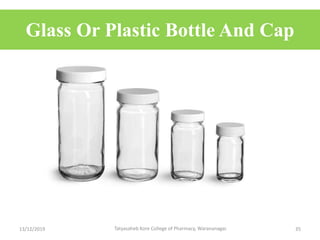
- Glass Or Plastic Bottle And Cap
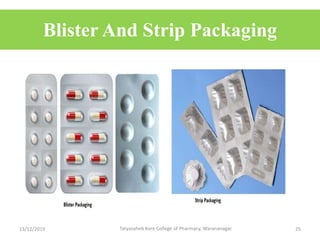
- Blister And Strip Packaging
- Sachet, Pouches
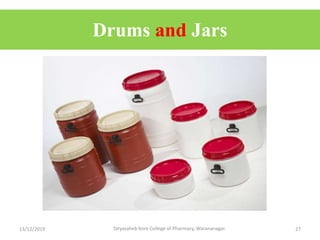
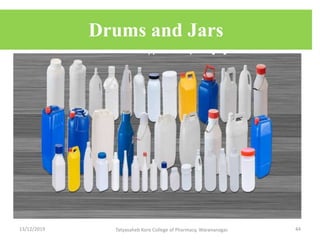
- Drums And Jars
Solids Non-Sterile Rectal
(Suppository)
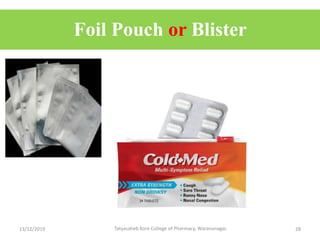
- Foil Pouch Or Blister
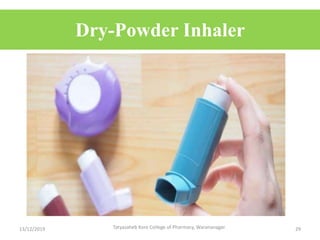
Solids Aseptic Inhalation - Dry-Powder Inhaler
13/12/2019 23Tatyasaheb Kore College of Pharmacy, Warananagar.
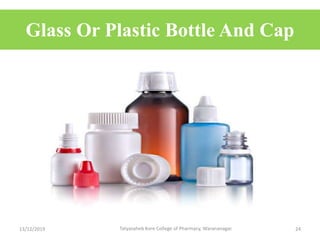
Glass Or Plastic Bottle And Cap
13/12/2019 Tatyasaheb Kore College of Pharmacy, Warananagar. 24
Blister And Strip Packaging
13/12/2019 Tatyasaheb Kore College of Pharmacy, Warananagar. 25
Sachet and Pouches
13/12/2019 Tatyasaheb Kore College of Pharmacy, Warananagar. 26
Drums and Jars
13/12/2019 Tatyasaheb Kore College of Pharmacy, Warananagar. 27
Foil Pouch or Blister
13/12/2019 Tatyasaheb Kore College of Pharmacy, Warananagar. 28
Dry-Powder Inhaler
13/12/2019 Tatyasaheb Kore College of Pharmacy, Warananagar. 29
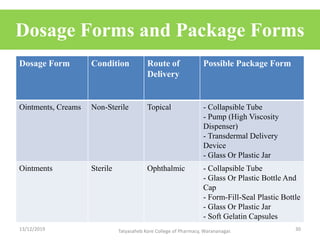
Dosage Forms and Package Forms
Dosage Form Condition Route of
Delivery
Possible Package Form
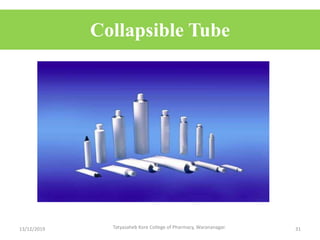
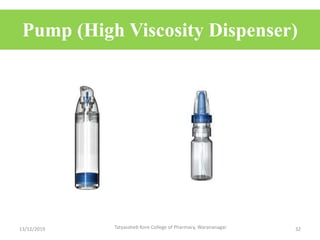
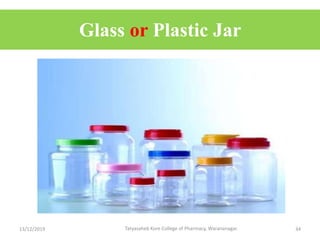
Ointments, Creams Non-Sterile Topical - Collapsible Tube
- Pump (High Viscosity
Dispenser)
- Transdermal Delivery
Device
- Glass Or Plastic Jar
Ointments Sterile Ophthalmic - Collapsible Tube
- Glass Or Plastic Bottle And
Cap
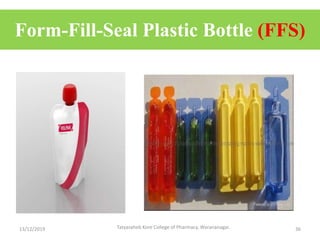
- Form-Fill-Seal Plastic Bottle
- Glass Or Plastic Jar
- Soft Gelatin Capsules
13/12/2019 30Tatyasaheb Kore College of Pharmacy, Warananagar.
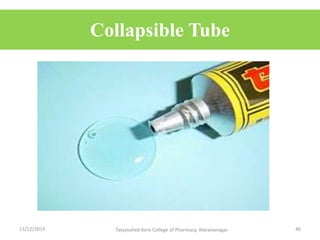
Collapsible Tube
13/12/2019 Tatyasaheb Kore College of Pharmacy, Warananagar. 31
Pump (High Viscosity Dispenser)
13/12/2019 Tatyasaheb Kore College of Pharmacy, Warananagar. 32
Transdermal and transmucosal Delivery
Devices
13/12/2019 Tatyasaheb Kore College of Pharmacy, Warananagar. 33
Glass or Plastic Jar
13/12/2019 Tatyasaheb Kore College of Pharmacy, Warananagar. 34
Glass Or Plastic Bottle And Cap
13/12/2019 Tatyasaheb Kore College of Pharmacy, Warananagar. 35
Form-Fill-Seal Plastic Bottle (FFS)
13/12/2019 Tatyasaheb Kore College of Pharmacy, Warananagar. 36
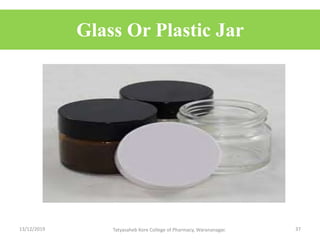
Glass Or Plastic Jar
13/12/2019 Tatyasaheb Kore College of Pharmacy, Warananagar. 37
Soft Gelatin Capsules
13/12/2019 Tatyasaheb Kore College of Pharmacy, Warananagar. 38
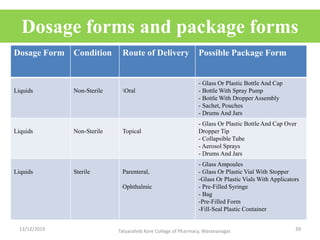
Dosage forms and package forms
Dosage Form Condition Route of Delivery Possible Package Form
Liquids Non-Sterile Oral
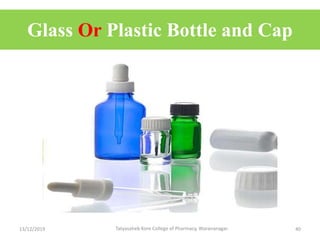
- Glass Or Plastic Bottle And Cap
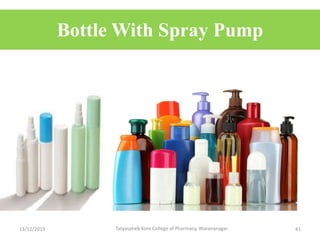
- Bottle With Spray Pump
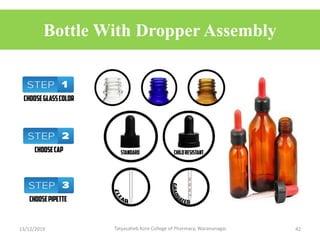
- Bottle With Dropper Assembly
- Sachet, Pouches
- Drums And Jars
Liquids Non-Sterile Topical
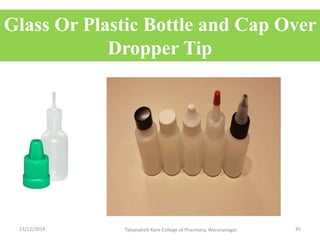
- Glass Or Plastic Bottle And Cap Over
Dropper Tip
- Collapsible Tube
- Aerosol Sprays
- Drums And Jars
Liquids Sterile Parenteral,
Ophthalmic
- Glass Ampoules
- Glass Or Plastic Vial With Stopper
-Glass Or Plastic Vials With Applicators
- Pre-Filled Syringe
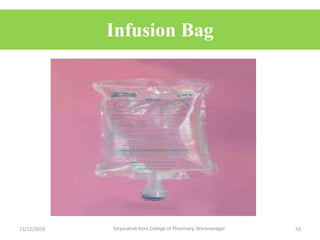
- Bag
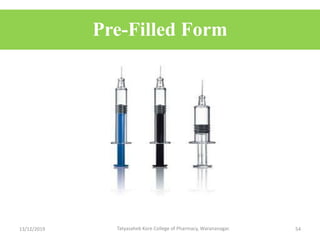
-Pre-Filled Form
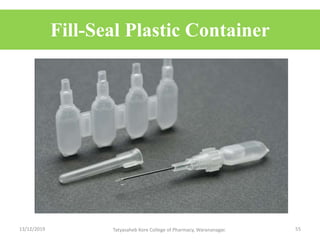
-Fill-Seal Plastic Container
13/12/2019 39Tatyasaheb Kore College of Pharmacy, Warananagar.
Glass Or Plastic Bottle and Cap
13/12/2019 Tatyasaheb Kore College of Pharmacy, Warananagar. 40
Bottle With Spray Pump
13/12/2019 Tatyasaheb Kore College of Pharmacy, Warananagar. 41
Bottle With Dropper Assembly
13/12/2019 Tatyasaheb Kore College of Pharmacy, Warananagar. 42
Sachet, Pouches
13/12/2019 Tatyasaheb Kore College of Pharmacy, Warananagar. 43
Drums and Jars
13/12/2019 Tatyasaheb Kore College of Pharmacy, Warananagar. 44
Glass Or Plastic Bottle and Cap Over
Dropper Tip
13/12/2019 Tatyasaheb Kore College of Pharmacy, Warananagar. 45
Collapsible Tube
13/12/2019 Tatyasaheb Kore College of Pharmacy, Warananagar. 46
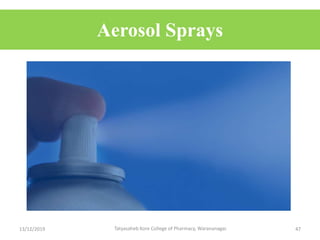
Aerosol Sprays
13/12/2019 Tatyasaheb Kore College of Pharmacy, Warananagar. 47
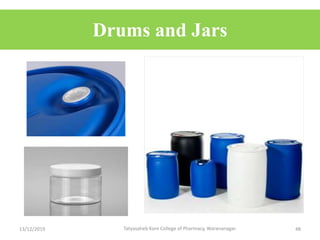
Drums and Jars
13/12/2019 Tatyasaheb Kore College of Pharmacy, Warananagar. 48
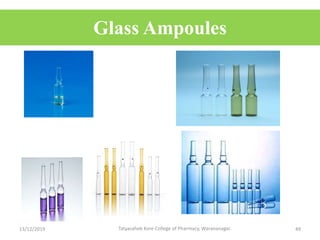
Glass Ampoules
13/12/2019 Tatyasaheb Kore College of Pharmacy, Warananagar. 49
Glass Or Plastic Vial With Stopper
13/12/2019 Tatyasaheb Kore College of Pharmacy, Warananagar. 50
Glass Or Plastic Vials With Applicators
13/12/2019 Tatyasaheb Kore College of Pharmacy, Warananagar. 51
Pre-Filled Syringe
13/12/2019 Tatyasaheb Kore College of Pharmacy, Warananagar. 52
Infusion Bag
13/12/2019 Tatyasaheb Kore College of Pharmacy, Warananagar. 53
Pre-Filled Form
13/12/2019 Tatyasaheb Kore College of Pharmacy, Warananagar. 54
Fill-Seal Plastic Container
13/12/2019 Tatyasaheb Kore College of Pharmacy, Warananagar. 55
Packaging of Medical/Surgical Devices
• They must be capable of being sterilized economically.
• They must withstand the shipping and handling
environment.
• They must be compatible with the procedures set up by
the hospitals.
• Sterility
• Environmental
• Product resistance: oils, water, chemicals, gas, etc.
• Physical: Dimensional stability (rigidity or flexibility,
resists puncture, tearing, abrasion, impact and pressure,
provides cushioning and structural support.
13/12/2019 56Tatyasaheb Kore College of Pharmacy, Warananagar.
Evaluation of Medical Device Packages
• To evaluate the component materials of
container and the inner protective cushioning
materials .
• To develop (through research) improved
methods or concepts and improved package
testing techniques.
13/12/2019 57Tatyasaheb Kore College of Pharmacy, Warananagar.
The types of tests carried out for Medical
Device Packages
• Sterility Testing
• Manual handling
• Vehicle stacking
• Loose-load vibration
• Vehicle vibration
• Drop test
• Compression
• Package seal strength testing
13/12/2019 58Tatyasaheb Kore College of Pharmacy, Warananagar.
Child Resistant Packaging
• Plastic and glass packaging design experts and
childproof packaging.
• Child-resistant packaging, also known as “CR
packaging”, is purpose made packaging utilised to
lower the risk of infants and children ingesting harmful
medicines.
• Packaging requirements from the EU and US standards
for child resistant packaging regarding prescription
drugs necessitate that over-the-counter medications and
products that contain chemicals require by law the use
of child safety features, and unit dosage packaging
(blister packs) are also covered by these regulations.
13/12/2019 59Tatyasaheb Kore College of Pharmacy, Warananagar.
Classifications of child-resistant
packages
• Type I: Reclosable packaging - continuous thread closure
• Type II: Reclosable packaging - lug finish closure
• Type III: Reclosable packaging - snap closure
• Type IV: Unit non-reclosable - flexible (strip/pouch)
• Type V: Unit non-reclosable - rigid
• Type VI: Unit reclosable packages
• Type VII: Aerosol packages
• Type VIII: Non-reclosable packages - semi-rigid (blister)
• Type IX: Dispensers (not intended to be removed)
• Type X: Box or tray package
• Type XI: Reclosable packaging - flexible
• Type XII: Dispenser (may be removed)
• Type XIII: Reclosable packaging - semi-rigid (blister)
13/12/2019 60Tatyasaheb Kore College of Pharmacy, Warananagar.
Tamper Proof Packaging
• Tamper proof containers are those that resist
the tampering of the product before consumer
the product.
• They help in….
- Receiving the products by patients “as
manufactured”
- Preventing “product browsing and sampling”
13/12/2019 61Tatyasaheb Kore College of Pharmacy, Warananagar.
Tamper Proof Containers
• Film Wrappers
• Blister or Strip Packs
• Bubble Packs
• Heat Shrink Bands or Wrappers
• Foil, Paper, or Plastic Pouches
• Bottle Mouth Inner Seals
• Tape Seals
• Breakable Caps
• Sealed Metal Tubes or
• Plastic Blind-end Heat Sealed Tubes
• Cans
• In-Built Tamper-Evident Controls
13/12/2019 62Tatyasaheb Kore College of Pharmacy, Warananagar.
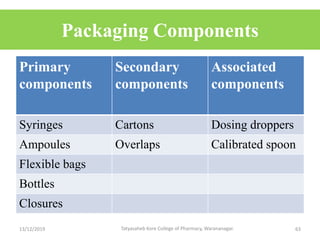
Packaging Components
Primary
components
Secondary
components
Associated
components
Syringes Cartons Dosing droppers
Ampoules Overlaps Calibrated spoon
Flexible bags
Bottles
Closures
13/12/2019 63Tatyasaheb Kore College of Pharmacy, Warananagar.
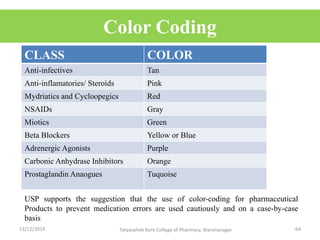
Color Coding
CLASS COLOR
Anti-infectives Tan
Anti-inflamatories/ Steroids Pink
Mydriatics and Cycloopegics Red
NSAIDs Gray
Miotics Green
Beta Blockers Yellow or Blue
Adrenergic Agonists Purple
Carbonic Anhydrase Inhibitors Orange
Prostaglandin Anaogues Tuquoise
USP supports the suggestion that the use of color-coding for pharmaceutical
Products to prevent medication errors are used cautiously and on a case-by-case
basis
13/12/2019 64Tatyasaheb Kore College of Pharmacy, Warananagar.
Stability
• Container closure system should be monitored
for sign of instability.
• Applicant should investigate any observed
change In the packaging system used in
stability studies.
• If corrective action requires a change in an
approved container closure system, a
supplemental application should be submitted.
13/12/2019 65Tatyasaheb Kore College of Pharmacy, Warananagar.
Purpose of Stability
• The purpose of stability testing is to provide
evidence of how the quality of an Active
Pharmaceutical Ingredient (API) or Finished
Pharmaceutical Product (FPP) varies with time
under the influence of a variety of environmental
factors such as temperature, humidity and light.
• The stability programme also includes the study
of product related factors that influence its
quality, for example, interaction of API with
excipients, container closure systems and
packaging materials.
13/12/2019 66Tatyasaheb Kore College of Pharmacy, Warananagar.
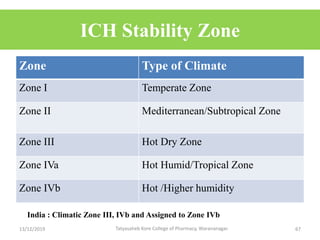
ICH Stability Zone
Zone Type of Climate
Zone I Temperate Zone
Zone II Mediterranean/Subtropical Zone
Zone III Hot Dry Zone
Zone IVa Hot Humid/Tropical Zone
Zone IVb Hot /Higher humidity
13/12/2019 Tatyasaheb Kore College of Pharmacy, Warananagar. 67
India : Climatic Zone III, IVb and Assigned to Zone IVb
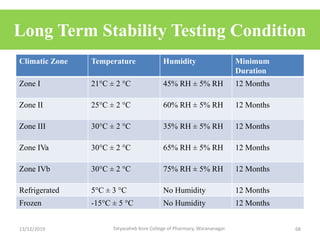
Long Term Stability Testing Condition
Climatic Zone Temperature Humidity Minimum
Duration
Zone I 21C ± 2 C 45% RH ± 5% RH 12 Months
Zone II 25C ± 2 C 60% RH ± 5% RH 12 Months
Zone III 30C ± 2 C 35% RH ± 5% RH 12 Months
Zone IVa 30C ± 2 C 65% RH ± 5% RH 12 Months
Zone IVb 30C ± 2 C 75% RH ± 5% RH 12 Months
Refrigerated 5C ± 3 C No Humidity 12 Months
Frozen -15C ± 5 C No Humidity 12 Months
13/12/2019 Tatyasaheb Kore College of Pharmacy, Warananagar. 68
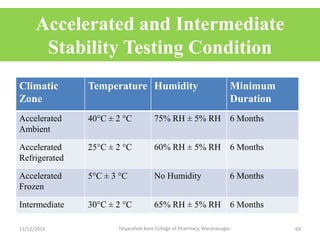
Accelerated and Intermediate
Stability Testing Condition
Climatic
Zone
Temperature Humidity Minimum
Duration
Accelerated
Ambient
40C ± 2 C 75% RH ± 5% RH 6 Months
Accelerated
Refrigerated
25C ± 2 C 60% RH ± 5% RH 6 Months
Accelerated
Frozen
5C ± 3 C No Humidity 6 Months
Intermediate 30C ± 2 C 65% RH ± 5% RH 6 Months
13/12/2019 Tatyasaheb Kore College of Pharmacy, Warananagar. 69
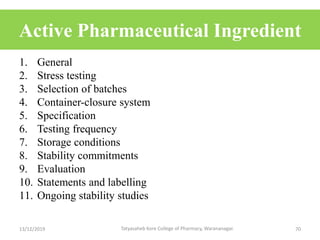
Active Pharmaceutical Ingredient
1. General
2. Stress testing
3. Selection of batches
4. Container-closure system
5. Specification
6. Testing frequency
7. Storage conditions
8. Stability commitments
9. Evaluation
10. Statements and labelling
11. Ongoing stability studies
13/12/2019 70Tatyasaheb Kore College of Pharmacy, Warananagar.
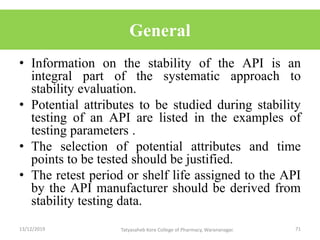
General
• Information on the stability of the API is an
integral part of the systematic approach to
stability evaluation.
• Potential attributes to be studied during stability
testing of an API are listed in the examples of
testing parameters .
• The selection of potential attributes and time
points to be tested should be justified.
• The retest period or shelf life assigned to the API
by the API manufacturer should be derived from
stability testing data.
13/12/2019 71Tatyasaheb Kore College of Pharmacy, Warananagar.
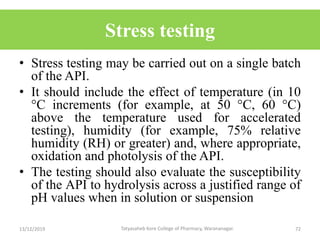
Stress testing
• Stress testing may be carried out on a single batch
of the API.
• It should include the effect of temperature (in 10
°C increments (for example, at 50 °C, 60 °C)
above the temperature used for accelerated
testing), humidity (for example, 75% relative
humidity (RH) or greater) and, where appropriate,
oxidation and photolysis of the API.
• The testing should also evaluate the susceptibility
of the API to hydrolysis across a justified range of
pH values when in solution or suspension
13/12/2019 72Tatyasaheb Kore College of Pharmacy, Warananagar.
Selection of Batches
• Data from stability studies on at least three primary
batches of the API should normally be provided.
• The batches should be manufactured at a minimum of
pilot scale by the same synthesis route as production
batches, and using a method of manufacture and a
procedure that simulates the final process to be used
for production batches.
• The overall quality of the batches of API placed on
stability studies should be representative of the
quality of the material to be made on a production
scale.
13/12/2019 73Tatyasaheb Kore College of Pharmacy, Warananagar.
Container-Closure System
• The stability studies should be conducted on the API
packaged in a container closure system that is the
same as, or simulates, the packaging proposed for
storage and distribution.
13/12/2019 74Tatyasaheb Kore College of Pharmacy, Warananagar.
Specification
• Stability studies should include testing of
stability-indicating attributes of the API, i.e. those
that are susceptible to change during storage and
are likely to influence quality, safety and/or
efficacy.
• The testing should cover, as appropriate, the
physical, chemical, biological and
microbiological attributes.
• Validated stability-indicating analytical
procedures should be applied.
13/12/2019 75Tatyasaheb Kore College of Pharmacy, Warananagar.
Testing Frequency
• For APIs with a proposed retest period or shelf
life of at least 12 months, the frequency of testing
at the long-term storage condition should
normally be every three months over the first
year, every six months over the second year, and
annually thereafter throughout the proposed retest
period or shelf life.
• At the accelerated storage condition, a minimum
of three time points, including the initial and final
time points (e.g. 0, 3 and 6 months), from a
sixmonth study is recommended.
13/12/2019 76Tatyasaheb Kore College of Pharmacy, Warananagar.
• Where it is expected (based on development experience)
that results from accelerated studies are likely to approach
significant change criteria, additional testing should be
conducted either by adding samples at the final time point
or by including a fourth time point in the study design.
• When testing at the intermediate storage condition is called
for as a result of significant change at the accelerated
storage condition, a minimum of four time points, including
the initial and final time points (e.g. 0, 6, 9 and 12 months),
from a 12-month study is recommended.
13/12/2019
Tatyasaheb Kore College of Pharmacy,
Warananagar.
77
Testing Frequency
Storage Conditions
• The storage conditions and the lengths of studies
chosen should be sufficient to cover storage and
shipment.
• Storage condition tolerances are defined as the
acceptable variations in temperature and RH of
storage facilities for stability studies.
• The equipment used should be capable of
controlling the storage conditions within the
ranges defined in these guidelines.
• The storage conditions should be monitored and
recorded.
13/12/2019 78Tatyasaheb Kore College of Pharmacy, Warananagar.
Storage Conditions
• Short-term environmental changes due to
opening the doors of the storage facility are
accepted as unavoidable.
• The effect of excursions due to equipment
failure should be assessed, addressed and
reported if judged to affect stability results.
• Excursions that exceed the defined tolerances
for more than 24 hours should be described in
the study report and their effects assessed.
13/12/2019
Tatyasaheb Kore College of Pharmacy,
Warananagar.
79
Storage Conditions
• If long-term studies are conducted at 25 °C ±2 °C/60% RH
±5% RH and “significant change” occurs at any time
during six months’ testing at the accelerated storage
condition, additional testing at the intermediate storage
condition should be conducted and evaluated against
significant change criteria.
• In this case, testing at the intermediate storage condition
should include all long-term tests, unless otherwise
justified, and the initial application should include a
minimum of six months’ data from a 12-month study at the
intermediate storage condition.
• “Significant change” for an API is defined as failure to meet
its specification.
13/12/2019 80Tatyasaheb Kore College of Pharmacy, Warananagar.
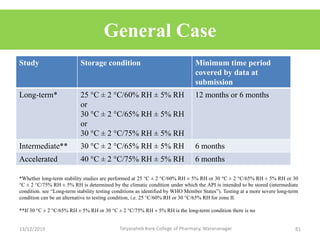
General Case
Study Storage condition Minimum time period
covered by data at
submission
Long-term* 25 °C ± 2 °C/60% RH ± 5% RH
or
30 °C ± 2 °C/65% RH ± 5% RH
or
30 °C ± 2 °C/75% RH ± 5% RH
12 months or 6 months
Intermediate** 30 °C ± 2 °C/65% RH ± 5% RH 6 months
Accelerated 40 °C ± 2 °C/75% RH ± 5% RH 6 months
*Whether long-term stability studies are performed at 25 °C ± 2 °C/60% RH ± 5% RH or 30 °C ± 2 °C/65% RH ± 5% RH or 30
°C ± 2 °C/75% RH ± 5% RH is determined by the climatic condition under which the API is intended to be stored (intermediate
condition. see “Long-term stability testing conditions as identified by WHO Member States”). Testing at a more severe long-term
condition can be an alternative to testing condition, i.e. 25 °C/60% RH or 30 °C/65% RH for zone II.
**If 30 °C ± 2 °C/65% RH ± 5% RH or 30 °C ± 2 °C/75% RH ± 5% RH is the long-term condition there is no
13/12/2019 81Tatyasaheb Kore College of Pharmacy, Warananagar.
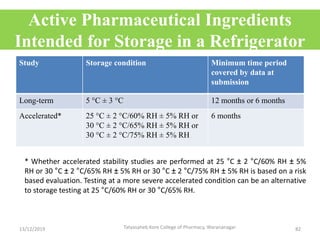
Active Pharmaceutical Ingredients
Intended for Storage in a Refrigerator
Study Storage condition Minimum time period
covered by data at
submission
Long-term 5 °C ± 3 °C 12 months or 6 months
Accelerated* 25 °C ± 2 °C/60% RH ± 5% RH or
30 °C ± 2 °C/65% RH ± 5% RH or
30 °C ± 2 °C/75% RH ± 5% RH
6 months
* Whether accelerated stability studies are performed at 25 °C ± 2 °C/60% RH ± 5%
RH or 30 °C ± 2 °C/65% RH ± 5% RH or 30 °C ± 2 °C/75% RH ± 5% RH is based on a risk
based evaluation. Testing at a more severe accelerated condition can be an alternative
to storage testing at 25 °C/60% RH or 30 °C/65% RH.
13/12/2019 82Tatyasaheb Kore College of Pharmacy, Warananagar.
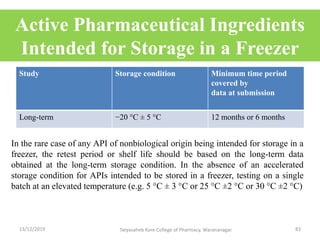
Active Pharmaceutical Ingredients
Intended for Storage in a Freezer
Study Storage condition Minimum time period
covered by
data at submission
Long-term −20 °C ± 5 °C 12 months or 6 months
In the rare case of any API of nonbiological origin being intended for storage in a
freezer, the retest period or shelf life should be based on the long-term data
obtained at the long-term storage condition. In the absence of an accelerated
storage condition for APIs intended to be stored in a freezer, testing on a single
batch at an elevated temperature (e.g. 5 °C ± 3 °C or 25 °C ±2 °C or 30 °C ±2 °C)
13/12/2019 83Tatyasaheb Kore College of Pharmacy, Warananagar.
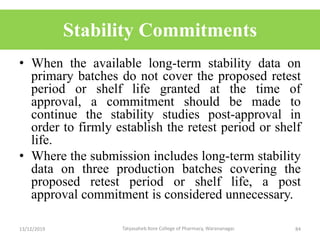
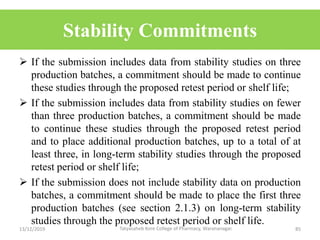
Stability Commitments
• When the available long-term stability data on
primary batches do not cover the proposed retest
period or shelf life granted at the time of
approval, a commitment should be made to
continue the stability studies post-approval in
order to firmly establish the retest period or shelf
life.
• Where the submission includes long-term stability
data on three production batches covering the
proposed retest period or shelf life, a post
approval commitment is considered unnecessary.
13/12/2019 84Tatyasaheb Kore College of Pharmacy, Warananagar.
Stability Commitments
 If the submission includes data from stability studies on three
production batches, a commitment should be made to continue
these studies through the proposed retest period or shelf life;
 If the submission includes data from stability studies on fewer
than three production batches, a commitment should be made
to continue these studies through the proposed retest period
and to place additional production batches, up to a total of at
least three, in long-term stability studies through the proposed
retest period or shelf life;
 If the submission does not include stability data on production
batches, a commitment should be made to place the first three
production batches (see section 2.1.3) on long-term stability
studies through the proposed retest period or shelf life.
13/12/2019 85Tatyasaheb Kore College of Pharmacy, Warananagar.
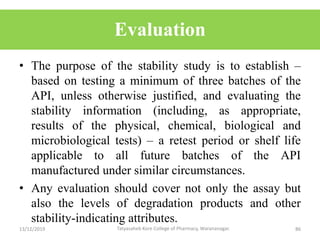
Evaluation
• The purpose of the stability study is to establish –
based on testing a minimum of three batches of the
API, unless otherwise justified, and evaluating the
stability information (including, as appropriate,
results of the physical, chemical, biological and
microbiological tests) – a retest period or shelf life
applicable to all future batches of the API
manufactured under similar circumstances.
• Any evaluation should cover not only the assay but
also the levels of degradation products and other
stability-indicating attributes.
13/12/2019 86Tatyasaheb Kore College of Pharmacy, Warananagar.
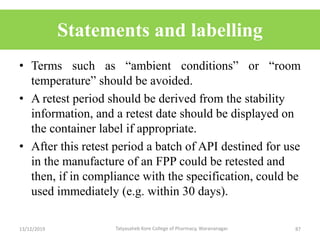
Statements and labelling
• Terms such as “ambient conditions” or “room
temperature” should be avoided.
• A retest period should be derived from the stability
information, and a retest date should be displayed on
the container label if appropriate.
• After this retest period a batch of API destined for use
in the manufacture of an FPP could be retested and
then, if in compliance with the specification, could be
used immediately (e.g. within 30 days).
13/12/2019 87Tatyasaheb Kore College of Pharmacy, Warananagar.
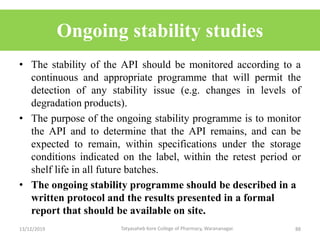
Ongoing stability studies
• The stability of the API should be monitored according to a
continuous and appropriate programme that will permit the
detection of any stability issue (e.g. changes in levels of
degradation products).
• The purpose of the ongoing stability programme is to monitor
the API and to determine that the API remains, and can be
expected to remain, within specifications under the storage
conditions indicated on the label, within the retest period or
shelf life in all future batches.
• The ongoing stability programme should be described in a
written protocol and the results presented in a formal
report that should be available on site.
13/12/2019 88Tatyasaheb Kore College of Pharmacy, Warananagar.
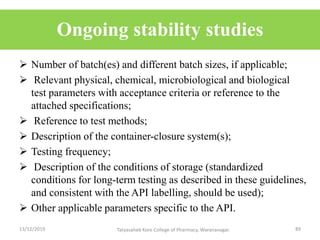
Ongoing stability studies
 Number of batch(es) and different batch sizes, if applicable;
 Relevant physical, chemical, microbiological and biological
test parameters with acceptance criteria or reference to the
attached specifications;
 Reference to test methods;
 Description of the container-closure system(s);
 Testing frequency;
 Description of the conditions of storage (standardized
conditions for long-term testing as described in these guidelines,
and consistent with the API labelling, should be used);
 Other applicable parameters specific to the API.
13/12/2019 89Tatyasaheb Kore College of Pharmacy, Warananagar.
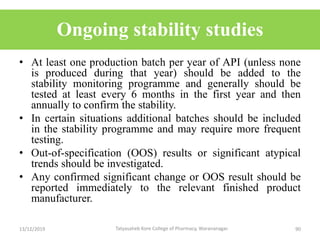
Ongoing stability studies
• At least one production batch per year of API (unless none
is produced during that year) should be added to the
stability monitoring programme and generally should be
tested at least every 6 months in the first year and then
annually to confirm the stability.
• In certain situations additional batches should be included
in the stability programme and may require more frequent
testing.
• Out-of-specification (OOS) results or significant atypical
trends should be investigated.
• Any confirmed significant change or OOS result should be
reported immediately to the relevant finished product
manufacturer.
13/12/2019 90Tatyasaheb Kore College of Pharmacy, Warananagar.
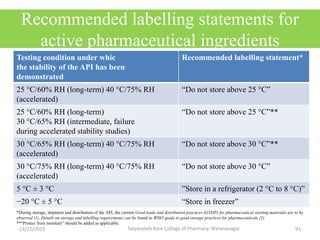
Recommended labelling statements for
active pharmaceutical ingredients
Testing condition under whic
the stability of the API has been
demonstrated
Recommended labelling statement*
25 °C/60% RH (long-term) 40 °C/75% RH
(accelerated)
“Do not store above 25 °C”
25 °C/60% RH (long-term)
30 °C/65% RH (intermediate, failure
during accelerated stability studies)
“Do not store above 25 °C”**
30 °C/65% RH (long-term) 40 °C/75% RH
(accelerated)
“Do not store above 30 °C”**
30 °C/75% RH (long-term) 40 °C/75% RH
(accelerated)
“Do not store above 30 °C”
5 °C ± 3 °C ”Store in a refrigerator (2 °C to 8 °C)”
−20 °C ± 5 °C “Store in freezer”
*During storage, shipment and distribution of the API, the current Good trade and distribution practices (GTDP) for pharmaceutical starting materials are to be
observed (1). Details on storage and labelling requirements can be found in WHO guide to good storage practices for pharmaceuticals (2).
**“Protect from moisture” should be added as applicable.
13/12/2019 91Tatyasaheb Kore College of Pharmacy, Warananagar.
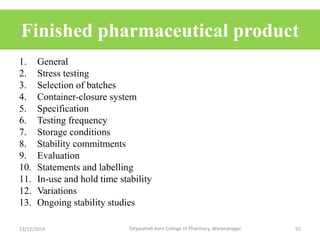
Finished pharmaceutical product
1. General
2. Stress testing
3. Selection of batches
4. Container-closure system
5. Specification
6. Testing frequency
7. Storage conditions
8. Stability commitments
9. Evaluation
10. Statements and labelling
11. In-use and hold time stability
12. Variations
13. Ongoing stability studies
13/12/2019 92Tatyasaheb Kore College of Pharmacy, Warananagar.
General
• The design of the stability studies for the FPP should
be based on knowledge of the behaviour and
properties of the API, information from stability
studies on the API and on experience gained from
preformulation studies, similar marketed formulations
and investigational FPPs.
13/12/2019 93Tatyasaheb Kore College of Pharmacy, Warananagar.
Stress testing
• Photostability testing, which is an integral part of
stress testing, should be conducted on at least one
primary batch of the FPP if appropriate.
• Additional stress testing of specific types of dosage
forms may be appropriate, e.g. cyclic studies for
semi-solid products or freeze–thaw studies for liquid
products.
13/12/2019 94Tatyasaheb Kore College of Pharmacy, Warananagar.
Selection of batches
• For FPPs containing new APIs, data from stability studies
should be provided on at least three primary batches of each
proposed strength of the FPP. Two of the three batches should
be at least pilot-scale batches and the third batch can be
smaller, if justified.
• For FPPs containing existing APIs (e.g. generics), data should
be provided on not less than two batches of at least pilot scale,
or in the case of an uncomplicated3 FPP (e.g. immediate-
release solid FPPs (with noted exceptions) or non-sterile
solutions), at least one batch of at least pilot scale and a second
batch which may be smaller (e.g. for solid oral dosage forms,
25 000 or 50 000 tablets or capsules) of each proposed
strength of the FPP.
13/12/2019 95Tatyasaheb Kore College of Pharmacy, Warananagar.
Container-Closure System
• Stability testing should be conducted on the dosage
form packaged in the primary container-closure
systems proposed for marketing.
• If the secondary container-closure system has
protective properties, and labelling clearly indicates
that the product is to be stored in the primary and
secondary packaging (e.g.“store tablets in blisters in the
provided cartons”), or if the product is packaged in a
semi-permeable container where components from the
secondary packaging can migrate into the product, the
secondary packaging may also form part of the
packaging system for stability samples.
13/12/2019 96Tatyasaheb Kore College of Pharmacy, Warananagar.
Specification
• Stability studies should include testing of stability-
indicating attributes of the FPP, i.e. those that are
susceptible to change during storage and are likely to
influence quality, safety and/or efficacy.
• The testing should cover, as appropriate, the physical,
chemical, biological and microbiological attributes,
preservative content (e.g. antioxidant or antimicrobial
preservatives) and functionality tests (e.g. for a dose
delivery system).
13/12/2019 97Tatyasaheb Kore College of Pharmacy, Warananagar.
Testing frequency
• For products with a proposed shelf life of at least 12 months, the frequency
of testing at the long-term storage condition should normally be every three
months over the first year, every six months over the second year and
annually thereafter throughout the proposed shelf life.
• At the accelerated storage condition, a minimum of three time points,
including the initial and final time points (e.g. 0, 3 and 6 months), from a
six month study is recommended.
• Where an expectation (based on development experience) exists that results
from accelerated testing are likely to approach significant change criteria,
testing should be increased either by adding samples at the final time point
or by including a fourth time point in the study design.
• When testing at the intermediate storage condition is called for as a result
of significant change at the accelerated storage condition, a minimum of
four time points, including the initial and final time points (e.g. 0, 6, 9 and
12 months), from a 12-month study is recommended.
13/12/2019 98Tatyasaheb Kore College of Pharmacy, Warananagar.
Storage conditions
• Stability data must demonstrate stability of the
medicinal product throughout its intended shelf life
under the climatic conditions prevalent in the target
countries.
• Merely applying the same requirements appropriate to
other markets could potentially lead to substandard
products if stability studies are conducted at the storage
conditions for countries in Climatic Zone I/II when the
products are supplied in countries in Climatic Zones III
and IV.
13/12/2019 99Tatyasaheb Kore College of Pharmacy, Warananagar.
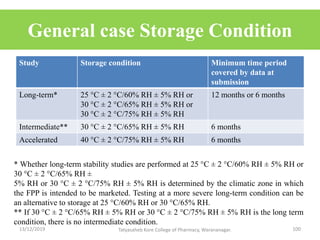
General case Storage Condition
Study Storage condition Minimum time period
covered by data at
submission
Long-term* 25 °C ± 2 °C/60% RH ± 5% RH or
30 °C ± 2 °C/65% RH ± 5% RH or
30 °C ± 2 °C/75% RH ± 5% RH
12 months or 6 months
Intermediate** 30 °C ± 2 °C/65% RH ± 5% RH 6 months
Accelerated 40 °C ± 2 °C/75% RH ± 5% RH 6 months
* Whether long-term stability studies are performed at 25 °C ± 2 °C/60% RH ± 5% RH or
30 °C ± 2 °C/65% RH ±
5% RH or 30 °C ± 2 °C/75% RH ± 5% RH is determined by the climatic zone in which
the FPP is intended to be marketed. Testing at a more severe long-term condition can be
an alternative to storage at 25 °C/60% RH or 30 °C/65% RH.
** If 30 °C ± 2 °C/65% RH ± 5% RH or 30 °C ± 2 °C/75% RH ± 5% RH is the long term
condition, there is no intermediate condition.
13/12/2019 100Tatyasaheb Kore College of Pharmacy, Warananagar.
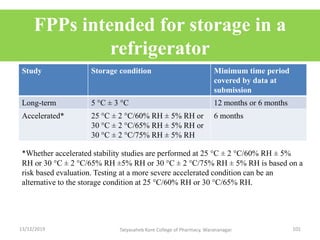
FPPs intended for storage in a
refrigerator
Study Storage condition Minimum time period
covered by data at
submission
Long-term 5 °C ± 3 °C 12 months or 6 months
Accelerated* 25 °C ± 2 °C/60% RH ± 5% RH or
30 °C ± 2 °C/65% RH ± 5% RH or
30 °C ± 2 °C/75% RH ± 5% RH
6 months
*Whether accelerated stability studies are performed at 25 °C ± 2 °C/60% RH ± 5%
RH or 30 °C ± 2 °C/65% RH ±5% RH or 30 °C ± 2 °C/75% RH ± 5% RH is based on a
risk based evaluation. Testing at a more severe accelerated condition can be an
alternative to the storage condition at 25 °C/60% RH or 30 °C/65% RH.
13/12/2019 101Tatyasaheb Kore College of Pharmacy, Warananagar.
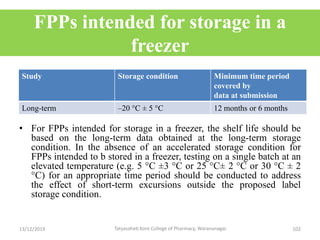
FPPs intended for storage in a
freezer
• For FPPs intended for storage in a freezer, the shelf life should be
based on the long-term data obtained at the long-term storage
condition. In the absence of an accelerated storage condition for
FPPs intended to b stored in a freezer, testing on a single batch at an
elevated temperature (e.g. 5 °C ±3 °C or 25 °C± 2 °C or 30 °C ± 2
°C) for an appropriate time period should be conducted to address
the effect of short-term excursions outside the proposed label
storage condition.
Study Storage condition Minimum time period
covered by
data at submission
Long-term –20 °C ± 5 °C 12 months or 6 months
13/12/2019 102Tatyasaheb Kore College of Pharmacy, Warananagar.
Stability Commitments
 When the available long-term stability data on primary batches do not
cover the proposed shelf life granted at the time of approval, a commitment
should be made to continue the stability studies post approval throughout
the proposed shelf life. This is the primary batch stability commitment.
 If the submission includes data from stability studies on fewer than three
production batches, a commitment should be made to place the next
production batches, up to a total of at least three, on long-term stability
studies throughout the proposed shelf life and on accelerated studies for six
months.
 This is the production batch stability commitment.
 For each product, an ongoing stability programme is required to monitor
the product over its shelf life and to determine that the product remains and
can be expected to remain within specifications under the storage
conditions on the label
13/12/2019 103Tatyasaheb Kore College of Pharmacy, Warananagar.
Evaluation
• A systematic approach should be adopted to the
presentation and evaluation of the stability information,
which should include, as appropriate, results from the
physical, chemical, biological and microbiological
tests, including particular attributes of the dosage form
(e.g. dissolution rate for solid oral dosage forms).
• Where appropriate, a summary of additional knowledge
and an understanding of stability gained from
supporting studies, modelling, predictive tools, etc.,
may be incorporated to support knowledge gained from
the primary stability programme.
13/12/2019 104Tatyasaheb Kore College of Pharmacy, Warananagar.
Statements and labelling
• A storage statement should be established for the label
based on the stability evaluation of the FPP.
• Where applicable, specific instructions should be
provided, particularly for FPPs that cannot tolerate
freezing. Terms such as “ambient conditions” or “room
temperature” should be avoided.
• There should be a direct link between the storage
statement on the label and the demonstrated stability of
the FPP.
• An expiry date should be displayed on the container
label.
13/12/2019 105Tatyasaheb Kore College of Pharmacy, Warananagar.
In-use and hold time stability
• The purpose of in-use stability testing is to provide
information for the labelling on the preparation, storage
conditions and utilization period of multidose products
after opening, reconstitution or dilution of a solution.
• In general, a 30-day in-use period is normally considered
acceptable without further supporting data.
• As far as possible the test should be designed to simulate
the use of the FPP in practice, taking into consideration
the filling volume of the container and any dilution or
reconstitution before use.
13/12/2019 106Tatyasaheb Kore College of Pharmacy, Warananagar.
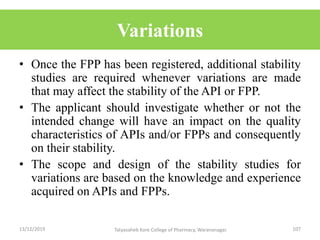
Variations
• Once the FPP has been registered, additional stability
studies are required whenever variations are made
that may affect the stability of the API or FPP.
• The applicant should investigate whether or not the
intended change will have an impact on the quality
characteristics of APIs and/or FPPs and consequently
on their stability.
• The scope and design of the stability studies for
variations are based on the knowledge and experience
acquired on APIs and FPPs.
13/12/2019 107Tatyasaheb Kore College of Pharmacy, Warananagar.
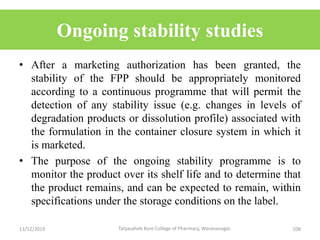
Ongoing stability studies
• After a marketing authorization has been granted, the
stability of the FPP should be appropriately monitored
according to a continuous programme that will permit the
detection of any stability issue (e.g. changes in levels of
degradation products or dissolution profile) associated with
the formulation in the container closure system in which it
is marketed.
• The purpose of the ongoing stability programme is to
monitor the product over its shelf life and to determine that
the product remains, and can be expected to remain, within
specifications under the storage conditions on the label.
13/12/2019 108Tatyasaheb Kore College of Pharmacy, Warananagar.
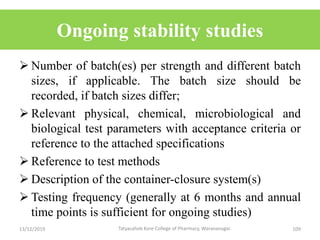
Ongoing stability studies
 Number of batch(es) per strength and different batch
sizes, if applicable. The batch size should be
recorded, if batch sizes differ;
 Relevant physical, chemical, microbiological and
biological test parameters with acceptance criteria or
reference to the attached specifications
 Reference to test methods
 Description of the container-closure system(s)
 Testing frequency (generally at 6 months and annual
time points is sufficient for ongoing studies)
13/12/2019 109Tatyasaheb Kore College of Pharmacy, Warananagar.
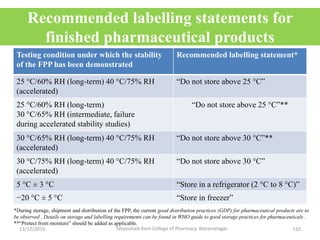
Recommended labelling statements for
finished pharmaceutical products
Testing condition under which the stability
of the FPP has been demonstrated
Recommended labelling statement*
25 °C/60% RH (long-term) 40 °C/75% RH
(accelerated)
“Do not store above 25 °C”
25 °C/60% RH (long-term)
30 °C/65% RH (intermediate, failure
during accelerated stability studies)
“Do not store above 25 °C”**
30 °C/65% RH (long-term) 40 °C/75% RH
(accelerated)
“Do not store above 30 °C”**
30 °C/75% RH (long-term) 40 °C/75% RH
(accelerated)
“Do not store above 30 °C”
5 °C ± 3 °C “Store in a refrigerator (2 °C to 8 °C)”
−20 °C ± 5 °C “Store in freezer”
*During storage, shipment and distribution of the FPP, the current good distribution practices (GDP) for pharmaceutical products are to
be observed . Details on storage and labelling requirements can be found in WHO guide to good storage practices for pharmaceuticals .
**“Protect from moisture” should be added as applicable.
13/12/2019 110Tatyasaheb Kore College of Pharmacy, Warananagar.
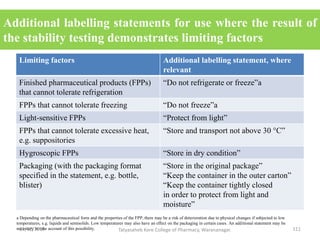
Additional labelling statements for use where the result of
the stability testing demonstrates limiting factors
Limiting factors Additional labelling statement, where
relevant
Finished pharmaceutical products (FPPs)
that cannot tolerate refrigeration
“Do not refrigerate or freeze”a
FPPs that cannot tolerate freezing “Do not freeze”a
Light-sensitive FPPs “Protect from light”
FPPs that cannot tolerate excessive heat,
e.g. suppositories
“Store and transport not above 30 °C”
Hygroscopic FPPs “Store in dry condition”
Packaging (with the packaging format
specified in the statement, e.g. bottle,
blister)
“Store in the original package”
“Keep the container in the outer carton”
“Keep the container tightly closed
in order to protect from light and
moisture”
a Depending on the pharmaceutical form and the properties of the FPP, there may be a risk of deterioration due to physical changes if subjected to low
temperatures, e.g. liquids and semisolids. Low temperatures may also have an effect on the packaging in certain cases. An additional statement may be
necessary to take account of this possibility.13/12/2019 111Tatyasaheb Kore College of Pharmacy, Warananagar.
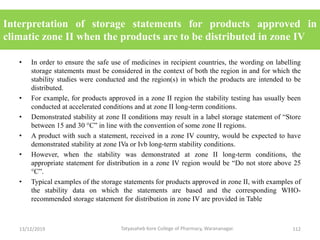
Interpretation of storage statements for products approved in
climatic zone II when the products are to be distributed in zone IV
• In order to ensure the safe use of medicines in recipient countries, the wording on labelling
storage statements must be considered in the context of both the region in and for which the
stability studies were conducted and the region(s) in which the products are intended to be
distributed.
• For example, for products approved in a zone II region the stability testing has usually been
conducted at accelerated conditions and at zone II long-term conditions.
• Demonstrated stability at zone II conditions may result in a label storage statement of “Store
between 15 and 30 °C” in line with the convention of some zone II regions.
• A product with such a statement, received in a zone IV country, would be expected to have
demonstrated stability at zone IVa or Ivb long-term stability conditions.
• However, when the stability was demonstrated at zone II long-term conditions, the
appropriate statement for distribution in a zone IV region would be “Do not store above 25
°C”.
• Typical examples of the storage statements for products approved in zone II, with examples of
the stability data on which the statements are based and the corresponding WHO-
recommended storage statement for distribution in zone IV are provided in Table
13/12/2019 112Tatyasaheb Kore College of Pharmacy, Warananagar.
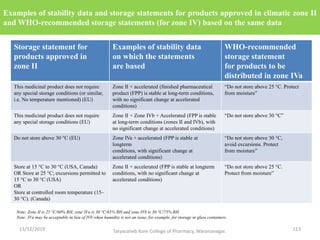
Examples of stability data and storage statements for products approved in climatic zone II
and WHO-recommended storage statements (for zone IV) based on the same data
Storage statement for
products approved in
zone II
Examples of stability data
on which the statements
are based
WHO-recommended
storage statement
for products to be
distributed in zone IVa
This medicinal product does not require
any special storage conditions (or similar,
i.e. No temperature mentioned) (EU)
Zone II + accelerated (finished pharmaceutical
product (FPP) is stable at long-term conditions,
with no significant change at accelerated
conditions)
“Do not store above 25 °C. Protect
from moisture”
This medicinal product does not require
any special storage conditions (EU)
Zone II + Zone IVb + Accelerated (FPP is stable
at long-term conditions (zones II and IVb), with
no significant change at accelerated conditions)
“Do not store above 30 °C”
Do not store above 30 °C (EU) Zone IVa + accelerated (FPP is stable at
longterm
conditions, with significant change at
accelerated conditions)
“Do not store above 30 °C,
avoid excursions. Protect
from moisture”
Store at 15 °C to 30 °C (USA, Canada)
OR Store at 25 °C; excursions permitted to
15 °C to 30 °C (USA)
OR
Store at controlled room temperature (15–
30 °C). (Canada)
Zone II + accelerated (FPP is stable at longterm
conditions, with no significant change at
accelerated conditions)
“Do not store above 25 °C.
Protect from moisture”
Note: Zone II is 25 °C/60% RH, zone IVa is 30 °C/65% RH and zone IVb is 30 °C/75% RH.
Note: IVa may be acceptable in lieu of IVb when humidity is not an issue, for example, for storage in glass containers
13/12/2019 113Tatyasaheb Kore College of Pharmacy, Warananagar.
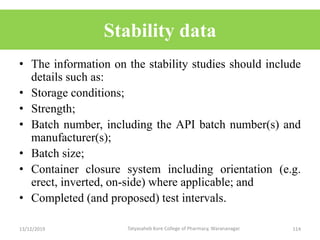
Stability data
• The information on the stability studies should include
details such as:
• Storage conditions;
• Strength;
• Batch number, including the API batch number(s) and
manufacturer(s);
• Batch size;
• Container closure system including orientation (e.g.
erect, inverted, on-side) where applicable; and
• Completed (and proposed) test intervals.
13/12/2019 114Tatyasaheb Kore College of Pharmacy, Warananagar.
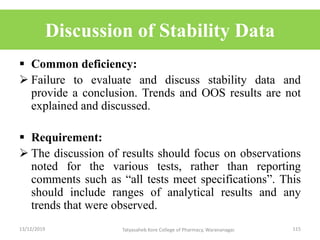
Discussion of Stability Data
 Common deficiency:
 Failure to evaluate and discuss stability data and
provide a conclusion. Trends and OOS results are not
explained and discussed.
 Requirement:
 The discussion of results should focus on observations
noted for the various tests, rather than reporting
comments such as “all tests meet specifications”. This
should include ranges of analytical results and any
trends that were observed.
13/12/2019 115Tatyasaheb Kore College of Pharmacy, Warananagar.
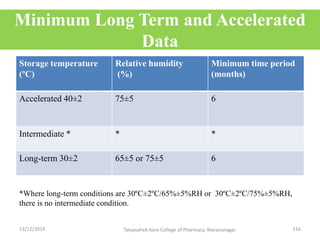
Minimum Long Term and Accelerated
Data
Storage temperature
(ºC)
Relative humidity
(%)
Minimum time period
(months)
Accelerated 40±2 75±5 6
Intermediate * * *
Long-term 30±2 65±5 or 75±5 6
*Where long-term conditions are 30ºC±2ºC/65%±5%RH or 30ºC±2ºC/75%±5%RH,
there is no intermediate condition.
13/12/2019 116Tatyasaheb Kore College of Pharmacy, Warananagar.
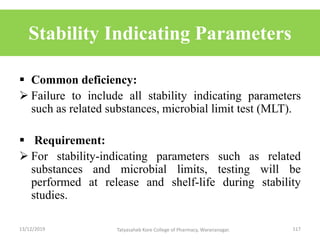
Stability Indicating Parameters
 Common deficiency:
 Failure to include all stability indicating parameters
such as related substances, microbial limit test (MLT).
 Requirement:
 For stability-indicating parameters such as related
substances and microbial limits, testing will be
performed at release and shelf-life during stability
studies.
13/12/2019 117Tatyasaheb Kore College of Pharmacy, Warananagar.
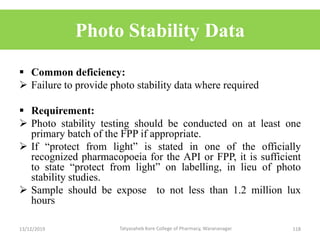
Photo Stability Data
 Common deficiency:
 Failure to provide photo stability data where required
 Requirement:
 Photo stability testing should be conducted on at least one
primary batch of the FPP if appropriate.
 If “protect from light” is stated in one of the officially
recognized pharmacopoeia for the API or FPP, it is sufficient
to state “protect from light” on labelling, in lieu of photo
stability studies.
 Sample should be expose to not less than 1.2 million lux
hours
13/12/2019 118Tatyasaheb Kore College of Pharmacy, Warananagar.
Zone IVb Climatic Conditions
 Common deficiency:
 Failure to conduct studies at zone IVb (Hot and very Humid) climatic
conditions of 30± 2C and 75 ±5%RH.
 Requirement:
 Stability data must demonstrate stability of the medicinal product
throughout its intended shelf‐life under the climatic conditions
prevalent in the target countries.
 Merely applying the same requirements applicable to other markets
could potentially lead to substandard products, e.g. stability studies
conducted for countries in Climatic Zone I/II when the products are
supplied in Climatic Zones III and IV countries.
13/12/2019 119Tatyasaheb Kore College of Pharmacy, Warananagar.
Zone IVb Climatic Conditions
• Effective as of September 2011, the required long-
term storage conditions for the Prequalification
Programme are 30ºC±2ºC/75%±5% RH, and after
this date the long-term data submitted in the product
dossier should be at these conditions.
• The use of alternative long-term conditions will need
to be justified and should be supported with
appropriate evidence.
13/12/2019 120Tatyasaheb Kore College of Pharmacy, Warananagar.
Generic Guideline
• The guideline on submission of documentation
for a multisource (generic) finished
pharmaceutical product (FPP) has been revised:
Preparation of Product Dossiers (PDS) in
Common Technical Document (CTD) format
(see link below):
http://apps.who.int/prequal/info_general/documen
ts/generic_guide/GenericGuideline_Quality.pdf
13/12/2019 121Tatyasaheb Kore College of Pharmacy, Warananagar.
New Generic Guide
1. ICH CTD structure has been adopted and the
guidelines provide full details on preparation of
dossiers in this format.
2. The quality guideline is more extensive than
previous guidelines. The guideline has been
updated to reflect current requirements and at the
same time, additional details have been provided
on how to meet the current requirements.
3. Certain reductions in requirements are described.
13/12/2019 122Tatyasaheb Kore College of Pharmacy, Warananagar.
Reduced requirement on Stability
• There is a reduced requirement for the number of
FPP batches required to establish the shelf-life,
for both complicated FPPs* (minimum three pilot
batches reduced to minimum two pilot batches)
and uncomplicated FPPs (minimum three pilot
batches reduced to minimum one pilot batch and a
second batch which may be smaller).
• These batches should be manufactured by a
procedure fully representative of and simulating
that to be applied to a full production-scale batch.
13/12/2019 123Tatyasaheb Kore College of Pharmacy, Warananagar.
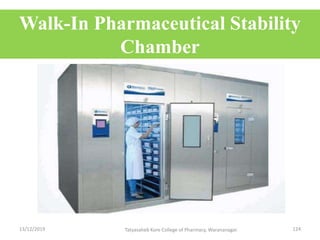
Walk-In Pharmaceutical Stability
Chamber
13/12/2019 Tatyasaheb Kore College of Pharmacy, Warananagar. 124
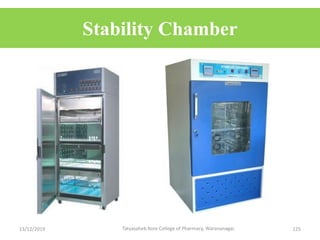
Stability Chamber
13/12/2019 Tatyasaheb Kore College of Pharmacy, Warananagar. 125
Packaging materials
• Pack is the integral part of the Finished product
• DOE should be done for the selection of best pack to
ensure the quality.
• Primary, secondary and tertiary packing should be
considered in to packaging
• Tests like moisture permeability, sturdiness, configuration
of the packs in the Shippers are a few factors to be
considered in the study ( barrier properties )
• Desiccants and Over space in plastic containers should
be dealt in detail for moisture sensitive formulations.
13/12/2019 Tatyasaheb Kore College of Pharmacy, Warananagar. 126
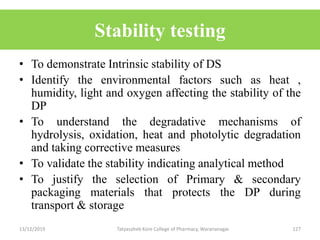
Stability testing
• To demonstrate Intrinsic stability of DS
• Identify the environmental factors such as heat ,
humidity, light and oxygen affecting the stability of the
DP
• To understand the degradative mechanisms of
hydrolysis, oxidation, heat and photolytic degradation
and taking corrective measures
• To validate the stability indicating analytical method
• To justify the selection of Primary & secondary
packaging materials that protects the DP during
transport & storage
13/12/2019 Tatyasaheb Kore College of Pharmacy, Warananagar. 127
THNAK YOU
E-mail: nanjwadebk@gmail.com
13/12/2019 Tatyasaheb Kore College of Pharmacy, Warananagar. 128

Packaging and Stability Requirements for Pharmaceuticals

  • 1.
    Packaging and Stability Requirementsfor Pharmaceuticals By Dr. Basavaraj K. Nanjwade M.Pharm., PhD Principal Scientist Trroy Life Sciences Pvt Ltd BANGALORE-560064 13/12/2019 1Tatyasaheb Kore College of Pharmacy, Warananagar.
  • 2.
    Packaging • Packing: Packingconsists of enclosing an individual item, or several items, in a container, usually for shipment or delivery. This operation is mostly done by hand and machine. • Pharmaceutical Packaging: Pharmaceutical packaging means the combination of components necessary to contain, preserve, protect & deliver a safe, efficacious drug product, such that at any time point before expiration date of the drug product, a safe & efficacious dosage form is available. 13/12/2019 2Tatyasaheb Kore College of Pharmacy, Warananagar.
  • 3.
    General principles • Thepurpose of stability testing is to provide evidence of how the quality of an API or FPP varies with time under the influence of a variety of environmental factors such as temperature, humidity and light. • The stability testing programme also includes the study of product-related factors that influence its quality, for example, interaction of the API with excipients, container-closure systems and packaging materials. • In fixed-dose combination FPPs (fixed-dose combinations (FDCs)) the interaction between two or more APIs also has to be considered. 13/12/2019 3Tatyasaheb Kore College of Pharmacy, Warananagar.
  • 4.
    Types of PackagingSystems • Primary package system: Made up of those package components & subcomponents that come into direct contact with the product, or those that may have a direct effect on the product shelf life. • Secondary or tertiary package system: Includes cartons, corrugated shippers & pallets. 13/12/2019 4Tatyasaheb Kore College of Pharmacy, Warananagar.
  • 5.
    13/12/2019 Tatyasaheb KoreCollege of Pharmacy, Warananagar. 5 Types of Packaging Systems
  • 6.
    Polypropylene (PP) 13/12/2019 TatyasahebKore College of Pharmacy, Warananagar. 6
  • 7.
    Polystyrene (solid form)(PS) 13/12/2019 Tatyasaheb Kore College of Pharmacy, Warananagar. 7
  • 8.
    Thermoplastic elastomers (TPE) 13/12/2019Tatyasaheb Kore College of Pharmacy, Warananagar. 8
  • 9.
    HDPE Pharmaceutical Bottles 13/12/20199Tatyasaheb Kore College of Pharmacy, Warananagar.
  • 10.
    LDPE Plastic Bottles 13/12/201910Tatyasaheb Kore College of Pharmacy, Warananagar.
  • 11.
    HC Glass typeI, II, III 13/12/2019 Tatyasaheb Kore College of Pharmacy, Warananagar. 11
  • 12.
    Polyethylene terephthalate (PET) 13/12/201912Tatyasaheb Kore College of Pharmacy, Warananagar.
  • 13.
    Polypropylene Ready toFill Vials 13/12/2019 13Tatyasaheb Kore College of Pharmacy, Warananagar.
  • 14.
    Quality Control • Qualitycontrol of primary pharmaceutical packaging materials for companies is vital to assure safety standards for the patient using the medical product. • Packaging meets Good Manufacturing Practice (GMP) for deliverables, pharmaceutical international standard ISO 15378, and environmental commitments standard ISO 14001. 13/12/2019 14Tatyasaheb Kore College of Pharmacy, Warananagar.
  • 15.
    Packaging must meetthe following Requirements • Protect the preparation from environmental conditions. • Non-reactive with the product and so does not alter the identity of the product • Does not impart tastes or odors to the product • Nontoxic • FDA approved • Protect the dosage form from damage or breakage • Meet tamper-resistance requirements, wherever applicable. • Adaptable to commonly employed high-speed packaging equipments. 13/12/2019 15Tatyasaheb Kore College of Pharmacy, Warananagar.
  • 16.
    Selection of packagematerial • Stability • Compatibility with the contents • Strength of container and the degree of protection required • Moisture-proofness • Resistance to corrosion by Acids or Alkalis • Resistance to grease • Protection against salt • Resistance to microorganisms • Resistance to insects and rodents • Resistance to differences in temperature • Protection against light, fire and pilferage • Odor retention and transmission • Aesthetic effect • Cost • Machine suitability of packaging and the filling method • Convenience of the packaging for the physician, pharmacist and finally the patient (size, weight, method of opening/re-closing, legibility of printing) 13/12/2019 16Tatyasaheb Kore College of Pharmacy, Warananagar.
  • 17.
    Packaging materials &closures • Glass • Plastic • Metals • Paper and Board • Rubber • Cotton • Adhesives and Inks • Closures 13/12/2019 17Tatyasaheb Kore College of Pharmacy, Warananagar.
  • 18.
    Types of Glass •Type I – Borosilicate Glass • Type II – Treated Soda-Lime Glass • Type III – Regular Soda-Lime Glass • Type NP – General Purpose Soda-Lime Glass 13/12/2019 18Tatyasaheb Kore College of Pharmacy, Warananagar.
  • 19.
    Closures • Depending uponthe type of container, closures may have different shapes & sizes. • Closures, which form a part of the primary packaging system. • They form essential component of the container & an integral part of the drug preparation. 13/12/2019 19Tatyasaheb Kore College of Pharmacy, Warananagar.
  • 20.
    Functions of aclosure • Hermetic seal: Permits no exchange between the contents & the outside of the pack, e.g. a fused glass ampoule. • Effective microbiological seal e.g. rubber cork & metal overseal. • Effective seal, acceptable to the product. 13/12/2019 20Tatyasaheb Kore College of Pharmacy, Warananagar.
  • 21.
    Packaging Evaluation 13/12/2019 21TatyasahebKore College of Pharmacy, Warananagar.
  • 22.
    Properties of suitabilityconcerns and interactions Attributes Concerns and Interaction Proposed Methods Protection Exposure to light, moisture, microbial ingress and oxidation of presence of oxygen USP <661> Light transmission and water vap or permission, Container integrity (Microbial Ingress, Dye penetration, Helium Leak Compatibility Leachable –induced degradation, absorption or adsorption of drug, precipitation, change in pH, discolouration, brittleness in packaging material Leachability study (Migration of chemicals into drug products) using LC/MS, GC/MS, ICP/AA, pH, Appearance drug and container, thermal analysis (DSC, TGA), & IR. Safety No leached harmful or undesired amounts of substances to expose patients treated with drugs Extraction study (USP Physicochemical Tests-Plastics), USP Elastomeric closures for Injections, Toxicological evaluation, USP Biological reactivity and complies with CFR additives and purity Performance Container Closure system, functionality, drug delivery Functionality (Improved patient compliance or use), Delivery (transfer dose in right amount or rate) 13/12/2019 22Tatyasaheb Kore College of Pharmacy, Warananagar.
  • 23.
    Dosage forms andpackage forms Dosage Form Condition Route of Delivery Possible Package Form Solids (Tablets, Capsules, Powders) Non-Sterile Oral - Glass Or Plastic Bottle And Cap - Blister And Strip Packaging - Sachet, Pouches - Drums And Jars Solids Non-Sterile Rectal (Suppository) - Foil Pouch Or Blister Solids Aseptic Inhalation - Dry-Powder Inhaler 13/12/2019 23Tatyasaheb Kore College of Pharmacy, Warananagar.
  • 24.
    Glass Or PlasticBottle And Cap 13/12/2019 Tatyasaheb Kore College of Pharmacy, Warananagar. 24
  • 25.
    Blister And StripPackaging 13/12/2019 Tatyasaheb Kore College of Pharmacy, Warananagar. 25
  • 26.
    Sachet and Pouches 13/12/2019Tatyasaheb Kore College of Pharmacy, Warananagar. 26
  • 27.
    Drums and Jars 13/12/2019Tatyasaheb Kore College of Pharmacy, Warananagar. 27
  • 28.
    Foil Pouch orBlister 13/12/2019 Tatyasaheb Kore College of Pharmacy, Warananagar. 28
  • 29.
    Dry-Powder Inhaler 13/12/2019 TatyasahebKore College of Pharmacy, Warananagar. 29
  • 30.
    Dosage Forms andPackage Forms Dosage Form Condition Route of Delivery Possible Package Form Ointments, Creams Non-Sterile Topical - Collapsible Tube - Pump (High Viscosity Dispenser) - Transdermal Delivery Device - Glass Or Plastic Jar Ointments Sterile Ophthalmic - Collapsible Tube - Glass Or Plastic Bottle And Cap - Form-Fill-Seal Plastic Bottle - Glass Or Plastic Jar - Soft Gelatin Capsules 13/12/2019 30Tatyasaheb Kore College of Pharmacy, Warananagar.
  • 31.
    Collapsible Tube 13/12/2019 TatyasahebKore College of Pharmacy, Warananagar. 31
  • 32.
    Pump (High ViscosityDispenser) 13/12/2019 Tatyasaheb Kore College of Pharmacy, Warananagar. 32
  • 33.
    Transdermal and transmucosalDelivery Devices 13/12/2019 Tatyasaheb Kore College of Pharmacy, Warananagar. 33
  • 34.
    Glass or PlasticJar 13/12/2019 Tatyasaheb Kore College of Pharmacy, Warananagar. 34
  • 35.
    Glass Or PlasticBottle And Cap 13/12/2019 Tatyasaheb Kore College of Pharmacy, Warananagar. 35
  • 36.
    Form-Fill-Seal Plastic Bottle(FFS) 13/12/2019 Tatyasaheb Kore College of Pharmacy, Warananagar. 36
  • 37.
    Glass Or PlasticJar 13/12/2019 Tatyasaheb Kore College of Pharmacy, Warananagar. 37
  • 38.
    Soft Gelatin Capsules 13/12/2019Tatyasaheb Kore College of Pharmacy, Warananagar. 38
  • 39.
    Dosage forms andpackage forms Dosage Form Condition Route of Delivery Possible Package Form Liquids Non-Sterile Oral - Glass Or Plastic Bottle And Cap - Bottle With Spray Pump - Bottle With Dropper Assembly - Sachet, Pouches - Drums And Jars Liquids Non-Sterile Topical - Glass Or Plastic Bottle And Cap Over Dropper Tip - Collapsible Tube - Aerosol Sprays - Drums And Jars Liquids Sterile Parenteral, Ophthalmic - Glass Ampoules - Glass Or Plastic Vial With Stopper -Glass Or Plastic Vials With Applicators - Pre-Filled Syringe - Bag -Pre-Filled Form -Fill-Seal Plastic Container 13/12/2019 39Tatyasaheb Kore College of Pharmacy, Warananagar.
  • 40.
    Glass Or PlasticBottle and Cap 13/12/2019 Tatyasaheb Kore College of Pharmacy, Warananagar. 40
  • 41.
    Bottle With SprayPump 13/12/2019 Tatyasaheb Kore College of Pharmacy, Warananagar. 41
  • 42.
    Bottle With DropperAssembly 13/12/2019 Tatyasaheb Kore College of Pharmacy, Warananagar. 42
  • 43.
    Sachet, Pouches 13/12/2019 TatyasahebKore College of Pharmacy, Warananagar. 43
  • 44.
    Drums and Jars 13/12/2019Tatyasaheb Kore College of Pharmacy, Warananagar. 44
  • 45.
    Glass Or PlasticBottle and Cap Over Dropper Tip 13/12/2019 Tatyasaheb Kore College of Pharmacy, Warananagar. 45
  • 46.
    Collapsible Tube 13/12/2019 TatyasahebKore College of Pharmacy, Warananagar. 46
  • 47.
    Aerosol Sprays 13/12/2019 TatyasahebKore College of Pharmacy, Warananagar. 47
  • 48.
    Drums and Jars 13/12/2019Tatyasaheb Kore College of Pharmacy, Warananagar. 48
  • 49.
    Glass Ampoules 13/12/2019 TatyasahebKore College of Pharmacy, Warananagar. 49
  • 50.
    Glass Or PlasticVial With Stopper 13/12/2019 Tatyasaheb Kore College of Pharmacy, Warananagar. 50
  • 51.
    Glass Or PlasticVials With Applicators 13/12/2019 Tatyasaheb Kore College of Pharmacy, Warananagar. 51
  • 52.
    Pre-Filled Syringe 13/12/2019 TatyasahebKore College of Pharmacy, Warananagar. 52
  • 53.
    Infusion Bag 13/12/2019 TatyasahebKore College of Pharmacy, Warananagar. 53
  • 54.
    Pre-Filled Form 13/12/2019 TatyasahebKore College of Pharmacy, Warananagar. 54
  • 55.
    Fill-Seal Plastic Container 13/12/2019Tatyasaheb Kore College of Pharmacy, Warananagar. 55
  • 56.
    Packaging of Medical/SurgicalDevices • They must be capable of being sterilized economically. • They must withstand the shipping and handling environment. • They must be compatible with the procedures set up by the hospitals. • Sterility • Environmental • Product resistance: oils, water, chemicals, gas, etc. • Physical: Dimensional stability (rigidity or flexibility, resists puncture, tearing, abrasion, impact and pressure, provides cushioning and structural support. 13/12/2019 56Tatyasaheb Kore College of Pharmacy, Warananagar.
  • 57.
    Evaluation of MedicalDevice Packages • To evaluate the component materials of container and the inner protective cushioning materials . • To develop (through research) improved methods or concepts and improved package testing techniques. 13/12/2019 57Tatyasaheb Kore College of Pharmacy, Warananagar.
  • 58.
    The types oftests carried out for Medical Device Packages • Sterility Testing • Manual handling • Vehicle stacking • Loose-load vibration • Vehicle vibration • Drop test • Compression • Package seal strength testing 13/12/2019 58Tatyasaheb Kore College of Pharmacy, Warananagar.
  • 59.
    Child Resistant Packaging •Plastic and glass packaging design experts and childproof packaging. • Child-resistant packaging, also known as “CR packaging”, is purpose made packaging utilised to lower the risk of infants and children ingesting harmful medicines. • Packaging requirements from the EU and US standards for child resistant packaging regarding prescription drugs necessitate that over-the-counter medications and products that contain chemicals require by law the use of child safety features, and unit dosage packaging (blister packs) are also covered by these regulations. 13/12/2019 59Tatyasaheb Kore College of Pharmacy, Warananagar.
  • 60.
    Classifications of child-resistant packages •Type I: Reclosable packaging - continuous thread closure • Type II: Reclosable packaging - lug finish closure • Type III: Reclosable packaging - snap closure • Type IV: Unit non-reclosable - flexible (strip/pouch) • Type V: Unit non-reclosable - rigid • Type VI: Unit reclosable packages • Type VII: Aerosol packages • Type VIII: Non-reclosable packages - semi-rigid (blister) • Type IX: Dispensers (not intended to be removed) • Type X: Box or tray package • Type XI: Reclosable packaging - flexible • Type XII: Dispenser (may be removed) • Type XIII: Reclosable packaging - semi-rigid (blister) 13/12/2019 60Tatyasaheb Kore College of Pharmacy, Warananagar.
  • 61.
    Tamper Proof Packaging •Tamper proof containers are those that resist the tampering of the product before consumer the product. • They help in…. - Receiving the products by patients “as manufactured” - Preventing “product browsing and sampling” 13/12/2019 61Tatyasaheb Kore College of Pharmacy, Warananagar.
  • 62.
    Tamper Proof Containers •Film Wrappers • Blister or Strip Packs • Bubble Packs • Heat Shrink Bands or Wrappers • Foil, Paper, or Plastic Pouches • Bottle Mouth Inner Seals • Tape Seals • Breakable Caps • Sealed Metal Tubes or • Plastic Blind-end Heat Sealed Tubes • Cans • In-Built Tamper-Evident Controls 13/12/2019 62Tatyasaheb Kore College of Pharmacy, Warananagar.
  • 63.
    Packaging Components Primary components Secondary components Associated components Syringes CartonsDosing droppers Ampoules Overlaps Calibrated spoon Flexible bags Bottles Closures 13/12/2019 63Tatyasaheb Kore College of Pharmacy, Warananagar.
  • 64.
    Color Coding CLASS COLOR Anti-infectivesTan Anti-inflamatories/ Steroids Pink Mydriatics and Cycloopegics Red NSAIDs Gray Miotics Green Beta Blockers Yellow or Blue Adrenergic Agonists Purple Carbonic Anhydrase Inhibitors Orange Prostaglandin Anaogues Tuquoise USP supports the suggestion that the use of color-coding for pharmaceutical Products to prevent medication errors are used cautiously and on a case-by-case basis 13/12/2019 64Tatyasaheb Kore College of Pharmacy, Warananagar.
  • 65.
    Stability • Container closuresystem should be monitored for sign of instability. • Applicant should investigate any observed change In the packaging system used in stability studies. • If corrective action requires a change in an approved container closure system, a supplemental application should be submitted. 13/12/2019 65Tatyasaheb Kore College of Pharmacy, Warananagar.
  • 66.
    Purpose of Stability •The purpose of stability testing is to provide evidence of how the quality of an Active Pharmaceutical Ingredient (API) or Finished Pharmaceutical Product (FPP) varies with time under the influence of a variety of environmental factors such as temperature, humidity and light. • The stability programme also includes the study of product related factors that influence its quality, for example, interaction of API with excipients, container closure systems and packaging materials. 13/12/2019 66Tatyasaheb Kore College of Pharmacy, Warananagar.
  • 67.
    ICH Stability Zone ZoneType of Climate Zone I Temperate Zone Zone II Mediterranean/Subtropical Zone Zone III Hot Dry Zone Zone IVa Hot Humid/Tropical Zone Zone IVb Hot /Higher humidity 13/12/2019 Tatyasaheb Kore College of Pharmacy, Warananagar. 67 India : Climatic Zone III, IVb and Assigned to Zone IVb
  • 68.
    Long Term StabilityTesting Condition Climatic Zone Temperature Humidity Minimum Duration Zone I 21C ± 2 C 45% RH ± 5% RH 12 Months Zone II 25C ± 2 C 60% RH ± 5% RH 12 Months Zone III 30C ± 2 C 35% RH ± 5% RH 12 Months Zone IVa 30C ± 2 C 65% RH ± 5% RH 12 Months Zone IVb 30C ± 2 C 75% RH ± 5% RH 12 Months Refrigerated 5C ± 3 C No Humidity 12 Months Frozen -15C ± 5 C No Humidity 12 Months 13/12/2019 Tatyasaheb Kore College of Pharmacy, Warananagar. 68
  • 69.
    Accelerated and Intermediate StabilityTesting Condition Climatic Zone Temperature Humidity Minimum Duration Accelerated Ambient 40C ± 2 C 75% RH ± 5% RH 6 Months Accelerated Refrigerated 25C ± 2 C 60% RH ± 5% RH 6 Months Accelerated Frozen 5C ± 3 C No Humidity 6 Months Intermediate 30C ± 2 C 65% RH ± 5% RH 6 Months 13/12/2019 Tatyasaheb Kore College of Pharmacy, Warananagar. 69
  • 70.
    Active Pharmaceutical Ingredient 1.General 2. Stress testing 3. Selection of batches 4. Container-closure system 5. Specification 6. Testing frequency 7. Storage conditions 8. Stability commitments 9. Evaluation 10. Statements and labelling 11. Ongoing stability studies 13/12/2019 70Tatyasaheb Kore College of Pharmacy, Warananagar.
  • 71.
    General • Information onthe stability of the API is an integral part of the systematic approach to stability evaluation. • Potential attributes to be studied during stability testing of an API are listed in the examples of testing parameters . • The selection of potential attributes and time points to be tested should be justified. • The retest period or shelf life assigned to the API by the API manufacturer should be derived from stability testing data. 13/12/2019 71Tatyasaheb Kore College of Pharmacy, Warananagar.
  • 72.
    Stress testing • Stresstesting may be carried out on a single batch of the API. • It should include the effect of temperature (in 10 °C increments (for example, at 50 °C, 60 °C) above the temperature used for accelerated testing), humidity (for example, 75% relative humidity (RH) or greater) and, where appropriate, oxidation and photolysis of the API. • The testing should also evaluate the susceptibility of the API to hydrolysis across a justified range of pH values when in solution or suspension 13/12/2019 72Tatyasaheb Kore College of Pharmacy, Warananagar.
  • 73.
    Selection of Batches •Data from stability studies on at least three primary batches of the API should normally be provided. • The batches should be manufactured at a minimum of pilot scale by the same synthesis route as production batches, and using a method of manufacture and a procedure that simulates the final process to be used for production batches. • The overall quality of the batches of API placed on stability studies should be representative of the quality of the material to be made on a production scale. 13/12/2019 73Tatyasaheb Kore College of Pharmacy, Warananagar.
  • 74.
    Container-Closure System • Thestability studies should be conducted on the API packaged in a container closure system that is the same as, or simulates, the packaging proposed for storage and distribution. 13/12/2019 74Tatyasaheb Kore College of Pharmacy, Warananagar.
  • 75.
    Specification • Stability studiesshould include testing of stability-indicating attributes of the API, i.e. those that are susceptible to change during storage and are likely to influence quality, safety and/or efficacy. • The testing should cover, as appropriate, the physical, chemical, biological and microbiological attributes. • Validated stability-indicating analytical procedures should be applied. 13/12/2019 75Tatyasaheb Kore College of Pharmacy, Warananagar.
  • 76.
    Testing Frequency • ForAPIs with a proposed retest period or shelf life of at least 12 months, the frequency of testing at the long-term storage condition should normally be every three months over the first year, every six months over the second year, and annually thereafter throughout the proposed retest period or shelf life. • At the accelerated storage condition, a minimum of three time points, including the initial and final time points (e.g. 0, 3 and 6 months), from a sixmonth study is recommended. 13/12/2019 76Tatyasaheb Kore College of Pharmacy, Warananagar.
  • 77.
    • Where itis expected (based on development experience) that results from accelerated studies are likely to approach significant change criteria, additional testing should be conducted either by adding samples at the final time point or by including a fourth time point in the study design. • When testing at the intermediate storage condition is called for as a result of significant change at the accelerated storage condition, a minimum of four time points, including the initial and final time points (e.g. 0, 6, 9 and 12 months), from a 12-month study is recommended. 13/12/2019 Tatyasaheb Kore College of Pharmacy, Warananagar. 77 Testing Frequency
  • 78.
    Storage Conditions • Thestorage conditions and the lengths of studies chosen should be sufficient to cover storage and shipment. • Storage condition tolerances are defined as the acceptable variations in temperature and RH of storage facilities for stability studies. • The equipment used should be capable of controlling the storage conditions within the ranges defined in these guidelines. • The storage conditions should be monitored and recorded. 13/12/2019 78Tatyasaheb Kore College of Pharmacy, Warananagar.
  • 79.
    Storage Conditions • Short-termenvironmental changes due to opening the doors of the storage facility are accepted as unavoidable. • The effect of excursions due to equipment failure should be assessed, addressed and reported if judged to affect stability results. • Excursions that exceed the defined tolerances for more than 24 hours should be described in the study report and their effects assessed. 13/12/2019 Tatyasaheb Kore College of Pharmacy, Warananagar. 79
  • 80.
    Storage Conditions • Iflong-term studies are conducted at 25 °C ±2 °C/60% RH ±5% RH and “significant change” occurs at any time during six months’ testing at the accelerated storage condition, additional testing at the intermediate storage condition should be conducted and evaluated against significant change criteria. • In this case, testing at the intermediate storage condition should include all long-term tests, unless otherwise justified, and the initial application should include a minimum of six months’ data from a 12-month study at the intermediate storage condition. • “Significant change” for an API is defined as failure to meet its specification. 13/12/2019 80Tatyasaheb Kore College of Pharmacy, Warananagar.
  • 81.
    General Case Study Storagecondition Minimum time period covered by data at submission Long-term* 25 °C ± 2 °C/60% RH ± 5% RH or 30 °C ± 2 °C/65% RH ± 5% RH or 30 °C ± 2 °C/75% RH ± 5% RH 12 months or 6 months Intermediate** 30 °C ± 2 °C/65% RH ± 5% RH 6 months Accelerated 40 °C ± 2 °C/75% RH ± 5% RH 6 months *Whether long-term stability studies are performed at 25 °C ± 2 °C/60% RH ± 5% RH or 30 °C ± 2 °C/65% RH ± 5% RH or 30 °C ± 2 °C/75% RH ± 5% RH is determined by the climatic condition under which the API is intended to be stored (intermediate condition. see “Long-term stability testing conditions as identified by WHO Member States”). Testing at a more severe long-term condition can be an alternative to testing condition, i.e. 25 °C/60% RH or 30 °C/65% RH for zone II. **If 30 °C ± 2 °C/65% RH ± 5% RH or 30 °C ± 2 °C/75% RH ± 5% RH is the long-term condition there is no 13/12/2019 81Tatyasaheb Kore College of Pharmacy, Warananagar.
  • 82.
    Active Pharmaceutical Ingredients Intendedfor Storage in a Refrigerator Study Storage condition Minimum time period covered by data at submission Long-term 5 °C ± 3 °C 12 months or 6 months Accelerated* 25 °C ± 2 °C/60% RH ± 5% RH or 30 °C ± 2 °C/65% RH ± 5% RH or 30 °C ± 2 °C/75% RH ± 5% RH 6 months * Whether accelerated stability studies are performed at 25 °C ± 2 °C/60% RH ± 5% RH or 30 °C ± 2 °C/65% RH ± 5% RH or 30 °C ± 2 °C/75% RH ± 5% RH is based on a risk based evaluation. Testing at a more severe accelerated condition can be an alternative to storage testing at 25 °C/60% RH or 30 °C/65% RH. 13/12/2019 82Tatyasaheb Kore College of Pharmacy, Warananagar.
  • 83.
    Active Pharmaceutical Ingredients Intendedfor Storage in a Freezer Study Storage condition Minimum time period covered by data at submission Long-term −20 °C ± 5 °C 12 months or 6 months In the rare case of any API of nonbiological origin being intended for storage in a freezer, the retest period or shelf life should be based on the long-term data obtained at the long-term storage condition. In the absence of an accelerated storage condition for APIs intended to be stored in a freezer, testing on a single batch at an elevated temperature (e.g. 5 °C ± 3 °C or 25 °C ±2 °C or 30 °C ±2 °C) 13/12/2019 83Tatyasaheb Kore College of Pharmacy, Warananagar.
  • 84.
    Stability Commitments • Whenthe available long-term stability data on primary batches do not cover the proposed retest period or shelf life granted at the time of approval, a commitment should be made to continue the stability studies post-approval in order to firmly establish the retest period or shelf life. • Where the submission includes long-term stability data on three production batches covering the proposed retest period or shelf life, a post approval commitment is considered unnecessary. 13/12/2019 84Tatyasaheb Kore College of Pharmacy, Warananagar.
  • 85.
    Stability Commitments  Ifthe submission includes data from stability studies on three production batches, a commitment should be made to continue these studies through the proposed retest period or shelf life;  If the submission includes data from stability studies on fewer than three production batches, a commitment should be made to continue these studies through the proposed retest period and to place additional production batches, up to a total of at least three, in long-term stability studies through the proposed retest period or shelf life;  If the submission does not include stability data on production batches, a commitment should be made to place the first three production batches (see section 2.1.3) on long-term stability studies through the proposed retest period or shelf life. 13/12/2019 85Tatyasaheb Kore College of Pharmacy, Warananagar.
  • 86.
    Evaluation • The purposeof the stability study is to establish – based on testing a minimum of three batches of the API, unless otherwise justified, and evaluating the stability information (including, as appropriate, results of the physical, chemical, biological and microbiological tests) – a retest period or shelf life applicable to all future batches of the API manufactured under similar circumstances. • Any evaluation should cover not only the assay but also the levels of degradation products and other stability-indicating attributes. 13/12/2019 86Tatyasaheb Kore College of Pharmacy, Warananagar.
  • 87.
    Statements and labelling •Terms such as “ambient conditions” or “room temperature” should be avoided. • A retest period should be derived from the stability information, and a retest date should be displayed on the container label if appropriate. • After this retest period a batch of API destined for use in the manufacture of an FPP could be retested and then, if in compliance with the specification, could be used immediately (e.g. within 30 days). 13/12/2019 87Tatyasaheb Kore College of Pharmacy, Warananagar.
  • 88.
    Ongoing stability studies •The stability of the API should be monitored according to a continuous and appropriate programme that will permit the detection of any stability issue (e.g. changes in levels of degradation products). • The purpose of the ongoing stability programme is to monitor the API and to determine that the API remains, and can be expected to remain, within specifications under the storage conditions indicated on the label, within the retest period or shelf life in all future batches. • The ongoing stability programme should be described in a written protocol and the results presented in a formal report that should be available on site. 13/12/2019 88Tatyasaheb Kore College of Pharmacy, Warananagar.
  • 89.
    Ongoing stability studies Number of batch(es) and different batch sizes, if applicable;  Relevant physical, chemical, microbiological and biological test parameters with acceptance criteria or reference to the attached specifications;  Reference to test methods;  Description of the container-closure system(s);  Testing frequency;  Description of the conditions of storage (standardized conditions for long-term testing as described in these guidelines, and consistent with the API labelling, should be used);  Other applicable parameters specific to the API. 13/12/2019 89Tatyasaheb Kore College of Pharmacy, Warananagar.
  • 90.
    Ongoing stability studies •At least one production batch per year of API (unless none is produced during that year) should be added to the stability monitoring programme and generally should be tested at least every 6 months in the first year and then annually to confirm the stability. • In certain situations additional batches should be included in the stability programme and may require more frequent testing. • Out-of-specification (OOS) results or significant atypical trends should be investigated. • Any confirmed significant change or OOS result should be reported immediately to the relevant finished product manufacturer. 13/12/2019 90Tatyasaheb Kore College of Pharmacy, Warananagar.
  • 91.
    Recommended labelling statementsfor active pharmaceutical ingredients Testing condition under whic the stability of the API has been demonstrated Recommended labelling statement* 25 °C/60% RH (long-term) 40 °C/75% RH (accelerated) “Do not store above 25 °C” 25 °C/60% RH (long-term) 30 °C/65% RH (intermediate, failure during accelerated stability studies) “Do not store above 25 °C”** 30 °C/65% RH (long-term) 40 °C/75% RH (accelerated) “Do not store above 30 °C”** 30 °C/75% RH (long-term) 40 °C/75% RH (accelerated) “Do not store above 30 °C” 5 °C ± 3 °C ”Store in a refrigerator (2 °C to 8 °C)” −20 °C ± 5 °C “Store in freezer” *During storage, shipment and distribution of the API, the current Good trade and distribution practices (GTDP) for pharmaceutical starting materials are to be observed (1). Details on storage and labelling requirements can be found in WHO guide to good storage practices for pharmaceuticals (2). **“Protect from moisture” should be added as applicable. 13/12/2019 91Tatyasaheb Kore College of Pharmacy, Warananagar.
  • 92.
    Finished pharmaceutical product 1.General 2. Stress testing 3. Selection of batches 4. Container-closure system 5. Specification 6. Testing frequency 7. Storage conditions 8. Stability commitments 9. Evaluation 10. Statements and labelling 11. In-use and hold time stability 12. Variations 13. Ongoing stability studies 13/12/2019 92Tatyasaheb Kore College of Pharmacy, Warananagar.
  • 93.
    General • The designof the stability studies for the FPP should be based on knowledge of the behaviour and properties of the API, information from stability studies on the API and on experience gained from preformulation studies, similar marketed formulations and investigational FPPs. 13/12/2019 93Tatyasaheb Kore College of Pharmacy, Warananagar.
  • 94.
    Stress testing • Photostabilitytesting, which is an integral part of stress testing, should be conducted on at least one primary batch of the FPP if appropriate. • Additional stress testing of specific types of dosage forms may be appropriate, e.g. cyclic studies for semi-solid products or freeze–thaw studies for liquid products. 13/12/2019 94Tatyasaheb Kore College of Pharmacy, Warananagar.
  • 95.
    Selection of batches •For FPPs containing new APIs, data from stability studies should be provided on at least three primary batches of each proposed strength of the FPP. Two of the three batches should be at least pilot-scale batches and the third batch can be smaller, if justified. • For FPPs containing existing APIs (e.g. generics), data should be provided on not less than two batches of at least pilot scale, or in the case of an uncomplicated3 FPP (e.g. immediate- release solid FPPs (with noted exceptions) or non-sterile solutions), at least one batch of at least pilot scale and a second batch which may be smaller (e.g. for solid oral dosage forms, 25 000 or 50 000 tablets or capsules) of each proposed strength of the FPP. 13/12/2019 95Tatyasaheb Kore College of Pharmacy, Warananagar.
  • 96.
    Container-Closure System • Stabilitytesting should be conducted on the dosage form packaged in the primary container-closure systems proposed for marketing. • If the secondary container-closure system has protective properties, and labelling clearly indicates that the product is to be stored in the primary and secondary packaging (e.g.“store tablets in blisters in the provided cartons”), or if the product is packaged in a semi-permeable container where components from the secondary packaging can migrate into the product, the secondary packaging may also form part of the packaging system for stability samples. 13/12/2019 96Tatyasaheb Kore College of Pharmacy, Warananagar.
  • 97.
    Specification • Stability studiesshould include testing of stability- indicating attributes of the FPP, i.e. those that are susceptible to change during storage and are likely to influence quality, safety and/or efficacy. • The testing should cover, as appropriate, the physical, chemical, biological and microbiological attributes, preservative content (e.g. antioxidant or antimicrobial preservatives) and functionality tests (e.g. for a dose delivery system). 13/12/2019 97Tatyasaheb Kore College of Pharmacy, Warananagar.
  • 98.
    Testing frequency • Forproducts with a proposed shelf life of at least 12 months, the frequency of testing at the long-term storage condition should normally be every three months over the first year, every six months over the second year and annually thereafter throughout the proposed shelf life. • At the accelerated storage condition, a minimum of three time points, including the initial and final time points (e.g. 0, 3 and 6 months), from a six month study is recommended. • Where an expectation (based on development experience) exists that results from accelerated testing are likely to approach significant change criteria, testing should be increased either by adding samples at the final time point or by including a fourth time point in the study design. • When testing at the intermediate storage condition is called for as a result of significant change at the accelerated storage condition, a minimum of four time points, including the initial and final time points (e.g. 0, 6, 9 and 12 months), from a 12-month study is recommended. 13/12/2019 98Tatyasaheb Kore College of Pharmacy, Warananagar.
  • 99.
    Storage conditions • Stabilitydata must demonstrate stability of the medicinal product throughout its intended shelf life under the climatic conditions prevalent in the target countries. • Merely applying the same requirements appropriate to other markets could potentially lead to substandard products if stability studies are conducted at the storage conditions for countries in Climatic Zone I/II when the products are supplied in countries in Climatic Zones III and IV. 13/12/2019 99Tatyasaheb Kore College of Pharmacy, Warananagar.
  • 100.
    General case StorageCondition Study Storage condition Minimum time period covered by data at submission Long-term* 25 °C ± 2 °C/60% RH ± 5% RH or 30 °C ± 2 °C/65% RH ± 5% RH or 30 °C ± 2 °C/75% RH ± 5% RH 12 months or 6 months Intermediate** 30 °C ± 2 °C/65% RH ± 5% RH 6 months Accelerated 40 °C ± 2 °C/75% RH ± 5% RH 6 months * Whether long-term stability studies are performed at 25 °C ± 2 °C/60% RH ± 5% RH or 30 °C ± 2 °C/65% RH ± 5% RH or 30 °C ± 2 °C/75% RH ± 5% RH is determined by the climatic zone in which the FPP is intended to be marketed. Testing at a more severe long-term condition can be an alternative to storage at 25 °C/60% RH or 30 °C/65% RH. ** If 30 °C ± 2 °C/65% RH ± 5% RH or 30 °C ± 2 °C/75% RH ± 5% RH is the long term condition, there is no intermediate condition. 13/12/2019 100Tatyasaheb Kore College of Pharmacy, Warananagar.
  • 101.
    FPPs intended forstorage in a refrigerator Study Storage condition Minimum time period covered by data at submission Long-term 5 °C ± 3 °C 12 months or 6 months Accelerated* 25 °C ± 2 °C/60% RH ± 5% RH or 30 °C ± 2 °C/65% RH ± 5% RH or 30 °C ± 2 °C/75% RH ± 5% RH 6 months *Whether accelerated stability studies are performed at 25 °C ± 2 °C/60% RH ± 5% RH or 30 °C ± 2 °C/65% RH ±5% RH or 30 °C ± 2 °C/75% RH ± 5% RH is based on a risk based evaluation. Testing at a more severe accelerated condition can be an alternative to the storage condition at 25 °C/60% RH or 30 °C/65% RH. 13/12/2019 101Tatyasaheb Kore College of Pharmacy, Warananagar.
  • 102.
    FPPs intended forstorage in a freezer • For FPPs intended for storage in a freezer, the shelf life should be based on the long-term data obtained at the long-term storage condition. In the absence of an accelerated storage condition for FPPs intended to b stored in a freezer, testing on a single batch at an elevated temperature (e.g. 5 °C ±3 °C or 25 °C± 2 °C or 30 °C ± 2 °C) for an appropriate time period should be conducted to address the effect of short-term excursions outside the proposed label storage condition. Study Storage condition Minimum time period covered by data at submission Long-term –20 °C ± 5 °C 12 months or 6 months 13/12/2019 102Tatyasaheb Kore College of Pharmacy, Warananagar.
  • 103.
    Stability Commitments  Whenthe available long-term stability data on primary batches do not cover the proposed shelf life granted at the time of approval, a commitment should be made to continue the stability studies post approval throughout the proposed shelf life. This is the primary batch stability commitment.  If the submission includes data from stability studies on fewer than three production batches, a commitment should be made to place the next production batches, up to a total of at least three, on long-term stability studies throughout the proposed shelf life and on accelerated studies for six months.  This is the production batch stability commitment.  For each product, an ongoing stability programme is required to monitor the product over its shelf life and to determine that the product remains and can be expected to remain within specifications under the storage conditions on the label 13/12/2019 103Tatyasaheb Kore College of Pharmacy, Warananagar.
  • 104.
    Evaluation • A systematicapproach should be adopted to the presentation and evaluation of the stability information, which should include, as appropriate, results from the physical, chemical, biological and microbiological tests, including particular attributes of the dosage form (e.g. dissolution rate for solid oral dosage forms). • Where appropriate, a summary of additional knowledge and an understanding of stability gained from supporting studies, modelling, predictive tools, etc., may be incorporated to support knowledge gained from the primary stability programme. 13/12/2019 104Tatyasaheb Kore College of Pharmacy, Warananagar.
  • 105.
    Statements and labelling •A storage statement should be established for the label based on the stability evaluation of the FPP. • Where applicable, specific instructions should be provided, particularly for FPPs that cannot tolerate freezing. Terms such as “ambient conditions” or “room temperature” should be avoided. • There should be a direct link between the storage statement on the label and the demonstrated stability of the FPP. • An expiry date should be displayed on the container label. 13/12/2019 105Tatyasaheb Kore College of Pharmacy, Warananagar.
  • 106.
    In-use and holdtime stability • The purpose of in-use stability testing is to provide information for the labelling on the preparation, storage conditions and utilization period of multidose products after opening, reconstitution or dilution of a solution. • In general, a 30-day in-use period is normally considered acceptable without further supporting data. • As far as possible the test should be designed to simulate the use of the FPP in practice, taking into consideration the filling volume of the container and any dilution or reconstitution before use. 13/12/2019 106Tatyasaheb Kore College of Pharmacy, Warananagar.
  • 107.
    Variations • Once theFPP has been registered, additional stability studies are required whenever variations are made that may affect the stability of the API or FPP. • The applicant should investigate whether or not the intended change will have an impact on the quality characteristics of APIs and/or FPPs and consequently on their stability. • The scope and design of the stability studies for variations are based on the knowledge and experience acquired on APIs and FPPs. 13/12/2019 107Tatyasaheb Kore College of Pharmacy, Warananagar.
  • 108.
    Ongoing stability studies •After a marketing authorization has been granted, the stability of the FPP should be appropriately monitored according to a continuous programme that will permit the detection of any stability issue (e.g. changes in levels of degradation products or dissolution profile) associated with the formulation in the container closure system in which it is marketed. • The purpose of the ongoing stability programme is to monitor the product over its shelf life and to determine that the product remains, and can be expected to remain, within specifications under the storage conditions on the label. 13/12/2019 108Tatyasaheb Kore College of Pharmacy, Warananagar.
  • 109.
    Ongoing stability studies Number of batch(es) per strength and different batch sizes, if applicable. The batch size should be recorded, if batch sizes differ;  Relevant physical, chemical, microbiological and biological test parameters with acceptance criteria or reference to the attached specifications  Reference to test methods  Description of the container-closure system(s)  Testing frequency (generally at 6 months and annual time points is sufficient for ongoing studies) 13/12/2019 109Tatyasaheb Kore College of Pharmacy, Warananagar.
  • 110.
    Recommended labelling statementsfor finished pharmaceutical products Testing condition under which the stability of the FPP has been demonstrated Recommended labelling statement* 25 °C/60% RH (long-term) 40 °C/75% RH (accelerated) “Do not store above 25 °C” 25 °C/60% RH (long-term) 30 °C/65% RH (intermediate, failure during accelerated stability studies) “Do not store above 25 °C”** 30 °C/65% RH (long-term) 40 °C/75% RH (accelerated) “Do not store above 30 °C”** 30 °C/75% RH (long-term) 40 °C/75% RH (accelerated) “Do not store above 30 °C” 5 °C ± 3 °C “Store in a refrigerator (2 °C to 8 °C)” −20 °C ± 5 °C “Store in freezer” *During storage, shipment and distribution of the FPP, the current good distribution practices (GDP) for pharmaceutical products are to be observed . Details on storage and labelling requirements can be found in WHO guide to good storage practices for pharmaceuticals . **“Protect from moisture” should be added as applicable. 13/12/2019 110Tatyasaheb Kore College of Pharmacy, Warananagar.
  • 111.
    Additional labelling statementsfor use where the result of the stability testing demonstrates limiting factors Limiting factors Additional labelling statement, where relevant Finished pharmaceutical products (FPPs) that cannot tolerate refrigeration “Do not refrigerate or freeze”a FPPs that cannot tolerate freezing “Do not freeze”a Light-sensitive FPPs “Protect from light” FPPs that cannot tolerate excessive heat, e.g. suppositories “Store and transport not above 30 °C” Hygroscopic FPPs “Store in dry condition” Packaging (with the packaging format specified in the statement, e.g. bottle, blister) “Store in the original package” “Keep the container in the outer carton” “Keep the container tightly closed in order to protect from light and moisture” a Depending on the pharmaceutical form and the properties of the FPP, there may be a risk of deterioration due to physical changes if subjected to low temperatures, e.g. liquids and semisolids. Low temperatures may also have an effect on the packaging in certain cases. An additional statement may be necessary to take account of this possibility.13/12/2019 111Tatyasaheb Kore College of Pharmacy, Warananagar.
  • 112.
    Interpretation of storagestatements for products approved in climatic zone II when the products are to be distributed in zone IV • In order to ensure the safe use of medicines in recipient countries, the wording on labelling storage statements must be considered in the context of both the region in and for which the stability studies were conducted and the region(s) in which the products are intended to be distributed. • For example, for products approved in a zone II region the stability testing has usually been conducted at accelerated conditions and at zone II long-term conditions. • Demonstrated stability at zone II conditions may result in a label storage statement of “Store between 15 and 30 °C” in line with the convention of some zone II regions. • A product with such a statement, received in a zone IV country, would be expected to have demonstrated stability at zone IVa or Ivb long-term stability conditions. • However, when the stability was demonstrated at zone II long-term conditions, the appropriate statement for distribution in a zone IV region would be “Do not store above 25 °C”. • Typical examples of the storage statements for products approved in zone II, with examples of the stability data on which the statements are based and the corresponding WHO- recommended storage statement for distribution in zone IV are provided in Table 13/12/2019 112Tatyasaheb Kore College of Pharmacy, Warananagar.
  • 113.
    Examples of stabilitydata and storage statements for products approved in climatic zone II and WHO-recommended storage statements (for zone IV) based on the same data Storage statement for products approved in zone II Examples of stability data on which the statements are based WHO-recommended storage statement for products to be distributed in zone IVa This medicinal product does not require any special storage conditions (or similar, i.e. No temperature mentioned) (EU) Zone II + accelerated (finished pharmaceutical product (FPP) is stable at long-term conditions, with no significant change at accelerated conditions) “Do not store above 25 °C. Protect from moisture” This medicinal product does not require any special storage conditions (EU) Zone II + Zone IVb + Accelerated (FPP is stable at long-term conditions (zones II and IVb), with no significant change at accelerated conditions) “Do not store above 30 °C” Do not store above 30 °C (EU) Zone IVa + accelerated (FPP is stable at longterm conditions, with significant change at accelerated conditions) “Do not store above 30 °C, avoid excursions. Protect from moisture” Store at 15 °C to 30 °C (USA, Canada) OR Store at 25 °C; excursions permitted to 15 °C to 30 °C (USA) OR Store at controlled room temperature (15– 30 °C). (Canada) Zone II + accelerated (FPP is stable at longterm conditions, with no significant change at accelerated conditions) “Do not store above 25 °C. Protect from moisture” Note: Zone II is 25 °C/60% RH, zone IVa is 30 °C/65% RH and zone IVb is 30 °C/75% RH. Note: IVa may be acceptable in lieu of IVb when humidity is not an issue, for example, for storage in glass containers 13/12/2019 113Tatyasaheb Kore College of Pharmacy, Warananagar.
  • 114.
    Stability data • Theinformation on the stability studies should include details such as: • Storage conditions; • Strength; • Batch number, including the API batch number(s) and manufacturer(s); • Batch size; • Container closure system including orientation (e.g. erect, inverted, on-side) where applicable; and • Completed (and proposed) test intervals. 13/12/2019 114Tatyasaheb Kore College of Pharmacy, Warananagar.
  • 115.
    Discussion of StabilityData  Common deficiency:  Failure to evaluate and discuss stability data and provide a conclusion. Trends and OOS results are not explained and discussed.  Requirement:  The discussion of results should focus on observations noted for the various tests, rather than reporting comments such as “all tests meet specifications”. This should include ranges of analytical results and any trends that were observed. 13/12/2019 115Tatyasaheb Kore College of Pharmacy, Warananagar.
  • 116.
    Minimum Long Termand Accelerated Data Storage temperature (ºC) Relative humidity (%) Minimum time period (months) Accelerated 40±2 75±5 6 Intermediate * * * Long-term 30±2 65±5 or 75±5 6 *Where long-term conditions are 30ºC±2ºC/65%±5%RH or 30ºC±2ºC/75%±5%RH, there is no intermediate condition. 13/12/2019 116Tatyasaheb Kore College of Pharmacy, Warananagar.
  • 117.
    Stability Indicating Parameters Common deficiency:  Failure to include all stability indicating parameters such as related substances, microbial limit test (MLT).  Requirement:  For stability-indicating parameters such as related substances and microbial limits, testing will be performed at release and shelf-life during stability studies. 13/12/2019 117Tatyasaheb Kore College of Pharmacy, Warananagar.
  • 118.
    Photo Stability Data Common deficiency:  Failure to provide photo stability data where required  Requirement:  Photo stability testing should be conducted on at least one primary batch of the FPP if appropriate.  If “protect from light” is stated in one of the officially recognized pharmacopoeia for the API or FPP, it is sufficient to state “protect from light” on labelling, in lieu of photo stability studies.  Sample should be expose to not less than 1.2 million lux hours 13/12/2019 118Tatyasaheb Kore College of Pharmacy, Warananagar.
  • 119.
    Zone IVb ClimaticConditions  Common deficiency:  Failure to conduct studies at zone IVb (Hot and very Humid) climatic conditions of 30± 2C and 75 ±5%RH.  Requirement:  Stability data must demonstrate stability of the medicinal product throughout its intended shelf‐life under the climatic conditions prevalent in the target countries.  Merely applying the same requirements applicable to other markets could potentially lead to substandard products, e.g. stability studies conducted for countries in Climatic Zone I/II when the products are supplied in Climatic Zones III and IV countries. 13/12/2019 119Tatyasaheb Kore College of Pharmacy, Warananagar.
  • 120.
    Zone IVb ClimaticConditions • Effective as of September 2011, the required long- term storage conditions for the Prequalification Programme are 30ºC±2ºC/75%±5% RH, and after this date the long-term data submitted in the product dossier should be at these conditions. • The use of alternative long-term conditions will need to be justified and should be supported with appropriate evidence. 13/12/2019 120Tatyasaheb Kore College of Pharmacy, Warananagar.
  • 121.
    Generic Guideline • Theguideline on submission of documentation for a multisource (generic) finished pharmaceutical product (FPP) has been revised: Preparation of Product Dossiers (PDS) in Common Technical Document (CTD) format (see link below): http://apps.who.int/prequal/info_general/documen ts/generic_guide/GenericGuideline_Quality.pdf 13/12/2019 121Tatyasaheb Kore College of Pharmacy, Warananagar.
  • 122.
    New Generic Guide 1.ICH CTD structure has been adopted and the guidelines provide full details on preparation of dossiers in this format. 2. The quality guideline is more extensive than previous guidelines. The guideline has been updated to reflect current requirements and at the same time, additional details have been provided on how to meet the current requirements. 3. Certain reductions in requirements are described. 13/12/2019 122Tatyasaheb Kore College of Pharmacy, Warananagar.
  • 123.
    Reduced requirement onStability • There is a reduced requirement for the number of FPP batches required to establish the shelf-life, for both complicated FPPs* (minimum three pilot batches reduced to minimum two pilot batches) and uncomplicated FPPs (minimum three pilot batches reduced to minimum one pilot batch and a second batch which may be smaller). • These batches should be manufactured by a procedure fully representative of and simulating that to be applied to a full production-scale batch. 13/12/2019 123Tatyasaheb Kore College of Pharmacy, Warananagar.
  • 124.
    Walk-In Pharmaceutical Stability Chamber 13/12/2019Tatyasaheb Kore College of Pharmacy, Warananagar. 124
  • 125.
    Stability Chamber 13/12/2019 TatyasahebKore College of Pharmacy, Warananagar. 125
  • 126.
    Packaging materials • Packis the integral part of the Finished product • DOE should be done for the selection of best pack to ensure the quality. • Primary, secondary and tertiary packing should be considered in to packaging • Tests like moisture permeability, sturdiness, configuration of the packs in the Shippers are a few factors to be considered in the study ( barrier properties ) • Desiccants and Over space in plastic containers should be dealt in detail for moisture sensitive formulations. 13/12/2019 Tatyasaheb Kore College of Pharmacy, Warananagar. 126
  • 127.
    Stability testing • Todemonstrate Intrinsic stability of DS • Identify the environmental factors such as heat , humidity, light and oxygen affecting the stability of the DP • To understand the degradative mechanisms of hydrolysis, oxidation, heat and photolytic degradation and taking corrective measures • To validate the stability indicating analytical method • To justify the selection of Primary & secondary packaging materials that protects the DP during transport & storage 13/12/2019 Tatyasaheb Kore College of Pharmacy, Warananagar. 127
  • 128.
    THNAK YOU E-mail: nanjwadebk@gmail.com 13/12/2019Tatyasaheb Kore College of Pharmacy, Warananagar. 128