Partial Correlation
K.THIYAGU, Assistant Professor, Department of Education, Central University of Kerala, Kasaragod
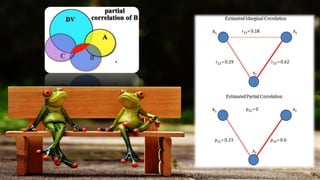
Partial Correlation
Partial Correlation measures the
Correlation between X and Y
Controlling for Z
Partial correlation is a measure of
the strength and direction of a
linear relationship between
two continuous variables
whilst
controlling for the effect of one or
more other continuous variables
(also known as 'covariates' or
'control' variables).
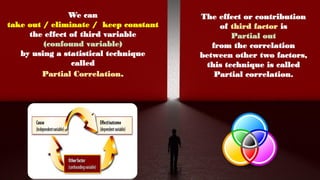
We can
take out / eliminate / keep constant
the effect of third variable
(confound variable)
by using a statistical technique
called
Partial Correlation.
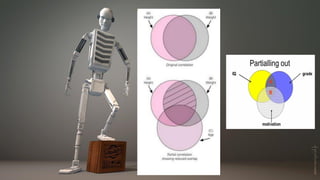
The effect or contribution
of third factor is
Partial out
from the correlation
between other two factors,
this technique is called
Partial correlation.
Variables
Involved
Predictor
Variable
IV
Predicted
Variable
DV
Control
Variable
Anxiety
X
Academic
Achievement
Y
Intelligence
Z
rAcademic Ahivement (Y) Anxiety (X) . Intelligence (Z)
Correlation can be represented as
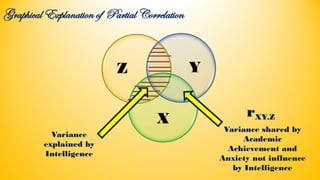
Z
X
Y
Variance
explained by
Intelligence
Variance shared by
Academic
Achievement and
Anxiety not influence
by Intelligence
Graphical Explanation of Partial Correlation
rXY.Z
Note the subscripts in the symbol for a
partial correlation coefficient:
rxy●z
which indicates that the correlation coefficient is for X
and Y controlling for Z
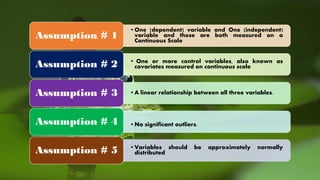
•One (dependent) variable and One (independent)
variable and these are both measured on a
Continuous Scale
Assumption # 1
• One or more control variables, also known as
covariates measured on continuous scaleAssumption # 2
•A linear relationship between all three variables.Assumption # 3
•No significant outliers.Assumption # 4
•Variables should be approximately normally
distributedAssumption # 5
Partial Correlation - Example
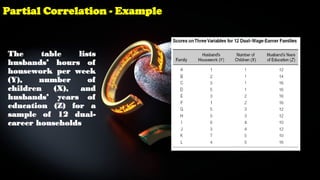
The table lists
husbands’ hours of
housework per week
(Y), number of
children (X), and
husbands’ years of
education (Z) for a
sample of 12 dual-
career households
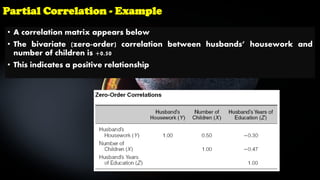
• A correlation matrix appears below
• The bivariate (zero-order) correlation between husbands’ housework and
number of children is +0.50
• This indicates a positive relationship
Partial Correlation - Example
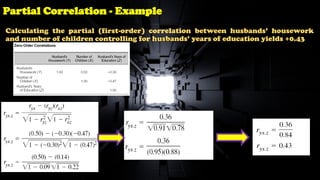
Calculating the partial (first-order) correlation between husbands’ housework
and number of children controlling for husbands’ years of education yields +0.43
Partial Correlation - Example
Interpretation
• Comparing the bivariate correlation (+0.50) to the partial
correlation (+0.43) finds little change
• The relationship between number of children and husbands’
housework controlling for husbands’ education has not changed
• Therefore, we have evidence of a direct relationship
Partial Correlation - Example
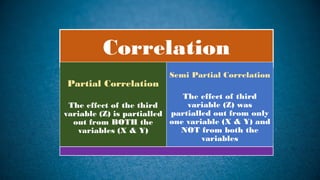
Correlation
Partial Correlation
The effect of the third
variable (Z) is partialled
out from BOTH the
variables (X & Y)
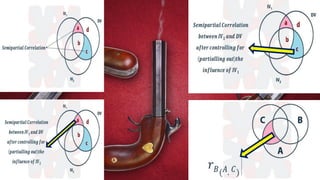
Semi Partial Correlation
The effect of third
variable (Z) was
partialled out from only
one variable (X & Y) and
NOT from both the
variables
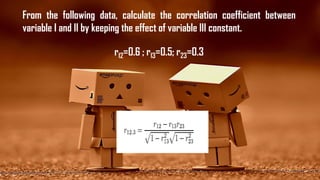
From the following data, calculate the correlation coefficient between
variable I and II by keeping the effect of variable III constant.
r12=0.6 ; r13=0.5; r23=0.3
Thank
You
K.THIYAGU, Assistant
Professor, Department of Education,
Central University of Kerala, Kasaragod

Partial Correlation - Thiyagu

  • 1.
    Partial Correlation K.THIYAGU, AssistantProfessor, Department of Education, Central University of Kerala, Kasaragod
  • 2.
    Partial Correlation Partial Correlationmeasures the Correlation between X and Y Controlling for Z Partial correlation is a measure of the strength and direction of a linear relationship between two continuous variables whilst controlling for the effect of one or more other continuous variables (also known as 'covariates' or 'control' variables).
  • 3.
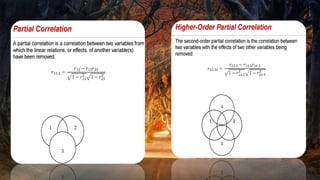
    We can take out/ eliminate / keep constant the effect of third variable (confound variable) by using a statistical technique called Partial Correlation. The effect or contribution of third factor is Partial out from the correlation between other two factors, this technique is called Partial correlation.
  • 4.
  • 5.
    Anxiety X Academic Achievement Y Intelligence Z rAcademic Ahivement (Y)Anxiety (X) . Intelligence (Z) Correlation can be represented as
  • 6.
    Z X Y Variance explained by Intelligence Variance sharedby Academic Achievement and Anxiety not influence by Intelligence Graphical Explanation of Partial Correlation rXY.Z
  • 10.
    Note the subscriptsin the symbol for a partial correlation coefficient: rxy●z which indicates that the correlation coefficient is for X and Y controlling for Z
  • 11.
    •One (dependent) variableand One (independent) variable and these are both measured on a Continuous Scale Assumption # 1 • One or more control variables, also known as covariates measured on continuous scaleAssumption # 2 •A linear relationship between all three variables.Assumption # 3 •No significant outliers.Assumption # 4 •Variables should be approximately normally distributedAssumption # 5
  • 12.
    Partial Correlation -Example The table lists husbands’ hours of housework per week (Y), number of children (X), and husbands’ years of education (Z) for a sample of 12 dual- career households
  • 13.
    • A correlationmatrix appears below • The bivariate (zero-order) correlation between husbands’ housework and number of children is +0.50 • This indicates a positive relationship Partial Correlation - Example
  • 14.
    Calculating the partial(first-order) correlation between husbands’ housework and number of children controlling for husbands’ years of education yields +0.43 Partial Correlation - Example
  • 15.
    Interpretation • Comparing thebivariate correlation (+0.50) to the partial correlation (+0.43) finds little change • The relationship between number of children and husbands’ housework controlling for husbands’ education has not changed • Therefore, we have evidence of a direct relationship Partial Correlation - Example
  • 16.
    Correlation Partial Correlation The effectof the third variable (Z) is partialled out from BOTH the variables (X & Y) Semi Partial Correlation The effect of third variable (Z) was partialled out from only one variable (X & Y) and NOT from both the variables
  • 18.
    From the followingdata, calculate the correlation coefficient between variable I and II by keeping the effect of variable III constant. r12=0.6 ; r13=0.5; r23=0.3
  • 19.
    Thank You K.THIYAGU, Assistant Professor, Departmentof Education, Central University of Kerala, Kasaragod