


Chapter 12
Correlation
Correlation - Definition
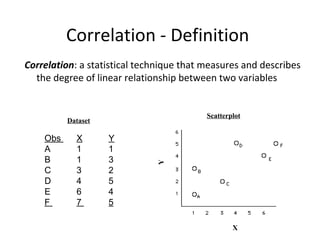
Correlation: a statistical technique that measures and describes
the degree of linear relationship between two variables
Obs X Y
A 1 1
B 1 3
C 3 2
D 4 5
E 6 4
F 7 5
Dataset
X
Y
Scatterplot
Characteristics
• Direction
– Positive (+) or Negative (-)
• Degree of association
– Between –1 and 1
– Absolute values signify strength
• Form
– Linear or Non-linear
– We will work with linear only
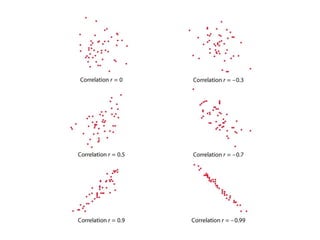
Direction
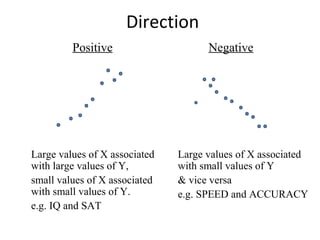
Positive
Large values of X associated
with large values of Y,
small values of X associated
with small values of Y.
e.g. IQ and SAT
Large values of X associated
with small values of Y
& vice versa
e.g. SPEED and ACCURACY
Negative
Degree of association
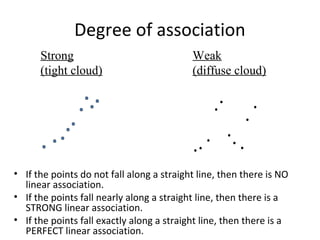
• If the points do not fall along a straight line, then there is NO
linear association.
• If the points fall nearly along a straight line, then there is a
STRONG linear association.
• If the points fall exactly along a straight line, then there is a
PERFECT linear association.
Strong
(tight cloud)
Weak
(diffuse cloud)
Practice
• Which value represents the strongest
relationship?
1. .56
2. -.32
3. .24
4. -.77
Practice
• Which value represents the weakest
relationship?
1. .56
2. -.32
3. .24
4. -.77
Practice
• Which value represents the strongest
relationship?
1. .89
2. .22
3. -.66
4. -.15
Practice
• The older we get, the less sleep we tend to
require. What is the nature of this
relationship?
1. Positive relationship
2. Negative relationship
Practice
• The more education we receive, the higher
our salary when we enter the workforce.
What is the nature of this relationship?
1. Positive relationship
2. Negative relationship
Practice
• The better an employees feels about his or
her job, the less often they will call in sick.
What is the nature of this relationship?
1. Positive relationship
2. Negative relationship
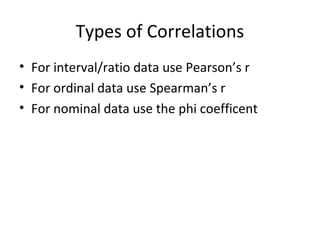
Types of Correlations
• For interval/ratio data use Pearson’s r
• For ordinal data use Spearman’s r
• For nominal data use the phi coefficent
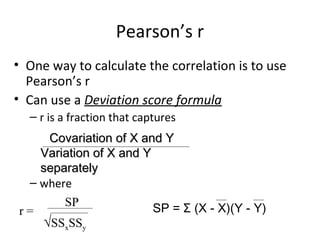
Pearson’s r
• One way to calculate the correlation is to use
Pearson’s r
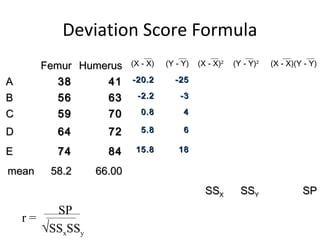
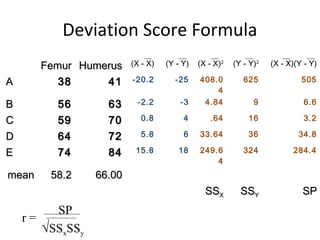
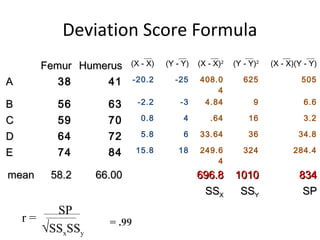
• Can use a Deviation score formula
– r is a fraction that captures
– where
Covariation of X and YCovariation of X and Y
Variation of X and YVariation of X and Y
separatelyseparately
r =
SP
√SSxSSy
SP = Σ (X - X)(Y - Y)
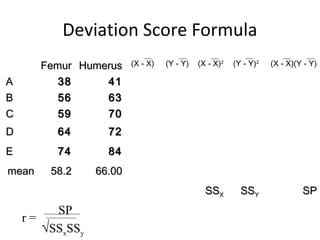
Deviation Score Formula
FemurFemur HumerusHumerus (X - X) (Y - Y) (X - X)2
(Y - Y)2
(X - X)(Y - Y)
AA 3838 4141
BB 5656 6363
CC 5959 7070
DD 6464 7272
EE 7474 8484
meanmean 58.258.2 66.0066.00
SSSSXX SSSSYY SPSP
r =
SP
√SSxSSy
Deviation Score Formula
FemurFemur HumerusHumerus (X - X) (Y - Y) (X - X)2
(Y - Y)2
(X - X)(Y - Y)
AA 3838 4141 -20.2-20.2 -25-25
BB 5656 6363 -2.2-2.2 -3-3
CC 5959 7070 0.80.8 44
DD 6464 7272 5.85.8 66
EE 7474 8484 15.815.8 1818
meanmean 58.258.2 66.0066.00
SSSSXX SSSSYY SPSP
r =
SP
√SSxSSy
Deviation Score Formula
FemurFemur HumerusHumerus (X - X) (Y - Y) (X - X)2
(Y - Y)2
(X - X)(Y - Y)
AA 3838 4141 -20.2 -25 408.0
4
625 505
BB 5656 6363 -2.2 -3 4.84 9 6.6
CC 5959 7070 0.8 4 .64 16 3.2
DD 6464 7272 5.8 6 33.64 36 34.8
EE 7474 8484 15.8 18 249.6
4
324 284.4
meanmean 58.258.2 66.0066.00
SSSSXX SSSSYY SPSP
r =
SP
√SSxSSy
Deviation Score Formula
FemurFemur HumerusHumerus (X - X) (Y - Y) (X - X)2
(Y - Y)2
(X - X)(Y - Y)
AA 38 41 -20.2 -25 408.0
4
625 505
BB 56 63 -2.2 -3 4.84 9 6.6
CC 59 70 0.8 4 .64 16 3.2
DD 64 72 5.8 6 33.64 36 34.8
EE 74 84 15.8 18 249.6
4
324 284.4
meanmean 58.258.2 66.0066.00 696.8696.8 10101010 834834
SSSSXX SSSSYY SPSP
r =
SP
√SSxSSy
= .99
The Computational Formula
( )( )
( )[ ] ( )[ ]∑ ∑∑ ∑
∑∑ ∑
−−
−
=
2222
YYnXXn
YXXYn
r
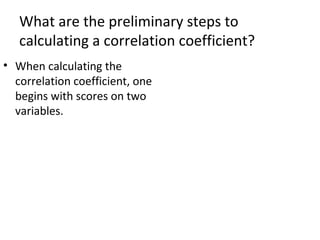
What are the preliminary steps to
calculating a correlation coefficient?
• When calculating the
correlation coefficient, one
begins with scores on two
variables.
What are the preliminary steps to
calculating a correlation coefficient?
• When calculating the
correlation coefficient, one
begins with scores on two
variables.
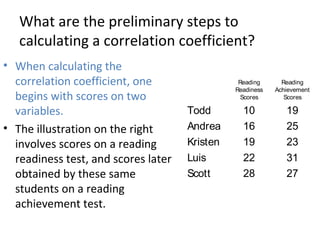
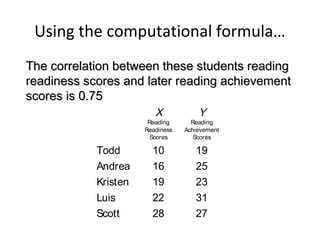
• The illustration on the right
involves scores on a reading
readiness test, and scores later
obtained by these same
students on a reading
achievement test.
Reading
Readiness
Scores
Reading
Achievement
Scores
Todd 10 19
Andrea 16 25
Kristen 19 23
Luis 22 31
Scott 28 27
What are the preliminary steps to
calculating a correlation coefficient?
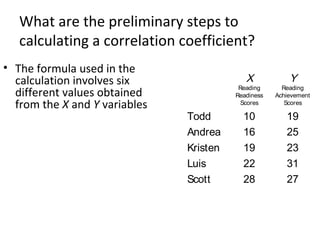
• The formula used in the
calculation involves six
different values obtained
from the X and Y variables
The first two values are simply
the sum of X values and Y
values. Those sums are 95
and 125 for these particular
test scores.
X
Reading
Readiness
Scores
Y
Reading
Achievement
Scores
Todd 10 19
Andrea 16 25
Kristen 19 23
Luis 22 31
Scott 28 27
What are the preliminary steps to
calculating a correlation coefficient?
• The formula used in the
calculation involves six
different values obtained
from the X and Y variables
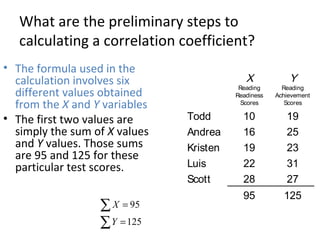
• The first two values are
simply the sum of X values
and Y values. Those sums
are 95 and 125 for these
particular test scores.
X
Reading
Readiness
Scores
Y
Reading
Achievement
Scores
Todd 10 19
Andrea 16 25
Kristen 19 23
Luis 22 31
Scott 28 27
95 125
∑
∑
=
=
125
95
Y
X
What are the preliminary steps to
calculating a correlation coefficient?
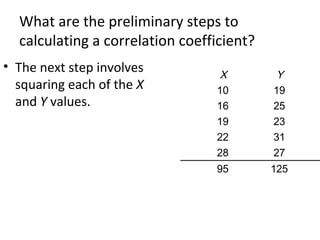
• The next step involves
squaring each of the X
and Y values.
X Y
10 19
16 25
19 23
22 31
28 27
95 125
What are the preliminary steps to
calculating a correlation coefficient?
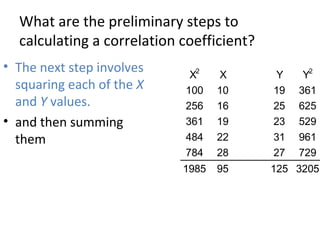
• The next step involves
squaring each of the X
and Y values.
• and then summing
them
X2
X Y Y2
100 10 19 361
256 16 25 625
361 19 23 529
484 22 31 961
784 28 27 729
1985 95 125 3205
What are the preliminary steps to
calculating a correlation coefficient?
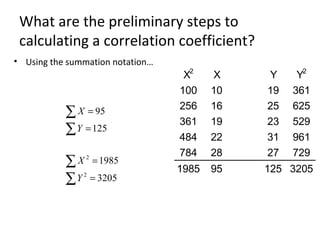
• Using the summation notation…
X2
X Y Y2
100 10 19 361
256 16 25 625
361 19 23 529
484 22 31 961
784 28 27 729
1985 95 125 3205
∑
∑
∑
∑
=
=
=
=
3205
1985
125
95
2
2
Y
X
Y
X
What are the preliminary steps to
calculating a correlation coefficient?
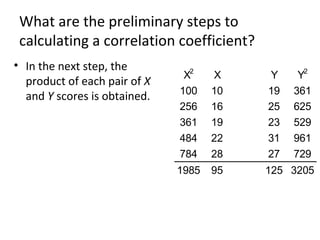
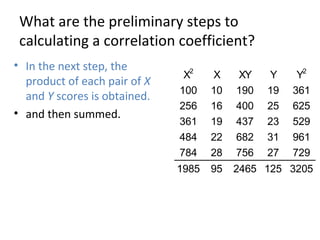
• In the next step, the
product of each pair of X
and Y scores is obtained.
X2
X Y Y2
100 10 19 361
256 16 25 625
361 19 23 529
484 22 31 961
784 28 27 729
1985 95 125 3205
What are the preliminary steps to
calculating a correlation coefficient?
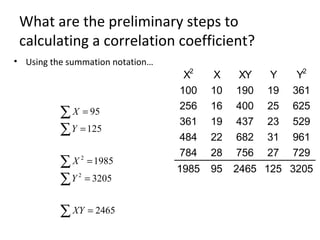
• In the next step, the
product of each pair of X
and Y scores is obtained.
• and then summed.
X2
X XY Y Y2
100 10 190 19 361
256 16 400 25 625
361 19 437 23 529
484 22 682 31 961
784 28 756 27 729
1985 95 2465 125 3205
What are the preliminary steps to
calculating a correlation coefficient?
• Using the summation notation…
X2
X XY Y Y2
100 10 190 19 361
256 16 400 25 625
361 19 437 23 529
484 22 682 31 961
784 28 756 27 729
1985 95 2465 125 3205
∑
∑
∑
∑
∑
=
=
=
=
=
2465
3205
1985
125
95
2
2
XY
Y
X
Y
X
What are the preliminary steps to
calculating a correlation coefficient?
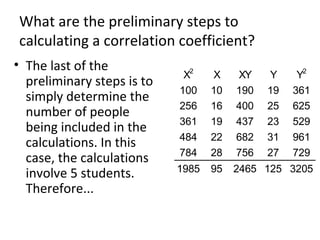
• The last of the
preliminary steps is to
simply determine the
number of people
being included in the
calculations. In this
case, the calculations
involve 5 students.
Therefore...
X2
X XY Y Y2
100 10 190 19 361
256 16 400 25 625
361 19 437 23 529
484 22 682 31 961
784 28 756 27 729
1985 95 2465 125 3205
What are the preliminary steps to
calculating a correlation coefficient?
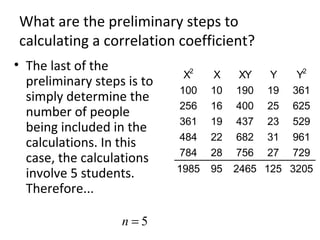
• The last of the
preliminary steps is to
simply determine the
number of people
being included in the
calculations. In this
case, the calculations
involve 5 students.
Therefore...
X2
X XY Y Y2
100 10 190 19 361
256 16 400 25 625
361 19 437 23 529
484 22 682 31 961
784 28 756 27 729
1985 95 2465 125 3205
5=n
What are the preliminary steps to
calculating a correlation coefficient?
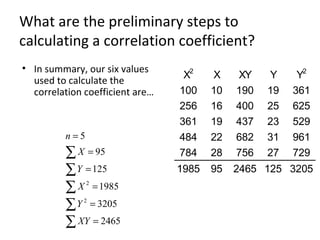
• In summary, our six values
used to calculate the
correlation coefficient are…
∑
∑
∑
∑
∑
=
=
=
=
=
=
2465
3205
1985
125
95
5
2
2
XY
Y
X
Y
X
n
X2
X XY Y Y2
100 10 190 19 361
256 16 400 25 625
361 19 437 23 529
484 22 682 31 961
784 28 756 27 729
1985 95 2465 125 3205
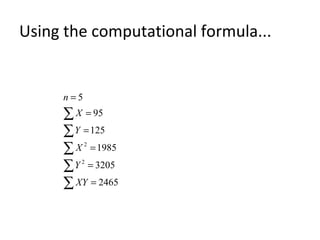
Using the computational formula...
∑
∑
∑
∑
∑
=
=
=
=
=
=
2465
3205
1985
125
95
5
2
2
XY
Y
X
Y
X
n
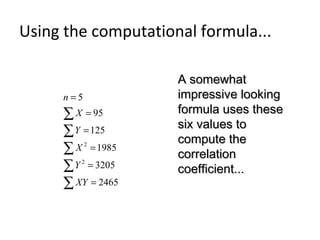
Using the computational formula...
A somewhatA somewhat
impressive lookingimpressive looking
formula uses theseformula uses these
six values tosix values to
compute thecompute the
correlationcorrelation
coefficient...coefficient...
∑
∑
∑
∑
∑
=
=
=
=
=
=
2465
3205
1985
125
95
5
2
2
XY
Y
X
Y
X
n
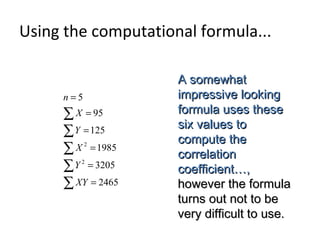
A somewhatA somewhat
impressive lookingimpressive looking
formula uses theseformula uses these
six values tosix values to
compute thecompute the
correlationcorrelation
coefficient…,coefficient…,
however the formulahowever the formula
turns out not to beturns out not to be
very difficult to use.very difficult to use.
∑
∑
∑
∑
∑
=
=
=
=
=
=
2465
3205
1985
125
95
5
2
2
XY
Y
X
Y
X
n
Using the computational formula...
( )( )
( )[ ] ( )[ ]∑ ∑∑ ∑
∑∑ ∑
−−
−
=
2222
YYnXXn
YXXYn
r
∑
∑
∑
∑
∑
=
=
=
=
=
=
2465
3205
1985
125
95
5
2
2
XY
Y
X
Y
X
n
The formula is...The formula is...
Using the computational formula...
( )( )
( )[ ] ( )[ ]∑ ∑∑ ∑
∑∑ ∑
−−
−
=
2222
YYnXXn
YXXYn
r
∑
∑
∑
∑
∑
=
=
=
=
=
=
2465
3205
1985
125
95
5
2
2
XY
Y
X
Y
X
n
The variables in thisThe variables in this
formula consist of onlyformula consist of only
the six previouslythe six previously
calculated values to thecalculated values to the
left...left...
Using the computational formula...
∑
∑
∑
∑
∑
=
=
=
=
=
=
2465
3205
1985
125
95
5
2
2
XY
Y
X
Y
X
n
Here is the formula withHere is the formula with
these values inserted...these values inserted...
Using the computational formula...
( )( )
( )[ ] ( )[ ]∑ ∑∑ ∑
∑∑ ∑
−−
−
=
2222
YYnXXn
YXXYn
r
( )( ) ( )( )
( )( ) ( )[ ]( )( ) ( )[ ]22
125320559519855
1259524655
−−
−
=r
The correlation between these students readingThe correlation between these students reading
readiness scores and later reading achievementreadiness scores and later reading achievement
scores is 0.75scores is 0.75
X
Reading
Readiness
Scores
Y
Reading
Achievement
Scores
Todd 10 19
Andrea 16 25
Kristen 19 23
Luis 22 31
Scott 28 27
Using the computational formula…
Determining Significance
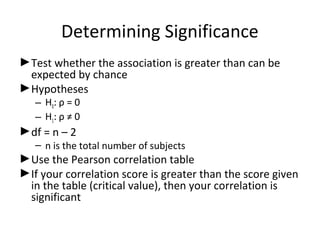
►Test whether the association is greater than can be
expected by chance
►Hypotheses
– H0: ρ = 0
– H1: ρ ≠ 0
►df = n – 2
– n is the total number of subjects
►Use the Pearson correlation table
►If your correlation score is greater than the score given
in the table (critical value), then your correlation is
significant
Now its your turn...
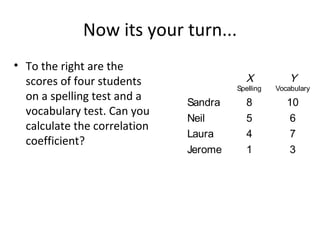
• To the right are the
scores of four students
on a spelling test and a
vocabulary test. Can you
calculate the correlation
coefficient?
X
Spelling
Y
Vocabulary
Sandra 8 10
Neil 5 6
Laura 4 7
Jerome 1 3
Now its your turn...
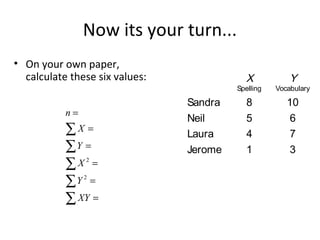
• On your own paper,
calculate these six values:
∑
∑
∑
∑
∑
=
=
=
=
=
=
XY
Y
X
Y
X
n
2
2
X
Spelling
Y
Vocabulary
Sandra 8 10
Neil 5 6
Laura 4 7
Jerome 1 3
Now its your turn...
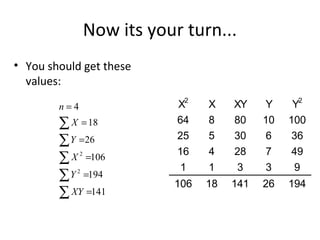
• You should get these
values:
141
194
106
26
18
4
2
2
∑
∑
∑
∑
∑
=
=
=
=
=
=
XY
Y
X
Y
X
n X2
X XY Y Y2
64 8 80 10 100
25 5 30 6 36
16 4 28 7 49
1 1 3 3 9
106 18 141 26 194
Now its your turn...
• Now insert these values
in the equation
141
194
106
26
18
4
2
2
∑
∑
∑
∑
∑
=
=
=
=
=
=
XY
Y
X
Y
X
n
( )( )
( )[ ] ( )[ ]∑ ∑∑ ∑
∑∑ ∑
−−
−
=
2222
YYnXXn
YXXYn
r
( )( ) ( )( )
( )( ) ( )[ ]( )( ) ( )[ ]22
261944181064
26181414
−−
−
=r
96.0
100
96
==r
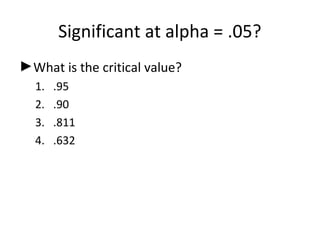
Significant at alpha = .05?
►What is the critical value?
1. .95
2. .90
3. .811
4. .632
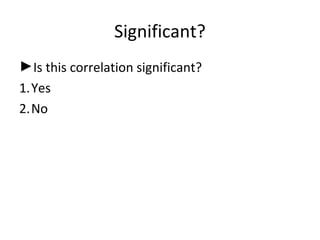
Significant?
►Is this correlation significant?
1.Yes
2.No
Regression
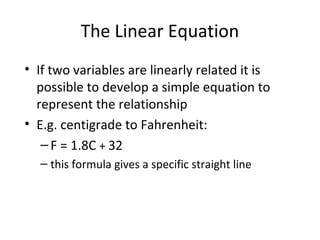
The Linear Equation
• If two variables are linearly related it is
possible to develop a simple equation to
represent the relationship
• E.g. centigrade to Fahrenheit:
–F = 1.8C + 32
– this formula gives a specific straight line
The Linear Equation
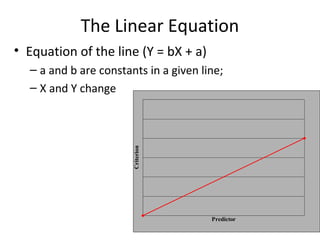
• Equation of the line (Y = bX + a)
– a and b are constants in a given line;
– X and Y change
Predictor
Criterion
The Linear Equation
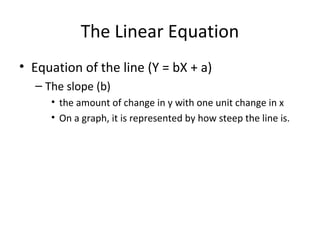
• Equation of the line (Y = bX + a)
– The slope (b)
• the amount of change in y with one unit change in x
• On a graph, it is represented by how steep the line is.
The Linear Equation
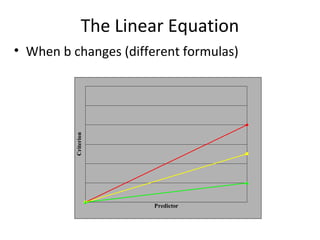
• When b changes (different formulas)
Predictor
Criterion
The Linear Equation
• Equation of the line (Y = bX + a)
– The intercept (a)
• the value of y when x is zero
• On a graph, it is represented by where the line crosses
the y axis
The Linear Equation
• When a changes (different formulas)
Predictor
Criterion
Practice
• Y = 32(.3) + 10
• Identify the slope
1. 32
2. .3
3. 10
Practice
• Y = 32(.3) + 10
• Identify the Y intercept
1. 32
2. .3
3. 10
The Regression Line
• Relationships are rarely perfect. Scores are
“scattered”.
• The regression line is a straight line which is
drawn through a scatterplot, to summarize
the relationship between X and Y
• It is the line that minimizes the squared
deviations (Y – Y’)2
• We call these vertical deviations “residuals”
When there is some linear association, the
regression line fits as close to the points as possible
150
175
200
225
250
67 68 69 70 71 72 73 74 75 76 77
Weight
in
Pounds
Height in Inches
The 2001 Mets
Calculating the regression lineCalculating the regression line
► To the right are theTo the right are the
scores of four studentsscores of four students
on a spelling test and aon a spelling test and a
vocabulary test.vocabulary test.
► Sallie has just takenSallie has just taken
the spelling test andthe spelling test and
scored a 6. What doscored a 6. What do
you predict heryou predict her
vocabulary score tovocabulary score to
be?be?
X
Spelling
Y
Vocabulary
Sandra 6 8
Neil 5 6
Laura 4 7
Jerome 1 3
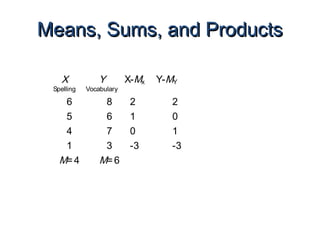
Means, Sums, and Products
X
Spelling
Y
Vocabulary
6 8
5 6
4 7
1 3
M=4 M=6
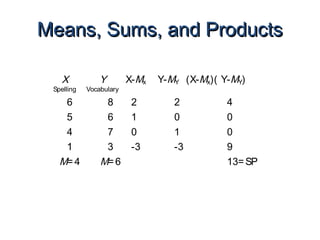
Means, Sums, and ProductsMeans, Sums, and Products
X
Spelling
Y
Vocabulary
X-Mx Y-MY
6 8 2 2
5 6 1 0
4 7 0 1
1 3 -3 -3
M=4 M=6
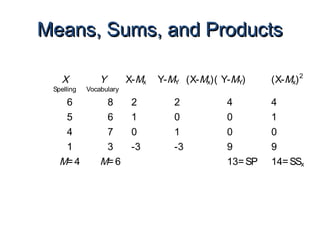
Means, Sums, and ProductsMeans, Sums, and Products
X
Spelling
Y
Vocabulary
X-Mx Y-MY (X-Mx)( Y-MY)
6 8 2 2 4
5 6 1 0 0
4 7 0 1 0
1 3 -3 -3 9
M=4 M=6 13=SP
Means, Sums, and ProductsMeans, Sums, and Products
X
Spelling
Y
Vocabulary
X-Mx Y-MY (X-Mx)( Y-MY) (X-Mx)2
6 8 2 2 4 4
5 6 1 0 0 1
4 7 0 1 0 0
1 3 -3 -3 9 9
M=4 M=6 13=SP 14=SSx
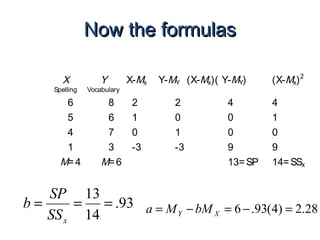
Now the formulasNow the formulas
X
Spelling
Y
Vocabulary
X-Mx Y-MY (X-Mx)( Y-MY) (X-Mx)2
6 8 2 2 4 4
5 6 1 0 0 1
4 7 0 1 0 0
1 3 -3 -3 9 9
M=4 M=6 13=SP 14=SSx
93.
14
13
===
xSS
SP
b 28.2)4(93.6 =−=−= XY bMMa
Now the formulas
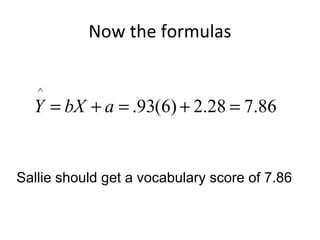
86.728.2)6(93.
^
=+=+= abXY
Sallie should get a vocabulary score of 7.86
Causation
• A strong relationship between variables does
not always mean that changes in one variable
cause changes in the other variable.
Causation
• The relationship between two variables is
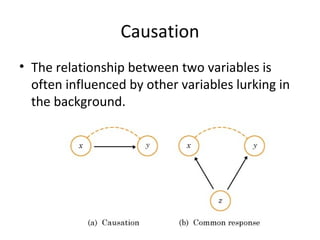
often influenced by other variables lurking in
the background.
“Beware the lurking variable!
Causation
• The best evidence of causation comes from
randomized comparative experiments.
The Chi-Square Analysis
Chi-Square
• Examines nominal data or ordinal data that is
being treated as a category
• Called a non-parametric test
– Chi-square requires no assumptions about the
shape of the population distribution from which a
sample is drawn.
• The test examines the difference between
observed counts and expected values
Chi-square Goodness of Fit
• Two ways to use the chi-square
• First way to use the chi-square is called the
Goodness of Fit test
– Determines whether a frequency distribution
follows a claimed distribution
• Hypothesis test
– Ho: the variable follows the claimed distribution
– H1: the variable does not follow the claimed
distribution
Chi-square Goodness of Fit
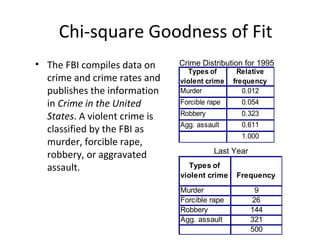
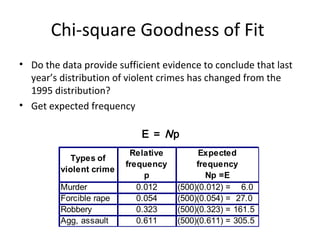
• The FBI compiles data on
crime and crime rates and
publishes the information
in Crime in the United
States. A violent crime is
classified by the FBI as
murder, forcible rape,
robbery, or aggravated
assault.
Types of
violent crime
Relative
frequency
Murder 0.012
Forcible rape 0.054
Robbery 0.323
Agg. assault 0.611
1.000
Types of
violent crime Frequency
Murder 9
Forcible rape 26
Robbery 144
Agg. assault 321
500
Crime Distribution for 1995
Last Year
Chi-square Goodness of Fit
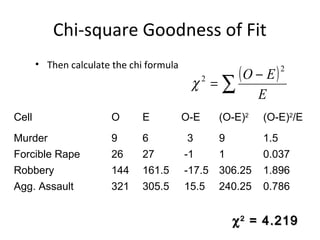
• Do the data provide sufficient evidence to conclude that last
year’s distribution of violent crimes has changed from the
1995 distribution?
• Get expected frequency
E = Np
Types of
violent crime
Relative
frequency
p
Expected
frequency
Np =E
Murder 0.012 (500)(0.012) = 6.0
Forcible rape 0.054 (500)(0.054) = 27.0
Robbery 0.323 (500)(0.323) = 161.5
Agg, assault 0.611 (500)(0.611) = 305.5
Chi-square Goodness of Fit
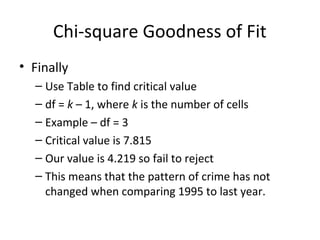
• Then calculate the chi formula
Cell O E O-E (O-E)2
(O-E)2
/E
Murder 9 6 3 9 1.5
Forcible Rape 26 27 -1 1 0.037
Robbery 144 161.5 -17.5 306.25 1.896
Agg. Assault 321 305.5 15.5 240.25 0.786
χχ22
= 4.219= 4.219
( )
∑
−
=
E
EO
2
2
χ
Chi-square Goodness of Fit
• Finally
– Use Table to find critical value
– df = k – 1, where k is the number of cells
– Example – df = 3
– Critical value is 7.815
– Our value is 4.219 so fail to reject
– This means that the pattern of crime has not
changed when comparing 1995 to last year.
Chi-square Test of Independence
• Second way to use a chi-square is the test of
independence
– Hypotheses
• H0: Variables Are Independent
• Ha: Variables Are Related (Dependent)
Chi-square Test of Independence
• We are interested in whether single men vs.
women are more likely to own cats vs. dogs.
• Notice that both variables are categorical.
– Kind of pet: people are classified as owning cats or
dogs. We can count the number of people
belonging to each category
– Sex: people are male or female. We count the
number of people in each category
Chi-square Test of Independence
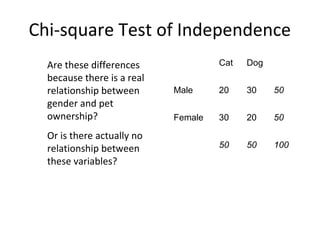
• Are these differences
because there is a real
relationship between
gender and pet
ownership?
• Or is there actually no
relationship between
these variables?
Cat Dog
Male 20 30 50
Female 30 20 50
50 50 100
Chi-square Test of Independence
• To answer this question, we need to know
what we would expect to observe if the null
hypothesis were true
• The differences between these expected
values and the observed values are
aggregated according to the Chi-square
formula
Chi-square Test of Independence
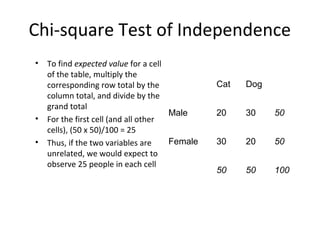
• To find expected value for a cell
of the table, multiply the
corresponding row total by the
column total, and divide by the
grand total
• For the first cell (and all other
cells), (50 x 50)/100 = 25
• Thus, if the two variables are
unrelated, we would expect to
observe 25 people in each cell
Cat Dog
Male 20 30 50
Female 30 20 50
50 50 100
Chi-square Test of Independence
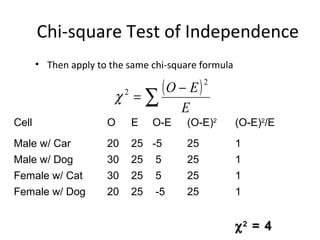
• Then apply to the same chi-square formula
( )
∑
−
=
E
EO
2
2
χ
Cell O E O-E (O-E)2
(O-E)2
/E
Male w/ Car 20 25 -5 25 1
Male w/ Dog 30 25 5 25 1
Female w/ Cat 30 25 5 25 1
Female w/ Dog 20 25 -5 25 1
χχ22
= 4= 4
Chi-square Test of Independence
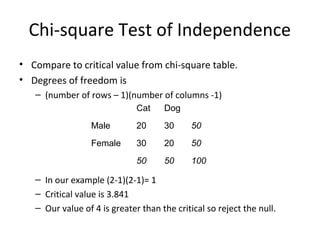
• Compare to critical value from chi-square table.
• Degrees of freedom is
– (number of rows – 1)(number of columns -1)
– In our example (2-1)(2-1)= 1
– Critical value is 3.841
– Our value of 4 is greater than the critical so reject the null.
Cat Dog
Male 20 30 50
Female 30 20 50
50 50 100

Chapter 12

  • 1.
  • 2.
  • 3.
    Correlation - Definition Correlation:a statistical technique that measures and describes the degree of linear relationship between two variables Obs X Y A 1 1 B 1 3 C 3 2 D 4 5 E 6 4 F 7 5 Dataset X Y Scatterplot
  • 4.
    Characteristics • Direction – Positive(+) or Negative (-) • Degree of association – Between –1 and 1 – Absolute values signify strength • Form – Linear or Non-linear – We will work with linear only
  • 5.
    Direction Positive Large values ofX associated with large values of Y, small values of X associated with small values of Y. e.g. IQ and SAT Large values of X associated with small values of Y & vice versa e.g. SPEED and ACCURACY Negative
  • 6.
    Degree of association •If the points do not fall along a straight line, then there is NO linear association. • If the points fall nearly along a straight line, then there is a STRONG linear association. • If the points fall exactly along a straight line, then there is a PERFECT linear association. Strong (tight cloud) Weak (diffuse cloud)
  • 8.
    Practice • Which valuerepresents the strongest relationship? 1. .56 2. -.32 3. .24 4. -.77
  • 9.
    Practice • Which valuerepresents the weakest relationship? 1. .56 2. -.32 3. .24 4. -.77
  • 10.
    Practice • Which valuerepresents the strongest relationship? 1. .89 2. .22 3. -.66 4. -.15
  • 11.
    Practice • The olderwe get, the less sleep we tend to require. What is the nature of this relationship? 1. Positive relationship 2. Negative relationship
  • 12.
    Practice • The moreeducation we receive, the higher our salary when we enter the workforce. What is the nature of this relationship? 1. Positive relationship 2. Negative relationship
  • 13.
    Practice • The betteran employees feels about his or her job, the less often they will call in sick. What is the nature of this relationship? 1. Positive relationship 2. Negative relationship
  • 14.
    Types of Correlations •For interval/ratio data use Pearson’s r • For ordinal data use Spearman’s r • For nominal data use the phi coefficent
  • 15.
    Pearson’s r • Oneway to calculate the correlation is to use Pearson’s r • Can use a Deviation score formula – r is a fraction that captures – where Covariation of X and YCovariation of X and Y Variation of X and YVariation of X and Y separatelyseparately r = SP √SSxSSy SP = Σ (X - X)(Y - Y)
  • 16.
    Deviation Score Formula FemurFemurHumerusHumerus (X - X) (Y - Y) (X - X)2 (Y - Y)2 (X - X)(Y - Y) AA 3838 4141 BB 5656 6363 CC 5959 7070 DD 6464 7272 EE 7474 8484 meanmean 58.258.2 66.0066.00 SSSSXX SSSSYY SPSP r = SP √SSxSSy
  • 17.
    Deviation Score Formula FemurFemurHumerusHumerus (X - X) (Y - Y) (X - X)2 (Y - Y)2 (X - X)(Y - Y) AA 3838 4141 -20.2-20.2 -25-25 BB 5656 6363 -2.2-2.2 -3-3 CC 5959 7070 0.80.8 44 DD 6464 7272 5.85.8 66 EE 7474 8484 15.815.8 1818 meanmean 58.258.2 66.0066.00 SSSSXX SSSSYY SPSP r = SP √SSxSSy
  • 18.
    Deviation Score Formula FemurFemurHumerusHumerus (X - X) (Y - Y) (X - X)2 (Y - Y)2 (X - X)(Y - Y) AA 3838 4141 -20.2 -25 408.0 4 625 505 BB 5656 6363 -2.2 -3 4.84 9 6.6 CC 5959 7070 0.8 4 .64 16 3.2 DD 6464 7272 5.8 6 33.64 36 34.8 EE 7474 8484 15.8 18 249.6 4 324 284.4 meanmean 58.258.2 66.0066.00 SSSSXX SSSSYY SPSP r = SP √SSxSSy
  • 19.
    Deviation Score Formula FemurFemurHumerusHumerus (X - X) (Y - Y) (X - X)2 (Y - Y)2 (X - X)(Y - Y) AA 38 41 -20.2 -25 408.0 4 625 505 BB 56 63 -2.2 -3 4.84 9 6.6 CC 59 70 0.8 4 .64 16 3.2 DD 64 72 5.8 6 33.64 36 34.8 EE 74 84 15.8 18 249.6 4 324 284.4 meanmean 58.258.2 66.0066.00 696.8696.8 10101010 834834 SSSSXX SSSSYY SPSP r = SP √SSxSSy = .99
  • 20.
    The Computational Formula ()( ) ( )[ ] ( )[ ]∑ ∑∑ ∑ ∑∑ ∑ −− − = 2222 YYnXXn YXXYn r
  • 21.
    What are thepreliminary steps to calculating a correlation coefficient? • When calculating the correlation coefficient, one begins with scores on two variables.
  • 22.
    What are thepreliminary steps to calculating a correlation coefficient? • When calculating the correlation coefficient, one begins with scores on two variables. • The illustration on the right involves scores on a reading readiness test, and scores later obtained by these same students on a reading achievement test. Reading Readiness Scores Reading Achievement Scores Todd 10 19 Andrea 16 25 Kristen 19 23 Luis 22 31 Scott 28 27
  • 23.
    What are thepreliminary steps to calculating a correlation coefficient? • The formula used in the calculation involves six different values obtained from the X and Y variables The first two values are simply the sum of X values and Y values. Those sums are 95 and 125 for these particular test scores. X Reading Readiness Scores Y Reading Achievement Scores Todd 10 19 Andrea 16 25 Kristen 19 23 Luis 22 31 Scott 28 27
  • 24.
    What are thepreliminary steps to calculating a correlation coefficient? • The formula used in the calculation involves six different values obtained from the X and Y variables • The first two values are simply the sum of X values and Y values. Those sums are 95 and 125 for these particular test scores. X Reading Readiness Scores Y Reading Achievement Scores Todd 10 19 Andrea 16 25 Kristen 19 23 Luis 22 31 Scott 28 27 95 125 ∑ ∑ = = 125 95 Y X
  • 25.
    What are thepreliminary steps to calculating a correlation coefficient? • The next step involves squaring each of the X and Y values. X Y 10 19 16 25 19 23 22 31 28 27 95 125
  • 26.
    What are thepreliminary steps to calculating a correlation coefficient? • The next step involves squaring each of the X and Y values. • and then summing them X2 X Y Y2 100 10 19 361 256 16 25 625 361 19 23 529 484 22 31 961 784 28 27 729 1985 95 125 3205
  • 27.
    What are thepreliminary steps to calculating a correlation coefficient? • Using the summation notation… X2 X Y Y2 100 10 19 361 256 16 25 625 361 19 23 529 484 22 31 961 784 28 27 729 1985 95 125 3205 ∑ ∑ ∑ ∑ = = = = 3205 1985 125 95 2 2 Y X Y X
  • 28.
    What are thepreliminary steps to calculating a correlation coefficient? • In the next step, the product of each pair of X and Y scores is obtained. X2 X Y Y2 100 10 19 361 256 16 25 625 361 19 23 529 484 22 31 961 784 28 27 729 1985 95 125 3205
  • 29.
    What are thepreliminary steps to calculating a correlation coefficient? • In the next step, the product of each pair of X and Y scores is obtained. • and then summed. X2 X XY Y Y2 100 10 190 19 361 256 16 400 25 625 361 19 437 23 529 484 22 682 31 961 784 28 756 27 729 1985 95 2465 125 3205
  • 30.
    What are thepreliminary steps to calculating a correlation coefficient? • Using the summation notation… X2 X XY Y Y2 100 10 190 19 361 256 16 400 25 625 361 19 437 23 529 484 22 682 31 961 784 28 756 27 729 1985 95 2465 125 3205 ∑ ∑ ∑ ∑ ∑ = = = = = 2465 3205 1985 125 95 2 2 XY Y X Y X
  • 31.
    What are thepreliminary steps to calculating a correlation coefficient? • The last of the preliminary steps is to simply determine the number of people being included in the calculations. In this case, the calculations involve 5 students. Therefore... X2 X XY Y Y2 100 10 190 19 361 256 16 400 25 625 361 19 437 23 529 484 22 682 31 961 784 28 756 27 729 1985 95 2465 125 3205
  • 32.
    What are thepreliminary steps to calculating a correlation coefficient? • The last of the preliminary steps is to simply determine the number of people being included in the calculations. In this case, the calculations involve 5 students. Therefore... X2 X XY Y Y2 100 10 190 19 361 256 16 400 25 625 361 19 437 23 529 484 22 682 31 961 784 28 756 27 729 1985 95 2465 125 3205 5=n
  • 33.
    What are thepreliminary steps to calculating a correlation coefficient? • In summary, our six values used to calculate the correlation coefficient are… ∑ ∑ ∑ ∑ ∑ = = = = = = 2465 3205 1985 125 95 5 2 2 XY Y X Y X n X2 X XY Y Y2 100 10 190 19 361 256 16 400 25 625 361 19 437 23 529 484 22 682 31 961 784 28 756 27 729 1985 95 2465 125 3205
  • 34.
    Using the computationalformula... ∑ ∑ ∑ ∑ ∑ = = = = = = 2465 3205 1985 125 95 5 2 2 XY Y X Y X n
  • 35.
    Using the computationalformula... A somewhatA somewhat impressive lookingimpressive looking formula uses theseformula uses these six values tosix values to compute thecompute the correlationcorrelation coefficient...coefficient... ∑ ∑ ∑ ∑ ∑ = = = = = = 2465 3205 1985 125 95 5 2 2 XY Y X Y X n
  • 36.
    A somewhatA somewhat impressivelookingimpressive looking formula uses theseformula uses these six values tosix values to compute thecompute the correlationcorrelation coefficient…,coefficient…, however the formulahowever the formula turns out not to beturns out not to be very difficult to use.very difficult to use. ∑ ∑ ∑ ∑ ∑ = = = = = = 2465 3205 1985 125 95 5 2 2 XY Y X Y X n Using the computational formula...
  • 37.
    ( )( ) ()[ ] ( )[ ]∑ ∑∑ ∑ ∑∑ ∑ −− − = 2222 YYnXXn YXXYn r ∑ ∑ ∑ ∑ ∑ = = = = = = 2465 3205 1985 125 95 5 2 2 XY Y X Y X n The formula is...The formula is... Using the computational formula...
  • 38.
    ( )( ) ()[ ] ( )[ ]∑ ∑∑ ∑ ∑∑ ∑ −− − = 2222 YYnXXn YXXYn r ∑ ∑ ∑ ∑ ∑ = = = = = = 2465 3205 1985 125 95 5 2 2 XY Y X Y X n The variables in thisThe variables in this formula consist of onlyformula consist of only the six previouslythe six previously calculated values to thecalculated values to the left...left... Using the computational formula...
  • 39.
    ∑ ∑ ∑ ∑ ∑ = = = = = = 2465 3205 1985 125 95 5 2 2 XY Y X Y X n Here is theformula withHere is the formula with these values inserted...these values inserted... Using the computational formula... ( )( ) ( )[ ] ( )[ ]∑ ∑∑ ∑ ∑∑ ∑ −− − = 2222 YYnXXn YXXYn r ( )( ) ( )( ) ( )( ) ( )[ ]( )( ) ( )[ ]22 125320559519855 1259524655 −− − =r
  • 40.
    The correlation betweenthese students readingThe correlation between these students reading readiness scores and later reading achievementreadiness scores and later reading achievement scores is 0.75scores is 0.75 X Reading Readiness Scores Y Reading Achievement Scores Todd 10 19 Andrea 16 25 Kristen 19 23 Luis 22 31 Scott 28 27 Using the computational formula…
  • 41.
    Determining Significance ►Test whetherthe association is greater than can be expected by chance ►Hypotheses – H0: ρ = 0 – H1: ρ ≠ 0 ►df = n – 2 – n is the total number of subjects ►Use the Pearson correlation table ►If your correlation score is greater than the score given in the table (critical value), then your correlation is significant
  • 42.
    Now its yourturn...
  • 43.
    Now its yourturn... • To the right are the scores of four students on a spelling test and a vocabulary test. Can you calculate the correlation coefficient? X Spelling Y Vocabulary Sandra 8 10 Neil 5 6 Laura 4 7 Jerome 1 3
  • 44.
    Now its yourturn... • On your own paper, calculate these six values: ∑ ∑ ∑ ∑ ∑ = = = = = = XY Y X Y X n 2 2 X Spelling Y Vocabulary Sandra 8 10 Neil 5 6 Laura 4 7 Jerome 1 3
  • 45.
    Now its yourturn... • You should get these values: 141 194 106 26 18 4 2 2 ∑ ∑ ∑ ∑ ∑ = = = = = = XY Y X Y X n X2 X XY Y Y2 64 8 80 10 100 25 5 30 6 36 16 4 28 7 49 1 1 3 3 9 106 18 141 26 194
  • 46.
    Now its yourturn... • Now insert these values in the equation 141 194 106 26 18 4 2 2 ∑ ∑ ∑ ∑ ∑ = = = = = = XY Y X Y X n ( )( ) ( )[ ] ( )[ ]∑ ∑∑ ∑ ∑∑ ∑ −− − = 2222 YYnXXn YXXYn r ( )( ) ( )( ) ( )( ) ( )[ ]( )( ) ( )[ ]22 261944181064 26181414 −− − =r 96.0 100 96 ==r
  • 47.
    Significant at alpha= .05? ►What is the critical value? 1. .95 2. .90 3. .811 4. .632
  • 48.
    Significant? ►Is this correlationsignificant? 1.Yes 2.No
  • 49.
  • 50.
    The Linear Equation •If two variables are linearly related it is possible to develop a simple equation to represent the relationship • E.g. centigrade to Fahrenheit: –F = 1.8C + 32 – this formula gives a specific straight line
  • 51.
    The Linear Equation •Equation of the line (Y = bX + a) – a and b are constants in a given line; – X and Y change Predictor Criterion
  • 52.
    The Linear Equation •Equation of the line (Y = bX + a) – The slope (b) • the amount of change in y with one unit change in x • On a graph, it is represented by how steep the line is.
  • 53.
    The Linear Equation •When b changes (different formulas) Predictor Criterion
  • 54.
    The Linear Equation •Equation of the line (Y = bX + a) – The intercept (a) • the value of y when x is zero • On a graph, it is represented by where the line crosses the y axis
  • 55.
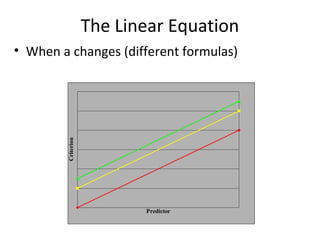
    The Linear Equation •When a changes (different formulas) Predictor Criterion
  • 56.
    Practice • Y =32(.3) + 10 • Identify the slope 1. 32 2. .3 3. 10
  • 57.
    Practice • Y =32(.3) + 10 • Identify the Y intercept 1. 32 2. .3 3. 10
  • 58.
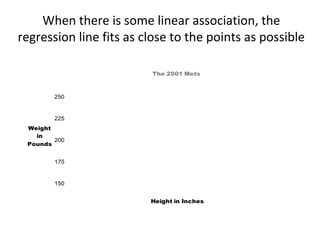
    The Regression Line •Relationships are rarely perfect. Scores are “scattered”. • The regression line is a straight line which is drawn through a scatterplot, to summarize the relationship between X and Y • It is the line that minimizes the squared deviations (Y – Y’)2 • We call these vertical deviations “residuals”
  • 59.
    When there issome linear association, the regression line fits as close to the points as possible 150 175 200 225 250 67 68 69 70 71 72 73 74 75 76 77 Weight in Pounds Height in Inches The 2001 Mets
  • 60.
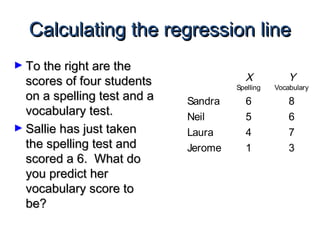
    Calculating the regressionlineCalculating the regression line ► To the right are theTo the right are the scores of four studentsscores of four students on a spelling test and aon a spelling test and a vocabulary test.vocabulary test. ► Sallie has just takenSallie has just taken the spelling test andthe spelling test and scored a 6. What doscored a 6. What do you predict heryou predict her vocabulary score tovocabulary score to be?be? X Spelling Y Vocabulary Sandra 6 8 Neil 5 6 Laura 4 7 Jerome 1 3
  • 61.
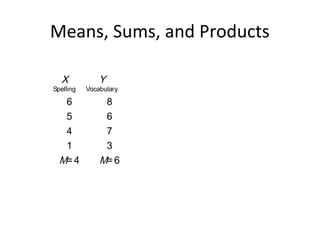
    Means, Sums, andProducts X Spelling Y Vocabulary 6 8 5 6 4 7 1 3 M=4 M=6
  • 62.
    Means, Sums, andProductsMeans, Sums, and Products X Spelling Y Vocabulary X-Mx Y-MY 6 8 2 2 5 6 1 0 4 7 0 1 1 3 -3 -3 M=4 M=6
  • 63.
    Means, Sums, andProductsMeans, Sums, and Products X Spelling Y Vocabulary X-Mx Y-MY (X-Mx)( Y-MY) 6 8 2 2 4 5 6 1 0 0 4 7 0 1 0 1 3 -3 -3 9 M=4 M=6 13=SP
  • 64.
    Means, Sums, andProductsMeans, Sums, and Products X Spelling Y Vocabulary X-Mx Y-MY (X-Mx)( Y-MY) (X-Mx)2 6 8 2 2 4 4 5 6 1 0 0 1 4 7 0 1 0 0 1 3 -3 -3 9 9 M=4 M=6 13=SP 14=SSx
  • 65.
    Now the formulasNowthe formulas X Spelling Y Vocabulary X-Mx Y-MY (X-Mx)( Y-MY) (X-Mx)2 6 8 2 2 4 4 5 6 1 0 0 1 4 7 0 1 0 0 1 3 -3 -3 9 9 M=4 M=6 13=SP 14=SSx 93. 14 13 === xSS SP b 28.2)4(93.6 =−=−= XY bMMa
  • 66.
    Now the formulas 86.728.2)6(93. ^ =+=+=abXY Sallie should get a vocabulary score of 7.86
  • 67.
    Causation • A strongrelationship between variables does not always mean that changes in one variable cause changes in the other variable.
  • 68.
    Causation • The relationshipbetween two variables is often influenced by other variables lurking in the background. “Beware the lurking variable!
  • 69.
    Causation • The bestevidence of causation comes from randomized comparative experiments.
  • 70.
  • 71.
    Chi-Square • Examines nominaldata or ordinal data that is being treated as a category • Called a non-parametric test – Chi-square requires no assumptions about the shape of the population distribution from which a sample is drawn. • The test examines the difference between observed counts and expected values
  • 72.
    Chi-square Goodness ofFit • Two ways to use the chi-square • First way to use the chi-square is called the Goodness of Fit test – Determines whether a frequency distribution follows a claimed distribution • Hypothesis test – Ho: the variable follows the claimed distribution – H1: the variable does not follow the claimed distribution
  • 73.
    Chi-square Goodness ofFit • The FBI compiles data on crime and crime rates and publishes the information in Crime in the United States. A violent crime is classified by the FBI as murder, forcible rape, robbery, or aggravated assault. Types of violent crime Relative frequency Murder 0.012 Forcible rape 0.054 Robbery 0.323 Agg. assault 0.611 1.000 Types of violent crime Frequency Murder 9 Forcible rape 26 Robbery 144 Agg. assault 321 500 Crime Distribution for 1995 Last Year
  • 74.
    Chi-square Goodness ofFit • Do the data provide sufficient evidence to conclude that last year’s distribution of violent crimes has changed from the 1995 distribution? • Get expected frequency E = Np Types of violent crime Relative frequency p Expected frequency Np =E Murder 0.012 (500)(0.012) = 6.0 Forcible rape 0.054 (500)(0.054) = 27.0 Robbery 0.323 (500)(0.323) = 161.5 Agg, assault 0.611 (500)(0.611) = 305.5
  • 75.
    Chi-square Goodness ofFit • Then calculate the chi formula Cell O E O-E (O-E)2 (O-E)2 /E Murder 9 6 3 9 1.5 Forcible Rape 26 27 -1 1 0.037 Robbery 144 161.5 -17.5 306.25 1.896 Agg. Assault 321 305.5 15.5 240.25 0.786 χχ22 = 4.219= 4.219 ( ) ∑ − = E EO 2 2 χ
  • 76.
    Chi-square Goodness ofFit • Finally – Use Table to find critical value – df = k – 1, where k is the number of cells – Example – df = 3 – Critical value is 7.815 – Our value is 4.219 so fail to reject – This means that the pattern of crime has not changed when comparing 1995 to last year.
  • 77.
    Chi-square Test ofIndependence • Second way to use a chi-square is the test of independence – Hypotheses • H0: Variables Are Independent • Ha: Variables Are Related (Dependent)
  • 78.
    Chi-square Test ofIndependence • We are interested in whether single men vs. women are more likely to own cats vs. dogs. • Notice that both variables are categorical. – Kind of pet: people are classified as owning cats or dogs. We can count the number of people belonging to each category – Sex: people are male or female. We count the number of people in each category
  • 79.
    Chi-square Test ofIndependence • Are these differences because there is a real relationship between gender and pet ownership? • Or is there actually no relationship between these variables? Cat Dog Male 20 30 50 Female 30 20 50 50 50 100
  • 80.
    Chi-square Test ofIndependence • To answer this question, we need to know what we would expect to observe if the null hypothesis were true • The differences between these expected values and the observed values are aggregated according to the Chi-square formula
  • 81.
    Chi-square Test ofIndependence • To find expected value for a cell of the table, multiply the corresponding row total by the column total, and divide by the grand total • For the first cell (and all other cells), (50 x 50)/100 = 25 • Thus, if the two variables are unrelated, we would expect to observe 25 people in each cell Cat Dog Male 20 30 50 Female 30 20 50 50 50 100
  • 82.
    Chi-square Test ofIndependence • Then apply to the same chi-square formula ( ) ∑ − = E EO 2 2 χ Cell O E O-E (O-E)2 (O-E)2 /E Male w/ Car 20 25 -5 25 1 Male w/ Dog 30 25 5 25 1 Female w/ Cat 30 25 5 25 1 Female w/ Dog 20 25 -5 25 1 χχ22 = 4= 4
  • 83.
    Chi-square Test ofIndependence • Compare to critical value from chi-square table. • Degrees of freedom is – (number of rows – 1)(number of columns -1) – In our example (2-1)(2-1)= 1 – Critical value is 3.841 – Our value of 4 is greater than the critical so reject the null. Cat Dog Male 20 30 50 Female 30 20 50 50 50 100

Editor's Notes

  • #3 Early developments Sir Francis Galton was very interested in these issues in the 1880’s Galton was the cousin of Darwin and thus he became interested in evolution and heredity Galton had an intuition that the heredity could be understood in terms of deviations from means He began to measure characteristics of plants and animals including people Lots of normality Galton found many characteristics that were normally distributed Height in humans (by gender) Weight in humans (by gender) Length of animal bones Weights of seeds of plants Sweat peas The next step that Galton took was to look at distributions of measurements of parents and offspring together He first looked at sweet pea plants because the female plants can self fertilize This makes examining the data easier because only one parent influences the characteristics of the offspring He plotted mother seed sizes against daughter seed sizes