Measures of
Central Tendency
K.THIYAGU, Assistant Professor DoE, Central University of Kerala, Kasaragod
1
@ThiyaguSuriya
Measures of Central Tendency
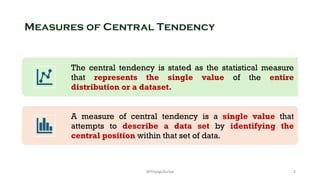
The central tendency is stated as the statistical measure
that represents the single value of the entire
distribution or a dataset.
A measure of central tendency is a single value that
attempts to describe a data set by identifying the
central position within that set of data.
2
@ThiyaguSuriya
Characteristics
Measures of central
tendency are sometimes
called measures of
central location.
A single number that
represents the entire set
of data (average)
3
@ThiyaguSuriya
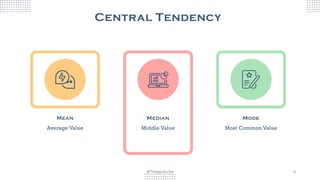
Central Tendency
Mean
Average Value
Median
Middle Value
Mode
Most Common Value
4
@ThiyaguSuriya
5
@ThiyaguSuriya
6
@ThiyaguSuriya
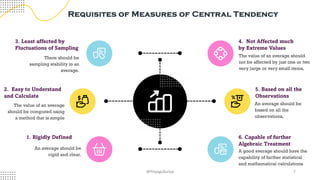
Requisites of Measures of Central Tendency
3. Least affected by
Fluctuations of Sampling
There should be
sampling stability in an
average.
2. Easy to Understand
and Calculate
The value of an average
should be computed using
a method that is simple
1. Rigidly Defined
An average should be
rigid and clear.
4. Not Affected much
by Extreme Values
The value of an average should
not be affected by just one or two
very large or very small items,
5. Based on all the
Observations
An average should be
based on all the
observations,
6. Capable of further
Algebraic Treatment
A good average should have the
capability of further statistical
and mathematical calculations
7
@ThiyaguSuriya
Mean
8
@ThiyaguSuriya
Mean
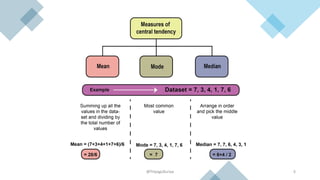
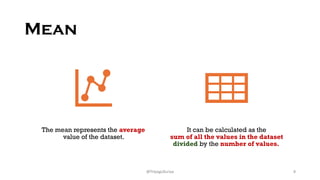
The mean represents the average
value of the dataset.
It can be calculated as the
sum of all the values in the dataset
divided by the number of values.
9
@ThiyaguSuriya
Mean Symbol (X Bar)
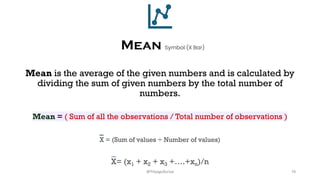
Mean is the average of the given numbers and is calculated by
dividing the sum of given numbers by the total number of
numbers.
Mean = ( Sum of all the observations / Total number of observations )
X = (Sum of values ÷ Number of values)
X= (x1 + x2 + x3 +….+xn)/n
10
@ThiyaguSuriya
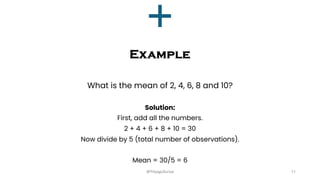
Example
What is the mean of 2, 4, 6, 8 and 10?
Solution:
First, add all the numbers.
2 + 4 + 6 + 8 + 10 = 30
Now divide by 5 (total number of observations).
Mean = 30/5 = 6
11
@ThiyaguSuriya
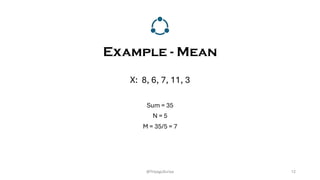
Example - Mean
X: 8, 6, 7, 11, 3
Sum = 35
N = 5
M = 35/5 = 7
12
@ThiyaguSuriya
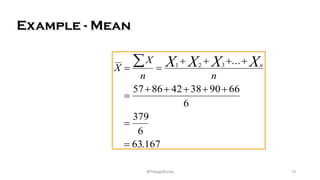
Example - Mean
X
X
n n
X X X Xn
= =
+ + + +
=
+ + + + +
=
=
å 1 2 3
57 86 42 38 90 66
6
379
6
63 167
...
.
13
@ThiyaguSuriya
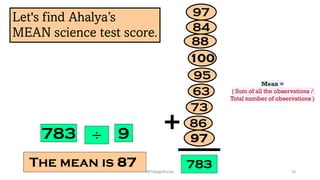
Let's find Ahalya’s
MEAN science test score.
97
84
73
88
100
63
97
95
86
+
783
783 ÷ 9
The mean is 87
Mean =
( Sum of all the observations /
Total number of observations )
14
@ThiyaguSuriya
Median
15
@ThiyaguSuriya
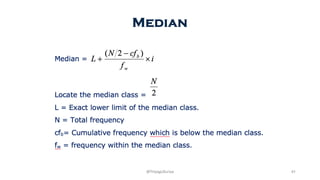
Median
The median is the middle value of the
dataset in which the dataset is arranged in
ascending order or in descending order.
The median is the middle score for a data set
arranged in order of magnitude.
16
@ThiyaguSuriya
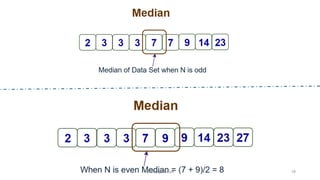
Finding the Median
1. Arrange the scores in ascending or
descending numerical order
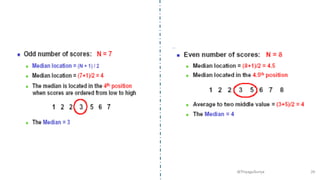
2. Calculate the value of [(N+1)/2]
3. round the {(N+1)/2]th item
17
@ThiyaguSuriya
18
@ThiyaguSuriya
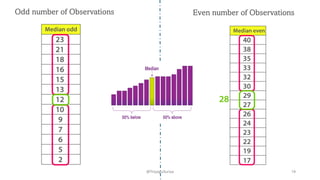
Odd number of Observations Even number of Observations
19
@ThiyaguSuriya
20
@ThiyaguSuriya
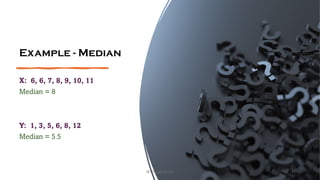
Example - Median
X: 6, 6, 7, 8, 9, 10, 11
Median = 8
Y: 1, 3, 5, 6, 8, 12
Median = 5.5
21
@ThiyaguSuriya
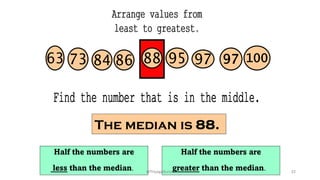
97
84
73 88 100
63 97
95
86
The median is 88.
Half the numbers are
less than the median.
Half the numbers are
greater than the median. 22
@ThiyaguSuriya
Mode
23
@ThiyaguSuriya
Mode
The mode represents the
frequently occurring value
in the dataset.
Sometimes the dataset may
contain multiple modes &
in some cases, it does not
contain any mode at all.
The mode is the
most frequent score
in our data set.
24
@ThiyaguSuriya
25
@ThiyaguSuriya
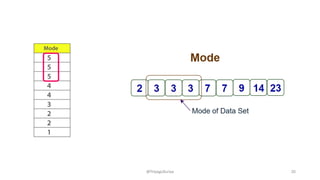
Mode
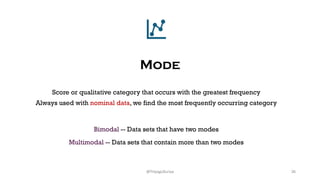
Score or qualitative category that occurs with the greatest frequency
Always used with nominal data, we find the most frequently occurring category
Bimodal -- Data sets that have two modes
Multimodal -- Data sets that contain more than two modes
26
@ThiyaguSuriya
Example - Mode
X: 8, 6, 7, 9, 10, 6
Mode = 6
Y: 1, 8, 12, 3, 8, 5, 6
Mode = 8
Can have more than one mode
Z: 1, 2, 2, 8, 10, 5, 5, 6
Mode = 2 and 5
27
@ThiyaguSuriya
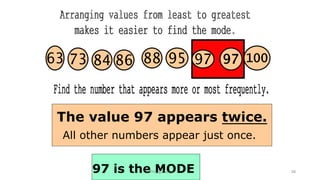
97
84
73 88 100
63 97
95
86
The value 97 appears twice.
All other numbers appear just once.
97 is the MODE 28
@ThiyaguSuriya
A Hint for remembering the MODE…
The first two letters give you a hint…
MOde
Most Often
29
@ThiyaguSuriya
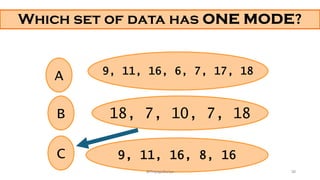
Which set of data has ONE MODE?
9, 11, 16, 8, 16
9, 11, 16, 6, 7, 17, 18
18, 7, 10, 7, 18
A
C
B
30
@ThiyaguSuriya
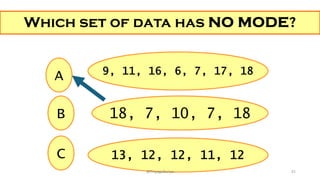
Which set of data has NO MODE?
13, 12, 12, 11, 12
9, 11, 16, 6, 7, 17, 18
18, 7, 10, 7, 18
A
C
B
31
@ThiyaguSuriya
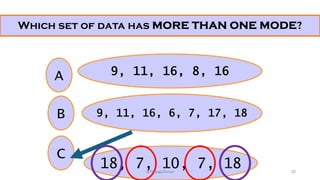
Which set of data has MORE THAN ONE MODE?
9, 11, 16, 8, 16
9, 11, 16, 6, 7, 17, 18
18, 7, 10, 7, 18
A
C
B
32
@ThiyaguSuriya
GROUPED
DATA
33
@ThiyaguSuriya
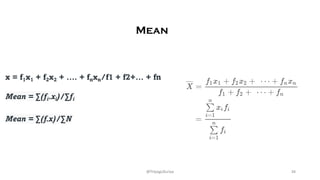
x = f1x1 + f2x2 + …. + fnxn/f1 + f2+… + fn
Mean = ∑(fi.xi)/∑fi
Mean = ∑(f.x)/∑N
Mean
34
@ThiyaguSuriya
Mean
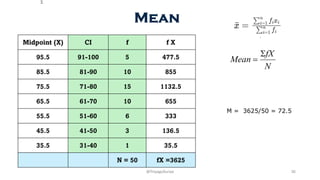
Midpoint (X) CI f f X
95.5 91-100 5 477.5
85.5 81-90 10 855
75.5 71-80 15 1132.5
65.5 61-70 10 655
55.5 51-60 6 333
45.5 41-50 3 136.5
35.5 31-40 1 35.5
N = 50 fX =3625
S
N
fX
Mean
S
=
M = 3625/50 = 72.5
35
@ThiyaguSuriya
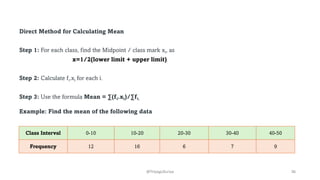
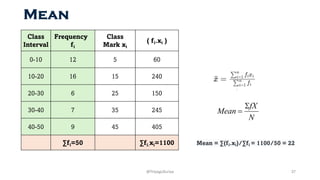
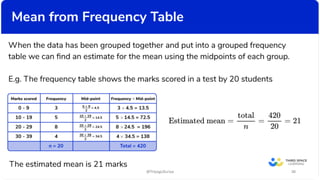
Direct Method for Calculating Mean
Step 1: For each class, find the Midpoint / class mark xi, as
x=1/2(lower limit + upper limit)
Step 2: Calculate fi.xi for each i.
Step 3: Use the formula Mean = ∑(fi.xi)/∑fi.
Class Interval 0-10 10-20 20-30 30-40 40-50
Frequency 12 16 6 7 9
Example: Find the mean of the following data
36
@ThiyaguSuriya
Class
Interval
Frequency
fi
Class
Mark xi
( fi.xi )
0-10 12 5 60
10-20 16 15 240
20-30 6 25 150
30-40 7 35 245
40-50 9 45 405
∑fi=50 ∑fi.xi=1100
Mean
N
fX
Mean
S
=
Mean = ∑(fi.xi)/∑fi = 1100/50 = 22
37
@ThiyaguSuriya
38
@ThiyaguSuriya
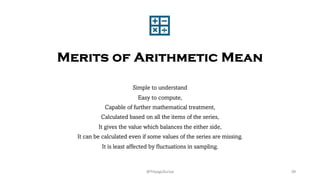
Merits of Arithmetic Mean
Simple to understand
Easy to compute,
Capable of further mathematical treatment,
Calculated based on all the items of the series,
It gives the value which balances the either side,
It can be calculated even if some values of the series are missing.
It is least affected by fluctuations in sampling.
39
@ThiyaguSuriya
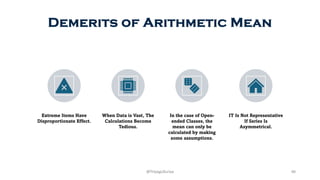
Demerits of Arithmetic Mean
Extreme Items Have
Disproportionate Effect.
When Data is Vast, The
Calculations Become
Tedious.
In the case of Open-
ended Classes, the
mean can only be
calculated by making
some assumptions.
IT Is Not Representative
If Series Is
Asymmetrical.
40
@ThiyaguSuriya
Median
41
@ThiyaguSuriya
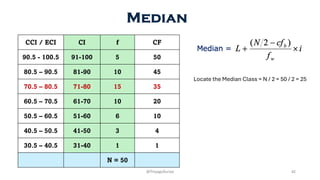
Median
CCI / ECI CI f CF
90.5 - 100.5 91-100 5 50
80.5 – 90.5 81-90 10 45
70.5 – 80.5 71-80 15 35
60.5 – 70.5 61-70 10 20
50.5 – 60.5 51-60 6 10
40.5 – 50.5 41-50 3 4
30.5 – 40.5 31-40 1 1
N = 50
Locate the Median Class = N / 2 = 50 / 2 = 25
42
@ThiyaguSuriya
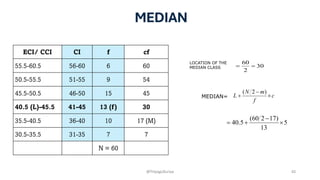
MEDIAN
ECI/ CCI CI f cf
55.5-60.5 56-60 6 60
50.5-55.5 51-55 9 54
45.5-50.5 46-50 15 45
40.5 (L)-45.5 41-45 13 (f) 30
35.5-40.5 36-40 10 17 (M)
30.5-35.5 31-35 7 7
N = 60
30
2
60
=
=
5
13
)
17
2
60
(
5
.
40 ´
-
+
=
c
f
m
N
L ´
-
+
)
2
(
LOCATION OF THE
MEDIAN CLASS
MEDIAN=
43
@ThiyaguSuriya
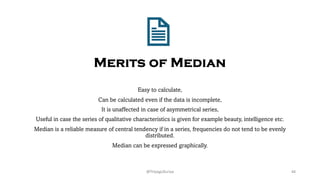
Merits of Median
Easy to calculate,
Can be calculated even if the data is incomplete,
It is unaffected in case of asymmetrical series,
Useful in case the series of qualitative characteristics is given for example beauty, intelligence etc.
Median is a reliable measure of central tendency if in a series, frequencies do not tend to be evenly
distributed.
Median can be expressed graphically.
44
@ThiyaguSuriya
Mode
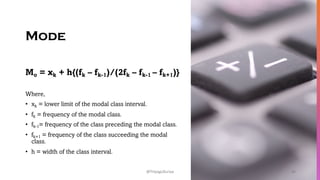
Mo = xk + h{(fk – fk-1)/(2fk – fk-1 – fk+1)}
Where,
• xk = lower limit of the modal class interval.
• fk = frequency of the modal class.
• fk-1= frequency of the class preceding the modal class.
• fk+1 = frequency of the class succeeding the modal
class.
• h = width of the class interval.
45
@ThiyaguSuriya
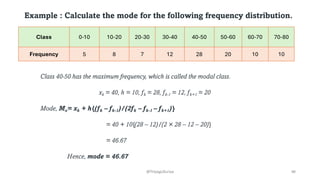
Example : Calculate the mode for the following frequency distribution.
Class 0-10 10-20 20-30 30-40 40-50 50-60 60-70 70-80
Frequency 5 8 7 12 28 20 10 10
Class 40-50 has the maximum frequency, which is called the modal class.
xk = 40, h = 10, fk = 28, fk-1 = 12, fk+1 = 20
Mode, Mo= xk + h{(fk – fk-1)/(2fk – fk-1 – fk+1)}
= 40 + 10{(28 – 12)/(2 × 28 – 12 – 20)}
= 46.67
Hence, mode = 46.67
46
@ThiyaguSuriya
Relationship
among mean,
median and mode,
Mode = 3(Median) – 2(Mean)
47
@ThiyaguSuriya
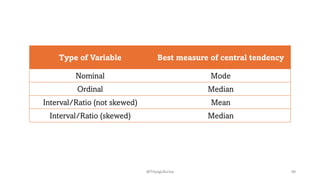
Type of Variable Best measure of central tendency
Nominal Mode
Ordinal Median
Interval/Ratio (not skewed) Mean
Interval/Ratio (skewed) Median
48
@ThiyaguSuriya
Thank You
49
@ThiyaguSuriya