


Measures
of
Dispersion/
Variability
K.THIYAGU, Assistant
Professor, Department of Education,
Central University of Kerala, Kasaragod @ThiyaguSuriya 1
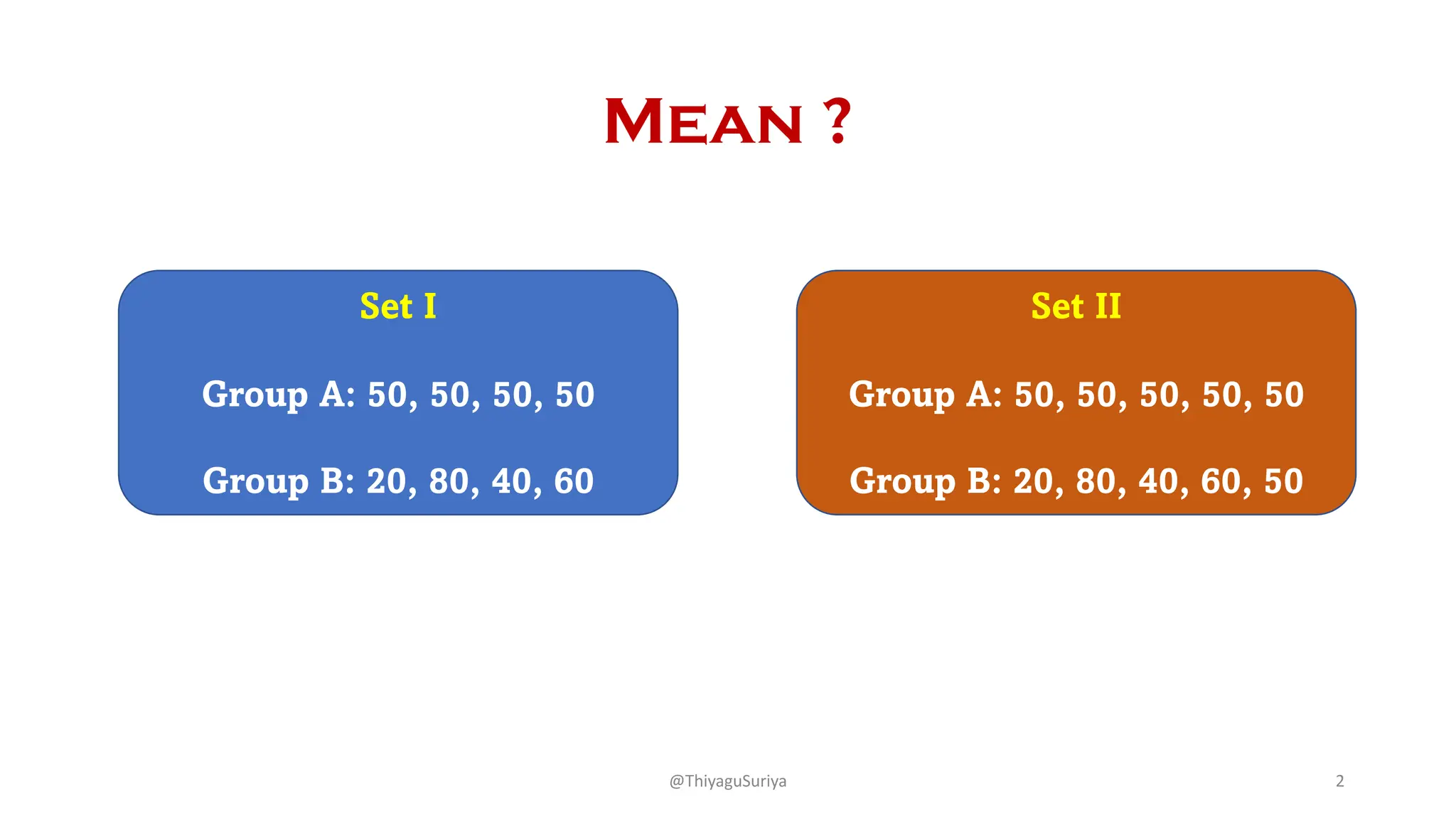
Mean ?
Set I
Group A: 50, 50, 50, 50
Group B: 20, 80, 40, 60
Set II
Group A: 50, 50, 50, 50, 50
Group B: 20, 80, 40, 60, 50
@ThiyaguSuriya 2
Mean
Set I
Group A: 50, 50, 50, 50
Group B: 20, 80, 40, 60
Set II
Group A: 50, 50, 50, 50, 50
Group B: 20, 80, 40, 60, 50
Mean
Group A: 50
Group B: 50
Mean
Group A: 50
Group B: 50
Is it means Group A = Group B ?
@ThiyaguSuriya 3
Measures of Variability
Set I
Group A: 50, 50, 50, 50
Group B: 20, 80, 40, 60
Set II
Group A: 50, 50, 50, 50, 50
Group B: 20, 80, 40, 60, 50
Mean
Group A: 50
Group B: 50
Mean
Group A: 50
Group B: 50
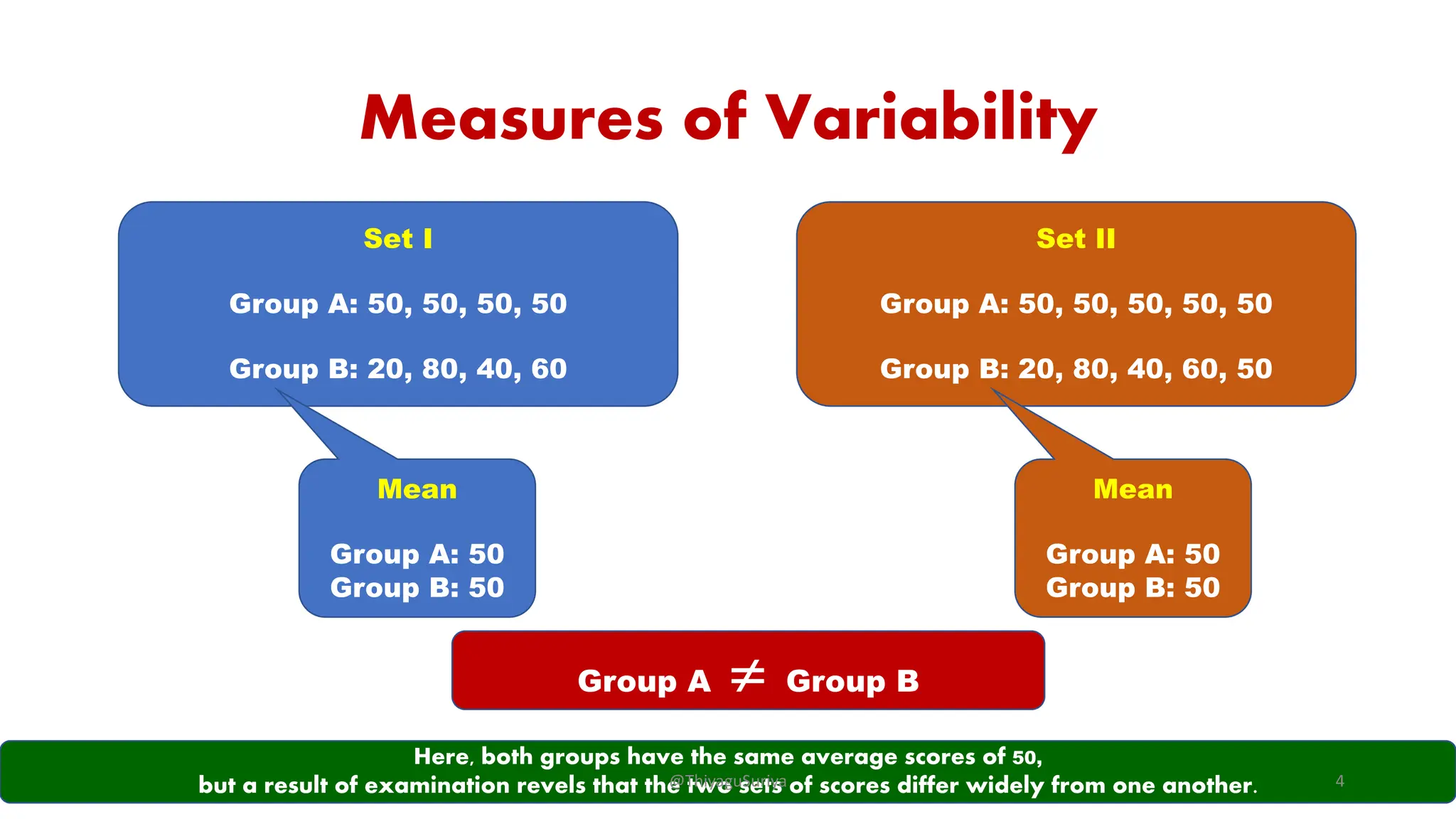
Group A š Group B
Here, both groups have the same average scores of 50,
but a result of examination revels that the two sets of scores differ widely from one another.
@ThiyaguSuriya 4
• Dispersion (also known as
Scatter, Spread or Variation)
is the state of getting
dispersed or spread.
• It measures the degree of
variation.
• Statistical dispersion means
the extent to which numerical
data is likely to vary about an
average value.
Set of data has a small value:
1, 2, 2, 3, 3, 4
…and this set has a wider one:
0, 1, 20, 30, 40, 100
@ThiyaguSuriya 5
@ThiyaguSuriya 6
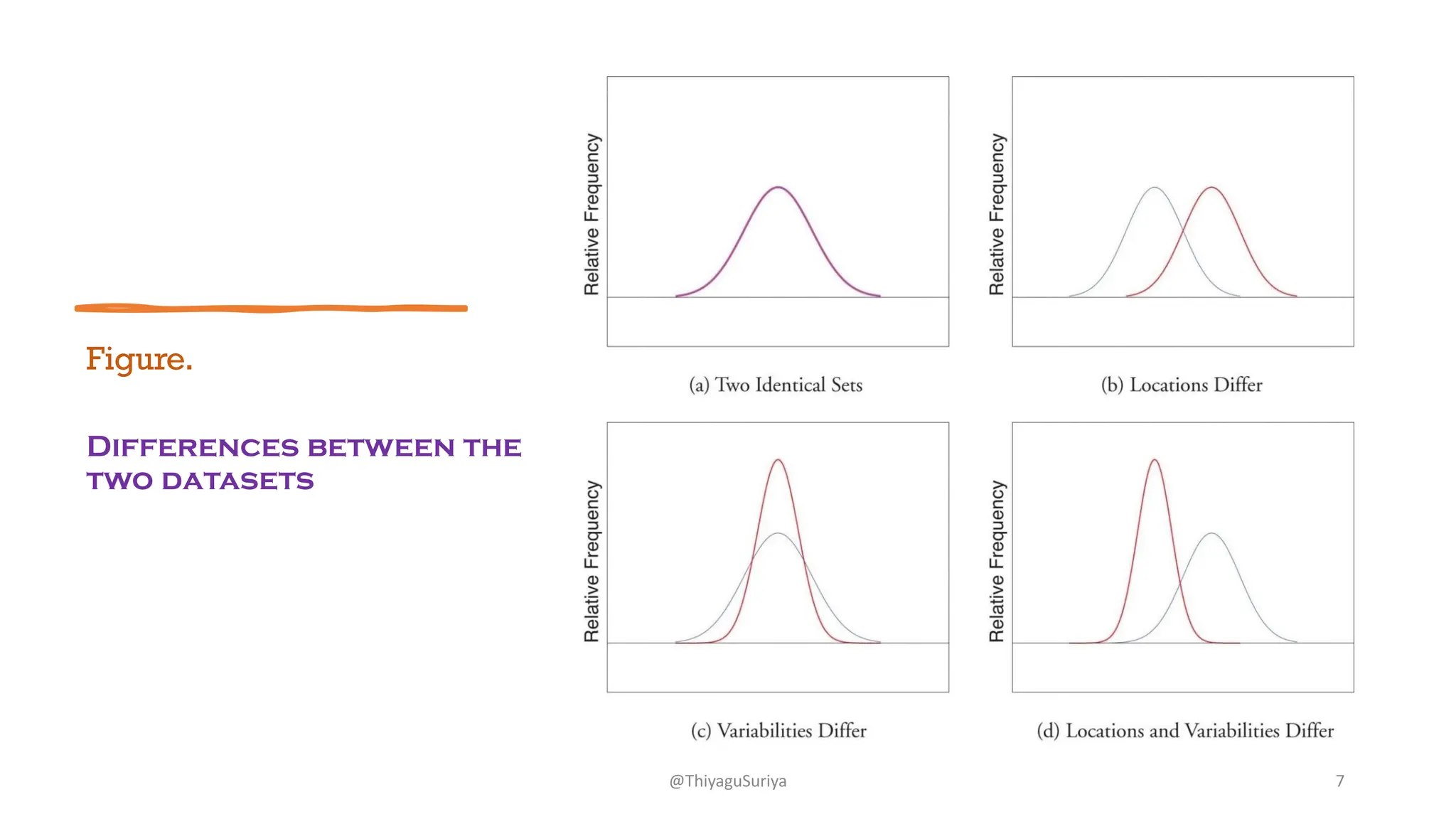
Figure.
Differences between the
two datasets
@ThiyaguSuriya 7
@ThiyaguSuriya 8
Measures of Dispersion
In statistics,
the measures of dispersion
help to interpret the
variability of data
i.e. to know how much
homogenous or heterogenous
the data is.
In simple terms,
it shows
how squeezed or
scattered the variable is.
@ThiyaguSuriya 9
Measures
of
Dispersion
Absolute
Measure of
Dispersion
Relative
Measure of
Dispersion
@ThiyaguSuriya 10
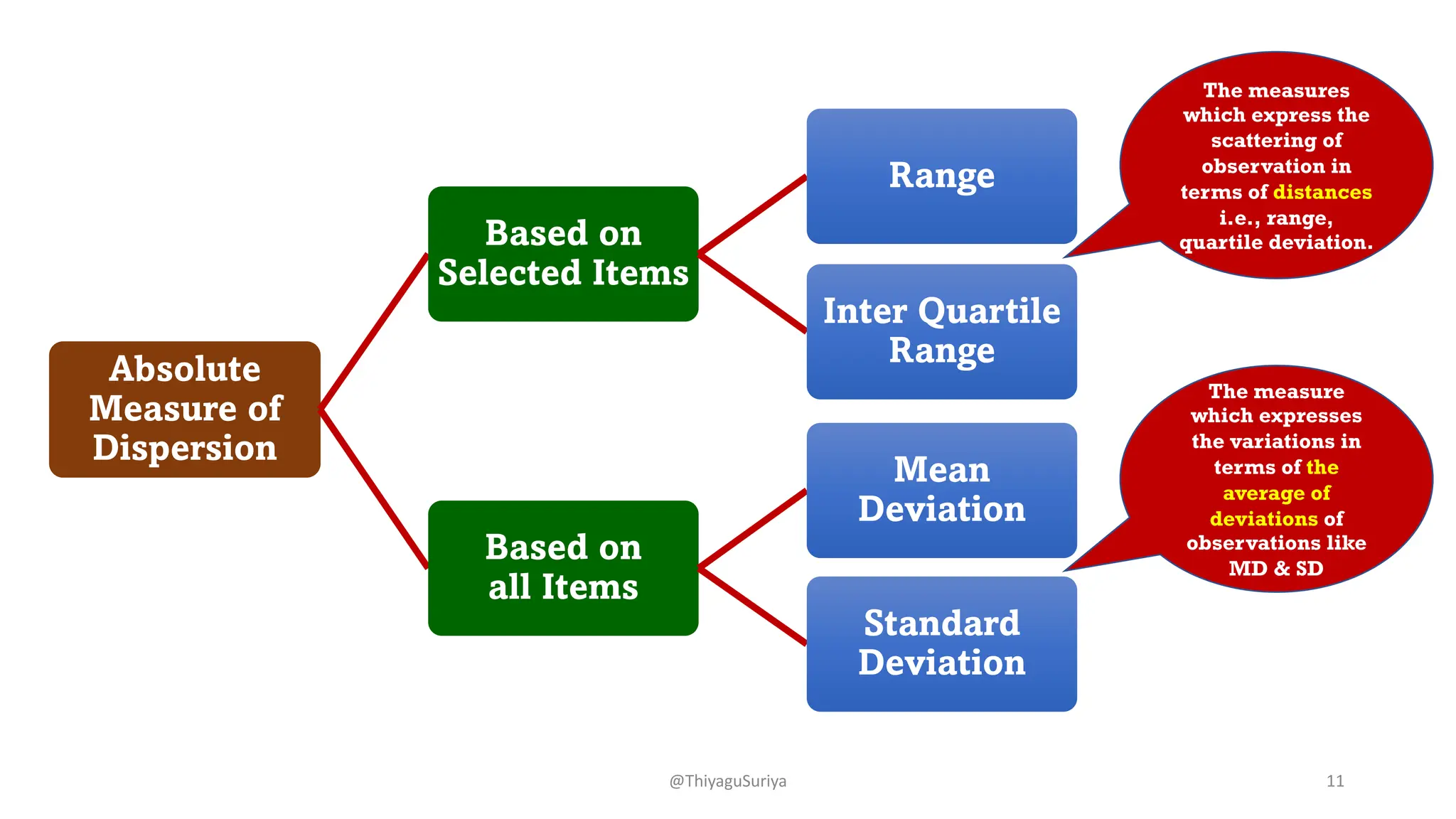
Absolute
Measure of
Dispersion
Based on
Selected Items
Range
Inter Quartile
Range
Based on
all Items
Mean
Deviation
Standard
Deviation
The measures
which express the
scattering of
observation in
terms of distances
i.e., range,
quartile deviation.
The measure
which expresses
the variations in
terms of the
average of
deviations of
observations like
MD & SD
@ThiyaguSuriya 11
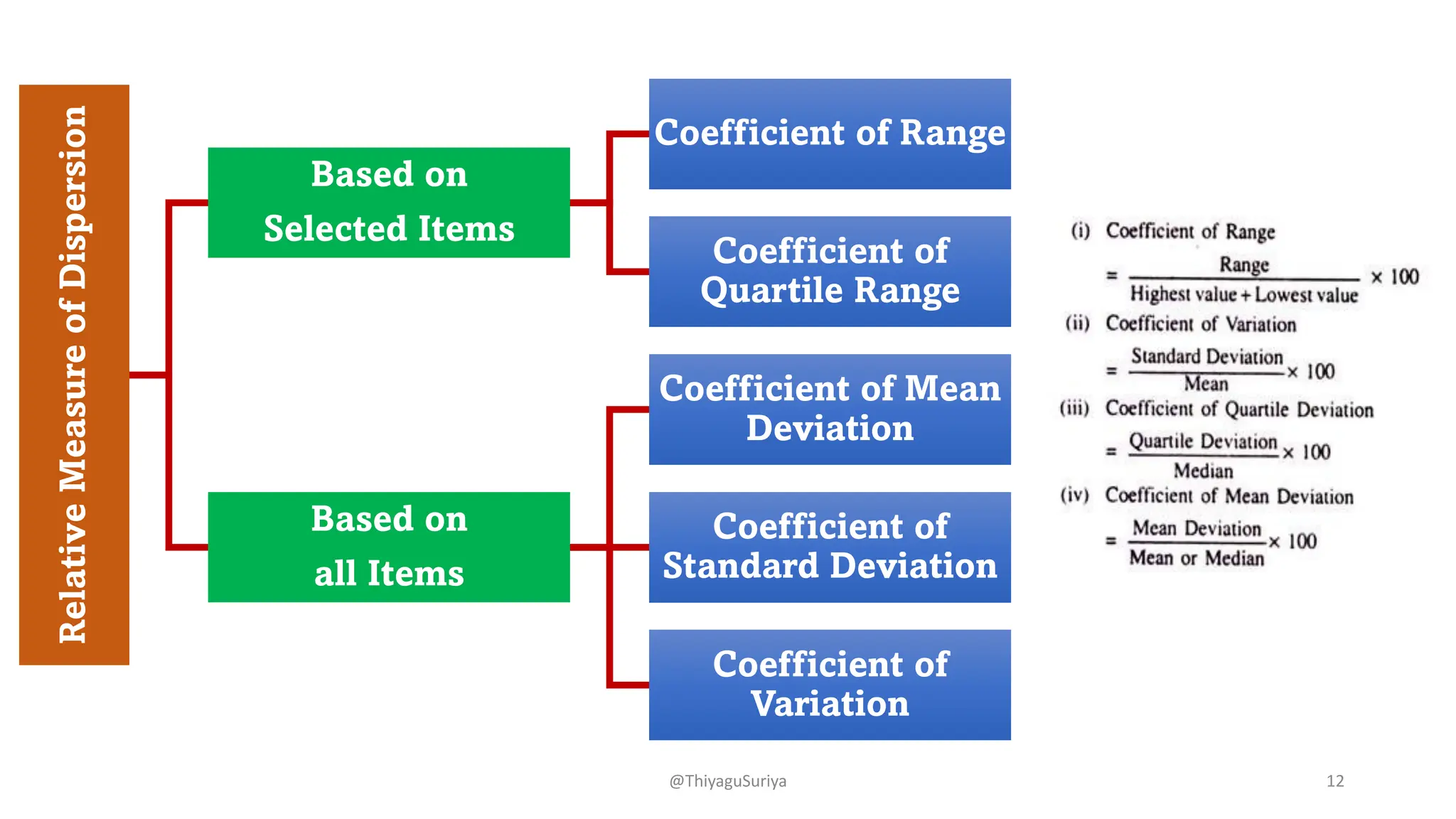
Relative
Measure
of
Dispersion
Based on
Selected Items
Coefficient of Range
Coefficient of
Quartile Range
Based on
all Items
Coefficient of Mean
Deviation
Coefficient of
Standard Deviation
Coefficient of
Variation
@ThiyaguSuriya 12
C.D. in terms of Coefficient of dispersion
Range C.D. = (Xmax – Xmin) ⁄ (Xmax + Xmin)
Quartile Deviation C.D. = (Q3 – Q1) ⁄ (Q3 + Q1)
Standard Deviation (S.D.) C.D. = S.D. ⁄ Mean
Mean Deviation C.D. = Mean deviation/Average
@ThiyaguSuriya 13
Range
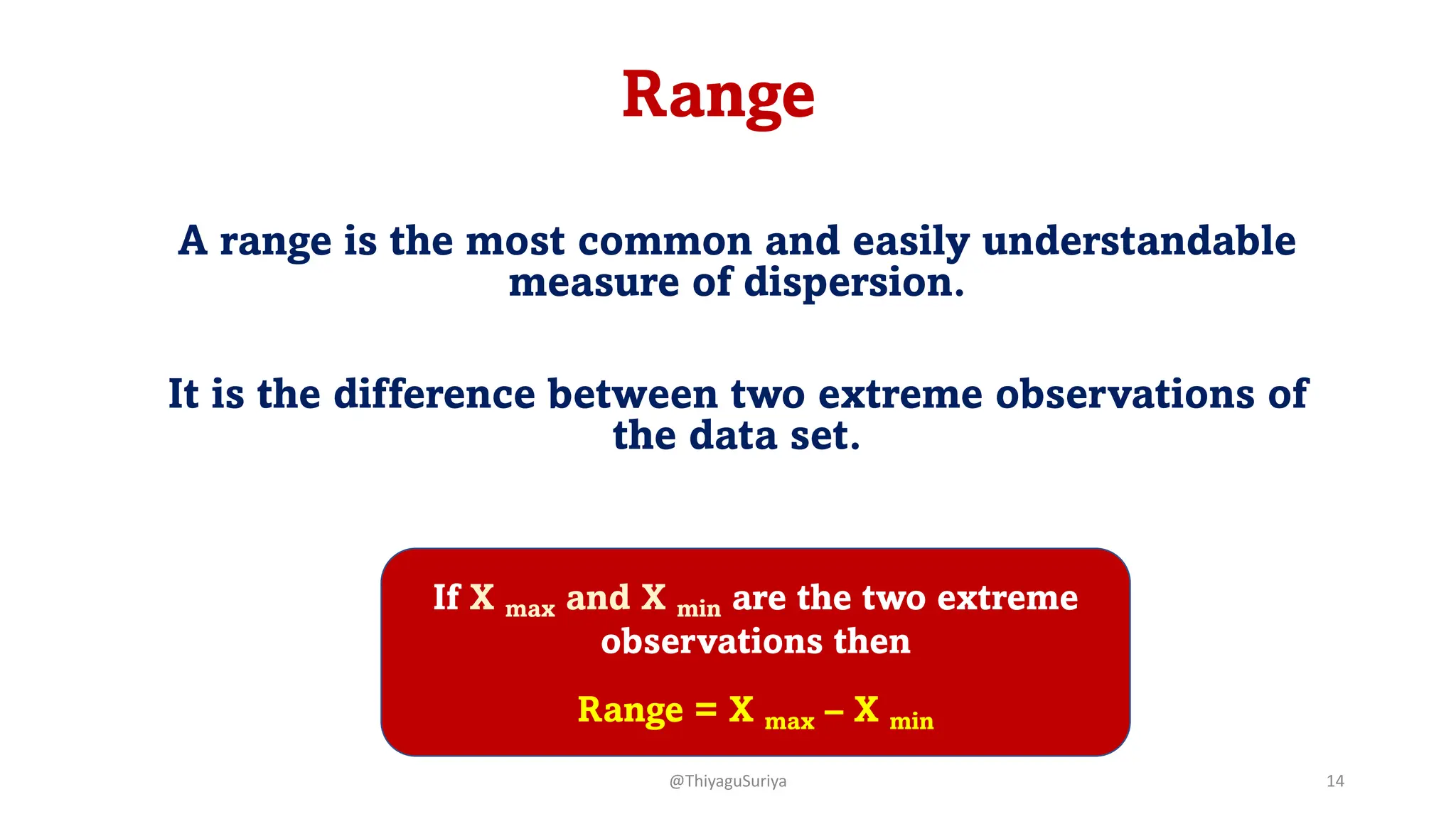
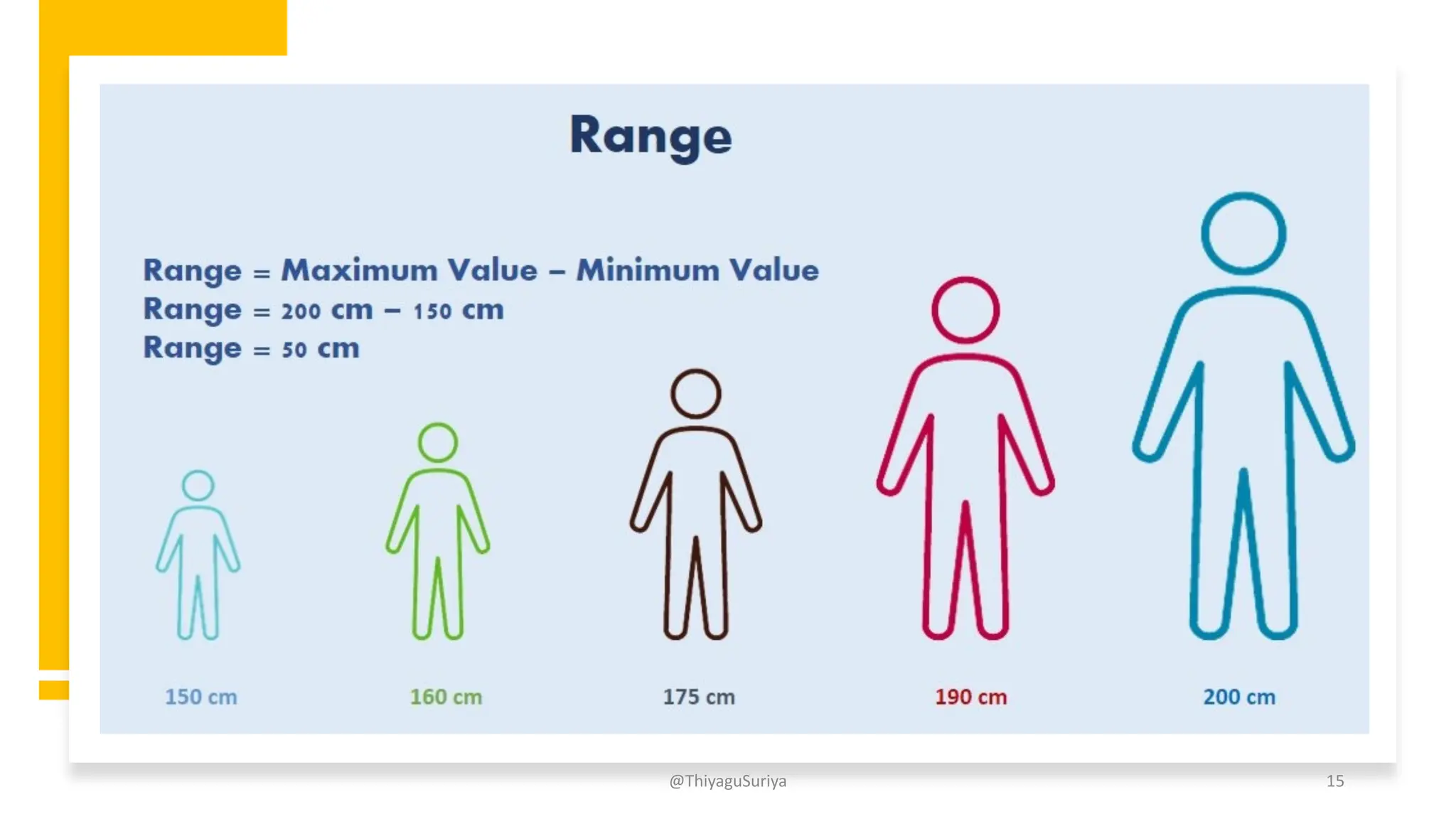
A range is the most common and easily understandable
measure of dispersion.
It is the difference between two extreme observations of
the data set.
If X max and X min are the two extreme
observations then
Range = X max – X min
@ThiyaguSuriya 14
@ThiyaguSuriya 15
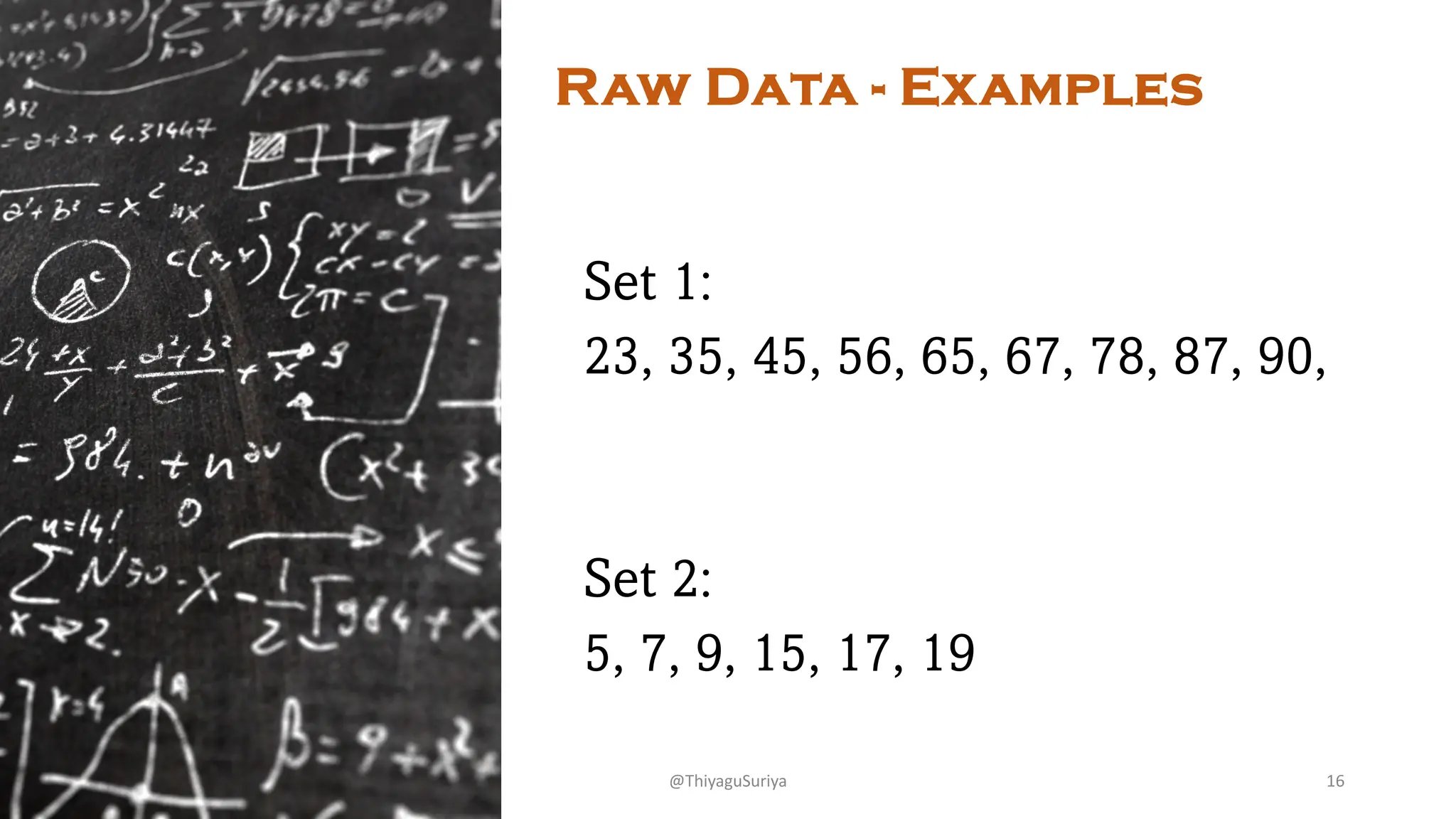
Raw Data - Examples
Set 1:
23, 35, 45, 56, 65, 67, 78, 87, 90,
Set 2:
5, 7, 9, 15, 17, 19
@ThiyaguSuriya 16
Raw Data - Examples
Set 1:
23, 35, 45, 56, 65, 67, 78, 87, 90,
Range =90 - 23 = 67
Set 2:
5, 7, 9, 15, 17, 19
Range = 19 - 5 = 14
@ThiyaguSuriya 17
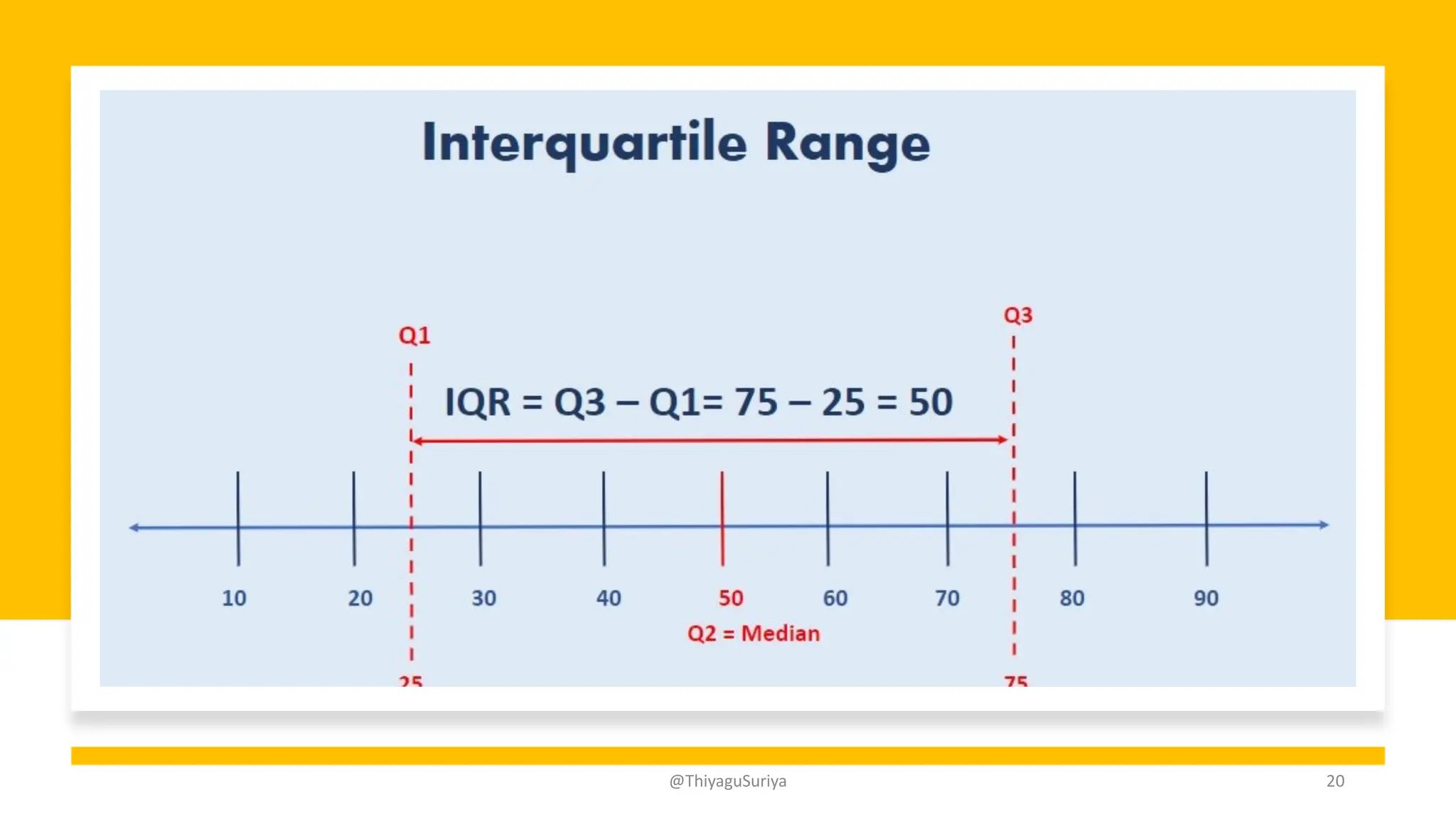
Quartile Deviation
The quartiles divide a data set into quarters.
The first quartile, (Q1) is the middle number between the
smallest number and the median of the data.
The second quartile, (Q2) is the median of the data set.
The third quartile, (Q3) is the middle number between
the median and the largest number.
Quartile deviation or
semi-inter-quartile deviation is
Q = ½ × (Q3 – Q1)
@ThiyaguSuriya 18
( ) score
N
Q
th
á
ø
Ăś
ç
è
ĂŚ +
=
4
1
3
3
score
N
Q
mdn
th
á
ø
Ăś
ç
è
ĂŚ +
=
2
1
)
( 2
score
N
Q
th
á
ø
Ăś
ç
è
ĂŚ +
=
4
1
1
The value of Q3 can be obtained by the formula
Calculating median we use the formula
The value of Q1 can be obtained by the formula
2
1
3 Q
Q -
QD =
Quartile Deviation from the ungrouped data Formula
@ThiyaguSuriya 19
@ThiyaguSuriya 20
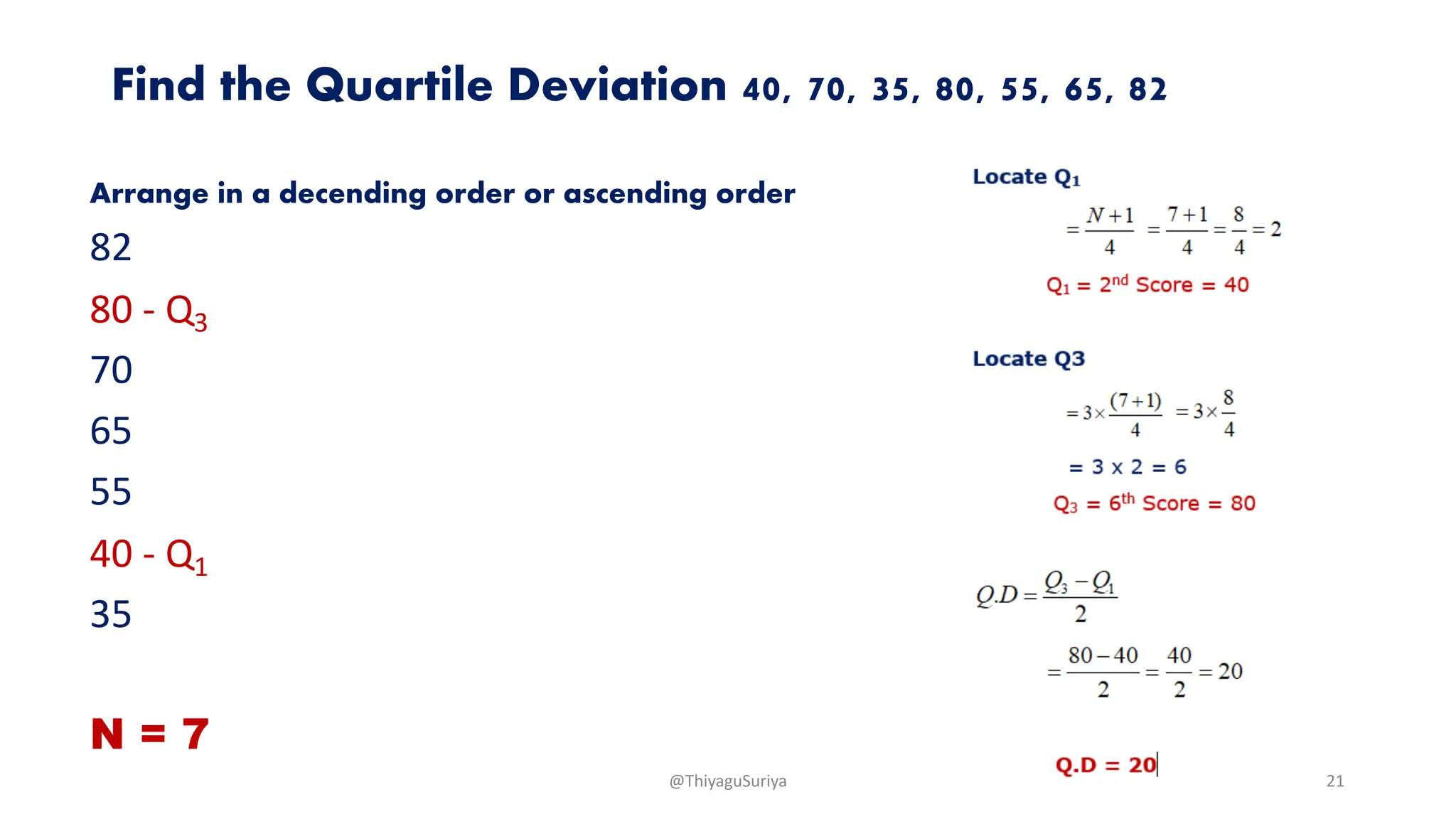
Find the Quartile Deviation 40, 70, 35, 80, 55, 65, 82
Arrange in a decending order or ascending order
82
80 - Q3
70
65
55
40 - Q1
35
N = 7
@ThiyaguSuriya 21
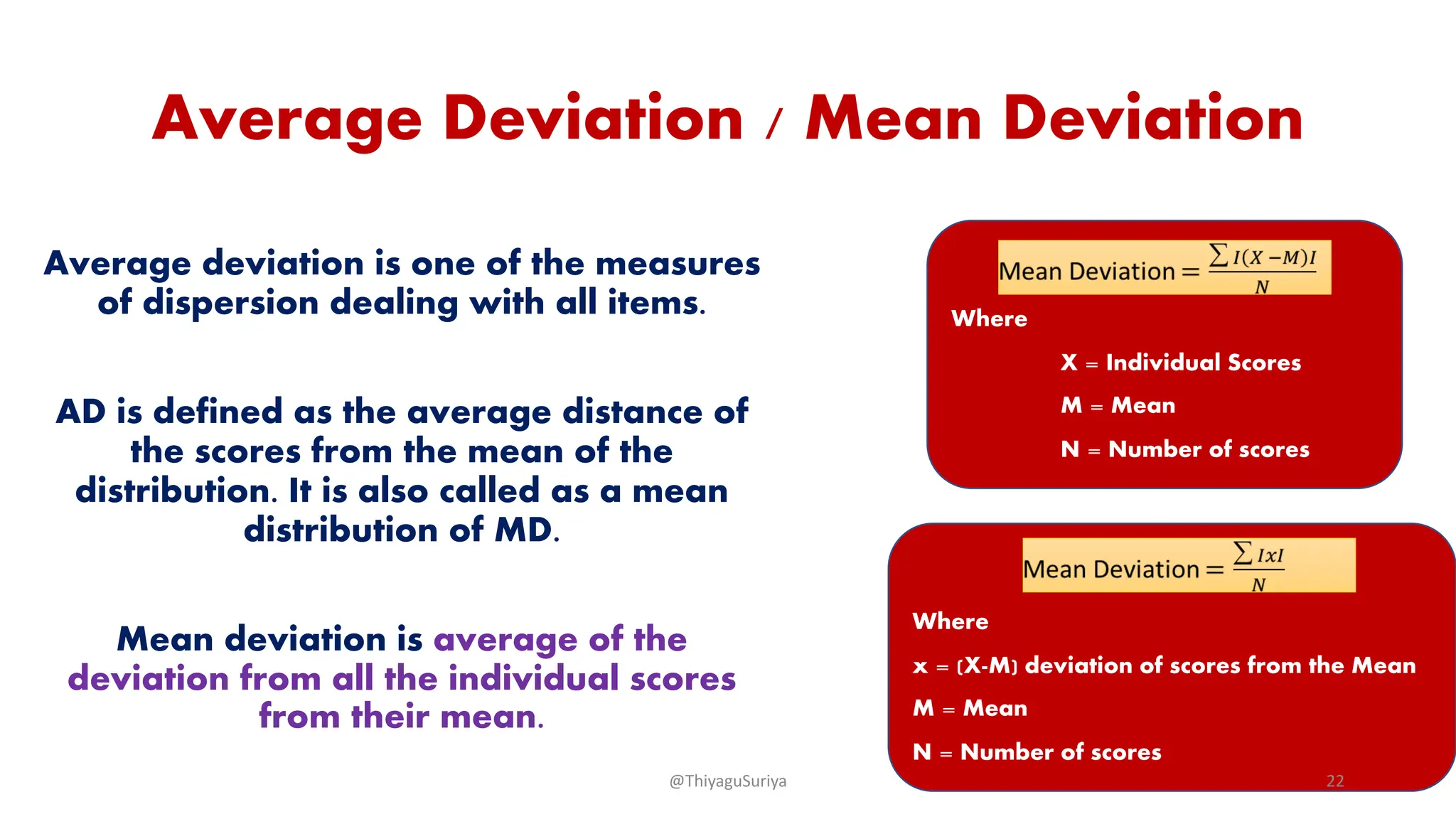
Average Deviation / Mean Deviation
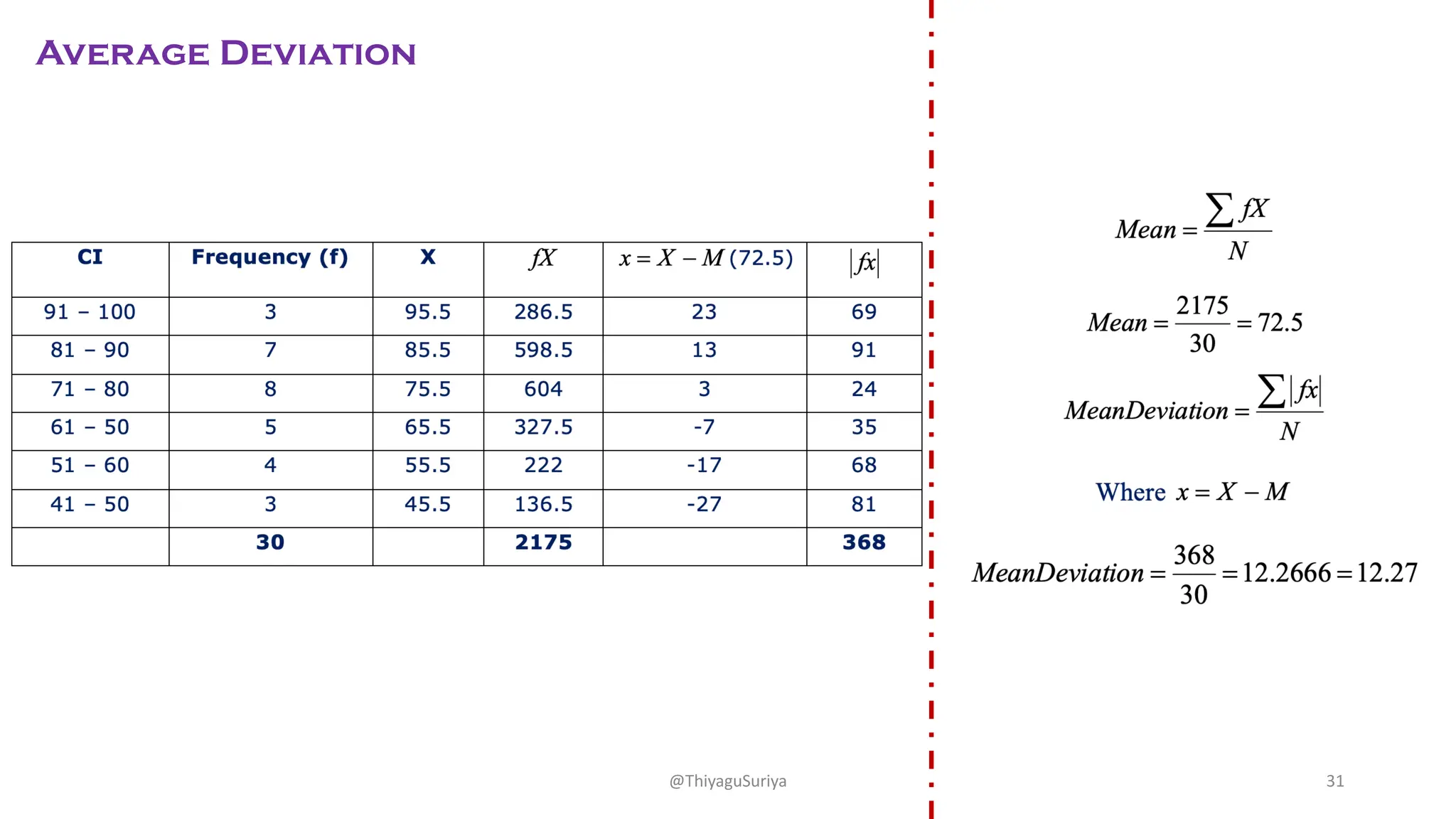
Average deviation is one of the measures
of dispersion dealing with all items.
AD is defined as the average distance of
the scores from the mean of the
distribution. It is also called as a mean
distribution of MD.
Mean deviation is average of the
deviation from all the individual scores
from their mean.
Where
X = Individual Scores
M = Mean
N = Number of scores
Where
x = (X-M) deviation of scores from the Mean
M = Mean
N = Number of scores
@ThiyaguSuriya 22
Scores Deviation (Raw Score – Mean) x IxI
10 10 – 30 -20 20
20 20 - 30 -10 10
30 30 – 30 0 0
40 40 – 30 10 10
50 50 - 30 20 20
∑X = 150 ∑IxI = 60
Raw Data: Example:
Calculate A.D. from the following Scores: 10, 20, 30, 40, 50
Where
x = (X-M) deviation of scores from the Mean
M = Mean
N = Number of scores
18 30 42
12 12
M
@ThiyaguSuriya 23
Standard Deviation
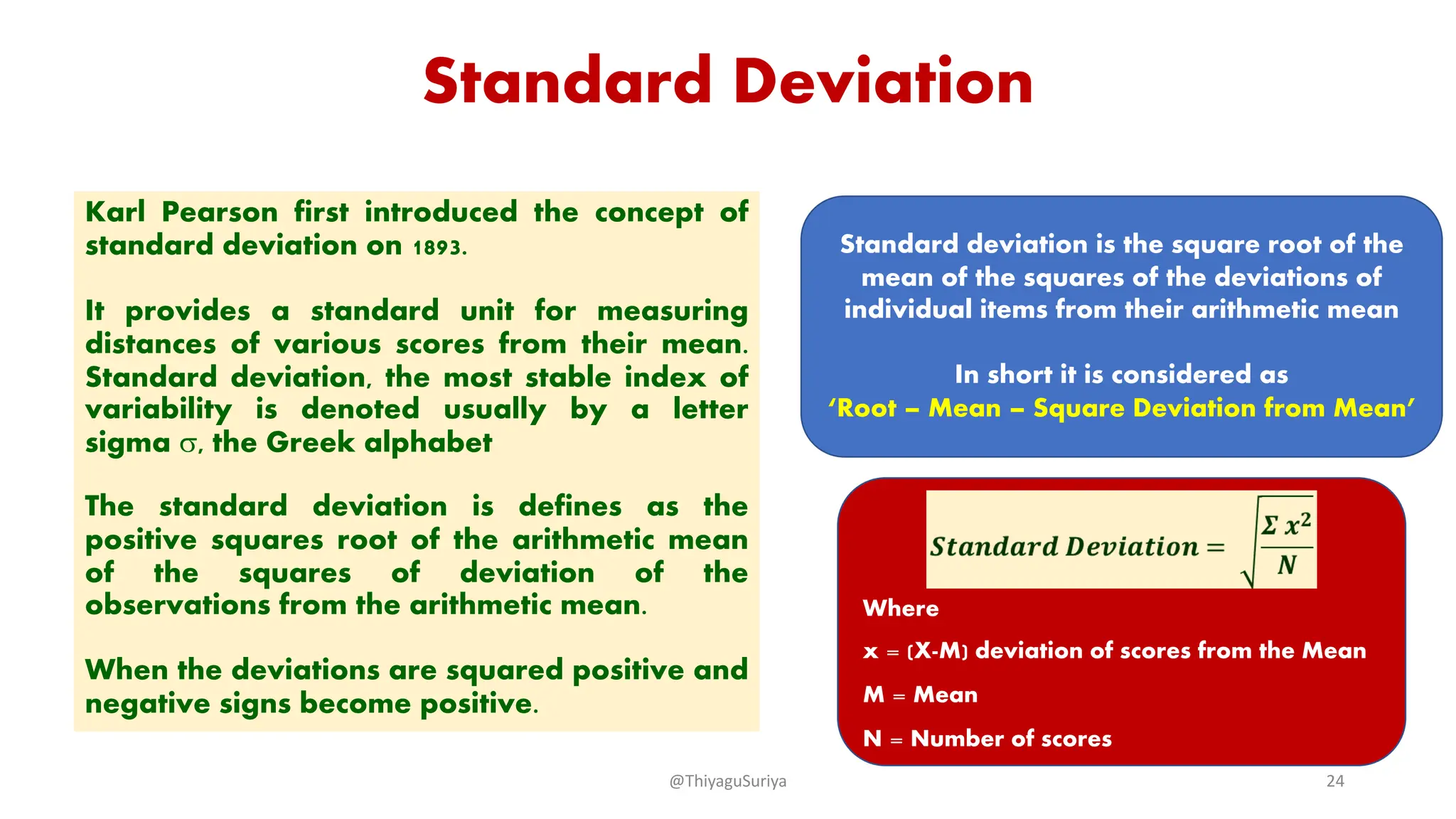
Karl Pearson first introduced the concept of
standard deviation on 1893.
It provides a standard unit for measuring
distances of various scores from their mean.
Standard deviation, the most stable index of
variability is denoted usually by a letter
sigma s, the Greek alphabet
The standard deviation is defines as the
positive squares root of the arithmetic mean
of the squares of deviation of the
observations from the arithmetic mean.
When the deviations are squared positive and
negative signs become positive.
Standard deviation is the square root of the
mean of the squares of the deviations of
individual items from their arithmetic mean
In short it is considered as
‘Root – Mean – Square Deviation from Mean’
Where
x = (X-M) deviation of scores from the Mean
M = Mean
N = Number of scores
@ThiyaguSuriya 24
@ThiyaguSuriya 25
Raw Data Examples:
Find out SD of the following scores: 10, 20, 30, 40, 50, 60, 70
Scores7 Deviation (Raw Score – Mean)
x x2
10 10 – 40 -30 900
20 20 - 40 -20 400
30 30 – 40 -10 100
40 40 – 40 0 0
50 50 - 40 10 100
60 60 – 40 20 400
70 70 - 40 30 900
∑X = 280 2800
Where
x = (X-M) deviation of scores from the Mean
M = Mean
N = Number of scores
20 40 60
20 20
M
@ThiyaguSuriya 26
Group Data
Measures of Dispersion
@ThiyaguSuriya 27
Range
@ThiyaguSuriya 28
Class Internal Frequency
91 – 100 3
81 – 90 7
71 – 80 8
61 – 50 5
51 – 60 4
41 – 50 3
Highest Score = 100
Lowest Score = 41
Range = 100 – 41 = 59
Range
@ThiyaguSuriya 29
Mean
Deviation
@ThiyaguSuriya 30
Average Deviation
@ThiyaguSuriya 31
Standard
Deviation
@ThiyaguSuriya 32
Standard Deviation
@ThiyaguSuriya 33
Quartile
Deviation
@ThiyaguSuriya 34
Quartile Deviation
@ThiyaguSuriya 35
Quartile Deviation
@ThiyaguSuriya 36
Thank You
@ThiyaguSuriya 37
Thank
You
@ThiyaguSuriya 38

Measures of Dispersion and Variability: Range, QD, AD and SD

  • 1.
    Measures of Dispersion/ Variability K.THIYAGU, Assistant Professor, Departmentof Education, Central University of Kerala, Kasaragod @ThiyaguSuriya 1
  • 2.
    Mean ? Set I GroupA: 50, 50, 50, 50 Group B: 20, 80, 40, 60 Set II Group A: 50, 50, 50, 50, 50 Group B: 20, 80, 40, 60, 50 @ThiyaguSuriya 2
  • 3.
    Mean Set I Group A:50, 50, 50, 50 Group B: 20, 80, 40, 60 Set II Group A: 50, 50, 50, 50, 50 Group B: 20, 80, 40, 60, 50 Mean Group A: 50 Group B: 50 Mean Group A: 50 Group B: 50 Is it means Group A = Group B ? @ThiyaguSuriya 3
  • 4.
    Measures of Variability SetI Group A: 50, 50, 50, 50 Group B: 20, 80, 40, 60 Set II Group A: 50, 50, 50, 50, 50 Group B: 20, 80, 40, 60, 50 Mean Group A: 50 Group B: 50 Mean Group A: 50 Group B: 50 Group A š Group B Here, both groups have the same average scores of 50, but a result of examination revels that the two sets of scores differ widely from one another. @ThiyaguSuriya 4
  • 5.
    • Dispersion (alsoknown as Scatter, Spread or Variation) is the state of getting dispersed or spread. • It measures the degree of variation. • Statistical dispersion means the extent to which numerical data is likely to vary about an average value. Set of data has a small value: 1, 2, 2, 3, 3, 4 …and this set has a wider one: 0, 1, 20, 30, 40, 100 @ThiyaguSuriya 5
  • 6.
  • 7.
    Figure. Differences between the twodatasets @ThiyaguSuriya 7
  • 8.
  • 9.
    Measures of Dispersion Instatistics, the measures of dispersion help to interpret the variability of data i.e. to know how much homogenous or heterogenous the data is. In simple terms, it shows how squeezed or scattered the variable is. @ThiyaguSuriya 9
  • 10.
  • 11.
    Absolute Measure of Dispersion Based on SelectedItems Range Inter Quartile Range Based on all Items Mean Deviation Standard Deviation The measures which express the scattering of observation in terms of distances i.e., range, quartile deviation. The measure which expresses the variations in terms of the average of deviations of observations like MD & SD @ThiyaguSuriya 11
  • 12.
    Relative Measure of Dispersion Based on Selected Items Coefficientof Range Coefficient of Quartile Range Based on all Items Coefficient of Mean Deviation Coefficient of Standard Deviation Coefficient of Variation @ThiyaguSuriya 12
  • 13.
    C.D. in termsof Coefficient of dispersion Range C.D. = (Xmax – Xmin) ⁄ (Xmax + Xmin) Quartile Deviation C.D. = (Q3 – Q1) ⁄ (Q3 + Q1) Standard Deviation (S.D.) C.D. = S.D. ⁄ Mean Mean Deviation C.D. = Mean deviation/Average @ThiyaguSuriya 13
  • 14.
    Range A range isthe most common and easily understandable measure of dispersion. It is the difference between two extreme observations of the data set. If X max and X min are the two extreme observations then Range = X max – X min @ThiyaguSuriya 14
  • 15.
  • 16.
    Raw Data -Examples Set 1: 23, 35, 45, 56, 65, 67, 78, 87, 90, Set 2: 5, 7, 9, 15, 17, 19 @ThiyaguSuriya 16
  • 17.
    Raw Data -Examples Set 1: 23, 35, 45, 56, 65, 67, 78, 87, 90, Range =90 - 23 = 67 Set 2: 5, 7, 9, 15, 17, 19 Range = 19 - 5 = 14 @ThiyaguSuriya 17
  • 18.
    Quartile Deviation The quartilesdivide a data set into quarters. The first quartile, (Q1) is the middle number between the smallest number and the median of the data. The second quartile, (Q2) is the median of the data set. The third quartile, (Q3) is the middle number between the median and the largest number. Quartile deviation or semi-inter-quartile deviation is Q = ½ × (Q3 – Q1) @ThiyaguSuriya 18
  • 19.
    ( ) score N Q th á ø Ü ç è Ì+ = 4 1 3 3 score N Q mdn th á ø Ü ç è Ì + = 2 1 ) ( 2 score N Q th á ø Ü ç è Ì + = 4 1 1 The value of Q3 can be obtained by the formula Calculating median we use the formula The value of Q1 can be obtained by the formula 2 1 3 Q Q - QD = Quartile Deviation from the ungrouped data Formula @ThiyaguSuriya 19
  • 20.
  • 21.
    Find the QuartileDeviation 40, 70, 35, 80, 55, 65, 82 Arrange in a decending order or ascending order 82 80 - Q3 70 65 55 40 - Q1 35 N = 7 @ThiyaguSuriya 21
  • 22.
    Average Deviation /Mean Deviation Average deviation is one of the measures of dispersion dealing with all items. AD is defined as the average distance of the scores from the mean of the distribution. It is also called as a mean distribution of MD. Mean deviation is average of the deviation from all the individual scores from their mean. Where X = Individual Scores M = Mean N = Number of scores Where x = (X-M) deviation of scores from the Mean M = Mean N = Number of scores @ThiyaguSuriya 22
  • 23.
    Scores Deviation (RawScore – Mean) x IxI 10 10 – 30 -20 20 20 20 - 30 -10 10 30 30 – 30 0 0 40 40 – 30 10 10 50 50 - 30 20 20 ∑X = 150 ∑IxI = 60 Raw Data: Example: Calculate A.D. from the following Scores: 10, 20, 30, 40, 50 Where x = (X-M) deviation of scores from the Mean M = Mean N = Number of scores 18 30 42 12 12 M @ThiyaguSuriya 23
  • 24.
    Standard Deviation Karl Pearsonfirst introduced the concept of standard deviation on 1893. It provides a standard unit for measuring distances of various scores from their mean. Standard deviation, the most stable index of variability is denoted usually by a letter sigma s, the Greek alphabet The standard deviation is defines as the positive squares root of the arithmetic mean of the squares of deviation of the observations from the arithmetic mean. When the deviations are squared positive and negative signs become positive. Standard deviation is the square root of the mean of the squares of the deviations of individual items from their arithmetic mean In short it is considered as ‘Root – Mean – Square Deviation from Mean’ Where x = (X-M) deviation of scores from the Mean M = Mean N = Number of scores @ThiyaguSuriya 24
  • 25.
  • 26.
    Raw Data Examples: Findout SD of the following scores: 10, 20, 30, 40, 50, 60, 70 Scores7 Deviation (Raw Score – Mean) x x2 10 10 – 40 -30 900 20 20 - 40 -20 400 30 30 – 40 -10 100 40 40 – 40 0 0 50 50 - 40 10 100 60 60 – 40 20 400 70 70 - 40 30 900 ∑X = 280 2800 Where x = (X-M) deviation of scores from the Mean M = Mean N = Number of scores 20 40 60 20 20 M @ThiyaguSuriya 26
  • 27.
    Group Data Measures ofDispersion @ThiyaguSuriya 27
  • 28.
  • 29.
    Class Internal Frequency 91– 100 3 81 – 90 7 71 – 80 8 61 – 50 5 51 – 60 4 41 – 50 3 Highest Score = 100 Lowest Score = 41 Range = 100 – 41 = 59 Range @ThiyaguSuriya 29
  • 30.
  • 31.
  • 32.
  • 33.
  • 34.
  • 35.
  • 36.
  • 37.
  • 38.