
CORRELATION
 NAME: ANJALI AWASTHI
 CLASS: M.SC. – SEM (III)
 SUBJECT: FORENSIC SCIENCE
CORRELATION
Correlation is an analysis used to determine the relationship between two or
more variables.
The measure of correlation is called coefficient of correlation and is denoted
by the symbol ‘r’.
It helps us in finding the degree or extent of quantitative relationship between
two variables.
It does not say anything about the cause and effect relationship between the
two variables.
SIGNIFICANCE OF CORRELATION
It is used to determine the relationship between two variables.
It reduces the range of uncertainty. The predictions based on correlation analysis
are more precise and reliable.
It helps us to estimate the value of dependent variable for the given value of
independent variable.
TYPES OF CORRELATION
 Correlation is described or classified in several different ways such as:
1. Positive and Negative Correlation: Whether correlation is positive (direct) or negative
(inverse) would depend upon the direction of change of the variables. If both the variables
are varying in the same direction i.e., if as one variable is increasing the other, on an
average is also increasing or, if as one variable is decreasing the other, on an average, is
also decreasing, correlation is said to be positive.
If on the other hand, the variable are varying in positive direction, i.e. as one variable is
increasing the other is decreasing or vise versa, and correlation is said to be negative.
2. Liner and Curvilinear (Non-Linear) Correlation.
 Linear Correlation: Correlation is said to be linear when the amount of change in one
variable tends to bear a constant ratio to the amount of change in the other.
 Non-Linear Correlation: The correlation would be non-linear if the amount of change in one
variable does not bear a constant ratio to the amount of change in the other variable.
METHODS OF STUDYING CORRELATION
 Correlation can be studied by any of the following method.
1. Scatter diagram method.
2. Karl Pearson’s coefficient of correlation.
3. Spearman’s coefficient of rank correlation and
4. Concurrent deviation method.
Scatter diagram method
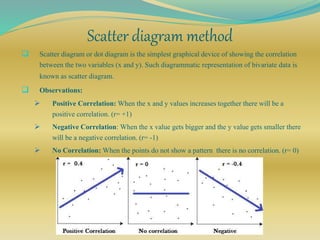
 Scatter diagram or dot diagram is the simplest graphical device of showing the correlation
between the two variables (x and y). Such diagrammatic representation of bivariate data is
known as scatter diagram.
 Observations:
 Positive Correlation: When the x and y values increases together there will be a
positive correlation. (r= +1)
 Negative Correlation: When the x value gets bigger and the y value gets smaller there
will be a negative correlation. (r= -1)
 No Correlation: When the points do not show a pattern there is no correlation. (r= 0)
It is simple and non-
mathematical method
of studying
correlation
It is easy to
understand
Merit of
Scatter
Diagram
Method It gives only a rough
idea of how the two
variable are related.
Exact degree of
correlation between
the two variables can
not be established
by applying this
method.
Demerit
of Scatter
Diagram
Method
Karl Pearson’s Coefficient of Correlation
 It is used universally for describing the degree of correlation between two series .
Formula of computing Pearson’s r is:
Here, x = ( X- X ) ; y= ( Y- Y )
Sx = Standard deviation of x series
Sy = Standard deviation of y series
N = Number of pairs of observation
 Modified version:
Where, x = ( X- X ) ; y= ( Y- Y )
Procedure for computing the correlation coefficient
 Calculate the mean of the two series ‘x’ &’y’
 Calculate the deviations ‘x’ &’y’ in two series from their respective mean.
 Square each deviation of ‘x’ &’y’ then obtain the sum of the squared deviation
i.e.
 Multiply each deviation under x with each deviation under y & obtain the product of ‘xy’.
Then obtain the sum of the product of x , y i.e. Σxy
 Substitute the value in the formula.
Example:
:
It is most
important and
precise
method of
measuring the
relationship of
two variables.
It measures the
direction as
well as the
relationship
between the
two variables.
Merit of
Karl
Pearson’s
Method
The computational
procedure of this
method is difficult
as compared to
other method.
The value of the
coefficient is
affected by
extreme items.
Demerit
of Karl
Pearson’s
Method

Correlation

  • 1.
    CORRELATION  NAME: ANJALIAWASTHI  CLASS: M.SC. – SEM (III)  SUBJECT: FORENSIC SCIENCE
  • 2.
    CORRELATION Correlation is ananalysis used to determine the relationship between two or more variables. The measure of correlation is called coefficient of correlation and is denoted by the symbol ‘r’. It helps us in finding the degree or extent of quantitative relationship between two variables. It does not say anything about the cause and effect relationship between the two variables.
  • 3.
    SIGNIFICANCE OF CORRELATION Itis used to determine the relationship between two variables. It reduces the range of uncertainty. The predictions based on correlation analysis are more precise and reliable. It helps us to estimate the value of dependent variable for the given value of independent variable.
  • 4.
    TYPES OF CORRELATION Correlation is described or classified in several different ways such as: 1. Positive and Negative Correlation: Whether correlation is positive (direct) or negative (inverse) would depend upon the direction of change of the variables. If both the variables are varying in the same direction i.e., if as one variable is increasing the other, on an average is also increasing or, if as one variable is decreasing the other, on an average, is also decreasing, correlation is said to be positive. If on the other hand, the variable are varying in positive direction, i.e. as one variable is increasing the other is decreasing or vise versa, and correlation is said to be negative.
  • 5.
    2. Liner andCurvilinear (Non-Linear) Correlation.  Linear Correlation: Correlation is said to be linear when the amount of change in one variable tends to bear a constant ratio to the amount of change in the other.  Non-Linear Correlation: The correlation would be non-linear if the amount of change in one variable does not bear a constant ratio to the amount of change in the other variable.
  • 6.
    METHODS OF STUDYINGCORRELATION  Correlation can be studied by any of the following method. 1. Scatter diagram method. 2. Karl Pearson’s coefficient of correlation. 3. Spearman’s coefficient of rank correlation and 4. Concurrent deviation method.
  • 7.
    Scatter diagram method Scatter diagram or dot diagram is the simplest graphical device of showing the correlation between the two variables (x and y). Such diagrammatic representation of bivariate data is known as scatter diagram.  Observations:  Positive Correlation: When the x and y values increases together there will be a positive correlation. (r= +1)  Negative Correlation: When the x value gets bigger and the y value gets smaller there will be a negative correlation. (r= -1)  No Correlation: When the points do not show a pattern there is no correlation. (r= 0)
  • 8.
    It is simpleand non- mathematical method of studying correlation It is easy to understand Merit of Scatter Diagram Method It gives only a rough idea of how the two variable are related. Exact degree of correlation between the two variables can not be established by applying this method. Demerit of Scatter Diagram Method
  • 9.
    Karl Pearson’s Coefficientof Correlation  It is used universally for describing the degree of correlation between two series . Formula of computing Pearson’s r is: Here, x = ( X- X ) ; y= ( Y- Y ) Sx = Standard deviation of x series Sy = Standard deviation of y series N = Number of pairs of observation  Modified version: Where, x = ( X- X ) ; y= ( Y- Y )
  • 10.
    Procedure for computingthe correlation coefficient  Calculate the mean of the two series ‘x’ &’y’  Calculate the deviations ‘x’ &’y’ in two series from their respective mean.  Square each deviation of ‘x’ &’y’ then obtain the sum of the squared deviation i.e.  Multiply each deviation under x with each deviation under y & obtain the product of ‘xy’. Then obtain the sum of the product of x , y i.e. Σxy  Substitute the value in the formula.
  • 11.
  • 12.
    It is most importantand precise method of measuring the relationship of two variables. It measures the direction as well as the relationship between the two variables. Merit of Karl Pearson’s Method The computational procedure of this method is difficult as compared to other method. The value of the coefficient is affected by extreme items. Demerit of Karl Pearson’s Method