Tetrachoric
Correlation
rt.
K.THIYAGU,
Assistant Professor,
Department of Education,
Central University of Kerala, Kasaragod
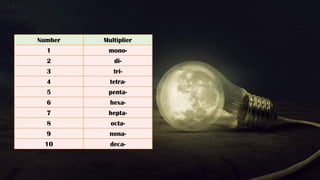
Number Multiplier
1 mono-
2 di-
3 tri-
4 tetra-
5 penta-
6 hexa-
7 hepta-
8 octa-
9 nona-
10 deca-
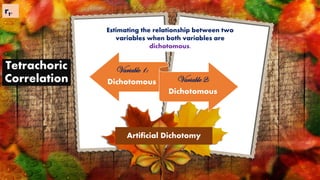
Tetrachoric
Correlation
Estimating the relationship between two
variables when both variables are
dichotomous.
Variable 1:
Dichotomous Variable 2:
Dichotomous
rt.
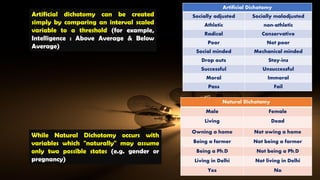
Artificial Dichotomy
Socially adjusted Socially maladjusted
Athletic non-athletic
Radical Conservative
Poor Not poor
Social minded Mechanical minded
Drop outs Stay-ins
Successful Unsuccessful
Moral Immoral
Pass Fail
Natural Dichotomy
Male Female
Living Dead
Owning a home Not owing a home
Being a farmer Not being a farmer
Being a Ph.D Not being a Ph.D
Living in Delhi Not living in Delhi
Yes No
While Natural Dichotomy occurs with
variables which "naturally" may assume
only two possible states (e.g. gender or
pregnancy)
Artificial dichotomy can be created
simply by comparing an interval scaled
variable to a threshold (for example,
Intelligence : Above Average & Below
Average)
Tetrachoric correlation is used to
measure rater agreement for
binary data; Binary data is data
with two possible answers —
usually right or wrong.
The tetrachoric correlation
estimates what the correlation
would be if measured on a
continuous scale.
The Tetrachoric Correlation Coefficient rtet
(sometimes written as r* or rt) tells us
how strong (or weak) the association is
between ratings for two raters.
Eg:
To study the relationship
between intelligence and
emotional maturity,
The first variable, ‘Intelligence’
may be dichotomised as above
average and below average
and the other variable
‘emotional maturity’, as
emotionally mature and
emotionally immature.
Tetrachoric Correlation
is suitable for situations in
which neither of the
two variables
Can be Measured
in terms of scores
But
both the variables
Can be Separated
in terms of
Two Categories.
Above Average
&
Below Average
Emotionally Mature
&
Emotionally immature
Example:
If we want to study the
relationship between
‘adjustment’ and ‘success’
in a job, we can
dichotomize the variables
as adjusted-maladjusted
and success-failure.
Adjusted Maladjusted
Success (A) (B)
Failure (C) (D)
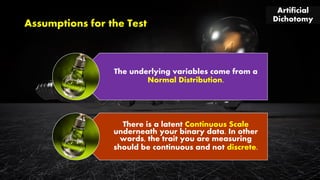
The underlying variables come from a
Normal Distribution.
There is a latent Continuous Scale
underneath your binary data. In other
words, the trait you are measuring
should be continuous and not discrete.
Assumptions for the Test
Artificial
Dichotomy
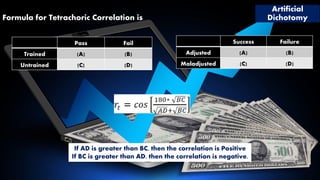
Pass Fail
Trained (A) (B)
Untrained (C) (D)
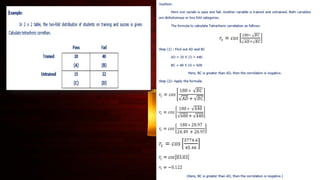
Formula for Tetrachoric Correlation is
If AD is greater than BC, then the correlation is Positive
If BC is greater than AD, then the correlation is negative.
Artificial
Dichotomy
Success Failure
Adjusted (A) (B)
Maladjusted (C) (D)
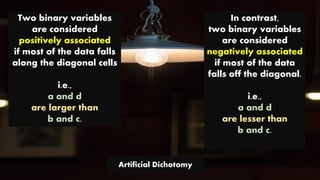
Two binary variables
are considered
positively associated
if most of the data falls
along the diagonal cells
i.e.,
a and d
are larger than
b and c.
In contrast,
two binary variables
are considered
negatively associated
if most of the data
falls off the diagonal.
i.e.,
a and d
are lesser than
b and c.
Artificial Dichotomy
Types of Correlation Coefficients
Correlation Coefficient Types of Scales
Pearson product-moment Both Scales - Interval (or) Ratio
Spearman rank-order Both Scales - Ordinal
Phi Both scales are Naturally Dichotomous (nominal)
Tetrachoric Both scales are Artificially Dichotomous (nominal)
Point-biserial
One scale Naturally Dichotomous (nominal),
one scale interval (or ratio)
Biserial
One scale Artificially Dichotomous (nominal),
one scale interval (or ratio)
Gamma One scale nominal, one scale ordinal
Thank You
K.THIYAGU, Assistant
Professor, Department of Education,
Central University of Kerala, Kasaragod

Tetrachoric Correlation - Thiyagu

  • 1.
    Tetrachoric Correlation rt. K.THIYAGU, Assistant Professor, Department ofEducation, Central University of Kerala, Kasaragod
  • 2.
    Number Multiplier 1 mono- 2di- 3 tri- 4 tetra- 5 penta- 6 hexa- 7 hepta- 8 octa- 9 nona- 10 deca-
  • 3.
    Tetrachoric Correlation Estimating the relationshipbetween two variables when both variables are dichotomous. Variable 1: Dichotomous Variable 2: Dichotomous rt. Artificial Dichotomy
  • 4.
    Artificial Dichotomy Socially adjustedSocially maladjusted Athletic non-athletic Radical Conservative Poor Not poor Social minded Mechanical minded Drop outs Stay-ins Successful Unsuccessful Moral Immoral Pass Fail Natural Dichotomy Male Female Living Dead Owning a home Not owing a home Being a farmer Not being a farmer Being a Ph.D Not being a Ph.D Living in Delhi Not living in Delhi Yes No While Natural Dichotomy occurs with variables which "naturally" may assume only two possible states (e.g. gender or pregnancy) Artificial dichotomy can be created simply by comparing an interval scaled variable to a threshold (for example, Intelligence : Above Average & Below Average)
  • 5.
    Tetrachoric correlation isused to measure rater agreement for binary data; Binary data is data with two possible answers — usually right or wrong. The tetrachoric correlation estimates what the correlation would be if measured on a continuous scale. The Tetrachoric Correlation Coefficient rtet (sometimes written as r* or rt) tells us how strong (or weak) the association is between ratings for two raters.
  • 6.
    Eg: To study therelationship between intelligence and emotional maturity, The first variable, ‘Intelligence’ may be dichotomised as above average and below average and the other variable ‘emotional maturity’, as emotionally mature and emotionally immature. Tetrachoric Correlation is suitable for situations in which neither of the two variables Can be Measured in terms of scores But both the variables Can be Separated in terms of Two Categories. Above Average & Below Average Emotionally Mature & Emotionally immature
  • 7.
    Example: If we wantto study the relationship between ‘adjustment’ and ‘success’ in a job, we can dichotomize the variables as adjusted-maladjusted and success-failure. Adjusted Maladjusted Success (A) (B) Failure (C) (D)
  • 8.
    The underlying variablescome from a Normal Distribution. There is a latent Continuous Scale underneath your binary data. In other words, the trait you are measuring should be continuous and not discrete. Assumptions for the Test Artificial Dichotomy
  • 9.
    Pass Fail Trained (A)(B) Untrained (C) (D) Formula for Tetrachoric Correlation is If AD is greater than BC, then the correlation is Positive If BC is greater than AD, then the correlation is negative. Artificial Dichotomy Success Failure Adjusted (A) (B) Maladjusted (C) (D)
  • 10.
    Two binary variables areconsidered positively associated if most of the data falls along the diagonal cells i.e., a and d are larger than b and c. In contrast, two binary variables are considered negatively associated if most of the data falls off the diagonal. i.e., a and d are lesser than b and c. Artificial Dichotomy
  • 13.
    Types of CorrelationCoefficients Correlation Coefficient Types of Scales Pearson product-moment Both Scales - Interval (or) Ratio Spearman rank-order Both Scales - Ordinal Phi Both scales are Naturally Dichotomous (nominal) Tetrachoric Both scales are Artificially Dichotomous (nominal) Point-biserial One scale Naturally Dichotomous (nominal), one scale interval (or ratio) Biserial One scale Artificially Dichotomous (nominal), one scale interval (or ratio) Gamma One scale nominal, one scale ordinal
  • 14.
    Thank You K.THIYAGU, Assistant Professor,Department of Education, Central University of Kerala, Kasaragod