Correlation
Chapter 15
Correlation
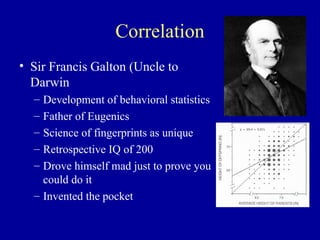
• Sir Francis Galton (Uncle to
Darwin
– Development of behavioral statistics
– Father of Eugenics
– Science of fingerprints as unique
– Retrospective IQ of 200
– Drove himself mad just to prove you
could do it
– Invented the pocket
Defining Correlation
• Co-variation or co-relation between two
variables
• These variables change together
• Usually scale (interval or ratio) variables
• http://www.youtube.com/watch?v=ahp7QhbB8G4
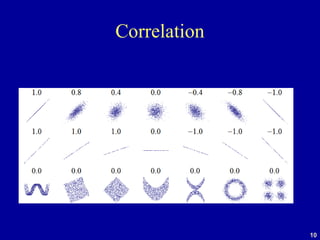
Correlation Coefficient
• A statistic that quantifies a relation between
two variables
• Can be either positive or negative
• Falls between -1.00 and 1.00
• The value of the number (not the sign)
indicates the strength of the relation
Y
X
Y
X
Y
Y
X
X
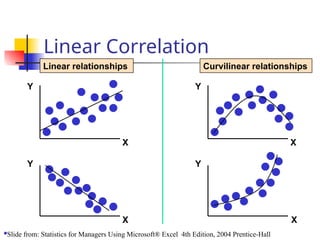
Linear relationships Curvilinear relationships
Linear Correlation
Slide from: Statistics for Managers Using Microsoft® Excel 4th Edition, 2004 Prentice-Hall
Y
X
Y
X
Y
Y
X
X
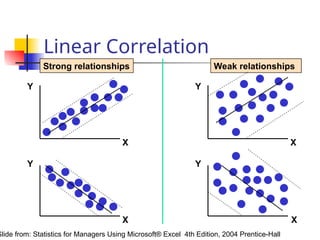
Strong relationships Weak relationships
Linear Correlation
Slide from: Statistics for Managers Using Microsoft® Excel 4th Edition, 2004 Prentice-Hall
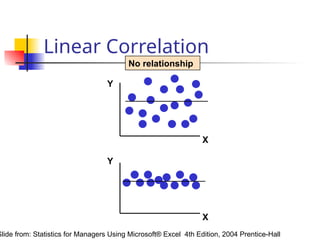
Linear Correlation
Y
X
Y
X
No relationship
Slide from: Statistics for Managers Using Microsoft® Excel 4th Edition, 2004 Prentice-Hall
10
Correlation
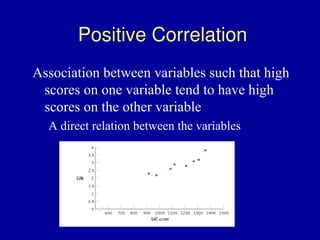
Positive Correlation
Association between variables such that high
scores on one variable tend to have high
scores on the other variable
A direct relation between the variables
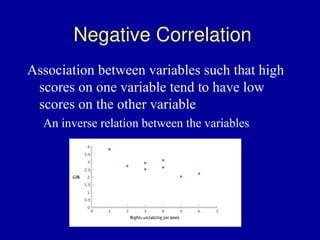
Negative Correlation
Association between variables such that high
scores on one variable tend to have low
scores on the other variable
An inverse relation between the variables
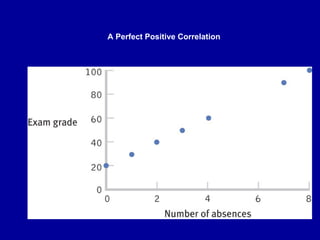
A Perfect Positive Correlation
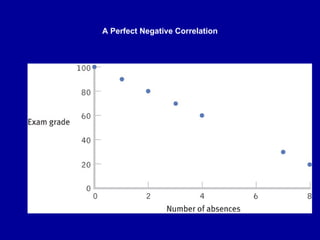
A Perfect Negative Correlation
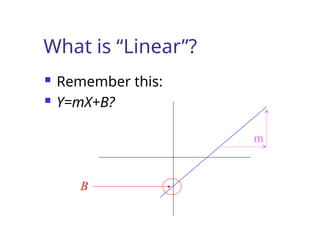
What is “Linear”?
 Remember this:
 Y=mX+B?
B
m
What’s Slope?
A slope of 2 means that every 1-unit change in
X yields a 2-unit change in Y.
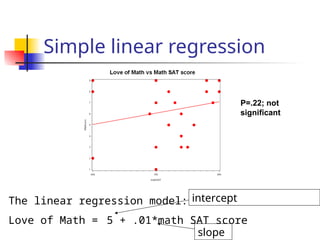
Simple linear regression
The linear regression model:
Love of Math = 5 + .01*math SAT score
intercept
slope
P=.22; not
significant
Check Your Learning
• Which is stronger?
– A correlation of 0.25 or -0.74?
Misleading Correlations
• Something to think about
– There is a 0.91 correlation between ice cream
consumption and drowning deaths.
• Does eating ice cream cause drowning?
• Does grief cause us to eat more ice cream?
21
Correlation
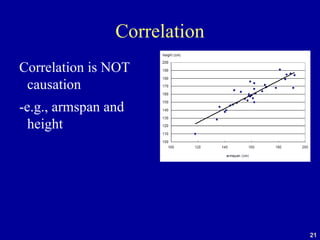
Correlation is NOT
causation
-e.g., armspan and
height
The Limitations of Correlation
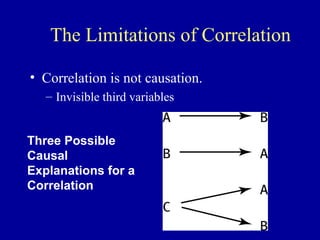
• Correlation is not causation.
– Invisible third variables
Three Possible
Causal
Explanations for a
Correlation
The Limitations of Correlation,
cont.
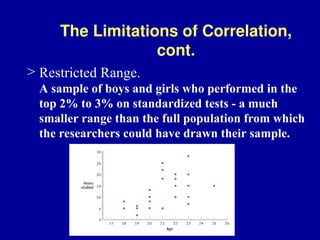
> Restricted Range.
A sample of boys and girls who performed in the
top 2% to 3% on standardized tests - a much
smaller range than the full population from which
the researchers could have drawn their sample.
> Restricted Range, cont.
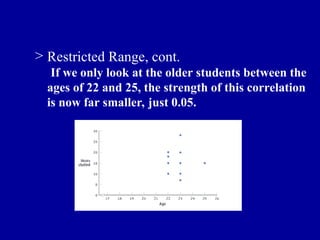
If we only look at the older students between the
ages of 22 and 25, the strength of this correlation
is now far smaller, just 0.05.
The Limitations of Correlation,
cont.
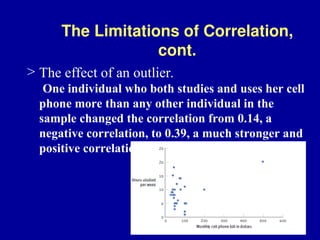
> The effect of an outlier.
One individual who both studies and uses her cell
phone more than any other individual in the
sample changed the correlation from 0.14, a
negative correlation, to 0.39, a much stronger and
positive correlation!
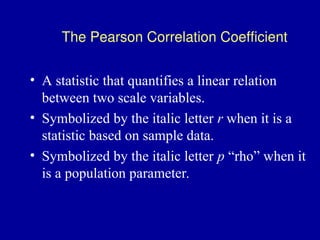
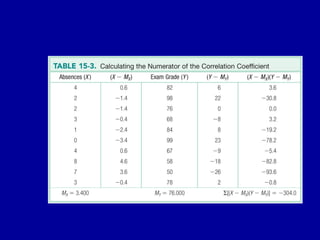
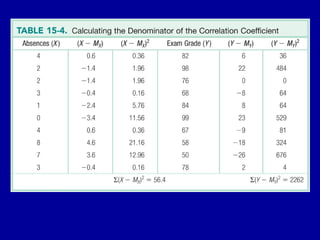
The Pearson Correlation Coefficient
• A statistic that quantifies a linear relation
between two scale variables.
• Symbolized by the italic letter r when it is a
statistic based on sample data.
• Symbolized by the italic letter p “rho” when it
is a population parameter.
• Pearson correlation coefficient
– r
– Linear relationship
)
)(
(
)]
)(
[(
Y
X
Y
X
SS
SS
M
Y
M
X
r
 


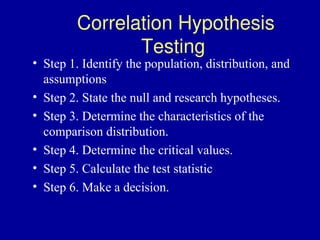
Correlation Hypothesis
Testing
• Step 1. Identify the population, distribution, and
assumptions
• Step 2. State the null and research hypotheses.
• Step 3. Determine the characteristics of the
comparison distribution.
• Step 4. Determine the critical values.
• Step 5. Calculate the test statistic
• Step 6. Make a decision.
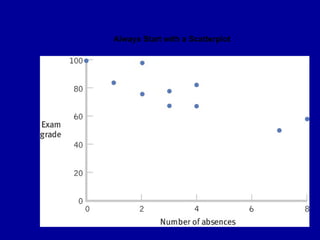
Always Start with a Scatterplot
Correlation and Psychometrics
• Psychometrics is used in the development of
tests and measures.
• Psychometricians use correlation to examine
two important aspects of the development of
measures—reliability and validity.
• A reliable measure is one that is consistent.
• One particular type of reliability is test–retest
reliability.
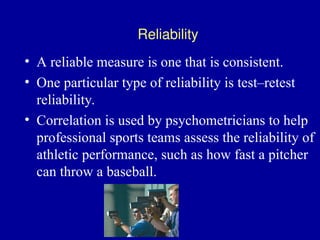
• Correlation is used by psychometricians to help
professional sports teams assess the reliability of
athletic performance, such as how fast a pitcher
can throw a baseball.
Reliability
Validity
• A valid measure is one that measures what
it was designed or intended to measure.
• Correlation is used to calculate validity,
often by correlating a new measure with
existing measures known to assess the
variable of interest.
• Correlation can also be used to establish
the validity of a personality test.
• Establishing validity is usually much
more difficult than establishing
reliability.
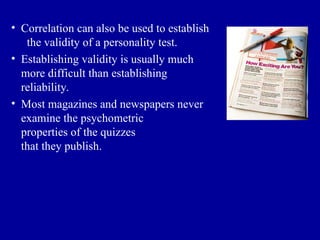
• Most magazines and newspapers never
examine the psychometric
properties of the quizzes
that they publish.
Partial Correlation
• A technique that quantifies the degree of
association between two variables after
statistically removing the association of a third
variable with both of those two variables.
• Allows us to quantify the relation between two
variables, controlling for the correlation of
each of these variables with a third related
variable.
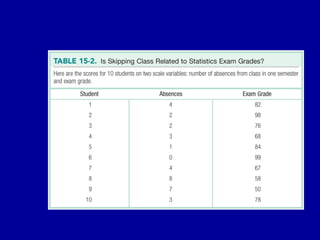
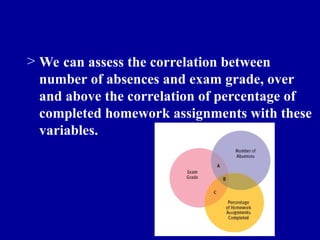
> We can assess the correlation between
number of absences and exam grade, over
and above the correlation of percentage of
completed homework assignments with these
variables.
Partial Correlation
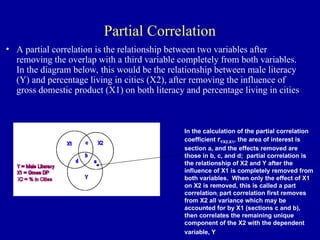
• A partial correlation is the relationship between two variables after
removing the overlap with a third variable completely from both variables.
In the diagram below, this would be the relationship between male literacy
(Y) and percentage living in cities (X2), after removing the influence of
gross domestic product (X1) on both literacy and percentage living in cities
In the calculation of the partial correlation
coefficient rYX2.X1, the area of interest is
section a, and the effects removed are
those in b, c, and d; partial correlation is
the relationship of X2 and Y after the
influence of X1 is completely removed from
both variables. When only the effect of X1
on X2 is removed, this is called a part
correlation; part correlation first removes
from X2 all variance which may be
accounted for by X1 (sections c and b),
then correlates the remaining unique
component of the X2 with the dependent
variable, Y
Statistical Control
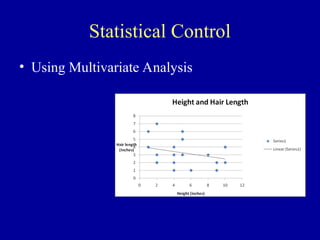
• Using Multivariate Analysis
Statistical Control
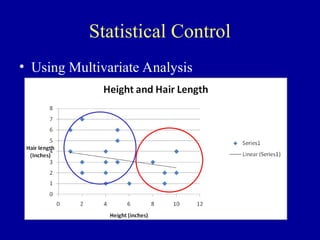
• Using Multivariate Analysis
Simpson’s Paradox
• In each of these examples, the bivariate
analysis (cross-tabulation or correlation) gave
misleading results
• Introducing another variable gave a better
understanding of the data
– It even reversed the initial conclusions
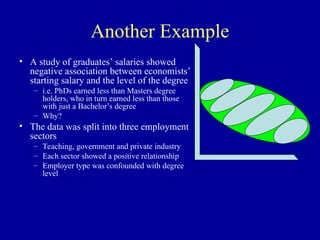
Another Example
• A study of graduates’ salaries showed
negative association between economists’
starting salary and the level of the degree
– i.e. PhDs earned less than Masters degree
holders, who in turn earned less than those
with just a Bachelor’s degree
– Why?
• The data was split into three employment
sectors
– Teaching, government and private industry
– Each sector showed a positive relationship
– Employer type was confounded with degree
level

lecture-10----Correlation-and-Regression.ppt

  • 1.
  • 2.
    Correlation • Sir FrancisGalton (Uncle to Darwin – Development of behavioral statistics – Father of Eugenics – Science of fingerprints as unique – Retrospective IQ of 200 – Drove himself mad just to prove you could do it – Invented the pocket
  • 3.
    Defining Correlation • Co-variationor co-relation between two variables • These variables change together • Usually scale (interval or ratio) variables • http://www.youtube.com/watch?v=ahp7QhbB8G4
  • 6.
    Correlation Coefficient • Astatistic that quantifies a relation between two variables • Can be either positive or negative • Falls between -1.00 and 1.00 • The value of the number (not the sign) indicates the strength of the relation
  • 7.
    Y X Y X Y Y X X Linear relationships Curvilinearrelationships Linear Correlation Slide from: Statistics for Managers Using Microsoft® Excel 4th Edition, 2004 Prentice-Hall
  • 8.
    Y X Y X Y Y X X Strong relationships Weakrelationships Linear Correlation Slide from: Statistics for Managers Using Microsoft® Excel 4th Edition, 2004 Prentice-Hall
  • 9.
    Linear Correlation Y X Y X No relationship Slidefrom: Statistics for Managers Using Microsoft® Excel 4th Edition, 2004 Prentice-Hall
  • 10.
  • 11.
    Positive Correlation Association betweenvariables such that high scores on one variable tend to have high scores on the other variable A direct relation between the variables
  • 12.
    Negative Correlation Association betweenvariables such that high scores on one variable tend to have low scores on the other variable An inverse relation between the variables
  • 13.
    A Perfect PositiveCorrelation
  • 14.
    A Perfect NegativeCorrelation
  • 15.
    What is “Linear”? Remember this:  Y=mX+B? B m
  • 16.
    What’s Slope? A slopeof 2 means that every 1-unit change in X yields a 2-unit change in Y.
  • 17.
    Simple linear regression Thelinear regression model: Love of Math = 5 + .01*math SAT score intercept slope P=.22; not significant
  • 19.
    Check Your Learning •Which is stronger? – A correlation of 0.25 or -0.74?
  • 20.
    Misleading Correlations • Somethingto think about – There is a 0.91 correlation between ice cream consumption and drowning deaths. • Does eating ice cream cause drowning? • Does grief cause us to eat more ice cream?
  • 21.
  • 22.
    The Limitations ofCorrelation • Correlation is not causation. – Invisible third variables Three Possible Causal Explanations for a Correlation
  • 23.
    The Limitations ofCorrelation, cont. > Restricted Range. A sample of boys and girls who performed in the top 2% to 3% on standardized tests - a much smaller range than the full population from which the researchers could have drawn their sample.
  • 24.
    > Restricted Range,cont. If we only look at the older students between the ages of 22 and 25, the strength of this correlation is now far smaller, just 0.05.
  • 25.
    The Limitations ofCorrelation, cont. > The effect of an outlier. One individual who both studies and uses her cell phone more than any other individual in the sample changed the correlation from 0.14, a negative correlation, to 0.39, a much stronger and positive correlation!
  • 26.
    The Pearson CorrelationCoefficient • A statistic that quantifies a linear relation between two scale variables. • Symbolized by the italic letter r when it is a statistic based on sample data. • Symbolized by the italic letter p “rho” when it is a population parameter.
  • 27.
    • Pearson correlationcoefficient – r – Linear relationship ) )( ( )] )( [( Y X Y X SS SS M Y M X r    
  • 28.
    Correlation Hypothesis Testing • Step1. Identify the population, distribution, and assumptions • Step 2. State the null and research hypotheses. • Step 3. Determine the characteristics of the comparison distribution. • Step 4. Determine the critical values. • Step 5. Calculate the test statistic • Step 6. Make a decision.
  • 30.
    Always Start witha Scatterplot
  • 33.
    Correlation and Psychometrics •Psychometrics is used in the development of tests and measures. • Psychometricians use correlation to examine two important aspects of the development of measures—reliability and validity.
  • 34.
    • A reliablemeasure is one that is consistent. • One particular type of reliability is test–retest reliability. • Correlation is used by psychometricians to help professional sports teams assess the reliability of athletic performance, such as how fast a pitcher can throw a baseball. Reliability
  • 35.
    Validity • A validmeasure is one that measures what it was designed or intended to measure. • Correlation is used to calculate validity, often by correlating a new measure with existing measures known to assess the variable of interest.
  • 36.
    • Correlation canalso be used to establish the validity of a personality test. • Establishing validity is usually much more difficult than establishing reliability. • Most magazines and newspapers never examine the psychometric properties of the quizzes that they publish.
  • 37.
    Partial Correlation • Atechnique that quantifies the degree of association between two variables after statistically removing the association of a third variable with both of those two variables. • Allows us to quantify the relation between two variables, controlling for the correlation of each of these variables with a third related variable.
  • 38.
    > We canassess the correlation between number of absences and exam grade, over and above the correlation of percentage of completed homework assignments with these variables.
  • 39.
    Partial Correlation • Apartial correlation is the relationship between two variables after removing the overlap with a third variable completely from both variables. In the diagram below, this would be the relationship between male literacy (Y) and percentage living in cities (X2), after removing the influence of gross domestic product (X1) on both literacy and percentage living in cities In the calculation of the partial correlation coefficient rYX2.X1, the area of interest is section a, and the effects removed are those in b, c, and d; partial correlation is the relationship of X2 and Y after the influence of X1 is completely removed from both variables. When only the effect of X1 on X2 is removed, this is called a part correlation; part correlation first removes from X2 all variance which may be accounted for by X1 (sections c and b), then correlates the remaining unique component of the X2 with the dependent variable, Y
  • 40.
    Statistical Control • UsingMultivariate Analysis
  • 41.
    Statistical Control • UsingMultivariate Analysis
  • 42.
    Simpson’s Paradox • Ineach of these examples, the bivariate analysis (cross-tabulation or correlation) gave misleading results • Introducing another variable gave a better understanding of the data – It even reversed the initial conclusions
  • 43.
    Another Example • Astudy of graduates’ salaries showed negative association between economists’ starting salary and the level of the degree – i.e. PhDs earned less than Masters degree holders, who in turn earned less than those with just a Bachelor’s degree – Why? • The data was split into three employment sectors – Teaching, government and private industry – Each sector showed a positive relationship – Employer type was confounded with degree level