Ocean Floor Topography
Prof. Liwayway Memije-Cruz
Ocean Floor Topography
 the study of numerous landforms that exist on
or below the earth.
 refers to the different forms in which the
ocean floor bottom can exist
 is similar to the ground topography with
features such as valleys, mountains, and
plateaus.
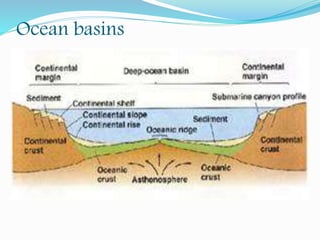
 it starts with the Outer Continental Shelf
followed by the Continental Slopes, and
subsequently the Ocean Floor.
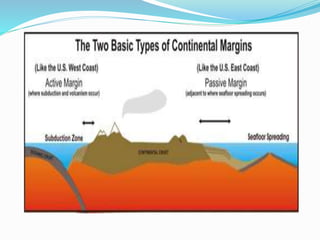
Passive Continental Margin
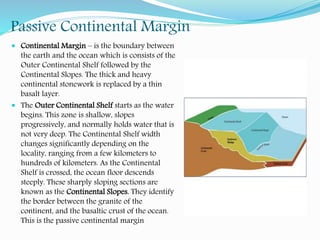
 Continental Margin – is the boundary between
the earth and the ocean which is consists of the
Outer Continental Shelf followed by the
Continental Slopes. The thick and heavy
continental stonework is replaced by a thin
basalt layer.
 The Outer Continental Shelf starts as the water
begins. This zone is shallow, slopes
progressively, and normally holds water that is
not very deep. The Continental Shelf width
changes significantly depending on the
locality, ranging from a few kilometers to
hundreds of kilometers. As the Continental
Shelf is crossed, the ocean floor descends
steeply. These sharply sloping sections are
known as the Continental Slopes. They identify
the border between the granite of the
continent, and the basaltic crust of the ocean.
This is the passive continental margin
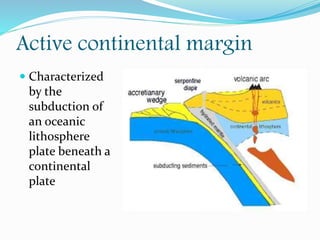
Active continental margin
 Characterized
by the
subduction of
an oceanic
lithosphere
plate beneath a
continental
plate
Oceanic Divisions
 Deep valleys have been observed
in the Continental Slopes which
have been created due to the
earthquakes, or have been eroded
by violent ocean currents.
 The divisions of the ocean water
according to depth are known as
Abyssal Zones. Each layer has its
own characteristic features of
pressure, temperature, salinity
and biodiversity. The deepest
oceanic zone is the hadalpelagic
zone that lies between 6,000–
11,000 meters.
Ocean basins
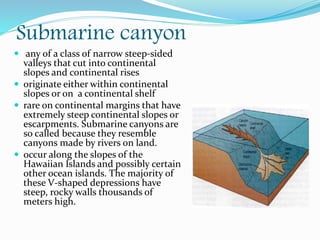
Submarine canyon
 any of a class of narrow steep-sided
valleys that cut into continental
slopes and continental rises
 originate either within continental
slopes or on a continental shelf
 rare on continental margins that have
extremely steep continental slopes or
escarpments. Submarine canyons are
so called because they resemble
canyons made by rivers on land.
 occur along the slopes of the
Hawaiian Islands and possibly certain
other ocean islands. The majority of
these V-shaped depressions have
steep, rocky walls thousands of
meters high.
Ocean currents
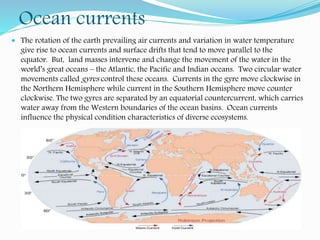
 The rotation of the earth prevailing air currents and variation in water temperature
give rise to ocean currents and surface drifts that tend to move parallel to the
equator. But, land masses intervene and change the movement of the water in the
world’s great oceans – the Atlantic, the Pacific and Indian oceans. Two circular water
movements called gyres control these oceans. Currents in the gyre move clockwise in
the Northern Hemisphere while current in the Southern Hemisphere move counter
clockwise. The two gyres are separated by an equatorial countercurrent, which carries
water away from the Western boundaries of the ocean basins. Ocean currents
influence the physical condition characteristics of diverse ecosystems.
Coriolis Effect
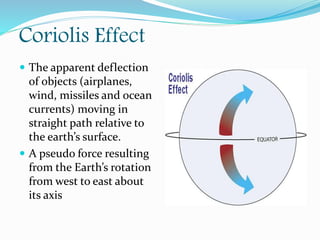
 The apparent deflection
of objects (airplanes,
wind, missiles and ocean
currents) moving in
straight path relative to
the earth’s surface.
 A pseudo force resulting
from the Earth’s rotation
from west to east about
its axis
Tidal currents
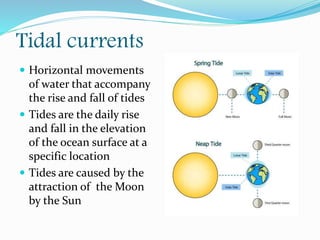
 Horizontal movements
of water that accompany
the rise and fall of tides
 Tides are the daily rise
and fall in the elevation
of the ocean surface at a
specific location
 Tides are caused by the
attraction of the Moon
by the Sun
Ocean waves
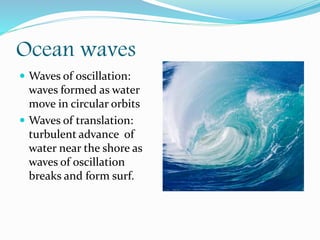
 Waves of oscillation:
waves formed as water
move in circular orbits
 Waves of translation:
turbulent advance of
water near the shore as
waves of oscillation
breaks and form surf.
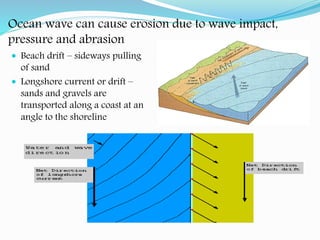
Ocean wave can cause erosion due to wave impact,
pressure and abrasion
 Beach drift – sideways pulling
of sand
 Longshore current or drift –
sands and gravels are
transported along a coast at an
angle to the shoreline

Ocean floor topography

  • 1.
    Ocean Floor Topography Prof.Liwayway Memije-Cruz
  • 2.
    Ocean Floor Topography the study of numerous landforms that exist on or below the earth.  refers to the different forms in which the ocean floor bottom can exist  is similar to the ground topography with features such as valleys, mountains, and plateaus.  it starts with the Outer Continental Shelf followed by the Continental Slopes, and subsequently the Ocean Floor.
  • 3.
    Passive Continental Margin Continental Margin – is the boundary between the earth and the ocean which is consists of the Outer Continental Shelf followed by the Continental Slopes. The thick and heavy continental stonework is replaced by a thin basalt layer.  The Outer Continental Shelf starts as the water begins. This zone is shallow, slopes progressively, and normally holds water that is not very deep. The Continental Shelf width changes significantly depending on the locality, ranging from a few kilometers to hundreds of kilometers. As the Continental Shelf is crossed, the ocean floor descends steeply. These sharply sloping sections are known as the Continental Slopes. They identify the border between the granite of the continent, and the basaltic crust of the ocean. This is the passive continental margin
  • 4.
    Active continental margin Characterized by the subduction of an oceanic lithosphere plate beneath a continental plate
  • 6.
    Oceanic Divisions  Deepvalleys have been observed in the Continental Slopes which have been created due to the earthquakes, or have been eroded by violent ocean currents.  The divisions of the ocean water according to depth are known as Abyssal Zones. Each layer has its own characteristic features of pressure, temperature, salinity and biodiversity. The deepest oceanic zone is the hadalpelagic zone that lies between 6,000– 11,000 meters.
  • 7.
  • 8.
    Submarine canyon  anyof a class of narrow steep-sided valleys that cut into continental slopes and continental rises  originate either within continental slopes or on a continental shelf  rare on continental margins that have extremely steep continental slopes or escarpments. Submarine canyons are so called because they resemble canyons made by rivers on land.  occur along the slopes of the Hawaiian Islands and possibly certain other ocean islands. The majority of these V-shaped depressions have steep, rocky walls thousands of meters high.
  • 9.
    Ocean currents  Therotation of the earth prevailing air currents and variation in water temperature give rise to ocean currents and surface drifts that tend to move parallel to the equator. But, land masses intervene and change the movement of the water in the world’s great oceans – the Atlantic, the Pacific and Indian oceans. Two circular water movements called gyres control these oceans. Currents in the gyre move clockwise in the Northern Hemisphere while current in the Southern Hemisphere move counter clockwise. The two gyres are separated by an equatorial countercurrent, which carries water away from the Western boundaries of the ocean basins. Ocean currents influence the physical condition characteristics of diverse ecosystems.
  • 10.
    Coriolis Effect  Theapparent deflection of objects (airplanes, wind, missiles and ocean currents) moving in straight path relative to the earth’s surface.  A pseudo force resulting from the Earth’s rotation from west to east about its axis
  • 11.
    Tidal currents  Horizontalmovements of water that accompany the rise and fall of tides  Tides are the daily rise and fall in the elevation of the ocean surface at a specific location  Tides are caused by the attraction of the Moon by the Sun
  • 12.
    Ocean waves  Wavesof oscillation: waves formed as water move in circular orbits  Waves of translation: turbulent advance of water near the shore as waves of oscillation breaks and form surf.
  • 13.
    Ocean wave cancause erosion due to wave impact, pressure and abrasion  Beach drift – sideways pulling of sand  Longshore current or drift – sands and gravels are transported along a coast at an angle to the shoreline