Oceans
- Vast bodies of salt water that separate the
continents.
- They cover about 71% of the earth’s surface
and hold over 97% of all the water on the
planet.
- Absorbs sun’s heat, making earth’s climate
more uniform compared to other planets
- Home to animal and plant life
- -Most of the oxygen in our atmosphere
comes from photosynthetic organisms
living in the oceans
- We need to exercise good and wise
dominion of the ocean
Scientists who study the ocean
• Oceanographers
• - marine scientists and engineers who work to better
understand and use the ocean
• Marine biologists
• -investigate the plant and animal life in the ocean
• Meteorologist
• - study the influence of the oceans on weather and climate
• Chemists
• -analyze the distribution of various elements and
compounds in the oceans and the ways those chemicals
affect ocean processes
• Physicists
• -model the distribution of energy in the oceans and the
motion of its great currents
• Marine Engineers
• -develop methods and vehicles to investigate and use
oceans, design ways to produce potable water and
electricity from seawater.
13.1
Ocean Basins
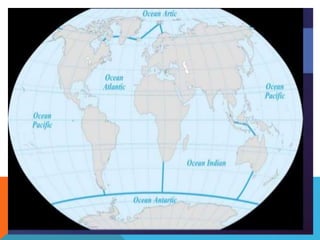
• One ocean
• Four major basins
• Arctic, Atlantic, Indian,
Pacific
• Sea
• - large section of ocean
mostly surrounded by land
or islands 13.2
Ocean Basins
• Origin of the oceans
• Old-earth view
• - believe that oceans have been here
from very early in Earth’s history, that
the ocean basins are just the result of
plate tectonics over billions of years.
• -The current Atlantic, Indian & Arctic
Ocean basins began forming 300
million years ago
• The Pacific Ocean basin is all that
remain from an earlier global sea,
Panthalassa 13.3
• Young-earth view
• Believe that the earth
began as a water planet,
with a single
supercontinent created by
God on Day 2.
• Supercontinent wrenched
apart at Flood around 5500
years ago resulting to the
shapes and sizes of the
present day ocean basins
• Local sea level
• Always changing height of
the ocean surface at a given
location
• Measured by Tide gauge
• Zero point for gauge
positioned at imaginary
surface of mathematical
model of the earth called
• Geoid
13.4
• Mean sea level (MSL)
• - what most people
simply call “sea level”
• -computed average
height of high and low
tides at a location
• Zero height used to
measure elevation
• Changes over time
• Risen during past 100
years 13.4
Basin Topography
• Shore
• -strip of land that
separates the coastal
regions from the ocean.
13.5
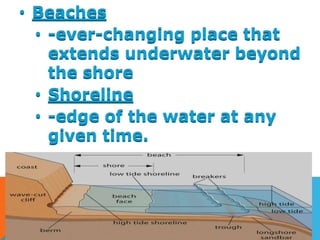
• Beaches
• -ever-changing place that
extends underwater beyond
the shore
• Shoreline
• -edge of the water at any
given time.
13.5
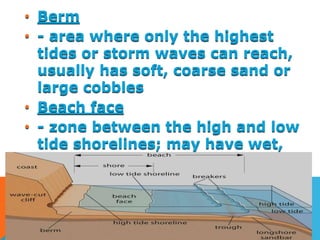
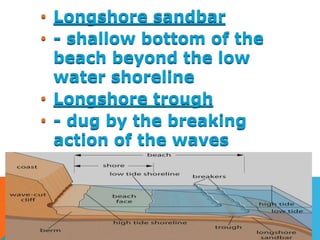
• Berm
• - area where only the highest
tides or storm waves can reach,
usually has soft, coarse sand or
large cobbles
• Beach face
• - zone between the high and low
tide shorelines; may have wet,
compact sand or fine pebbles.
• Longshore sandbar
• - shallow bottom of the
beach beyond the low
water shoreline
• Longshore trough
• - dug by the breaking
action of the waves
13.5
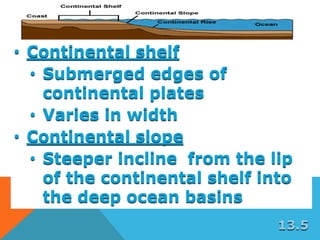
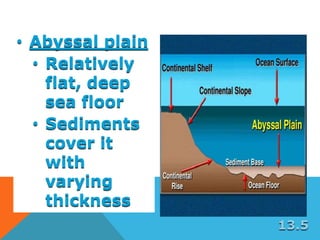
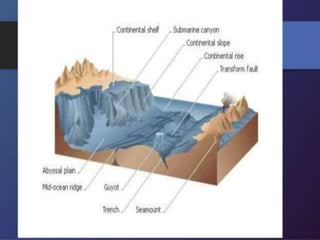
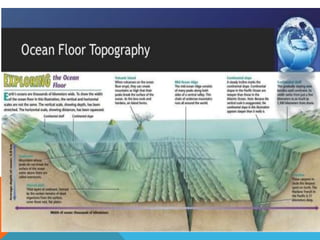
• Continental shelf
• Submerged edges of
continental plates
• Varies in width
• Continental slope
• Steeper incline from the lip
of the continental shelf into
the deep ocean basins
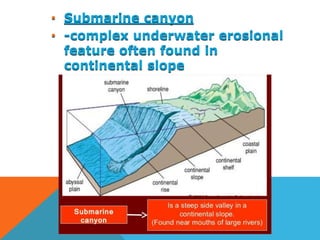
• Submarine canyon
• -complex underwater erosional
feature often found in
continental slope
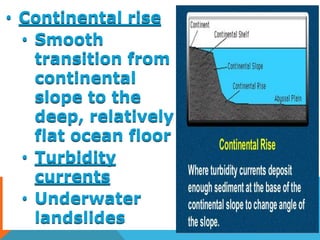
• Continental rise
• Smooth
transition from
continental
slope to the
deep, relatively
flat ocean floor
• Turbidity
currents
• Underwater
landslides 13.5
• Abyssal plain
• Relatively
flat, deep
sea floor
• Sediments
cover it
with
varying
thickness
13.5
Tectonic features
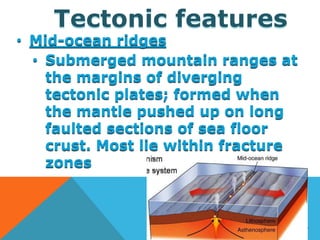
• Mid-ocean ridges
• Submerged mountain ranges at
the margins of diverging
tectonic plates; formed when
the mantle pushed up on long
faulted sections of sea floor
crust. Most lie within fracture
zones
13.6
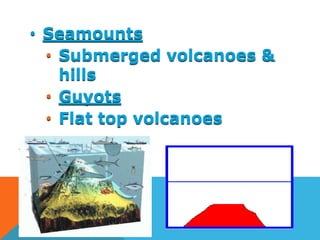
• Seamounts
• Submerged volcanoes &
hills
• Guyots
• Flat top volcanoes
• Trenches
• -deep notch in the ocean floor
formed when oceanic plates slid
below continental plates in
convergent subduction zones
• Challenger Deep –deepest point
in any ocean, was found in the
Mariana Trench in the western
Pacific
13.6
Island arcs
- long, curved strings of volcanic island
Coral reefs
- Accumulated skeletal material, an underwater ridge,
formed from coral colonies that excrete rock –like
calcium carbonate support structure or skeleton; can
become islands when sea level changed.
Fringing reefs
- Coral reefs that grow right up to the beach along a
coastline
Barrier reefs
-farther from the land, form a lagoon between the reef and
the land
Atoll
-a ring of low coral islands and reefs surrounding a central
lagoon.
Chapter 13 a ocean basins

Chapter 13 a ocean basins

  • 2.
    Oceans - Vast bodiesof salt water that separate the continents. - They cover about 71% of the earth’s surface and hold over 97% of all the water on the planet. - Absorbs sun’s heat, making earth’s climate more uniform compared to other planets - Home to animal and plant life - -Most of the oxygen in our atmosphere comes from photosynthetic organisms living in the oceans - We need to exercise good and wise dominion of the ocean
  • 4.
    Scientists who studythe ocean • Oceanographers • - marine scientists and engineers who work to better understand and use the ocean • Marine biologists • -investigate the plant and animal life in the ocean • Meteorologist • - study the influence of the oceans on weather and climate • Chemists • -analyze the distribution of various elements and compounds in the oceans and the ways those chemicals affect ocean processes • Physicists • -model the distribution of energy in the oceans and the motion of its great currents • Marine Engineers • -develop methods and vehicles to investigate and use oceans, design ways to produce potable water and electricity from seawater. 13.1
  • 5.
    Ocean Basins • Oneocean • Four major basins • Arctic, Atlantic, Indian, Pacific • Sea • - large section of ocean mostly surrounded by land or islands 13.2
  • 6.
    Ocean Basins • Originof the oceans • Old-earth view • - believe that oceans have been here from very early in Earth’s history, that the ocean basins are just the result of plate tectonics over billions of years. • -The current Atlantic, Indian & Arctic Ocean basins began forming 300 million years ago • The Pacific Ocean basin is all that remain from an earlier global sea, Panthalassa 13.3
  • 7.
    • Young-earth view •Believe that the earth began as a water planet, with a single supercontinent created by God on Day 2. • Supercontinent wrenched apart at Flood around 5500 years ago resulting to the shapes and sizes of the present day ocean basins
  • 8.
    • Local sealevel • Always changing height of the ocean surface at a given location • Measured by Tide gauge • Zero point for gauge positioned at imaginary surface of mathematical model of the earth called • Geoid 13.4
  • 9.
    • Mean sealevel (MSL) • - what most people simply call “sea level” • -computed average height of high and low tides at a location • Zero height used to measure elevation • Changes over time • Risen during past 100 years 13.4
  • 10.
    Basin Topography • Shore •-strip of land that separates the coastal regions from the ocean. 13.5
  • 11.
    • Beaches • -ever-changingplace that extends underwater beyond the shore • Shoreline • -edge of the water at any given time. 13.5
  • 12.
    • Berm • -area where only the highest tides or storm waves can reach, usually has soft, coarse sand or large cobbles • Beach face • - zone between the high and low tide shorelines; may have wet, compact sand or fine pebbles.
  • 13.
    • Longshore sandbar •- shallow bottom of the beach beyond the low water shoreline • Longshore trough • - dug by the breaking action of the waves
  • 14.
    13.5 • Continental shelf •Submerged edges of continental plates • Varies in width • Continental slope • Steeper incline from the lip of the continental shelf into the deep ocean basins
  • 15.
    • Submarine canyon •-complex underwater erosional feature often found in continental slope
  • 16.
    • Continental rise •Smooth transition from continental slope to the deep, relatively flat ocean floor • Turbidity currents • Underwater landslides 13.5
  • 17.
    • Abyssal plain •Relatively flat, deep sea floor • Sediments cover it with varying thickness 13.5
  • 18.
    Tectonic features • Mid-oceanridges • Submerged mountain ranges at the margins of diverging tectonic plates; formed when the mantle pushed up on long faulted sections of sea floor crust. Most lie within fracture zones 13.6
  • 19.
    • Seamounts • Submergedvolcanoes & hills • Guyots • Flat top volcanoes
  • 20.
    • Trenches • -deepnotch in the ocean floor formed when oceanic plates slid below continental plates in convergent subduction zones • Challenger Deep –deepest point in any ocean, was found in the Mariana Trench in the western Pacific 13.6
  • 22.
    Island arcs - long,curved strings of volcanic island Coral reefs - Accumulated skeletal material, an underwater ridge, formed from coral colonies that excrete rock –like calcium carbonate support structure or skeleton; can become islands when sea level changed. Fringing reefs - Coral reefs that grow right up to the beach along a coastline Barrier reefs -farther from the land, form a lagoon between the reef and the land Atoll -a ring of low coral islands and reefs surrounding a central lagoon.