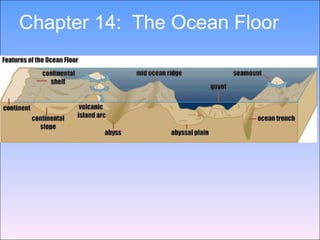
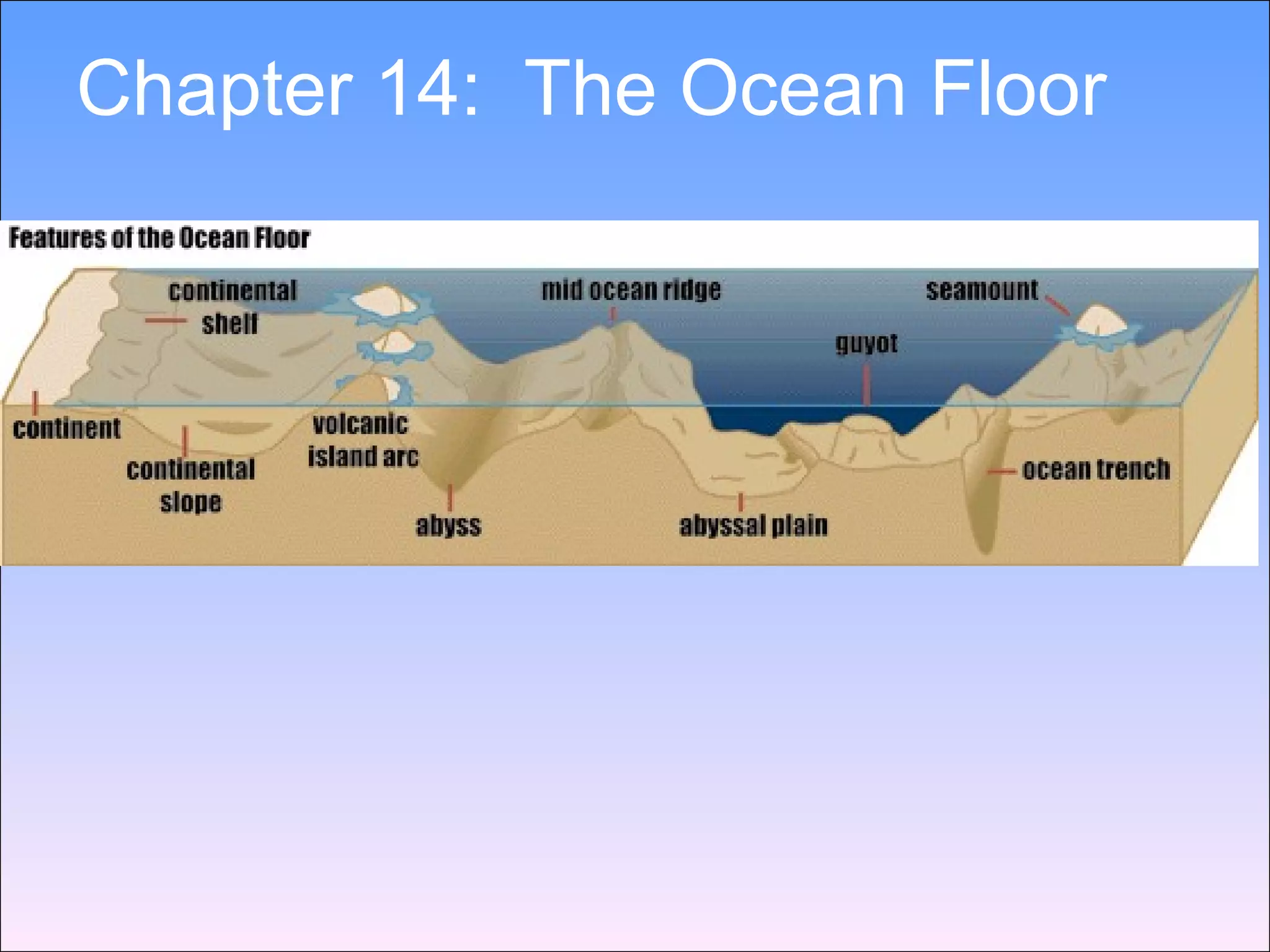
Chapter 14:  The Ocean Floor
Starter #10   Imagine you are an astronaut on a new planet.  You were sent to this planet to explore and record your findings. Write 3 sentences using these facts below that you have discovered on this new planet. (5 minutes)  There IS life.  There is a high-pressure, thick atmosphere. There is NO sun/star light on the surface of this new planet.
Starter #10   http://www.youtube.com/watch?v=hDPBn17s0uI  (Alien, first 60 seconds) http://www.youtube.com/watch?v=SyBO10VhVmc&feature=related
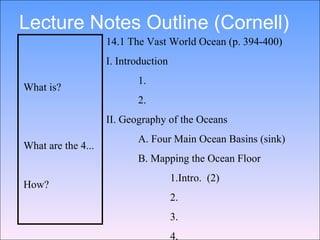
Lecture Notes Outline (Cornell) 14.1 The Vast World Ocean (p. 394-400) I. Introduction 1. 2.  II. Geography of the Oceans A. Four Main Ocean Basins (sink)  B. Mapping the Ocean Floor 1.Intro.  (2) 2.  3. 4.  What is? What are the 4... How?
14.1   The Vast World Ocean     Nearly 71 percent of Earth’s surface is covered by the global ocean.    Oceanography  is a science that draws on the methods and knowledge of geology, chemistry, physics, and biology to study all aspects of the world ocean. The Blue Planet
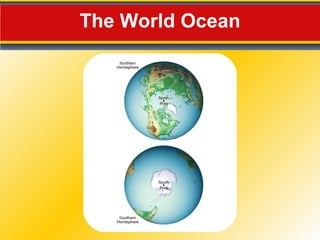
The World Ocean
14.1   The Vast World Ocean     The world ocean can be divided into four main ocean basins—the Pacific Ocean, the Atlantic Ocean, the Indian Ocean, and the Arctic Ocean. The Arctic Ocean  is about 7 percent of the size of the Pacific.  The Pacific Ocean  is the largest and has the greatest depth. The Atlantic Ocean  is about half the size of the Pacific and not quite as deep.  The Indian Ocean ,  largely a southern hemisphere body, is slightly smaller than the Atlantic.  Geography of the Oceans
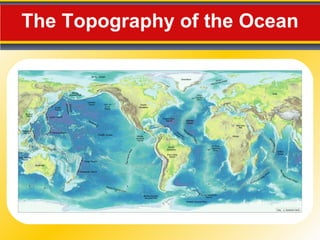
14.1  The Vast World Ocean     The topography of the ocean floor is as diverse as that of the continents.    Bathymetry  is the measurement of ocean depths and the charting of the shape or topography of the ocean floor.    Today’s technology—particularly  sonar, satellites, and submersibles—allows  scientists to study the ocean floor in a more efficient and precise manner than ever before. Mapping the Ocean Floor
The Topography of the Ocean
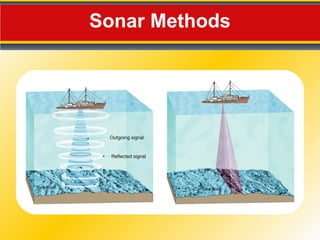
14.1   The Vast World Ocean     Sonar Sonar  is an acronym for  so und  na vigation and  r anging. It is also referred to as echo sounding. Sonar works by transmitting sound waves toward the ocean bottom. Mapping the Ocean Floor
Sonar Methods
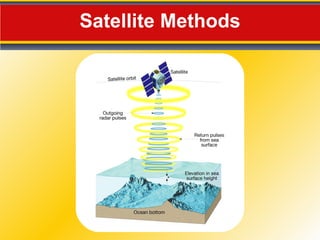
14.1   The Vast World Ocean     Satellites Satellites are able to measure small differences by bouncing microwaves off the ocean surface. Using this new technology, scientists have discovered that the ocean surface is not perfectly flat. Differences in the height of the ocean surface are caused by ocean-floor features. Mapping the Ocean Floor
Satellite Methods
Starter #11 What percentage of the Earth is covered in water? Break down the word ‘Oceanography’, what does it mean?
Mapping the ocean floor
14.1   The Vast World Ocean     Submersibles Submersibles  are small underwater crafts used for deep-sea research. Today, many submersibles are unmanned and operated remotely by computers. These remotely operated vehicles (ROVs) can remain underwater for long periods. Mapping the Ocean Floor
14.2   Ocean Floor Features  The ocean floor regions are (3): the  continental margins ,  the ocean basin   floor, and the mid-ocean ridge . Mapping the Ocean Floor
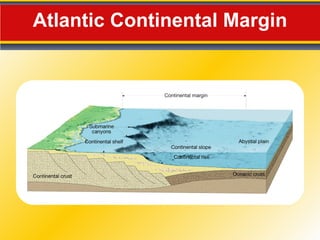
14.2  Ocean Floor Features     In the Atlantic Ocean, thick layers of undisturbed sediment cover the continental margin. This region has very little volcanic or earthquake activity.    A   continental margin  is the zone of transition between a continent and the adjacent ocean basin floor. Continental Margins
Atlantic Continental Margin
14.2  Ocean Floor Features     In the Pacific Ocean, oceanic crust plunges beneath continental crust. This force results in a narrow continental margin that experiences both volcanic activity and earthquakes. Continental Margins
14.2   Ocean Floor Features     Continental Shelf A  continental shelf  is the gently sloping submerged surface extending from the shoreline. Continental shelves contain important mineral deposits, large reservoirs of oil and natural gas, and huge sand and gravel deposits. Continental Margins
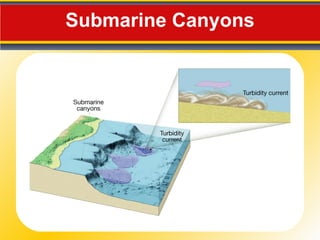
14.2   Ocean Floor Features     Continental Slope A continental slope  is the  steep  gradient that leads to the deep-ocean floor and marks the seaward edge of the continental shelf. A submarine canyon  is the seaward extension of a valley that was cut on the continental shelf during a time when sea level was lower—a canyon carved into the outer continental shelf, slope, and rise by turbidity currents. A turbidity current  is the downslope movement of dense, sediment-laden water created when sand and mud on the continental shelf and slope are dislodged and thrown into suspension. Continental Margins
Submarine Canyons
14.2  Ocean Floor Features     Continental Rise A  continental rise  is the gently sloping surface at the base of the continental slope. Continental Margins
14.2  Ocean Floor Features     The  ocean basin floor   is the area of the deep-ocean floor between the continental margin and the oceanic ridge. Trenches form at the sites of plate convergence where one moving plate descends beneath another and plunges back into the mantle. DRAW a Deep-Ocean Trench in your notebook     Deep-Ocean Trenches Ocean Basin Floor
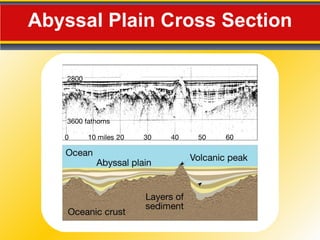
14.2  Ocean Floor Features     Abyssal Plains An  abyssal plain  is a very level area of the deep-ocean floor, usually lying at the foot of the continental rise. The sediments that make up abyssal plains are carried there by turbidity currents or are deposited as suspended sediment settles out.    Seamounts and Guyots A  seamount  is an isolated volcanic peak that rises at least 1000 meters above the deep-ocean floor, and a  guyot  is an eroded, submerged seamount. Ocean Basin Floor
Abyssal Plain Cross Section
14.2   Ocean Floor Features     A  mid-ocean ridge   is found near the center of most ocean basins. It is an interconnected system of underwater mountains that have developed on newly formed ocean crust.    Seafloor Spreading Seafloor spreading  is the process by which plate tectonics produces new oceanic lithosphere at ocean ridges. New ocean floor is formed at mid-ocean ridges as magma rises between the diverging plates and cools. Mid-Ocean Ridges
14.2  Ocean Floor Features     Hydrothermal Vents Hydrothermal vents form along mid-ocean ridges. These are zones where mineral-rich water, heated by the hot, newly-formed oceanic crust, escapes through cracks in the oceanic crust into surrounding water. Mid-Ocean Ridges
Hydrothermal Vents Youtube video http://www.youtube.com/watch?v=XotF9fzo4Vo  What is chemosynthesis? Where would you find these vents? What is ‘special’ about these ecosystems?
14.3   Seafloor Sediments     Ocean-floor sediments can be classified according to their origin into three broad categories: terrigenous sediment, biogenous sediment, and hydrogenous sediment.    Terrigenous Sediment Terrigenous   sediments  consist primarily of mineral grains that were eroded from continental rocks and transported to the ocean. Types of Seafloor Sediments
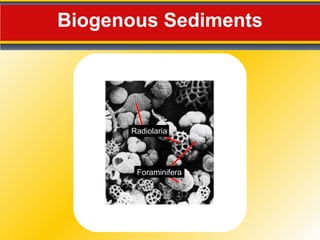
14.3   Seafloor Sediments     Biogenous Sediment Biogenous sediments  consist of shells and skeletons of marine animals and algae. -  Calcareous ooze  is thick, common biogenous sediment produced by dissolving calcium carbonate shells. -  Siliceous ooze  is biogenous sediment composed of silica-based shells of single-celled animals and algae. Types of Seafloor Sediments
14.3   Seafloor Sediments     Hydrogenous Sediment Hydrogenous sediment  consists of minerals that crystallize directly from ocean water through various chemical reactions. Types of Seafloor Sediments
Biogenous Sediments Radiolaria Foraminifera
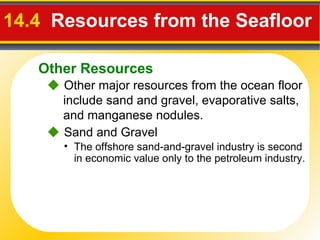
14.4   Resources from the Seafloor    Oil and natural gas  are the main energy products currently being obtained from the ocean floor. Gas hydrates   are compact chemical structures made of water and natural gas.    Gas Hydrates Most oceanic gas hydrates are created when bacteria break down organic matter in ocean-floor sediments. Energy Resources
Gas Hydrates
14.4  Resources from the Seafloor    Other major resources from the ocean floor include sand and gravel, evaporative salts, and manganese nodules.    Sand and Gravel The offshore sand-and-gravel industry is second in economic value only to the petroleum industry. Other Resources
14.4   Resources from the Seafloor    Manganese Nodules    Evaporative Salts When seawater evaporates, the salt increases in concentration until it can no longer remain dissolved. When the concentration becomes high enough, the salts precipitate out of solution and form salt deposits. Manganese nodules  are hard lumps of manganese and other metals (like cobalt, copper, and iron) that precipitate around a small object. The most economically important salt is  halite —common table salt. Other Resources
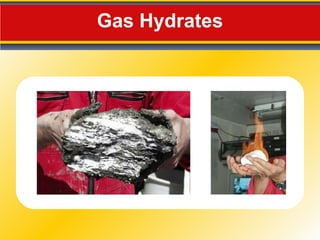
Manganese Nodules

Ch. 14 the ocean floor

  • 1.
    Chapter 14: The Ocean Floor
  • 2.
    Starter #10 Imagine you are an astronaut on a new planet. You were sent to this planet to explore and record your findings. Write 3 sentences using these facts below that you have discovered on this new planet. (5 minutes) There IS life. There is a high-pressure, thick atmosphere. There is NO sun/star light on the surface of this new planet.
  • 3.
    Starter #10 http://www.youtube.com/watch?v=hDPBn17s0uI (Alien, first 60 seconds) http://www.youtube.com/watch?v=SyBO10VhVmc&feature=related
  • 4.
    Lecture Notes Outline(Cornell) 14.1 The Vast World Ocean (p. 394-400) I. Introduction 1. 2. II. Geography of the Oceans A. Four Main Ocean Basins (sink) B. Mapping the Ocean Floor 1.Intro. (2) 2. 3. 4. What is? What are the 4... How?
  • 5.
    14.1 The Vast World Ocean  Nearly 71 percent of Earth’s surface is covered by the global ocean.  Oceanography is a science that draws on the methods and knowledge of geology, chemistry, physics, and biology to study all aspects of the world ocean. The Blue Planet
  • 6.
  • 7.
    14.1 The Vast World Ocean  The world ocean can be divided into four main ocean basins—the Pacific Ocean, the Atlantic Ocean, the Indian Ocean, and the Arctic Ocean. The Arctic Ocean is about 7 percent of the size of the Pacific. The Pacific Ocean is the largest and has the greatest depth. The Atlantic Ocean is about half the size of the Pacific and not quite as deep. The Indian Ocean , largely a southern hemisphere body, is slightly smaller than the Atlantic. Geography of the Oceans
  • 8.
    14.1 TheVast World Ocean  The topography of the ocean floor is as diverse as that of the continents.  Bathymetry is the measurement of ocean depths and the charting of the shape or topography of the ocean floor.  Today’s technology—particularly sonar, satellites, and submersibles—allows scientists to study the ocean floor in a more efficient and precise manner than ever before. Mapping the Ocean Floor
  • 9.
  • 10.
    14.1 The Vast World Ocean  Sonar Sonar is an acronym for so und na vigation and r anging. It is also referred to as echo sounding. Sonar works by transmitting sound waves toward the ocean bottom. Mapping the Ocean Floor
  • 11.
  • 12.
    14.1 The Vast World Ocean  Satellites Satellites are able to measure small differences by bouncing microwaves off the ocean surface. Using this new technology, scientists have discovered that the ocean surface is not perfectly flat. Differences in the height of the ocean surface are caused by ocean-floor features. Mapping the Ocean Floor
  • 13.
  • 14.
    Starter #11 Whatpercentage of the Earth is covered in water? Break down the word ‘Oceanography’, what does it mean?
  • 15.
  • 16.
    14.1 The Vast World Ocean  Submersibles Submersibles are small underwater crafts used for deep-sea research. Today, many submersibles are unmanned and operated remotely by computers. These remotely operated vehicles (ROVs) can remain underwater for long periods. Mapping the Ocean Floor
  • 17.
    14.2 Ocean Floor Features The ocean floor regions are (3): the continental margins , the ocean basin floor, and the mid-ocean ridge . Mapping the Ocean Floor
  • 18.
    14.2 OceanFloor Features  In the Atlantic Ocean, thick layers of undisturbed sediment cover the continental margin. This region has very little volcanic or earthquake activity.  A continental margin is the zone of transition between a continent and the adjacent ocean basin floor. Continental Margins
  • 19.
  • 20.
    14.2 OceanFloor Features  In the Pacific Ocean, oceanic crust plunges beneath continental crust. This force results in a narrow continental margin that experiences both volcanic activity and earthquakes. Continental Margins
  • 21.
    14.2 Ocean Floor Features  Continental Shelf A continental shelf is the gently sloping submerged surface extending from the shoreline. Continental shelves contain important mineral deposits, large reservoirs of oil and natural gas, and huge sand and gravel deposits. Continental Margins
  • 22.
    14.2 Ocean Floor Features  Continental Slope A continental slope is the steep gradient that leads to the deep-ocean floor and marks the seaward edge of the continental shelf. A submarine canyon is the seaward extension of a valley that was cut on the continental shelf during a time when sea level was lower—a canyon carved into the outer continental shelf, slope, and rise by turbidity currents. A turbidity current is the downslope movement of dense, sediment-laden water created when sand and mud on the continental shelf and slope are dislodged and thrown into suspension. Continental Margins
  • 23.
  • 24.
    14.2 OceanFloor Features  Continental Rise A continental rise is the gently sloping surface at the base of the continental slope. Continental Margins
  • 25.
    14.2 OceanFloor Features  The ocean basin floor is the area of the deep-ocean floor between the continental margin and the oceanic ridge. Trenches form at the sites of plate convergence where one moving plate descends beneath another and plunges back into the mantle. DRAW a Deep-Ocean Trench in your notebook  Deep-Ocean Trenches Ocean Basin Floor
  • 26.
    14.2 OceanFloor Features  Abyssal Plains An abyssal plain is a very level area of the deep-ocean floor, usually lying at the foot of the continental rise. The sediments that make up abyssal plains are carried there by turbidity currents or are deposited as suspended sediment settles out.  Seamounts and Guyots A seamount is an isolated volcanic peak that rises at least 1000 meters above the deep-ocean floor, and a guyot is an eroded, submerged seamount. Ocean Basin Floor
  • 27.
  • 28.
    14.2 Ocean Floor Features  A mid-ocean ridge is found near the center of most ocean basins. It is an interconnected system of underwater mountains that have developed on newly formed ocean crust.  Seafloor Spreading Seafloor spreading is the process by which plate tectonics produces new oceanic lithosphere at ocean ridges. New ocean floor is formed at mid-ocean ridges as magma rises between the diverging plates and cools. Mid-Ocean Ridges
  • 29.
    14.2 OceanFloor Features  Hydrothermal Vents Hydrothermal vents form along mid-ocean ridges. These are zones where mineral-rich water, heated by the hot, newly-formed oceanic crust, escapes through cracks in the oceanic crust into surrounding water. Mid-Ocean Ridges
  • 30.
    Hydrothermal Vents Youtubevideo http://www.youtube.com/watch?v=XotF9fzo4Vo What is chemosynthesis? Where would you find these vents? What is ‘special’ about these ecosystems?
  • 31.
    14.3 Seafloor Sediments  Ocean-floor sediments can be classified according to their origin into three broad categories: terrigenous sediment, biogenous sediment, and hydrogenous sediment.  Terrigenous Sediment Terrigenous sediments consist primarily of mineral grains that were eroded from continental rocks and transported to the ocean. Types of Seafloor Sediments
  • 32.
    14.3 Seafloor Sediments  Biogenous Sediment Biogenous sediments consist of shells and skeletons of marine animals and algae. - Calcareous ooze is thick, common biogenous sediment produced by dissolving calcium carbonate shells. - Siliceous ooze is biogenous sediment composed of silica-based shells of single-celled animals and algae. Types of Seafloor Sediments
  • 33.
    14.3 Seafloor Sediments  Hydrogenous Sediment Hydrogenous sediment consists of minerals that crystallize directly from ocean water through various chemical reactions. Types of Seafloor Sediments
  • 34.
  • 35.
    14.4 Resources from the Seafloor  Oil and natural gas are the main energy products currently being obtained from the ocean floor. Gas hydrates are compact chemical structures made of water and natural gas.  Gas Hydrates Most oceanic gas hydrates are created when bacteria break down organic matter in ocean-floor sediments. Energy Resources
  • 36.
  • 37.
    14.4 Resourcesfrom the Seafloor  Other major resources from the ocean floor include sand and gravel, evaporative salts, and manganese nodules.  Sand and Gravel The offshore sand-and-gravel industry is second in economic value only to the petroleum industry. Other Resources
  • 38.
    14.4 Resources from the Seafloor  Manganese Nodules  Evaporative Salts When seawater evaporates, the salt increases in concentration until it can no longer remain dissolved. When the concentration becomes high enough, the salts precipitate out of solution and form salt deposits. Manganese nodules are hard lumps of manganese and other metals (like cobalt, copper, and iron) that precipitate around a small object. The most economically important salt is halite —common table salt. Other Resources
  • 39.

Editor's Notes

  • #7 Makes no sense without caption in book
  • #10 Makes no sense without caption in book
  • #12 Makes no sense without caption in book
  • #14 Makes no sense without caption in book
  • #20 Makes no sense without caption in book
  • #24 Makes no sense without caption in book
  • #28 Makes no sense without caption in book
  • #35 Makes no sense without caption in book
  • #37 Makes no sense without caption in book
  • #40 Makes no sense without caption in book