WELCOME
1
GEE-221: GEOMORPHOLOGY- I
(2 Credits)
Introduction to Geomorphology
Presented by
Md. Nazir Hossain
Lecturer
Geography and Environment
Shahjalal University of Science & Technology
Sylhet-3114, Bangladesh
nazirswapon@gmail.com
2
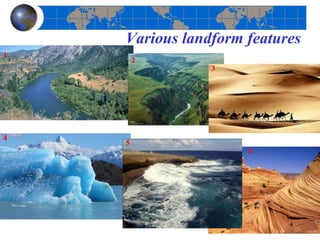
What we see on the earth’s natural
surface?
3
Various landform features
1
2
3
4
5
6
4
Landforms? Which? & Where?
How these features are formed?
5
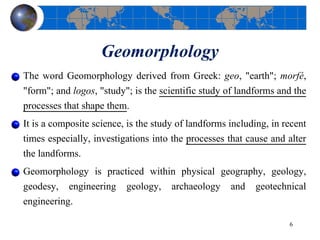
Geomorphology
The word Geomorphology derived from Greek: geo, "earth"; morfé,
"form"; and logos, "study"; is the scientific study of landforms and the
processes that shape them.
It is a composite science, is the study of landforms including, in recent
times especially, investigations into the processes that cause and alter
the landforms.
Geomorphology is practiced within physical geography, geology,
geodesy, engineering geology, archaeology and geotechnical
engineering.
6
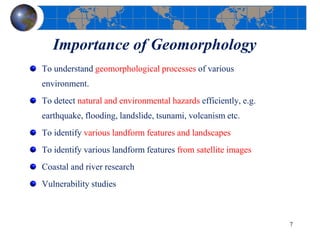
Importance of Geomorphology
To understand geomorphological processes of various
environment.
To detect natural and environmental hazards efficiently, e.g.
earthquake, flooding, landslide, tsunami, volcanism etc.
To identify various landform features and landscapes
To identify various landform features from satellite images
Coastal and river research
Vulnerability studies
7
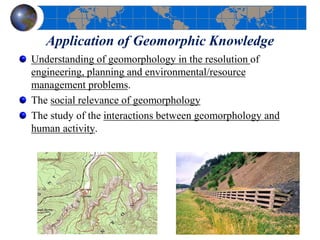
Application of Geomorphic Knowledge
Understanding of geomorphology in the resolution of
engineering, planning and environmental/resource
management problems.
The social relevance of geomorphology
The study of the interactions between geomorphology and
human activity.
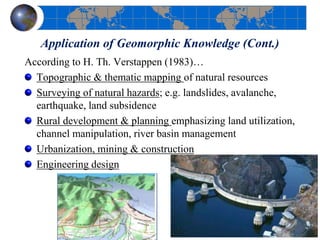
Application of Geomorphic Knowledge (Cont.)
According to H. Th. Verstappen (1983)…
Topographic & thematic mapping of natural resources
Surveying of natural hazards; e.g. landslides, avalanche,
earthquake, land subsidence
Rural development & planning emphasizing land utilization,
channel manipulation, river basin management
Urbanization, mining & construction
Engineering design
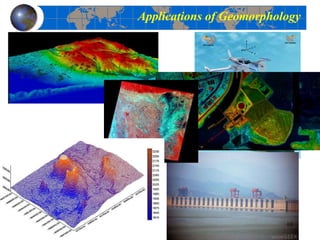
Applications of Geomorphology
10
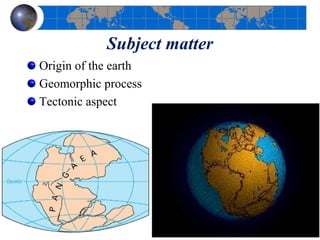
Subject matter
Origin of the earth
Geomorphic process
Tectonic aspect
11
Subject matter (Cont.)
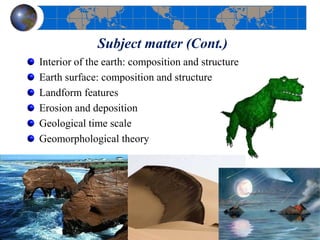
Interior of the earth: composition and structure
Earth surface: composition and structure
Landform features
Erosion and deposition
Geological time scale
Geomorphological theory
12
What are the processes work behind the
landforms?
13
Geomorphic Process
The process responsible for the formation and alteration of the
earth's surface.
The physical and chemical interactions between the earth's
surface and the natural forces acting upon it to produce
landforms.
The processes are determined by such natural environmental
variables as geology, climate, vegetation and base level, to say
nothing of human interference.
14
Geomorphic Process (Cont…)
Definition:
The geomorphic processes are all those physical and
chemical changes which effect a modification of the
earth’s surgical form [W. D. Thornbury (1968): Principles
of Geomorphology, pp. 34].
A process by which the earth’s land forms are changed or
maintained [Jim Gardner (1979): Physical Geology].
15
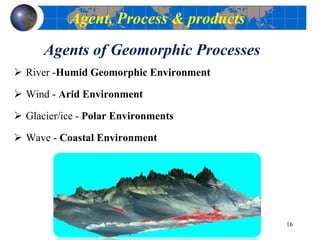
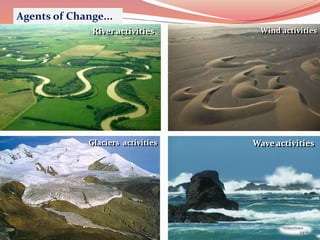
Agents of Geomorphic Processes
 River -Humid Geomorphic Environment
 Wind - Arid Environment
 Glacier/ice - Polar Environments
 Wave - Coastal Environment
16
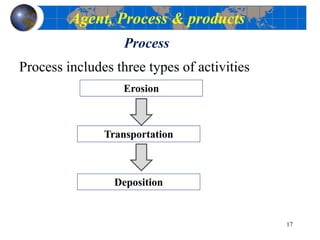
Agent, Process & products
Process
Process includes three types of activities
Erosion
Transportation
Deposition
17
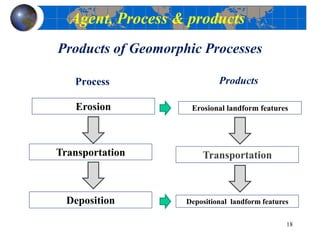
Agent, Process & products
Products of Geomorphic Processes
Process
Erosion
Transportation
Deposition
Erosional landform features
Transportation
Depositional landform features
Products
18
Agent, Process & products
Agents of Change...
Wind activitiesRiver activities
Glaciers activities Wave activities
19
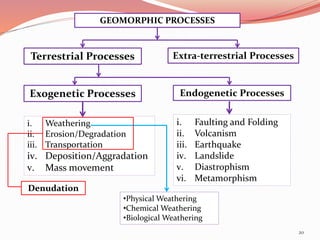
GEOMORPHIC PROCESSES
Terrestrial Processes Extra-terrestrial Processes
Exogenetic Processes Endogenetic Processes
i. Weathering
ii. Erosion/Degradation
iii. Transportation
iv. Deposition/Aggradation
v. Mass movement
i. Faulting and Folding
ii. Volcanism
iii. Earthquake
iv. Landslide
v. Diastrophism
vi. Metamorphism
•Physical Weathering
•Chemical Weathering
•Biological Weathering
Denudation
20
Types of Geomorphic Processes
 Geomorphic Processes
A. Terrestrial processes
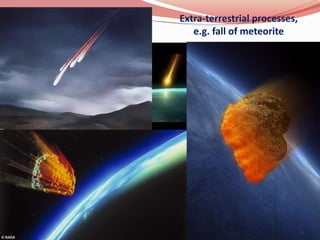
B. Extra-terrestrial processes, e.g. fall of meteorite
(mass/rock from outer space).
Terrestrial processes
1. Exogenetic / Exogenous Processes
2. Endogenetic / Endogenous Processes
21
Extra-terrestrial processes,
e.g. fall of meteorite
22
Types of Geomorphic Processes (Cont…)
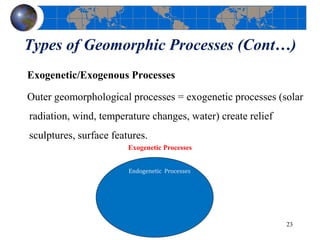
Exogenetic/Exogenous Processes
Outer geomorphological processes = exogenetic processes (solar
radiation, wind, temperature changes, water) create relief
sculptures, surface features.
Exogenetic Processes
Endogenetic Processes
23
Types of Geomorphic Processes (Cont…)
Endogenetic Processes
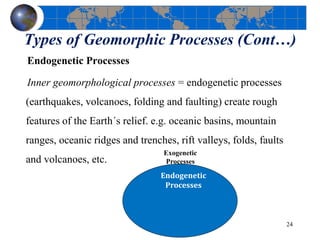
Inner geomorphological processes = endogenetic processes
(earthquakes, volcanoes, folding and faulting) create rough
features of the Earth´s relief. e.g. oceanic basins, mountain
ranges, oceanic ridges and trenches, rift valleys, folds, faults
and volcanoes, etc.
Exogenetic
Processes
Endogenetic
Processes
24
Basic difference between the two process
Processes that are caused by forces from within the
Earth are endogenous processes.
By contrast, exogenous processes come from forces
on or above the Earth's surface.
Endogenic Processes Exogenic Processes
Originate in the interior of the earth. Originate on the surface of the earth.
Causes sudden or rapid movements Causes slow movements.
Eg: Earthquake, faulting, diastrophism Eg: Erosional and Depositional
25
Types of Exogenetic / Exogenous Processes
i. Weathering
ii. Erosion/ Degradation
iii. Transportation
iv. Deposition/Aggradation
v. Mass movement
26
Denudation
It means to make the things exposed.
The processes by which the rocks on the earth’s surface are broken
into pieces through the application of external physical forces and
the debris are transported elsewhere is known as denudation.
This denudation work is performed through three processes such as
weathering, erosion and transportation.
Denudation= Weathering + Erosion + Transportation
27
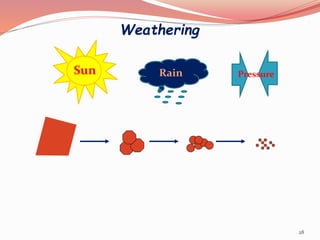
Weathering
Sun PressureRain
28
Weathering
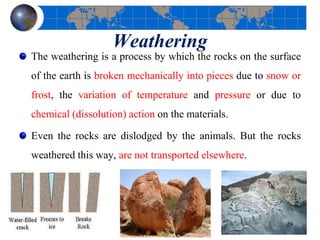
The weathering is a process by which the rocks on the surface
of the earth is broken mechanically into pieces due to snow or
frost, the variation of temperature and pressure or due to
chemical (dissolution) action on the materials.
Even the rocks are dislodged by the animals. But the rocks
weathered this way, are not transported elsewhere.
29
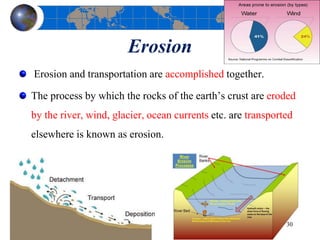
Erosion
Erosion and transportation are accomplished together.
The process by which the rocks of the earth’s crust are eroded
by the river, wind, glacier, ocean currents etc. are transported
elsewhere is known as erosion.
30
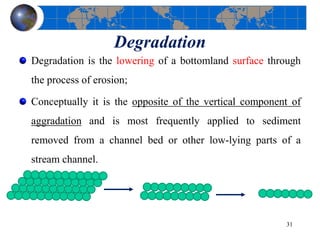
Degradation
Degradation is the lowering of a bottomland surface through
the process of erosion;
Conceptually it is the opposite of the vertical component of
aggradation and is most frequently applied to sediment
removed from a channel bed or other low-lying parts of a
stream channel.
31
Weathering vs. Erosion
Weathering = process of disintegration or
decomposition of rocks which stay then in the
same place.
Erosion = process of disintegration or
decomposition of rocks which are transported
somewhere else.
32
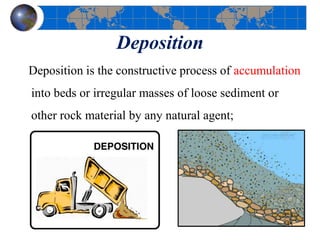
Deposition
Deposition is the constructive process of accumulation
into beds or irregular masses of loose sediment or
other rock material by any natural agent;
33
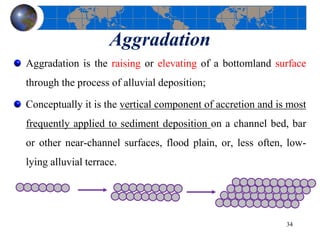
Aggradation
Aggradation is the raising or elevating of a bottomland surface
through the process of alluvial deposition;
Conceptually it is the vertical component of accretion and is most
frequently applied to sediment deposition on a channel bed, bar
or other near-channel surfaces, flood plain, or, less often, low-
lying alluvial terrace.
34
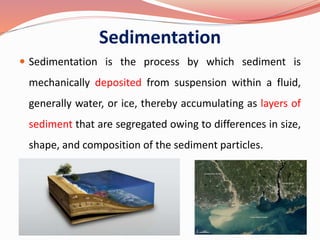
Sedimentation
 Sedimentation is the process by which sediment is
mechanically deposited from suspension within a fluid,
generally water, or ice, thereby accumulating as layers of
sediment that are segregated owing to differences in size,
shape, and composition of the sediment particles.
35
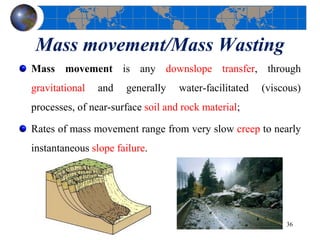
Mass movement/Mass Wasting
Mass movement is any downslope transfer, through
gravitational and generally water-facilitated (viscous)
processes, of near-surface soil and rock material;
Rates of mass movement range from very slow creep to nearly
instantaneous slope failure.
36
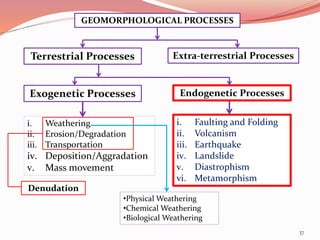
GEOMORPHOLOGICAL PROCESSES
Terrestrial Processes Extra-terrestrial Processes
Exogenetic Processes Endogenetic Processes
i. Weathering
ii. Erosion/Degradation
iii. Transportation
iv. Deposition/Aggradation
v. Mass movement
i. Faulting and Folding
ii. Volcanism
iii. Earthquake
iv. Landslide
v. Diastrophism
vi. Metamorphism
•Physical Weathering
•Chemical Weathering
•Biological Weathering
Denudation
37
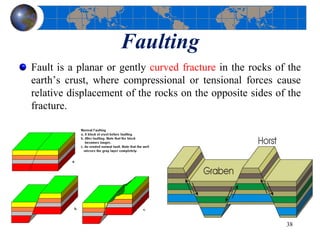
Faulting
Fault is a planar or gently curved fracture in the rocks of the
earth’s crust, where compressional or tensional forces cause
relative displacement of the rocks on the opposite sides of the
fracture.
38
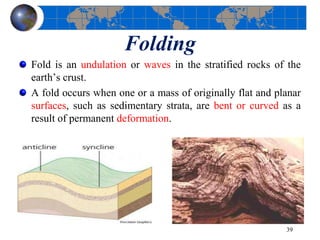
Folding
Fold is an undulation or waves in the stratified rocks of the
earth’s crust.
A fold occurs when one or a mass of originally flat and planar
surfaces, such as sedimentary strata, are bent or curved as a
result of permanent deformation.
39
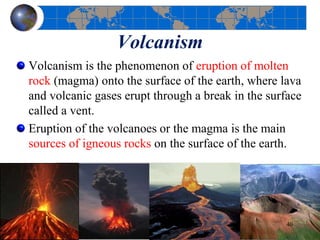
Volcanism
Volcanism is the phenomenon of eruption of molten
rock (magma) onto the surface of the earth, where lava
and volcanic gases erupt through a break in the surface
called a vent.
Eruption of the volcanoes or the magma is the main
sources of igneous rocks on the surface of the earth.
40
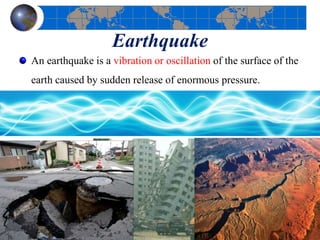
Earthquake
An earthquake is a vibration or oscillation of the surface of the
earth caused by sudden release of enormous pressure.
41
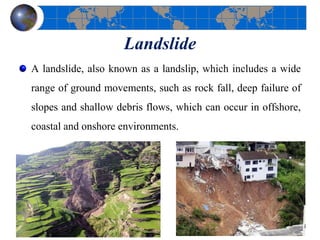
Landslide
A landslide, also known as a landslip, which includes a wide
range of ground movements, such as rock fall, deep failure of
slopes and shallow debris flows, which can occur in offshore,
coastal and onshore environments.
42
Diastrophism
 Diastrophism is also called tectonism, large-scale
deformation of earth’s crust by natural processes, which leads
to the formation of continents and ocean basins, mountain
systems, plateaus, rift valleys, and other features by
mechanisms such as plate movement, volcanic loading, or
folding.
 Internal forces active here
43
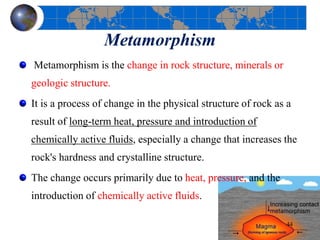
Metamorphism
Metamorphism is the change in rock structure, minerals or
geologic structure.
It is a process of change in the physical structure of rock as a
result of long-term heat, pressure and introduction of
chemically active fluids, especially a change that increases the
rock's hardness and crystalline structure.
The change occurs primarily due to heat, pressure, and the
introduction of chemically active fluids.
44
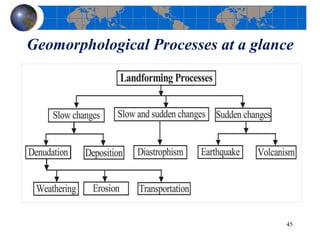
Geomorphological Processes at a glance
45
Next Lecture
Erosion & Deposition
46
Thanks To All
47

Introduction to geomorphology

  • 1.
  • 2.
    GEE-221: GEOMORPHOLOGY- I (2Credits) Introduction to Geomorphology Presented by Md. Nazir Hossain Lecturer Geography and Environment Shahjalal University of Science & Technology Sylhet-3114, Bangladesh nazirswapon@gmail.com 2
  • 3.
    What we seeon the earth’s natural surface? 3
  • 4.
  • 5.
    Landforms? Which? &Where? How these features are formed? 5
  • 6.
    Geomorphology The word Geomorphologyderived from Greek: geo, "earth"; morfé, "form"; and logos, "study"; is the scientific study of landforms and the processes that shape them. It is a composite science, is the study of landforms including, in recent times especially, investigations into the processes that cause and alter the landforms. Geomorphology is practiced within physical geography, geology, geodesy, engineering geology, archaeology and geotechnical engineering. 6
  • 7.
    Importance of Geomorphology Tounderstand geomorphological processes of various environment. To detect natural and environmental hazards efficiently, e.g. earthquake, flooding, landslide, tsunami, volcanism etc. To identify various landform features and landscapes To identify various landform features from satellite images Coastal and river research Vulnerability studies 7
  • 8.
    Application of GeomorphicKnowledge Understanding of geomorphology in the resolution of engineering, planning and environmental/resource management problems. The social relevance of geomorphology The study of the interactions between geomorphology and human activity.
  • 9.
    Application of GeomorphicKnowledge (Cont.) According to H. Th. Verstappen (1983)… Topographic & thematic mapping of natural resources Surveying of natural hazards; e.g. landslides, avalanche, earthquake, land subsidence Rural development & planning emphasizing land utilization, channel manipulation, river basin management Urbanization, mining & construction Engineering design
  • 10.
  • 11.
    Subject matter Origin ofthe earth Geomorphic process Tectonic aspect 11
  • 12.
    Subject matter (Cont.) Interiorof the earth: composition and structure Earth surface: composition and structure Landform features Erosion and deposition Geological time scale Geomorphological theory 12
  • 13.
    What are theprocesses work behind the landforms? 13
  • 14.
    Geomorphic Process The processresponsible for the formation and alteration of the earth's surface. The physical and chemical interactions between the earth's surface and the natural forces acting upon it to produce landforms. The processes are determined by such natural environmental variables as geology, climate, vegetation and base level, to say nothing of human interference. 14
  • 15.
    Geomorphic Process (Cont…) Definition: Thegeomorphic processes are all those physical and chemical changes which effect a modification of the earth’s surgical form [W. D. Thornbury (1968): Principles of Geomorphology, pp. 34]. A process by which the earth’s land forms are changed or maintained [Jim Gardner (1979): Physical Geology]. 15
  • 16.
    Agents of GeomorphicProcesses  River -Humid Geomorphic Environment  Wind - Arid Environment  Glacier/ice - Polar Environments  Wave - Coastal Environment 16 Agent, Process & products
  • 17.
    Process Process includes threetypes of activities Erosion Transportation Deposition 17 Agent, Process & products
  • 18.
    Products of GeomorphicProcesses Process Erosion Transportation Deposition Erosional landform features Transportation Depositional landform features Products 18 Agent, Process & products
  • 19.
    Agents of Change... WindactivitiesRiver activities Glaciers activities Wave activities 19
  • 20.
    GEOMORPHIC PROCESSES Terrestrial ProcessesExtra-terrestrial Processes Exogenetic Processes Endogenetic Processes i. Weathering ii. Erosion/Degradation iii. Transportation iv. Deposition/Aggradation v. Mass movement i. Faulting and Folding ii. Volcanism iii. Earthquake iv. Landslide v. Diastrophism vi. Metamorphism •Physical Weathering •Chemical Weathering •Biological Weathering Denudation 20
  • 21.
    Types of GeomorphicProcesses  Geomorphic Processes A. Terrestrial processes B. Extra-terrestrial processes, e.g. fall of meteorite (mass/rock from outer space). Terrestrial processes 1. Exogenetic / Exogenous Processes 2. Endogenetic / Endogenous Processes 21
  • 22.
  • 23.
    Types of GeomorphicProcesses (Cont…) Exogenetic/Exogenous Processes Outer geomorphological processes = exogenetic processes (solar radiation, wind, temperature changes, water) create relief sculptures, surface features. Exogenetic Processes Endogenetic Processes 23
  • 24.
    Types of GeomorphicProcesses (Cont…) Endogenetic Processes Inner geomorphological processes = endogenetic processes (earthquakes, volcanoes, folding and faulting) create rough features of the Earth´s relief. e.g. oceanic basins, mountain ranges, oceanic ridges and trenches, rift valleys, folds, faults and volcanoes, etc. Exogenetic Processes Endogenetic Processes 24
  • 25.
    Basic difference betweenthe two process Processes that are caused by forces from within the Earth are endogenous processes. By contrast, exogenous processes come from forces on or above the Earth's surface. Endogenic Processes Exogenic Processes Originate in the interior of the earth. Originate on the surface of the earth. Causes sudden or rapid movements Causes slow movements. Eg: Earthquake, faulting, diastrophism Eg: Erosional and Depositional 25
  • 26.
    Types of Exogenetic/ Exogenous Processes i. Weathering ii. Erosion/ Degradation iii. Transportation iv. Deposition/Aggradation v. Mass movement 26
  • 27.
    Denudation It means tomake the things exposed. The processes by which the rocks on the earth’s surface are broken into pieces through the application of external physical forces and the debris are transported elsewhere is known as denudation. This denudation work is performed through three processes such as weathering, erosion and transportation. Denudation= Weathering + Erosion + Transportation 27
  • 28.
  • 29.
    Weathering The weathering isa process by which the rocks on the surface of the earth is broken mechanically into pieces due to snow or frost, the variation of temperature and pressure or due to chemical (dissolution) action on the materials. Even the rocks are dislodged by the animals. But the rocks weathered this way, are not transported elsewhere. 29
  • 30.
    Erosion Erosion and transportationare accomplished together. The process by which the rocks of the earth’s crust are eroded by the river, wind, glacier, ocean currents etc. are transported elsewhere is known as erosion. 30
  • 31.
    Degradation Degradation is thelowering of a bottomland surface through the process of erosion; Conceptually it is the opposite of the vertical component of aggradation and is most frequently applied to sediment removed from a channel bed or other low-lying parts of a stream channel. 31
  • 32.
    Weathering vs. Erosion Weathering= process of disintegration or decomposition of rocks which stay then in the same place. Erosion = process of disintegration or decomposition of rocks which are transported somewhere else. 32
  • 33.
    Deposition Deposition is theconstructive process of accumulation into beds or irregular masses of loose sediment or other rock material by any natural agent; 33
  • 34.
    Aggradation Aggradation is theraising or elevating of a bottomland surface through the process of alluvial deposition; Conceptually it is the vertical component of accretion and is most frequently applied to sediment deposition on a channel bed, bar or other near-channel surfaces, flood plain, or, less often, low- lying alluvial terrace. 34
  • 35.
    Sedimentation  Sedimentation isthe process by which sediment is mechanically deposited from suspension within a fluid, generally water, or ice, thereby accumulating as layers of sediment that are segregated owing to differences in size, shape, and composition of the sediment particles. 35
  • 36.
    Mass movement/Mass Wasting Massmovement is any downslope transfer, through gravitational and generally water-facilitated (viscous) processes, of near-surface soil and rock material; Rates of mass movement range from very slow creep to nearly instantaneous slope failure. 36
  • 37.
    GEOMORPHOLOGICAL PROCESSES Terrestrial ProcessesExtra-terrestrial Processes Exogenetic Processes Endogenetic Processes i. Weathering ii. Erosion/Degradation iii. Transportation iv. Deposition/Aggradation v. Mass movement i. Faulting and Folding ii. Volcanism iii. Earthquake iv. Landslide v. Diastrophism vi. Metamorphism •Physical Weathering •Chemical Weathering •Biological Weathering Denudation 37
  • 38.
    Faulting Fault is aplanar or gently curved fracture in the rocks of the earth’s crust, where compressional or tensional forces cause relative displacement of the rocks on the opposite sides of the fracture. 38
  • 39.
    Folding Fold is anundulation or waves in the stratified rocks of the earth’s crust. A fold occurs when one or a mass of originally flat and planar surfaces, such as sedimentary strata, are bent or curved as a result of permanent deformation. 39
  • 40.
    Volcanism Volcanism is thephenomenon of eruption of molten rock (magma) onto the surface of the earth, where lava and volcanic gases erupt through a break in the surface called a vent. Eruption of the volcanoes or the magma is the main sources of igneous rocks on the surface of the earth. 40
  • 41.
    Earthquake An earthquake isa vibration or oscillation of the surface of the earth caused by sudden release of enormous pressure. 41
  • 42.
    Landslide A landslide, alsoknown as a landslip, which includes a wide range of ground movements, such as rock fall, deep failure of slopes and shallow debris flows, which can occur in offshore, coastal and onshore environments. 42
  • 43.
    Diastrophism  Diastrophism isalso called tectonism, large-scale deformation of earth’s crust by natural processes, which leads to the formation of continents and ocean basins, mountain systems, plateaus, rift valleys, and other features by mechanisms such as plate movement, volcanic loading, or folding.  Internal forces active here 43
  • 44.
    Metamorphism Metamorphism is thechange in rock structure, minerals or geologic structure. It is a process of change in the physical structure of rock as a result of long-term heat, pressure and introduction of chemically active fluids, especially a change that increases the rock's hardness and crystalline structure. The change occurs primarily due to heat, pressure, and the introduction of chemically active fluids. 44
  • 45.
  • 46.
  • 47.