◾ While there is only one global ocean, the vast body of water that
covers 71 percent of the Earth is geographically divided into
distinct named regions. The boundaries between these regions have
evolved over time for a variety of historical, cultural, geographical,
and scientific reasons.
◾ Historically, there are four named oceans: the Atlantic, Pacific,
Indian, and Arctic. However, a new ocean has now been recognized
as the Southern (Antarctic) as the fifth ocean. The Pacific, Atlantic,
and Indian are known as the three major oceans.
◾ They are source of food- fish, mammals, reptiles, salt and other
marine foodstuffs.
◾ The tides can be harnessed to provide power.
◾ Bathymetry is the study of underwater depth of ocean
floors, lake floors, or river floors. In other words,
bathymetry is the underwater equivalent to
hypsometry or topography.
I. Challenger expedition 1870s
◾ Used LINE SOUNDING TECHNIQUE – which is good for
smaller depth and shallow water study
◾ Studied about the ocean
◾ water salinity
◾ Temperature
◾ Density
◾ Biodiversity
◾ Ocean depth.
II. Sonar ranging techniques
◾ Double hull sonar – double sided mapping of
ocean floor at the same time.
◾ Give a more detailed information about the terrain
◾ Swath sonar – they are mobile sonar instruments attached
to the moving vessel.
◾ Controlled explosion sonar recorder –
◾ Provide information regarding the composition of rocks and
minerals.
III. GRAVITY STUDY
Mountains and other seafloor features have a lot of
mass, so they exert a gravitational pull on the water
above and around them; essentially, seamounts pull
more water toward their center of mass. This causes
water to pile up in small but measurable bumps on the
sea surface.
◾ MORE MASS = MORE GRAVITY – MORE WATER GET
ATTRACTED TOWARDS IT.
◾ David Sandwell of the Scripps Institution of Oceanography
and Walter Smith of the National Oceanic and Atmospheric
Administration has prepared a global data set that tells where
the ridges and valleys are by showing where the planet’s
gravity field varies.
Ocean crust Continental crust
Basaltic rock Granite, diorite, Andesite,
Rhyolite
Denser Mafic rocks – rich in
iron and magnesium
Light felsic rocks
Basic in nature Acidic rocks
Ocean crust is thinner – 2 to 5
km
Thicker crust 20 to 60 km
Ocean Relief
◾ As the continents, Ocean relief is largely due
to tectonic, volcanic, erosion and depositional
processes and their interactions.
◾ Thurman and Trujillo has classified the ocean floor
into 3
◾ Ocean margins
◾ Deep sea plain
◾ Mid ocean ridges
◾ Ocean margins
1. continental shelf
2. continental slope
3. continental rise
◾ The continental shelf is the extended margin of each continent
occupied by relatively shallow seas.
◾ It is the shallowest part of the ocean showing an average
gradient of 1° or even less.
◾ The shelf typically ends at a very steep slope, called the shelf
break.
◾ The width of the continental shelves varies from one ocean to
another
◾ The average width of continental shelves is about 80 km.
◾ Eastern pacific coast is has very narrow shelf
◾ On the contrary, the Siberian shelf in the Arctic Ocean, the largest
in the world, stretches to 1,500 km in width.
◾ The depth of the shelves also varies. It may be as shallow as 30 m
in some areas while in some areas it is as deep as 600 m.
◾ The continental shelves are covered with variable thicknesses of
sediments brought down by rivers, glaciers, wind, from the land and
distributed by waves and currents.
◾ Massive sedimentary deposits received over a long time by the
continent shelves, become the source of fossil fuels.
◾ Good penetration of sunlight
◾ Good sediment load
◾ Highly productive zones of the ocean
◾ Rich biodiversity
◾ Fishing zone
◾ Oil and natural gas
◾ Shoals and wider banks are present. – sedimentary
accumulation
◾ Grand bank, Sable bank – northAmerica
◾ Dogger bank North sea.
There are 3 views on continental shelf –
1. Tectonic – because of large scale upliftment or submergence
of a portion of land. – western coast of India
2. They may have been formed by the deposition of lands
derived or river borne materials on the off-shore terrace –
eastern deltaic coast of India.
3. Shelf of coral origin -
Continental shelf geographical significance
◾ Their shallowness enables sunlight to penetrate through the
water, which encourages the growth of plants and
organism → now rich in plankton → fish thrive on them
→ so continental shelves are richest fishing grounds.
◾ E.g. – Grand banks off Newfoundland, the North Sea and the
Sunda shelf.
◾ Their limited depth and gentle slope keep out cold under-
currents
◾ It increase the height of tide.
◾ it sometimes hinders shipping and other marine activities
since ships can only enter and leave port on the tide.
◾ Ports like Southampton, London, Hamburg, Rotterdam, Hong
Kong and Singapore are located on continental shelves.
◾ The continental slope connects the continental shelf and the
ocean basins. It begins where the bottom of the continental
shelf sharply drops off into a steep slope.
◾ The depth of the slope region varies between 200 and 3,000
m.
◾ The slope boundary indicates the end of the continents.
Canyons and trenches are observed in this region.
◾ Do not carry sediments.
◾ Witnesses underwater landslides. Which an trigger
TURBIDITY CURRENTS.
◾ Slopes have deep valleys and submarine canyons.
◾ These are deep valleys, some comparable to the Grand
Canyon of the Colorado River.
◾ They are sometimes found cutting across the continental
shelves and slopes, often extending from the mouths of large
rivers. The Hudson Canyon is the best-known submarine
canyon in the world.
◾ Mekong
◾ Indus
◾ Congo canyons
◾ The continental rise is a low-relief zone of accumulated
sediments that lies between the continental slope and the
abyssal plain. It is a major part of the continental margin,
covering around 10% of the ocean floor.
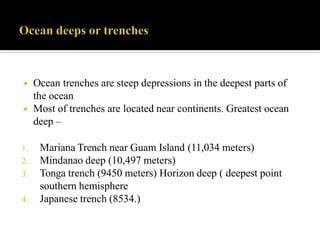
◾ Ocean trenches are steep depressions in the deepest parts of
the ocean
◾ Most of trenches are located near continents. Greatest ocean
deep –
1. Mariana Trench near Guam Island (11,034 meters)
2. Mindanao deep (10,497 meters)
3. Tonga trench (9450 meters) Horizon deep ( deepest point
southern hemisphere
4. Japanese trench (8534.)
◾ An abyssal plain is an underwater plain on the deep ocean
floor
◾ Found at depths - between 3,000 meters and 6,000 meters.
◾ Lying generally between the foot of a continental rise and a
mid-ocean ridge, abyssal plains cover more than 60% of the
Earth's surface.
◾ It has extensive submarine plateaus, ridges, trenches, and
oceanic islands that rise above sea level in the midst of
oceans.
◾ They are generally flat and has more red clay deposits - fine
grained organically originated
◾ A mid-oceanic ridge is composed of two chains of mountains
separated by a large depression. They are an elongated parallel
mountain range with volcanism.
◾ Basalt rocks
◾ Location of ocean floor formation.
: It is a mountain with pointed summits, rising from the seafloor
that does not reach the surface of the ocean.
 Seamounts are volcanic in origin. These can be 3,000- 4,500
m tall.
 The Emperor seamount, an extension of the Hawaiian
Islands in the Pacific Ocean
GUYOTS
◾ It is a flat-topped seamount. They show evidences of
gradual subsidence through stages to become flat topped
submerged mountains. It is estimated that more than
10,000 seamounts and guyots exist in the Pacific Ocean
alone.
pacific Atlantic Indian
Continental shelf East – shelf is
missing – zone of
plate subduction.
And trenches
West – wider
continentalshelf .
Within the back arc
zone of kuril,japan
Philippinesislands.
Very broad.
200 to 500kmwide
Passive plate
activities.
Well developed
fishing zones,
Rich oil reserves.
Broad shelf
absence of major
active subduction
zones.
Land subsidence of
western India
Gulf of Persia made
the CS more wider.
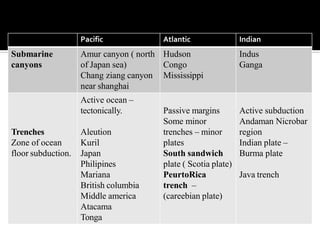
Pacific Atlantic Indian
Submarine
canyons
Amur canyon ( north
of Japan sea)
Chang ziang canyon
near shanghai
Hudson
Congo
Mississippi
Indus
Ganga
Trenches
Zone of ocean
floor subduction.
Active ocean –
tectonically.
Aleution
Kuril
Japan
Philipines
Mariana
British columbia
Middle america
Atacama
Tonga
Passive margins
Some minor
trenches – minor
plates
South sandwich
plate ( Scotia plate)
PeurtoRica
trench –
(careebian plate)
Active subduction
Andaman Nicrobar
region
Indian plate –
Burma plate
Java trench
Pacific Atlantic Indian
Marginal seas
Eastern pacific – n0
marginalsea
Western pacific –
Okhotsk sea,
Hudson
Labrador
Caribbean sea
Rio de la Plata sea.
Mediterranean
North sea
Balticsea
Red sea
Bay of Bengal
Arabian sea
Persian gulf
Andaman sea.
Sea of Japan
East china sea
South china sea
Pacific Atlantic Indian
Islands
Volcanic
Continental
Coralislands
VOLCANIC HOTSPOT
Hawaiian
Midway
Emperor
Easter islands
ARCHIPELAGO
Kurile
Aleutian ,Japan
CONTINENTAL ISLAND
Eastern pacific coast –
Vancouver island.
Chile coastal islands.
CORAL ISLANDS –
tropical part – soth
western equatorial
region – Micronesia
Melanesia, Polynesia
HOT SPOTVOLCANIC
island.
Azores
Part of Iceland
ARCHIPELAGO
South sandwich island
Georgiaisland
LesserAntilles
CONTINENTAL
Cuba , Hispaniola,
Falkland island
CORALS
CentralAtlantic
Volcanic – Hot spot
volcanic
Reunion ,Mauritius
ARCHIPELAGO
Andaman Nicobar
CONTINNENTAL
Sri lanka
Madagascar
CORALS
Maldives
Lakshadweep
Seychelles.
online-pdf-no-copy.com

Geography oceanography optional material.pptx

  • 2.
    ◾ While thereis only one global ocean, the vast body of water that covers 71 percent of the Earth is geographically divided into distinct named regions. The boundaries between these regions have evolved over time for a variety of historical, cultural, geographical, and scientific reasons. ◾ Historically, there are four named oceans: the Atlantic, Pacific, Indian, and Arctic. However, a new ocean has now been recognized as the Southern (Antarctic) as the fifth ocean. The Pacific, Atlantic, and Indian are known as the three major oceans. ◾ They are source of food- fish, mammals, reptiles, salt and other marine foodstuffs. ◾ The tides can be harnessed to provide power.
  • 5.
    ◾ Bathymetry isthe study of underwater depth of ocean floors, lake floors, or river floors. In other words, bathymetry is the underwater equivalent to hypsometry or topography.
  • 6.
    I. Challenger expedition1870s ◾ Used LINE SOUNDING TECHNIQUE – which is good for smaller depth and shallow water study ◾ Studied about the ocean ◾ water salinity ◾ Temperature ◾ Density ◾ Biodiversity ◾ Ocean depth.
  • 7.
  • 8.
    ◾ Double hullsonar – double sided mapping of ocean floor at the same time. ◾ Give a more detailed information about the terrain
  • 9.
    ◾ Swath sonar– they are mobile sonar instruments attached to the moving vessel. ◾ Controlled explosion sonar recorder – ◾ Provide information regarding the composition of rocks and minerals.
  • 10.
    III. GRAVITY STUDY Mountainsand other seafloor features have a lot of mass, so they exert a gravitational pull on the water above and around them; essentially, seamounts pull more water toward their center of mass. This causes water to pile up in small but measurable bumps on the sea surface.
  • 11.
    ◾ MORE MASS= MORE GRAVITY – MORE WATER GET ATTRACTED TOWARDS IT. ◾ David Sandwell of the Scripps Institution of Oceanography and Walter Smith of the National Oceanic and Atmospheric Administration has prepared a global data set that tells where the ridges and valleys are by showing where the planet’s gravity field varies.
  • 14.
    Ocean crust Continentalcrust Basaltic rock Granite, diorite, Andesite, Rhyolite Denser Mafic rocks – rich in iron and magnesium Light felsic rocks Basic in nature Acidic rocks Ocean crust is thinner – 2 to 5 km Thicker crust 20 to 60 km
  • 15.
    Ocean Relief ◾ Asthe continents, Ocean relief is largely due to tectonic, volcanic, erosion and depositional processes and their interactions.
  • 18.
    ◾ Thurman andTrujillo has classified the ocean floor into 3 ◾ Ocean margins ◾ Deep sea plain ◾ Mid ocean ridges
  • 19.
    ◾ Ocean margins 1.continental shelf 2. continental slope 3. continental rise
  • 21.
    ◾ The continentalshelf is the extended margin of each continent occupied by relatively shallow seas. ◾ It is the shallowest part of the ocean showing an average gradient of 1° or even less. ◾ The shelf typically ends at a very steep slope, called the shelf break. ◾ The width of the continental shelves varies from one ocean to another ◾ The average width of continental shelves is about 80 km.
  • 22.
    ◾ Eastern pacificcoast is has very narrow shelf ◾ On the contrary, the Siberian shelf in the Arctic Ocean, the largest in the world, stretches to 1,500 km in width. ◾ The depth of the shelves also varies. It may be as shallow as 30 m in some areas while in some areas it is as deep as 600 m. ◾ The continental shelves are covered with variable thicknesses of sediments brought down by rivers, glaciers, wind, from the land and distributed by waves and currents. ◾ Massive sedimentary deposits received over a long time by the continent shelves, become the source of fossil fuels.
  • 23.
    ◾ Good penetrationof sunlight ◾ Good sediment load ◾ Highly productive zones of the ocean ◾ Rich biodiversity ◾ Fishing zone ◾ Oil and natural gas ◾ Shoals and wider banks are present. – sedimentary accumulation ◾ Grand bank, Sable bank – northAmerica ◾ Dogger bank North sea.
  • 24.
    There are 3views on continental shelf – 1. Tectonic – because of large scale upliftment or submergence of a portion of land. – western coast of India 2. They may have been formed by the deposition of lands derived or river borne materials on the off-shore terrace – eastern deltaic coast of India. 3. Shelf of coral origin -
  • 25.
    Continental shelf geographicalsignificance ◾ Their shallowness enables sunlight to penetrate through the water, which encourages the growth of plants and organism → now rich in plankton → fish thrive on them → so continental shelves are richest fishing grounds. ◾ E.g. – Grand banks off Newfoundland, the North Sea and the Sunda shelf. ◾ Their limited depth and gentle slope keep out cold under- currents ◾ It increase the height of tide.
  • 28.
    ◾ it sometimeshinders shipping and other marine activities since ships can only enter and leave port on the tide. ◾ Ports like Southampton, London, Hamburg, Rotterdam, Hong Kong and Singapore are located on continental shelves.
  • 29.
    ◾ The continentalslope connects the continental shelf and the ocean basins. It begins where the bottom of the continental shelf sharply drops off into a steep slope. ◾ The depth of the slope region varies between 200 and 3,000 m. ◾ The slope boundary indicates the end of the continents. Canyons and trenches are observed in this region. ◾ Do not carry sediments. ◾ Witnesses underwater landslides. Which an trigger TURBIDITY CURRENTS.
  • 30.
    ◾ Slopes havedeep valleys and submarine canyons. ◾ These are deep valleys, some comparable to the Grand Canyon of the Colorado River. ◾ They are sometimes found cutting across the continental shelves and slopes, often extending from the mouths of large rivers. The Hudson Canyon is the best-known submarine canyon in the world.
  • 31.
  • 32.
    ◾ The continentalrise is a low-relief zone of accumulated sediments that lies between the continental slope and the abyssal plain. It is a major part of the continental margin, covering around 10% of the ocean floor.
  • 33.
    ◾ Ocean trenchesare steep depressions in the deepest parts of the ocean ◾ Most of trenches are located near continents. Greatest ocean deep – 1. Mariana Trench near Guam Island (11,034 meters) 2. Mindanao deep (10,497 meters) 3. Tonga trench (9450 meters) Horizon deep ( deepest point southern hemisphere 4. Japanese trench (8534.)
  • 38.
    ◾ An abyssalplain is an underwater plain on the deep ocean floor ◾ Found at depths - between 3,000 meters and 6,000 meters. ◾ Lying generally between the foot of a continental rise and a mid-ocean ridge, abyssal plains cover more than 60% of the Earth's surface. ◾ It has extensive submarine plateaus, ridges, trenches, and oceanic islands that rise above sea level in the midst of oceans.
  • 39.
    ◾ They aregenerally flat and has more red clay deposits - fine grained organically originated
  • 40.
    ◾ A mid-oceanicridge is composed of two chains of mountains separated by a large depression. They are an elongated parallel mountain range with volcanism. ◾ Basalt rocks ◾ Location of ocean floor formation.
  • 45.
    : It isa mountain with pointed summits, rising from the seafloor that does not reach the surface of the ocean.  Seamounts are volcanic in origin. These can be 3,000- 4,500 m tall.  The Emperor seamount, an extension of the Hawaiian Islands in the Pacific Ocean
  • 46.
    GUYOTS ◾ It isa flat-topped seamount. They show evidences of gradual subsidence through stages to become flat topped submerged mountains. It is estimated that more than 10,000 seamounts and guyots exist in the Pacific Ocean alone.
  • 48.
    pacific Atlantic Indian Continentalshelf East – shelf is missing – zone of plate subduction. And trenches West – wider continentalshelf . Within the back arc zone of kuril,japan Philippinesislands. Very broad. 200 to 500kmwide Passive plate activities. Well developed fishing zones, Rich oil reserves. Broad shelf absence of major active subduction zones. Land subsidence of western India Gulf of Persia made the CS more wider.
  • 50.
    Pacific Atlantic Indian Submarine canyons Amurcanyon ( north of Japan sea) Chang ziang canyon near shanghai Hudson Congo Mississippi Indus Ganga Trenches Zone of ocean floor subduction. Active ocean – tectonically. Aleution Kuril Japan Philipines Mariana British columbia Middle america Atacama Tonga Passive margins Some minor trenches – minor plates South sandwich plate ( Scotia plate) PeurtoRica trench – (careebian plate) Active subduction Andaman Nicrobar region Indian plate – Burma plate Java trench
  • 52.
    Pacific Atlantic Indian Marginalseas Eastern pacific – n0 marginalsea Western pacific – Okhotsk sea, Hudson Labrador Caribbean sea Rio de la Plata sea. Mediterranean North sea Balticsea Red sea Bay of Bengal Arabian sea Persian gulf Andaman sea. Sea of Japan East china sea South china sea
  • 53.
    Pacific Atlantic Indian Islands Volcanic Continental Coralislands VOLCANICHOTSPOT Hawaiian Midway Emperor Easter islands ARCHIPELAGO Kurile Aleutian ,Japan CONTINENTAL ISLAND Eastern pacific coast – Vancouver island. Chile coastal islands. CORAL ISLANDS – tropical part – soth western equatorial region – Micronesia Melanesia, Polynesia HOT SPOTVOLCANIC island. Azores Part of Iceland ARCHIPELAGO South sandwich island Georgiaisland LesserAntilles CONTINENTAL Cuba , Hispaniola, Falkland island CORALS CentralAtlantic Volcanic – Hot spot volcanic Reunion ,Mauritius ARCHIPELAGO Andaman Nicobar CONTINNENTAL Sri lanka Madagascar CORALS Maldives Lakshadweep Seychelles.
  • 55.