Guided by,
associate Prof. ASHA MANJERY
Dept. of earth science 108/04/19
CONTENT
Introduction
Chemistry
Condition for karst formation
Morphological features
 conclusion
reference
08/04/19 2
•.
INTRODUCTION
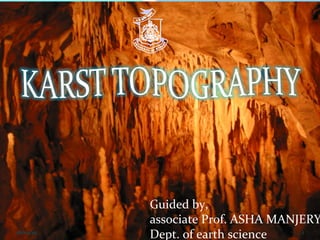
caves, sinkholes,stalagmites,stalactites,
speleogens, natural springs, losing streams,
natural bridges are main features
Karst topography is a geologic formation
shaped by the dissolution of a layer or layers of
soluble bedrock, usually carbonate rock such as
limestone or dolomite
The geological process of erosion can take
thousands of years to form Karst topography
08/04/19 3
CHEMISTRY
Karst landforms are generally the result of
mildly acidic water acting on weakly soluble
bedrock
 The mildly acidic water begins to dissolve the
surface along bedding planes in the bedrock.
These fractures enlarge as the bedrock continues
to dissolve.
 Openings in the rock increase in size, and an
underground drainage system begins to develop,
allowing more water to pass through the area,
08/04/19 4
The Limestone formation contains > 80%
calcium
Carbonates
Complex patterns of joints for conducting water
through subsurface drainage channels
An air-containing zone between ground surface
and water Table
Vegetation cover to supply organic acids
08/04/19 5
•Caverns
•Sinkholes
•Disappearing streams
•cave deposits :
Speleogens
stalactites
stalagmites
columns
•Spring deposits:
geodes
kankars
08/04/19 6
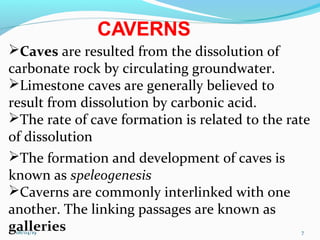
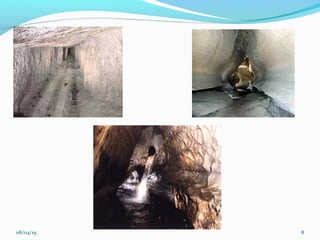
The formation and development of caves is
known as speleogenesis
Caverns are commonly interlinked with one
another. The linking passages are known as
galleries
Caves are resulted from the dissolution of
carbonate rock by circulating groundwater.
Limestone caves are generally believed to
result from dissolution by carbonic acid.
The rate of cave formation is related to the rate
of dissolution
08/04/19 7
08/04/19 8
SINKHOLES
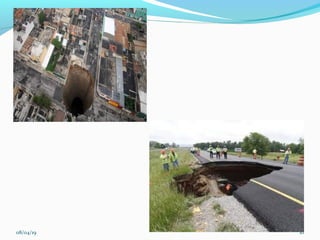
An opening which connects the cave with the surface is
called sinkhole
Some sinkholes are formed when caves have
collapsed-collapse sink hole, others are formed from
dissolution-solution sinkhole
Many sinkholes are located at the
intersection of joints.
New sinkholes are forming because of the
lowering of the water table due to
excessive pumping.08/04/19 9
08/04/19 10
08/04/19 11
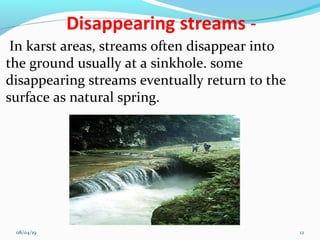
In karst areas, streams often disappear into
the ground usually at a sinkhole. some
disappearing streams eventually return to the
surface as natural spring.
08/04/19 12
Speleogens are irregular or distinctive shapes
of carbonate rock etched from bedrock by
dripping or running water.
• Speleogens can form where bedrock is not
uniform in chemical composition.
speleothems including cone-shaped stalactites ,
stalagmites , columns
08/04/19 13
Stalactites are formed by the deposition of calcium
carbonate and other minerals, which is precipitate
from mineralized water solutions &hanging from the
roof of a cave
 The same water drops that fall from the tip of a
stalactite deposit more calcite on the floor below,
eventually resulting in a rounded or cone-shaped
stalagmite
If these formations grow together, the result is
known as a columns
08/04/19 14
08/04/19 15
Spring deposits
Under ground water highly charged with mineral matter
emerging on the surface in the form of spring is often
found to form loose , superficial deposits of Si or CaCO3.
GEODES: A rock mass with a spherical cavity filled with
mineral crystals. Commonly occur in Limestone & shale
KANKARS: In unconsolidated sediments, such
deposition in the interspaces causes cementation of loose
material and their consequent conversion into compact
rocks. The compact masses so produced are called
Kankars.
08/04/19 16
CONCLUSION
• Karst topography is a geologic formation shaped by
the dissolution of a layer or layers of soluble bedrock.
• Mildly acidic water begins to dissolve the surface along
bedding planes in the bedrock.
• Mainly it seen in limestone terrance's .
• caves, sinkholes,stalagmites,stalactites, speleogens,
natural springs, losing streams, natural bridges are the
main features produced by karst topography.
08/04/19 17
REFERENCE
William D . Thornbary (1954), principles of geomorphology ,
Wiley eastern limited, p.p- 303 to 335.
O.D Von engeln (1942), geomorphology, the MacMillan
company, p.p- 563 to 588
Edward Derbyshire (1976), geomorphology & climate , John
Wiley and sons ,p.p - 345 ,391 to 399.
Websites
www.goole.com
www. Wikepedia.com
08/04/19 18
08/04/19 19

Karst topography

  • 1.
    Guided by, associate Prof.ASHA MANJERY Dept. of earth science 108/04/19
  • 2.
    CONTENT Introduction Chemistry Condition for karstformation Morphological features  conclusion reference 08/04/19 2
  • 3.
    •. INTRODUCTION caves, sinkholes,stalagmites,stalactites, speleogens, naturalsprings, losing streams, natural bridges are main features Karst topography is a geologic formation shaped by the dissolution of a layer or layers of soluble bedrock, usually carbonate rock such as limestone or dolomite The geological process of erosion can take thousands of years to form Karst topography 08/04/19 3
  • 4.
    CHEMISTRY Karst landforms aregenerally the result of mildly acidic water acting on weakly soluble bedrock  The mildly acidic water begins to dissolve the surface along bedding planes in the bedrock. These fractures enlarge as the bedrock continues to dissolve.  Openings in the rock increase in size, and an underground drainage system begins to develop, allowing more water to pass through the area, 08/04/19 4
  • 5.
    The Limestone formationcontains > 80% calcium Carbonates Complex patterns of joints for conducting water through subsurface drainage channels An air-containing zone between ground surface and water Table Vegetation cover to supply organic acids 08/04/19 5
  • 6.
    •Caverns •Sinkholes •Disappearing streams •cave deposits: Speleogens stalactites stalagmites columns •Spring deposits: geodes kankars 08/04/19 6
  • 7.
    The formation anddevelopment of caves is known as speleogenesis Caverns are commonly interlinked with one another. The linking passages are known as galleries Caves are resulted from the dissolution of carbonate rock by circulating groundwater. Limestone caves are generally believed to result from dissolution by carbonic acid. The rate of cave formation is related to the rate of dissolution 08/04/19 7
  • 8.
  • 9.
    SINKHOLES An opening whichconnects the cave with the surface is called sinkhole Some sinkholes are formed when caves have collapsed-collapse sink hole, others are formed from dissolution-solution sinkhole Many sinkholes are located at the intersection of joints. New sinkholes are forming because of the lowering of the water table due to excessive pumping.08/04/19 9
  • 10.
  • 11.
  • 12.
    In karst areas,streams often disappear into the ground usually at a sinkhole. some disappearing streams eventually return to the surface as natural spring. 08/04/19 12
  • 13.
    Speleogens are irregularor distinctive shapes of carbonate rock etched from bedrock by dripping or running water. • Speleogens can form where bedrock is not uniform in chemical composition. speleothems including cone-shaped stalactites , stalagmites , columns 08/04/19 13
  • 14.
    Stalactites are formedby the deposition of calcium carbonate and other minerals, which is precipitate from mineralized water solutions &hanging from the roof of a cave  The same water drops that fall from the tip of a stalactite deposit more calcite on the floor below, eventually resulting in a rounded or cone-shaped stalagmite If these formations grow together, the result is known as a columns 08/04/19 14
  • 15.
  • 16.
    Spring deposits Under groundwater highly charged with mineral matter emerging on the surface in the form of spring is often found to form loose , superficial deposits of Si or CaCO3. GEODES: A rock mass with a spherical cavity filled with mineral crystals. Commonly occur in Limestone & shale KANKARS: In unconsolidated sediments, such deposition in the interspaces causes cementation of loose material and their consequent conversion into compact rocks. The compact masses so produced are called Kankars. 08/04/19 16
  • 17.
    CONCLUSION • Karst topographyis a geologic formation shaped by the dissolution of a layer or layers of soluble bedrock. • Mildly acidic water begins to dissolve the surface along bedding planes in the bedrock. • Mainly it seen in limestone terrance's . • caves, sinkholes,stalagmites,stalactites, speleogens, natural springs, losing streams, natural bridges are the main features produced by karst topography. 08/04/19 17
  • 18.
    REFERENCE William D .Thornbary (1954), principles of geomorphology , Wiley eastern limited, p.p- 303 to 335. O.D Von engeln (1942), geomorphology, the MacMillan company, p.p- 563 to 588 Edward Derbyshire (1976), geomorphology & climate , John Wiley and sons ,p.p - 345 ,391 to 399. Websites www.goole.com www. Wikepedia.com 08/04/19 18
  • 19.