
OCEAN CURRENTSOCEAN CURRENTS
Tanuj PareekTanuj Pareek
OceanographyOceanography
Kirorimal College DU , INDIAKirorimal College DU , INDIA
CURRENTSCURRENTS
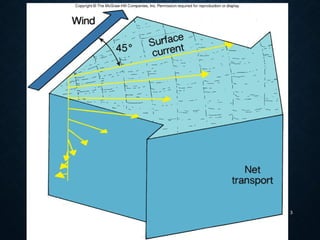
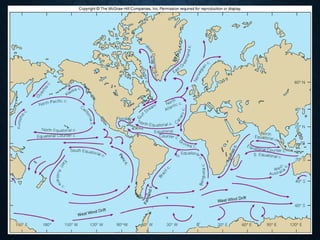
• Surface currents in the oceans are driven by winds. The
major surface circulation patterns at sea are the result of the
prevailing winds in the atmosphere.
• Prevailing winds in the atmosphere drive surface currents in
the oceans in predictable patterns.
• Because the density of the water is about 1000 times greater
than the density of the air, the motion in the water will
continue even when there is no wind because of the water’s
inertia.
• Surface circulation is a response to the long-term average
atmospheric circulation.
2
3
OCEAN CURRENTS- INDIANOCEAN CURRENTS- INDIAN
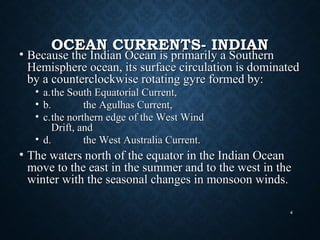
• Because the Indian Ocean is primarily a SouthernBecause the Indian Ocean is primarily a Southern
Hemisphere ocean, its surface circulation is dominatedHemisphere ocean, its surface circulation is dominated
by a counterclockwise rotating gyre formed by:by a counterclockwise rotating gyre formed by:
• a.a.the South Equatorial Current,the South Equatorial Current,
• b.b. the Agulhas Current,the Agulhas Current,
• c.c.the northern edge of the West Windthe northern edge of the West Wind
Drift, andDrift, and
• d.d. the West Australia Current.the West Australia Current.
• The waters north of the equator in the Indian OceanThe waters north of the equator in the Indian Ocean
move to the east in the summer and to the west in themove to the east in the summer and to the west in the
winter with the seasonal changes in monsoon winds.winter with the seasonal changes in monsoon winds.
4
5
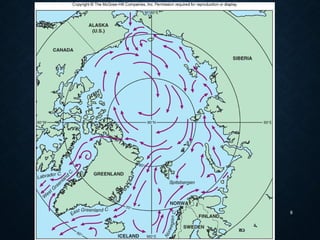
OCEAN CURRENTS- POLAROCEAN CURRENTS- POLAR
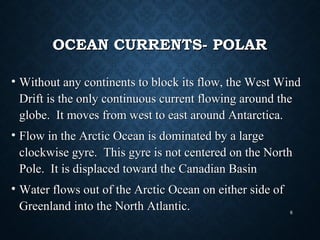
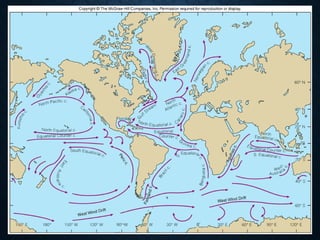
• Without any continents to block its flow, the West WindWithout any continents to block its flow, the West Wind
Drift is the only continuous current flowing around theDrift is the only continuous current flowing around the
globe. It moves from west to east around Antarctica.globe. It moves from west to east around Antarctica.
• Flow in the Arctic Ocean is dominated by a largeFlow in the Arctic Ocean is dominated by a large
clockwise gyre. This gyre is not centered on the Northclockwise gyre. This gyre is not centered on the North
Pole. It is displaced toward the Canadian BasinPole. It is displaced toward the Canadian Basin
• Water flows out of the Arctic Ocean on either side ofWater flows out of the Arctic Ocean on either side of
Greenland into the North Atlantic.Greenland into the North Atlantic. 6
7
8
EDDIESEDDIES
• Currents do not generally flow in
smooth curves or straight lines.
Current paths will meander and
sometimes close on themselves to form
eddies.
9
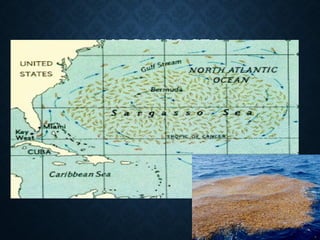
SARGASSO SEASARGASSO SEA
10
PATTERNS OF GLOBAL
CIRCULATION
• Circulation patterns have changed with time
in response to changing configurations of
continents, climate patterns, and
atmospheric circulation.
• Studies of fossil organisms in marine
sediments show that the temperature of the
North Atlantic Ocean has varied during
glacial and interglacial periods.
• These changes have been related to
Milankovitch cycles. 11
THE END
12

Ocean Currents

  • 1.
    OCEAN CURRENTSOCEAN CURRENTS TanujPareekTanuj Pareek OceanographyOceanography Kirorimal College DU , INDIAKirorimal College DU , INDIA
  • 2.
    CURRENTSCURRENTS • Surface currentsin the oceans are driven by winds. The major surface circulation patterns at sea are the result of the prevailing winds in the atmosphere. • Prevailing winds in the atmosphere drive surface currents in the oceans in predictable patterns. • Because the density of the water is about 1000 times greater than the density of the air, the motion in the water will continue even when there is no wind because of the water’s inertia. • Surface circulation is a response to the long-term average atmospheric circulation. 2
  • 3.
  • 4.
    OCEAN CURRENTS- INDIANOCEANCURRENTS- INDIAN • Because the Indian Ocean is primarily a SouthernBecause the Indian Ocean is primarily a Southern Hemisphere ocean, its surface circulation is dominatedHemisphere ocean, its surface circulation is dominated by a counterclockwise rotating gyre formed by:by a counterclockwise rotating gyre formed by: • a.a.the South Equatorial Current,the South Equatorial Current, • b.b. the Agulhas Current,the Agulhas Current, • c.c.the northern edge of the West Windthe northern edge of the West Wind Drift, andDrift, and • d.d. the West Australia Current.the West Australia Current. • The waters north of the equator in the Indian OceanThe waters north of the equator in the Indian Ocean move to the east in the summer and to the west in themove to the east in the summer and to the west in the winter with the seasonal changes in monsoon winds.winter with the seasonal changes in monsoon winds. 4
  • 5.
  • 6.
    OCEAN CURRENTS- POLAROCEANCURRENTS- POLAR • Without any continents to block its flow, the West WindWithout any continents to block its flow, the West Wind Drift is the only continuous current flowing around theDrift is the only continuous current flowing around the globe. It moves from west to east around Antarctica.globe. It moves from west to east around Antarctica. • Flow in the Arctic Ocean is dominated by a largeFlow in the Arctic Ocean is dominated by a large clockwise gyre. This gyre is not centered on the Northclockwise gyre. This gyre is not centered on the North Pole. It is displaced toward the Canadian BasinPole. It is displaced toward the Canadian Basin • Water flows out of the Arctic Ocean on either side ofWater flows out of the Arctic Ocean on either side of Greenland into the North Atlantic.Greenland into the North Atlantic. 6
  • 7.
  • 8.
  • 9.
    EDDIESEDDIES • Currents donot generally flow in smooth curves or straight lines. Current paths will meander and sometimes close on themselves to form eddies. 9
  • 10.
  • 11.
    PATTERNS OF GLOBAL CIRCULATION •Circulation patterns have changed with time in response to changing configurations of continents, climate patterns, and atmospheric circulation. • Studies of fossil organisms in marine sediments show that the temperature of the North Atlantic Ocean has varied during glacial and interglacial periods. • These changes have been related to Milankovitch cycles. 11
  • 12.