NORMAL CURVE
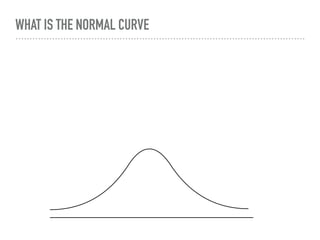
WHAT IS THE NORMAL CURVE
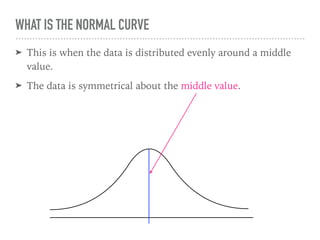
➤ This is when the data is distributed evenly around a middle
value.
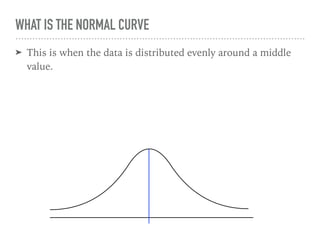
WHAT IS THE NORMAL CURVE
➤ This is when the data is distributed evenly around a middle
value.
➤ The data is symmetrical about the middle value.
WHAT IS THE NORMAL CURVE
➤ This is when the data is distributed evenly around a middle
value.
➤ The data is symmetrical about the middle value.
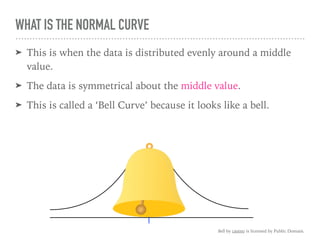
➤ This is called a ‘Bell Curve’ because it looks like a bell.
Bell by casino is licensed by Public Domain.
WHAT IS THE NORMAL CURVE
➤ This is when the data is distributed evenly around a middle
value.
➤ The data is symmetrical about the middle value.
➤ This is called a ‘Bell Curve’ because it looks like a bell.
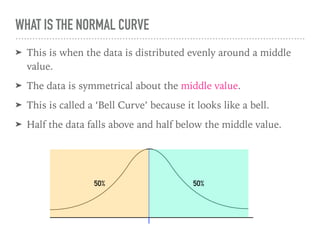
➤ Half the data falls above and half below the middle value.
50% 50%
MEAN - MEDIAN - MODE
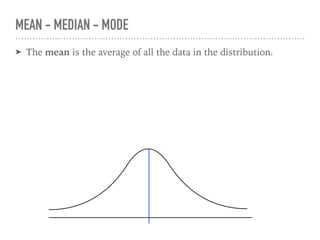
➤ The mean is the average of all the data in the distribution.
MEAN - MEDIAN - MODE
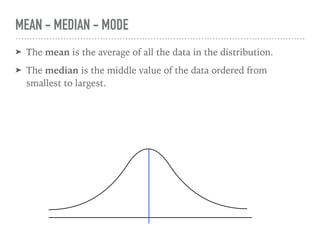
➤ The mean is the average of all the data in the distribution.
➤ The median is the middle value of the data ordered from
smallest to largest.
MEAN - MEDIAN - MODE
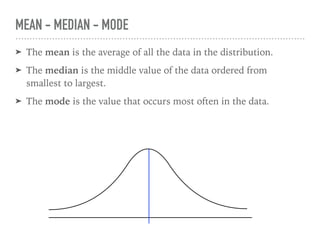
➤ The mean is the average of all the data in the distribution.
➤ The median is the middle value of the data ordered from
smallest to largest.
➤ The mode is the value that occurs most often in the data.
MEAN - MEDIAN - MODE
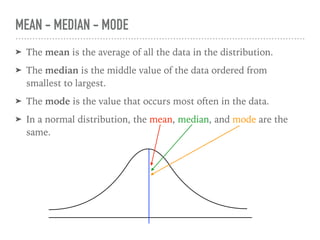
➤ The mean is the average of all the data in the distribution.
➤ The median is the middle value of the data ordered from
smallest to largest.
➤ The mode is the value that occurs most often in the data.
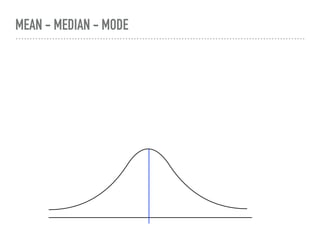
➤ In a normal distribution, the mean, median, and mode are the
same.
MEAN - MEDIAN - MODE
STANDARD DEVIATION
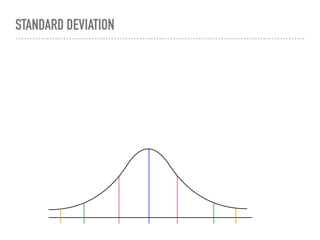
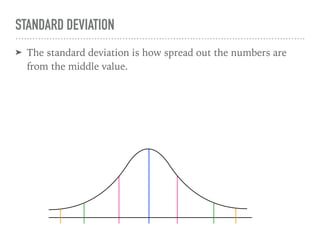
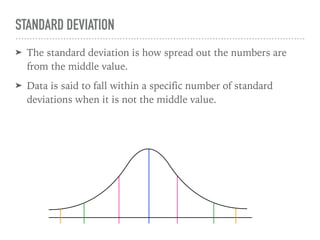
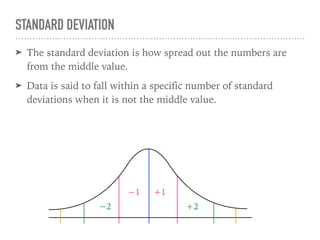
➤ The standard deviation is how spread out the numbers are
from the middle value.
STANDARD DEVIATION
➤ The standard deviation is how spread out the numbers are
from the middle value.
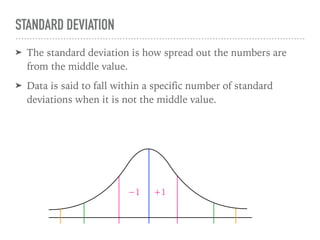
➤ Data is said to fall within a specific number of standard
deviations when it is not the middle value.
STANDARD DEVIATION
➤ The standard deviation is how spread out the numbers are
from the middle value.
➤ Data is said to fall within a specific number of standard
deviations when it is not the middle value.
STANDARD DEVIATION
+1−1
➤ The standard deviation is how spread out the numbers are
from the middle value.
➤ Data is said to fall within a specific number of standard
deviations when it is not the middle value.
STANDARD DEVIATION
+1−1
+2−2
➤ The standard deviation is how spread out the numbers are
from the middle value.
➤ Data is said to fall within a specific number of standard
deviations when it is not the middle value.
STANDARD DEVIATION
+1−1
+2−2
+3−3
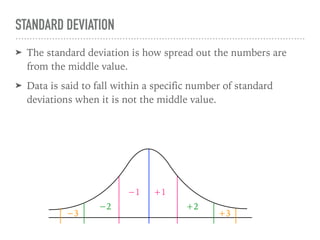
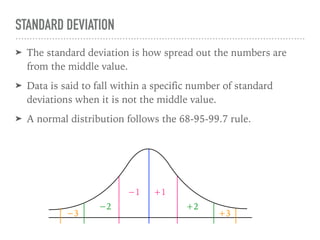
➤ The standard deviation is how spread out the numbers are
from the middle value.
➤ Data is said to fall within a specific number of standard
deviations when it is not the middle value.
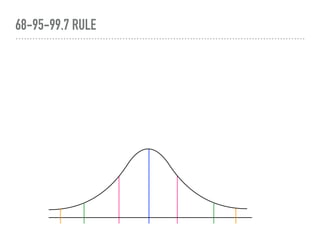
➤ A normal distribution follows the 68-95-99.7 rule.
STANDARD DEVIATION
+1−1
+2−2
+3−3
68-95-99.7 RULE
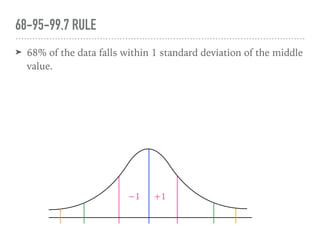
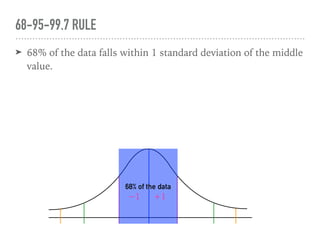
➤ 68% of the data falls within 1 standard deviation of the middle
value.
68-95-99.7 RULE
+1−1
➤ 68% of the data falls within 1 standard deviation of the middle
value.
68-95-99.7 RULE
68% of the data
+1−1
➤ 68% of the data falls within 1 standard deviation of the middle
value.
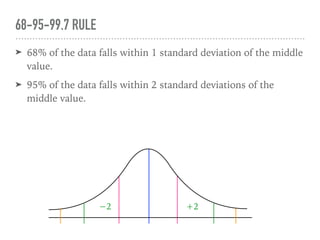
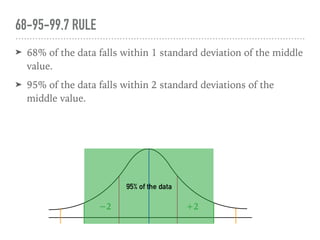
➤ 95% of the data falls within 2 standard deviations of the
middle value.
68-95-99.7 RULE
+2−2
➤ 68% of the data falls within 1 standard deviation of the middle
value.
➤ 95% of the data falls within 2 standard deviations of the
middle value.
68-95-99.7 RULE
95% of the data
+2−2
➤ 68% of the data falls within 1 standard deviation of the middle
value.
➤ 95% of the data falls within 2 standard deviations of the
middle value.
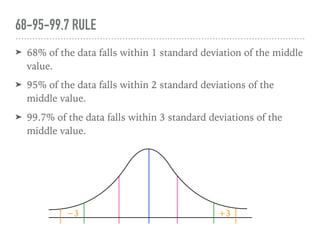
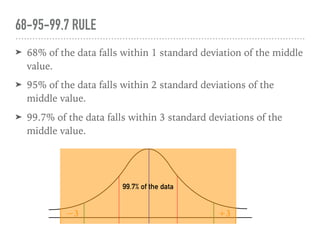
➤ 99.7% of the data falls within 3 standard deviations of the
middle value.
68-95-99.7 RULE
+3−3
➤ 68% of the data falls within 1 standard deviation of the middle
value.
➤ 95% of the data falls within 2 standard deviations of the
middle value.
➤ 99.7% of the data falls within 3 standard deviations of the
middle value.
68-95-99.7 RULE
99.7% of the data
+3−3
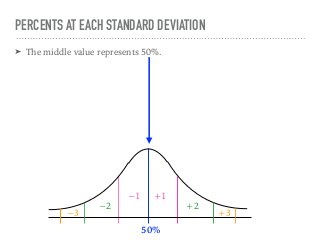
➤ The middle value represents 50%.
PERCENTS AT EACH STANDARD DEVIATION
+1−1
+2−2
+3−3
50%
➤ The middle value represents 50%.
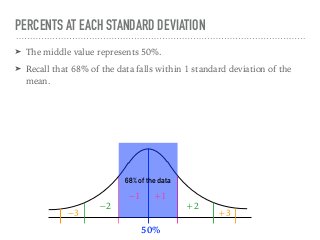
➤ Recall that 68% of the data falls within 1 standard deviation of the
mean.
PERCENTS AT EACH STANDARD DEVIATION
68% of the data
+1−1
+2−2
+3−3
50%
➤ The middle value represents 50%.
➤ Recall that 68% of the data falls within 1 standard deviation of the
mean.
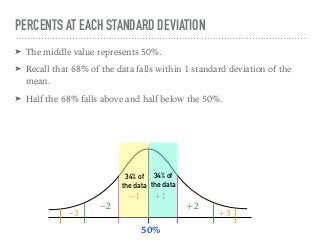
➤ Half the 68% falls above and half below the 50%.
PERCENTS AT EACH STANDARD DEVIATION
+1−1
+2−2
+3−3
50%
34% of
the data
34% of
the data
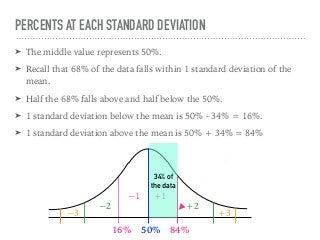
➤ The middle value represents 50%.
➤ Recall that 68% of the data falls within 1 standard deviation of the
mean.
➤ Half the 68% falls above and half below the 50%.
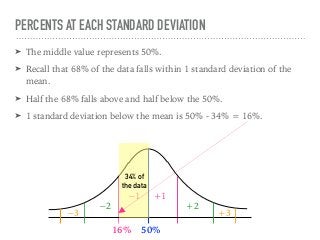
➤ 1 standard deviation below the mean is 50% - 34% = 16%.
PERCENTS AT EACH STANDARD DEVIATION
+1−1
+2−2
+3−3
50%
34% of
the data
16%
➤ The middle value represents 50%.
➤ Recall that 68% of the data falls within 1 standard deviation of the
mean.
➤ Half the 68% falls above and half below the 50%.
➤ 1 standard deviation below the mean is 50% - 34% = 16%.
➤ 1 standard deviation above the mean is 50% + 34% = 84%
PERCENTS AT EACH STANDARD DEVIATION
+1−1
+2−2
+3−3
50%16% 84%
34% of
the data
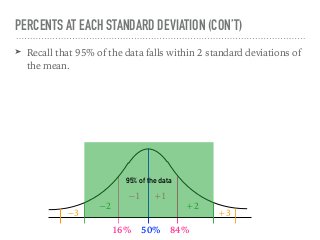
➤ Recall that 95% of the data falls within 2 standard deviations of
the mean.
PERCENTS AT EACH STANDARD DEVIATION (CON’T)
+1−1
+2−2
+3−3
50%16% 84%
95% of the data
➤ Recall that 95% of the data falls within 2 standard deviations of
the mean.
➤ Half the 95% falls above and half below the 50%.
PERCENTS AT EACH STANDARD DEVIATION (CON’T)
+1−1
+2−2
+3−3
50%
47.5% of the data 47.5% of the data
16% 84%
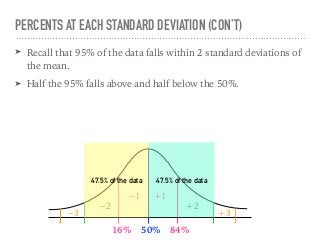
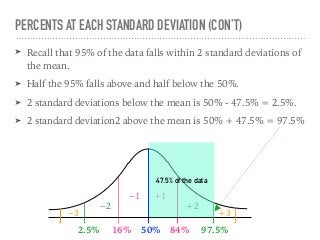
➤ Recall that 95% of the data falls within 2 standard deviations of
the mean.
➤ Half the 95% falls above and half below the 50%.
➤ 2 standard deviations below the mean is 50% - 47.5% = 2.5%.
PERCENTS AT EACH STANDARD DEVIATION (CON’T)
+1−1
+2−2
+3−3
50%
47.5% of the data
16% 84%2.5%
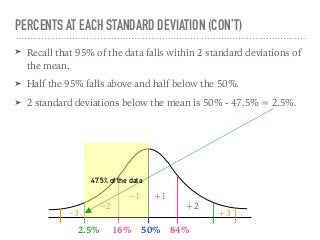
➤ Recall that 95% of the data falls within 2 standard deviations of
the mean.
➤ Half the 95% falls above and half below the 50%.
➤ 2 standard deviations below the mean is 50% - 47.5% = 2.5%.
➤ 2 standard deviation2 above the mean is 50% + 47.5% = 97.5%
PERCENTS AT EACH STANDARD DEVIATION (CON’T)
+1−1
+2−2
+3−3
50%16% 84%
47.5% of the data
2.5% 97.5%
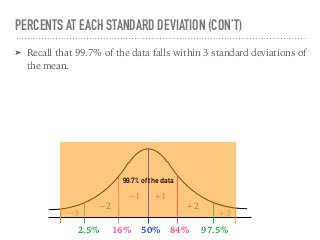
➤ Recall that 99.7% of the data falls within 3 standard deviations of
the mean.
PERCENTS AT EACH STANDARD DEVIATION (CON’T)
+1−1
+2−2
+3−3
50%16% 84%2.5% 97.5%
99.7% of the data
➤ Recall that 99.7% of the data falls within 3 standard deviations of
the mean.
➤ Half the 99.7% falls above and half below the 50%.
PERCENTS AT EACH STANDARD DEVIATION (CON’T)
+1−1
+2−2
+3−3
50%
49.85% of the data 49.85% of the data
16% 84%2.5% 97.5%
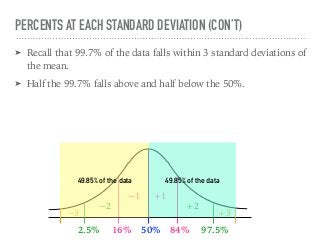
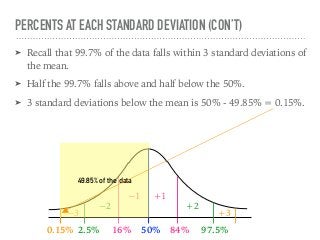
➤ Recall that 99.7% of the data falls within 3 standard deviations of
the mean.
➤ Half the 99.7% falls above and half below the 50%.
➤ 3 standard deviations below the mean is 50% - 49.85% = 0.15%.
PERCENTS AT EACH STANDARD DEVIATION (CON’T)
+1−1
+2−2
+3−3
50%
49.85% of the data
16% 84%2.5% 97.5%0.15%
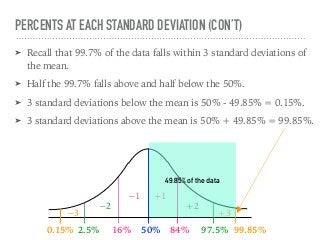
➤ Recall that 99.7% of the data falls within 3 standard deviations of
the mean.
➤ Half the 99.7% falls above and half below the 50%.
➤ 3 standard deviations below the mean is 50% - 49.85% = 0.15%.
➤ 3 standard deviations above the mean is 50% + 49.85% = 99.85%.
PERCENTS AT EACH STANDARD DEVIATION (CON’T)
+1−1
+2−2
+3−3
50%16% 84%
49.85% of the data
2.5% 97.5%0.15% 99.85%

Normal curve

  • 1.
  • 2.
    WHAT IS THENORMAL CURVE
  • 3.
    WHAT IS THENORMAL CURVE ➤ This is when the data is distributed evenly around a middle value.
  • 4.
    WHAT IS THENORMAL CURVE ➤ This is when the data is distributed evenly around a middle value. ➤ The data is symmetrical about the middle value.
  • 5.
    WHAT IS THENORMAL CURVE ➤ This is when the data is distributed evenly around a middle value. ➤ The data is symmetrical about the middle value. ➤ This is called a ‘Bell Curve’ because it looks like a bell. Bell by casino is licensed by Public Domain.
  • 6.
    WHAT IS THENORMAL CURVE ➤ This is when the data is distributed evenly around a middle value. ➤ The data is symmetrical about the middle value. ➤ This is called a ‘Bell Curve’ because it looks like a bell. ➤ Half the data falls above and half below the middle value. 50% 50%
  • 7.
  • 8.
    ➤ The meanis the average of all the data in the distribution. MEAN - MEDIAN - MODE
  • 9.
    ➤ The meanis the average of all the data in the distribution. ➤ The median is the middle value of the data ordered from smallest to largest. MEAN - MEDIAN - MODE
  • 10.
    ➤ The meanis the average of all the data in the distribution. ➤ The median is the middle value of the data ordered from smallest to largest. ➤ The mode is the value that occurs most often in the data. MEAN - MEDIAN - MODE
  • 11.
    ➤ The meanis the average of all the data in the distribution. ➤ The median is the middle value of the data ordered from smallest to largest. ➤ The mode is the value that occurs most often in the data. ➤ In a normal distribution, the mean, median, and mode are the same. MEAN - MEDIAN - MODE
  • 12.
  • 13.
    ➤ The standarddeviation is how spread out the numbers are from the middle value. STANDARD DEVIATION
  • 14.
    ➤ The standarddeviation is how spread out the numbers are from the middle value. ➤ Data is said to fall within a specific number of standard deviations when it is not the middle value. STANDARD DEVIATION
  • 15.
    ➤ The standarddeviation is how spread out the numbers are from the middle value. ➤ Data is said to fall within a specific number of standard deviations when it is not the middle value. STANDARD DEVIATION +1−1
  • 16.
    ➤ The standarddeviation is how spread out the numbers are from the middle value. ➤ Data is said to fall within a specific number of standard deviations when it is not the middle value. STANDARD DEVIATION +1−1 +2−2
  • 17.
    ➤ The standarddeviation is how spread out the numbers are from the middle value. ➤ Data is said to fall within a specific number of standard deviations when it is not the middle value. STANDARD DEVIATION +1−1 +2−2 +3−3
  • 18.
    ➤ The standarddeviation is how spread out the numbers are from the middle value. ➤ Data is said to fall within a specific number of standard deviations when it is not the middle value. ➤ A normal distribution follows the 68-95-99.7 rule. STANDARD DEVIATION +1−1 +2−2 +3−3
  • 19.
  • 20.
    ➤ 68% ofthe data falls within 1 standard deviation of the middle value. 68-95-99.7 RULE +1−1
  • 21.
    ➤ 68% ofthe data falls within 1 standard deviation of the middle value. 68-95-99.7 RULE 68% of the data +1−1
  • 22.
    ➤ 68% ofthe data falls within 1 standard deviation of the middle value. ➤ 95% of the data falls within 2 standard deviations of the middle value. 68-95-99.7 RULE +2−2
  • 23.
    ➤ 68% ofthe data falls within 1 standard deviation of the middle value. ➤ 95% of the data falls within 2 standard deviations of the middle value. 68-95-99.7 RULE 95% of the data +2−2
  • 24.
    ➤ 68% ofthe data falls within 1 standard deviation of the middle value. ➤ 95% of the data falls within 2 standard deviations of the middle value. ➤ 99.7% of the data falls within 3 standard deviations of the middle value. 68-95-99.7 RULE +3−3
  • 25.
    ➤ 68% ofthe data falls within 1 standard deviation of the middle value. ➤ 95% of the data falls within 2 standard deviations of the middle value. ➤ 99.7% of the data falls within 3 standard deviations of the middle value. 68-95-99.7 RULE 99.7% of the data +3−3
  • 26.
    ➤ The middlevalue represents 50%. PERCENTS AT EACH STANDARD DEVIATION +1−1 +2−2 +3−3 50%
  • 27.
    ➤ The middlevalue represents 50%. ➤ Recall that 68% of the data falls within 1 standard deviation of the mean. PERCENTS AT EACH STANDARD DEVIATION 68% of the data +1−1 +2−2 +3−3 50%
  • 28.
    ➤ The middlevalue represents 50%. ➤ Recall that 68% of the data falls within 1 standard deviation of the mean. ➤ Half the 68% falls above and half below the 50%. PERCENTS AT EACH STANDARD DEVIATION +1−1 +2−2 +3−3 50% 34% of the data 34% of the data
  • 29.
    ➤ The middlevalue represents 50%. ➤ Recall that 68% of the data falls within 1 standard deviation of the mean. ➤ Half the 68% falls above and half below the 50%. ➤ 1 standard deviation below the mean is 50% - 34% = 16%. PERCENTS AT EACH STANDARD DEVIATION +1−1 +2−2 +3−3 50% 34% of the data 16%
  • 30.
    ➤ The middlevalue represents 50%. ➤ Recall that 68% of the data falls within 1 standard deviation of the mean. ➤ Half the 68% falls above and half below the 50%. ➤ 1 standard deviation below the mean is 50% - 34% = 16%. ➤ 1 standard deviation above the mean is 50% + 34% = 84% PERCENTS AT EACH STANDARD DEVIATION +1−1 +2−2 +3−3 50%16% 84% 34% of the data
  • 31.
    ➤ Recall that95% of the data falls within 2 standard deviations of the mean. PERCENTS AT EACH STANDARD DEVIATION (CON’T) +1−1 +2−2 +3−3 50%16% 84% 95% of the data
  • 32.
    ➤ Recall that95% of the data falls within 2 standard deviations of the mean. ➤ Half the 95% falls above and half below the 50%. PERCENTS AT EACH STANDARD DEVIATION (CON’T) +1−1 +2−2 +3−3 50% 47.5% of the data 47.5% of the data 16% 84%
  • 33.
    ➤ Recall that95% of the data falls within 2 standard deviations of the mean. ➤ Half the 95% falls above and half below the 50%. ➤ 2 standard deviations below the mean is 50% - 47.5% = 2.5%. PERCENTS AT EACH STANDARD DEVIATION (CON’T) +1−1 +2−2 +3−3 50% 47.5% of the data 16% 84%2.5%
  • 34.
    ➤ Recall that95% of the data falls within 2 standard deviations of the mean. ➤ Half the 95% falls above and half below the 50%. ➤ 2 standard deviations below the mean is 50% - 47.5% = 2.5%. ➤ 2 standard deviation2 above the mean is 50% + 47.5% = 97.5% PERCENTS AT EACH STANDARD DEVIATION (CON’T) +1−1 +2−2 +3−3 50%16% 84% 47.5% of the data 2.5% 97.5%
  • 35.
    ➤ Recall that99.7% of the data falls within 3 standard deviations of the mean. PERCENTS AT EACH STANDARD DEVIATION (CON’T) +1−1 +2−2 +3−3 50%16% 84%2.5% 97.5% 99.7% of the data
  • 36.
    ➤ Recall that99.7% of the data falls within 3 standard deviations of the mean. ➤ Half the 99.7% falls above and half below the 50%. PERCENTS AT EACH STANDARD DEVIATION (CON’T) +1−1 +2−2 +3−3 50% 49.85% of the data 49.85% of the data 16% 84%2.5% 97.5%
  • 37.
    ➤ Recall that99.7% of the data falls within 3 standard deviations of the mean. ➤ Half the 99.7% falls above and half below the 50%. ➤ 3 standard deviations below the mean is 50% - 49.85% = 0.15%. PERCENTS AT EACH STANDARD DEVIATION (CON’T) +1−1 +2−2 +3−3 50% 49.85% of the data 16% 84%2.5% 97.5%0.15%
  • 38.
    ➤ Recall that99.7% of the data falls within 3 standard deviations of the mean. ➤ Half the 99.7% falls above and half below the 50%. ➤ 3 standard deviations below the mean is 50% - 49.85% = 0.15%. ➤ 3 standard deviations above the mean is 50% + 49.85% = 99.85%. PERCENTS AT EACH STANDARD DEVIATION (CON’T) +1−1 +2−2 +3−3 50%16% 84% 49.85% of the data 2.5% 97.5%0.15% 99.85%