The Normal Distribution
DEPARTMENT OF STATISTICS
RAMJAS COLLEGE,
UNIVERSITY OF DELHI
Presented By:
Shubham Mehta
BSc. (H) Statistics
Examples of continuous
probability distributions:
The normal and standard normal
Order of Study
 Introduction
 Functions
 Graphs
 Data Analysis and Problems
 Case Study and Questions
 Binomial Approximations
 Conclusion
Normal Distribution
Normal Distribution, also called Gaussian
Distribution, is one of the widely used
continuous distributions existing which is
used to model a number of scenarios such as
marks of students, heights of people, salaries
of working people etc.
It is given utmost importance due to Central
Limit Theorem which shall not be dealt with
here.
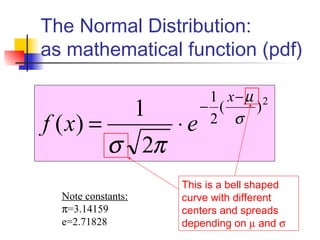
The Normal Distribution:
as mathematical function (pdf)
2
)(
2
1
2
1
)( σ
µ
πσ
−
−
⋅=
x
exf
Note constants:
π=3.14159
e=2.71828
This is a bell shaped
curve with different
centers and spreads
depending on µ and σ
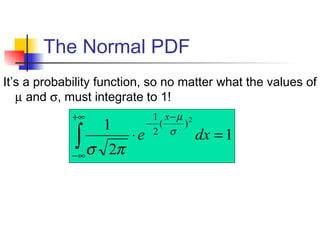
The Normal PDF
1
2
1 2
)(
2
1
=⋅∫
+∞
∞−
−
−
dxe
x
σ
µ
πσ
It’s a probability function, so no matter what the values of
µ and σ, must integrate to 1!
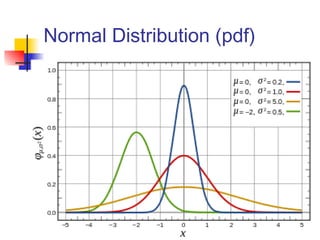
Normal Distribution (pdf)
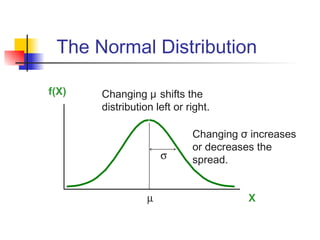
The Normal Distribution
X
f(X)
µ
σ
Changing μ shifts the
distribution left or right.
Changing σ increases
or decreases the
spread.
Normal distribution is defined
by its mean and standard dev.
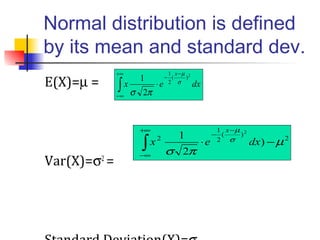
E(X)=µ =
Var(X)=σ2
=
dxex
x
∫
+∞
∞−
−
−
⋅
2
)(
2
1
2
1 σ
µ
πσ
2
)(
2
1
2
)
2
1
(
2
µ
πσ
σ
µ
−⋅∫
+∞
∞−
−
−
dxex
x
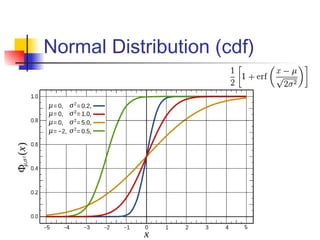
Normal Distribution (cdf)
Properties of Normal
Distribution
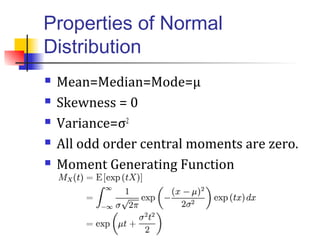
 Mean=Median=Mode=µ
 Skewness = 0
 Variance=σ2
 All odd order central moments are zero.
 Moment Generating Function
*
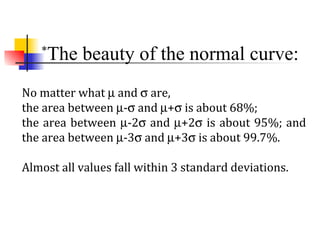
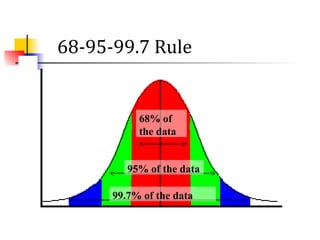
The beauty of the normal curve:
No matter what µ and σ are,
the area between µ-σ and µ+σ is about 68%;
the area between µ-2σ and µ+2σ is about 95%; and
the area between µ-3σ and µ+3σ is about 99.7%.
Almost all values fall within 3 standard deviations.
68-95-99.7 Rule
68% of
the data
95% of the data
99.7% of the data
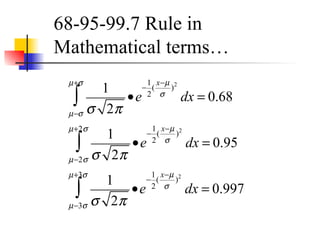
68-95-99.7 Rule in
Mathematical terms…
1
σ 2π
•e
−
1
2
(
x−µ
σ
)2
dx
µ−σ
µ+σ
∫ = 0.68
1
σ 2π
•e
−
1
2
(
x−µ
σ
)2
dx
µ−2σ
µ+2σ
∫ = 0.95
1
σ 2π
•e
−
1
2
(
x−µ
σ
)2
dx
µ−3σ
µ+3σ
∫ = 0.997
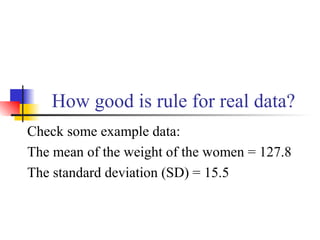
How good is rule for real data?
Check some example data:
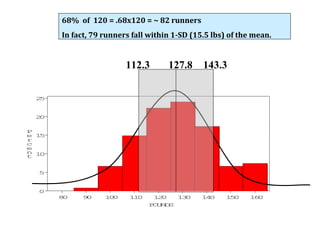
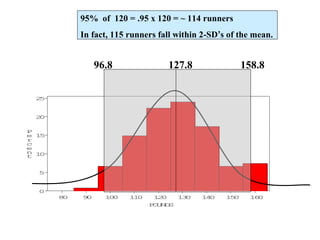
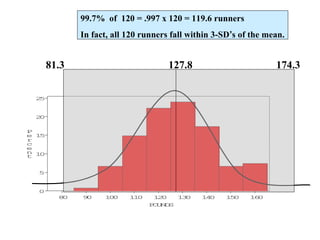
The mean of the weight of the women = 127.8
The standard deviation (SD) = 15.5
80 90 100 110 120 130 140 150 160
0
5
10
15
20
25
P
e
r
c
e
n
t
POUNDS
127.8 143.3112.3
68% of 120 = .68x120 = ~ 82 runners
In fact, 79 runners fall within 1-SD (15.5 lbs) of the mean.
80 90 100 110 120 130 140 150 160
0
5
10
15
20
25
P
e
r
c
e
n
t
POUNDS
127.896.8
95% of 120 = .95 x 120 = ~ 114 runners
In fact, 115 runners fall within 2-SD’s of the mean.
158.8
80 90 100 110 120 130 140 150 160
0
5
10
15
20
25
P
e
r
c
e
n
t
POUNDS
127.881.3
99.7% of 120 = .997 x 120 = 119.6 runners
In fact, all 120 runners fall within 3-SD’s of the mean.
174.3
Example
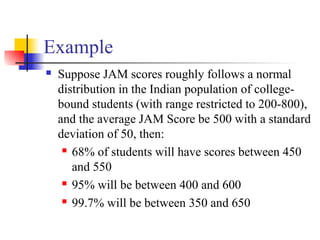
 Suppose JAM scores roughly follows a normal
distribution in the Indian population of college-
bound students (with range restricted to 200-800),
and the average JAM Score be 500 with a standard
deviation of 50, then:
 68% of students will have scores between 450
and 550
 95% will be between 400 and 600
 99.7% will be between 350 and 650
Example
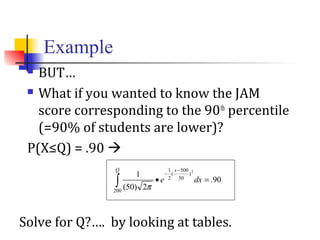
 BUT…
 What if you wanted to know the JAM
score corresponding to the 90th
percentile
(=90% of students are lower)?
P(X≤Q) = .90 
90.
2)50(
1
200
)
50
500
(
2
1 2
=•∫
−
−
Q x
dxe
π
Solve for Q?…. by looking at tables.
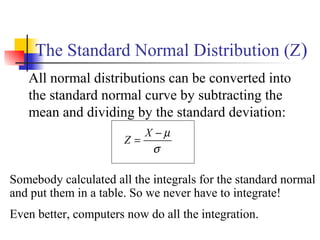
The Standard Normal Distribution (Z)
All normal distributions can be converted into
the standard normal curve by subtracting the
mean and dividing by the standard deviation:
σ
µ−
=
X
Z
Somebody calculated all the integrals for the standard normal
and put them in a table. So we never have to integrate!
Even better, computers now do all the integration.
The Standard Normal (Z):
“Universal Currency”
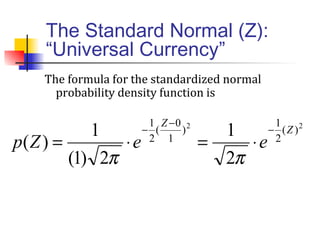
The formula for the standardized normal
probability density function is
22
)(
2
1
)
1
0
(
2
1
2
1
2)1(
1
)(
Z
Z
eeZp
−
−
−
⋅=⋅=
ππ
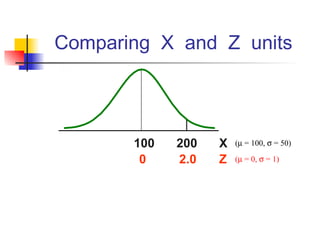
Comparing X and Z units
Z
100
2.00
200 X (µ = 100, σ = 50)
(µ = 0, σ = 1)
Example
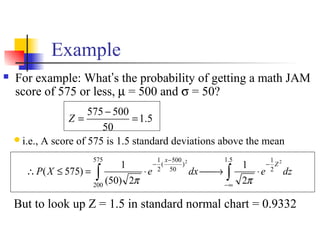
 For example: What’s the probability of getting a math JAM
score of 575 or less, µ = 500 and σ = 50?
5.1
50
500575
=
−
=Z
i.e., A score of 575 is 1.5 standard deviations above the mean
∫∫ ∞−
−
−
−
⋅→⋅=≤∴
5.1
2
1575
200
)
50
500
(
2
1 22
2
1
2)50(
1
)575( dzedxeXP
Z
x
ππ
But to look up Z = 1.5 in standard normal chart = 0.9332
Practice problem
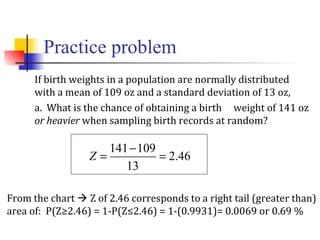
If birth weights in a population are normally distributed
with a mean of 109 oz and a standard deviation of 13 oz,
a. What is the chance of obtaining a birth weight of 141 oz
or heavier when sampling birth records at random?
46.2
13
109141
=
−
=Z
From the chart  Z of 2.46 corresponds to a right tail (greater than)
area of: P(Z≥2.46) = 1-P(Z≤2.46) = 1-(0.9931)= 0.0069 or 0.69 %
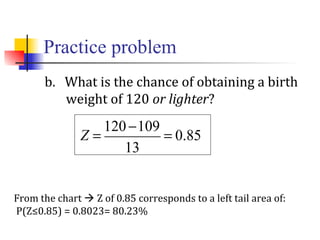
Practice problem
b. What is the chance of obtaining a birth
weight of 120 or lighter?
From the chart  Z of 0.85 corresponds to a left tail area of:
P(Z≤0.85) = 0.8023= 80.23%
Z =
120 −109
13
= 0.85
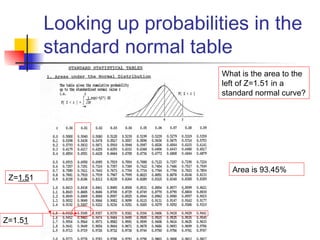
Looking up probabilities in the
standard normal table
What is the area to the
left of Z=1.51 in a
standard normal curve?
Z=1.51
Z=1.51
Area is 93.45%
Is my data “normal”?
 Not all continuous random variables are
normally distributed!!
 It is important to evaluate how well the data
are approximated by a normal distribution
Note: At this level, we cannot state whether the Normal Distribution is the
best fit for the given data or NOT.
Is my data normally
distributed?
1. Look at the histogram! Does it appear bell shaped?
2. Compute descriptive summary measures—are mean,
median, and mode similar?
3. Do 2/3 of observations lie within 1st
std dev of the mean?
Do 95% of observations lie within 2nd
std dev of the
mean?
4. Look at a normal probability plot—is it approximately
linear?
Data from a class…
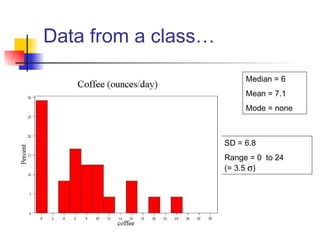
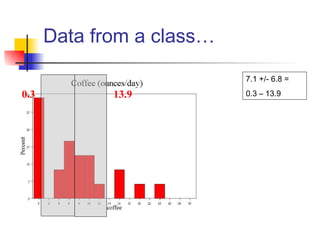
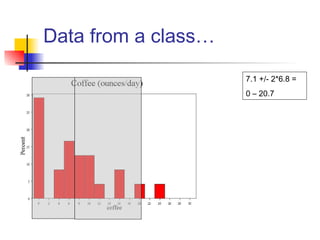
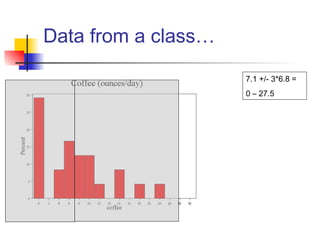
Median = 6
Mean = 7.1
Mode = none
SD = 6.8
Range = 0 to 24
(= 3.5 σ)
Data from a class…
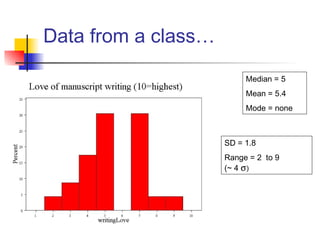
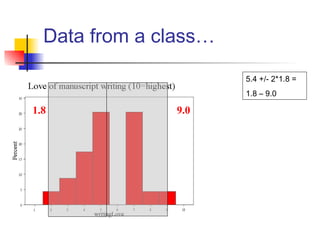
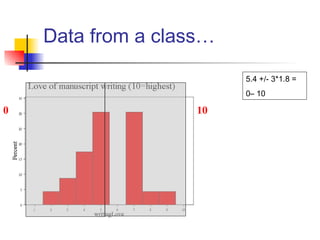
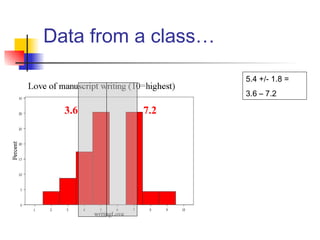
Median = 5
Mean = 5.4
Mode = none
SD = 1.8
Range = 2 to 9
(~ 4 σ)
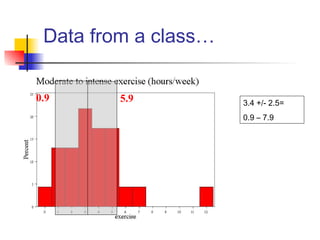
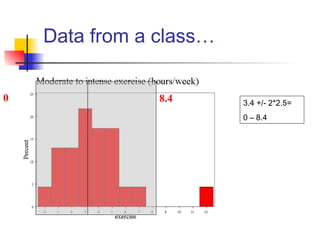
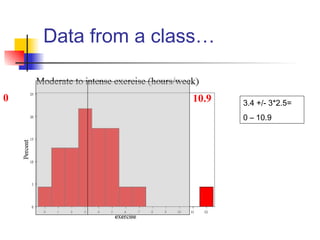
Data from a class…
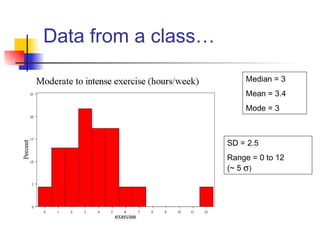
Median = 3
Mean = 3.4
Mode = 3
SD = 2.5
Range = 0 to 12
(~ 5 σ)
Data from a class…
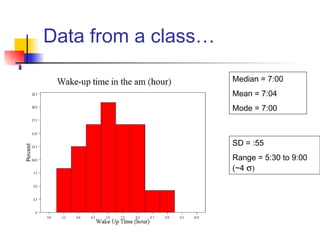
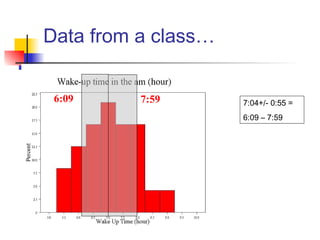
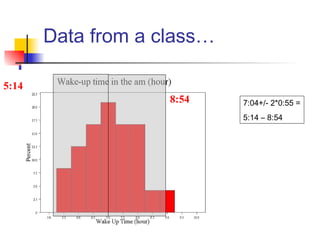
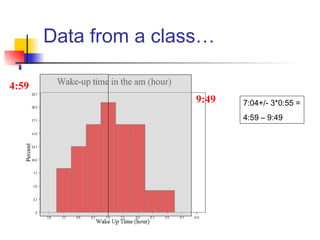
Median = 7:00
Mean = 7:04
Mode = 7:00
SD = :55
Range = 5:30 to 9:00
(~4 σ)
Data from a class…
7.1 +/- 6.8 =
0.3 – 13.90.3 13.9
Data from a class…
7.1 +/- 2*6.8 =
0 – 20.7
Data from a class…
7.1 +/- 3*6.8 =
0 – 27.5
Data from a class…
5.4 +/- 1.8 =
3.6 – 7.2
3.6 7.2
Data from a class…
5.4 +/- 2*1.8 =
1.8 – 9.0
1.8 9.0
Data from a class…
5.4 +/- 3*1.8 =
0– 10
0 10
Data from a class…
3.4 +/- 2.5=
0.9 – 7.9
0.9 5.9
Data from a class…
3.4 +/- 2*2.5=
0 – 8.4
0 8.4
Data from a class…
3.4 +/- 3*2.5=
0 – 10.9
0 10.9
Data from a class…
7:04+/- 0:55 =
6:09 – 7:59
6:09 7:59
Data from a class…
7:04+/- 2*0:55 =
5:14 – 8:54
5:14
8:54
Data from a class…
7:04+/- 3*0:55 =
4:59 – 9:49
4:59
9:49
The Normal Probability Plot
 The normal probability plot is a graphical technique for normality
testing: assessing whether or not a data set is approximately
normally distributed.
 The data are plotted against a theoretical normal distribution in
such a way that the points should form an approximate straight
line. Departures from this straight line indicate departures from
normality.
 The Probit function is the quantile function associated with the
standard normal distribution.
The Normal Probability Plot
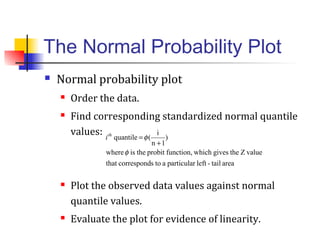
 Normal probability plot
 Order the data.
 Find corresponding standardized normal quantile
values:
 Plot the observed data values against normal
quantile values.
 Evaluate the plot for evidence of linearity.
areatail-leftparticularatoscorrespondthat
valueZthegiveswhichfunction,probittheiswhere
)
1n
i
(quantile
φ
φ
+
=th
i
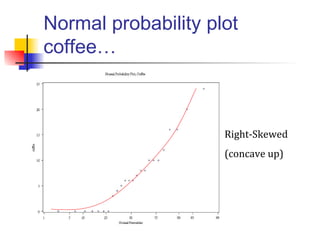
Normal probability plot
coffee…
Right-Skewed
(concave up)
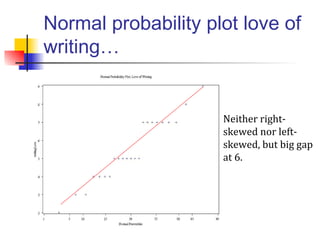
Normal probability plot love of
writing…
Neither right-
skewed nor left-
skewed, but big gap
at 6.
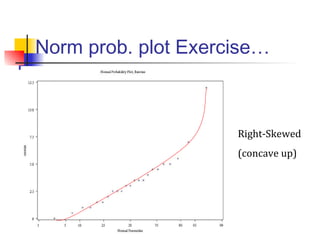
Norm prob. plot Exercise…
Right-Skewed
(concave up)
Norm prob. plot Wake up time
Closest to a straight
line…
Formal tests for normality
Results:
Coffee: Strong evidence of non-normality
(p<0.01)
Writing love: Moderate evidence of non-
normality (p = 0.01)
Exercise: Weak to no evidence of non-normality
(p>0.10)
Wakeup time: No evidence of non-normality
(p>0.25)
Normal approximation to the
binomial
When you have a binomial distribution where n is large
and p is middle-of-the road (not too small, not too big,
closer to 0.5), then the binomial starts to look like a
normal distribution In fact, this doesn’t even take a
particularly large n.
Recall: What is the probability of being a smoker among a
group of cases with lung cancer is 0.6; What’s the
probability that in a group of 8 cases you have less than
2 smokers?
Normal approximation to the
binomial
When you have a binomial distribution where n
is large and p isn’t too small (rule of thumb:
mean>5), then the binomial starts to look like a
normal distribution.
Recall: smoking example…
1 4 52 3 6 7 80
.27 Starting to have a normal
shape even with fairly small
n. You can imagine that if n
got larger, the bars would get
thinner and thinner and this
would look more and more
like a continuous function,
with a bell curve shape. Here
np=4.8.
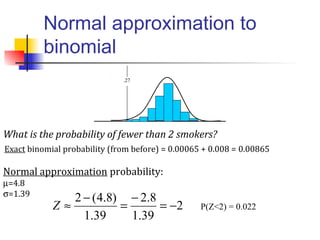
Normal approximation to
binomial
1 4 52 3 6 7 80
.27
What is the probability of fewer than 2 smokers?
Normal approximation probability:
µ=4.8
σ=1.39
2
39.1
8.2
39.1
)8.4(2
−=
−
=
−
≈Z
Exact binomial probability (from before) = 0.00065 + 0.008 = 0.00865
P(Z<2) = 0.022
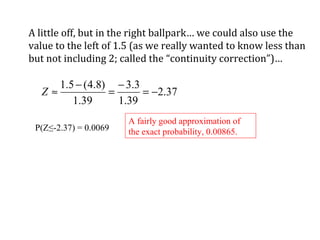
A little off, but in the right ballpark… we could also use the
value to the left of 1.5 (as we really wanted to know less than
but not including 2; called the “continuity correction”)…
37.2
39.1
3.3
39.1
)8.4(5.1
−=
−
=
−
≈Z
P(Z≤-2.37) = 0.0069
A fairly good approximation of
the exact probability, 0.00865.
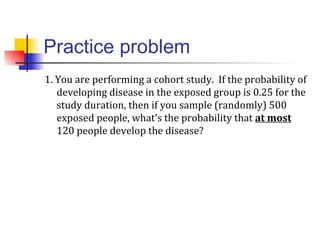
Practice problem
1. You are performing a cohort study. If the probability of
developing disease in the exposed group is 0.25 for the
study duration, then if you sample (randomly) 500
exposed people, what’s the probability that at most
120 people develop the disease?
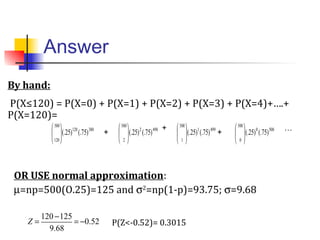
Answer
P(Z<-0.52)= 0.3015Z =
120 −125
9.68
= −0.52
5000
500
0
)75(.)25(.




4991
500
1
)75(.)25(.




4982
500
2
)75(.)25(.




380120
500
120
)75(.)25(.





+
+
+
…
By hand:
P(X≤120) = P(X=0) + P(X=1) + P(X=2) + P(X=3) + P(X=4)+….+
P(X=120)=
OR USE normal approximation:
µ=np=500(O.25)=125 and σ2
=np(1-p)=93.75; σ=9.68
Case Study
A company supplies pins in bulk to a customer. The company
uses an automatic lathe to produce the pins. Due to many
causes - vibration, temperature, wear and tear, and the like –
the lengths of the pins made by the machine are normally
distributed with a mean of 1.012 inches and a standard
deviation of 0.018 inch. The customer will buy only those pins
with lengths in the interval 1.00±0.02 inch. In other words,
the customer wants the length to be 1.00 inch but will accept
up to 0.02 inch deviation on either side. This 0.02 inch is
known as the tolerance.
Questions
Q. What percentage of pins will be accepted by the
customer?
A. Required Percentage =
(NORM.DIST(1.02,1.012,0.018,TRUE)-
NORM.DIST(0.98,1.012,0.018,TRUE))
= 0.633919177 [ Using MS Excel ]
It means that around 63.4% of the nails will be accepted
by the customer.
Q. In order to improve percentage accepted, the production
manager and the engineers discuss adjusting the population
mean and standard deviation of the length of the pins.
If the lathe can be adjusted to have the mean of the lengths to
any desired value, what should it be adjusted to? Why?
A. The mean length should be 1 because that is what
customer wants with a tolerance of 0.02
Q. Suppose mean cannot be adjusted but standard deviation
can be reduced, what maximum standard deviation would
make the customer accept -
1.95% of the sample
2.99% of the sample
Which, according to you, is easier to adjust mean or standard
deviation?
A. We know that 95% of the values lie between ±1.96.
Therefore,
=(1.02-1.012)/1.96
=0.004082 New Standard Deviation
99% of the values lie between ±2.58. Therefore
=(1.02-1.012)/2.58
=0.003101 New Standard Deviation
Q. The production manager then considers the costs
involved. The cost of resetting the machine to adjust the
population mean involves the engineers' time and the cost
of production time lost.
The cost of reducing the population standard deviation
involves, in addition to these cost, the cost of overhauling the
machine and reengineering the process.
Assume it costs $150000x2
to decrease the standard deviation
by x inch.
Find the cost of reducing the standard deviation to the values
found in previous question?
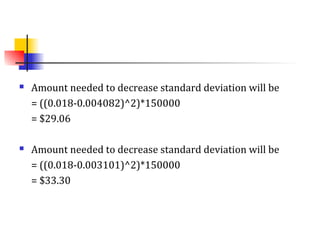
 Amount needed to decrease standard deviation will be
= ((0.018-0.004082)^2)*150000
= $29.06
 Amount needed to decrease standard deviation will be
= ((0.018-0.003101)^2)*150000
= $33.30
Question
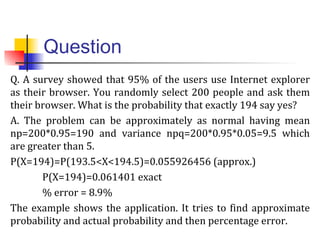
Q. A survey showed that 95% of the users use Internet explorer
as their browser. You randomly select 200 people and ask them
their browser. What is the probability that exactly 194 say yes?
A. The problem can be approximately as normal having mean
np=200*0.95=190 and variance npq=200*0.95*0.05=9.5 which
are greater than 5.
P(X=194)=P(193.5<X<194.5)=0.055926456 (approx.)
P(X=194)=0.061401 exact
% error = 8.9%
The example shows the application. It tries to find approximate
probability and actual probability and then percentage error.
Conclusion
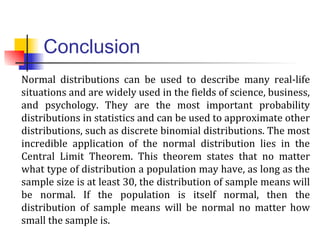
Normal distributions can be used to describe many real-life
situations and are widely used in the fields of science, business,
and psychology. They are the most important probability
distributions in statistics and can be used to approximate other
distributions, such as discrete binomial distributions. The most
incredible application of the normal distribution lies in the
Central Limit Theorem. This theorem states that no matter
what type of distribution a population may have, as long as the
sample size is at least 30, the distribution of sample means will
be normal. If the population is itself normal, then the
distribution of sample means will be normal no matter how
small the sample is.

Normal Distribution

  • 1.
    The Normal Distribution DEPARTMENTOF STATISTICS RAMJAS COLLEGE, UNIVERSITY OF DELHI
  • 2.
  • 3.
    Examples of continuous probabilitydistributions: The normal and standard normal
  • 4.
    Order of Study Introduction  Functions  Graphs  Data Analysis and Problems  Case Study and Questions  Binomial Approximations  Conclusion
  • 5.
    Normal Distribution Normal Distribution,also called Gaussian Distribution, is one of the widely used continuous distributions existing which is used to model a number of scenarios such as marks of students, heights of people, salaries of working people etc. It is given utmost importance due to Central Limit Theorem which shall not be dealt with here.
  • 6.
    The Normal Distribution: asmathematical function (pdf) 2 )( 2 1 2 1 )( σ µ πσ − − ⋅= x exf Note constants: π=3.14159 e=2.71828 This is a bell shaped curve with different centers and spreads depending on µ and σ
  • 7.
    The Normal PDF 1 2 12 )( 2 1 =⋅∫ +∞ ∞− − − dxe x σ µ πσ It’s a probability function, so no matter what the values of µ and σ, must integrate to 1!
  • 8.
  • 9.
    The Normal Distribution X f(X) µ σ Changingμ shifts the distribution left or right. Changing σ increases or decreases the spread.
  • 10.
    Normal distribution isdefined by its mean and standard dev. E(X)=µ = Var(X)=σ2 = dxex x ∫ +∞ ∞− − − ⋅ 2 )( 2 1 2 1 σ µ πσ 2 )( 2 1 2 ) 2 1 ( 2 µ πσ σ µ −⋅∫ +∞ ∞− − − dxex x
  • 11.
  • 12.
    Properties of Normal Distribution Mean=Median=Mode=µ  Skewness = 0  Variance=σ2  All odd order central moments are zero.  Moment Generating Function
  • 13.
    * The beauty ofthe normal curve: No matter what µ and σ are, the area between µ-σ and µ+σ is about 68%; the area between µ-2σ and µ+2σ is about 95%; and the area between µ-3σ and µ+3σ is about 99.7%. Almost all values fall within 3 standard deviations.
  • 14.
    68-95-99.7 Rule 68% of thedata 95% of the data 99.7% of the data
  • 15.
    68-95-99.7 Rule in Mathematicalterms… 1 σ 2π •e − 1 2 ( x−µ σ )2 dx µ−σ µ+σ ∫ = 0.68 1 σ 2π •e − 1 2 ( x−µ σ )2 dx µ−2σ µ+2σ ∫ = 0.95 1 σ 2π •e − 1 2 ( x−µ σ )2 dx µ−3σ µ+3σ ∫ = 0.997
  • 16.
    How good isrule for real data? Check some example data: The mean of the weight of the women = 127.8 The standard deviation (SD) = 15.5
  • 17.
    80 90 100110 120 130 140 150 160 0 5 10 15 20 25 P e r c e n t POUNDS 127.8 143.3112.3 68% of 120 = .68x120 = ~ 82 runners In fact, 79 runners fall within 1-SD (15.5 lbs) of the mean.
  • 18.
    80 90 100110 120 130 140 150 160 0 5 10 15 20 25 P e r c e n t POUNDS 127.896.8 95% of 120 = .95 x 120 = ~ 114 runners In fact, 115 runners fall within 2-SD’s of the mean. 158.8
  • 19.
    80 90 100110 120 130 140 150 160 0 5 10 15 20 25 P e r c e n t POUNDS 127.881.3 99.7% of 120 = .997 x 120 = 119.6 runners In fact, all 120 runners fall within 3-SD’s of the mean. 174.3
  • 20.
    Example  Suppose JAMscores roughly follows a normal distribution in the Indian population of college- bound students (with range restricted to 200-800), and the average JAM Score be 500 with a standard deviation of 50, then:  68% of students will have scores between 450 and 550  95% will be between 400 and 600  99.7% will be between 350 and 650
  • 21.
    Example  BUT…  Whatif you wanted to know the JAM score corresponding to the 90th percentile (=90% of students are lower)? P(X≤Q) = .90  90. 2)50( 1 200 ) 50 500 ( 2 1 2 =•∫ − − Q x dxe π Solve for Q?…. by looking at tables.
  • 22.
    The Standard NormalDistribution (Z) All normal distributions can be converted into the standard normal curve by subtracting the mean and dividing by the standard deviation: σ µ− = X Z Somebody calculated all the integrals for the standard normal and put them in a table. So we never have to integrate! Even better, computers now do all the integration.
  • 23.
    The Standard Normal(Z): “Universal Currency” The formula for the standardized normal probability density function is 22 )( 2 1 ) 1 0 ( 2 1 2 1 2)1( 1 )( Z Z eeZp − − − ⋅=⋅= ππ
  • 24.
    Comparing X andZ units Z 100 2.00 200 X (µ = 100, σ = 50) (µ = 0, σ = 1)
  • 25.
    Example  For example:What’s the probability of getting a math JAM score of 575 or less, µ = 500 and σ = 50? 5.1 50 500575 = − =Z i.e., A score of 575 is 1.5 standard deviations above the mean ∫∫ ∞− − − − ⋅→⋅=≤∴ 5.1 2 1575 200 ) 50 500 ( 2 1 22 2 1 2)50( 1 )575( dzedxeXP Z x ππ But to look up Z = 1.5 in standard normal chart = 0.9332
  • 26.
    Practice problem If birthweights in a population are normally distributed with a mean of 109 oz and a standard deviation of 13 oz, a. What is the chance of obtaining a birth weight of 141 oz or heavier when sampling birth records at random? 46.2 13 109141 = − =Z From the chart  Z of 2.46 corresponds to a right tail (greater than) area of: P(Z≥2.46) = 1-P(Z≤2.46) = 1-(0.9931)= 0.0069 or 0.69 %
  • 27.
    Practice problem b. Whatis the chance of obtaining a birth weight of 120 or lighter? From the chart  Z of 0.85 corresponds to a left tail area of: P(Z≤0.85) = 0.8023= 80.23% Z = 120 −109 13 = 0.85
  • 28.
    Looking up probabilitiesin the standard normal table What is the area to the left of Z=1.51 in a standard normal curve? Z=1.51 Z=1.51 Area is 93.45%
  • 29.
    Is my data“normal”?  Not all continuous random variables are normally distributed!!  It is important to evaluate how well the data are approximated by a normal distribution Note: At this level, we cannot state whether the Normal Distribution is the best fit for the given data or NOT.
  • 30.
    Is my datanormally distributed? 1. Look at the histogram! Does it appear bell shaped? 2. Compute descriptive summary measures—are mean, median, and mode similar? 3. Do 2/3 of observations lie within 1st std dev of the mean? Do 95% of observations lie within 2nd std dev of the mean? 4. Look at a normal probability plot—is it approximately linear?
  • 31.
    Data from aclass… Median = 6 Mean = 7.1 Mode = none SD = 6.8 Range = 0 to 24 (= 3.5 σ)
  • 32.
    Data from aclass… Median = 5 Mean = 5.4 Mode = none SD = 1.8 Range = 2 to 9 (~ 4 σ)
  • 33.
    Data from aclass… Median = 3 Mean = 3.4 Mode = 3 SD = 2.5 Range = 0 to 12 (~ 5 σ)
  • 34.
    Data from aclass… Median = 7:00 Mean = 7:04 Mode = 7:00 SD = :55 Range = 5:30 to 9:00 (~4 σ)
  • 35.
    Data from aclass… 7.1 +/- 6.8 = 0.3 – 13.90.3 13.9
  • 36.
    Data from aclass… 7.1 +/- 2*6.8 = 0 – 20.7
  • 37.
    Data from aclass… 7.1 +/- 3*6.8 = 0 – 27.5
  • 38.
    Data from aclass… 5.4 +/- 1.8 = 3.6 – 7.2 3.6 7.2
  • 39.
    Data from aclass… 5.4 +/- 2*1.8 = 1.8 – 9.0 1.8 9.0
  • 40.
    Data from aclass… 5.4 +/- 3*1.8 = 0– 10 0 10
  • 41.
    Data from aclass… 3.4 +/- 2.5= 0.9 – 7.9 0.9 5.9
  • 42.
    Data from aclass… 3.4 +/- 2*2.5= 0 – 8.4 0 8.4
  • 43.
    Data from aclass… 3.4 +/- 3*2.5= 0 – 10.9 0 10.9
  • 44.
    Data from aclass… 7:04+/- 0:55 = 6:09 – 7:59 6:09 7:59
  • 45.
    Data from aclass… 7:04+/- 2*0:55 = 5:14 – 8:54 5:14 8:54
  • 46.
    Data from aclass… 7:04+/- 3*0:55 = 4:59 – 9:49 4:59 9:49
  • 47.
    The Normal ProbabilityPlot  The normal probability plot is a graphical technique for normality testing: assessing whether or not a data set is approximately normally distributed.  The data are plotted against a theoretical normal distribution in such a way that the points should form an approximate straight line. Departures from this straight line indicate departures from normality.  The Probit function is the quantile function associated with the standard normal distribution.
  • 48.
    The Normal ProbabilityPlot  Normal probability plot  Order the data.  Find corresponding standardized normal quantile values:  Plot the observed data values against normal quantile values.  Evaluate the plot for evidence of linearity. areatail-leftparticularatoscorrespondthat valueZthegiveswhichfunction,probittheiswhere ) 1n i (quantile φ φ + =th i
  • 49.
  • 50.
    Normal probability plotlove of writing… Neither right- skewed nor left- skewed, but big gap at 6.
  • 51.
    Norm prob. plotExercise… Right-Skewed (concave up)
  • 52.
    Norm prob. plotWake up time Closest to a straight line…
  • 53.
    Formal tests fornormality Results: Coffee: Strong evidence of non-normality (p<0.01) Writing love: Moderate evidence of non- normality (p = 0.01) Exercise: Weak to no evidence of non-normality (p>0.10) Wakeup time: No evidence of non-normality (p>0.25)
  • 54.
    Normal approximation tothe binomial When you have a binomial distribution where n is large and p is middle-of-the road (not too small, not too big, closer to 0.5), then the binomial starts to look like a normal distribution In fact, this doesn’t even take a particularly large n. Recall: What is the probability of being a smoker among a group of cases with lung cancer is 0.6; What’s the probability that in a group of 8 cases you have less than 2 smokers?
  • 55.
    Normal approximation tothe binomial When you have a binomial distribution where n is large and p isn’t too small (rule of thumb: mean>5), then the binomial starts to look like a normal distribution. Recall: smoking example… 1 4 52 3 6 7 80 .27 Starting to have a normal shape even with fairly small n. You can imagine that if n got larger, the bars would get thinner and thinner and this would look more and more like a continuous function, with a bell curve shape. Here np=4.8.
  • 56.
    Normal approximation to binomial 14 52 3 6 7 80 .27 What is the probability of fewer than 2 smokers? Normal approximation probability: µ=4.8 σ=1.39 2 39.1 8.2 39.1 )8.4(2 −= − = − ≈Z Exact binomial probability (from before) = 0.00065 + 0.008 = 0.00865 P(Z<2) = 0.022
  • 57.
    A little off,but in the right ballpark… we could also use the value to the left of 1.5 (as we really wanted to know less than but not including 2; called the “continuity correction”)… 37.2 39.1 3.3 39.1 )8.4(5.1 −= − = − ≈Z P(Z≤-2.37) = 0.0069 A fairly good approximation of the exact probability, 0.00865.
  • 58.
    Practice problem 1. Youare performing a cohort study. If the probability of developing disease in the exposed group is 0.25 for the study duration, then if you sample (randomly) 500 exposed people, what’s the probability that at most 120 people develop the disease?
  • 59.
    Answer P(Z<-0.52)= 0.3015Z = 120−125 9.68 = −0.52 5000 500 0 )75(.)25(.     4991 500 1 )75(.)25(.     4982 500 2 )75(.)25(.     380120 500 120 )75(.)25(.      + + + … By hand: P(X≤120) = P(X=0) + P(X=1) + P(X=2) + P(X=3) + P(X=4)+….+ P(X=120)= OR USE normal approximation: µ=np=500(O.25)=125 and σ2 =np(1-p)=93.75; σ=9.68
  • 60.
    Case Study A companysupplies pins in bulk to a customer. The company uses an automatic lathe to produce the pins. Due to many causes - vibration, temperature, wear and tear, and the like – the lengths of the pins made by the machine are normally distributed with a mean of 1.012 inches and a standard deviation of 0.018 inch. The customer will buy only those pins with lengths in the interval 1.00±0.02 inch. In other words, the customer wants the length to be 1.00 inch but will accept up to 0.02 inch deviation on either side. This 0.02 inch is known as the tolerance.
  • 61.
    Questions Q. What percentageof pins will be accepted by the customer? A. Required Percentage = (NORM.DIST(1.02,1.012,0.018,TRUE)- NORM.DIST(0.98,1.012,0.018,TRUE)) = 0.633919177 [ Using MS Excel ] It means that around 63.4% of the nails will be accepted by the customer.
  • 62.
    Q. In orderto improve percentage accepted, the production manager and the engineers discuss adjusting the population mean and standard deviation of the length of the pins. If the lathe can be adjusted to have the mean of the lengths to any desired value, what should it be adjusted to? Why? A. The mean length should be 1 because that is what customer wants with a tolerance of 0.02
  • 63.
    Q. Suppose meancannot be adjusted but standard deviation can be reduced, what maximum standard deviation would make the customer accept - 1.95% of the sample 2.99% of the sample Which, according to you, is easier to adjust mean or standard deviation?
  • 64.
    A. We knowthat 95% of the values lie between ±1.96. Therefore, =(1.02-1.012)/1.96 =0.004082 New Standard Deviation 99% of the values lie between ±2.58. Therefore =(1.02-1.012)/2.58 =0.003101 New Standard Deviation
  • 65.
    Q. The productionmanager then considers the costs involved. The cost of resetting the machine to adjust the population mean involves the engineers' time and the cost of production time lost. The cost of reducing the population standard deviation involves, in addition to these cost, the cost of overhauling the machine and reengineering the process. Assume it costs $150000x2 to decrease the standard deviation by x inch. Find the cost of reducing the standard deviation to the values found in previous question?
  • 66.
     Amount neededto decrease standard deviation will be = ((0.018-0.004082)^2)*150000 = $29.06  Amount needed to decrease standard deviation will be = ((0.018-0.003101)^2)*150000 = $33.30
  • 67.
    Question Q. A surveyshowed that 95% of the users use Internet explorer as their browser. You randomly select 200 people and ask them their browser. What is the probability that exactly 194 say yes? A. The problem can be approximately as normal having mean np=200*0.95=190 and variance npq=200*0.95*0.05=9.5 which are greater than 5. P(X=194)=P(193.5<X<194.5)=0.055926456 (approx.) P(X=194)=0.061401 exact % error = 8.9% The example shows the application. It tries to find approximate probability and actual probability and then percentage error.
  • 68.
    Conclusion Normal distributions canbe used to describe many real-life situations and are widely used in the fields of science, business, and psychology. They are the most important probability distributions in statistics and can be used to approximate other distributions, such as discrete binomial distributions. The most incredible application of the normal distribution lies in the Central Limit Theorem. This theorem states that no matter what type of distribution a population may have, as long as the sample size is at least 30, the distribution of sample means will be normal. If the population is itself normal, then the distribution of sample means will be normal no matter how small the sample is.

Editor's Notes

  • #7 Pdf: probability Density function; A pdf is always defined for a random variable x (given), mu-mean, sigma-standard deviation.
  • #12 Cdf- cumulative distribution function, it is an integral function of pdf. Erf –error function, Also called gauss function and it is not yet calcluated using mathematics but is calculated using functions.
  • #13 For symmetric function case mean=median=mode, skewness – deviation from original values. Moment is E(x^r) this is rth moment, definition of moments is the values that describe the nature of distribution
  • #15 SAY: within 1 standard deviation either way of the mean within 2 standard deviations of the mean within 3 standard deviations either way of the mean WORKS FOR ALL NORMAL CURVES NO MATTER HOW SKINNY OR FAT they are.
  • #17 The weight is in pounds.
  • #18 Total people surveyed were 120.
  • #23 We have 3 types of table. One which gives us the area from -∞ to a particular point. The second gives us the area from a given point to ∞. The third one gives us the area from origin to a given point.
  • #31 We will be talking about the probability plot further in this chapter.
  • #55 We have assumed this condition for the approximation.