Normal Curve
HISTORY
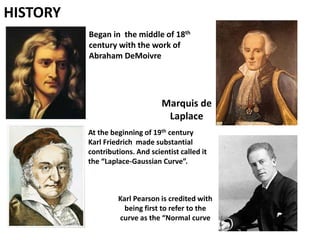
Began in the middle of 18th
century with the work of
Abraham DeMoivre
Marquis de
Laplace
At the beginning of 19th century
Karl Friedrich made substantial
contributions. And scientist called it
the “Laplace-Gaussian Curve”.
Karl Pearson is credited with
being first to refer to the
curve as the “Normal curve
IMPORTANCE
 One reason the normal distribution is important
is that many psychological and educational
variables are distributed approximately
normally.
-Measures of reading ability,
introversion, job satisfaction, and memory
are among the many psychological variables
approximately normally distributed.
-Although the distributions are only
approximately normal, they are usually
quite close.
IMPORTANCE
The second reason the normal distribution is so
important is that it is easy for mathematical statisticians
to work with.
-This means that many kinds of statistical tests can
be derived for normal distributions.
-Almost all statistical tests discussed in this text
assume normal distributions.
-Fortunately, these tests work very well even if the
distribution is only approximately normally
distributed.
-Some tests work well even with very wide
deviations from normality.
CHARACTERISTIC
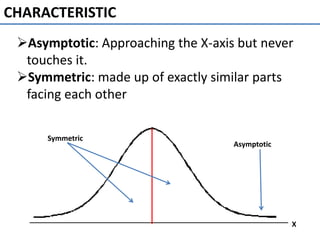
Asymptotic: Approaching the X-axis but never
touches it.
Symmetric: made up of exactly similar parts
facing each other
Symmetric
Asymptotic
X
CHARACTERISTIC
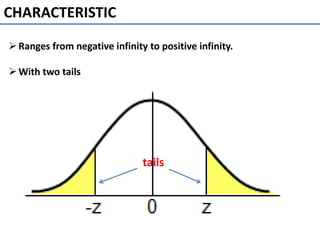
Ranges from negative infinity to positive infinity.
With two tails
tails
WHAT IS THE NORMAL CURVE
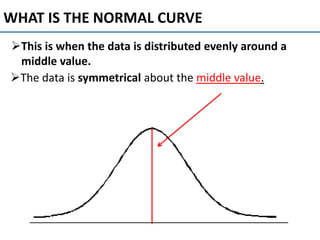
This is when the data is distributed evenly around a
middle value.
The data is symmetrical about the middle value.
WHAT IS THE NORMAL CURVE
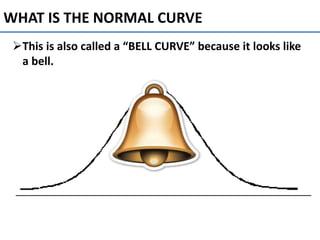
This is also called a “BELL CURVE” because it looks like
a bell.
WHAT IS THE NORMAL CURVE
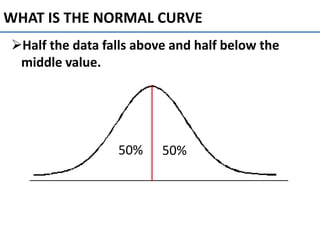
Half the data falls above and half below the
middle value.
50% 50%
MEAN – MEDIAN - MODE
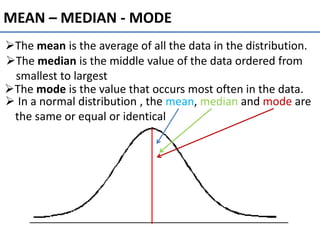
The mean is the average of all the data in the distribution.
The median is the middle value of the data ordered from
smallest to largest
The mode is the value that occurs most often in the data.
 In a normal distribution , the mean, median and mode are
the same or equal or identical
STANDARD DEVIATION
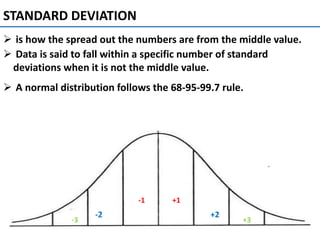
 is how the spread out the numbers are from the middle value.
 Data is said to fall within a specific number of standard
deviations when it is not the middle value.
-1 +1
-2 +2
-3 +3
 A normal distribution follows the 68-95-99.7 rule.
68-95-99.7 RULE also called the Empirical Rule
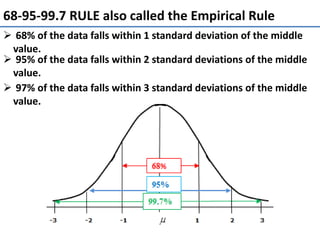
 68% of the data falls within 1 standard deviation of the middle
value.
 95% of the data falls within 2 standard deviations of the middle
value.
 97% of the data falls within 3 standard deviations of the middle
value.
PERCENT AT EACH STANDARD DEVIATION
The middle value represents 50%.
Recall that 68% of the data falls within 1 standard
deviation of the mean.
Half the 68% falls above and half below 50%.
1 standard deviation below the mean is 50% - 34% = 16%
1 standard deviation above the mean is 50% + 34% = 84%
PERCENT AT EACH STANDARD DEVIATION
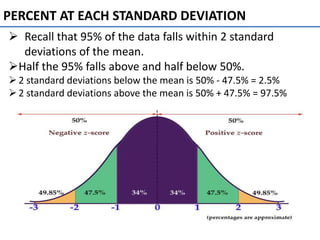
 Recall that 95% of the data falls within 2 standard
deviations of the mean.
Half the 95% falls above and half below 50%.
2 standard deviations below the mean is 50% - 47.5% = 2.5%
2 standard deviations above the mean is 50% + 47.5% = 97.5%
PERCENT AT EACH STANDARD DEVIATION
 Recall that 99.7% of the data falls within 3 standard
deviations of the mean.
Half the 99.7% falls above and half below 50%.
3standard deviations below the mean is 50% - 49.85% = .15%
3 standard deviations above the mean is 50% + 49.85% = 99.85%
HOW TO USE NORMAL CURVE TO DETERMINE
PROBABILITY
Determine the mean. (µ)
Determine the standard deviation. (ơ)
Plot the mean and SD on the
normal curve.
Analyze the problem.
Apply the 68-95-99.7 or empirical rule
Practice
The normal distribution below has a standard deviation of 10.
Approximately what area contained between 70 and 90?
40 60 70 80 90 10050
Mean= 70
SD= 10
Practice
For the normal distribution below, approximately what area
contained between -2 and 1
1-1 2 30-3 -2
Mean = 0
SD= 1
Practice
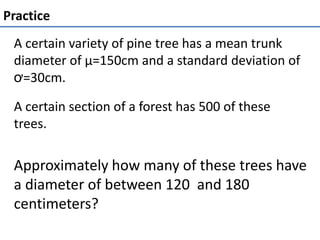
A certain variety of pine tree has a mean trunk
diameter of µ=150cm and a standard deviation of
ơ=30cm.
A certain section of a forest has 500 of these
trees.
Approximately how many of these trees have
a diameter of between 120 and 180
centimeters?
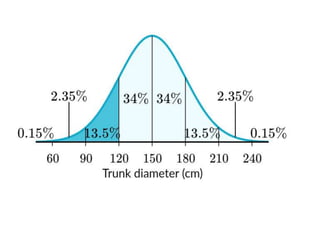
34% + 34% = 68%
68% of 500
340 trees

Normal curve

  • 1.
  • 2.
    HISTORY Began in themiddle of 18th century with the work of Abraham DeMoivre Marquis de Laplace At the beginning of 19th century Karl Friedrich made substantial contributions. And scientist called it the “Laplace-Gaussian Curve”. Karl Pearson is credited with being first to refer to the curve as the “Normal curve
  • 3.
    IMPORTANCE  One reasonthe normal distribution is important is that many psychological and educational variables are distributed approximately normally. -Measures of reading ability, introversion, job satisfaction, and memory are among the many psychological variables approximately normally distributed. -Although the distributions are only approximately normal, they are usually quite close.
  • 4.
    IMPORTANCE The second reasonthe normal distribution is so important is that it is easy for mathematical statisticians to work with. -This means that many kinds of statistical tests can be derived for normal distributions. -Almost all statistical tests discussed in this text assume normal distributions. -Fortunately, these tests work very well even if the distribution is only approximately normally distributed. -Some tests work well even with very wide deviations from normality.
  • 5.
    CHARACTERISTIC Asymptotic: Approaching theX-axis but never touches it. Symmetric: made up of exactly similar parts facing each other Symmetric Asymptotic X
  • 6.
    CHARACTERISTIC Ranges from negativeinfinity to positive infinity. With two tails tails
  • 7.
    WHAT IS THENORMAL CURVE This is when the data is distributed evenly around a middle value. The data is symmetrical about the middle value.
  • 8.
    WHAT IS THENORMAL CURVE This is also called a “BELL CURVE” because it looks like a bell.
  • 9.
    WHAT IS THENORMAL CURVE Half the data falls above and half below the middle value. 50% 50%
  • 10.
    MEAN – MEDIAN- MODE The mean is the average of all the data in the distribution. The median is the middle value of the data ordered from smallest to largest The mode is the value that occurs most often in the data.  In a normal distribution , the mean, median and mode are the same or equal or identical
  • 11.
    STANDARD DEVIATION  ishow the spread out the numbers are from the middle value.  Data is said to fall within a specific number of standard deviations when it is not the middle value. -1 +1 -2 +2 -3 +3  A normal distribution follows the 68-95-99.7 rule.
  • 12.
    68-95-99.7 RULE alsocalled the Empirical Rule  68% of the data falls within 1 standard deviation of the middle value.  95% of the data falls within 2 standard deviations of the middle value.  97% of the data falls within 3 standard deviations of the middle value.
  • 13.
    PERCENT AT EACHSTANDARD DEVIATION The middle value represents 50%. Recall that 68% of the data falls within 1 standard deviation of the mean. Half the 68% falls above and half below 50%. 1 standard deviation below the mean is 50% - 34% = 16% 1 standard deviation above the mean is 50% + 34% = 84%
  • 14.
    PERCENT AT EACHSTANDARD DEVIATION  Recall that 95% of the data falls within 2 standard deviations of the mean. Half the 95% falls above and half below 50%. 2 standard deviations below the mean is 50% - 47.5% = 2.5% 2 standard deviations above the mean is 50% + 47.5% = 97.5%
  • 15.
    PERCENT AT EACHSTANDARD DEVIATION  Recall that 99.7% of the data falls within 3 standard deviations of the mean. Half the 99.7% falls above and half below 50%. 3standard deviations below the mean is 50% - 49.85% = .15% 3 standard deviations above the mean is 50% + 49.85% = 99.85%
  • 16.
    HOW TO USENORMAL CURVE TO DETERMINE PROBABILITY Determine the mean. (µ) Determine the standard deviation. (ơ) Plot the mean and SD on the normal curve. Analyze the problem. Apply the 68-95-99.7 or empirical rule
  • 17.
    Practice The normal distributionbelow has a standard deviation of 10. Approximately what area contained between 70 and 90? 40 60 70 80 90 10050 Mean= 70 SD= 10
  • 18.
    Practice For the normaldistribution below, approximately what area contained between -2 and 1 1-1 2 30-3 -2 Mean = 0 SD= 1
  • 19.
    Practice A certain varietyof pine tree has a mean trunk diameter of µ=150cm and a standard deviation of ơ=30cm. A certain section of a forest has 500 of these trees. Approximately how many of these trees have a diameter of between 120 and 180 centimeters?
  • 21.
    34% + 34%= 68% 68% of 500 340 trees