Solving Literal
   Equations
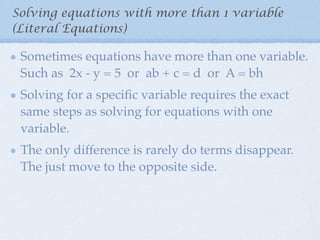
Solving equations with more than 1 variable
(Literal Equations)

 Sometimes equations have more than one variable.
 Such as 2x - y = 5 or ab + c = d or A = bh
 Solving for a specific variable requires the exact
 same steps as solving for equations with one
 variable.
 The only difference is rarely do terms disappear.
 The just move to the opposite side.
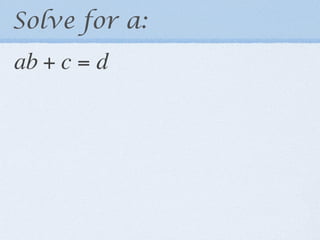
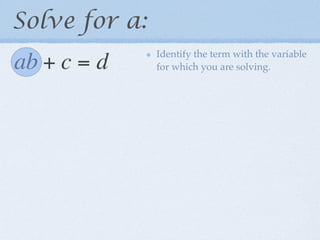
Solve for a:
ab + c = d
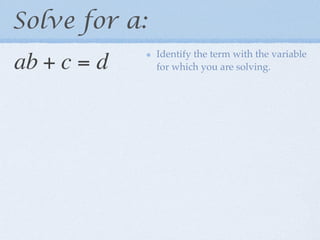
Solve for a:
               Identify the term with the variable
ab + c = d     for which you are solving.
Solve for a:
               Identify the term with the variable
ab + c = d     for which you are solving.
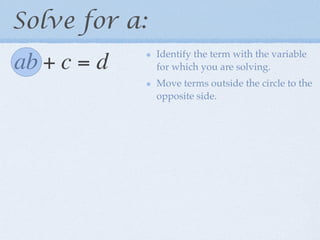
Solve for a:
               Identify the term with the variable
ab + c = d     for which you are solving.
               Move terms outside the circle to the
               opposite side.
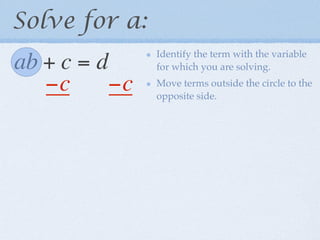
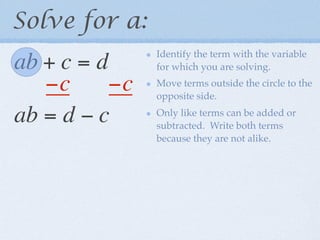
Solve for a:
                Identify the term with the variable
ab + c = d      for which you are solving.

   −c      −c   Move terms outside the circle to the
                opposite side.
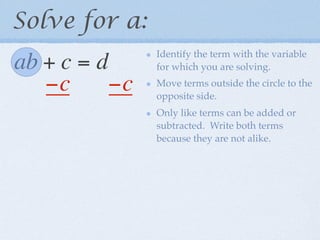
Solve for a:
                Identify the term with the variable
ab + c = d      for which you are solving.

   −c      −c   Move terms outside the circle to the
                opposite side.
                Only like terms can be added or
                subtracted. Write both terms
                because they are not alike.
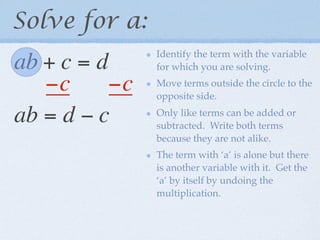
Solve for a:
                Identify the term with the variable
ab + c = d      for which you are solving.

   −c      −c   Move terms outside the circle to the
                opposite side.

ab = d − c      Only like terms can be added or
                subtracted. Write both terms
                because they are not alike.
Solve for a:
                Identify the term with the variable
ab + c = d      for which you are solving.

   −c      −c   Move terms outside the circle to the
                opposite side.

ab = d − c      Only like terms can be added or
                subtracted. Write both terms
                because they are not alike.
                The term with ‘a’ is alone but there
                is another variable with it. Get the
                ‘a’ by itself by undoing the
                multiplication.
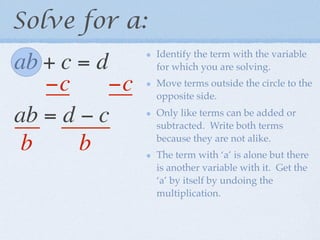
Solve for a:
                Identify the term with the variable
ab + c = d      for which you are solving.

   −c      −c   Move terms outside the circle to the
                opposite side.

ab = d − c      Only like terms can be added or
                subtracted. Write both terms

 b     b        because they are not alike.
                The term with ‘a’ is alone but there
                is another variable with it. Get the
                ‘a’ by itself by undoing the
                multiplication.
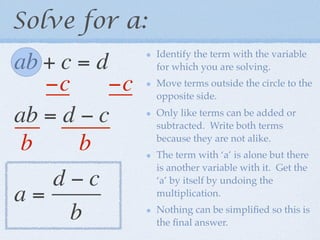
Solve for a:
                Identify the term with the variable
ab + c = d      for which you are solving.

   −c      −c   Move terms outside the circle to the
                opposite side.

ab = d − c      Only like terms can be added or
                subtracted. Write both terms

 b     b        because they are not alike.
                The term with ‘a’ is alone but there
                is another variable with it. Get the
    d−c         ‘a’ by itself by undoing the
a=              multiplication.

      b         Nothing can be simplified so this is
                the final answer.
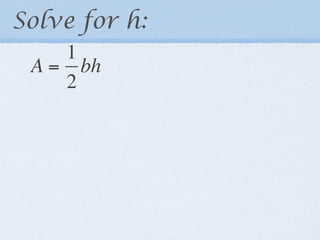
Solve for h:
    1
 A = bh
    2
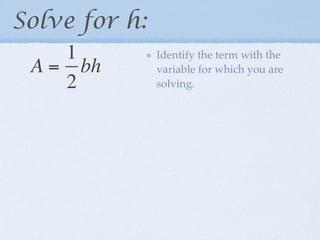
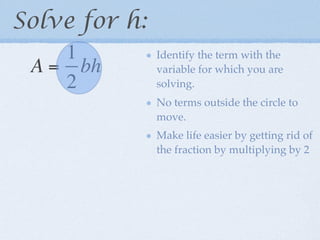
Solve for h:
    1          Identify the term with the
 A = bh        variable for which you are
    2          solving.
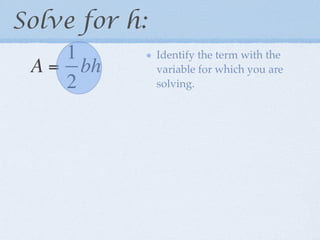
Solve for h:
    1          Identify the term with the
 A = bh        variable for which you are
    2          solving.
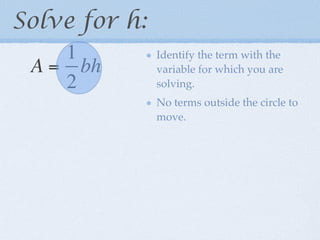
Solve for h:
    1          Identify the term with the
 A = bh        variable for which you are
    2          solving.
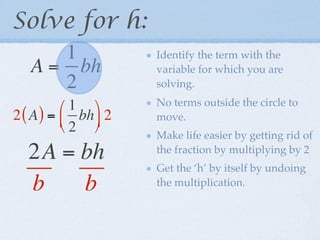
               No terms outside the circle to
               move.
Solve for h:
    1          Identify the term with the
 A = bh        variable for which you are
    2          solving.
               No terms outside the circle to
               move.
               Make life easier by getting rid of
               the fraction by multiplying by 2
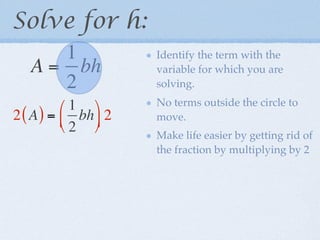
Solve for h:
      1              Identify the term with the
   A = bh            variable for which you are
      2              solving.

          1        No terms outside the circle to
2 ( A ) =  bh  2   move.
          2 
                     Make life easier by getting rid of
                     the fraction by multiplying by 2
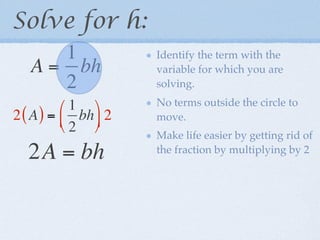
Solve for h:
      1              Identify the term with the
   A = bh            variable for which you are
      2              solving.

          1        No terms outside the circle to
2 ( A ) =  bh  2   move.
          2 
                     Make life easier by getting rid of
  2A = bh            the fraction by multiplying by 2
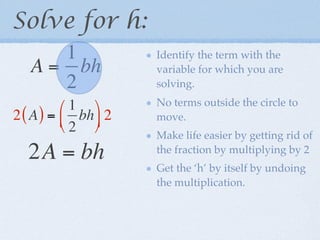
Solve for h:
      1              Identify the term with the
   A = bh            variable for which you are
      2              solving.

          1        No terms outside the circle to
2 ( A ) =  bh  2   move.
          2 
                     Make life easier by getting rid of
  2A = bh            the fraction by multiplying by 2
                     Get the ‘h’ by itself by undoing
                     the multiplication.
Solve for h:
      1              Identify the term with the
   A = bh            variable for which you are
      2              solving.

          1        No terms outside the circle to
2 ( A ) =  bh  2   move.
          2 
                     Make life easier by getting rid of
  2A = bh            the fraction by multiplying by 2
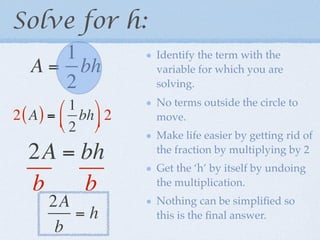
                     Get the ‘h’ by itself by undoing
  b    b             the multiplication.
Solve for h:
      1              Identify the term with the
   A = bh            variable for which you are
      2              solving.

          1        No terms outside the circle to
2 ( A ) =  bh  2   move.
          2 
                     Make life easier by getting rid of
  2A = bh            the fraction by multiplying by 2
                     Get the ‘h’ by itself by undoing
  b    b             the multiplication.
      2A             Nothing can be simplified so
         =h          this is the final answer.
       b
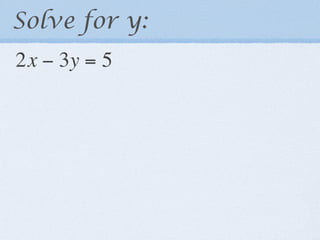
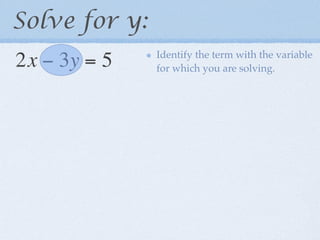
Solve for y:
2x − 3y = 5
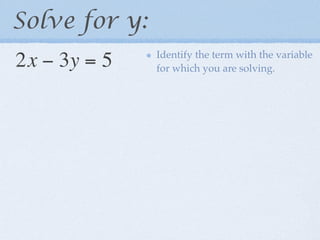
Solve for y:
               Identify the term with the variable
2x − 3y = 5    for which you are solving.
Solve for y:
               Identify the term with the variable
2x − 3y = 5    for which you are solving.
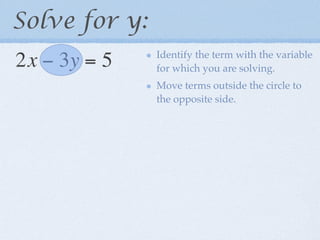
Solve for y:
               Identify the term with the variable
2x − 3y = 5    for which you are solving.
               Move terms outside the circle to
               the opposite side.
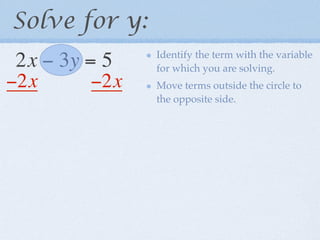
Solve for y:
               Identify the term with the variable
2x − 3y = 5    for which you are solving.
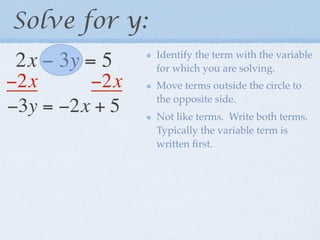
−2x     −2x    Move terms outside the circle to
               the opposite side.
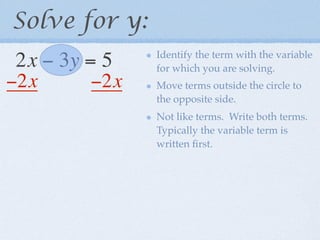
Solve for y:
               Identify the term with the variable
2x − 3y = 5    for which you are solving.
−2x     −2x    Move terms outside the circle to
               the opposite side.
               Not like terms. Write both terms.
               Typically the variable term is
               written first.
Solve for y:
                Identify the term with the variable
 2x − 3y = 5    for which you are solving.
−2x      −2x    Move terms outside the circle to
                the opposite side.
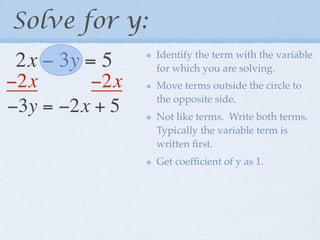
−3y = −2x + 5   Not like terms. Write both terms.
                Typically the variable term is
                written first.
Solve for y:
                Identify the term with the variable
 2x − 3y = 5    for which you are solving.
−2x      −2x    Move terms outside the circle to
                the opposite side.
−3y = −2x + 5   Not like terms. Write both terms.
                Typically the variable term is
                written first.
                Get coefficient of y as 1.
Solve for y:
                Identify the term with the variable
 2x − 3y = 5    for which you are solving.
−2x      −2x    Move terms outside the circle to
                the opposite side.
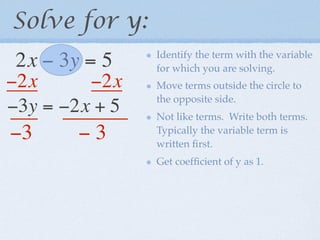
−3y = −2x + 5   Not like terms. Write both terms.
−3      −3      Typically the variable term is
                written first.
                Get coefficient of y as 1.
Solve for y:
                Identify the term with the variable
 2x − 3y = 5    for which you are solving.
−2x      −2x    Move terms outside the circle to
                the opposite side.
−3y = −2x + 5   Not like terms. Write both terms.
−3      −3      Typically the variable term is
                written first.
                Get coefficient of y as 1.
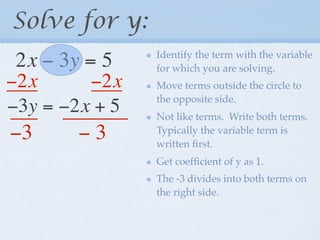
                The -3 divides into both terms on
                the right side.
Solve for y:
                Identify the term with the variable
 2x − 3y = 5    for which you are solving.
−2x      −2x    Move terms outside the circle to
                the opposite side.
−3y = −2x + 5   Not like terms. Write both terms.
−3      −3      Typically the variable term is
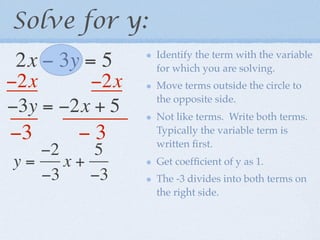
                written first.
   −2    5
y=    x+        Get coefficient of y as 1.
   −3    −3     The -3 divides into both terms on
                the right side.
Solve for y:
                Identify the term with the variable
 2x − 3y = 5    for which you are solving.
−2x      −2x    Move terms outside the circle to
                the opposite side.
−3y = −2x + 5   Not like terms. Write both terms.
−3      −3      Typically the variable term is
                written first.
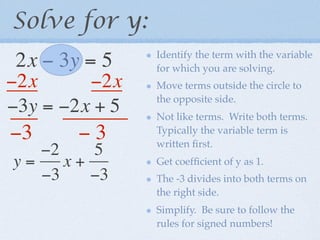
   −2    5
y=    x+        Get coefficient of y as 1.
   −3    −3     The -3 divides into both terms on
                the right side.
                Simplify. Be sure to follow the
                rules for signed numbers!
Solve for y:
                Identify the term with the variable
 2x − 3y = 5    for which you are solving.
−2x      −2x    Move terms outside the circle to
                the opposite side.
−3y = −2x + 5   Not like terms. Write both terms.
−3      −3      Typically the variable term is
                written first.
   −2    5
y=    x+        Get coefficient of y as 1.
   −3    −3     The -3 divides into both terms on
                the right side.
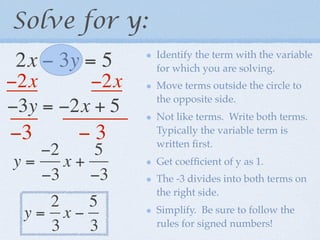
   2   5        Simplify. Be sure to follow the
 y= x−
   3   3        rules for signed numbers!

Unit 3 hw 7 - literal equations

  • 1.
  • 2.
    Solving equations withmore than 1 variable (Literal Equations) Sometimes equations have more than one variable. Such as 2x - y = 5 or ab + c = d or A = bh Solving for a specific variable requires the exact same steps as solving for equations with one variable. The only difference is rarely do terms disappear. The just move to the opposite side.
  • 3.
  • 4.
    Solve for a: Identify the term with the variable ab + c = d for which you are solving.
  • 5.
    Solve for a: Identify the term with the variable ab + c = d for which you are solving.
  • 6.
    Solve for a: Identify the term with the variable ab + c = d for which you are solving. Move terms outside the circle to the opposite side.
  • 7.
    Solve for a: Identify the term with the variable ab + c = d for which you are solving. −c −c Move terms outside the circle to the opposite side.
  • 8.
    Solve for a: Identify the term with the variable ab + c = d for which you are solving. −c −c Move terms outside the circle to the opposite side. Only like terms can be added or subtracted. Write both terms because they are not alike.
  • 9.
    Solve for a: Identify the term with the variable ab + c = d for which you are solving. −c −c Move terms outside the circle to the opposite side. ab = d − c Only like terms can be added or subtracted. Write both terms because they are not alike.
  • 10.
    Solve for a: Identify the term with the variable ab + c = d for which you are solving. −c −c Move terms outside the circle to the opposite side. ab = d − c Only like terms can be added or subtracted. Write both terms because they are not alike. The term with ‘a’ is alone but there is another variable with it. Get the ‘a’ by itself by undoing the multiplication.
  • 11.
    Solve for a: Identify the term with the variable ab + c = d for which you are solving. −c −c Move terms outside the circle to the opposite side. ab = d − c Only like terms can be added or subtracted. Write both terms b b because they are not alike. The term with ‘a’ is alone but there is another variable with it. Get the ‘a’ by itself by undoing the multiplication.
  • 12.
    Solve for a: Identify the term with the variable ab + c = d for which you are solving. −c −c Move terms outside the circle to the opposite side. ab = d − c Only like terms can be added or subtracted. Write both terms b b because they are not alike. The term with ‘a’ is alone but there is another variable with it. Get the d−c ‘a’ by itself by undoing the a= multiplication. b Nothing can be simplified so this is the final answer.
  • 13.
    Solve for h: 1 A = bh 2
  • 14.
    Solve for h: 1 Identify the term with the A = bh variable for which you are 2 solving.
  • 15.
    Solve for h: 1 Identify the term with the A = bh variable for which you are 2 solving.
  • 16.
    Solve for h: 1 Identify the term with the A = bh variable for which you are 2 solving. No terms outside the circle to move.
  • 17.
    Solve for h: 1 Identify the term with the A = bh variable for which you are 2 solving. No terms outside the circle to move. Make life easier by getting rid of the fraction by multiplying by 2
  • 18.
    Solve for h: 1 Identify the term with the A = bh variable for which you are 2 solving. 1  No terms outside the circle to 2 ( A ) =  bh  2 move. 2  Make life easier by getting rid of the fraction by multiplying by 2
  • 19.
    Solve for h: 1 Identify the term with the A = bh variable for which you are 2 solving. 1  No terms outside the circle to 2 ( A ) =  bh  2 move. 2  Make life easier by getting rid of 2A = bh the fraction by multiplying by 2
  • 20.
    Solve for h: 1 Identify the term with the A = bh variable for which you are 2 solving. 1  No terms outside the circle to 2 ( A ) =  bh  2 move. 2  Make life easier by getting rid of 2A = bh the fraction by multiplying by 2 Get the ‘h’ by itself by undoing the multiplication.
  • 21.
    Solve for h: 1 Identify the term with the A = bh variable for which you are 2 solving. 1  No terms outside the circle to 2 ( A ) =  bh  2 move. 2  Make life easier by getting rid of 2A = bh the fraction by multiplying by 2 Get the ‘h’ by itself by undoing b b the multiplication.
  • 22.
    Solve for h: 1 Identify the term with the A = bh variable for which you are 2 solving. 1  No terms outside the circle to 2 ( A ) =  bh  2 move. 2  Make life easier by getting rid of 2A = bh the fraction by multiplying by 2 Get the ‘h’ by itself by undoing b b the multiplication. 2A Nothing can be simplified so =h this is the final answer. b
  • 23.
    Solve for y: 2x− 3y = 5
  • 24.
    Solve for y: Identify the term with the variable 2x − 3y = 5 for which you are solving.
  • 25.
    Solve for y: Identify the term with the variable 2x − 3y = 5 for which you are solving.
  • 26.
    Solve for y: Identify the term with the variable 2x − 3y = 5 for which you are solving. Move terms outside the circle to the opposite side.
  • 27.
    Solve for y: Identify the term with the variable 2x − 3y = 5 for which you are solving. −2x −2x Move terms outside the circle to the opposite side.
  • 28.
    Solve for y: Identify the term with the variable 2x − 3y = 5 for which you are solving. −2x −2x Move terms outside the circle to the opposite side. Not like terms. Write both terms. Typically the variable term is written first.
  • 29.
    Solve for y: Identify the term with the variable 2x − 3y = 5 for which you are solving. −2x −2x Move terms outside the circle to the opposite side. −3y = −2x + 5 Not like terms. Write both terms. Typically the variable term is written first.
  • 30.
    Solve for y: Identify the term with the variable 2x − 3y = 5 for which you are solving. −2x −2x Move terms outside the circle to the opposite side. −3y = −2x + 5 Not like terms. Write both terms. Typically the variable term is written first. Get coefficient of y as 1.
  • 31.
    Solve for y: Identify the term with the variable 2x − 3y = 5 for which you are solving. −2x −2x Move terms outside the circle to the opposite side. −3y = −2x + 5 Not like terms. Write both terms. −3 −3 Typically the variable term is written first. Get coefficient of y as 1.
  • 32.
    Solve for y: Identify the term with the variable 2x − 3y = 5 for which you are solving. −2x −2x Move terms outside the circle to the opposite side. −3y = −2x + 5 Not like terms. Write both terms. −3 −3 Typically the variable term is written first. Get coefficient of y as 1. The -3 divides into both terms on the right side.
  • 33.
    Solve for y: Identify the term with the variable 2x − 3y = 5 for which you are solving. −2x −2x Move terms outside the circle to the opposite side. −3y = −2x + 5 Not like terms. Write both terms. −3 −3 Typically the variable term is written first. −2 5 y= x+ Get coefficient of y as 1. −3 −3 The -3 divides into both terms on the right side.
  • 34.
    Solve for y: Identify the term with the variable 2x − 3y = 5 for which you are solving. −2x −2x Move terms outside the circle to the opposite side. −3y = −2x + 5 Not like terms. Write both terms. −3 −3 Typically the variable term is written first. −2 5 y= x+ Get coefficient of y as 1. −3 −3 The -3 divides into both terms on the right side. Simplify. Be sure to follow the rules for signed numbers!
  • 35.
    Solve for y: Identify the term with the variable 2x − 3y = 5 for which you are solving. −2x −2x Move terms outside the circle to the opposite side. −3y = −2x + 5 Not like terms. Write both terms. −3 −3 Typically the variable term is written first. −2 5 y= x+ Get coefficient of y as 1. −3 −3 The -3 divides into both terms on the right side. 2 5 Simplify. Be sure to follow the y= x− 3 3 rules for signed numbers!