Populations and
samples
2
Population
Unknown: we would like to
make inferences (statement)
about
Take a
Sample
Use the sample to say
something about the
population
3
Sampling: A Pictorial View
Sample
Target Population
Sampled
(Study)
Population
Sample
Target Population  Sampled(STUDY) Population 
Sampling variation
We need to distinguish between a population and a sample of a
population
• Data from a sample:
• The mean of a variable ( ) is considered an estimate of the
true population mean (µ)
• The standard deviation of the variable (s) estimates the
population standard deviation (s)
However, if another sample is drawn:
The second sample mean will differ from the first sample mean
• This is called sampling variation
x
µ = population mean
1 , 2 are sample means
1 2
µ
Frequency
Population
Samples
How variable are the sample means
The Standard Deviation (sd):
• The sample standard deviation (s) estimates the variability of the
individual data in the population (s)
The Standard Error (SE)
• Represents the variability of the sample means
• Can be estimated from the standard deviation as s/√n
• Standard Error decreases as the sample size increases
standard deviation represents the variability in the individual data
standard error represents the variability in the sample means
Normal Distribution
Definitions
 Continuous data are data such as age, weight, height,
haemoglobin.
 In descriptive stats we use the mean and standard
deviation to describe these data
 Assumption the data are approximately Normal
 If not we could use median and IQR to describe the
data
WHY THE NORMAL DISTRIBUTION IS
IMPORTANT
 A good empirical description of the distribution of many
variables
the sampling distribution of a mean is normal, even
when the individual observations are not normally
distributed, provided that the sample size is not too
small
 it occupies a central role in statistical analysis.
CI’s, P-values, proportions and rates
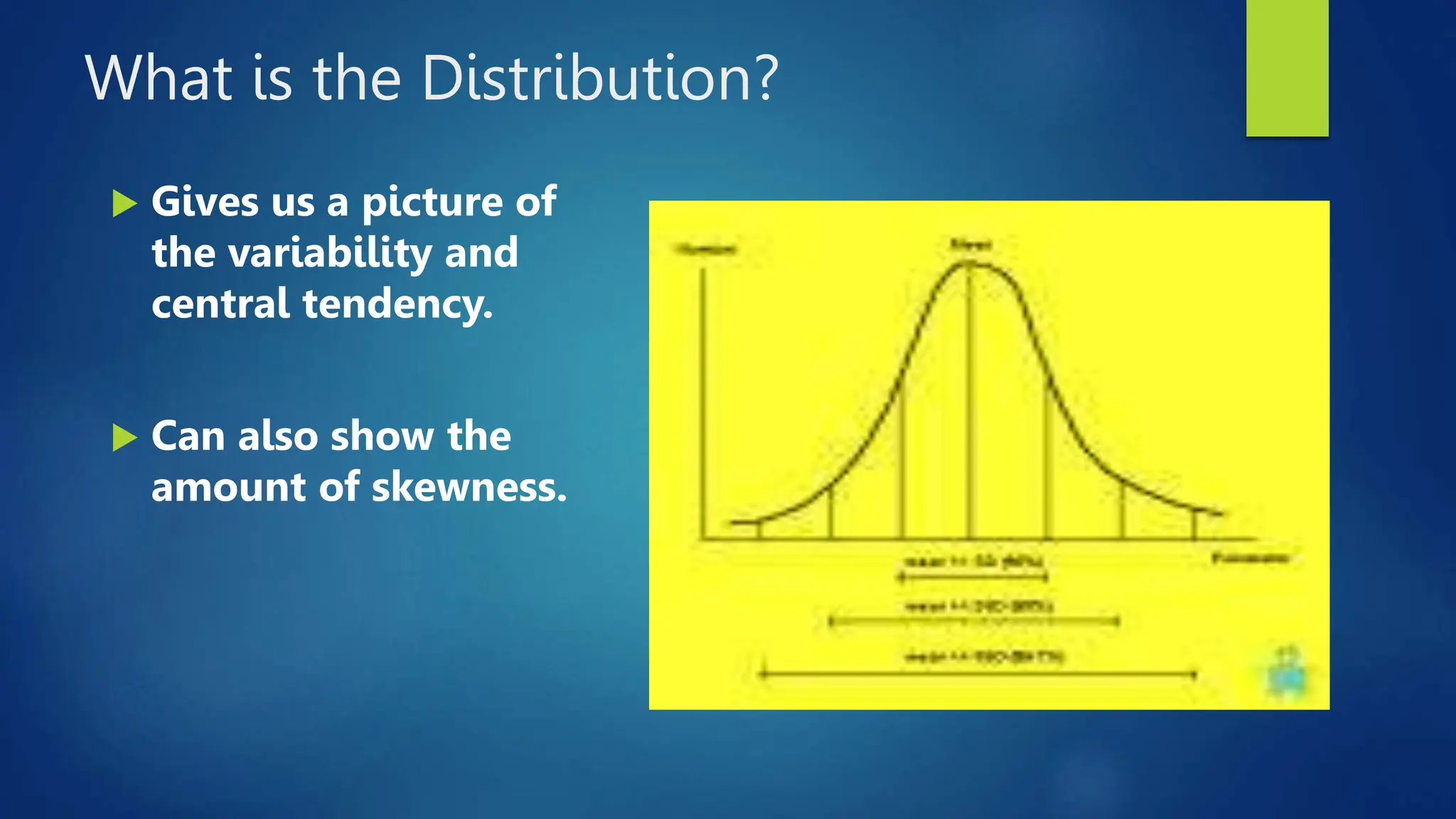
What is the Distribution?
 Gives us a picture of
the variability and
central tendency.
 Can also show the
amount of skewness.
Normal Distributions
(aka Bell-Shaped Curves, Gaussian Distributions)
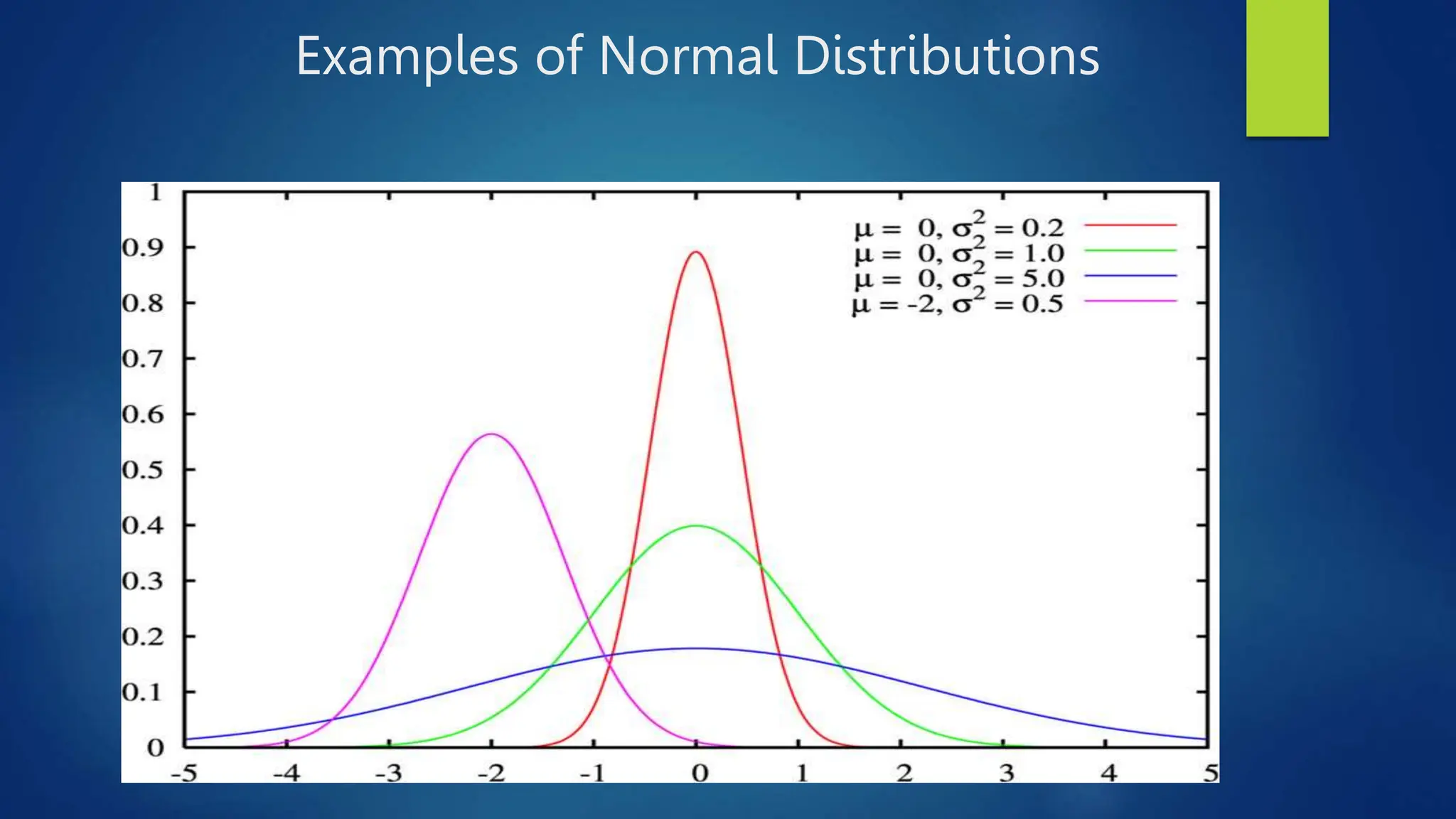
Examples of Normal Distributions
Characteristics of Normal Distributions
Mean = Median = Mode
Bilaterally symmetrical
Tails never touch x-axis
Total area under curve = 1
Notation
 A random sample of size n is taken from the population of
interest.
 The mean and standard deviation of the quantitative variable
x in the population and in the sample are given by:
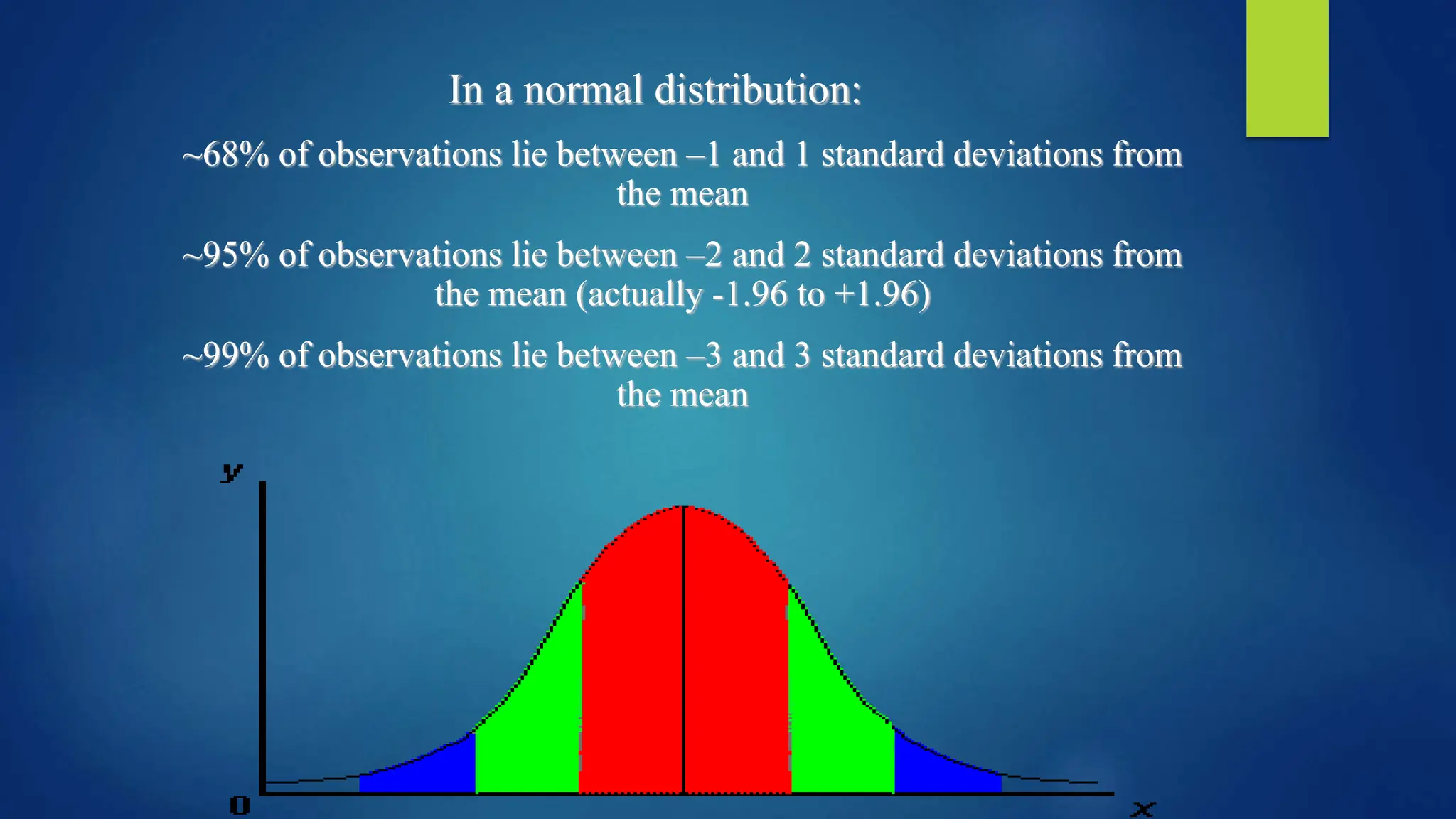
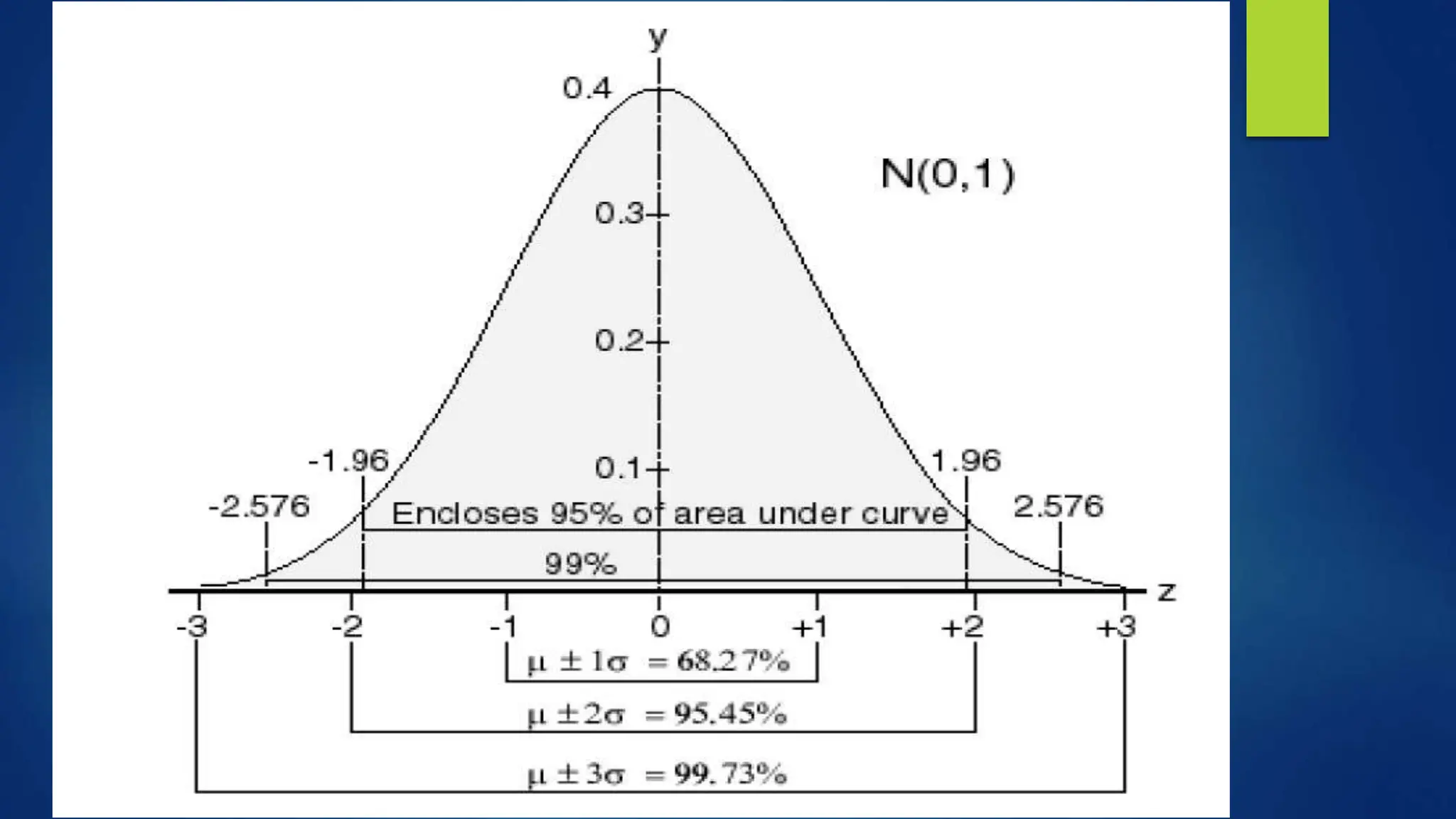
In a normal distribution:
~68% of observations lie between –1 and 1 standard deviations from
the mean
~95% of observations lie between –2 and 2 standard deviations from
the mean (actually -1.96 to +1.96)
~99% of observations lie between –3 and 3 standard deviations from
the mean
Example of normal distribution
Relationship between the mean, standard
deviation and the normal distribution
 For symmetric distributions, approximately, 95% of all observations
lie in the interval  2s
 The limits: - 2s and + 2s are referred to as the 95% tolerance limits
(or 95% spread limits)
 Values contained in the interval are commonly termed as “THE
NORMAL VALUES”
In Summary
 For most continuous data, the data points are Normally
distributed, around the Mean, with a spread which is called the
Standard deviations
 From any sample of continuous data, the mean is calculated, and
will vary from sample to sample.
 The sample mean will have a distribution which is centered on
the Population mean , and will have a spread which is called
the Standard Error.
 The standard error of the sample mean is related to the
standard deviation and the sample size.

Lecture 9-Normal distribution......... ...pptx

  • 1.
  • 2.
    2 Population Unknown: we wouldlike to make inferences (statement) about Take a Sample Use the sample to say something about the population
  • 3.
    3 Sampling: A PictorialView Sample Target Population Sampled (Study) Population Sample Target Population  Sampled(STUDY) Population 
  • 4.
    Sampling variation We needto distinguish between a population and a sample of a population • Data from a sample: • The mean of a variable ( ) is considered an estimate of the true population mean (µ) • The standard deviation of the variable (s) estimates the population standard deviation (s) However, if another sample is drawn: The second sample mean will differ from the first sample mean • This is called sampling variation x
  • 5.
    µ = populationmean 1 , 2 are sample means 1 2 µ Frequency Population Samples
  • 6.
    How variable arethe sample means The Standard Deviation (sd): • The sample standard deviation (s) estimates the variability of the individual data in the population (s) The Standard Error (SE) • Represents the variability of the sample means • Can be estimated from the standard deviation as s/√n • Standard Error decreases as the sample size increases standard deviation represents the variability in the individual data standard error represents the variability in the sample means
  • 7.
  • 8.
    Definitions  Continuous dataare data such as age, weight, height, haemoglobin.  In descriptive stats we use the mean and standard deviation to describe these data  Assumption the data are approximately Normal  If not we could use median and IQR to describe the data
  • 9.
    WHY THE NORMALDISTRIBUTION IS IMPORTANT  A good empirical description of the distribution of many variables the sampling distribution of a mean is normal, even when the individual observations are not normally distributed, provided that the sample size is not too small  it occupies a central role in statistical analysis. CI’s, P-values, proportions and rates
  • 10.
    What is theDistribution?  Gives us a picture of the variability and central tendency.  Can also show the amount of skewness.
  • 11.
    Normal Distributions (aka Bell-ShapedCurves, Gaussian Distributions)
  • 12.
    Examples of NormalDistributions
  • 13.
    Characteristics of NormalDistributions Mean = Median = Mode Bilaterally symmetrical Tails never touch x-axis Total area under curve = 1
  • 14.
    Notation  A randomsample of size n is taken from the population of interest.  The mean and standard deviation of the quantitative variable x in the population and in the sample are given by:
  • 15.
    In a normaldistribution: ~68% of observations lie between –1 and 1 standard deviations from the mean ~95% of observations lie between –2 and 2 standard deviations from the mean (actually -1.96 to +1.96) ~99% of observations lie between –3 and 3 standard deviations from the mean
  • 17.
    Example of normaldistribution
  • 18.
    Relationship between themean, standard deviation and the normal distribution  For symmetric distributions, approximately, 95% of all observations lie in the interval  2s  The limits: - 2s and + 2s are referred to as the 95% tolerance limits (or 95% spread limits)  Values contained in the interval are commonly termed as “THE NORMAL VALUES”
  • 19.
    In Summary  Formost continuous data, the data points are Normally distributed, around the Mean, with a spread which is called the Standard deviations  From any sample of continuous data, the mean is calculated, and will vary from sample to sample.  The sample mean will have a distribution which is centered on the Population mean , and will have a spread which is called the Standard Error.  The standard error of the sample mean is related to the standard deviation and the sample size.