OBJECTIVES
The learners are expected to:
a. Calculate the Standard
   Deviation of a given set of
   data.
b. Calculate the Variance of a
   given set of data.
STANDARD DEVIATION

 is a special form of average
 deviation from the mean.
 is the positive square root of
 the arithmetic mean of the
 squared deviations from the
 mean of the distribution.
STANDARD DEVIATION

 is considered as the most
 reliable measure of variability.
 is affected by the individual
 values or items in the
 distribution.
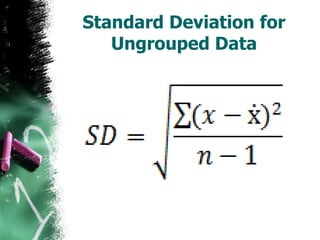
Standard Deviation for
   Ungrouped Data
How to Calculate the
  Standard Deviation for
     Ungrouped Data
1. Find the Mean.
2. Calculate the difference
   between each score and the
   mean.
3. Square the difference
   between each score and the
   mean.
How to Calculate the
   Standard Deviation for
      Ungrouped Data
4. Add up all the squares of the
    difference between each
    score and the mean.
5. Divide the obtained sum by n
    – 1.
6. Extract the positive square
    root of the obtained quotient.
Find the Standard
       Deviation
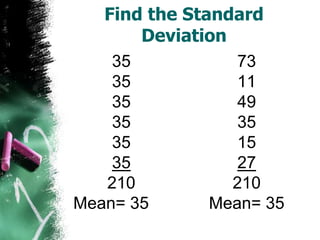
    35            73
    35            11
    35            49
    35            35
    35            15
    35            27
   210           210
Mean= 35       Mean= 35
Find the Standard
         Deviation
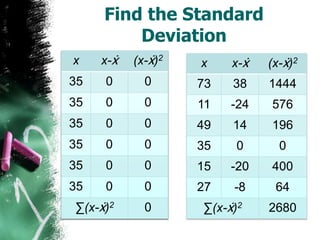
x    x-ẋ   (x-ẋ)2   x    x-ẋ   (x-ẋ)2
35   0       0      73   38    1444
35   0       0      11   -24   576
35   0       0      49   14    196
35   0       0      35    0      0
35   0       0      15   -20   400
35   0       0      27   -8     64
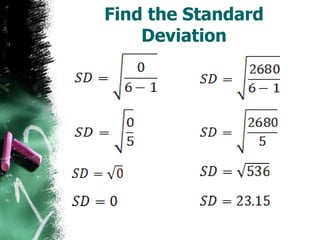
∑(x-ẋ)2      0      ∑(x-ẋ)2    2680
Find the Standard
    Deviation
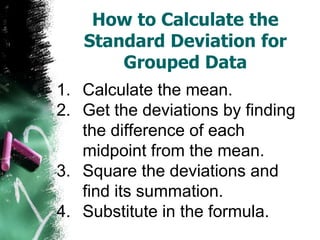
How to Calculate the
   Standard Deviation for
       Grouped Data
1. Calculate the mean.
2. Get the deviations by finding
   the difference of each
   midpoint from the mean.
3. Square the deviations and
   find its summation.
4. Substitute in the formula.
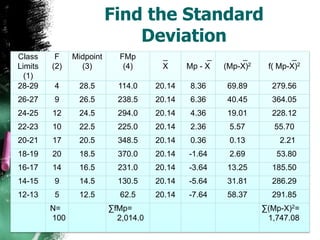
Find the Standard
                              Deviation
Class     F    Midpoint     FMp        _           _        _            _
Limits   (2)     (3)         (4)       X      Mp - X   (Mp-X)2    f( Mp-X)2
  (1)
28-29    4      28.5        114.0     20.14   8.36     69.89       279.56
26-27    9      26.5        238.5     20.14   6.36     40.45       364.05
24-25    12     24.5        294.0     20.14   4.36     19.01       228.12
22-23    10     22.5        225.0     20.14   2.36      5.57        55.70
20-21    17     20.5        348.5     20.14   0.36      0.13         2.21
18-19    20     18.5        370.0     20.14   -1.64     2.69        53.80
16-17    14     16.5        231.0     20.14   -3.64    13.25       185.50
14-15    9      14.5        130.5     20.14   -5.64    31.81       286.29
12-13    5      12.5        62.5      20.14   -7.64    58.37       291.85
         N=               ∑fMp=                                  ∑(Mp-X)2=
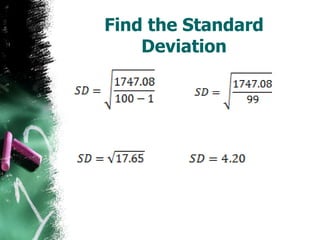
         100                2,014.0                               1,747.08
Find the Standard
    Deviation
Characteristics of the
     Standard Deviation
1. The standard deviation is
   affected by the value of every
   observation.
2. The process of squaring the
   deviations before adding
   avoids the algebraic fallacy
   of disregarding the signs.
Characteristics of the
      Standard Deviation
3. It has a definite mathematical
     meaning and is perfectly
     adapted to algebraic
     treatment.
4. It is, in general, less affected by
     fluctuations of sampling than
     the other measures of
     dispersion.
Characteristics of the
      Standard Deviation
5. The standard deviation is the
    unit customarily used in
    defining areas under the
    normal curve of error. It has,
    thus, great practical utility in
    sampling and statistical
    inference.
VARIANCE

 is the square of the standard
 deviation.
    In short, having obtained
 the value of the standard
 deviation, you can already
 determine the value of the
 variance.
VARIANCE

   It follows then that similar
process will be observed in
calculating both standard
deviation and variance. It is
only the square root symbol
that makes standard deviation
different from variance.
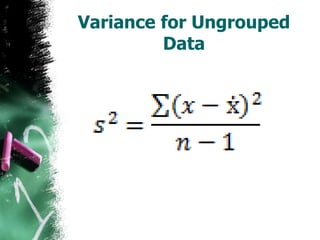
Variance for Ungrouped
         Data
How to Calculate the
Variance for Ungrouped Data

1. Find the Mean.
2. Calculate the difference
   between each score and the
   mean.
3. Square the difference
   between each score and the
   mean.
How to Calculate the
Variance for Ungrouped Data

4. Add up all the squares of the
    difference between each
    score and the mean.
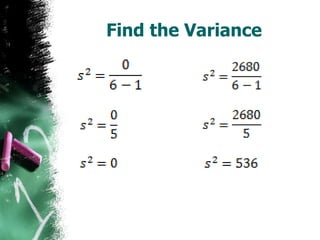
5. Divide the obtained sum by n
    – 1.
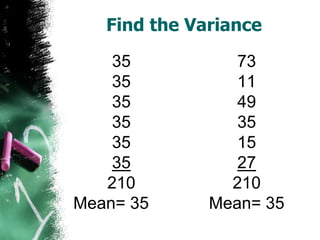
Find the Variance

    35           73
    35           11
    35           49
    35           35
    35           15
    35           27
   210          210
Mean= 35      Mean= 35
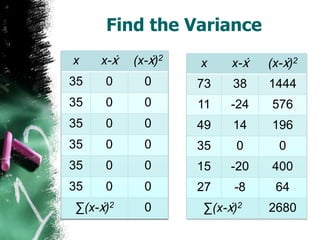
Find the Variance
x    x-ẋ   (x-ẋ)2   x    x-ẋ   (x-ẋ)2
35   0       0      73   38    1444
35   0       0      11   -24   576
35   0       0      49   14    196
35   0       0      35    0      0
35   0       0      15   -20   400
35   0       0      27   -8     64
∑(x-ẋ)2      0      ∑(x-ẋ)2    2680
Find the Variance
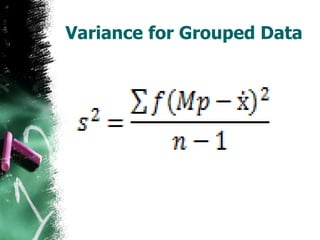
Variance for Grouped Data
How to Calculate the
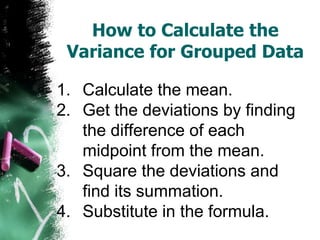
 Variance for Grouped Data

1. Calculate the mean.
2. Get the deviations by finding
   the difference of each
   midpoint from the mean.
3. Square the deviations and
   find its summation.
4. Substitute in the formula.
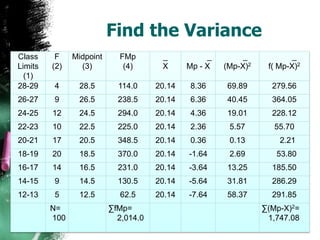
Find the Variance
Class     F    Midpoint     FMp        _           _        _            _
Limits   (2)     (3)         (4)       X      Mp - X   (Mp-X)2    f( Mp-X)2
  (1)
28-29    4      28.5        114.0     20.14   8.36     69.89       279.56
26-27    9      26.5        238.5     20.14   6.36     40.45       364.05
24-25    12     24.5        294.0     20.14   4.36     19.01       228.12
22-23    10     22.5        225.0     20.14   2.36      5.57        55.70
20-21    17     20.5        348.5     20.14   0.36      0.13         2.21
18-19    20     18.5        370.0     20.14   -1.64     2.69        53.80
16-17    14     16.5        231.0     20.14   -3.64    13.25       185.50
14-15    9      14.5        130.5     20.14   -5.64    31.81       286.29
12-13    5      12.5        62.5      20.14   -7.64    58.37       291.85
         N=               ∑fMp=                                  ∑(Mp-X)2=
         100                2,014.0                               1,747.08
Find the Variance
Standard Deviation and Variance

Standard Deviation and Variance

  • 2.
    OBJECTIVES The learners areexpected to: a. Calculate the Standard Deviation of a given set of data. b. Calculate the Variance of a given set of data.
  • 3.
    STANDARD DEVIATION  isa special form of average deviation from the mean.  is the positive square root of the arithmetic mean of the squared deviations from the mean of the distribution.
  • 4.
    STANDARD DEVIATION  isconsidered as the most reliable measure of variability.  is affected by the individual values or items in the distribution.
  • 5.
  • 6.
    How to Calculatethe Standard Deviation for Ungrouped Data 1. Find the Mean. 2. Calculate the difference between each score and the mean. 3. Square the difference between each score and the mean.
  • 7.
    How to Calculatethe Standard Deviation for Ungrouped Data 4. Add up all the squares of the difference between each score and the mean. 5. Divide the obtained sum by n – 1. 6. Extract the positive square root of the obtained quotient.
  • 8.
    Find the Standard Deviation 35 73 35 11 35 49 35 35 35 15 35 27 210 210 Mean= 35 Mean= 35
  • 9.
    Find the Standard Deviation x x-ẋ (x-ẋ)2 x x-ẋ (x-ẋ)2 35 0 0 73 38 1444 35 0 0 11 -24 576 35 0 0 49 14 196 35 0 0 35 0 0 35 0 0 15 -20 400 35 0 0 27 -8 64 ∑(x-ẋ)2 0 ∑(x-ẋ)2 2680
  • 10.
  • 11.
    How to Calculatethe Standard Deviation for Grouped Data 1. Calculate the mean. 2. Get the deviations by finding the difference of each midpoint from the mean. 3. Square the deviations and find its summation. 4. Substitute in the formula.
  • 12.
    Find the Standard Deviation Class F Midpoint FMp _ _ _ _ Limits (2) (3) (4) X Mp - X (Mp-X)2 f( Mp-X)2 (1) 28-29 4 28.5 114.0 20.14 8.36 69.89 279.56 26-27 9 26.5 238.5 20.14 6.36 40.45 364.05 24-25 12 24.5 294.0 20.14 4.36 19.01 228.12 22-23 10 22.5 225.0 20.14 2.36 5.57 55.70 20-21 17 20.5 348.5 20.14 0.36 0.13 2.21 18-19 20 18.5 370.0 20.14 -1.64 2.69 53.80 16-17 14 16.5 231.0 20.14 -3.64 13.25 185.50 14-15 9 14.5 130.5 20.14 -5.64 31.81 286.29 12-13 5 12.5 62.5 20.14 -7.64 58.37 291.85 N= ∑fMp= ∑(Mp-X)2= 100 2,014.0 1,747.08
  • 13.
  • 14.
    Characteristics of the Standard Deviation 1. The standard deviation is affected by the value of every observation. 2. The process of squaring the deviations before adding avoids the algebraic fallacy of disregarding the signs.
  • 15.
    Characteristics of the Standard Deviation 3. It has a definite mathematical meaning and is perfectly adapted to algebraic treatment. 4. It is, in general, less affected by fluctuations of sampling than the other measures of dispersion.
  • 16.
    Characteristics of the Standard Deviation 5. The standard deviation is the unit customarily used in defining areas under the normal curve of error. It has, thus, great practical utility in sampling and statistical inference.
  • 17.
    VARIANCE  is thesquare of the standard deviation. In short, having obtained the value of the standard deviation, you can already determine the value of the variance.
  • 18.
    VARIANCE It follows then that similar process will be observed in calculating both standard deviation and variance. It is only the square root symbol that makes standard deviation different from variance.
  • 19.
  • 20.
    How to Calculatethe Variance for Ungrouped Data 1. Find the Mean. 2. Calculate the difference between each score and the mean. 3. Square the difference between each score and the mean.
  • 21.
    How to Calculatethe Variance for Ungrouped Data 4. Add up all the squares of the difference between each score and the mean. 5. Divide the obtained sum by n – 1.
  • 22.
    Find the Variance 35 73 35 11 35 49 35 35 35 15 35 27 210 210 Mean= 35 Mean= 35
  • 23.
    Find the Variance x x-ẋ (x-ẋ)2 x x-ẋ (x-ẋ)2 35 0 0 73 38 1444 35 0 0 11 -24 576 35 0 0 49 14 196 35 0 0 35 0 0 35 0 0 15 -20 400 35 0 0 27 -8 64 ∑(x-ẋ)2 0 ∑(x-ẋ)2 2680
  • 24.
  • 25.
  • 26.
    How to Calculatethe Variance for Grouped Data 1. Calculate the mean. 2. Get the deviations by finding the difference of each midpoint from the mean. 3. Square the deviations and find its summation. 4. Substitute in the formula.
  • 27.
    Find the Variance Class F Midpoint FMp _ _ _ _ Limits (2) (3) (4) X Mp - X (Mp-X)2 f( Mp-X)2 (1) 28-29 4 28.5 114.0 20.14 8.36 69.89 279.56 26-27 9 26.5 238.5 20.14 6.36 40.45 364.05 24-25 12 24.5 294.0 20.14 4.36 19.01 228.12 22-23 10 22.5 225.0 20.14 2.36 5.57 55.70 20-21 17 20.5 348.5 20.14 0.36 0.13 2.21 18-19 20 18.5 370.0 20.14 -1.64 2.69 53.80 16-17 14 16.5 231.0 20.14 -3.64 13.25 185.50 14-15 9 14.5 130.5 20.14 -5.64 31.81 286.29 12-13 5 12.5 62.5 20.14 -7.64 58.37 291.85 N= ∑fMp= ∑(Mp-X)2= 100 2,014.0 1,747.08
  • 28.