BUKIDNON STATE UNIVERSITY
     Graduate External Studies
     Surigao Study Center
     Surigao City


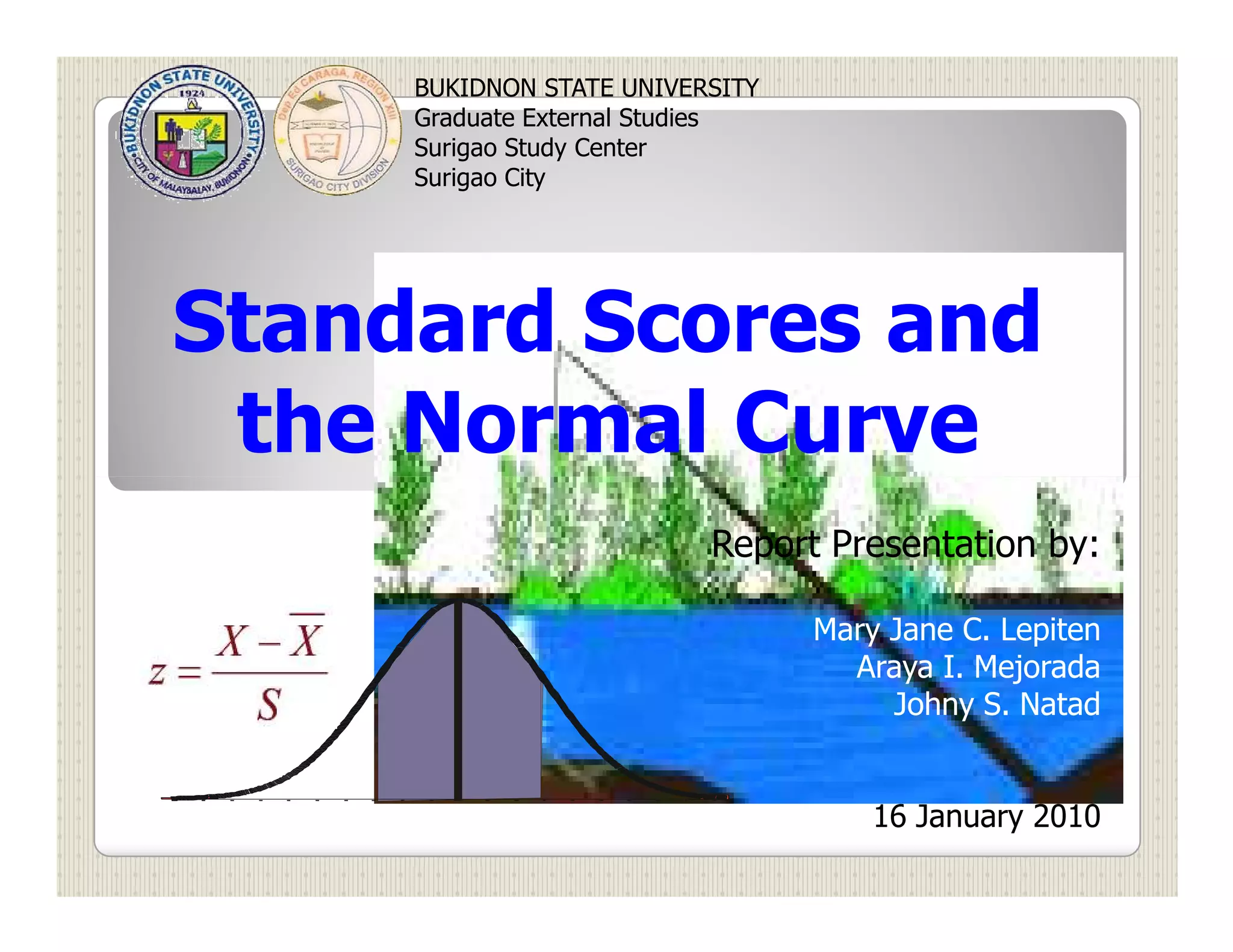
Standard Scores and
 the Normal Curve
                          Report Presentation by:

                                 Mary Jane C. Lepiten
                                   Araya I. Mejorada
                                      Johny S. Natad


                                     16 January 2010
Content for Discussion

 Standard Scores or Z scores
     by: Ms. Mary Jane C. Lepiten

 Uses of Z scores
     by: Johny S. Natad

 The Normal Curve
     by Ms. Araya I. Mejorada
Ms. Mary Jane C. Lepiten


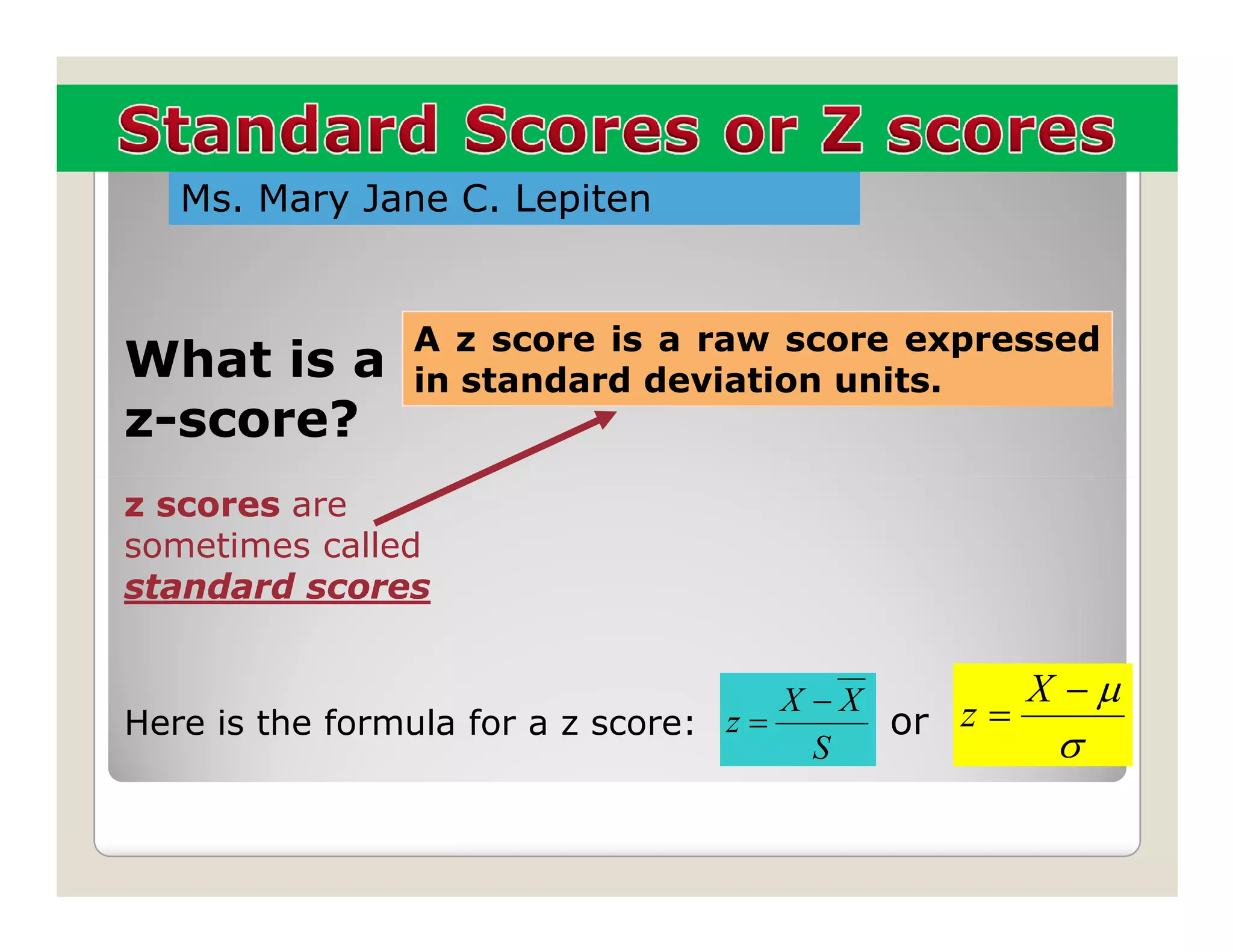
               A z score is a raw score expressed
What is a      in standard deviation units.
z-score?
z scores are
sometimes called
standard scores


                                       X −X        X −µ
Here is the formula for a z score: z =      or z =
                                         S          σ
Computational Formula

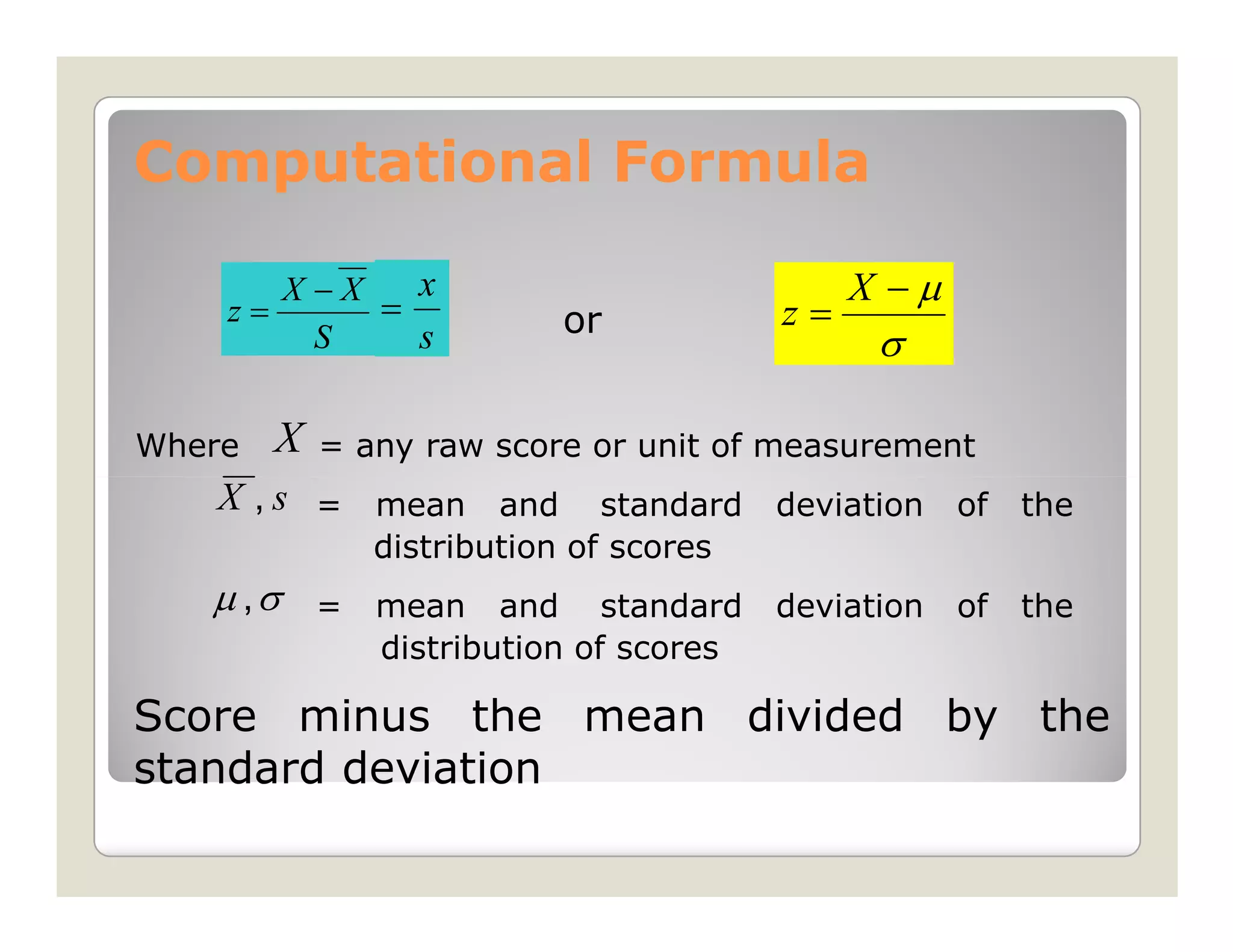
       X −X   x                                X −µ
    z=      =              or             z=
         S    s                                 σ

Where   X   = any raw score or unit of measurement
   X , s = mean and            standard   deviation   of   the
                distribution of scores
   µ ,σ     =   mean and standard         deviation   of   the
                distribution of scores

Score minus the mean divided by the
standard deviation
Using z scores to compare two raw
scores from different distributions
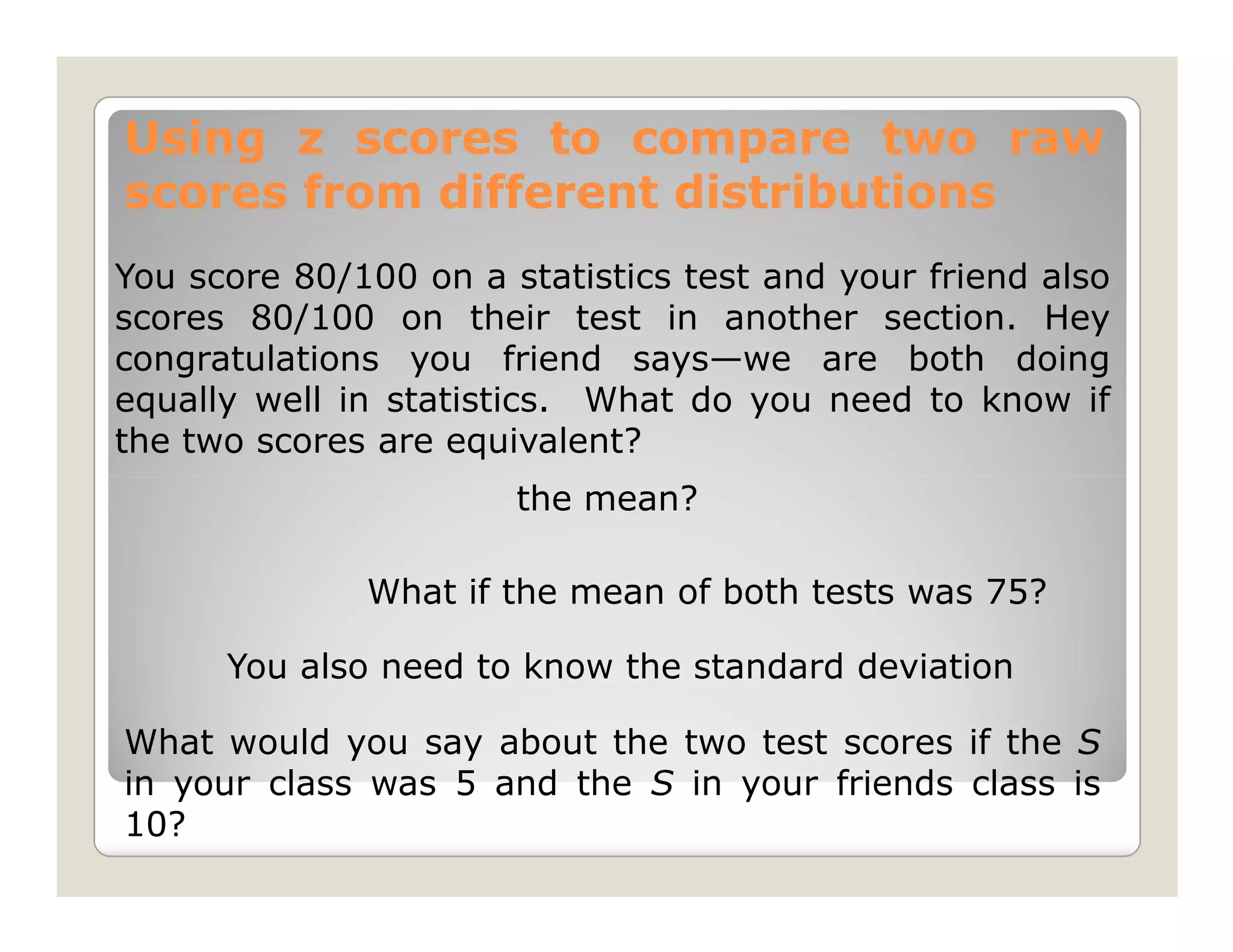
You score 80/100 on a statistics test and your friend also
scores 80/100 on their test in another section. Hey
congratulations you friend says—we are both doing
equally well in statistics. What do you need to know if
the two scores are equivalent?
                       the mean?

              What if the mean of both tests was 75?

      You also need to know the standard deviation

What would you say about the two test scores if the S
in your class was 5 and the S in your friends class is
10?
Calculating z scores
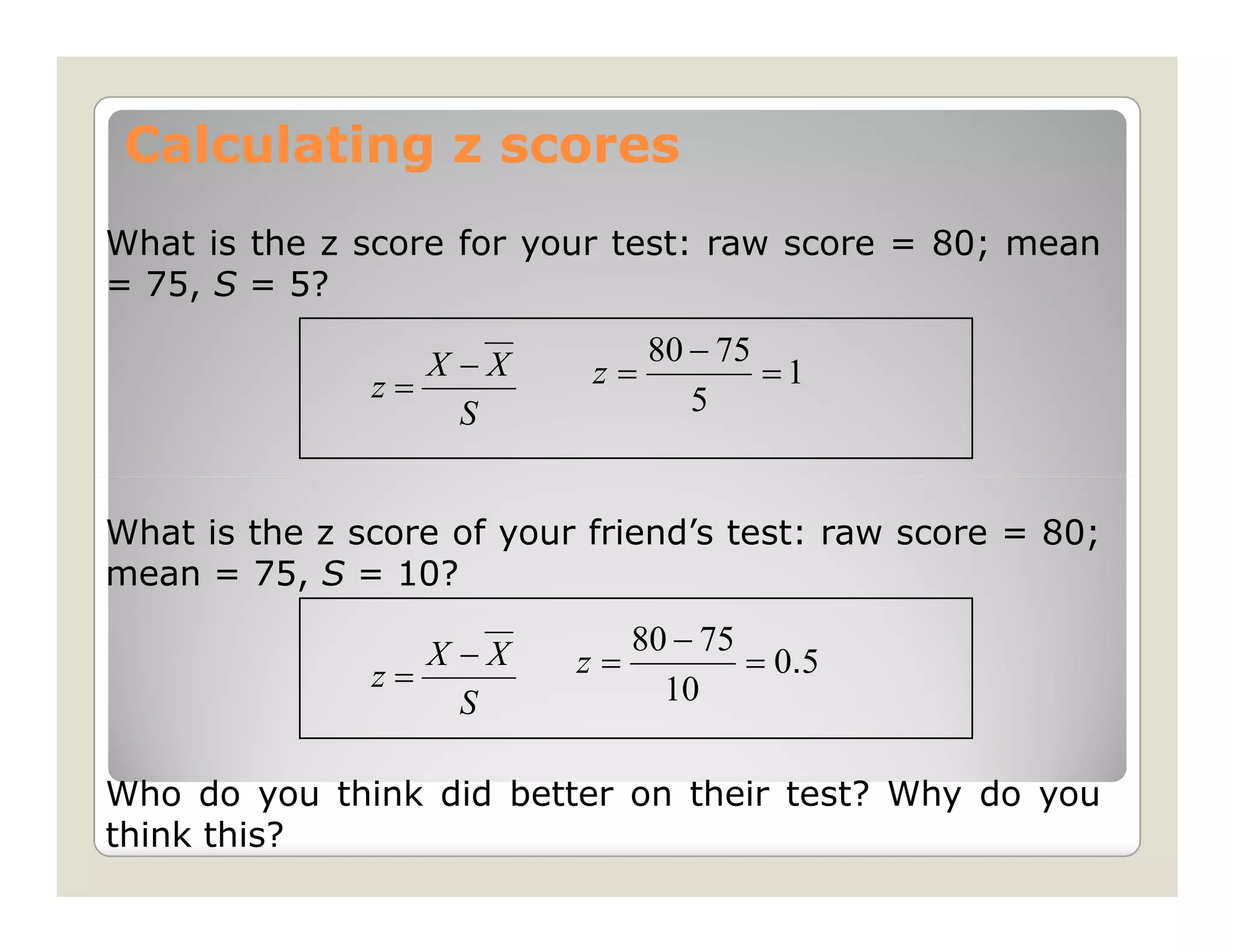
What is the z score for your test: raw score = 80; mean
= 75, S = 5?

                  X −X           80 − 75
               z=           z=           =1
                    S               5


What is the z score of your friend’s test: raw score = 80;
mean = 75, S = 10?

                  X −X        80 − 75
               z=          z=         = 0. 5
                    S           10

Who do you think did better on their test? Why do you
think this?
Calculating z scores
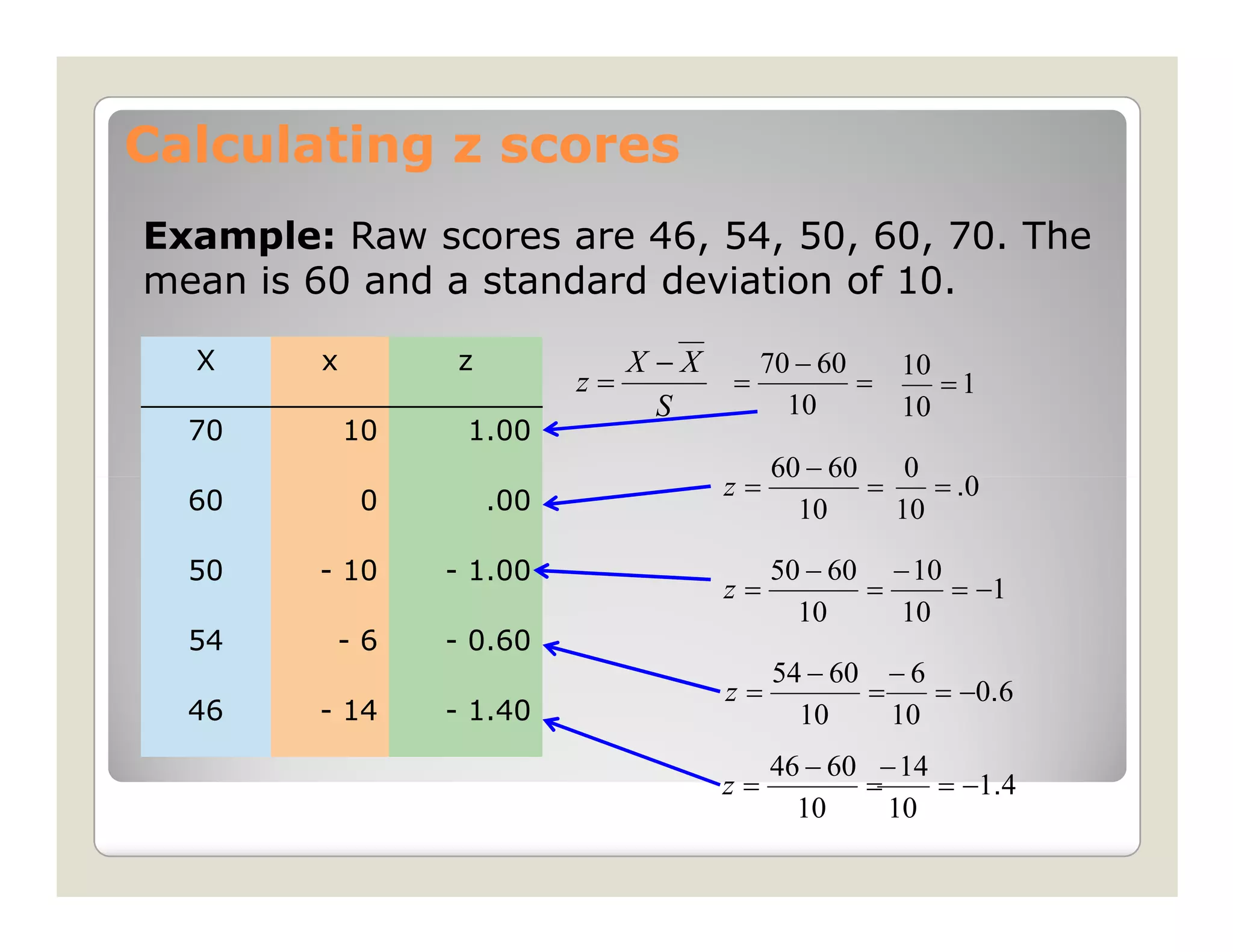
Example: Raw scores are 46, 54, 50, 60, 70. The
mean is 60 and a standard deviation of 10.

  X     x        z              X −X        70 − 60   10
                           z=          =            =    =1
                                  S           10      10
  70        10    1.00
                                            60 − 60    0
  60        0        .00
                                       z=           =    = .0
                                              10      10

  50    - 10     - 1.00                     50 − 60 − 10
                                       z=          =     = −1
                                              10     10
  54     -6      - 0.60
                                            54 − 60 − 6
                                       z=          =    = −0.6
  46    - 14     - 1.40                       10     10
                                            46 − 60 − 14
                                       z=          =     = −1.4
                                              10     10
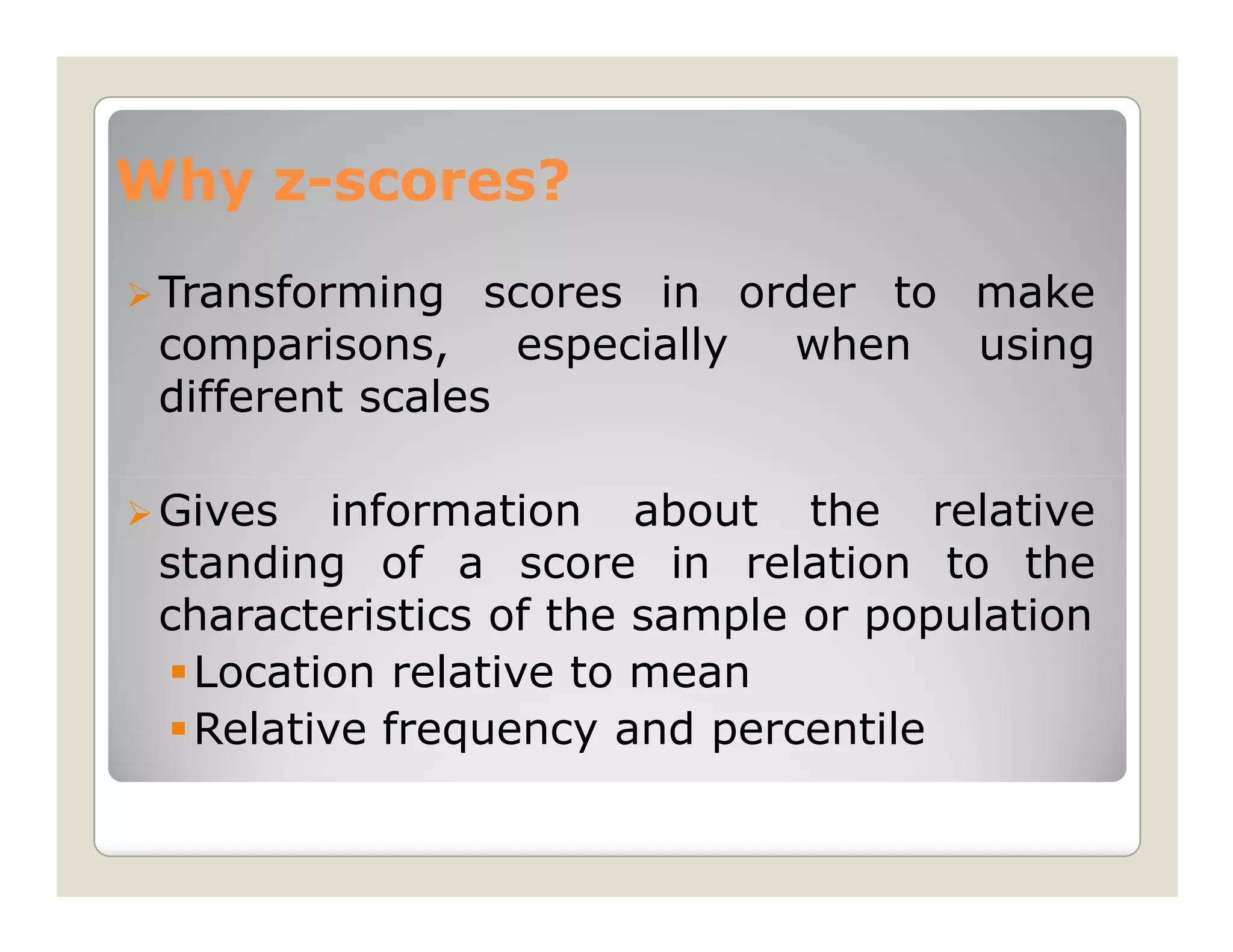
Why z-scores?
    z-
 Transforming scores in order to make
 comparisons,     especially when using
 different scales

 Gives information about the relative
 standing of a score in relation to the
 characteristics of the sample or population
   Location relative to mean
   Relative frequency and percentile
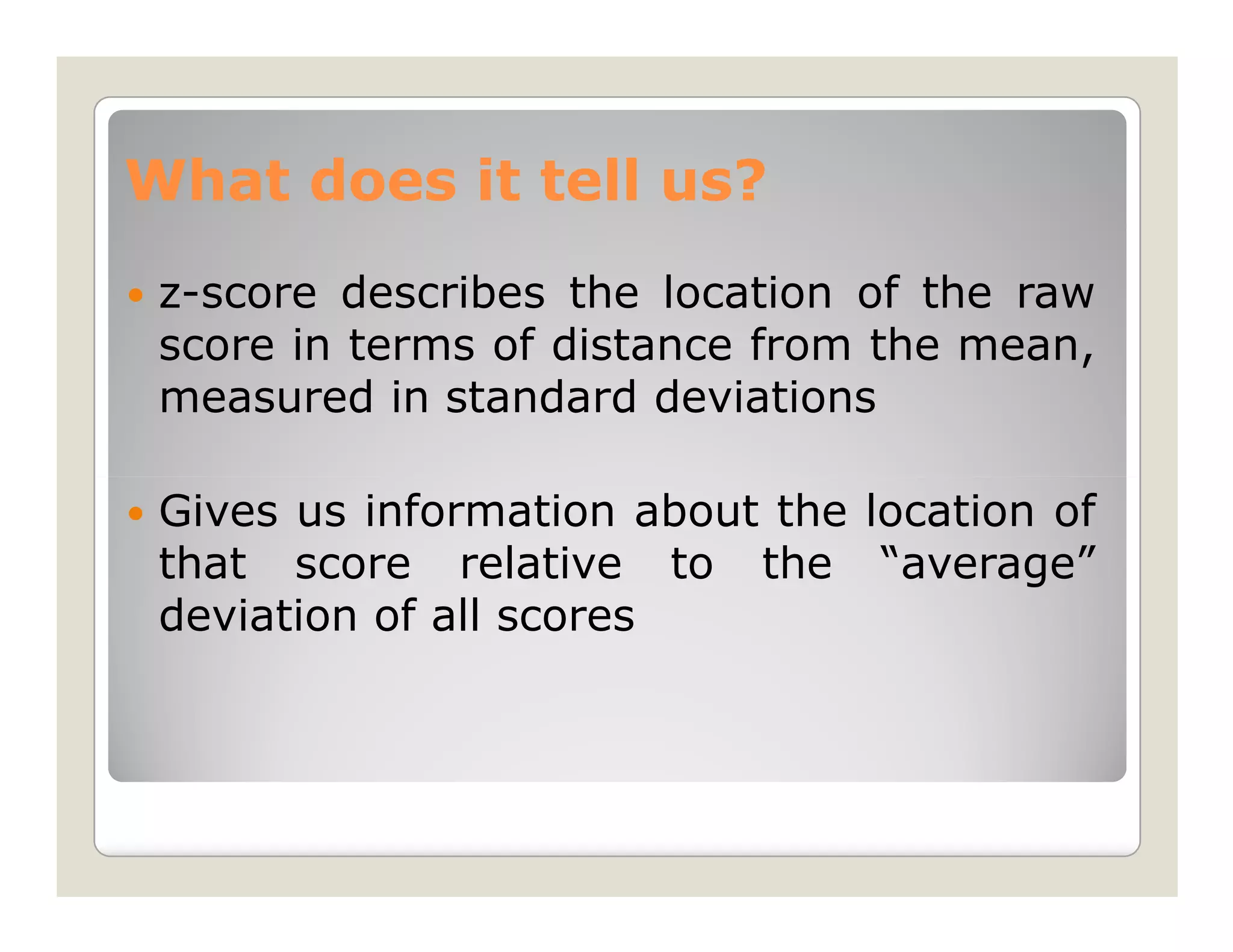
What does it tell us?
 z-score describes the location of the raw
 score in terms of distance from the mean,
 measured in standard deviations

 Gives us information about the location of
 that score relative to the “average”
 deviation of all scores
Z-score Distribution
  Mean of zero
  ◦ Zero distance from the mean

  Standard deviation of 1

  Z-score distribution always has same
  shape as raw score. If distribution was
  positively skewed to begin with, z
  scores made from such a distribution
  would be positively skewed.
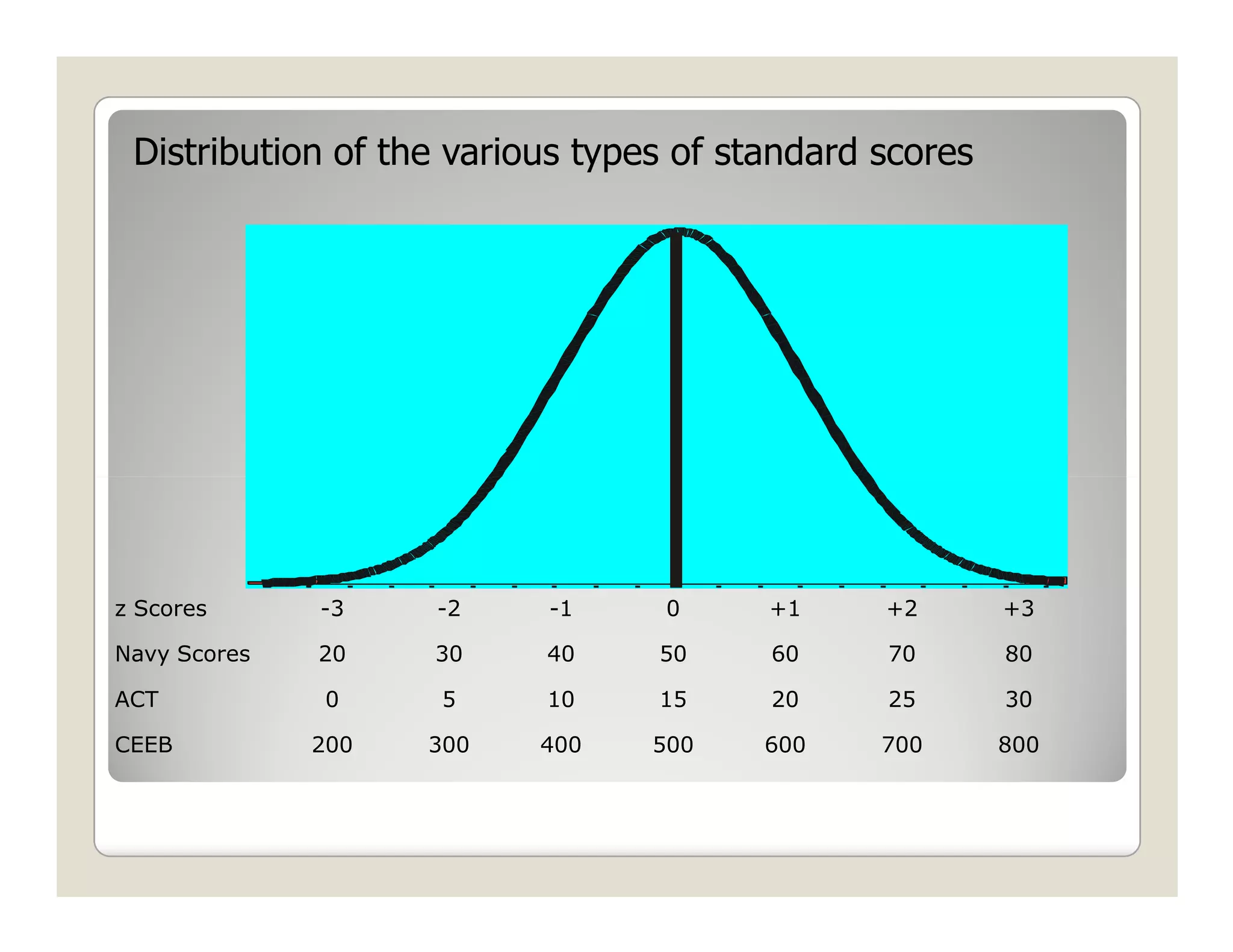
Distribution of the various types of standard scores


z Scores      -3    -2    -1     0      +1     +2       +3

Navy Scores   20    30    40     50     60     70       80

ACT           0     5     10     15     20     25       30

CEEB          200   300   400    500    600    700      800
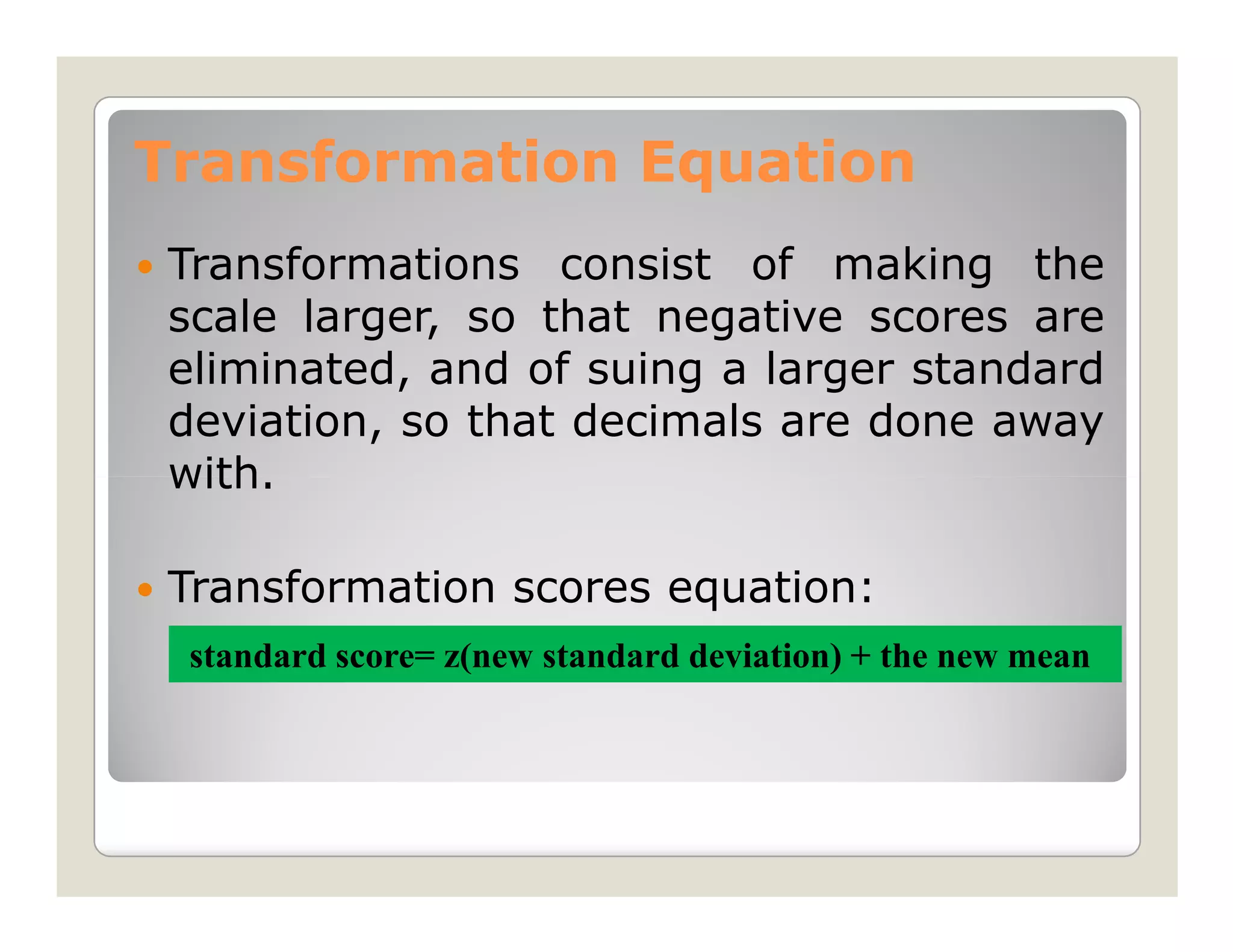
Transformation Equation
 Transformations consist of making the
 scale larger, so that negative scores are
 eliminated, and of suing a larger standard
 deviation, so that decimals are done away
 with.

 Transformation scores equation:
 standard score= z(new standard deviation) + the new mean
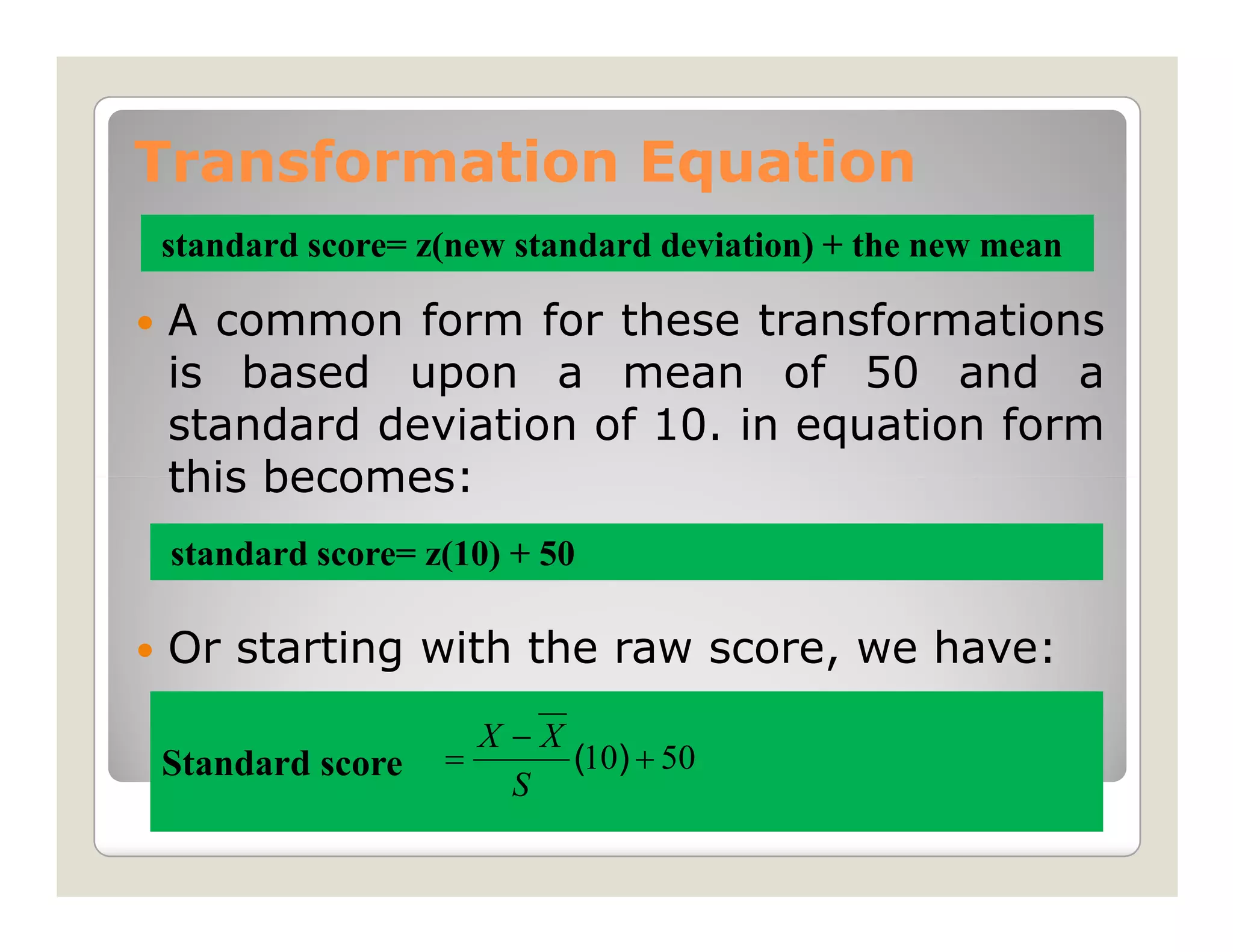
Transformation Equation
standard score= z(new standard deviation) + the new mean

 A common form for these transformations
 is based upon a mean of 50 and a
 standard deviation of 10. in equation form
 this becomes:
 standard score= z(10) + 50

 Or starting with the raw score, we have:
                      X−X
Standard score    =       (10) + 50
                       S
Fun facts about z scores

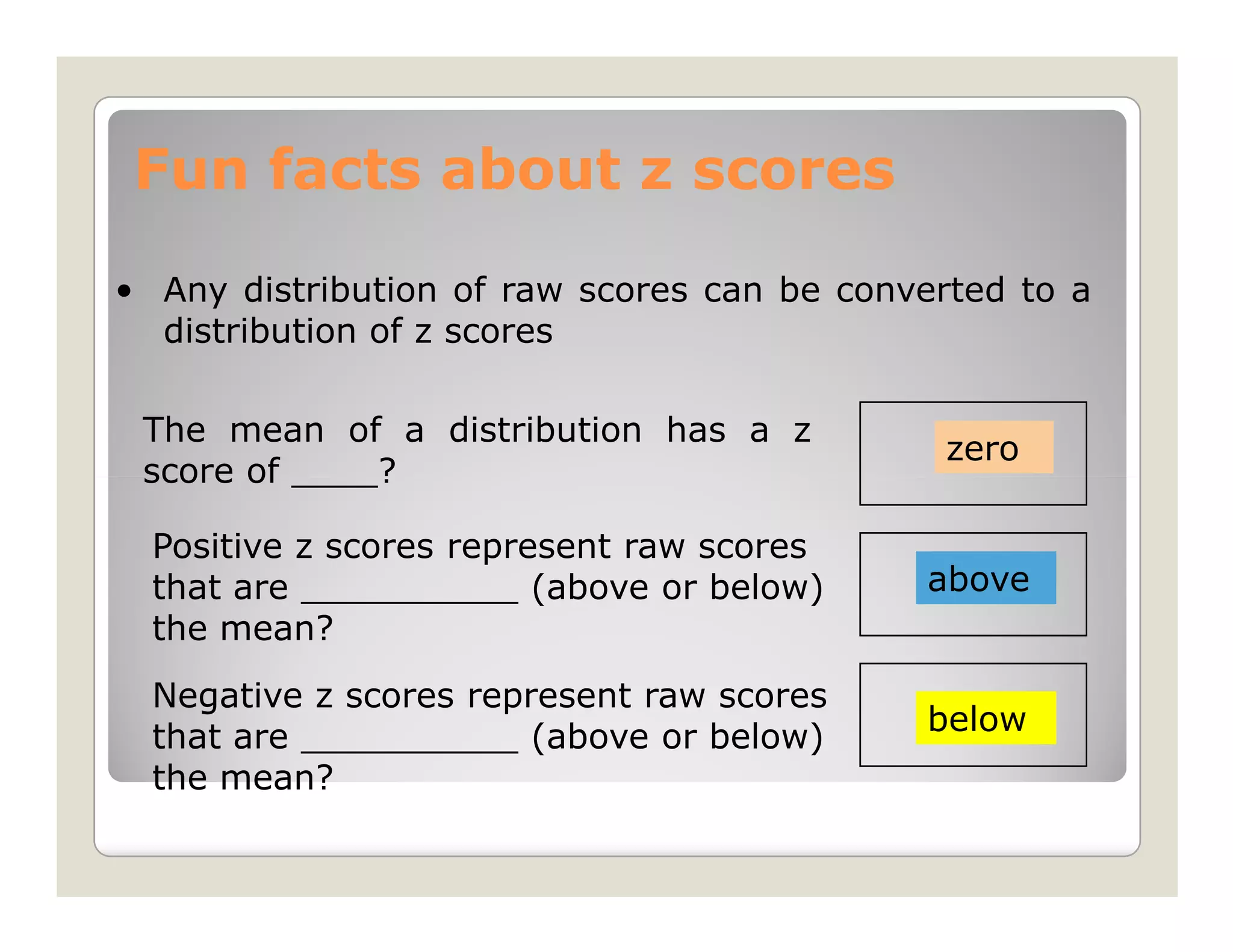
• Any distribution of raw scores can be converted to a
  distribution of z scores

 The mean of a distribution has a z
                                             zero
 score of ____?

  Positive z scores represent raw scores
  that are __________ (above or below)      above
  the mean?
  Negative z scores represent raw scores
                                            below
  that are __________ (above or below)
  the mean?
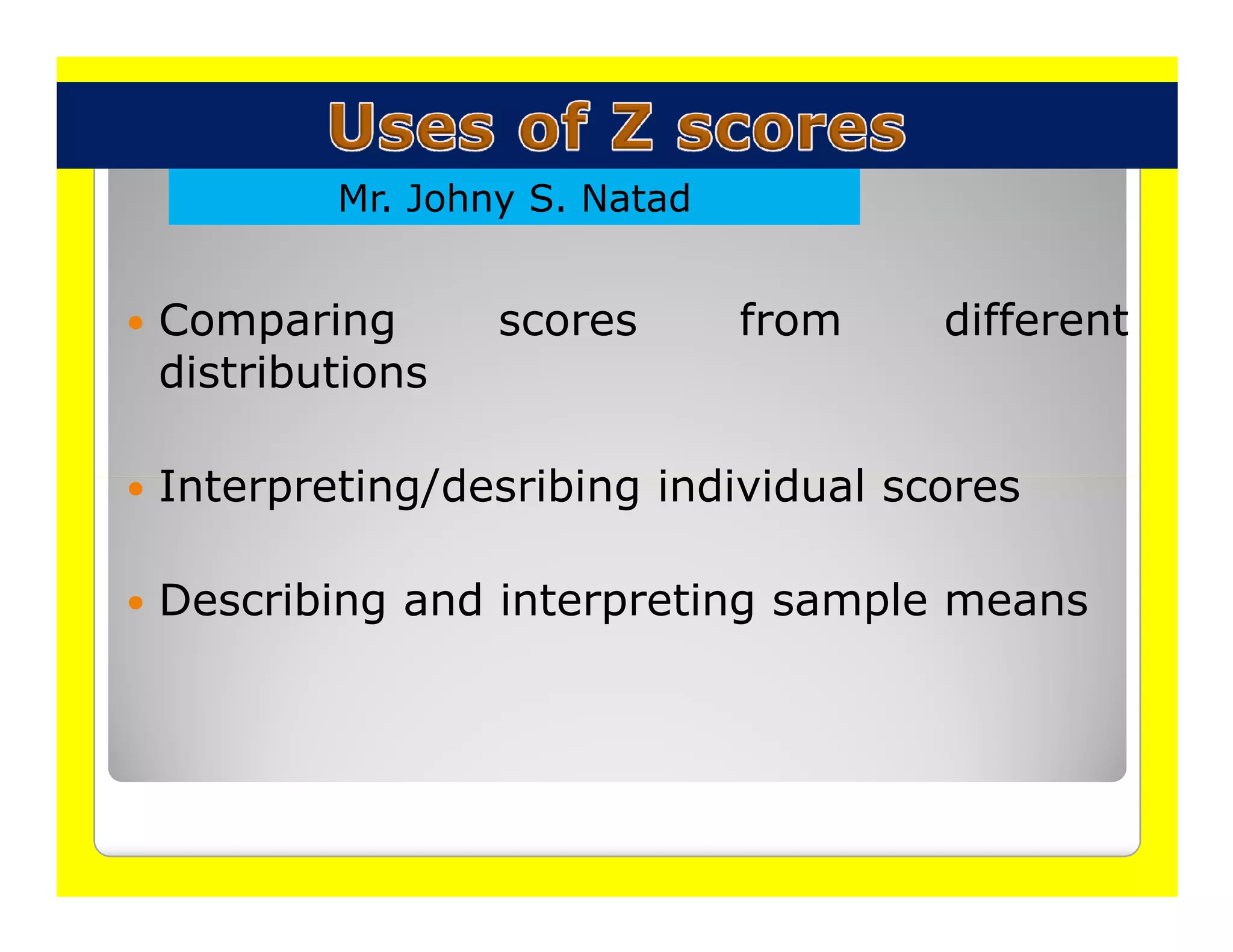
Mr. Johny S. Natad


Comparing       scores       from   different
distributions

Interpreting/desribing individual scores

Describing and interpreting sample means
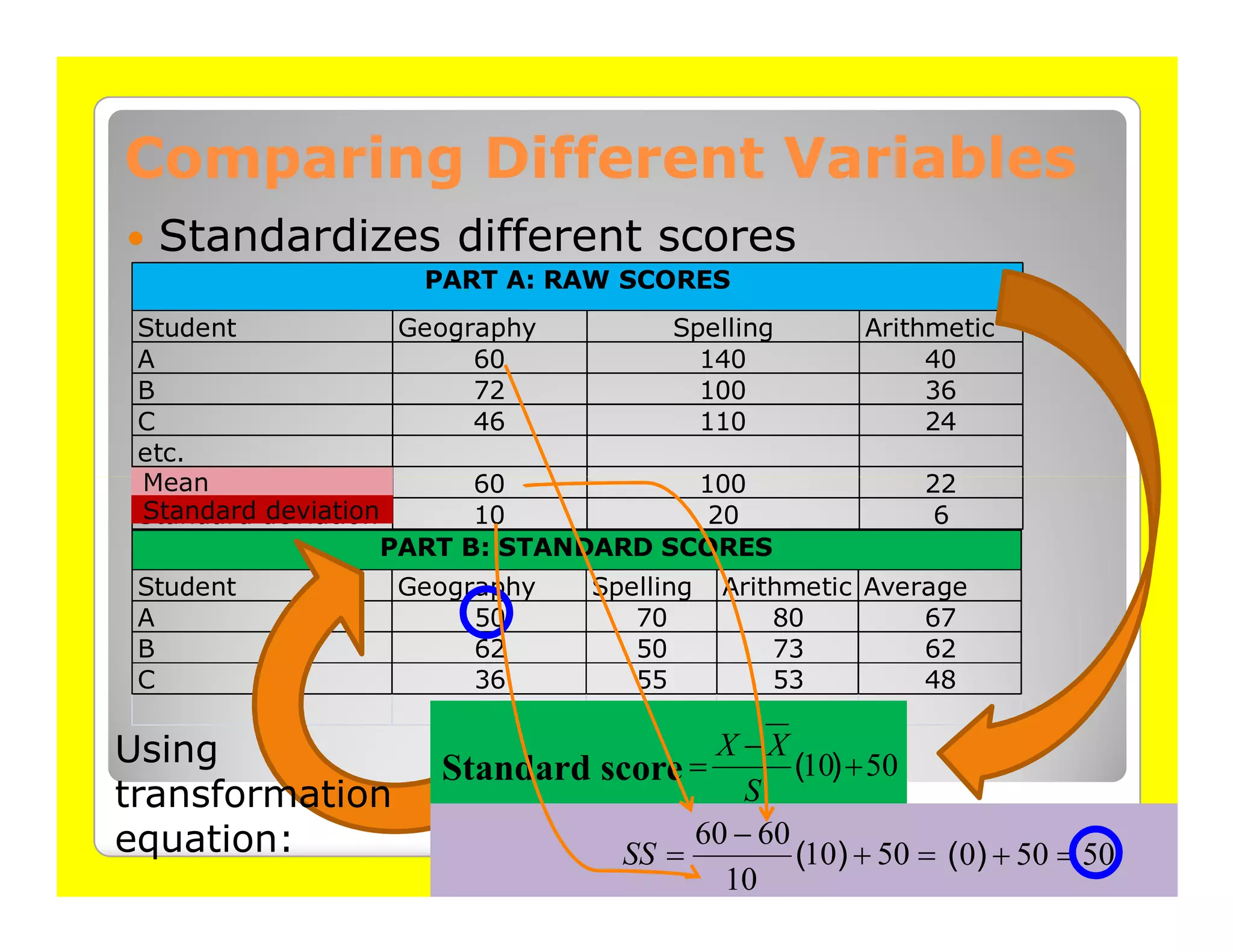
Comparing Different Variables
  Standardizes different scores
                     PART A: RAW SCORES
 Student             Geography        Spelling        Arithmetic
 A                        60            140                40
 B                        72            100                36
 C                        46            110                24
 etc.
 Mean
 Mean                     60            100               22
 Standard deviation
 Standard deviation       10             20                6
                    PART B: STANDARD SCORES
 Student           Geography     Spelling   Arithmetic Average
 A                      50          70          80         67
 B                      62          50          73         62
 C                      36          55          53         48

Using                                    X −X
                      Standard score =          (10) + 50
transformation                              S
equation:                               60 − 60
                                   SS =         (10) + 50 = (0) + 50 = 50
                                          10
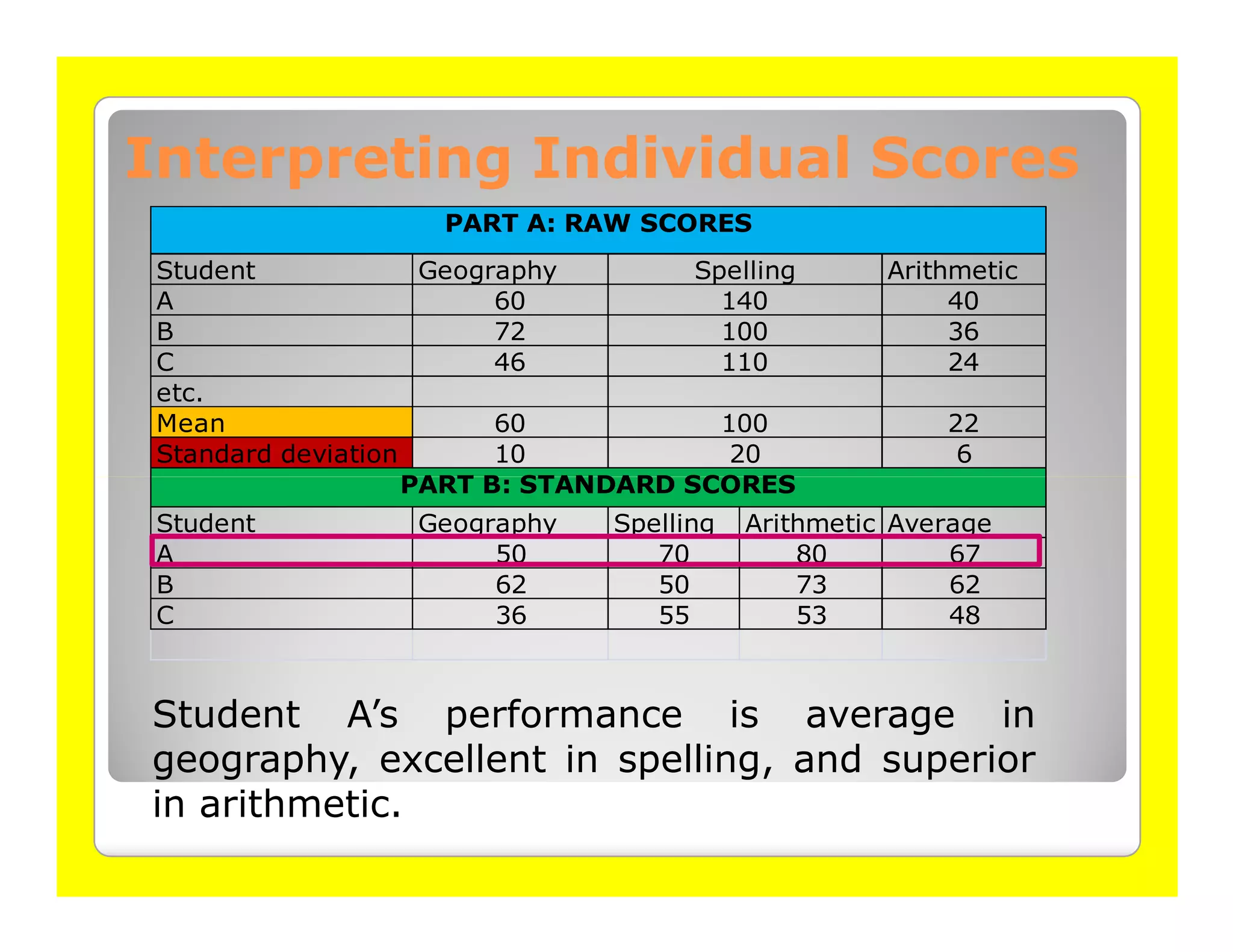
Interpreting Individual Scores
                     PART A: RAW SCORES
 Student             Geography        Spelling        Arithmetic
 A                        60            140                40
 B                        72            100                36
 C                        46            110                24
 etc.
 Mean                     60            100               22
 Standard deviation       10             20                6
                    PART B: STANDARD SCORES
 Student           Geography     Spelling   Arithmetic Average
 A                      50          70          80         67
 B                      62          50          73         62
 C                      36          55          53         48


Student A’s performance is average in
geography, excellent in spelling, and superior
in arithmetic.
Using standard deviation units
   to describe individual scores
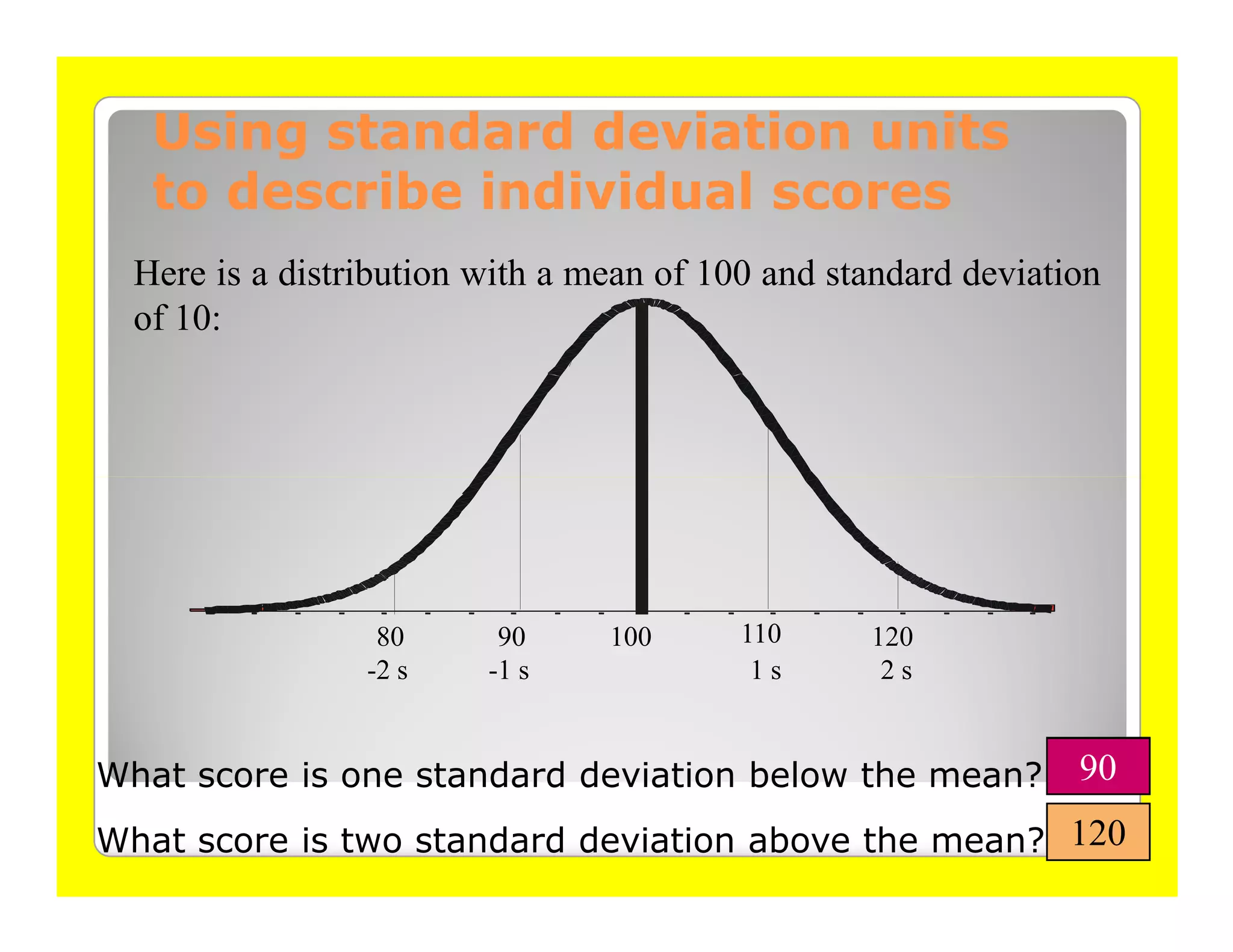
  Here is a distribution with a mean of 100 and standard deviation
  of 10:


                  80      90     100      110     120
                 -2 s    -1 s              1s      2s


What score is one standard deviation below the mean?            90
What score is two standard deviation above the mean? 120
Using standard deviation units to
   describe individual scores
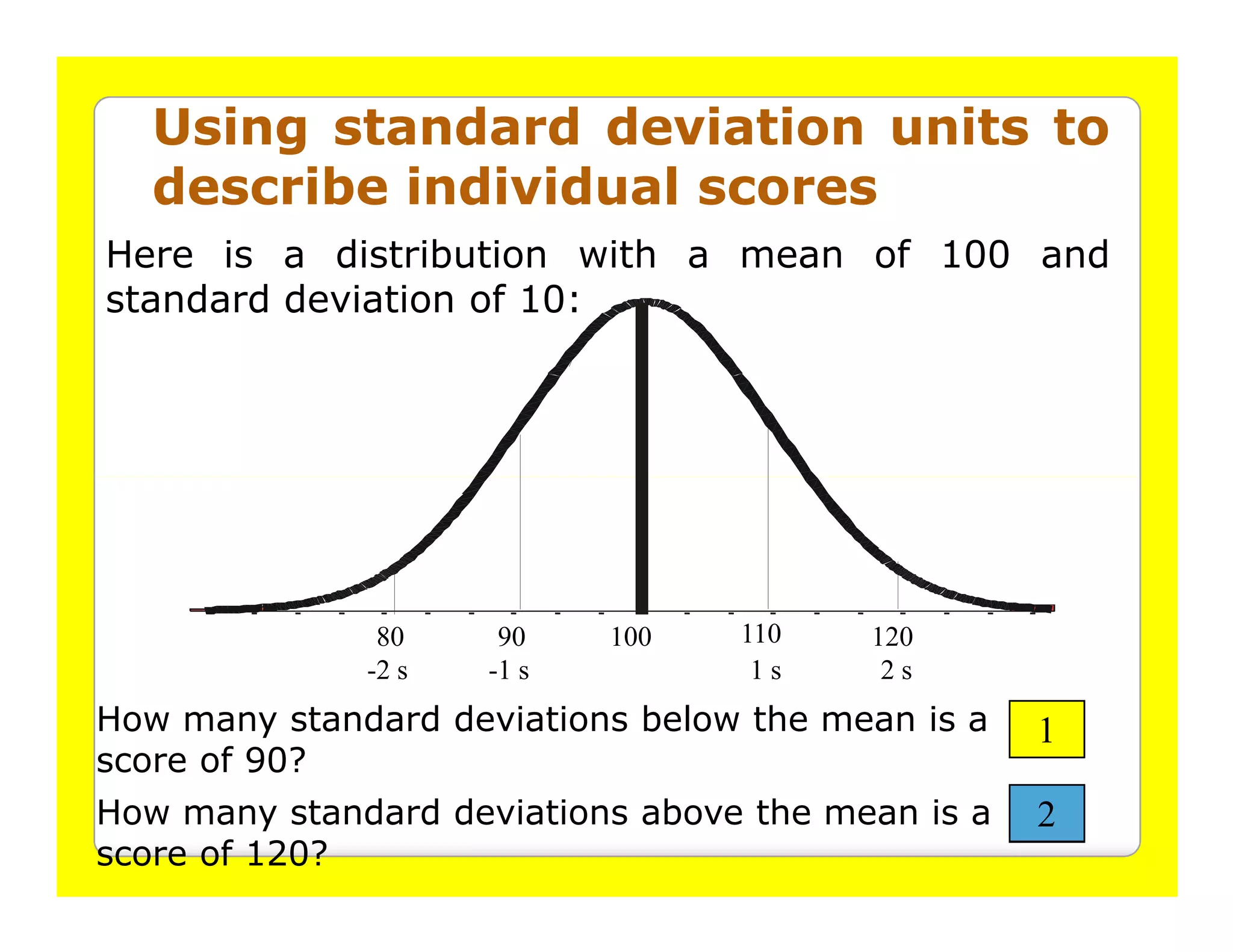
Here is a distribution with a mean of 100 and
standard deviation of 10:


               80     90    100   110    120
              -2 s   -1 s          1s     2s
How many standard deviations below the mean is a   1
score of 90?
How many standard deviations above the mean is a   2
score of 120?
Describing Individual Scores
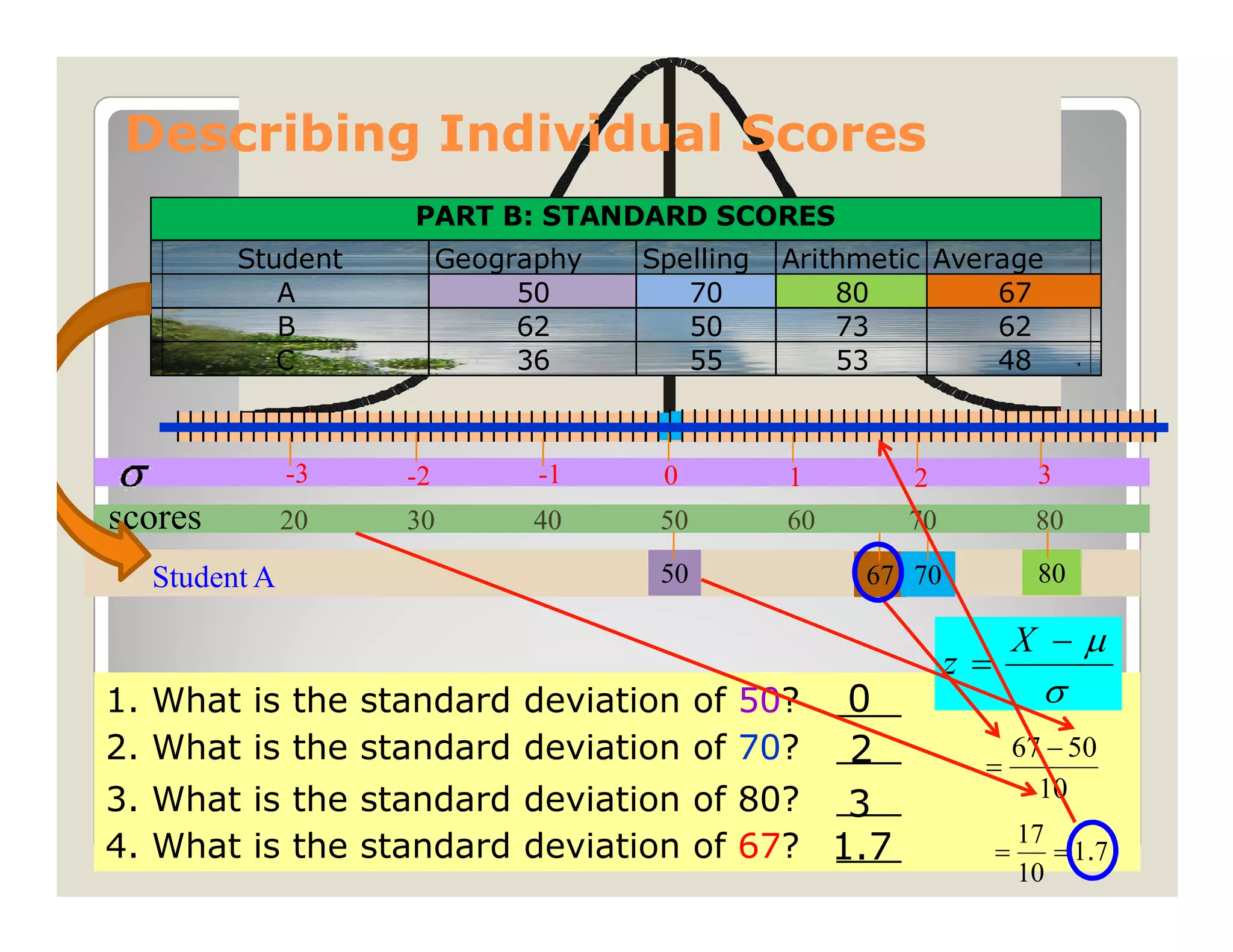
                   PART B: STANDARD SCORES
         Student        Geography   Spelling   Arithmetic Average
            A                50        70          80         67
            B                62        50          73         62
            C                36        55          53         48


              -3   -2         -1     0         1          2                3
scores        20   30         40     50        60         70              80

  Student A                          50              67 70                 80

                                                                         X −µ
                                                               z =
1. What is the standard deviation of 50?             0
                                                    ___                    σ
2. What is the standard deviation of 70?            ___
                                                     2           =
                                                                         67 − 50
3. What is the standard deviation of 80? ___                               10
                                          3
                                                                         17
4. What is the standard deviation of 67? 1.7
                                         ___                         =      = 1 .7
                                                                         10
Describing Individual Scores
                   PART B: STANDARD SCORES
         Student        Geography   Spelling   Arithmetic Average
            A                50        70          80         67
            B                62        50          73         62
            C                36        55          53         48


              -3   -2         -1     0         1        2       3
scores        20   30         40     50        60      70       80

  Student A                          50             67 70       80
                                      0             1.7 2       3

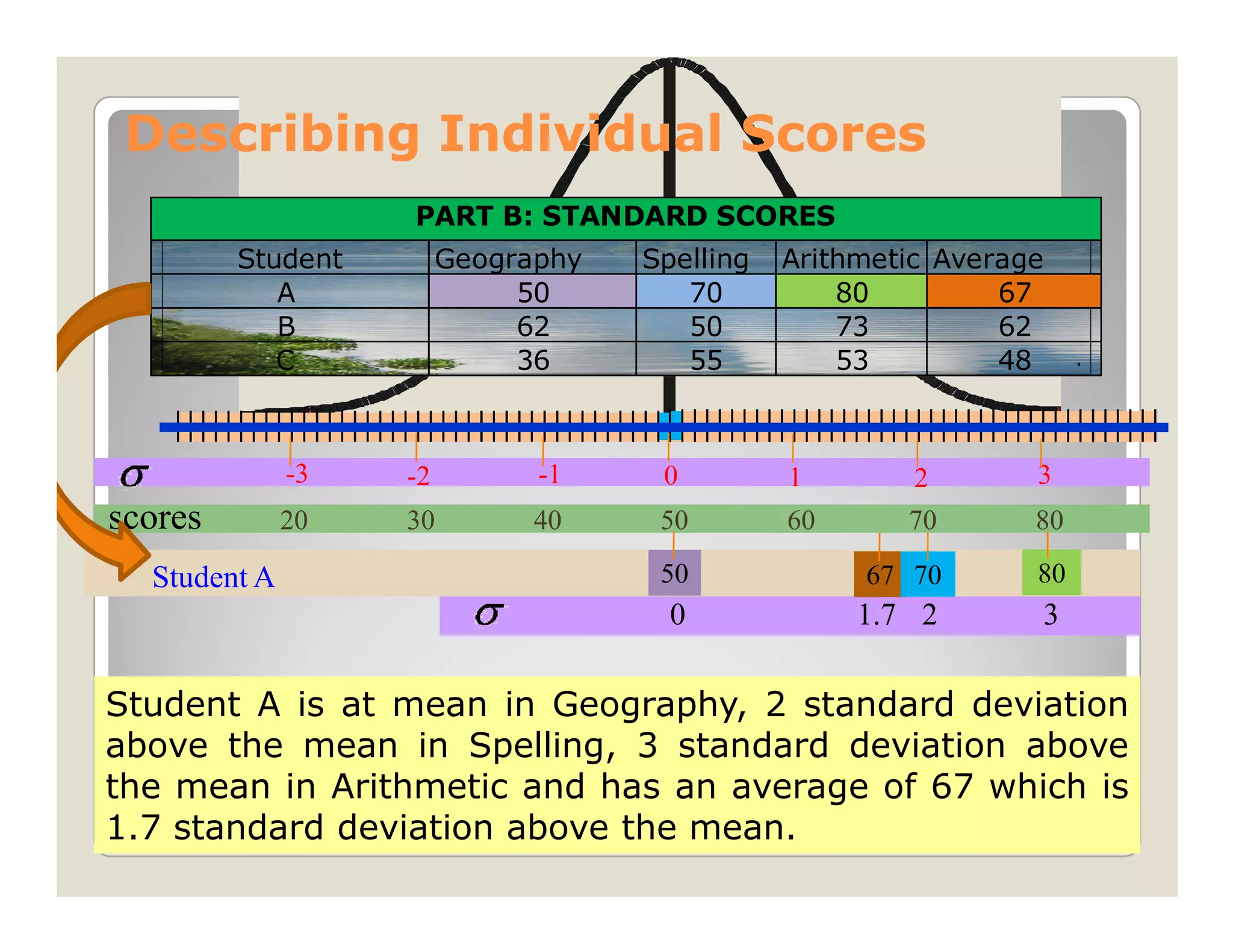
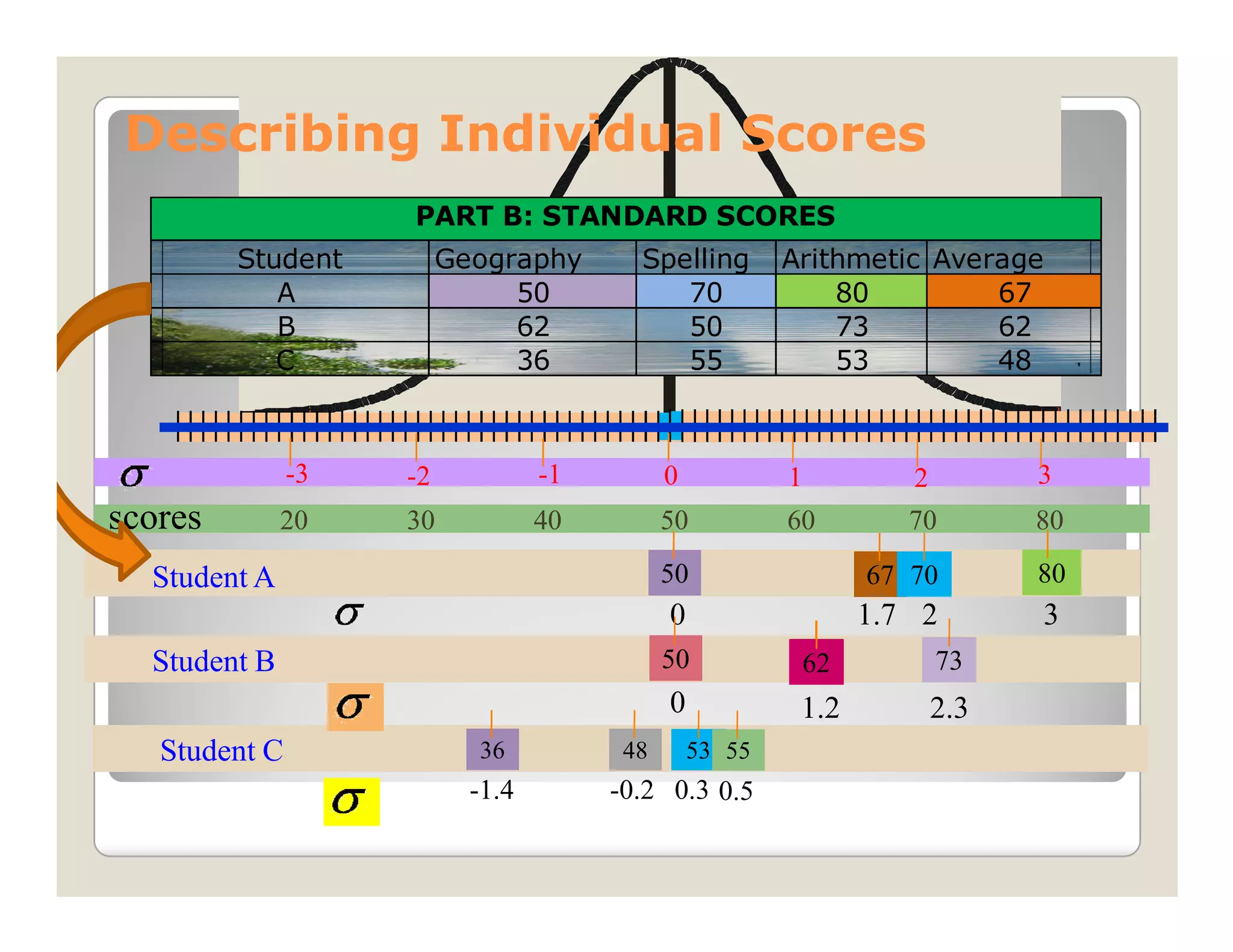
Student A is at mean in Geography, 2 standard deviation
above the mean in Spelling, 3 standard deviation above
the mean in Arithmetic and has an average of 67 which is
1.7 standard deviation above the mean.
Describing Individual Scores
                    PART B: STANDARD SCORES
         Student         Geography       Spelling        Arithmetic Average
            A                 50            70               80         67
            B                 62            50               73         62
            C                 36            55               53         48


               -3   -2            -1         0           1         2         3
scores        20    30            40         50          60        70        80

  Student A                                  50                 67 70        80
                                             0                  1.7 2        3
  Student B                                  50           62           73
                                             0            1.2          2.3
   Student C               36           48       53 55
                           -1.4        -0.2 0.3 0.5
Using the z-Table
          z-

Important when dealing with decimal z-
scores

Gives information about the area between
the mean and the z and the area beyond z
in the tail

Use z-scores   to   define   psychological
attributes
Using z-scores to Describe Sample
      z-
Means
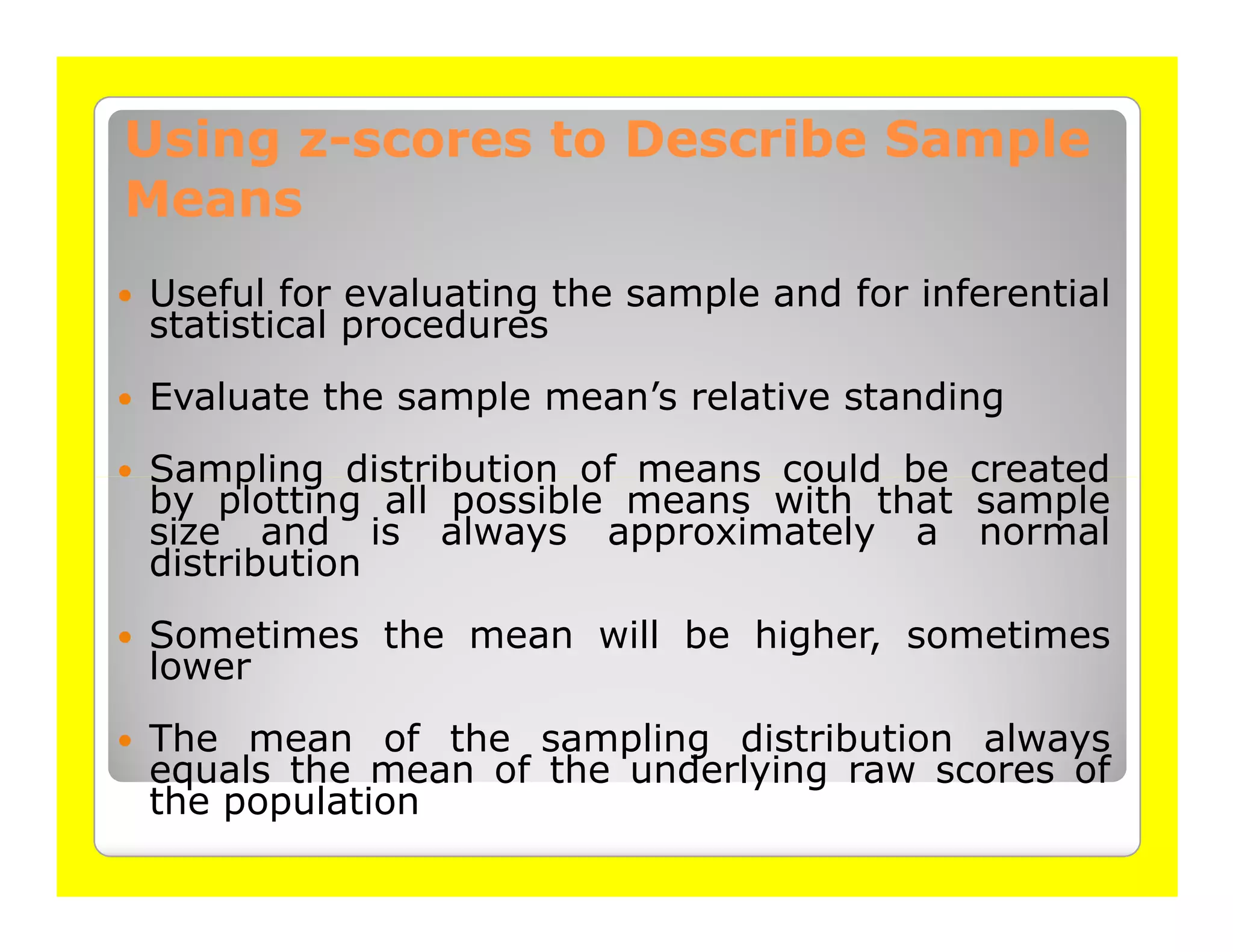
Useful for evaluating the sample and for inferential
statistical procedures
Evaluate the sample mean’s relative standing
Sampling distribution of means could be created
by plotting all possible means with that sample
size and is always approximately a normal
distribution
Sometimes the mean will be higher, sometimes
lower
The mean of the sampling distribution always
equals the mean of the underlying raw scores of
the population
Ms. Araya I. Mejorada

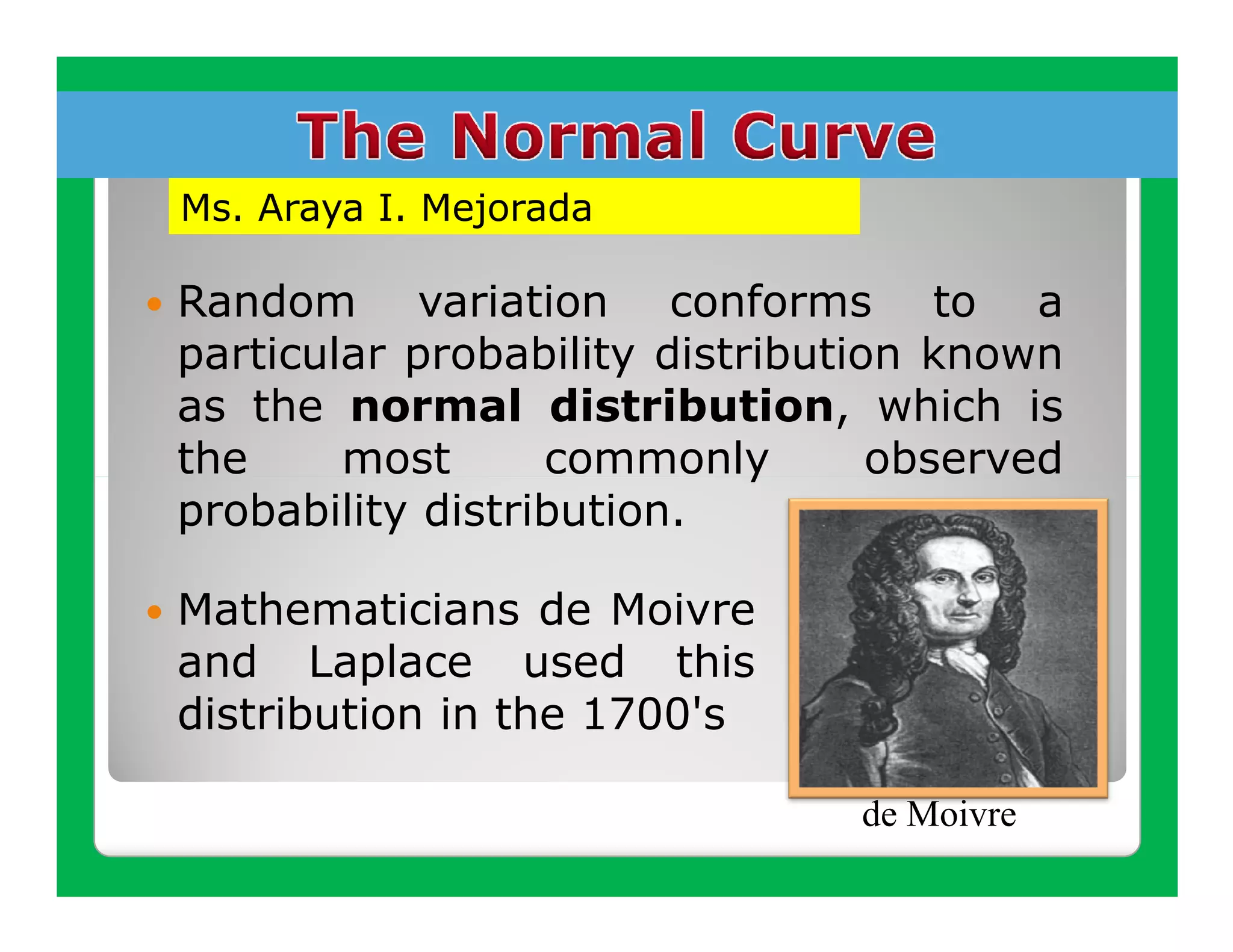
Random variation conforms to a
particular probability distribution known
as the normal distribution, which is
the     most      commonly        observed
probability distribution.

Mathematicians de Moivre
and Laplace used this
distribution in the 1700's

                                de Moivre
The Standard Normal Curve
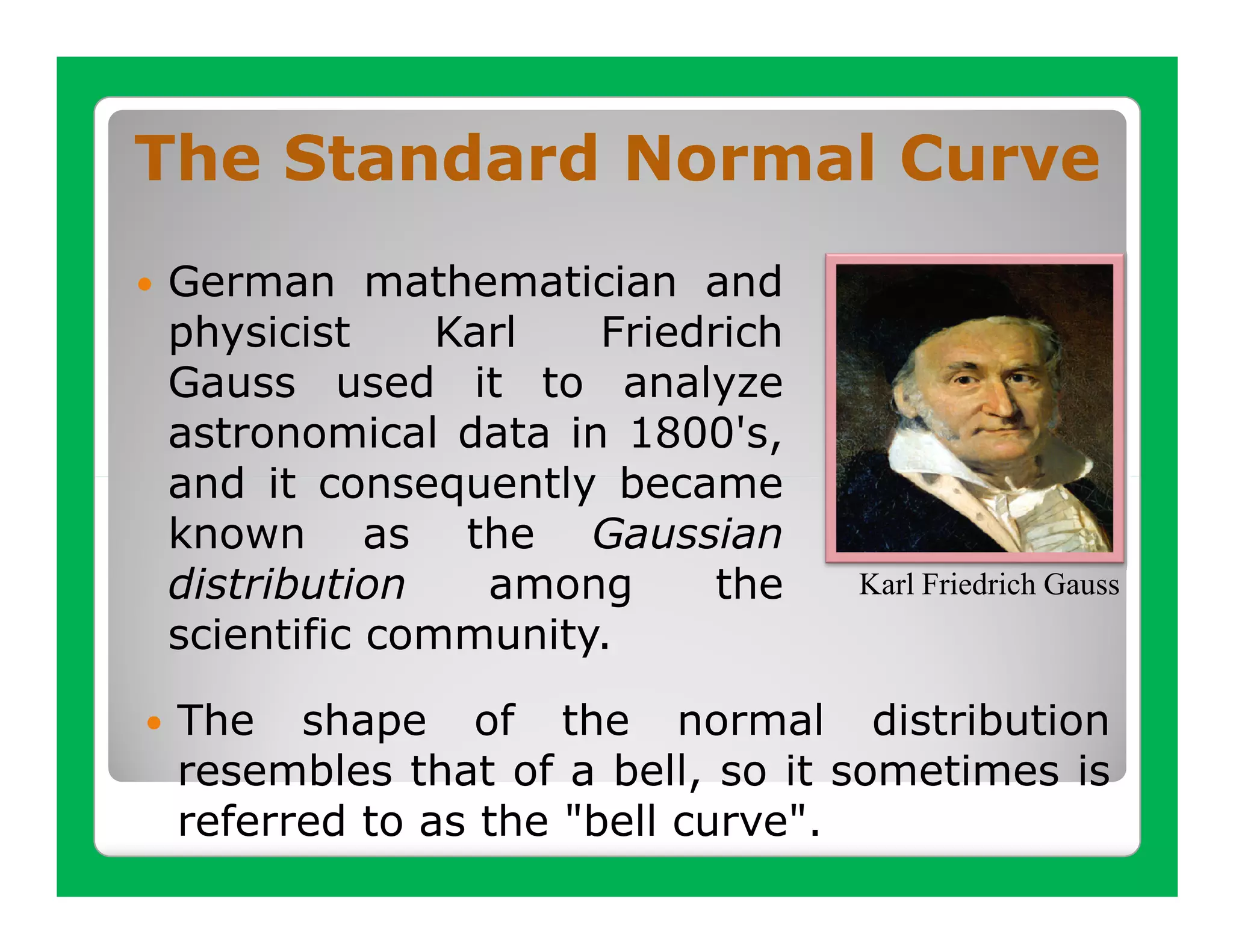
German mathematician and
physicist     Karl  Friedrich
Gauss used it to analyze
astronomical data in 1800's,
and it consequently became
known as the Gaussian
distribution    among     the    Karl Friedrich Gauss
scientific community.

 The shape of the normal distribution
 resembles that of a bell, so it sometimes is
 referred to as the "bell curve".
Bell Curve Characteristic
Symmetric - the mean coincides with a
line that divides the normal curve into parts.
It is symmetrical about the mean because
the left half of the curve is just equal to the
right half.
Unimodal     - a probability distribution is
said to be normal if the mean, median and
mode coincide at a single point
Extends to +/- infinity - left and right tails
are asymptotic with respect to the horizontal
lines
Area under the curve = 1
Completely     Described      by    Two
Parameters

 The normal distribution can be completely
 specified by two parameters:
  1.mean
  2.standard deviation


 If the mean and standard deviation are
 known, then one essentially knows as
 much as if one had access to every point
 in the data set.
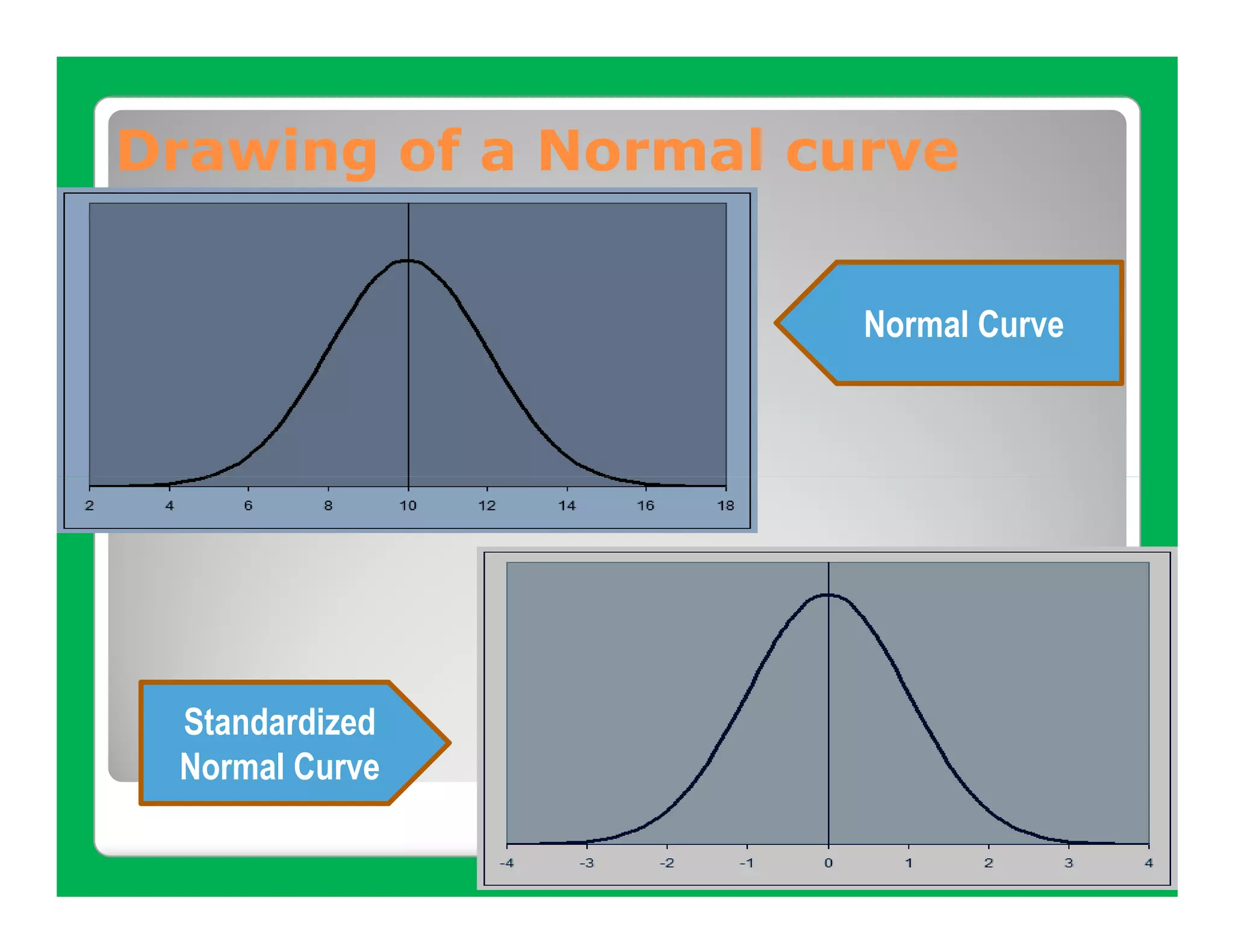
Drawing of a Normal curve

                      Normal Curve


 Standardized
 Normal Curve
Areas Under the Normal Curve


.3413 of the curve falls between the mean and one
standard deviation above the mean, which means
that about 34 percent of all the values of a normally
distributed variable are between the mean and one
standard deviation above it
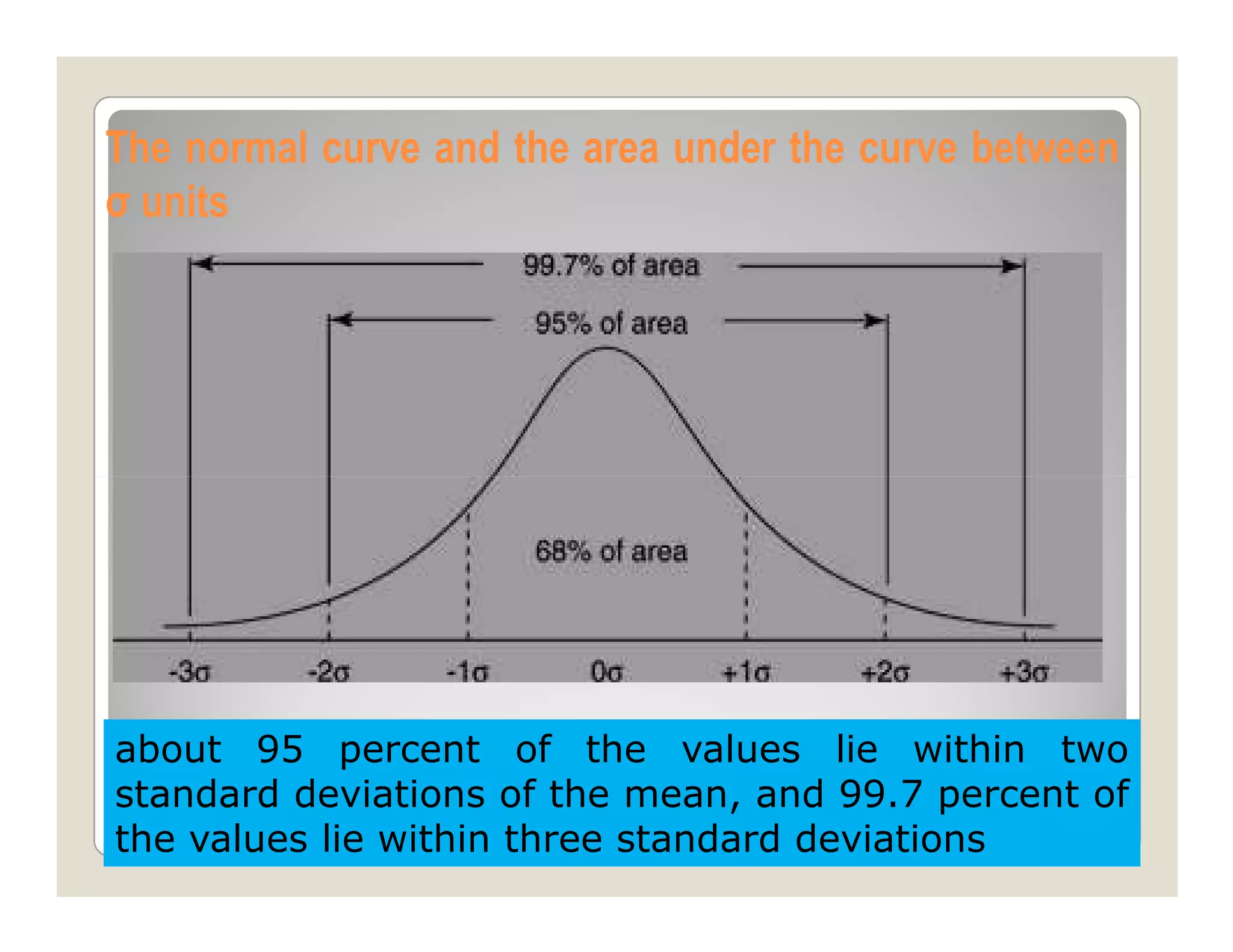
The normal curve and the area under the curve between
σ units


about 95 percent of the values lie within two
standard deviations of the mean, and 99.7 percent of
the values lie within three standard deviations
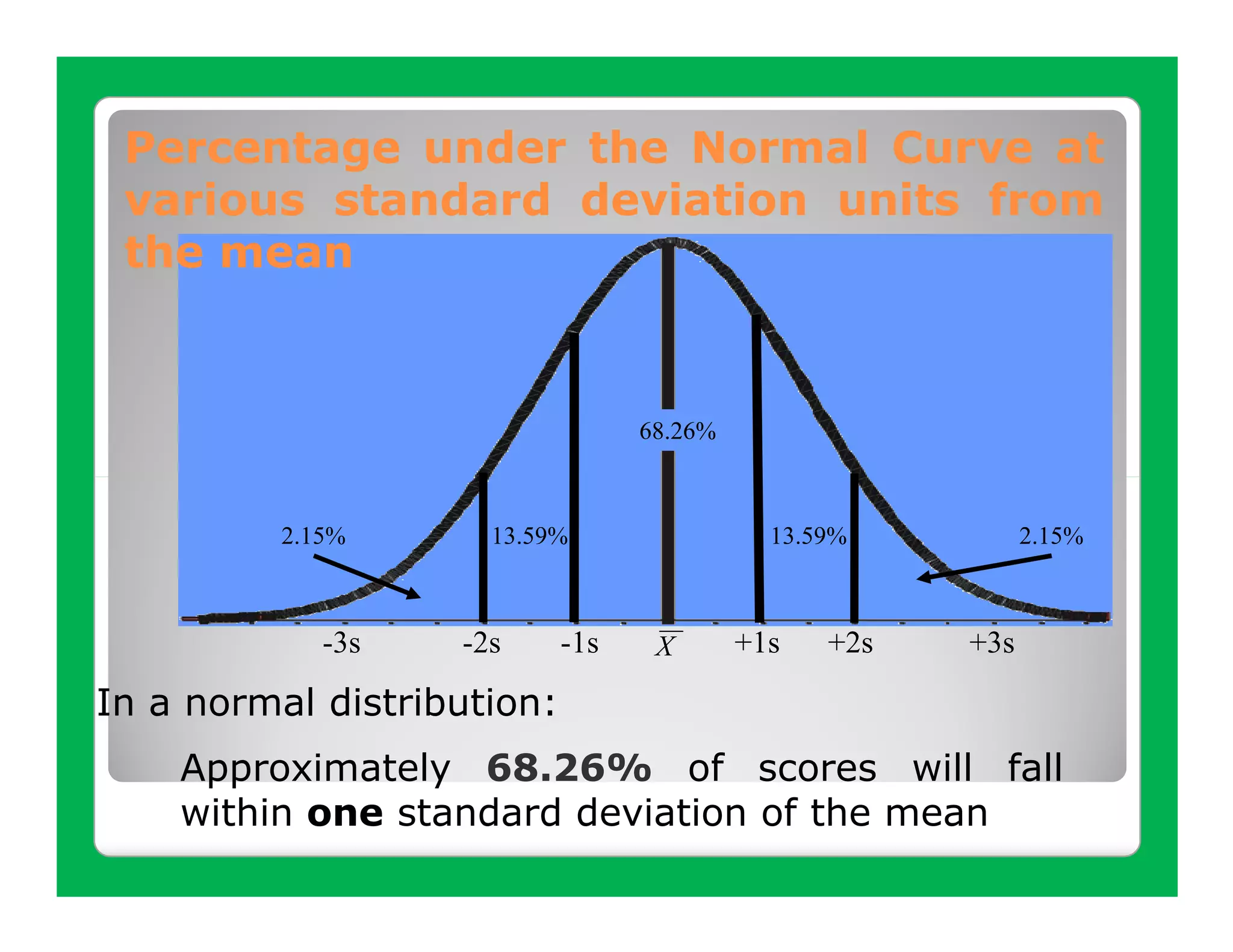
Percentage under the Normal Curve at
 various standard deviation units from
 the mean


                                  68.26%


          2.15%      13.59%                  13.59%          2.15%


             -3s   -2s      -1s    X       +1s   +2s   +3s

In a normal distribution:
    Approximately 68.26% of scores will fall
    within one standard deviation of the mean
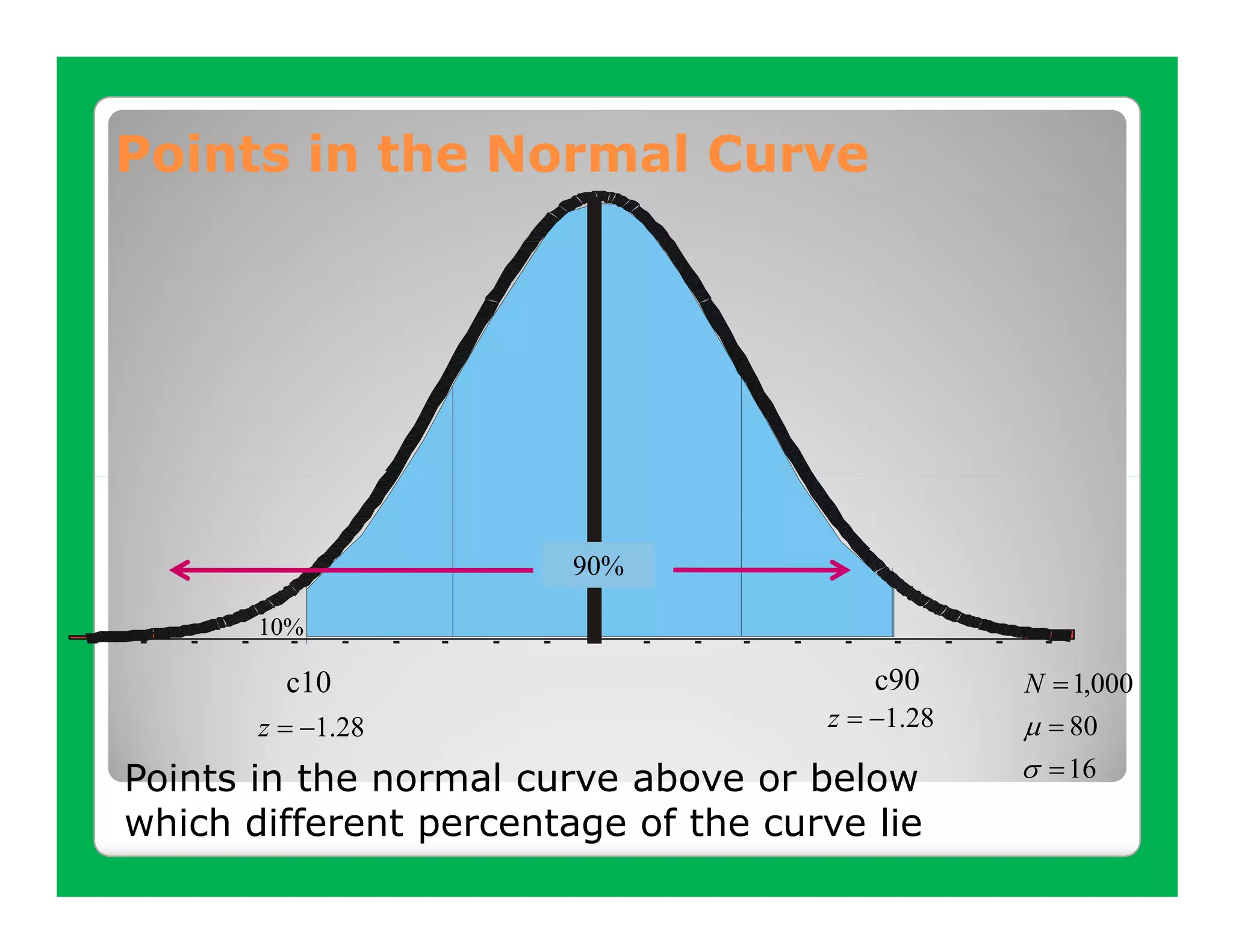
Points in the Normal Curve


                        90%

       10%

         c10                            c90      N = 1,000
       z = −1.28                     z = −1.28   µ = 80
Points in the normal curve above or below        σ = 16
which different percentage of the curve lie
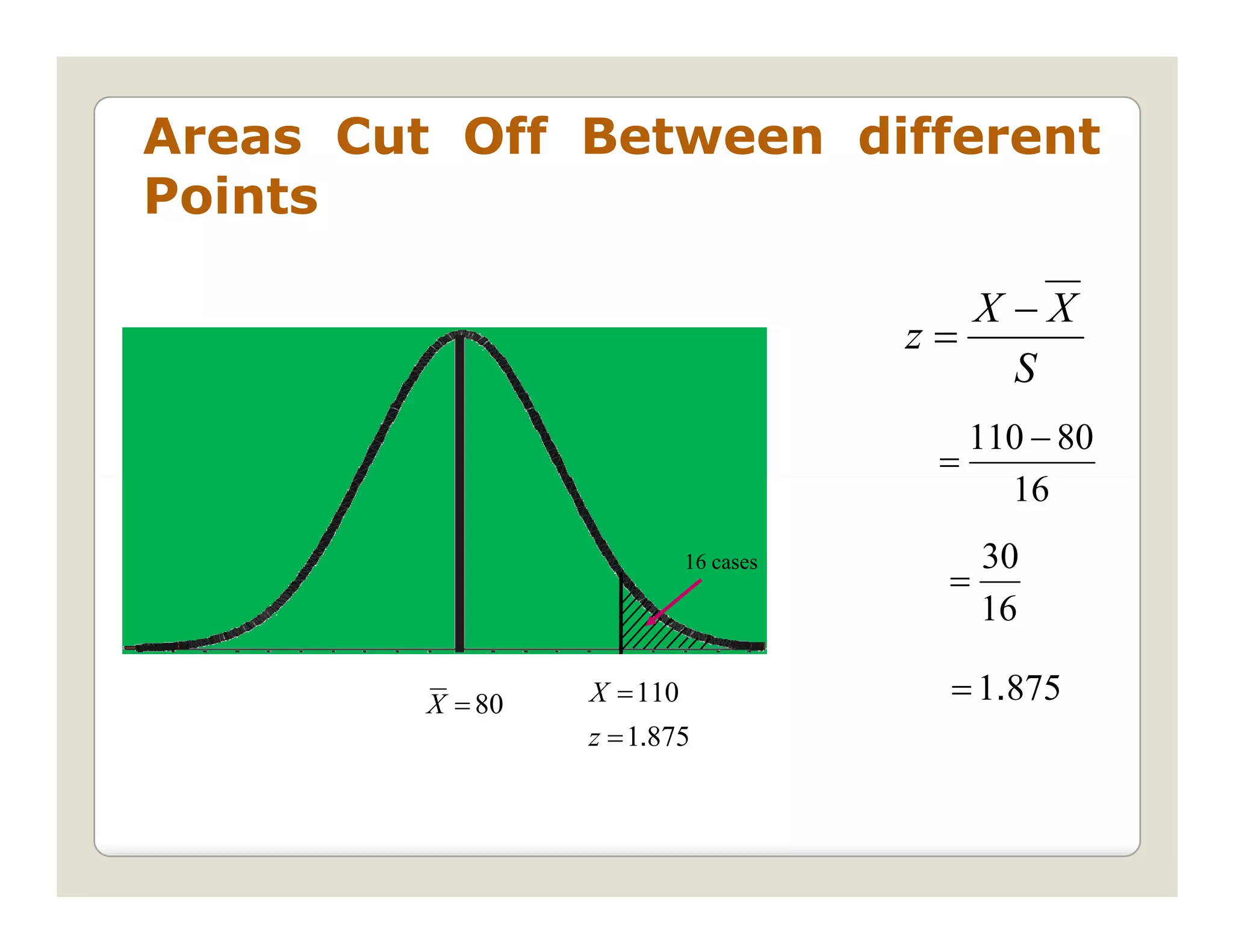
Areas Cut Off Between different
Points

                                          X−X
                                       z=
                                           S
                                            110 − 80
                                        =
                                              16
                            16 cases      30
                                        =
                                          16

         X = 80   X = 110               = 1.875
                  z = 1.875
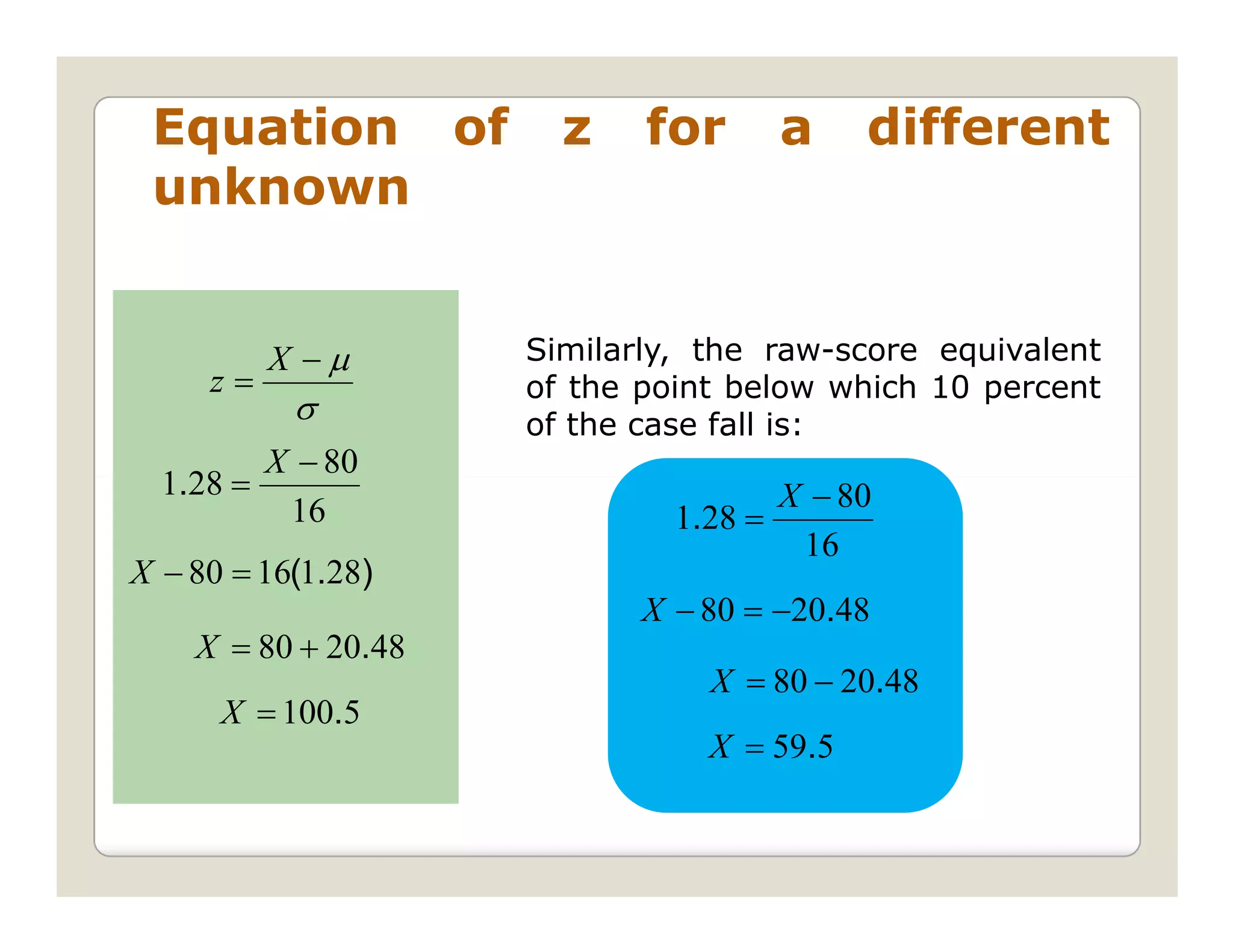
Equation of           z    for        a    different
 unknown


          X −µ       Similarly, the raw-score equivalent
     z=              of the point below which 10 percent
           σ         of the case fall is:
         X − 80
  1.28 =                               X − 80
          16                  1.28 =
                                        16
X − 80 = 16(1.28)
                            X − 80 = −20.48
    X = 80 + 20.48
                                X = 80 − 20.48
      X = 100.5
                                X = 59.5
Application of Normal Curve Model

 Can determine the proportion of scores
 between the mean and a particular score

 Can determine the number of people
 within a particular range of scores by
 multiplying the proportion by N

 Can determine percentile rank

 Can determine raw score given the
 percentile
Acknowledgement of References:

  N.M Downie and R.W Heath. Basic
  Statistical Methods, 5th Edition. Harper &
  Row Publisher, 1983

  Robert Niles
   http://www.robertniles.com/stats/stdev.shtml

  Rosita G. Santos, Phd, et. al. Statistics.
  Escolar University, 1995.

  Leslie MacGregor. z Scores & the Normal
  Curve Model (presentation)
Standard Score And The Normal Curve

Standard Score And The Normal Curve

  • 1.
    BUKIDNON STATE UNIVERSITY Graduate External Studies Surigao Study Center Surigao City Standard Scores and the Normal Curve Report Presentation by: Mary Jane C. Lepiten Araya I. Mejorada Johny S. Natad 16 January 2010
  • 2.
    Content for Discussion Standard Scores or Z scores by: Ms. Mary Jane C. Lepiten Uses of Z scores by: Johny S. Natad The Normal Curve by Ms. Araya I. Mejorada
  • 3.
    Ms. Mary JaneC. Lepiten A z score is a raw score expressed What is a in standard deviation units. z-score? z scores are sometimes called standard scores X −X X −µ Here is the formula for a z score: z = or z = S σ
  • 4.
    Computational Formula X −X x X −µ z= = or z= S s σ Where X = any raw score or unit of measurement X , s = mean and standard deviation of the distribution of scores µ ,σ = mean and standard deviation of the distribution of scores Score minus the mean divided by the standard deviation
  • 5.
    Using z scoresto compare two raw scores from different distributions You score 80/100 on a statistics test and your friend also scores 80/100 on their test in another section. Hey congratulations you friend says—we are both doing equally well in statistics. What do you need to know if the two scores are equivalent? the mean? What if the mean of both tests was 75? You also need to know the standard deviation What would you say about the two test scores if the S in your class was 5 and the S in your friends class is 10?
  • 6.
    Calculating z scores Whatis the z score for your test: raw score = 80; mean = 75, S = 5? X −X 80 − 75 z= z= =1 S 5 What is the z score of your friend’s test: raw score = 80; mean = 75, S = 10? X −X 80 − 75 z= z= = 0. 5 S 10 Who do you think did better on their test? Why do you think this?
  • 7.
    Calculating z scores Example:Raw scores are 46, 54, 50, 60, 70. The mean is 60 and a standard deviation of 10. X x z X −X 70 − 60 10 z= = = =1 S 10 10 70 10 1.00 60 − 60 0 60 0 .00 z= = = .0 10 10 50 - 10 - 1.00 50 − 60 − 10 z= = = −1 10 10 54 -6 - 0.60 54 − 60 − 6 z= = = −0.6 46 - 14 - 1.40 10 10 46 − 60 − 14 z= = = −1.4 10 10
  • 8.
    Why z-scores? z- Transforming scores in order to make comparisons, especially when using different scales Gives information about the relative standing of a score in relation to the characteristics of the sample or population Location relative to mean Relative frequency and percentile
  • 9.
    What does ittell us? z-score describes the location of the raw score in terms of distance from the mean, measured in standard deviations Gives us information about the location of that score relative to the “average” deviation of all scores
  • 10.
    Z-score Distribution Mean of zero ◦ Zero distance from the mean Standard deviation of 1 Z-score distribution always has same shape as raw score. If distribution was positively skewed to begin with, z scores made from such a distribution would be positively skewed.
  • 11.
    Distribution of thevarious types of standard scores z Scores -3 -2 -1 0 +1 +2 +3 Navy Scores 20 30 40 50 60 70 80 ACT 0 5 10 15 20 25 30 CEEB 200 300 400 500 600 700 800
  • 12.
    Transformation Equation Transformationsconsist of making the scale larger, so that negative scores are eliminated, and of suing a larger standard deviation, so that decimals are done away with. Transformation scores equation: standard score= z(new standard deviation) + the new mean
  • 13.
    Transformation Equation standard score=z(new standard deviation) + the new mean A common form for these transformations is based upon a mean of 50 and a standard deviation of 10. in equation form this becomes: standard score= z(10) + 50 Or starting with the raw score, we have: X−X Standard score = (10) + 50 S
  • 14.
    Fun facts aboutz scores • Any distribution of raw scores can be converted to a distribution of z scores The mean of a distribution has a z zero score of ____? Positive z scores represent raw scores that are __________ (above or below) above the mean? Negative z scores represent raw scores below that are __________ (above or below) the mean?
  • 15.
    Mr. Johny S.Natad Comparing scores from different distributions Interpreting/desribing individual scores Describing and interpreting sample means
  • 16.
    Comparing Different Variables Standardizes different scores PART A: RAW SCORES Student Geography Spelling Arithmetic A 60 140 40 B 72 100 36 C 46 110 24 etc. Mean Mean 60 100 22 Standard deviation Standard deviation 10 20 6 PART B: STANDARD SCORES Student Geography Spelling Arithmetic Average A 50 70 80 67 B 62 50 73 62 C 36 55 53 48 Using X −X Standard score = (10) + 50 transformation S equation: 60 − 60 SS = (10) + 50 = (0) + 50 = 50 10
  • 17.
    Interpreting Individual Scores PART A: RAW SCORES Student Geography Spelling Arithmetic A 60 140 40 B 72 100 36 C 46 110 24 etc. Mean 60 100 22 Standard deviation 10 20 6 PART B: STANDARD SCORES Student Geography Spelling Arithmetic Average A 50 70 80 67 B 62 50 73 62 C 36 55 53 48 Student A’s performance is average in geography, excellent in spelling, and superior in arithmetic.
  • 18.
    Using standard deviationunits to describe individual scores Here is a distribution with a mean of 100 and standard deviation of 10: 80 90 100 110 120 -2 s -1 s 1s 2s What score is one standard deviation below the mean? 90 What score is two standard deviation above the mean? 120
  • 19.
    Using standard deviationunits to describe individual scores Here is a distribution with a mean of 100 and standard deviation of 10: 80 90 100 110 120 -2 s -1 s 1s 2s How many standard deviations below the mean is a 1 score of 90? How many standard deviations above the mean is a 2 score of 120?
  • 20.
    Describing Individual Scores PART B: STANDARD SCORES Student Geography Spelling Arithmetic Average A 50 70 80 67 B 62 50 73 62 C 36 55 53 48 -3 -2 -1 0 1 2 3 scores 20 30 40 50 60 70 80 Student A 50 67 70 80 X −µ z = 1. What is the standard deviation of 50? 0 ___ σ 2. What is the standard deviation of 70? ___ 2 = 67 − 50 3. What is the standard deviation of 80? ___ 10 3 17 4. What is the standard deviation of 67? 1.7 ___ = = 1 .7 10
  • 21.
    Describing Individual Scores PART B: STANDARD SCORES Student Geography Spelling Arithmetic Average A 50 70 80 67 B 62 50 73 62 C 36 55 53 48 -3 -2 -1 0 1 2 3 scores 20 30 40 50 60 70 80 Student A 50 67 70 80 0 1.7 2 3 Student A is at mean in Geography, 2 standard deviation above the mean in Spelling, 3 standard deviation above the mean in Arithmetic and has an average of 67 which is 1.7 standard deviation above the mean.
  • 22.
    Describing Individual Scores PART B: STANDARD SCORES Student Geography Spelling Arithmetic Average A 50 70 80 67 B 62 50 73 62 C 36 55 53 48 -3 -2 -1 0 1 2 3 scores 20 30 40 50 60 70 80 Student A 50 67 70 80 0 1.7 2 3 Student B 50 62 73 0 1.2 2.3 Student C 36 48 53 55 -1.4 -0.2 0.3 0.5
  • 23.
    Using the z-Table z- Important when dealing with decimal z- scores Gives information about the area between the mean and the z and the area beyond z in the tail Use z-scores to define psychological attributes
  • 24.
    Using z-scores toDescribe Sample z- Means Useful for evaluating the sample and for inferential statistical procedures Evaluate the sample mean’s relative standing Sampling distribution of means could be created by plotting all possible means with that sample size and is always approximately a normal distribution Sometimes the mean will be higher, sometimes lower The mean of the sampling distribution always equals the mean of the underlying raw scores of the population
  • 25.
    Ms. Araya I.Mejorada Random variation conforms to a particular probability distribution known as the normal distribution, which is the most commonly observed probability distribution. Mathematicians de Moivre and Laplace used this distribution in the 1700's de Moivre
  • 26.
    The Standard NormalCurve German mathematician and physicist Karl Friedrich Gauss used it to analyze astronomical data in 1800's, and it consequently became known as the Gaussian distribution among the Karl Friedrich Gauss scientific community. The shape of the normal distribution resembles that of a bell, so it sometimes is referred to as the "bell curve".
  • 27.
    Bell Curve Characteristic Symmetric- the mean coincides with a line that divides the normal curve into parts. It is symmetrical about the mean because the left half of the curve is just equal to the right half. Unimodal - a probability distribution is said to be normal if the mean, median and mode coincide at a single point Extends to +/- infinity - left and right tails are asymptotic with respect to the horizontal lines Area under the curve = 1
  • 28.
    Completely Described by Two Parameters The normal distribution can be completely specified by two parameters: 1.mean 2.standard deviation If the mean and standard deviation are known, then one essentially knows as much as if one had access to every point in the data set.
  • 29.
    Drawing of aNormal curve Normal Curve Standardized Normal Curve
  • 30.
    Areas Under theNormal Curve .3413 of the curve falls between the mean and one standard deviation above the mean, which means that about 34 percent of all the values of a normally distributed variable are between the mean and one standard deviation above it
  • 31.
    The normal curveand the area under the curve between σ units about 95 percent of the values lie within two standard deviations of the mean, and 99.7 percent of the values lie within three standard deviations
  • 32.
    Percentage under theNormal Curve at various standard deviation units from the mean 68.26% 2.15% 13.59% 13.59% 2.15% -3s -2s -1s X +1s +2s +3s In a normal distribution: Approximately 68.26% of scores will fall within one standard deviation of the mean
  • 33.
    Points in theNormal Curve 90% 10% c10 c90 N = 1,000 z = −1.28 z = −1.28 µ = 80 Points in the normal curve above or below σ = 16 which different percentage of the curve lie
  • 34.
    Areas Cut OffBetween different Points X−X z= S 110 − 80 = 16 16 cases 30 = 16 X = 80 X = 110 = 1.875 z = 1.875
  • 35.
    Equation of z for a different unknown X −µ Similarly, the raw-score equivalent z= of the point below which 10 percent σ of the case fall is: X − 80 1.28 = X − 80 16 1.28 = 16 X − 80 = 16(1.28) X − 80 = −20.48 X = 80 + 20.48 X = 80 − 20.48 X = 100.5 X = 59.5
  • 36.
    Application of NormalCurve Model Can determine the proportion of scores between the mean and a particular score Can determine the number of people within a particular range of scores by multiplying the proportion by N Can determine percentile rank Can determine raw score given the percentile
  • 37.
    Acknowledgement of References: N.M Downie and R.W Heath. Basic Statistical Methods, 5th Edition. Harper & Row Publisher, 1983 Robert Niles http://www.robertniles.com/stats/stdev.shtml Rosita G. Santos, Phd, et. al. Statistics. Escolar University, 1995. Leslie MacGregor. z Scores & the Normal Curve Model (presentation)